A Little Background to our Trip:
When we left our home in the UK we cancelled every fixed bill that we didn’t need to pay whilst away. Unfortunately there is no reprieve from council tax or utility bills and so we have budgeted to pay these bills alongside the expense of our trip.
Money that would normally be spent on variable expenses such as petrol, food, clothes, personal expenses etc has instead been placed into the travel fund.
To keep costs down we have committed to using local/inter city trains and, for stays of 3 nights or more, have rented airbnb’s to minimise accommodation cost and ensure we are self sufficient food wise. Where we have booked hotels for the shorter stays we have ensured that breakfast is included. This should cut down our food intake when out and about.
We could have invested in inter-rail passes but hubby calculated all the rail fares, in advance, and has told me there is very little difference in costs. Additionally inter-rail spaces on trains are limited, have to be booked well in advance and in Spain and France, despite having an inter rail pass, you have to then pay to book your seat. Time will tell if his calculations are correct!
We arrived in Madrid after a 4.5 hr, seamless train journey from Bilboa and checked into our second Air BnB.
We have visited Madrid before, back in May 2018, when we brought my daughter here as part of her 21st birthday present. It was somewhere she wanted to go and was a great choice. Madrid still features in our top 3 cities in the world to date and we were happy to come back.
However having completed all the tourist attractions in the city that we want to see we are this time using it only as a base. From here we can venture out into the Spanish countryside and visit other places of interest. Today’s city of choice is Segovia.
Getting to Segovia from Madrid:
Using google maps I managed to plan the journey firstly from our temporary home to Madrid-Chamartín-Clara Campoamor train station via the Madrid Metro.
The metro is fairly easy to use. You have to purchase a transport card from a machine at the first metro station you enter. We only needed one card between us because you can pass it across the barrier and reuse it when you enter the relevant metro line. They are very much like Oyster cards in London so for us not unfamiliar.
Once you have purchased your card, which at the time was 2.50 euros, you can then either load individual trips onto it each time or you can purchase a group of tickets in one transaction and load them onto your card, utilising them until they are finished. A trip on the metro wass 2 euros per person and the package we bought today was 10 trips for 6.10 euros, so a bargain!
We would suggest you arrive at the main train station 30 minutes before departure as Spanish trains leave on time and you still have to tackle security.
Once at the train station you need to check the board for the platform from which you will depart. Unlike the UK it does not show all the stops, only the final destination, so you need to utilise the departure time and the number of the train shown on your ticket to find your correct train.
When you reach the platform entrance your ticket and ID are checked and your belongings have to go through a security scanner like being at an airport. It’s a fairly quick process.
Our train is bound for Salamanca but Madrid to Segovia Guiomar station takes only 30 minutes. This is a fairly new station on the outskirts of the city. It appears as if they are trying to take traffic away from the historical interior and also facilitate easier commuting into Madrid for work.
As we leave the station there is a number 11 bus standing outside waiting. For 2 euros per person you can travel the 20 minutes into the centre and be dropped off right next to the astounding Aqueduct. The journey into the centre takes you past “New Segovia” and I must admit it was slightly off putting to begin with. I was sat there thinking “where is this glorious old town I’ve read about? Are we in the right place?”
It seems as if money has been injected into housing and to attract more business. I do wish these beautiful old places were left alone but I guess you can’t always stop modernisation!
Aqueduct:

This amazing piece of Roman architecture is a sight to behold. Roman remains always fascinate me, mainly because of the sheer engineering ability they had. This aqueduct was built to bring water from the mountain to Segovia. Originating from the 1st century BC it was in continual use until quite recently. 36 of the 166 arches were damaged back in 1072 during an attack on the city but were restored in the 15th century and you can still walk all 11 miles of the aqueduct should you wish.
Leaving this masterpiece behind we wander up the olde world street past an array of shops. The Old Town including the aqueduct is a Unesco World Heritage site so take your time and marvel at some of the beautiful buildings en route including the library. Also check out the masonry and decorations on the houses.
Segovia Cathedral:
As you reach the top you cannot miss the 16th century Gothic style cathedral that towers above the city and can be seen from everywhere. We wandered around the outside first just to be able to marvel at the craftsmanship used to create it.
There is paid entry and audio guides are available if you want to learn more about the interior.
You might find it a bit odd that a non religious person such as myself (assuming you’ve read other parts of my blog) visits religious buildings but for me it’s not about the reason for the build but how it’s built. The amount of artistry that goes into the statues, paintings, wooden artefacts and most importantly the ceiling adornments just leaves me breathless. How were they capable of creating such beauty so long ago? It always begs the question “have we actually developed anything better than this since?”.

Inside the cathedral I was drawn to two specific paintings.
The first is this really odd picture of Jesus and a skeleton under a tree with some sort of party taking place on top of the tree?

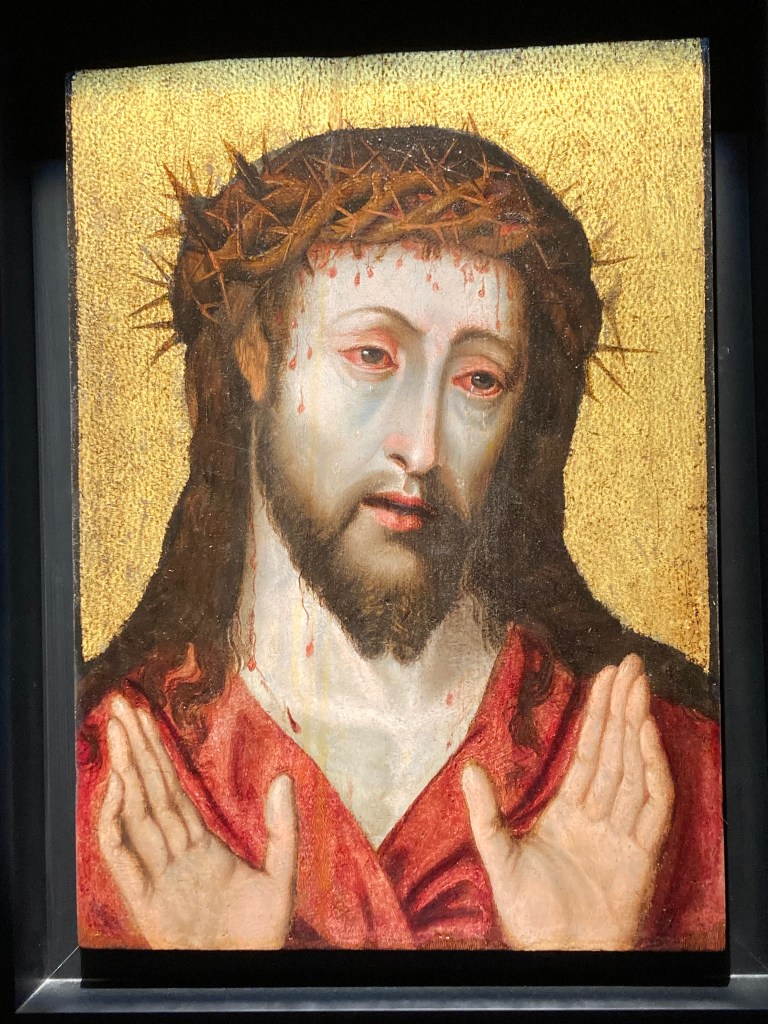
The second highlights for me how brilliant the artist was in showing Jesus with tears in his eyes. The tears are just so realistic and emphasise to me what art really is. The ability to convey in a picture an emotion that looks real.
Leaving the cathedral behind there are signs to follow to reach the third key attraction in Segovia -The Alcazar.
The pathway takes you through the oldest part of the city and there are other clear examples of Roman architecture and engineering en route.
The Alcazar:
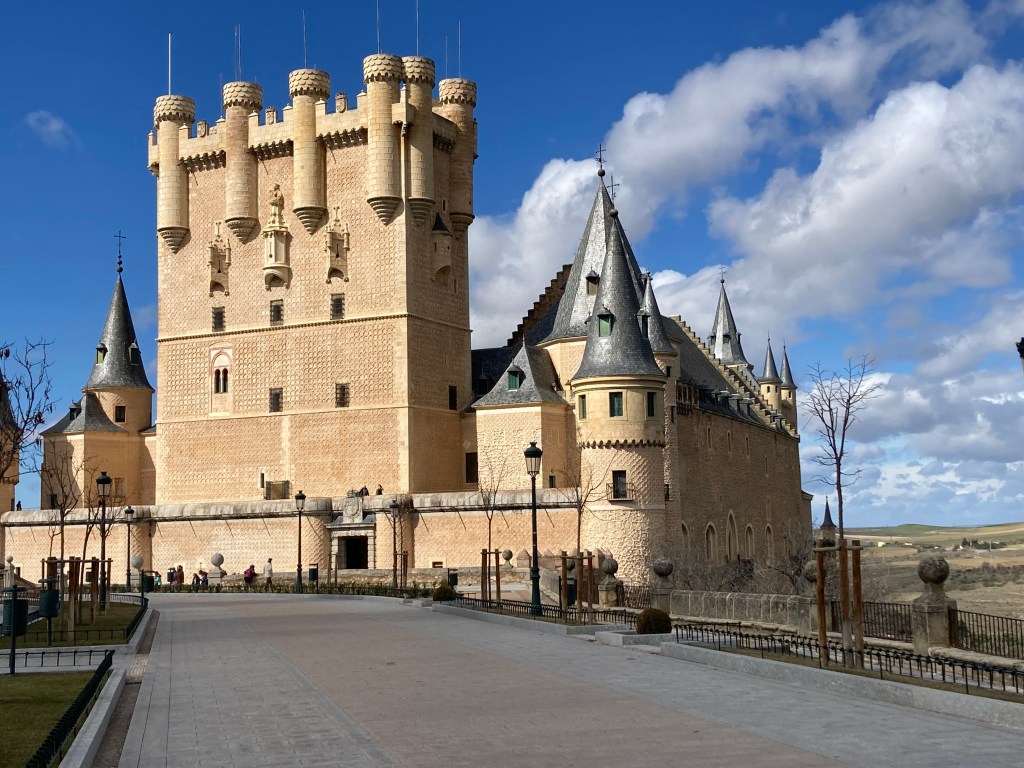
This beautiful medieval castle, rising out of a rocky crag, stands prominently with 360 degree views overlooking the valleys below. Shaped like the bow of a ship it was originally built in the 11th century as a fortress.
Alphonse VIII and his wife Eleanor of England (sister of Richard the Lionheart) were the first monarchs to make it their home and it subsequently served as a royal palace for 21 further generations.
Entry tickets are purchased in the building to the left of the Alcazar and there is also an audioguide available.
This building also contains a cafeteria where we sampled some traditional Segovian fare before making our way back over to commence our self guided tour.
There is much to marvel at from the beautiful external architecture, traditional armoury, to the Hall of the Kings and the unique tapestries and of course the amazing views all around.
Next time you are in the Castile area of Spain take a trip out to Segovia. It has a lot more to offer, I have only included three key highlights.
There is also an alternative train journey which is cheaper than the direct train we used which takes 2 hrs and meanders its way from Madrid through the mountains to Segovia Central train station. Our Air BnB host strongly recommended it but time was not on our side on this particular day.
This is my second post on our extended trip to Western Europe and also the second in Spain. There will be more to follow on this tour.
 A Midlife Adventure