The Renfe Cercanios Madrid Network:
When we were waiting for our return train yesterday in Avila we discovered there is another train service separate to the Metro and also not part of the Renfe intercity fast train network -the Renfe Cercanios Madrid network. It’s a bit like the London Underground in that it serves outlying regions of Madrid but instead of it being part of the Metro, as it is in London, it is separate.
Weirdly if we Google map from our present location to Avila, for example, it does not show Cercanios as an option. Despite research we have not yet discovered why, maybe Google maps doesn’t have it in its system?
Anyway having discovered this network exists we picked up a pocket sized map of the lines it runs, labelled line C2 up to C10 which take you out of the city of Madrid on metro style trains. They are, obviously, slower because they stop at every station but more convenient if you are not sure how long you are going to be visiting a destination and do not want to be confined to certain pre bought train times and tickets.
We decided on Saturday to give this service a trial. We had already booked our train tickets, as normal with Trainline, and had a fast train to take at 09:10 from Madrid Atocha to Aranjuez with a return ticket at 18:30. More of this later.
The Royal Palace of Aranjuez:
Leaving home to walk the 20 minutes to Atocha station we boarded our planned service and arrived into Aranjuez 45 minutes later. There were a couple of buses waiting outside the station on our arrival but we opted to walk in the spring sunshine down the tree lined Carr de Toledo instead. The entrance to the Palace is fairly easy to locate and being so early there wasn’t a queue. Our tickets were available on hubby’s mobile, having booked them in advance, and I picked up my audioguide which was on a tablet. You need to utilise the separate email you receive for this.
The site was originally established as a royal hunting lodge in the 16th century before Philip II of Spain built the palace itself and it became one of the four seasonal seats of the court.
The palace was almost destroyed by fire in 1748.
Ferdinand VI rebuilt the palace and although still respecting the original foundations, the new structure reflects late baroque style and an 18th century aesthetic with a series of beautifully furnished rooms within
The current building we view today, however, is mainly as a result of the work completed by Charles II. The architect of this modern palace was the Italian Francesco Sabatini.
During the 18th and 19th centuries it was enriched with paintings by various artists, hardwood furniture in the halls and collections of clocks, lamps, tapestries and sculptures were installed.
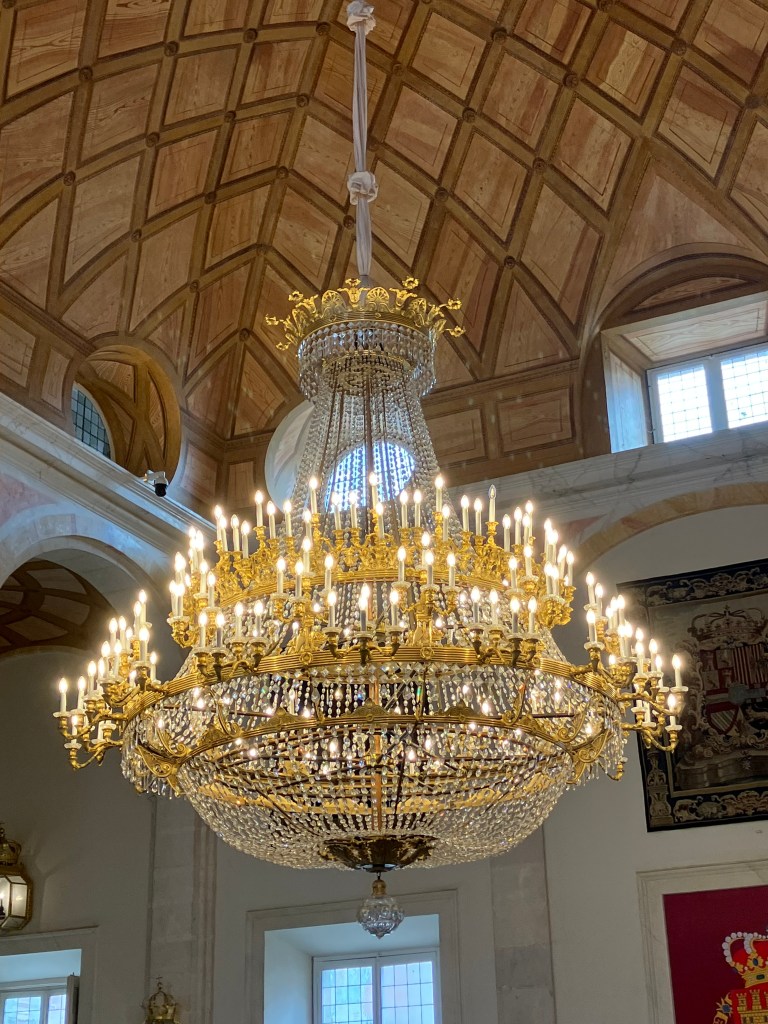
The tour begins in the hallway with its grand central staircase over which hangs a chandelier of gilt bronze and crystal. This is merely the starting point of what is to come as you follow the designated route through both the King’s and Queen’s various chambers with all they have to offer. Alas you are not allowed to take photos!
My two personal favourite rooms were the Moorish room or Salon Arabe which was made for Queen Isabel II between 1847 and 1851 and is decorated throughout with a Moorish style similar to that seen in the Alhambra Palace in Granada. The minimalist furniture consists of a porcelain central table and a bronze and crystal lamp. It was used as a smoking room mainly for men. The decoration of the walls being made of brightly coloured plaster work.
Secondly the Salon de Porcelana which was created by Charles III. The walls and ceilings are completely lined by plaques, attached to timber walls by screws, of white porcelain and reliefs with motifs of fruits, flowers, monkeys, vases, birds and dragons. The floor is marble and 8 large mirrors against the walls multiply the effect of the decorations.
In the centre of the ceiling is a lamp that looks like a palm, while a Chineses man with a hand fan and a monkey on his shoulders climbs the trunk. The room was originally for the purpose of playing games. It honestly is awe inspiring.
Jardin de la Isla

The audioguide includes coverage of the exterior of the Palace. I found this really helpful but a little astounding considering I was basically walking around outside with a tablet around my neck!
The Garden of the Island was given this name because it is surrounded by water on all three sides: the Tagus river, an artificial inlet from the river, and the Royal Palace.
Created originally by Philip II it is a lovely example of a Spanish Renaissance garden.
Laid out in a rectangular fashion it comprises a variety of different areas bordered by box hedges, each featuring a statue with a fountain dedicated to a god. My favourite was Bacchus.
Unfortunately of the 13 fountains only 4 apparently still work which is sad because seeing them all working would greatly enhance your visit.
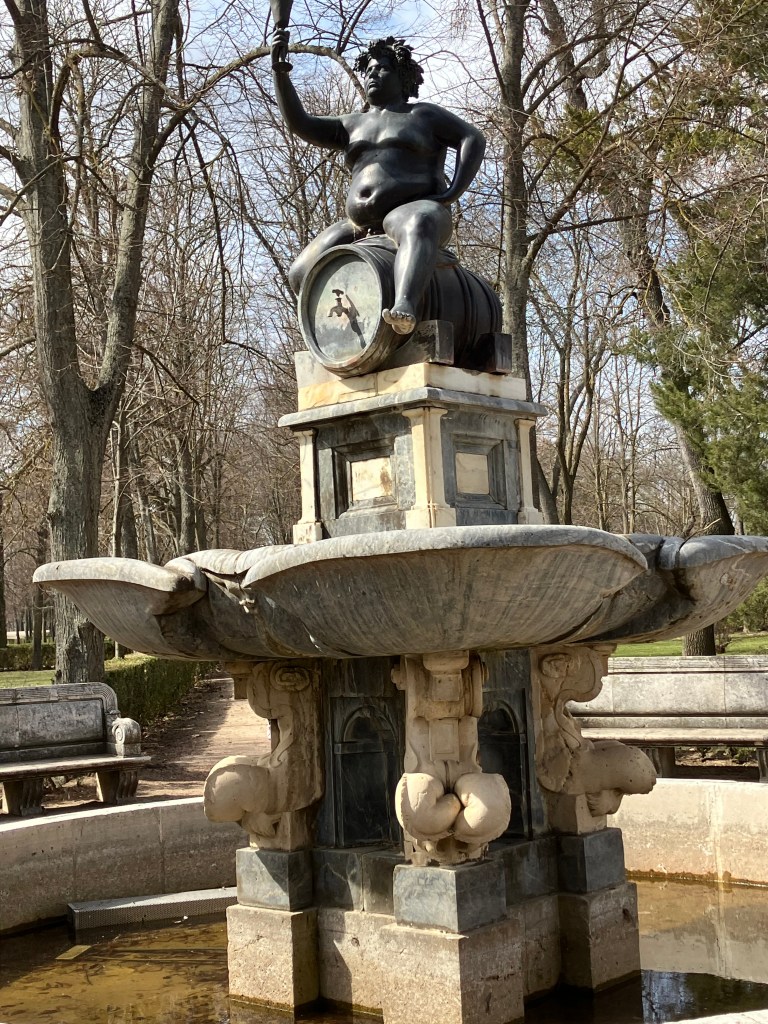
There are two other gardens worth visiting whilst you are in Aranjuez, firstly the Jardin del Parterre which sits right next to the Palace and was originally designed to be the Queen’s formal flower gardens, although it is somewhat lacking in flowers today.
Secondly the Jardin de Principe. This large picturesque green space features manicured gardens, fountains, statues and monuments, To access it walk through the Garden del Parterre towards the El Rana Verde restaurant. As you walk to the left of this restaurant you will find several other popular restaurants should you want to stop to eat.
Continue walking and the entrance to the Garden del Principe is just a little further down on your left. There are rows of cars parked here and you can walk through the gardens to the Casa del Labrador. This is a Neo classical palace designed to complement the Royal Palace. Unfortunately it is was temporarily shut when we visited.
Picnics
Another slight adjustment we are having to make here in Spain is the organisation of a picnic, It was, here on Saturday, that we discovered it is easier to design and create it yourself before you leave and carry it with you.
We walked, what felt like, around the whole of Aranjuez looking for a bakery/cafe that made or had ready to purchase fresh rolls or batons filled with meat, cheese, fish etc. Unfortunately there weren’t any! Whilst fresh bread is plentiful in Spain this type of premises is not.
Returning Home
Due to the Casa del Labrador being closed we found ourselves ready to return home 2 hours earlier than expected. Armed with our new information about the Cercanios we walked back to the station and enquired about the possibility of returning using this method. The Customer Services man tried to replace our tickets but because we had booked them on line was unable to do so. He found our idea of purchasing two new tickets instead of waiting 2 hrs a bit odd but this we duly did. Whilst travelling back on the countryside metro I checked my purchase on Trainline and found we were covered for a 65% refund of our return journey. Ok it wasn’t the full price but it was something!
NB:
This is my fourth contribution detailing our tour of Western Europe. Why not check out all the previous posts and follow us as we learn more about this fascinating area of the world?
.
.[1]
 A Midlife Adventure
