We set out early on Friday morning to catch the metro just down the hill at Lavapies or Lava Pies as I tend to refer to it!
With a quick change at Plaza de Espana we soon arrived at Principe Pio to board our train going 70 miles, more or less, due west of Madrid to Avila. Avila lies on the right bank of the river Adaja and is the highest provincial capital in Spain. The city was declared a Unesco World Heritage Site back in 1985.
Alighting at the train station in Avila, 90 minutes later, we began our 15 minute walk towards the Old City. The sun was shining, it was a lovely Spring morning and as if to reaffirm the season we caught sight of three stork nests balancing precariously either side of a church bell tower. The storks sat proudly on their enormous nests adding the odd twig or two as we watched.

It wasn’t long before the looming city walls came into view and although we had an idea of what we wanted to see today we decided to head to the tourist information office.
These are not always very evident in Spain so you often have to revert to Google maps to actually locate one if you need it.
We picked up a map of the old city. Hubby was in his element, he does love a map! 😊
Before we met he’d never used a sat nav in his car instead there was one of those big AA road map books of England and he still doesn’t like relying on Google maps when we are out. Is this a man thing? Does it revert back to caveman days when the man was the hunter gatherer I wonder?
In broken Spanish/English we also managed to understand that there were two parts of the walls open for walking and viewing: a short stretch or a longer section and where to access the office for tickets etc.

Las Murallas de Avila:
The walls were built to completely circumnavigate the city back in medieval times in Romanesque style and stretch for 12.5 miles. Work began in 1090 but it took until the 14th century to actually complete them and they encircle 77 acres of land. The city, itself, has been inhabited since pre-Roman times around the 5th century BC.
There are 87 semicircular towers with an average height of 39 ft and 9 gates which allow access.
You can walk nearly half of the original walls.
We entered at La Puerta de la Catedral, at the entrance in the Casa de Carnicerías. The towers that you pass throughout the walk, some of which are open, are numbered based upon the site of the cathedral ,this being tower number 1.
Between towers 8 and 9 is the Puerta da San Vicente or Gate of St Vincent. This is a monumental gate with very strong turrets flanking the entrance. You can climb to the top of some of the towers and take in the extensive views across the outer city and beyond as well as key sites in the inner city. The longest part of the wall that you can walk takes in 41 towers and covers the northern side. You finish the walk at the turret of San Segundo so-called because it looks onto the Shrine of San Segundo.
Access to the second walled section is through the Puerta del Alcázar. This is a lot smaller section and you can buy a ticket solely for this section if you don’t wish to walk the longer part. I took up the offer of a free audio guide and found this useful in terms of giving me some background history and highlighting parts of both the inner and outer city as we walked.
Lunch:
The Spanish way of life is very different to us in the UK. Most families back home will eat breakfast (before work or school), lunch (around 12 noon to 1 pm and dinner (after work/school, anytime from 5 – 8 pm).
In Spain the day usually starts with breakfast and lunch is often between 2-3 pm. The whole town/city shuts down except for some tourist sites for siesta and everything then re-opens at 5:00 pm and everyone goes back to work until 8 pm.
Most restaurants open for lunch around 1:30 and the crowds start pouring in around 2. On weekends, tables will stay full until well past 4:30 as friends and family keep talking long after the meal is over.
Dinner time is also very late at 10:00 pm
It isn’t abnormal for Spaniards to also eat snacks between breakfast and lunch and again between lunch and dinner.
My daughter did a Spanish exchange when in school and found the eating customs quite hard to adapt to as did her Spanish exchange student when she arrived in the UK.
We are also finding it harder than we thought on this trip.
It might be due to it being a midlife adventure and our bodies are already a bit stuck in their ways!
As lunch is often the biggest meal of the day restaurants sometimes offer a 3 course lunch at a set price with various choices of starters, mains and dessert. Restaurants often have very few tables inside instead they spill out onto the street or plaza.
For the first time since arriving in Spain we decided to take advantage of this offer whilst in Avila. The sun was still shining bright and it made a pleasant rest sitting directly outside the walls, be it we were early for lunch as it was only 12.30 pm! Oddly English rock and pop music from the 80″s seemed to be the chosen background to this lunch.
To give you a flavour of what was on offer we had tomato and goats cheese salad and mash potato with paprika for starters followed by chicken stew and fried dogfish for mains with strawberries and cream and lemon mousse for afters. This was all for the sum total of 15 euros each and we left completely stuffed!
Catedral de Avila
After lunch we walked inside the walls and visited the cathedral. There is an entrance fee and an audio guide is offered via your mobile phone.
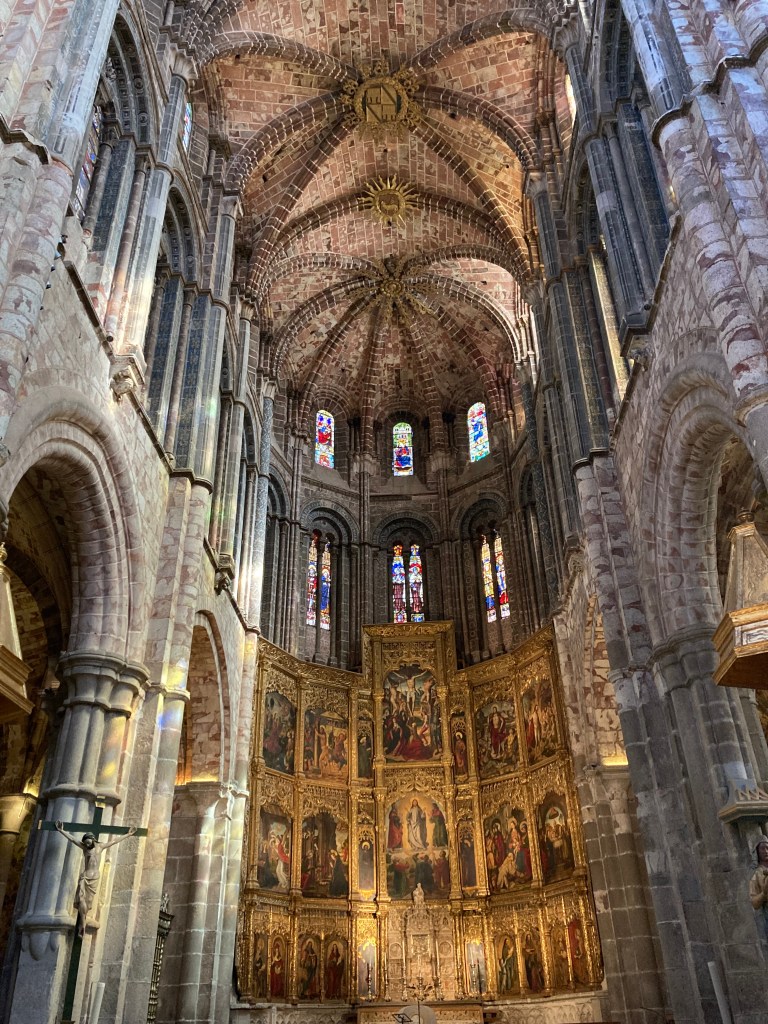
Built as a planned cathedral-fortress and incorporated into the city walls, there is a mixture of Romanesque and Gothic architecture. Said to have been built between the 11th and 14th centuries, the earlier Romanesque parts are made of a striking red-and-white “blood” limestone, while the Gothic parts were built with pure white stone.
The cathedral features 24 pieces depicting the life of Jesus, the Evangelists and the Apostles hanging in the altar. There is much to admire including the stained-glass windows that date to the 15th century, and the choir section carved out of walnut, which was completed in 1546.
Plaza del Mercado Chico
Markets are a common sight in Spanish towns/cities. As we had eaten lunch early, before siesta, the market was slowing down when we arrived after our cathedral visit but there were still stalls offering fruit, vegetables, fish, pastries etc . If you are self catering like us you are never spoilt for choice in terms of fresh produce. The plaza or square of any Spanish town always exudes atmosphere and this one is made more unique by the thoughts of those who have trodden the cobbles before you.

There are many more historic sites and parks to see in Avila both inside and outside of the walls but far too many to mention here. You really have to plan your visit, however, as some attractions close during siesta. On this occasion this included the Convent of St Teresa which we would have liked to have visited. Unfortunately we came away with just a photo of her!
If you are planning a visit to the Castile region of Spain, Avila should be on your list!
This is part three of our extended trip to Western Europe and also the third post about Spain. There will be more to follow on this tour.
 A Midlife Adventure