We stayed 40 minutes walk outside of the “old town” within a fairly densely populated area surrounded by Spanish families, in an apartment on the sixth and top floor of a block of flats.
Over 65% of Spanish people live in flats because they are more affordable, with reduced living costs, and it has been culturally the norm since the mid 20th century.
The two bedroom apartment was light and airy with everything we needed but it was time to see if we could actually “live like a local” for a week.
Our washing was hung out on the rooftop shared by those living in the same block. Our rubbish and recycling was taken down to the communal bins located on the roadsides, which has been a common theme throughout the cities we have visited, and collected here at 1 a.m. every day by the bin men. No one leaves their rubbish on the streets.
We shopped at the local supermarket complete with ultra fresh fish counter, meat area, in store cake shop and bakery and cheese island.
Living as they do encourages a sense of community. We wandered past many local cafe bars where people gathered during siesta, particularly at weekends, for drinks, socialising and sometimes food.
We also learnt how to use their local buses which on the whole run on time, are often quite crowded and cost 1.40 euro per person for a trip into the city. Buying multiple tickets/travel card saves money.
I must admit I’m normally a bit of a Lonely Planet fan but on this occasion we used the DK EyeWitness guide to Seville and Andalucia. This book divides Seville into five key areas and we spent four days exploring them all. Day One, which I’ve already shared, was spent in El Arenal bounded by the River Guadalquivir and also included the area of Parque Maria Luisa.
I could, probably, fill another four posts with everything that we visited but instead I hope to give you a taste, which just might awaken your souls and prompt you to add Seville to your travel plans.
Santa Cruz
This is the old Jewish quarter, where the Jewish community lived from 1248 until they were driven out of Spain in 1492.
Real Alcazar
This is listed on Tripadvisor as the number two attraction in Seville and nearly 28,000 people class it as excellent so it would be a little remiss of me not to include it in my blog.
As we discovered on Monday, Seville is often a “long weekend” jaunt” for tourists and despite being March the streets were very busy. Timed ticket entry prevails at the Real Alcazar and everything was sold out two days beforehand so if this is somewhere you want to visit buy your tickets on line well in advance. Once you have a ticket you still have to queue up to gain entry so be there 15-30 minutes before and remember, don’t be late, and bring the ID you used to book the tickets or you may find yourself being declined entry even with a ticket!
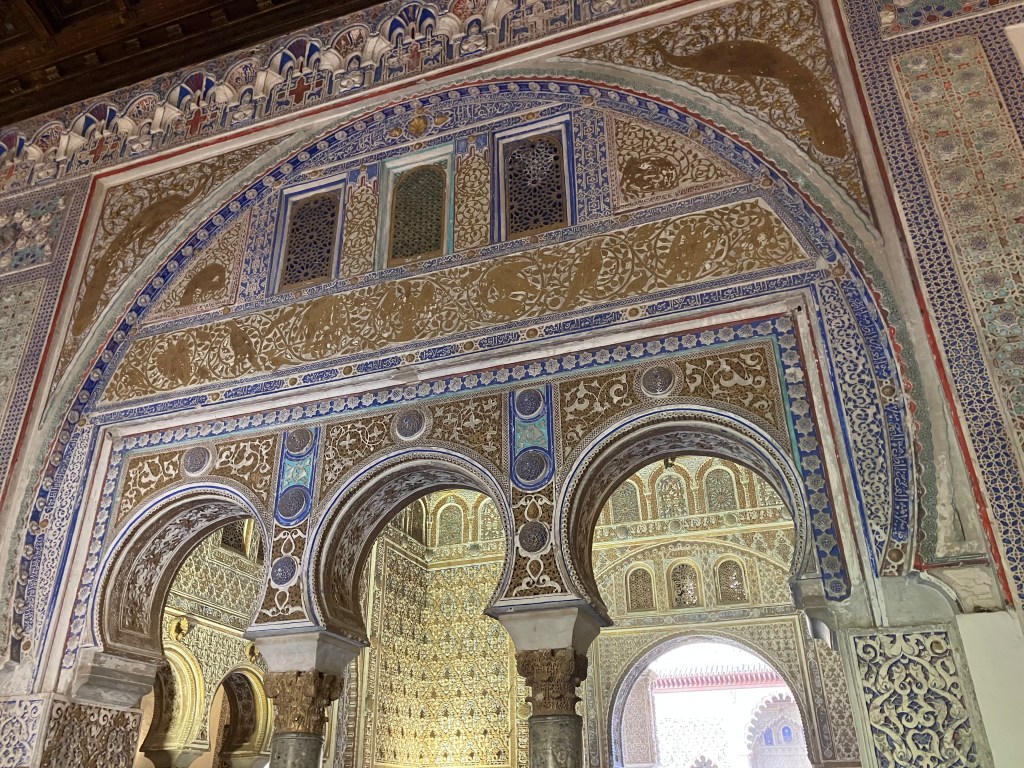
It took five hundred years to actually build the palace and as a result, whilst being a leading example of Mudejar style it also combines Romanesque, Gothic and Renaissance elements.
I paid for an audioguide rather than downloading the narrative from a QR code but to be honest, for the first time on this trip, I didn’t find it particularly useful. There is no suggested route to follow either with or without an audioguide. Some of the rooms have lost their numbers and have names that do not match with the guide and I found the whole site a bit baffling.
Notwithstanding my confusion there are some fine examples of tile decoration for which the palace is famous, as seen below. It is hard to capture personal memories of the interior due to the crowds and the inescapable “selfie brigade”. The palace and grounds were also used in the fifth series of “Game of Thrones” so fans of this drama are looking to photograph themselves where specific scenes were shot.
Stepping out into the gardens, however, it is easier to leave all the visitors behind and just revel in some solitude.
There is a plan of the gardens that you can follow but with more than 20,000 plants, some were planted from seeds brought back from South America by explorers, I just enjoyed going for a stroll. Taking in the scents of the jasmine, admiring the wisteria which was just starting to flower, being slightly amazed at the amount of orange and lemon trees whose fruits gathered on the grounds and occasionally catching the herby smells of amongst others myrtle, rosemary and sage.
You could easily lose yourself here amongst the 60,000 square meters of pools, fountains, water basins, and tiled benches.
La Macarena
This area of Seville has thus far avoided development and so walking around here gave us more of an insight into everyday life. It allowed us to avoid the constant parade of tourists that you see elsewhere, as well as an opportunity to glimpse the remains of the original city walls.
Basilica de la Macarena
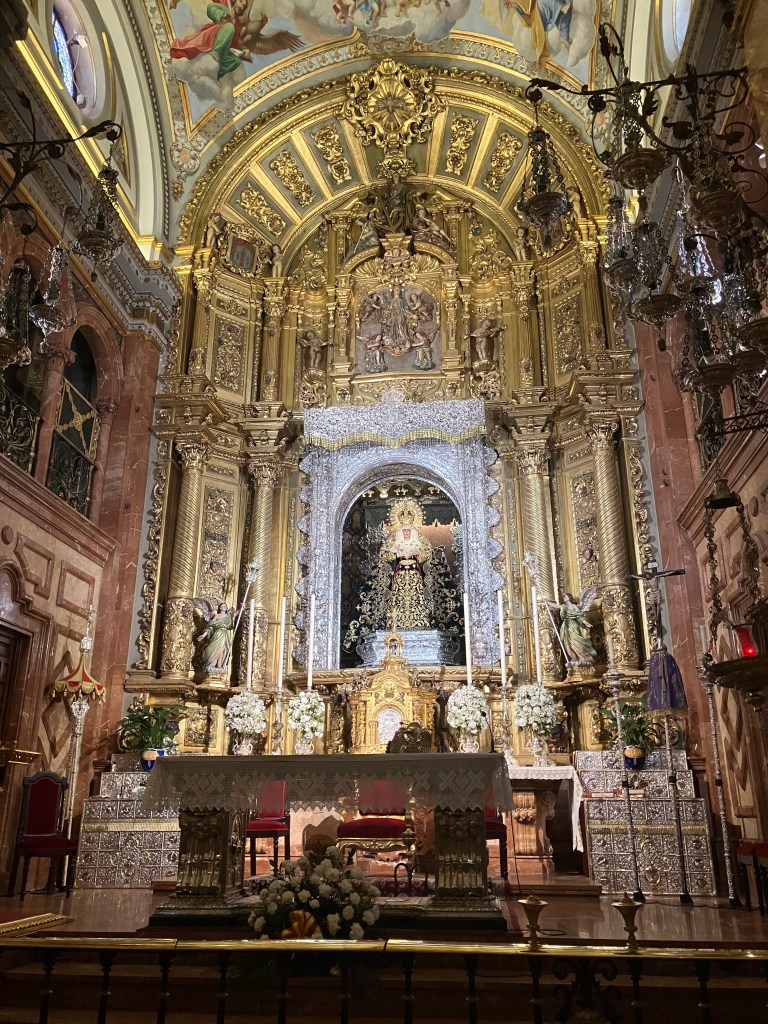
No visit to this area is complete without a visit inside the Basilica which houses the famous statue of the Virgen de la Esperanza Macarena, standing above the main altar amid waterfalls of gold and silver.
The “weeping virgin” takes centre stage during the Easter processions or Semana Santa.
If you’ve never seen videos of this spectacle have a look on line.
Organised by religious groups and brotherhoods that date back hundreds of years, it is during the small hours of Good Friday morning in Seville, the Hermandad de la Esperanza Macarena, the biggest brotherhood in the city, will take out the famous Virgen de la Macarena for an epic 13-hour tour.
Carried through the streets on heavy floats (pasos) — often weighing over a ton — by their members, they are accompanied by the Nazarenes in their cloaks and traditional pointed hoods. Seeing these garments displayed within the Basilica it’s hard not to think about the Ku Klux Klan.
Whatever your religious beliefs you have to admire their dedication and fortitude.
We left the Basilica in search of a light lunch and made our way further into La Macarena. it wasn’t long before we came across a traditional cafe/bar with tables, chairs and umbrellas lining the roadside. The locals were gathered inside avoiding the midday sunshine but savouring the weather we sat outside alongside a couple of other evidently local retirees! Orders are placed at the counter for simple Spanish fare with staff who are authentically friendly and helpful.
Palacio de Las Duenas
I cannot complete our highlights of La Macarenas without mentioning this Palace. Built in the 15th century, it was the favourite home of one of Spain’s most famous aristocrats, the late Duchess de Alba, who died in 2014. It was opened to the public by her son and primary heir in 2016.
One of my guilty pleasures is reading “Hello” magazine in which the Duchess of Alba was often featured and always fascinated me for her independent spirit and overwhelming joie de vivre.
Born in 1926 into the Fitz-James Stuarts, the most powerful aristocratic dynasty in Spain, who always enjoyed a close relationship with the Spanish Royal Family, her godmother was Queen Victoria Eugenie, a granddaughter of Queen Victoria.
The Duchess was also a descendant of King James II of England (VII of Scotland) through the illegitimate son he had with his mistress, Arabella Churchill, the sister of the 1st Duke of Marlborough.
The Albas are also distant relatives of Queen Elizabeth II, Sir Winston Churchill, and Diana, Princess of Wales.
The Duchess of Alba, Head of the House of Alba from 1953-2014 and Spain’s richest aristocrat at the time of her death, had a fortune that some experts estimated to be over €3.5 billion. It was rumoured that she could travel from northern to southern Spain without leaving her own property. She was well known throughout Spanish society for her strong sense of independence, style, and irreverence, famously refusing to pose nude for Pablo Picasso and fraternizing with some of the most famous people of the 20th century. Her social circle included Princess Grace of Monaco, Jackie Kennedy, Princess Margaret, Walt Disney, Audrey Hepburn, and Yves Saint Laurent. The palace was also visited by Edward VIII and Wallis Simpson.
She was also well known for her love of bullfighting, horses, and flamenco.
Widowed twice, the Duchess of Alba caused a huge scandal by marrying for the third time at the age of 85 over the objection of King Juan Carlos. He cautioned her against marrying Alfonso Diez Carabantes, a civil servant 25 years her junior that he suspected was after her immense wealth, a sentiment shared by her children. She married Carabantes in 2011 anyway, opting to give her children their inheritance early, including several palaces, land, and a first edition of Miguel Cervantes’ Don Quixote. Carabantes agreed to renounce any claim to her fortune.
She died at the age of 88 after a short illness having been named by Guinness World Records as the world’s most titled person. She was 14 times a Spanish grandee, five times a duchess, once a countess-duchess, 18 times a marchioness, 18 times a countess and once a viscountess, according to the entry.
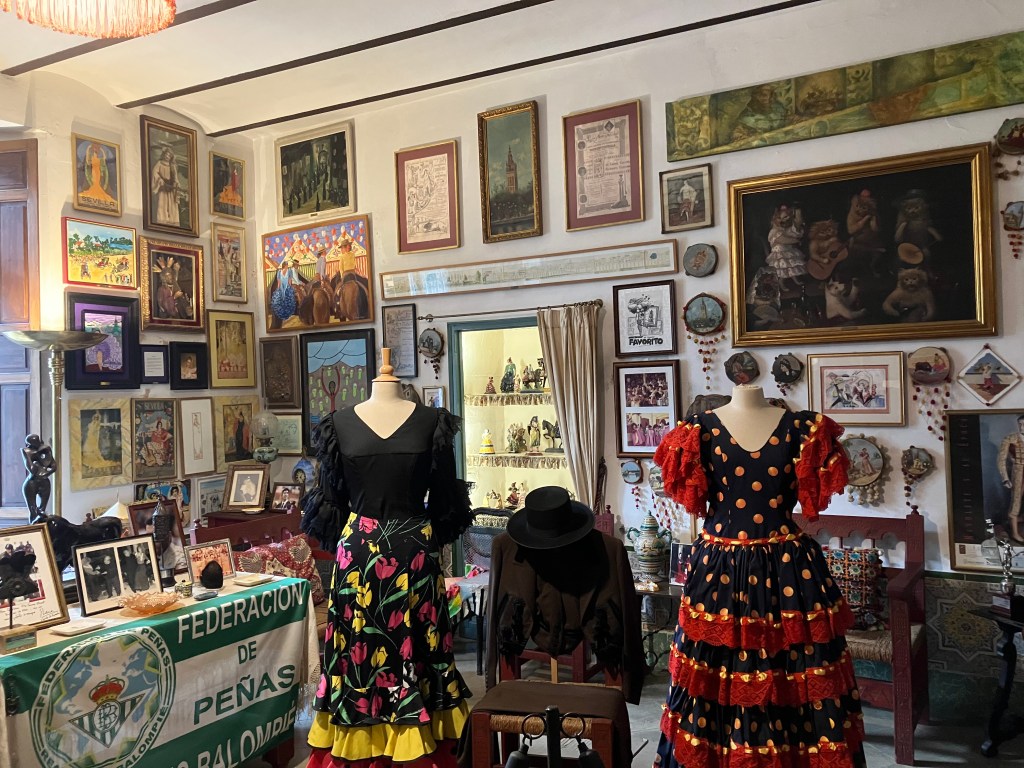
As you tour the grounds and downstairs rooms evidence of her flamboyant lifestyle and photos of her many friends remain on view.
Across the River
A trip to Seville is not complete without venturing across one of the bridges to Triana. Since Roman times this area of Seville has been famous for pottery. It has traditionally been a working class area famous for bullfighters and flamenco dancers but it appears to be experiencing something of a renaissance.
We took a walk through the traditional narrow streets, with beautiful tiled houses and flower filled outdoor displays which presented a reprieve from the activity across the river in the centre of Seville.
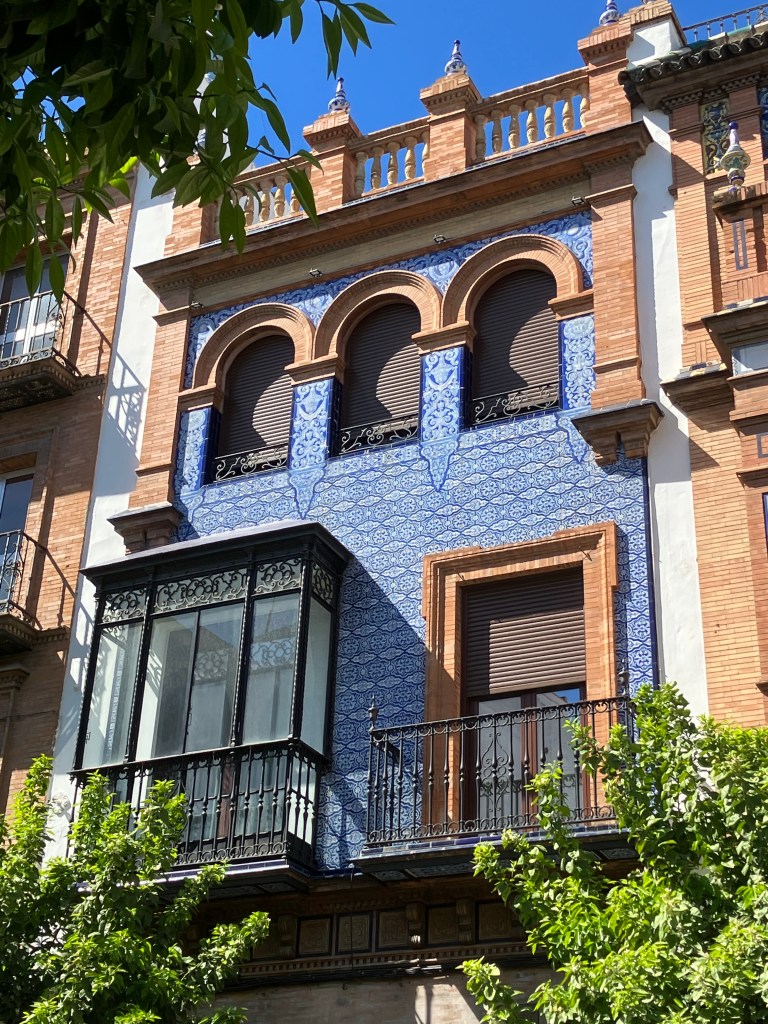
There are still workshops producing and selling tiles and pottery but be aware they tend to close for siesta. There are plenty of inviting cafes, restaurants and bars spilling out onto the streets which somehow have a different atmosphere to anywhere else we had experienced in Seville.
We also took a walk along the riverbank and settled into a small cafe/restaurant overlooking the water. If you want something a bit more expensive and exclusive then keep walking and you will find some more private choices to eat.
As a midlife adventurer this was honestly one of our favourite parts of the trip to Seville and if we had our time over again, despite this area being the furthest away from the train station, we would have found an Air BnB here and happily stayed.
Outside of Seville
We ventured out of the city, again by train, on two separate days visiting Cadiz down on the coast and Jerez for the unique show, “How the Andalusian Horses Dance”.
This is an equestrian ballet accompanied by authentic Spanish music and 18th century styled costumes. As an equestrian enthusiast this was a visit I really wanted to make.
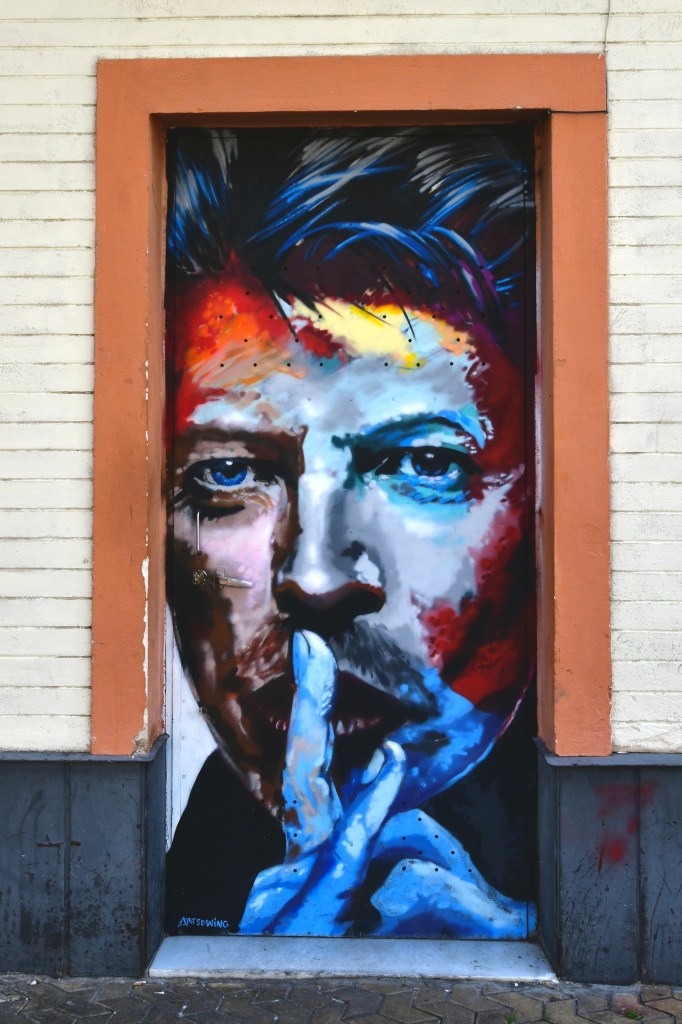
Before saying a final goodbye to Seville I’d just like to share this fantastic piece of street art with you which we came across accidentally while visiting Alameda de Hercules.
NB:
We are currently touring Spain as part of our journey around Western Europe and this is my second post about Seville. Why not have a read of my first post about this marvellous city and then catch up on our journey thus far. Why not follow us as we continue discovering this lovely part of the world?
 A Midlife Adventure