We arrived by train into the city of Granada on Sunday Afternoon. At the foot of the Sierra Nevada mountains, but only one hour by car from the Mediterranean coast, it is of course famous for the Alhambra Palace.
The Alhambra is one of the most revered monuments of Islamic architecture and one of the top visitor attractions in Spain.
Our hotel for the next three nights is situated in the Albacin neighbourhood, which is also full of Islamic influence and Moorish architecture. Even on the drive from the train station it is evident that like so many ancient cities in Spain, Granada is divided into the old and the new. With the new part of the city harbouring apartment style living and business premises.
Approaching our hotel we realise that the old cobbled streets are off limits to normal traffic and the taxi driver has to “buzz” himself in through a set of lights where a hydraulic barrier disappears downwards to let him through.
Our bedroom looks over the street and has two balconies. With the doors thrown open the afternoon sun shines in, along with the chatter from the small shops below clustered together like a “souk” and the distinct aroma of Middle Eastern food.
The receptionist has armed us with a map of the city to hubby’s delight and we settle in unpacking and preparing for an early start the next day.
Tickets for the Alhambra Palace
These can sell out a month in advance and acquiring them is a minefield all of its own. There are so many sites that indicate, at first glance, that they are the real site but are, in fact, companies offering accompanied tours. Once on the official site (alhambra-patronato.es) you then have a choice of about nine different tickets. The key is to ensure your ticket includes access to the Nasrid Palace.
If you read my blog about the Real Alcazar in Seville you would have learnt, that having arrived in Seville, we had to wait a couple of days for tickets to this attraction.
For this reason, despite it only being March, we started addressing all tickets for the next month and, in so doing, had discovered that we couldn’t get any tickets for the Alhambra Palace for the days we were going to be in Granada!
Although I do all the planning, I had given the responsibility of tickets to hubby. He finds it so frustrating that you can no longer just turn up in a city and spontaneously visit an attraction you wish to see. Having to plan the day and even sometimes the actual time of your visit is somewhat anathema to him. Thus he had not been as “on it” as he perhaps should have been.
What ensued was a desperate search of the internet for another site that had tickets. We trolled through all sorts of companies offering guided tours, not that we really wanted to do a group visit. We eventually, however, came across the Granada Card. The price per person (for a 48 hr pass) was substantially higher than a normal ticket for the Alhambra Palace but it did include entrance to other sites and some other benefits such as bus tickets. More to the point, having indicated which day we wanted the pass to begin, we could get into the Alhambra Palace on the Monday after we arrived, at a time that suited us.
It opens at 8.30 a.m and so we chose 9 a.m. in the hope that it wouldn’t be totally swamped with tourists.
Be aware that you have to show your ID (in our case our passports) at every checkpoint, into every different area, throughout the day. If you turn up without your ID they won’t let you in!
Additionally you have to arrive 30 mins earlier than your ticket time to get through security checks and actually walk to the Nasrid Palace. The time on your ticket is your entry into the Nasrid and if you are late they advertise they have the option to refuse entry!
I guess it depends on the security guard on the day and how busy they are but personally I wasn’t prepared to take the risk and so we were there at 8.30. a.m.
Getting to the Alhambra Palace
The Palace was built on the Sabika hill, an outcrop of the Sierra Nevada mountains. It had been the site of earlier fortresses and of an 11th-century palace which Nasrid rulers continuously modified.
To walk up to the palace from the old town takes about 30 minutes but it is a fairly steep uphill climb. Given that we knew there would be a lot of walking throughout the day (we did 6 miles that day in total) we opted to take a cab but walk back down. There are also buses though that run from Plaza Nueva.
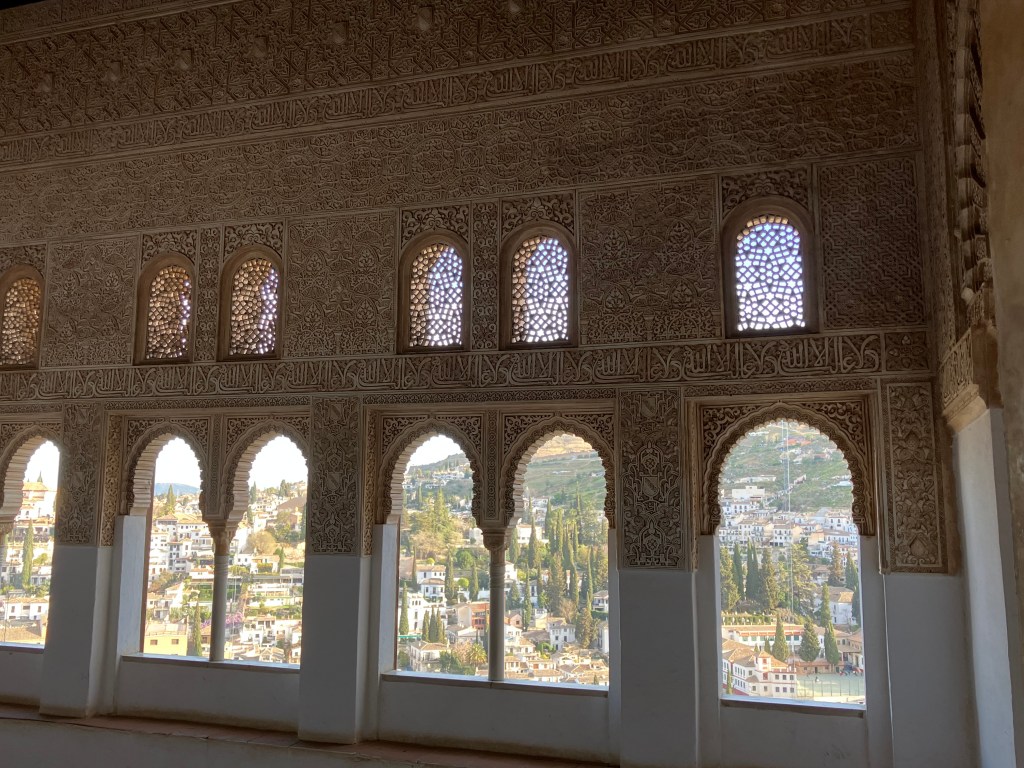
The Nasrid Palace
To try and give you some idea of the size of the palace, throughout the Nasrid era, the Alhambra was a self-contained city separate from the rest of Granada below. Within its walls could be found most of the amenities of a Muslim city such as a mosque, public baths, roads, houses, workshops and a sophisticated water supply system.
As a royal city, there were at least six major palaces, most of them located along the northern edge where they commanded views over the Albacin neighbourhood.
The most famous and best-preserved are the Mexuar, the Comares Palace and The Palace of the Lions. All of these basically form the main attraction to visitors today.
I should probably say, at this stage, I invested 6 euros in an audioguide. I found it really easy to operate and really helpful in terms of the information it gave, alongside the suggested route to follow which is indicated throughout the Palace.
The Moorish architecture within the Nasrid was developed over centuries. There is a central courtyard around which other halls and rooms were placed. The decoration on the inside of the building is made up of tile mosaics on the lower wall and carved stucco on the upper walls. There are decorative motifs of geometric pattern, patterns based on plants and flowers found in the natural world and Arabic inscriptions.

What I found most fascinating and unique here were the ceiling sculptures which reminded me of “bee hives”. They are known as mugarnos and with their stalactite sculpting lend a three dimensional feature to the vaulted ceilings.

Palace of Charles V
Having finished our exploration of Nasrid we walked to this massive square structure of stone which looks really big from the outside but internally it encloses a perfectly circular courtyard. Personally I was reminded of the Roman colisseum.
The construction of this Italian-influenced palace in the heart of the Nasrid-built Alhambra symbolises the triumph of Christianity over Islam. The building began in 1527 but wasn’t actually finished until 400 years later around 1923.
Internally is the Alhambra Museum, which holds objects and artefacts relating to the Alhambra’s history, as well as the Fine Arts Museum of Granada, with it’s collection of paintings from Granada dating from the 16th to 20th centuries. Unfortunately both were closed on the day we went.
Alcazaba
We then moved across to this central fortification which is the oldest part of the Alhambra today.
You can not only view the remains of this residential district where elite guards of the Alhambra lived but you can climb both the Torre de la Vela which acted as a watch tower and also the Tower of Homage which, at 85 ft, was the tallest tower and military command post. The views from both are extraordinary and it’s not hard to stand there and imagine how this city ruled over the surrounding areas.

The Partal Palace
We then walked back towards where our Nastrid tour had ended to view this pavilion on the edge of the Alhambra walls with it’s portico facing a large reflective pool.

From here we wandered amongst the gardens which follow the northern walls. Throughout our visit I have to say we were both really impressed with the care and attention put into the gardens, they are beautiful.
In addition to the gardens you can also view several towers (from the outside) which were converted into small palatial residences. All of these have a narrative on the audio guide.
Generalife
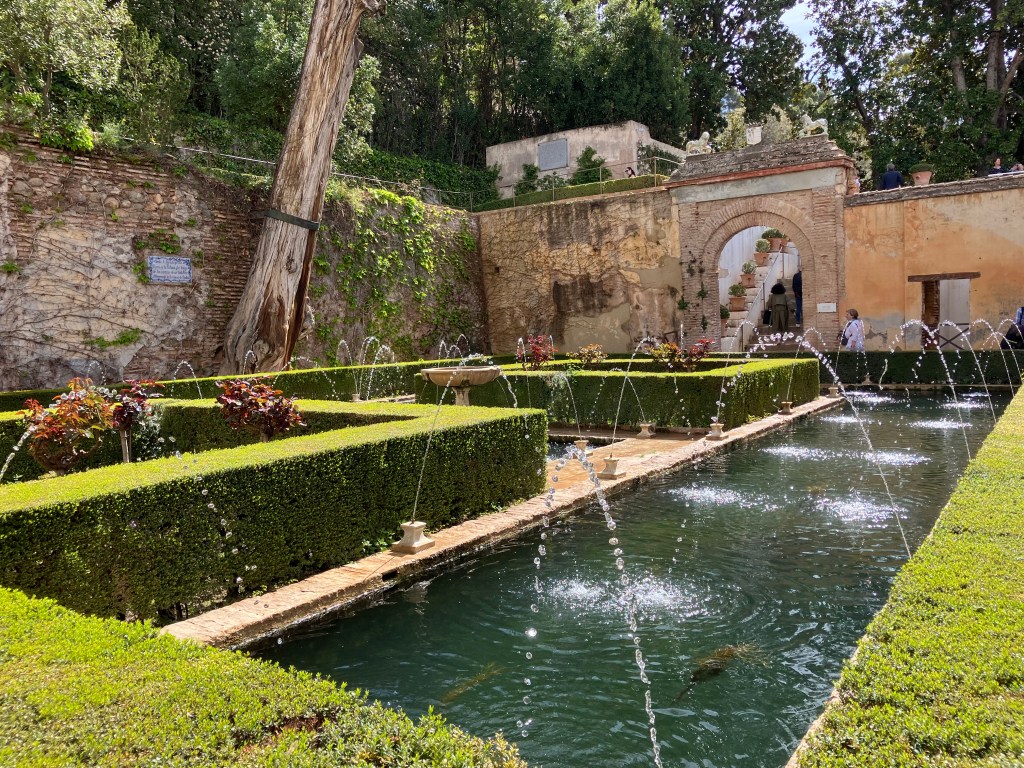
This is the area outside of the palace walls which was originally developed as a country estate. It has undergone several developments from the Nasrid period right up to the 20th century.
Meandering along you often come across rectangular garden courtyards with decorated pavilions, then there is the landscaped gardens with the central full length pool and fountain, not to mention the rose garden which I’m sure must smell unbelievable when the roses bloom. Then just as you think you’ve finally completed your tour you have the wonderful fountain filled courtyard.
NB:
This is part nine in my series of posts about our tour of Western Europe. Why not read the previous posts and then follow us on our journey as we continue to explore this lovely part of the world
 A Midlife Adventure

