So what else did we see or do which made us want to stay in this wondrous city?
We took a break from the Jardin de Turin to visit the Museum Faller. This museum is all about the art of carnival sculpture and to which I am dedicating a separate article on Tuesday because it simply deserves its own space!
Instead, following on from my previous post, I’m going to chat about where we went next and hopefully you will share my enthusiasm for this city that just seems to have it all!
The City of Arts and Sciences
Firstly this construction is probably one of the most contentious architecturally in the whole of Spain. Personally I love it but I can understand that some people would feel it is a blot on the landscape.
The City of Arts and Sciences sits at the eastern end of the Jardin de Turin just before you reach the coast. It is made up of six distinct areas and was designed by Valencian architect Santiago Calatrava.
Started in July 1996 the first section was opened in 1998 but the final part was not inaugurated until 2009. Originally budgeted at €300 million in 1991 for only three structures, it has expanded about three times the initial expected cost. In 2019 it was reported, however, that the economic impact of the complex is €113 million a year and generates over 3500 jobs!
Hemisferic was the first site to open and the centre piece of the City of Arts and Sciences.
It is also known as the Eye of Knowledge. It is so hard to describe it but the design resembles an eyelid that opens to access the surrounding 24,000 square meters of water pool. The bottom of the pool is glass, creating the illusion of the eye as a whole.
Within the structure there is a Laserium, a Planetarium and an IMAX cinema with over 900 square meters of screen.
My only question if I lived here would be where do I start?

Prince Felipe Museum of Science opened in 2000 and is an interactive museum of science built to resemble a whale skeleton. The architecture is known for its geometry, structure, use of materials and its design around nature. At 42,000 square meters the building houses 26,000 square meters of exhibition space, the largest in Spain.
It occupies three floors and is dedicated to learning science through experience so everything is graphically displayed with plenty of interaction.
I’m sure it is geared towards school age children but I’d still love to visit!

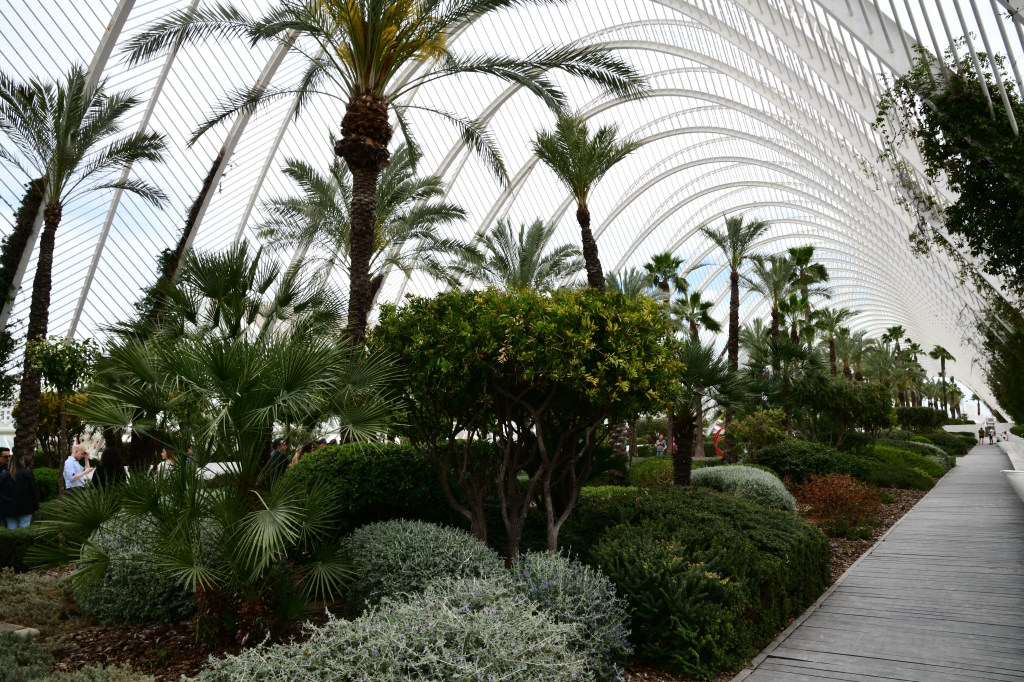
L’Umbracle was the third to open in 2001 and designed as an entrance to the City of Arts and Sciences. At 320 meters long and 60 meters wide it was designed as an open structure with 55 fixed arches and 54 floating arches that stand 18 meters high all encircling a landscaped walk with plants found in Valencia. The plants being specifically picked to change colour with each season.
Internally there is also The Walk of the Sculptures which is like an outdoor gallery with sculptures by artists including Yoko Ono.
We were able to walk around here whilst on our visit, the bougainvillea was just beginning to flower, the honeysuckle scent reminded me of home (it was one of my Mum’s favourites) and the smell of rosemary and lavender filled the air.
What would it be like to return each season and watch the changes?
Oceanografic opened in 2003. Built in the shape of a water lily, it is the largest oceanographic aquarium in Europe with 110,000 square meters and 42 million litres of water. More than 45,000 examples of 500 different marine species inhabit nine underwater towers spread over two levels. Each represents a different aquatic environment including the Mediterranean, wetlands, temperate and tropical seas, the Antarctic, the Arctic, islands and the Red Sea.
My all time favourite aquarium is in Monterey, California but I’m open to having my mind changed
Valencia Opera House which opened in 2005 is not just an opera house but a centre dedicated to music and performing arts. Personally I feel it looks like a fish with it’s mouth open?
Measuring over 70 metres in height, the Palau de les Arts is divided into four separate halls, all boasting the latest technology in order to stage all kinds of opera, musical and theatrical performances.
It is surrounded by 87,000 square meters of landscape and water, as well as 10,000 square meters of walking area. To add to the theatre, panoramic lifts and stairways connect platforms at different heights on the inside of the metallic frames of the building.
Culture on your doorstep, what more can you ask?

Agora, the final part to open in 2009 is a covered plaza in which concerts and sporting events can be held. It is, however, completely versatile so there is no limit to the type of performances that could be held here.
Wow, they seem to have thought of it all!

Surrounding all this magnificence are pools of water with walkways all with plenty of seating and just inviting you to sit, take a breathe, maybe read a book or have a picnic.
I really cannot wait!

From Oceanografic you can either walk for forty minutes or jump on a bus to the beach. We, however, opted to visit on a different day, giving us a chance to test out the theory that our apartment was indeed thirty minutes walk to the old town or to the beach in the opposite direction.
Playa de las Arenas
Firstly before reaching the beach it’s worth having a look around the harbour since this is where the Americas Cup was held in 2007.
Additionally The European Grand Prix was held at the Valencia Street Circuit from 2008 until 2012. The Formula 1 circuit used public roads near the Port of Valencia as well as a purpose built section nearby.
After the last race, the track was abandoned with the purpose built section remaining as it had been and there is evidence of the race still throughout the port area including the abandoned pit building.
Leaving the port behind we walked from here to the beach which stretches north from the marina. The first thing we noticed about the beach is its pure width ranging from an average of 60m up to 100m in places, there is definitely no shortage of space.
Secondly, which to be honest, is something I always check out before taking off my trainers and socks to put my feet in the sand is how clean is it? Valencia’s beach is super clean.
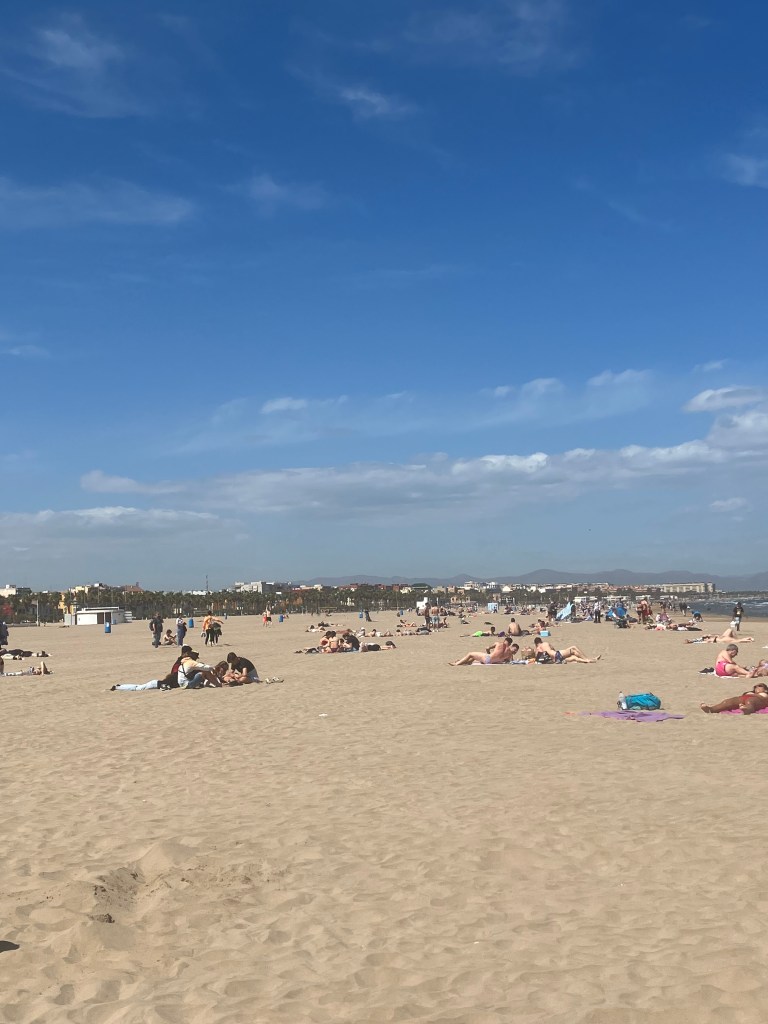
This is not the best photo but it gives some idea of the size.
Behind the sandy beach is an impressive boardwalk, known as the paseo maritimo. Although this is lined with bars and restaurants, some with an unobscured view of the sea beyond, it is spacious. There are plenty of benches to stop and rest whilst watching other visitors taking a stroll, riding a bike or a scooter or even skating, without causing any interference to each other.
On the beach, itself, we took a moment to watch the volleyball players. Whilst there were evidently people sharing a court for an informal game between friends there are also some serious games to watch. Beach volleyball is a very popular sport in Valencia with players competing at local, national and international level.
As you walk along the beach it is hard to know where one beach ends and another starts. Playa de las Arenas blends into La Malvarossa and ultimately Patacona Beach. There are roughly 2 miles of sand.
We couldn’t come to the beach without tasting a traditional Valencian paella. Whilst paella is popular throughout Spain it is nationally recognised that the Valencia region is responsible for the original recipe. It consists of round-grain rice, specific varieties of green beans, rabbit, chicken garrofó (a variety of lima or butter bean) and it is cooked in olive oil and chicken broth.
There is a second variety based on seafood but paella that is mixed i.e. seafood and meat is not traditional although it is available in some restaurants. We chose to stay with the meat variety and left the beach with our tummies happily full.
So there you have it a City of Arts and Sciences and 2 miles of beautiful beach with traditional paella. Any more reasons why we want to stay?
NB:
This is my second post about the great city of Valencia. Why not have a read of my first post? And then catch up on our tour of Western Europe thus far?
 A Midlife Adventure