Whilst I left Barcelona feeling as if it had sold it’s soul for the tourist dollar ( see my previous post published on April 11th) I also left appreciating and acknowledging that the city has some rare and beautiful modern architecture.
You cannot help but be in awe of Gaudi’s work, Barcelona’s most famous Modernist architect, and whose buildings are targets for the flocks of tourists that come to the city. I have personally decided not to write a post about his work for no other reason than I honestly could not do it justice and if you are in Barcelona, despite the crowds, you have to visit Palau Guell, Casa Mila and Las Sagrada Familia.
There is also, however, a great deal of art nouveau architecture to be seen in the city aside from his, examples that are tucked away in everyday streets, which also deserve credit.
As midlife adventurers we don’t always want to follow the tourist trail and so will quite often look out for unusual self guided walks which allow us to see a bit more of a city. In this case we took in some Modernist architecture whilst also learning a bit more about the Gracia area of Barcelona, where we were staying, before heading down into the centre.
I make no apologies for the amount of photos included in this post as the beauty of the architecture should be displayed.
Some highlights of our walk included Casa de les Punxes or Casa Bartomeu Terrades i Brutau which is three houses in one. It was built in 1905 by Josep Puig i Cadafalch and Terrades’ three daughters each lived in one section of the house. It looks like it could belong in Bavaria and yet somehow tourists wander past without blinking an eye.
Cadafalch built many houses in and around Barcelona so this is just one example.

We also saw examples of sgraffito which is defined as a form of decoration made by scratching through a surface to reveal a lower layer of a contrasting colour, typically done in plaster or stucco on walls. Casa Manuel Llopis (below) is an example of this, built in 1903 by Anton Gallissa i Soque with sgraffito by Josep Maria Jujol, who also worked on several of Gaudi’s projects.
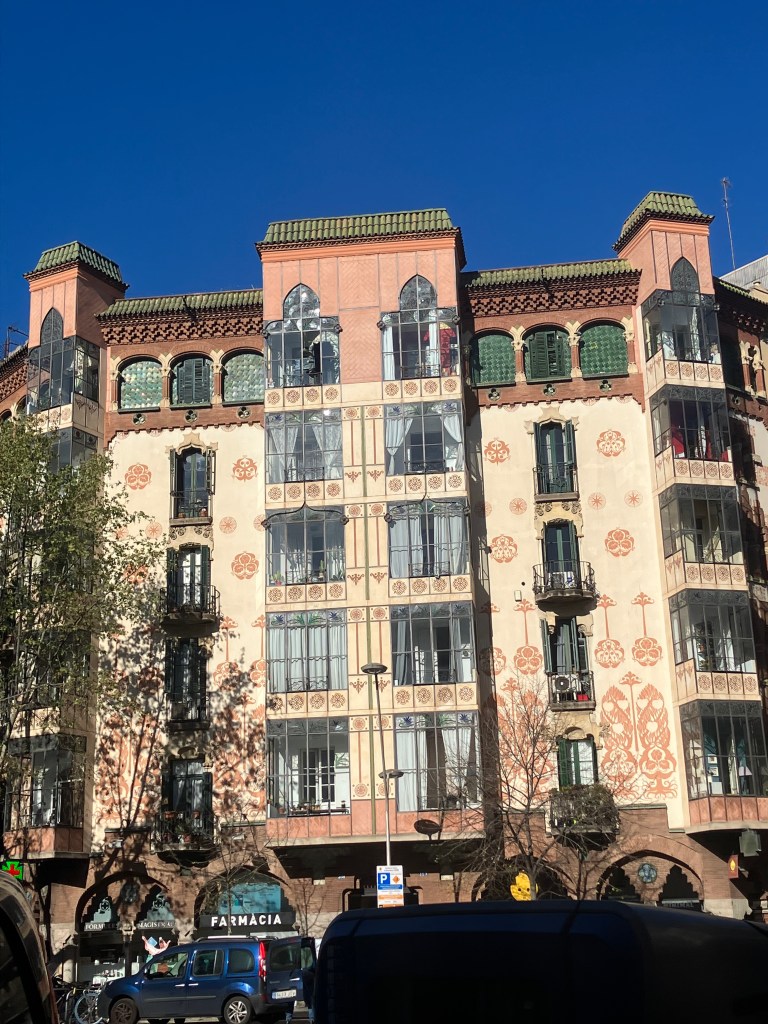
Another example of sgraffito was evident at Casa Francesc Cama built by the architect Francesc Berenguer i Mestres in 1905. Unfortunately he couldn’t actually sign the facade because he didn’t possess a university degree so it bears his boss’s signature Miquel Pascual i Tintorer. This house also features some beautiful stained glass windows in the lower section.
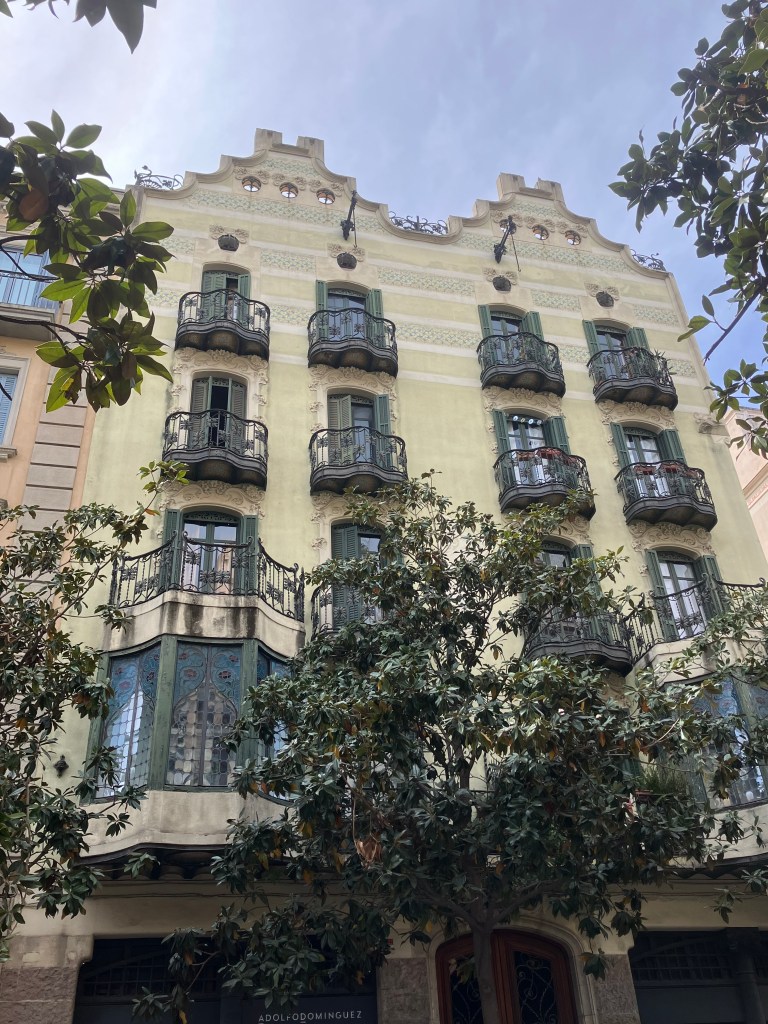
Another example of Mestres work is Casa Cama i Escurra which has beautiful stained glass oriels. Imagine what those windows look like on the inside!
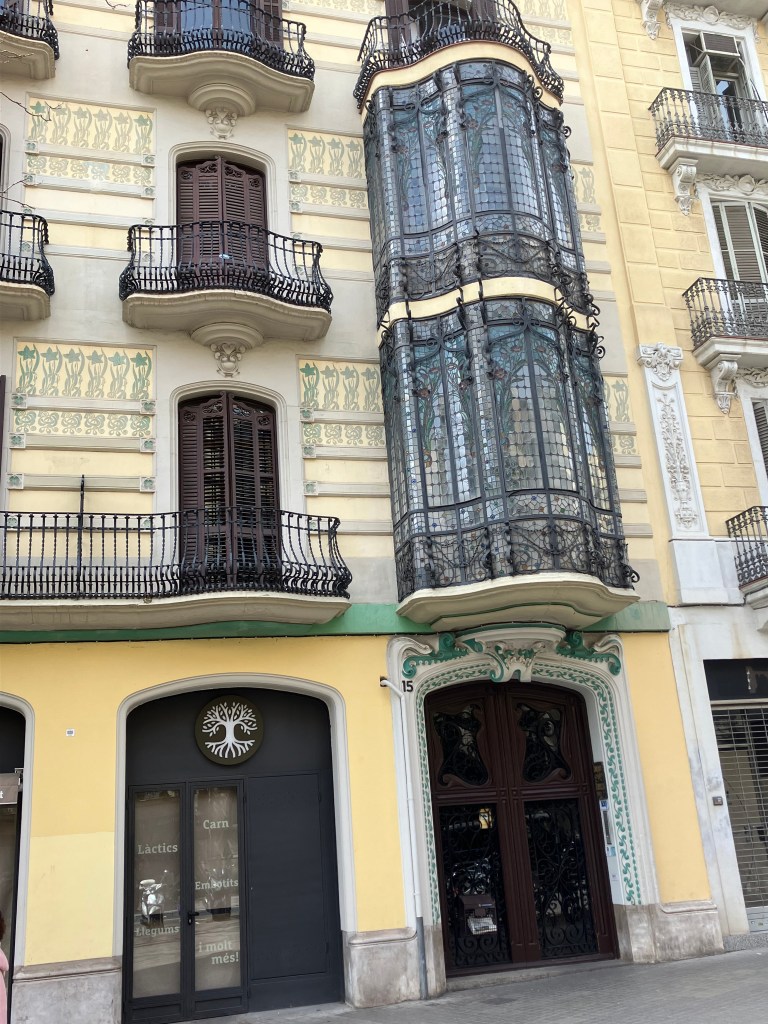
All of these houses are sitting on ordinary roads in Barcelona, clearly visible and yet invisible to the majority of tourists.
One of Gaudi’s first commissions, however, is in the Gracia neighbourhood -Casa Vicens on Carrer de les Carolines, where we saw our first small gathering of tourists that day. It was built between 1883 and 1888 as a summer house for the tile manufacturer Manuel Vicens. When Gaudi first visited the site he found a yellow zinnia flower and used this as the motif for thousands of tiles that clad the exterior of this Moorish-style building.
He also used a palm leaf discovered on the ground to inspire the wonderful iron railings that surround the courtyard. This was an idea that Gaudi went on to use again at Parc Guell.


Further into the centre of the city, surrounded by people, we admired the Manzana de la Discordia. Here you find three houses built by three leading Modernist rivals forming one of the most famous architectural bodies of work in Barcelona.
On the far right, as you look at the houses, is Casa Lleo Morera, an ornate remodelling of an existing building by Lluis Domenech i Montaner completed in 1905. I’ve not included a photo as his work features later.
On the far left, built by Josep Puig i Cadafalch five years earlier in 1900, is Casa Amatller. Built to resemble an extravagant version of a Dutch or Flemish step gabled house he utilised sgraffito but then enhanced it with fanciful ceramic motifs which I, personally, felt took this art to a higher level.

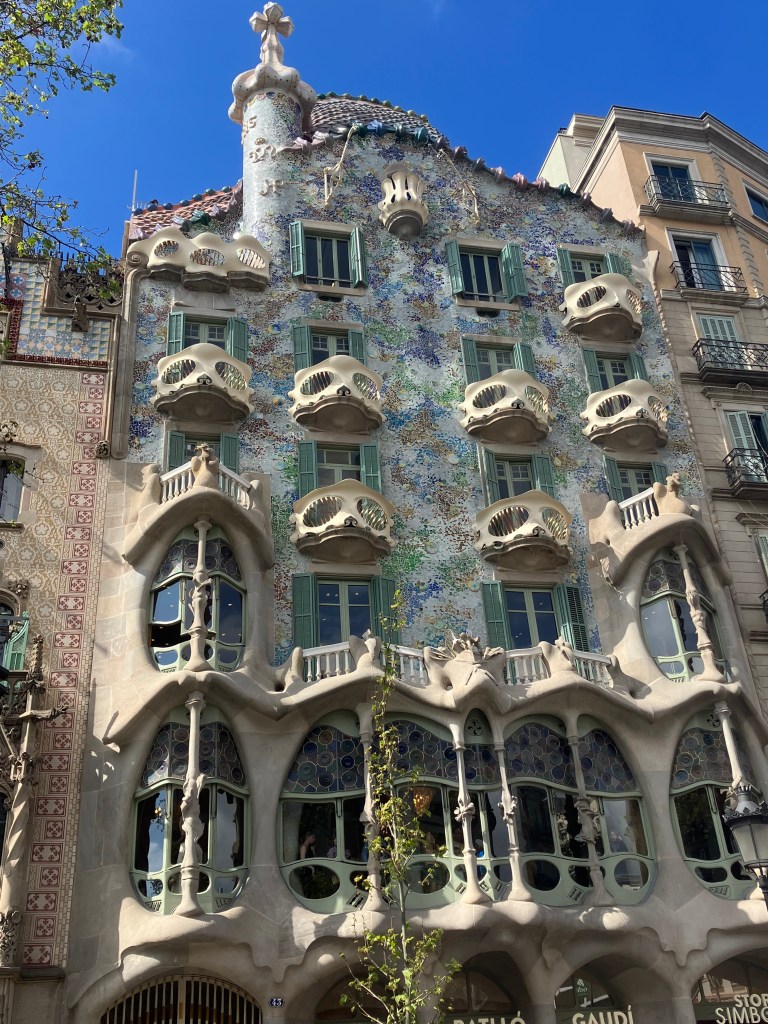
Finally the third house, in the middle, is Casa Battlo designed by Gaudi and completed in 1907. It is several metres taller than the other two and Gaudi’s idea was to utilise the exterior to illustrate the legend of St George (who is Catalonia’s patron saint) The green and blue ceramic cladding on the walls represents the dragon’s scaly skin, the curved roof-top it’s crested back and the balcony railings and pillars the bones of the dragon’s victims. He had quite an imagination!
Finally our walk ended at the Palace of Catalan Music where we had organised to join an English speaking guided tour. We are not massive fans of choral, chamber, symphonic or classical music for which the internal Palace is famous. But the building itself is widely regarded as a masterpiece of Catalan architecture, a majestic example of the Modernist style and a magnificent end to our day. The architecture throughout is to die for!
Built in 1908 by Lluis Domenech i Montaner, the outside is currently undergoing refurbishment work and is partly covered with scaffolding and plastic shielding but you can still admire some of the mosaic covered columns.

Internally much of the work is on a floral theme. Roses, lilies and other beautiful flowers climb up pillars, trail across the stained glass windows and cover the ceilings. The Modernist style abounds and the auditorium is the central masterpiece.
Viewed from the upper floor, celestial stained glass windows surround the organ below which behind the stage you can see muse-like figures with mosaic tile bodies and terracotta statues for heads.
On either side of the stage are marble sculptures. On the right hand side Richard Wagner’s Valkyries ride over a bust of Beethoven whilst on the left a tree of traditional song provides leafy shade to Anselm Clave, a Catalan composer.

Finally look up and you see the piece de resistance, the absolute gem that is the blue and gold stained glass skylight encircled by forty women’s heads to represent the heavenly choir.

What an ending to our exploration into Modernist architecture!
NB:
This is my second post about Barcelona. Why not have a read of the first post?
We are currently on a tour of Western Europe, why not catch up with where we have been and then follow us as we continue to explore this lovely part of the world?
 A Midlife Adventure