Whilst in Paris we have visited both Versailles and Chantilly. What a totally different experience! This is certainly a tail of two chateaux!
The aim of this post is to hopefully enable you to decide which property you would prefer to visit assuming you have a choice.
Versailles is of course a Palace and not a chateau. It was in the top three of my list of places to visit whilst here in the French capital. I’d been before but a long time ago and by a long time I’m talking the late eighties!
Chantilly, in contrast, was a new idea which stemmed from an article my hubby had read.
We were staying in the 18th arrondissement of Paris which is centred around hilltop Montmartre, a former artists’ village once inhabited by Picasso and Dali, and home to the majestic Sacré-Cœur basilica. In visiting both estates we needed to make public travel arrangements.
Tickets and Arrival
We set off, for Versailles, early on a Saturday morning and we were, unfortunately, not blessed with a sunny Spring day. It was instead cold, wet and at times raining.
With 15 million visitors a year, you have to book your tickets for Versailles in advance in order to secure your visit, so if it’s raining there isn’t a lot you can do but just get on with it. We purchased the “Passport” ticket, at 28.50 euros each, which gives you admission to everything there is to see.
From the local metro station it only took us about an hour via metro and the RER C service (8.10 euros each) to reach Versailles Château Rive Gauche. From the station it is about a 10-15 minute walk to the Palace itself. On arrival we joined the queue assembled for the 10 a.m. entry.
Organisation was poor and it wasn’t long before people started to sneak into the queue and double if not triple and quadruple up. This then gave the impression that there were in fact two separate queues. Grumbles began to echo around us, but no one wanted to be that person who caused a fuss and maybe risked being asked to leave the queue. The staff member, to be fair, did at one point come along and explain there was only one queue but it was all a little too late and the guilty parties just ignored him.
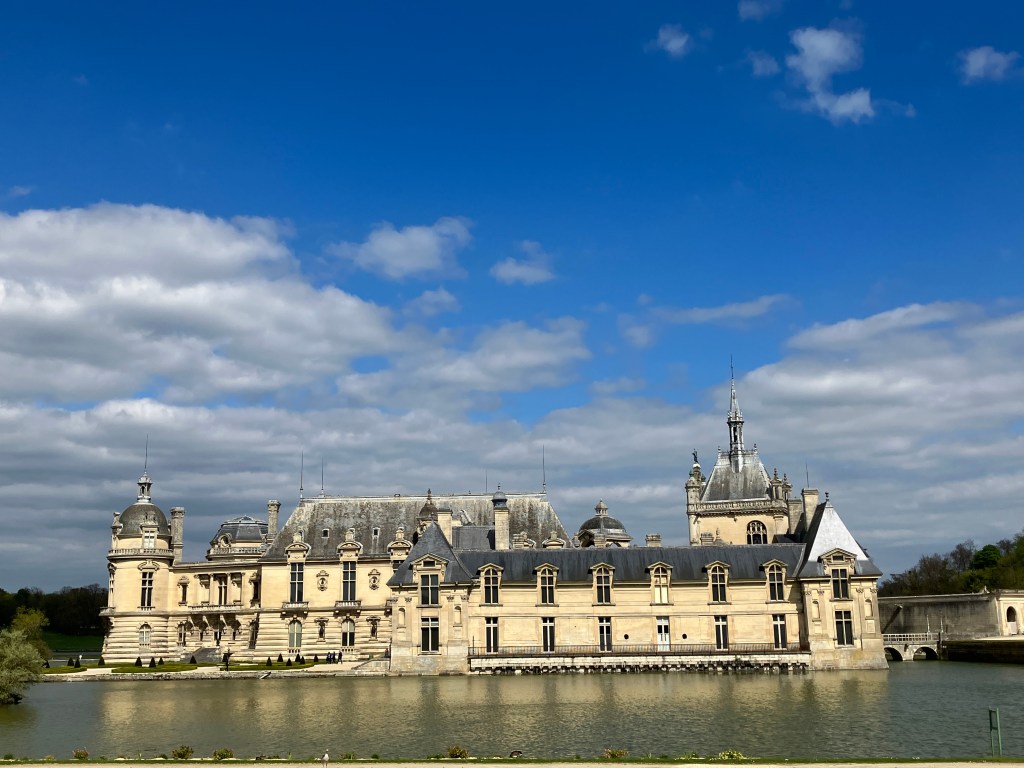
Tickets for Chantilly can be bought at any time including on the day. With about half a million visitors a year your ticket is valid for a full twelve month period following purchase if you want to revisit. We bought our tickets (17 euros each) the night before, travelled by metro to Gare Du Nord and then caught the train to Chantilly Gouvieux (15.20 euros each ). The journey again took about an hour in total with a slightly longer walk of about 25-30 minutes to the chateau which opens up before you surrounded by it’s moat.
Interior:
Versailles has 2300 rooms of which you can view about 2%. I paid for an audioguide (5 euros) in advance in order to fully understand the history and the purpose of every room. Visitors follow a predetermined route so your progress is somewhat determined by the amount of people there at the time and the size of each specific room.
On our visit there were times where we were queuing up to walk and in order to listen to my audioguide I often had to find small spaces near the windows to stop and absorb the information.
There is an interactive guide on their website which shows a short precis of each room in advance.
The tour starts on the first floor and the first ten rooms you pass through in succession are mainly devoid of furniture and hung with paintings relevant to the theme of that room. Personally this was a disappointing start for me as I like to absorb the whole history of a Palace including understanding how the residents lived.
The next six rooms are all dedicated to individual Gods such as Venus, Diana and Mars etc. These rooms all have decorative ceilings painted upon the theme of the God for which the room is named.

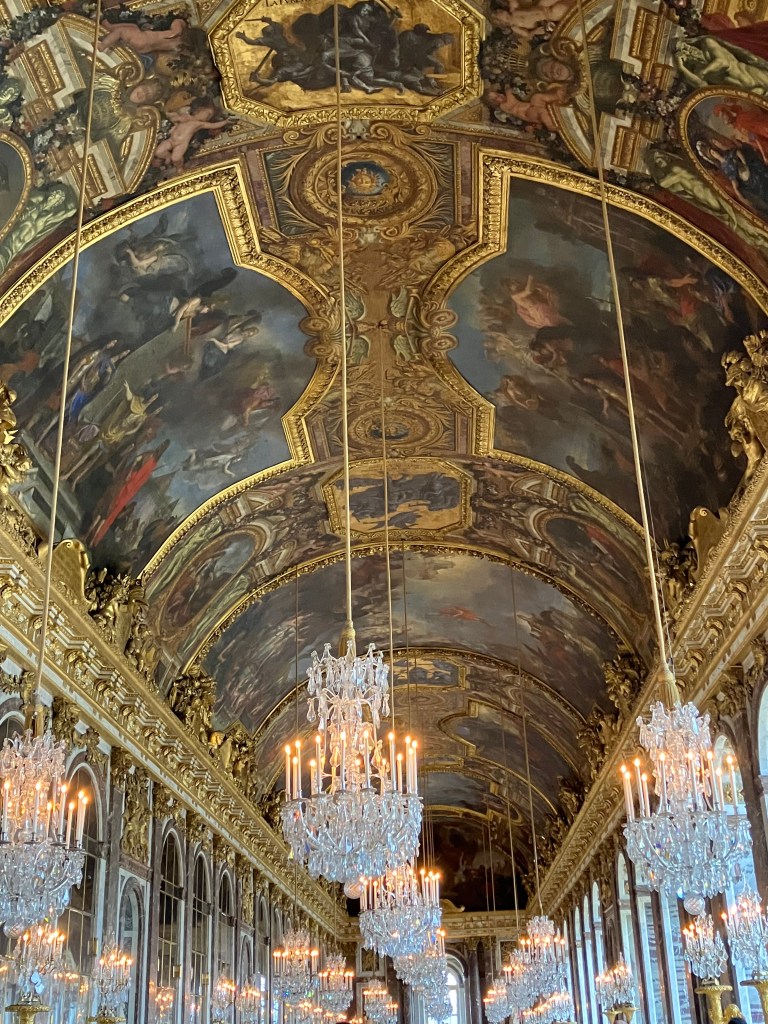
You then move onto the opulently decorated War Room depicting Louis XIV as a victorious King before the centre point of Versailles which is The Hall of Mirrors. This luxuriant room measuring 73m long holds 357 mirrors covering the 17 arches opposite the windows. It’s difficult to record it’s majestic beauty because of the sheer volume of visitors, hence my photo doesn’t include the bottom half of the room.
You then move onto the Peace Salon and the Coronation Room alongside the Queen’s chambers before heading downstairs.The twelve rooms on the ground floor are those of the Princesses Victoire and Adelaide and the Dauphin. These surround the Marble Courtyard.
The remaining fourteen rooms are only accessible as part of a guided tour.

Chantilly begins with a video presentation, in the chapel just to the left of the main entrance, which introduces the chateau to the public, its history and eleven centuries of ownership. Again I opted for an audioguide to learn as much as I could, along with a map of the rooms available to view. Whilst there is a suggested route you can wander at your leisure. With the decreased number of visitors compared to Versailles no one is rushing you along.
The chateau is the work of a man with an extraordinary destiny: Henri d’Orléans, Duke of Aumale, son of the last King of France, Louis-Philippe. He was considered to be the greatest collector of his time and made Chantilly the showcase for his countless masterpieces and precious manuscripts.
He designed the art galleries as a showcase for his exceptional collections, putting together the second largest collection of antique paintings in France, after the Louvre Museum including three paintings by Raphael. In keeping with the Duke of Aumale’s wishes, the layout of the paintings have remained unchanged since the 19th century.
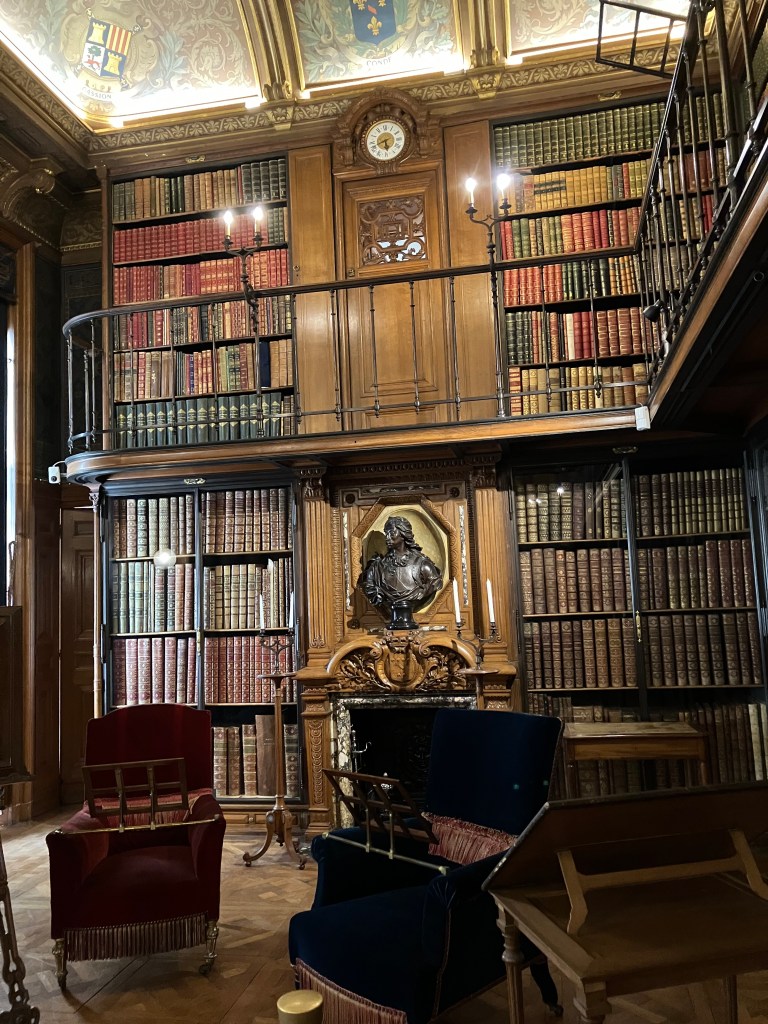
There are 27 rooms open to the public and highlights include The Reading Room or Library where over 1,500 manuscripts and 17,500 printed volumes are housed, along with part of the collection of over 700 incunabula and some 300 medieval manuscripts. An incunabula is a book, pamphlet, or broadsheet that was printed in the earliest stages of printing in Europe, up to the year 1500. They were produced before the printing press became widespread on the continent and are distinct from manuscripts which are documents written by hand.

You can also view the Grande Singerie, a salon with paintings on the walls of monkeys engaged in human activities, once a fashionable salon motif, but with few examples surviving anywhere today.

In contrast to Versailles all the rooms are fully decorated with original furniture.
Located on the 1st floor of the Château, the large suites were used as reception rooms by the Princes of Bourbon-Condé. They are a wonderful example of the ceremonial decors in fashion in the 18th century and provide a broad variety of decorative arts, furniture and Old Master paintings. This feels more like a home preserved for future generations.
Exterior and Gardens
The Gardens of Versailles to the west of the palace was one of the key draws for my visit. Covering some 800 hectares of land, much of which is landscaped as a French formal garden, it was created predominantly by Andre Le Notre.
If you did not purchase the “passport” ticket the gardens come at an extra cost so all visitors are channelled through another gateway to enter. We picked up a leaflet outlining everything there is to see, intent on enjoying the rest of our day regardless of the weather.
Look at any images on Google and you will see flowers in abundance in Spring and Summer with the classic Latona’s fountain in the foreground and the Grand Canal tempting your view to the landscape beyond. The reality was much different. The gardens didn’t appear to have been planted this year and the Latona wasn’t working?
The Apollo fountain further down before the Grand Canal is also under reconstruction.

The grounds at Chantilly are a lot smaller at 115 hectares but also feature a French-style garden created by André Le Nôtre in the 17th century along with the Anglo-Chinese Garden from the 18th century and the English Garden developed at the beginning of the 19th century.
As you walk the grounds you feel at one with nature and armed with the leaflet, previously mentioned, it is easy to find your way around. Keep your eyes peeled for wildlife, we managed to catch sight of a beaver!
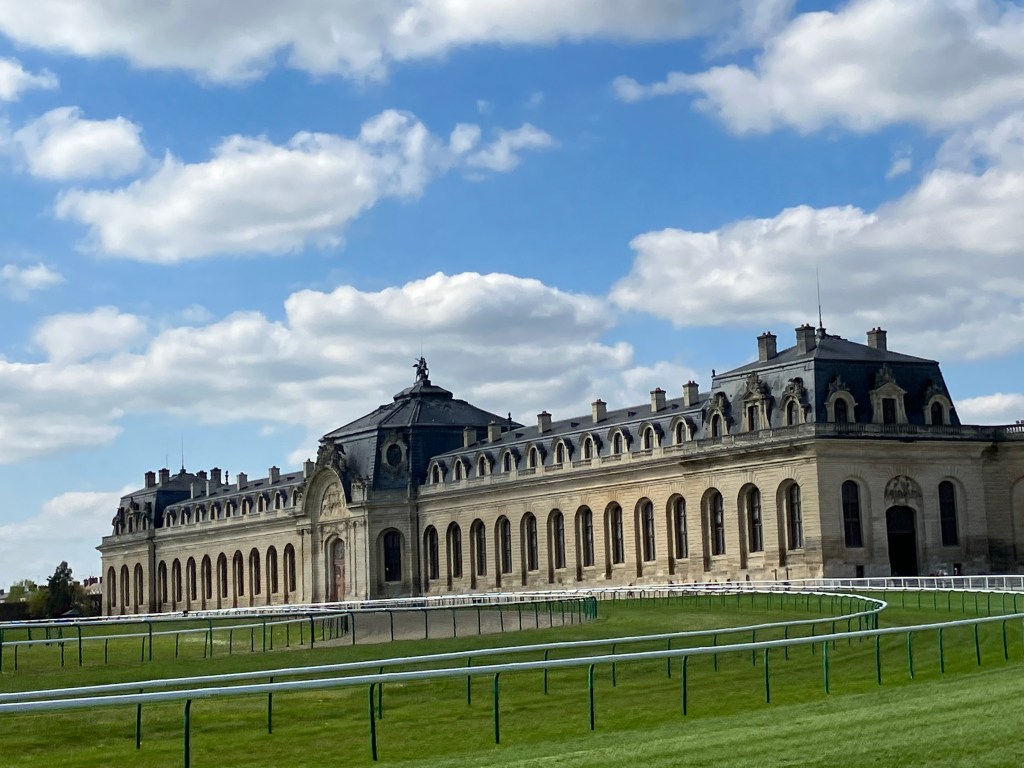
Additionally across the road from the main chateau is the famous Chantilly racecourse, home of the French Derby. The stables are an architectural masterpiece of the 18th century and when en route from the train station can be easily mistaken for the chateau itself!
Built from 1719 to 1735 to house 240 horses and over 400 hounds, it recently celebrated its three hundredth birthday!
The Great Stables are also home to the Museum of the Horse, which presents the relationship between humans and horses since the beginning of civilisation. They are also home to an Equestrian troop that stages original creations all year round in the purpose built arena. We were able to see a 30 minute demonstration at 2.30 on the day of our visit.
Finally Food!
Food and drinks are not allowed inside the museum at Versailles and picnics are not allowed in the gardens. However, it is possible to have a picnic in the park.
On the first floor of the Palace of Versailles, the restaurant Angelina tea room offers sweet and savoury dishes all day long. As quoted from their website “The space combines elegance, charm and refinement. With its exceptional pastries, the Angelina tea room is a place of gourmet delights.”
Alternatively you can dine at Ore. “This specially-designed restaurant facility created by Alain Ducasse is an elegant contemporary cafe in the French spirit on the first floor of the Dufour Pavilion, looking out onto the Royal Courtyard.”
If like me you don’t require fine dining whilst on a visit to the palace you can choose between the Grand Café d’Orléans which is described as “a series of lounges, decorated in a contemporary style where all visitors can enjoy fast food, sandwiches and desserts in the cafeteria to eat in or take away without needing to book.”
The reality is a mile long queue, which in itself should tell those managing the estate the preference of the majority of its visitors, followed by a frantic search for somewhere to sit in the dedicated room which is overflowing with people and looks like you have been relegated to the old staff quarters!
Another option is to walk out into the grounds and partake of takeaway food at either Girondole or Dauphin Grove. The only slight hiccup is there is no indoor seating here so if it is raining as it was on our visit you are slightly stuck!
Chantilly allows picnics and provides benches all around the gardens along with picnic tables near the playground. We came prepared for this.
If, however, you do want to buy food the Chantilly website says “under the arches of famous 17th century French chef François Vatel’s old kitchens, at the heart of the château, La Capitainerie restaurant offers during the winter holidays hot and cold drinks, sandwiches, waffles and chips for sale or to take away. “
Alternatively in the grounds “The Hameau is located in the peaceful surroundings of the gardens, at the heart of the Anglo-Chinese garden. These seven small rustic-style houses inspired Marie-Antoinette’s Petit Trianon in Versailles. Le Hameau restaurant, famous for its Chantilly whipped cream, is located in one of these small houses.”
Conclusion
I am fond of reducing decisions to a base level and to me it seems to come down to whether you want to follow the multitudes and visit the grandiose Palace of Versailles with all that comes with it. Or do you want to step outside of the masses and have a quieter but just as fulfilling day at Chantilly?
NB:
This is my second post whilst we are in Paris, why not learn a little more about Paris in my first post? We are currently on a tour of Western Europe, you can catch up with where we have been and follow us as we progress. It would be great to have you with us on our journey!
 A Midlife Adventure
One thought on “Guide to Versailles and Chantilly: A Tale of Two Châteaux”