Last week in Paris, as part of our current adventure, we visited the Memorial de la Shoah – The Holocaust Memorial.
For us it was the amalgamation of three adventures that began back in December 2016 in Berlin, moved through September 2019 in Krakow and ended here.
Coincidentally this weekend an article was printed by a journalist – Maria Murphy, producer at GB News, who shared a photograph she’d taken of a tourist posing with a smile on her face on the tracks into Auschwitz-Birkenau.
If you have not seen the article here is a link;
https://www.independent.co.uk/news/world/europe/auschwitz-tourist-photo-viral-selfie-b2324377.html (https://www.independent.co.uk/news/world/europe/auschwitz-tourist-photo-viral-selfie-b2324377.html)
This is an apt follow up of my earlier post “The Instagram Society -Am I Too Old to Understand?”
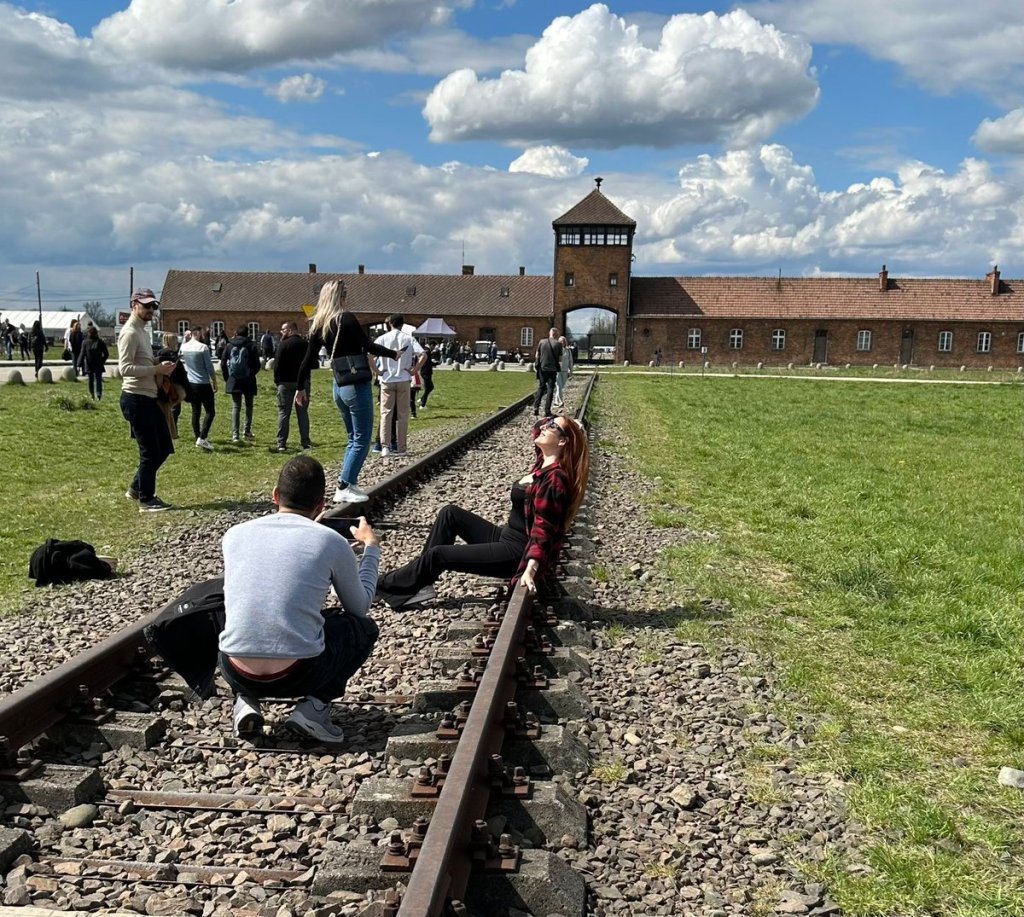
1939-1945 is a six year period in history that can never be allowed to be repeated and that the whole world should have learnt from. This is where prejudice of all forms: racism, religious, sexual and social discrimination can ultimately land up.
I challenge anyone to visit this Holocaust Memorial in Paris, Auschwitz-Birkenau near Krakow or The Topography of Terror (also known as the Gestapo Museum) in Berlin and not to leave unchanged. If at no point do you wipe away a tear from your eye or feel a knot in your stomach or a lump in your throat then frankly you are inhumane.
Shoah is the Hebrew word for “catastrophe”. This term specifically means the killing of nearly six million Jews in Europe by Nazi Germany and its collaborators during the Second World War. English-speaking countries more commonly use the word Holocaust, which is Greek for “sacrifice by fire”.
Access is free and when you arrive at the Memorial de la Shoah you are immediately met with factual evidence of the genocide of the Jews. They don’t hide it, it’s there in your face, the Memorial Wall of Names.
76,000 names of Jewish men, women and children deported from France between 1942 and 1944. 11,000 of those names belong to children! And only 2,500 of those names you read survived.
The purpose of the wall is to ensure that they will not be forgotten.
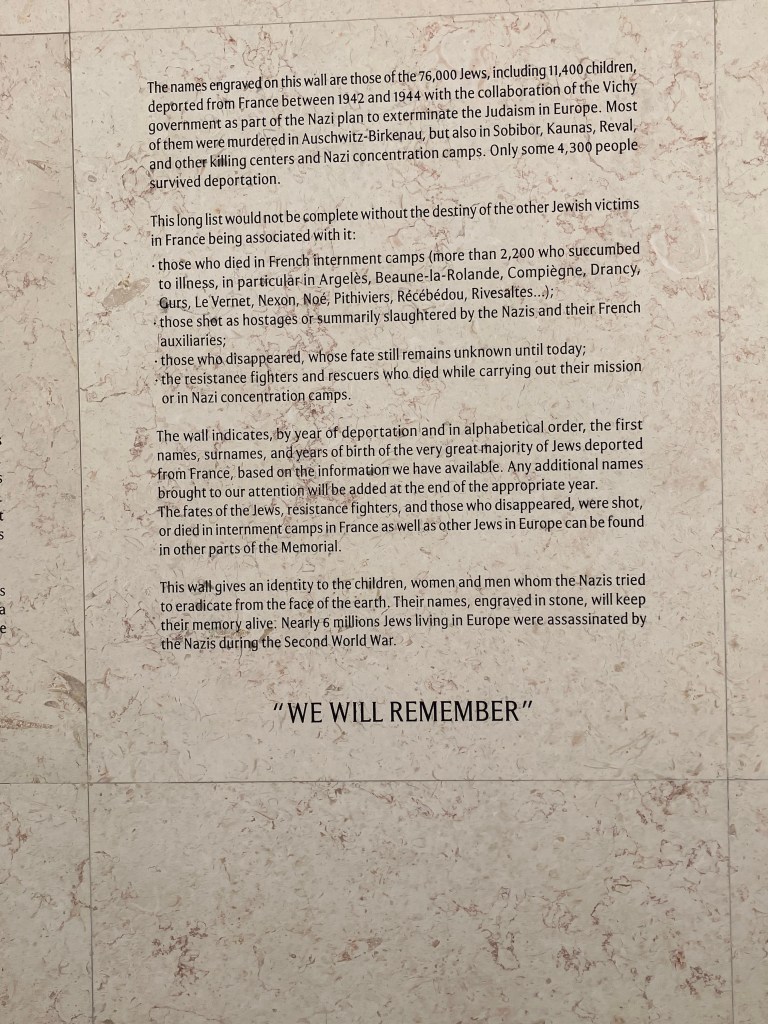
People come here from all over the world to find the name of a loved one. Someone who they may never have known in life but who was sacrificed at the behest of Hitler.
The museum contains a reading room and documentation centre which anyone can gain access to. Within the centre are 50 million archives, some 320,000 photographs, 14,000 films (2,500 testimonies),1500 sound archives and more than 80,000 books and periodicals all testifying to the life of the Jews in Europe and France under the Nazi occupation. The staff will willingly assist families to find their relatives.
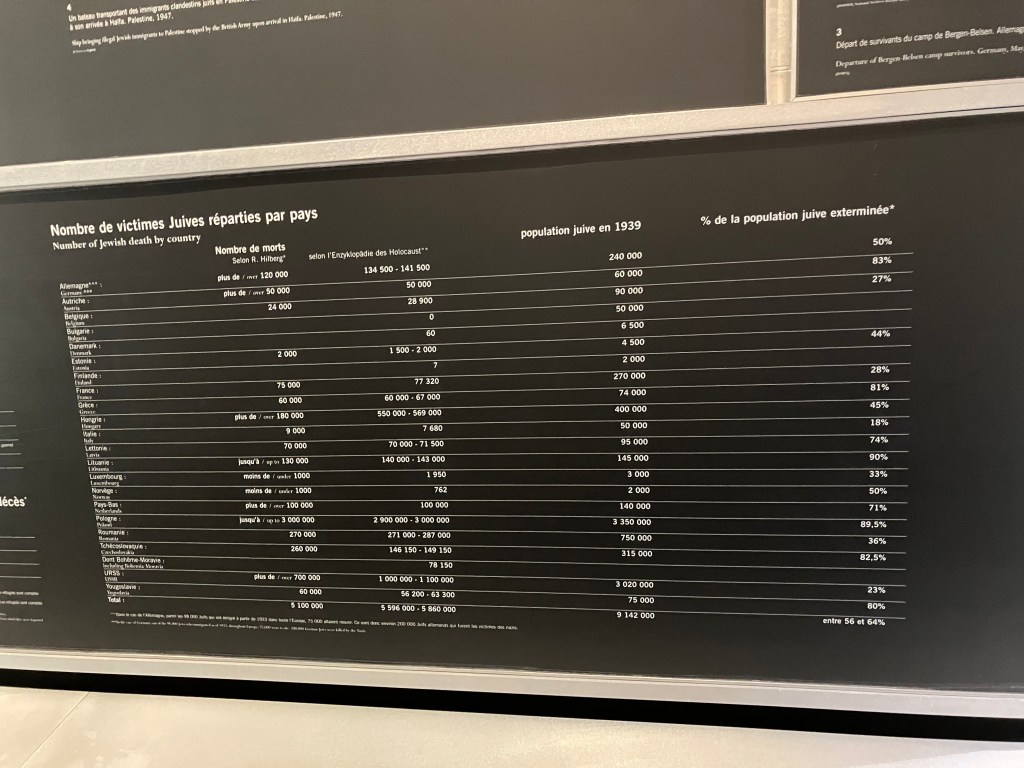
Inside the museum on the first floor is the permanent exhibition which traces the history of the Jews of France during the Holocaust in chronological order. During the period of 1940-42 you can read about how the French Jews suffered from both French and German legislation, about their internment and ultimate deportation.
The Jews, at the time, believed themselves to be fully accepted into French society and that they would be protected. However as the war raged, support from their fellow Frenchmen was distinctly lacking and ultimately the French Vichy Government delivered Jewish children under the age of sixteen to the Germans occupying France, along with all the Jews rounded up by the Vichy in southern France which was still under French administration.
After years of ignoring this involvement, France finally acknowledged the responsibility of the Vichy government in 1995.
The museum doesn’t hide what happened, it is hard hitting and so it should be. New generations need to learn and understand about these atrocities. It’s impossible to take everything in on one visit and to be frank your emotions, like mine, may get the better of you. I’ve attached three photos that give a small insight into the journey the Jews suffered.
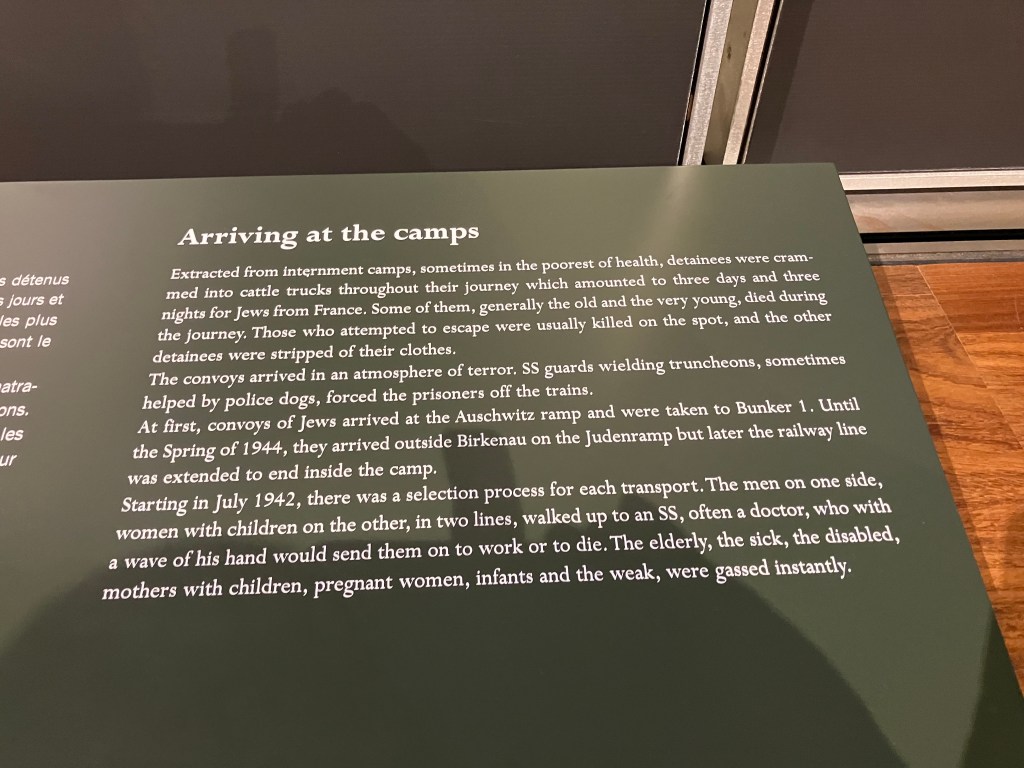
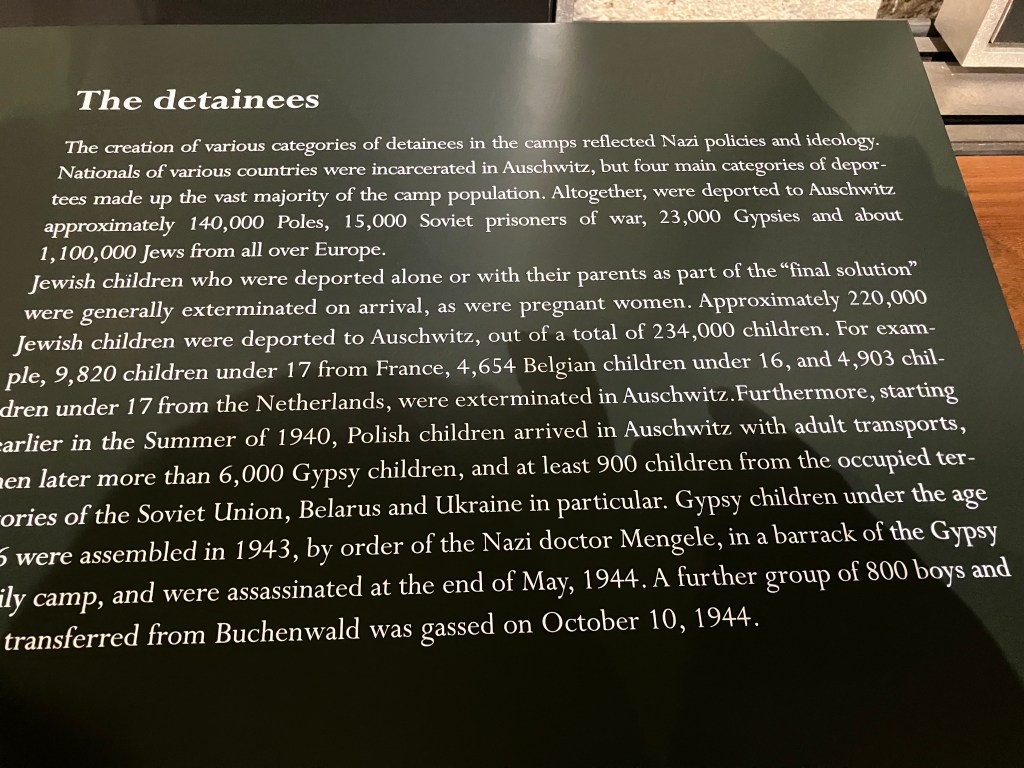
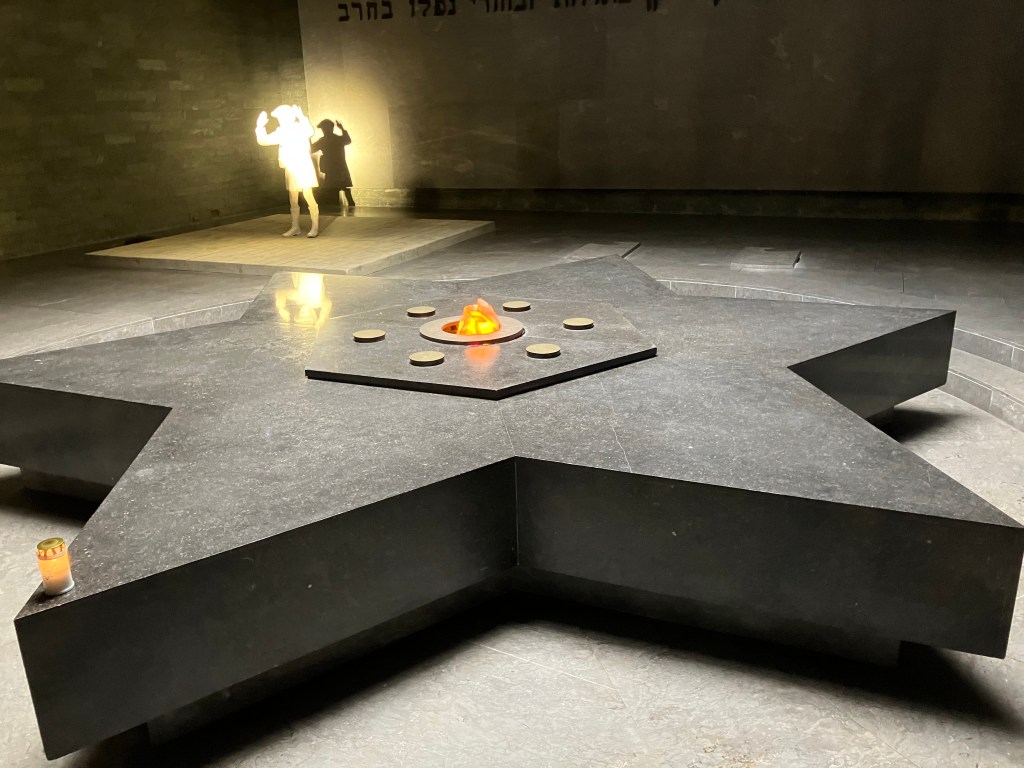
At the centre of the museum is the crypt where you can see the black marble Star of David which sits beneath the forecourt and is the symbolic tomb of six million Jews who do not have a grave.
Gathered from the death camps and the Warsaw Ghetto’s ruins, the ashes of Jews are mingled in this place. Grand Rabbi Jacob Kaplan buried them, with soil from Israel, on February 24, 1957 in accordance with Jewish tradition.
Additionally, in the crypt, on the occasion of the 80th anniversary of the Warsaw Ghetto uprising, the Shoah Memorial invited the contemporary artist Adel Abdessemed to present a set of works entitled “My child”: a sculpture, and a series of drawings inspired by the emblematic photograph N° 14 that SS Jürgen Stroop sent to Krüger and Himmler, documenting the suppression of the insurrection in April-May 1943.

The current temporary exhibition, housed on the ground floor, was devised to mark International Women’s Day and features the work of Julia Pirotte (1907-2000). Pirotte is known worldwide for her photojournalism during the Second World War.
Jewish, communist and in the Resistance, Pirotte, who did not think she would survive the war, took her Leica camera with her wherever she went, capturing faces, scenes of life and scenes of war to leave a trace.
She eyewitnessed the internment of Jewish women and children in Bompard, Resistance operations in the South of France, the liberation of Marseille and the immediate aftermath of the Kielce pogrom in 1946.
Antisemitic violence did not end with the Second World War. In 1946, a pogrom broke out in Kielce, Poland. As rumors circulated that Jews had kidnapped a Christian boy, a mob attacked Holocaust survivors in the town, many of them former residents who had returned home.
Forty-two Jews were killed and approximately eighty wounded. The Kielce pogrom showed that even after all the Jews had endured they were still not wanted, they were still spurned by certain elements of society. This was a key factor in the refusal of many Holocaust survivors to return home and spurred their immigration to the British Mandate of Palestine or the United States.
This exhibition about Julia Pirotte also ties in with the Wall of the Righteous outside. Located in the walkway alongside the Memorial and bearing the names of over 3,900 people who risked their lives to save Jews in France during the Second World War. They received the title of “Righteous Among the Nations”, which the Yad Vashem Museum Memorial in Jerusalem has awarded since 1963. So far, the honor has been bestowed on over 24,000 people all over the world.
Places like this memorial not only educate me in the horrors that took place but humanise the experience. I cannot even begin to imagine how these French Jews felt. They trusted the French administration only to be betrayed in the worse way possible. Having been to Birkenau and seen those train tracks and stood there and imagined the fear as they were ordered off the train, naked, humiliated and cold, leaving behind those already dead or dying, I still feel that emotion today. We need to learn from this. We need to promise each other that this atrocity will never be repeated.
NB:
This is my third post whilst we are in Paris, why not learn a little more about Paris in my previous two posts? We are currently on a tour of Western Europe, you can catch up with where we have been and follow us as we progress. It would be great to have you with us on our journey!
 A Midlife Adventure