This museum tells the story of the Netherlands and its people from May 1940 to May 1945, when Nazi forces occupied the country.
Having put four pieces of the jigsaw in place before arriving at this museum I had already begun to question, what would I have done if I was one of those people caught up in World War II in Europe?
The morning before coming to this museum we had visited Anne Frank’s House. This was the first part of the jigsaw and the beginning of the road to hell!
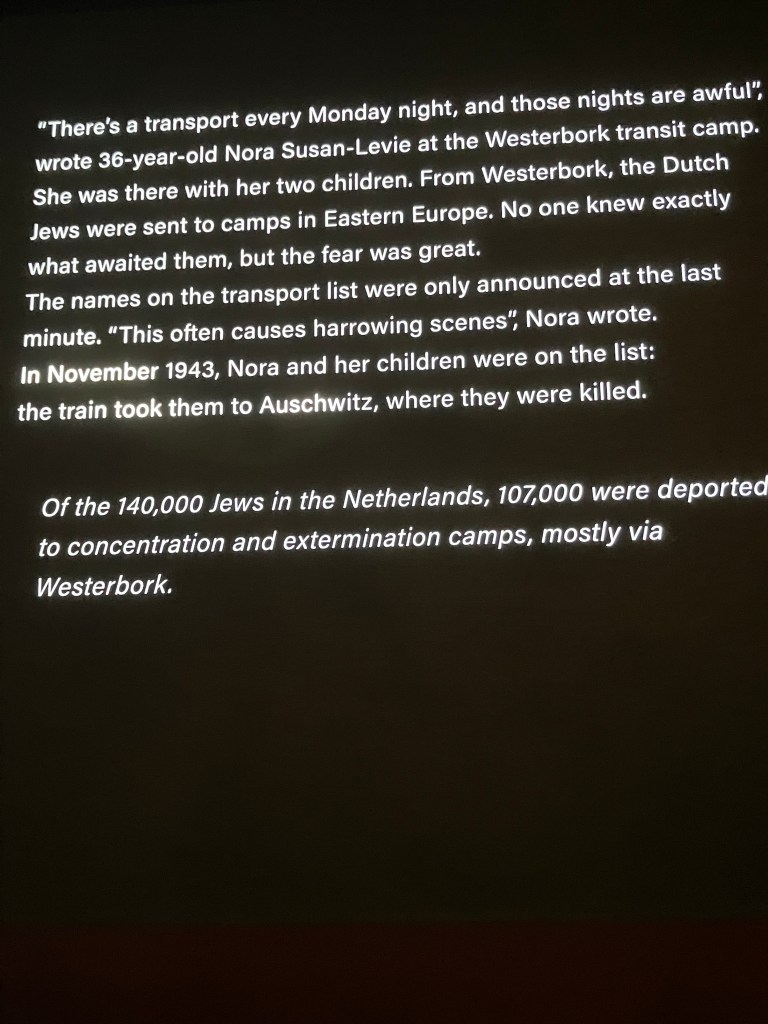
Anne is famous for her diaries of her life under German occupation and how, as Jews, the family had remained hidden in the attic of their Father’s office block until their discovery on August 4th 1944. After their discovery all eight people who had been hidden in the attic were sent to a concentration camp in Holland, and in September Anne and most of the others were shipped to the Auschwitz death camp in Poland. In the fall of 1944, with the Soviet liberation of Poland underway, Anne was moved with her sister Margot to the Bergen-Belsen concentration camp in Germany where Anne and her sister Margot are suspected to have died from typhoid.
In December 2016 we visited “The Topography of Terror” in Berlin, this exhibition is located on the site where between 1933 and 1945 the headquarters of the Gestapo existed. The Gestapo, of course, were responsible for the widespread atrocities exercised during World War II in particular the Holocaust. This had proved to be a hard hitting introduction for me into what actually occurred once all these thousands of people, who Hitler had decided did not fit with his “Aryan Society”, were taken from their homes and served as the second part of the jigsaw.
We had also recently visited, as part of this adventure, the Shoah Memorial in Paris which I have previously posted about. This explained in more detail the Jewish persecution that happened during the war in particular in France and serves as a memorial to those who lost their lives and, for me, the third part of the jigsaw.
In September 2019, just before Covid had hit, we had also visited Auschwitz and Birkenau, sited just outside Krakow. This was the largest of the German Nazi concentration camps and extermination centres. Over 1.1 million men, women and children lost their lives here mainly Jews. Just looking at the railway line that brought the trains into the camp stirred both anger and sadness inside me. The thought of how they were herded off the trains, selected for hard labour until they dropped down dead or immediate extermination begs belief and served as the fourth part of my jigsaw.
And so to the Verzetsmuseum in Amsterdam, also known as the Resistance Museum. This is, for me, the final piece of the jigsaw. How did people resist the occupation?
Using moving personal documents you learn about the story of people who were confronted with dilemmas by the German occupation, and were forced to make choices. What would you have done?
Dutch public official Jacob Lent was asked by the German occupiers to design an ID card. Utilising special ink, stamps, fingerprints and three watermarks Jacob designed a card that was nearly impossible to forge.
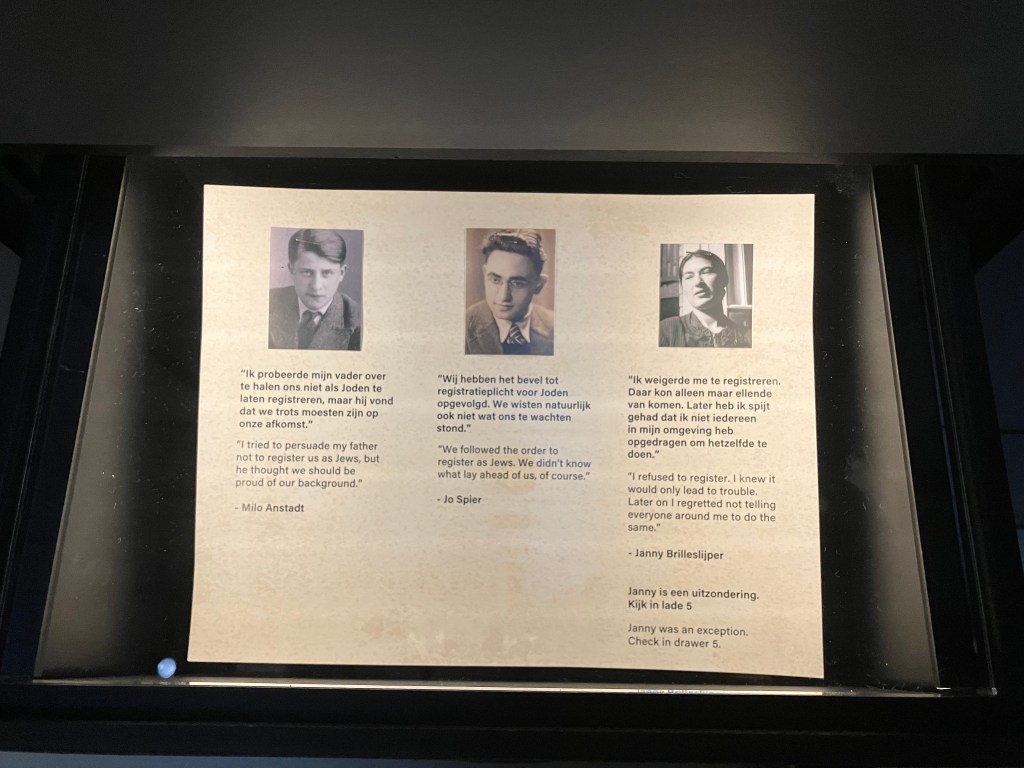
Very few people objected to having an ID card which everyone over the age of fifteen had to carry with them. For the Germans the identity card turned out to be an ideal way to control the population in particular the Jews whose ID card would be stamped with a large letter “J”.
Did Jacob do the right thing? If he had refused what would have happened to him? And surely the Germans would have found someone else willing to comply?
After the war Jacob was sentenced to three years in prison for his work on producing the ID cards.
During the occupation women served as bicycle couriers. They were essential to the resistance. They were less likely to attract suspicion and would not be put to work by the Germans. A 19-year-old from Utrecht, Femanda Kapten, was one such bicycle courier. Illegal newspapers were stenciled in her parents’ bookshop. These underground publications provided the public with the truth. They gave important updates on the war’s political issues, battle results, large scale troop movements and casualties. They also provided an editorialisation of the war.
One day, Femanda was en route with 500 illegal brochures in her saddlebags when things almost went wrong. “Suddenly, there was a German checkpoint: One of the German soldiers nudged her saddlebag with the butt of his rifle. There were potatoes on top of the brochures. “Kartoffeln?” Fernanda nodded and was allowed to pass. “I started walking as slowly and casually as I could” she said “though I felt like running at full tilt”.
Would you have been brave enough to cycle alone on your bike delivering these all important pieces of news?
Other civilians helped to hide those fleeing persecution or stranded Allied troops.
Twenty four year old Johan Snoek helped those in hiding, right up until he and his family were driven out of their home by the Battle of Arnhem when they then moved in with three aunts in Ede.
When the British General, John Hackett, found himself wounded and trapped in the occupied part of the Netherlands following the battle of Arnhem he sought somewhere to hide. Johan thrilled with the chance to aid the resistance once again took him in.
Johan wanted to help Hackett reach liberated territory, but he kept having to cancel their plans until in early 1945 when he finally came up with a new plan for escape.
Resistance groups smuggled over 600 crew members from downed Allied aircraft out of the country. After the defeat at the Battle of Arnhem, some 350 Allied troops went into hiding in the area, at least 145 of whom were transported back to friendly lines by the Dutch resistance.
Would you have had the nerve to help?
Then there were those who played a more active role in direct sabbotage.
In the hamlet of Woeste Hove, on the night of 6 to 7 March 1945, resistance members attempted to commandeer a German vehicle as part of a plan to steal meat. As chance would have it, the car they stopped belonged to Rauter, the highest-ranking SS leader in the Netherlands. Rauter immediately shouted: “Achtung, these people are probably terrorists.”
The leader of the resistance group, Geert Gosens, saw the occupants move to draw their guns and opened fire. The resistance fighters’ Sten guns rattled off one round after another, riddling the car with bullets. Then they fled the scene. They had no idea who they had shot at. Rauter was badly wounded. The retaliation by the German occupiers was brutal: they shot 263 prisoners. The bodies were left on the side of the road, along with a sign: “This is what we do to terrorists and saboteurs.”
Over 5,000 people were killed by the German occupiers as retaliation for resistance activities; most were prisoners, some were innocent civilians. After an attack near Putten, every man in the town was sent to a concentration camp, where 552 of them died.
Would you have put your life on the line, time and time again, in order to sabotage the German war machine?
Some families provided homes for Jewish children whose families had sent them away from the conflict in the hope that they would be saved from the Jewish persecution.
Ellen Mike Olman was only nine months old when she went into hiding and was separated from her parents and sister.
Her foster parents loved her dearly. When Ellen Mike was three years old, the Netherlands was liberated. “For me, that was when the problems started. I was sent back to my mother, a woman I didn’t know and whom I called ‘ma’am!” Her relationship with her mother remained difficult for a long time.
Ellen Mike’s foster parents continued to play an important role in her life. On her 18th birthday, they gave her a photo album (which is on display in the museum) about the time she spent in hiding. “The album gave me back a piece of history that I couldn’t remember clearly but had an emotional sense of.
Some 5,000 Jewish children survived the war in hiding, often in the homes of Christian foster families. Around 2,000 of those children lost both parents. A conflict emerged around them: should they stay with their Christian hosts or be raised by their Jewish relatives?
Could you have sent your nine month old baby away to live with strangers in an attempt to save her life?
Could you have taken in someone else’s child in an attempt to save them from persecution?
7000 people died in concentration camps and prisons having taken part in resistance activities.
2000 people were shot in The Netherlands for taking part in resistance fighting.
These people were all heroes, people who went above and beyond their normal everyday life to try and turn the tide of the war.
Would you have been one of them?
NB:
This is our seventeenth stop on our current tour of Western Europe. Why not catch up on where we have been already and then join us as we progress?
 A Midlife Adventure