Time is our greatest gift, we cannot buy any more of it but we can waste it, give it away to people who maybe don’t deserve it.
We are all guilty of thinking we have time, time to do everything we want to, time to tell our loved ones how we feel, time to rekindle friendships, time to forgive those we feel have wronged us or time to apologise to those we have wronged.
The truth is no one has an infinite amount of time.
If you have read any of my previous posts including “All About Me!” or “The Philosophical Me” you will know that I learnt at a very young age that life is not forever. As you grow older and in my case move into midlife you read more and more obituaries of people you have known or even famous stars who are of a similar age and realise that whoever you are you cannot escape time.
In life we measure time in so many different ways.
There is the obvious, time ticking by on the clock.
Then there is the years that go by whether that is measured in calendar years or from birthday to birthday.
When we are young we often wish those years away waiting and hoping to be older so we can experience more of life.
When we are older we might well want to press pause as our children grow older or life seems to be slipping by.
The fact is none of us can control time.
Time for me is what drives my ambition to go out into the world and experience adventure. This quote by Randy Komisar gives me a perspective on time.

So why write a post about time?
Because I’ve just left Oklahoma and whilst there the aspect of time was brought home to me loud and clear.
In just one minute time can change your life, it can take away someone you love, it can throw your whole world upside down, it can leave you questioning why you changed your routine that day or maybe wishing you had.
On April 19th 1995 at 9.01 a.m. life is normal or as normal as it ever is.
Tim McVeigh drives a Ryder van to the front of the nine story high Alfred P. Murrah Federal Building in the centre of Oklahoma City. He parks the van and walks away.
At 9.02 a.m. the 5000 lbs of explosives inside the van go off.
By 9.03 a.m. life for the whole city has changed.
700 men, women and children are injured but survive, 168 die.
One half of the Murrah Building collapses, destroying nine other buildings nearby.
Inside the building was a children’s daycare facility.
Another twenty five structures are seriously damaged whilst three hundred and twelve additional buildings sustain other damage.
Nearby cars are incinerated.

The FBI investigation includes this narrative entitled “Where Are You Guys?”
“Florence Rogers, head of the Federal Employees Credit Union, was in her office on the third floor of the Murrah building that morning. Seated around her desk were eight credit union employees, some of whom Rogers had known and worked with for decades. Although they were having a business meeting, spring was in the air, and there was talk of the women’s colorful seasonal dresses.
When the bomb went off at 9:02, Rogers was thrown backward onto the floor, her desk and other office items landing all around her. When she looked up, every one of her colleagues had vanished. “I started hollering, ‘Where are you guys? Where are you guys?’”
In the next moments, before building and car alarms triggered by the blast began to howl, before fire engine and police sirens wailed, and before cries rang out from the trapped and injured, Rogers experienced an “eerie silence.” Alone on a narrow ledge—all that was left of her office floor—below which was a deadly, open pit, she wondered where her colleagues had gone. She wondered why she could see daylight where walls and ceilings should have been. And later, after being helped to safety, she would wonder at the miracle of her own survival on a day when so many had perished.
One minute is all it took to change lives………………..
The story of this bombing is told in detail at the National Memorial Museum.
They make no excuses for the presentation. Utilising exhibits, theatre and interaction you learn about those who responded to the bombing from the emergency services, hear from those who survived, see how the city reacted and visit the Gallery of Honor to those who died.

On a more positive note you get to see how the investigation progressed and how those responsible were brought to justice.
You get to witness how such a tragedy brought the city together.

Then you get to step outside to see The OutDoor Symbolic Memorial.
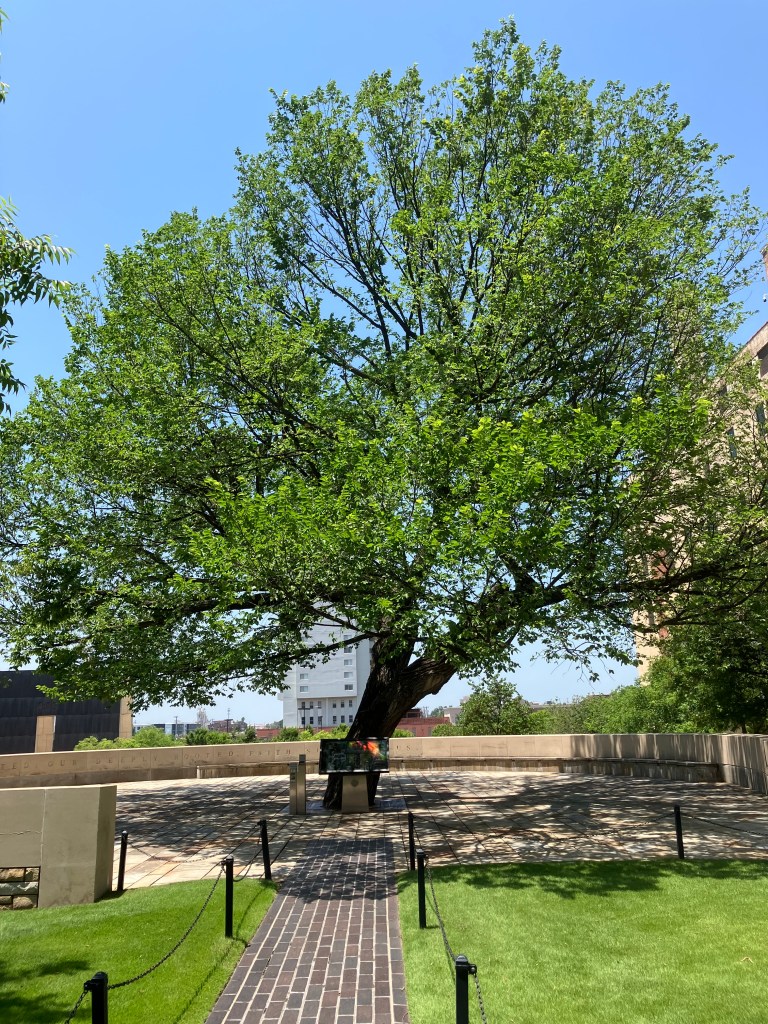
You get to visit the Survivor Tree, the American Elm tree which is nearly a century old and somehow stood tall and resisted the effect of the bomb. It stands at the top of the memorial as a symbol of strength and resilience.
The Field of Empty Chairs is located where the Murray Building once stood. The chairs are arranged in nine rows which reflect the floor where those who were killed were at 9.02 am. Each chair is etched with the name of a person killed. The nineteen small chairs represent the children killed. All the chairs light up at night as a beacon of hope.
The only remaining walls of the building are etched with the names of those who survived.

Just one minute is all it took………………..
 A Midlife Adventure