When I was planning this trip with its two different adventurous road trips, I also had a couple of subjects in the back of my mind that I wanted to learn more about. One of these was the Native American Indians.
Having visited the Museum of Westward Expansion in St Louis my knowledge of these people who roamed throughout America for up to 20,000 years before Columbus arrived and their consequent removal from their lands following the Louisiana Purchase of 1803 had improved.
However my opportunity to understand their unique culture and heritage came to fruition when we were up in Monument Valley and booked a sunrise excursion with the Navajo Spirit Tours.
We left the comfort of our hotel room to meet up with our Navajo Guide at ten past five in the morning!
It was still dark outside and the surrounding landscape was eery as we drove to our meeting point – The Navajo Welcome Centre.
Arriving early we sat alone in the deserted carpark until spot on time we saw a safari style truck pull up along the roadside with headlamps on full beam. Our guide had arrived and it transpired that we were the only two on the tour!
He introduced himself as Sean and gave us the typical Native American handshake. In their culture a strong handshake is deemed to be overbearing and even offensive and so only a light handshake is used.
Similarly Navajos value personal space and have a larger area of personal distance than non-natives. They consider eye contact as impolite and admittedly I did find it slightly disconcerting on first meeting Sean that he looked down or away and never at me, but weirdly I soon became accustomed to it.
After a brief introduction to the tour we set off at a pace towards the entrance to Monument Valley. There is a 17 mile drive that anyone can do, once the park is open, but by joining a tour you not only get a Navajo guide but you protect your car from the dry, rutted, dirt roads and have an expert who not only knows how to navigate the tracks but can take you beyond what everyone else sees.
The Valley itself is truly breath taking and Sean happily explained its spiritual significance to the Navajos.
It was of course brought to the public’s attention by John Ford, the master Director of Western movies.
This is ancestral Navajo land. When the Navajo were forced out of Canyon De Chelly in New Mexico by the U.S. Army during the “Long Walk”, some took refuge in Monument Valley.
An 1868 treaty allowed their return to their ancestral homeland and established the Navajo Reservation with other parts being added in 1884. Monument Valley, itself, wasn’t given back in its entirety to the Navajo until 1933 after it was declared useless for mining by the white people!.
Today the Navajo Reservation stretches over 26,000 square miles, a portion of which we had passed through travelling here from Flagstaff, 180 miles away. A desert style landscape with scattered homesteads, scrubland and virtually no signs of working life or schools.
Four Corners where the four states of Arizona, Utah, New Mexico and Colorado meet also sits on Navajo land.
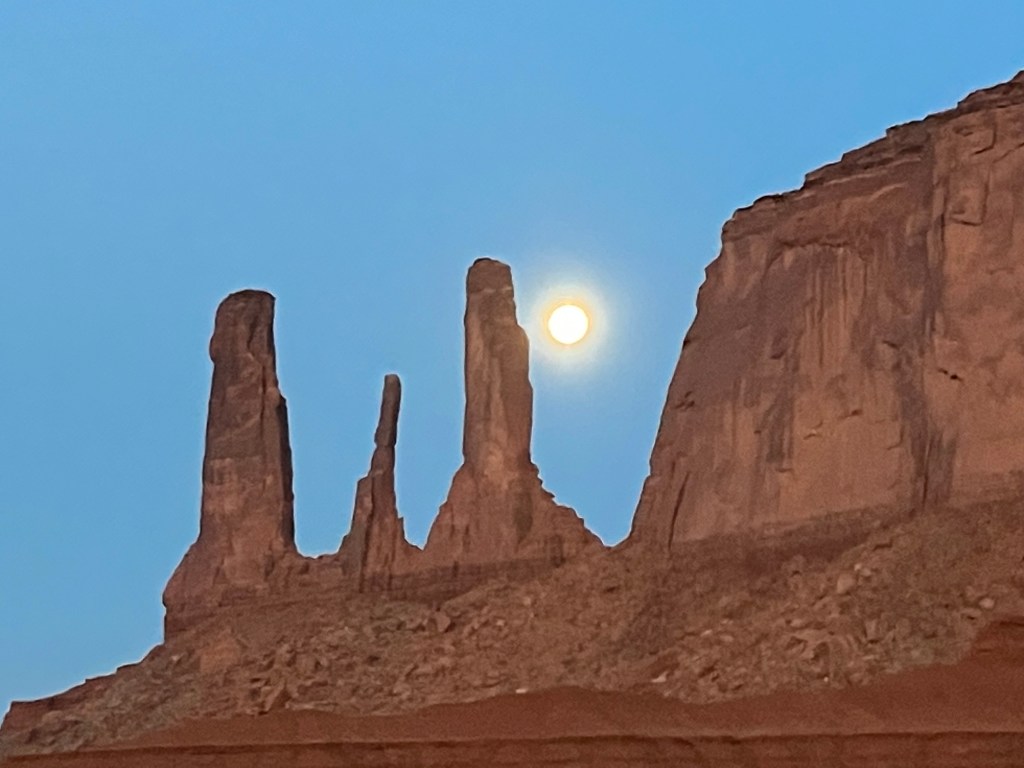
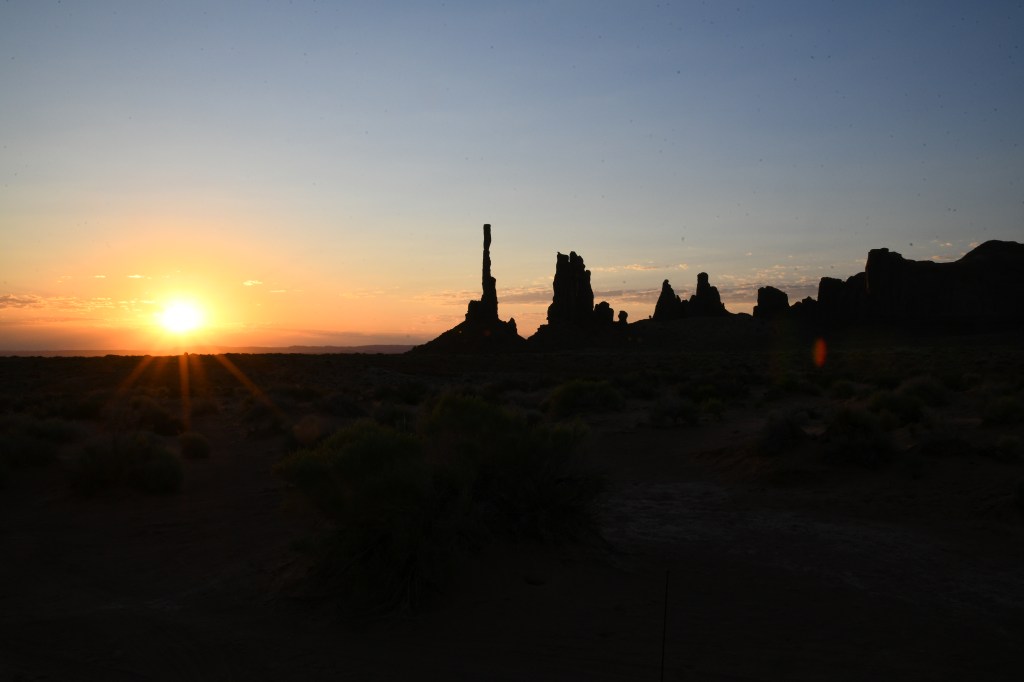
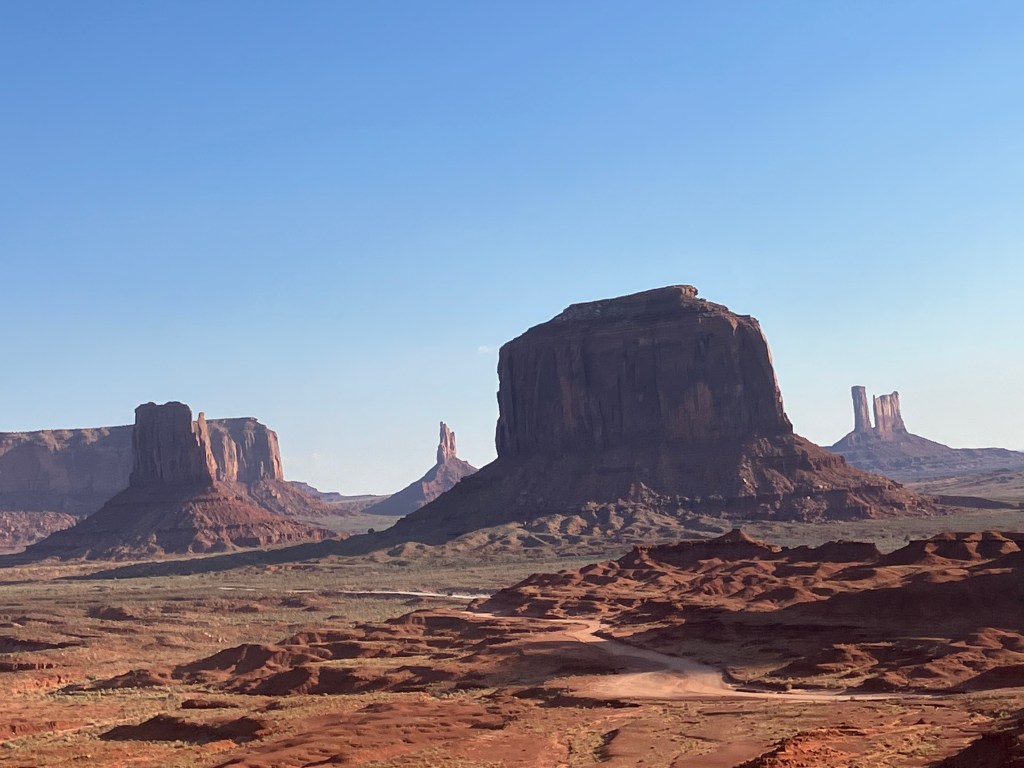
The sandstone buttes, for which the Valley is so well known climb from a height of 400 feet up to 1000 feet and at this time of the morning we were fortunate to see the moon still glowing to the west, framed by two such buttresses whilst the sun was rising on our left, to the East. It was a once in a lifetime sight.
Throughout our journey Sean stopped to point out various sights, talked about the geology of the region and the fauna and flora.
Up to 100 Navajo still reside in the Valley, depending upon the season, most without electricity or running water! Over 400,000 people from around the world visit here each year thus tourism is a high income generator for the Navajo who live in the area.
Sean was happy to share his hobbies and interests with us. He carried his camera with him in the front of the truck, sometimes taking photos alongside us if there was a particular vista that caught his eye.
He talked about his hiking trips out into the park during the low season when the sun is not beating down on the sand and rocks all day. A keen archeologist he spoke about the ancient Ancestral Puebloan (also known as Anasazi) sites and ruins dating prior to 1300 A.D that have been identified here. The valley was abandoned by the Ancestral Puebloans in the 1300’s, as were other areas in the Four Corners region.

The date of the first Navajo settlement in Monument Valley is unknown. For hundreds of years, the Navajo raised sheep and other livestock, and farmed small quantities of crops in the valley.
Sean explained to us the significance of the houses or hogans still being used on the valley floor. Traditional Navajo homes are called a “hogan”, and vary slightly in appearance depending on whether they are “male” or “female”. Male hogans are square or conical, with a rectangular entrance, whereas female hogans are six to eight-sided houses. Both are made of wood and covered in dried mud, and their doors always face east to welcome the sun each morning.
Traditionally, male hogans were used for sacred or private ceremonies, and female hogans housed family life – where children would play, women would cook and weave and men would socialise.
Sean was happy to answer our questions. I was keen to understand what life was like here on a reservation so I spoke to him about the vast emptiness of the region and how hard it must be to gain employment.
Outside of the tourist industry Sean explained how many fathers, including his own, had been forced to leave the reservations to go away to work to earn money for their families. They worked in the oil and mining industry or took work trucking.
Given the matriarchal structure of Navajo homes the absence of his father didn’t vastly affect his homelife.
Descent and inheritance are determined through one’s mother. Navajo women have traditionally owned the bulk of resources and property, such as livestock. In cases of marital separation, women retained the property and children.
He had also explained to us earlier that whilst Sean Holiday was his name, when a child is born Navajo they receive four additional names. As they grow up and have to introduce themselves, it is more than just telling someone their name, it’s about sharing who they are and where they come from. This starts with their clans. Each clan comes from a different area of the Navajo Nation, with their own meaning and a story. Each person belongs to four different clans.
“When you meet someone and shake their hand, you are telling them your whole story,” explaining that a person’s story is told by their hand, each finger representing a clan. “You are your thumb and then you introduce your four clans. The first finger is for the clan of your mother (nishłį́), the second is the clan of your father (bashishchiin), the third is the clan of your maternal grandfather (dashicheii) and the fourth is the clan of your paternal grandfather (dashinalí).
The grandparents play an important role in educating their grandchildren in Navajo life and ensuring they grow up within the cultures and traditions that have been passed down through the years. They often take full responsibility for the child’s upbringing allowing the parents to work and earn money to support the household.
Unlike many tribes, the Navajo have succeeded in keeping their cultural heritage alive. Over 97% of adults still speak the Navajo language, and many tribal members continue to practice the ancient religious and ceremonial ways.
I was intrigued to know where his Mum shopped for food in the wilderness that surrounds his home or where he went to school.
“My Mum shops every 2-4 weeks. She drives to the nearest large Costco in Flagstaff” he explains. That’s a 5 hour round trip! The roads may be straight and easy to navigate but 5 hours to buy food!
In America children from kindergarten through grade 12 in high school can go to public school for free. The city, state, or federal government fund public schools so you do not have to pay. Education law says everyone has a right to free education.
But how did that work in areas such as this where there were vast expanses of seeming wilderness?
Progressive educators viewed buses as a step toward modernising rural education. By 1932, there were 63,000 school buses on the road.
Sean describes to us the rigours of a 2 hr bus journey to school because at that time there weren’t any schools nearby to educate him or fellow Navajo students. He tells us about the new school that has opened in Monument Valley funded not by the Government or the State but by donations!
Given the enormity of the task faced by Sean to gain an education I was truly amazed by his knowledge, his thirst for more understanding of the land he called home and his appreciation for life!
Surrounded by the magnificent vistas of Monument Valley when the sun was rising in the sky I had taken a moment to just stand and breath. To really take in the panorama of the country around me and in that moment I felt more at peace that I probably ever have. There is something unique about this place, a peacefulness, a history, a spirituality that calls to me.
Armed with a better understanding of this wonderful land and the people who call it home I left it behind taking with me only the photographs I’d managed to capture of its beauty but with a deep yearning to one day return.
 A Midlife Adventure