Apologies to those who read my blog regularly. I have been somewhat remiss since coming home to the UK.
When you return from a lengthy trip away there is so much to deal with on your return:- unpacking, washing n drying, post, post n more post!, the over run garden, trying to settle back into real life etc
It is definitely weird being back and is taking some adapting to.
There are a few more posts I would like to write about our time in America and this is one of them.
Throughout our three month road trip in America two subjects kept rearing their head in conversation: religion and politics.
Given that I was brought up not to mention these subjects in polite society this was a little alien to me. I would not have a clue whether my neighbours or even family relatives are religious and I definitely wouldn’t know how they voted politically. It just isn’t talked about here in the UK, well certainly not as much as it is in America!
Religion:
The “Bible Belt” in America is used to describe the 10 states of Mississippi, Alabama, Louisiana, Arkansas, South Carolina, Tennessee, North Carolina, Georgia and Oklahoma. This was a new concept to me.
I look around the UK and this type of affinity doesn’t exist here. I suppose Southern Ireland is seen as the most religious as Catholicism is stronger there than anywhere else but other than that there isn’t really a particular area where religion is more prevalent than another.

As we travelled along Route 66 and then up the Eastern Seaboard we passed through four of these Bible Belt states which are known for being socially conservative where Protestant Christianity plays a strong role in society. Church attendance across the denominations is generally higher here than the nation’s average.
In plain English this means that those attending seek to preserve traditional values and beliefs.
Religious conservatives also typically oppose abortion, LGBT behaviour (or, in certain cases, identity), drug use, and sexual activity outside of marriage. In some cases, conservative values are grounded in religious beliefs, and conservatives seek to increase the role of religion in public life.
This narrative tends to be that of the current OAP (65+) community here. They have a tendency to want to hang onto tradition, struggle to manage change, are often technophobic, have deep rooted respect for the armed forces and monarchy.
Statistics post the coronation of King Charles III show 62% of society support the monarchy but in the 65+ age group this climbs to 80% whereas in the under 50’s this drops by age group until you reach the 18-24 year olds where the percentage is 32%.
As we drove across America on Route 66 the sheer amount of churches and the diversity of religion was mind blowing. We drove through one small town, we would probably call a large village here in the UK and counted 24 churches. It honestly left us with our mouths agape. How can one community of this size need 24 different places of worship?
I had to examine this on my return to the UK and my research shows according to the National Congregational Study Survey, there are an estimated 380,000 churches in the U.S. I actually find this hard to get my head around.
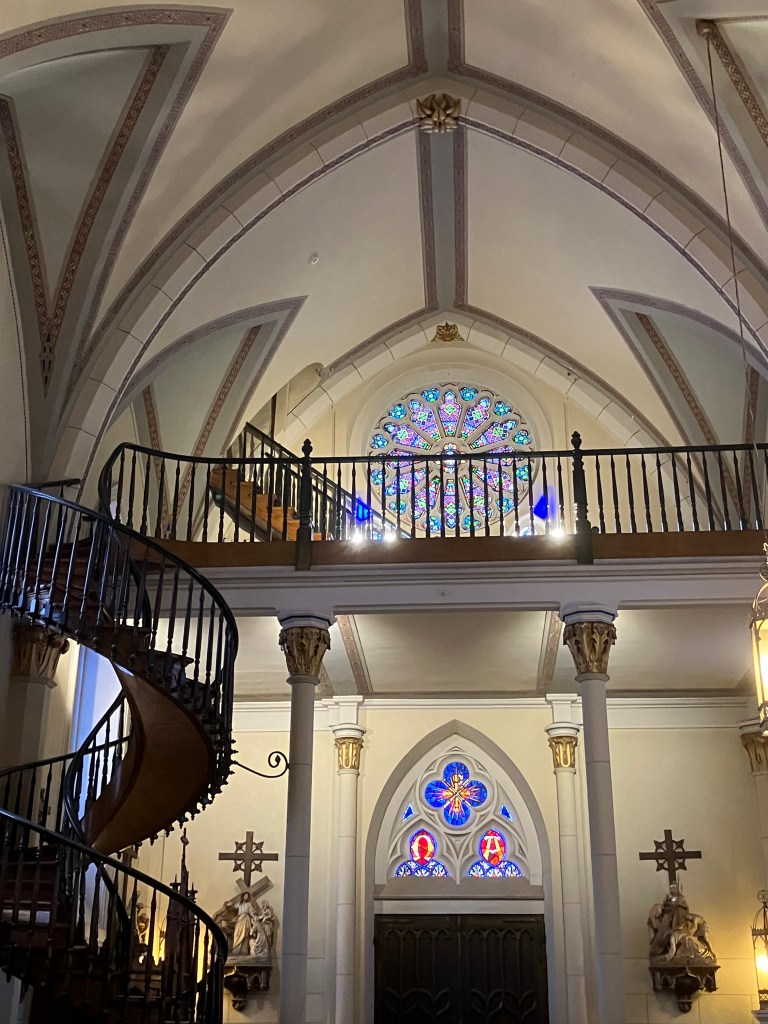
When people spoke to me about religion whilst on our trip I tended to talk about the fact that religion is decreasing in the UK.
On census day, 21 March 2021, which was during a Covid lockdown and as such is probably one of the most accurate census we have had since everyone was at home, it shows 46.2% of people identified themselves as Christians. For the first time ever this showed that less than half the population were Christians. This compared with 59.3% of the population in the 2011 census, a 13-percentage point drop in a decade.
Based on previous analysis in 2015 that shows of those stating they were Christians, less than 5% attended church regularly, the projection is that this has fallen still further.
A key finding from the census was the significant rise in people identifying as of no particular faith at all -across England and Wales, 37% said they had no religion, around 10% of the population are of non-Christian religions mainly Muslim.
When I mentioned these figures in America the overall reaction was one of shock. I actually felt like some people were suddenly seeing us a bunch of heathens!
To give some comparison on this The American Religious Landscape in 2020 shows seven in ten Americans (70%) identify as Christian. Nearly one in four Americans (23%) are religiously unaffiliated, and 5% identify with non-Christian religions.
Churches are shutting down in the UK due to non attendance.
In my home area when I was a child, back in the late 1960’s, every church held a service on a Sunday morning. Sixty years on the smaller churches are closed and those still wishing to attend a service have to travel to one of the larger churches where a vicar is still in attendance.
Some churches although depleted of a regular Sunday congregation remain open but may have a Sunday service once a month held by a circuit vicar who travels around taking service in one of four different places on a given Sunday each month.
Those that are shut down, particularly those that are not owned by the Church of England or The Roman Catholic faiths, who are notoriously richer in monetary terms, often sell them off for repurposing into housing, entertainment or retail.
Figures show that The Church of England is declining faster than other denominations; if it carries on shrinking at the rate suggested by the latest British Social Attitudes survey, Anglicanism will disappear from Britain in 2033. That’s in ten years time!
One of the other key questions we were asked in America was about the monarchy and often alongside this the future of the monarchy since the death of Queen Elizabeth II. I tended to respond by explaining that one of the monarch’s key roles is “The Defender of Faith and Supreme Governor of the Church of England”, titles that date back to the reign of King Henry VIII. Without Christianity where does that leave the role of the monarch?
A survey by the National Centre for Social Research (NatCen) just prior to the coronation showed public support for the monarchy has fallen to a historic low. A total of 45% of respondents said either it should be abolished, was not at all important or not very important.
An additional concern is that just 12% of 18- to 34-year-olds view the monarchy as “very important”, compared with 42% of those aged 55 and older. The challenge going forward will be for the monarchy to deliver its relevance and appeal to a younger generation to maintain this support.
In conclusion culturally where religion is concerned the UK and America are currently sitting in very different places which is probably why I found, during our travels, the focus on religion in America to be slightly too intense for my liking.
Politics:
If I thought religion was intense, how would I describe the political field in America? Probably all encompassing.
It came to a point, quite quickly, that I had to consult my husband every time we crossed a state line to know which political affiliation the new state voted, purely so I could avoid difficult situations and conversations.
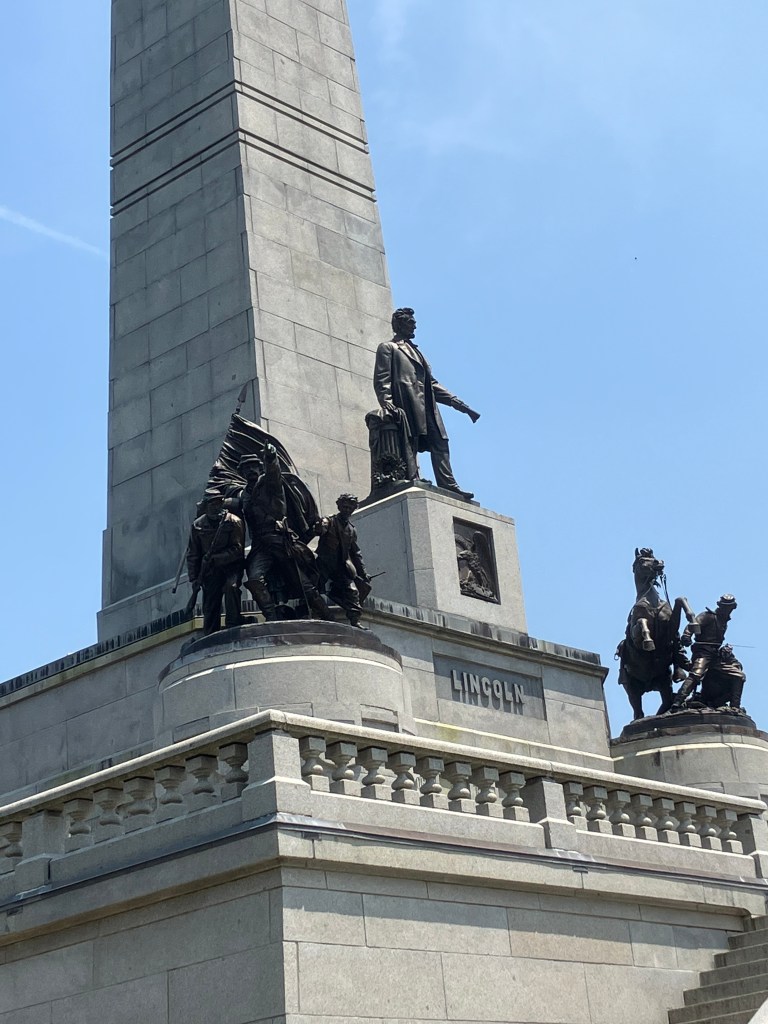
The openness and strength of belief about politics in society was really quite overbearing.
As soon as we left Chicago and headed out onto Route 66 evidence of political belief became visible and sometimes stared us in the face. For example out in the Illinois countryside surrounded by acres of corn you couldn’t help but see the roof of the farmhouse painted red with large white lettering showing allegiance to Donald Trump.
When we had to use a taxi during our travels it wasn’t unusual, once the driver knew we were English, to then start asking about our political standing.
We heard comments in independent shops particularly book shops which we found odd, from local tourist guides whose political leanings sometimes showed in what they said about eras of history, over breakfast in BnB’s and often if the subject of Covid was being discussed.
We just don’t see anything like this here in the UK. When election season is on us you may see small flags outside peoples’ houses showing affiliation to a certain political party or sometimes purely stating “Vote Labour” or “Vote Conservative”.
Voting, here in the UK, is very personal. It’s not unusual for people within the same family to be unaware of how each other have voted.
Interestingly the percentage of people that voted at the last election in the UK in 2019 (67.3%) wasn’t vastly different to the US election in 2020 (66.8%).
It became apparent to us that because of the sheer size of the USA the vote for a president is economically beyond anything we in the UK can imagine. This, in itself, raises the stakes.
A lot of cash is needed in America to spread the word.
Conversely there are tight controls on what parties can spend here on campaigning during a general election, and private contributions are relatively modest.
In the US, the size of the country alone demands far more from private investors to get a candidate’s message heard. The 2019 -2020 campaign ran into billions of dollars overall.
The size of US rallies, also tends to dwarf public appearances by party leaders in the UK.
In each type of election, key states in the US or constituencies in the UK are usually chosen for stops on the campaign trail, but US candidates tend to focus heavily on the “swing states” where a change in affiliation from one party to another can have a huge impact on the outcome of the election.
Although it is becoming more common in the UK, TV debates are not guaranteed.
In America, however, they seem integral to the election process. Not only do presidential candidates from each opposing party debate on live TV (moderated by a prominent broadcast journalist), but there are also several televised debates before the primary elections take place.
In the UK, politicians are not necessarily expected to take part in televised debates, although a growing public interest in media has put pressure on party leaders to engage.
With elections due in both countries in 2024 it will be interesting to see how each election is conducted and ultimately what if anything changes in terms of those who win power.

Returning to our adventure in America and the subject of both religion and politics it was interesting that in Oklahoma which is part of the Bible Belt we often heard religion mixed up with politics.
As of 2023, the Oklahoma Republican Party controls all 12 statewide executive offices and holds majorities in both the Oklahoma Senate and the Oklahoma House of Representatives; Republicans also hold both of the state’s U.S. Senate seats and all five of the state’s U.S. House seats.
It was like a double whammy for us to which a change of subject was often neatly negotiated by either myself or my husband.
In a country so hung up on these two subjects we personally would find it very hard to be happy here. Culturally our two countries are very different and this was probably one of the biggest learnings from our trip.
 A Midlife Adventure