I was recently visiting my daughter, who at the time was in Lincolnshire.
Traversing across the country from West to East I found myself bypassing Leicester and then driving along the A46. This is weird I thought, the A46 runs from Bath to Stroud back in The Cotswolds from whence I have come?
When I returned home I had to research this and I discovered the A46 is basically an old Roman Road that runs from Bath, in the South West to Cleethorpes and Grimsby in the North East. It’s amazing how much the Romans built in order to move their armies across Britain. This peeked my interest and so I headed off to Cirencester, my nearest Roman town to discover more.
Parking in Cirencester isn’t that easy. It’s worth checking it out on line before you arrive. We parked in the long stay car park at Sheep Street. Compared to other towns and villages nearby it is also more expensive at £7.90 for five and a half hours.
The advantage for parking here though is that it is only a four minute walk to our first destination –The Corinium Museum in Park Street and also presents an opportunity for a good circular navigation of the town.
Look out for Laurence Llewelyn-Bowen’s interior design shop en route. Also nearby you can see the blue Historic Cirencester sign denoting the original Cirencester Grammar School frequented by Edward Jenner, founder of the smallpox vaccine and often credited with saving more lives than any other man in history.

Corinium was the Roman name for Cirencester. The joy of this museum is that it is presented in chronological order and takes you right back to the beginning of prehistoric times and brings you all the way through the ages up to modern Britain.
Starting our journey through the museum, aided by an audioguide, I am firstly impressed to discover that people existed in this area from around 900,000 years ago, a period known as the Palaeolithic (Old Stone Age). There was extreme climatic change at this time with ice sheets advancing and retreating and sea levels rising and falling. Britain was joined to mainland Europe during the coldest spells.
Early modern humans adapted to these climatic conditions and exploited the natural resources available in Britain. In the Cotswolds, the evidence for the first people comes from the discovery of a small number of handaxes. These were butchery tools made and used around 200,000 years ago, probably by Neanderthals. Modern humans first appeared in Britain around 40,000 years ago.
Around 10,000 BC the environment became warmer and temperatures stabilised. Sea levels rose and, by 6,000 BC, Britain had become an island. This period is known as the Mesolithic Era or Middle Stone Age.
The local woodlands provided an ideal environment for hunting animals and gathering plants, fruits and nuts which attracted hunter-gatherers to the Cotswolds who set up seasonal camps. .
In addition over 70 Neolithic long barrows have been discovered in Gloucestershire, the majority of which sit in The Cotswolds. A display within the museum clearly shows one such long barrow -the South Chamber of the Hazleton North Long Barrow, the excavation of which took place between 1979 and 1982. This long barrow had two stone chambers, north and south. The chambers contained human bones, which were moved around when further bodies were added. A small number of stone tools, pottery shards and items of jewellery were found alongside the human remains.
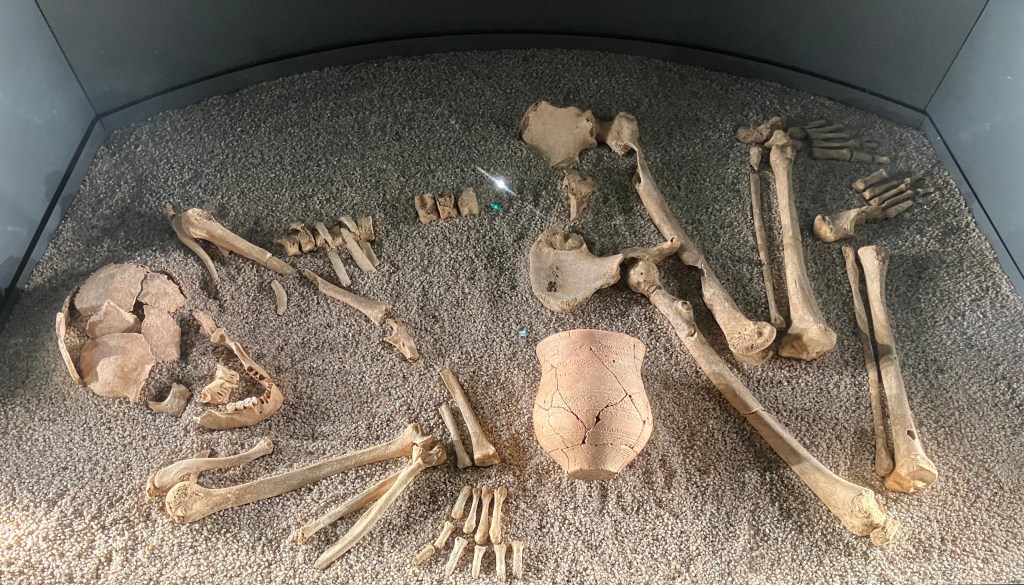
An early Bronze Age Beaker burial, dated to 2,400 – 2.100 BC, was also discovered at Kingshill North on the edge of Cirencester. This has revealed interesting information in that the teeth of the female skeleton, aged between 30-40 years old, showed that she was born on the chalklands of southern England. This means that she was not from the Cotswolds and had travelled a long way to live here. A fine decorated Beaker vessel was found within the grave and a cow hide was used to cover it. This was then covered by a large round barrow measuring 12 metres across.
The museum leads us on into the Roman era. The first two campaigns to Britain were in 55 and 54 BC led by General Julius Caesar himself. For the majority of Britons this would have been their first sight of an organised army, which must have left a lasting impression. It was almost a hundred years before the Romans returned to Britain.
In 43 AD Emperor Claudius sent an army of 40,000 men to conquer Britain. These men were well equipped, trained and disciplined. Within this army were separate legions each consisting of 5,300 men, who were in turn supported by auxiliary regiments drawn from all over the Roman Empire. The recruits included specialists such as slingers, archers and cavalrymen.
The Britons were defeated in two major battles which resulted in the surrender of a number of tribes from across Britain. One of these was probably the local Dobunni tribe.
Corinium Dobunnorum, Roman Cirencester, was the second largest town in Roman Britain. Its walls eventually enclosed 96 hectares. The town was the tribal capital and administrative centre for the Dobunni, the pre-Roman local tribe. It has been estimated that it had a population of between 10,000 and 20,000. This compares to modern day Cirencester which has a population of around 18,000.
Soon after the conquest of Britain, the Roman Army established forts and later a road network to help with communication and supplies. The main Roman roads identified in Cirencester are Ermin Street, the Fosse Way and Akeman Street.
Corinium had one of the largest amphitheatres in Roman Britain. Oval in shape it had two entrances on the long axis, one in the northeast and one in the southwest. Constructed in the early 2nd century AD. it was a centre for entertainment and events, which could hold the entire free adult population of the town. Favourite attractions probably included gladiatorial combat, bear-baiting, animal hunts, boxing and wrestling.
The seating banks, originally rising to 10 metres, had tiers of wooden seats laid on low dry stonewalls.It is assumed that the rear terraces were for standing spectators and it is estimated that this amphitheatre could accommodate 8,000 people. Whilst it fell into disrepair during the 4th century, its impressive remains are still visible to the southwest of the modern town centre.
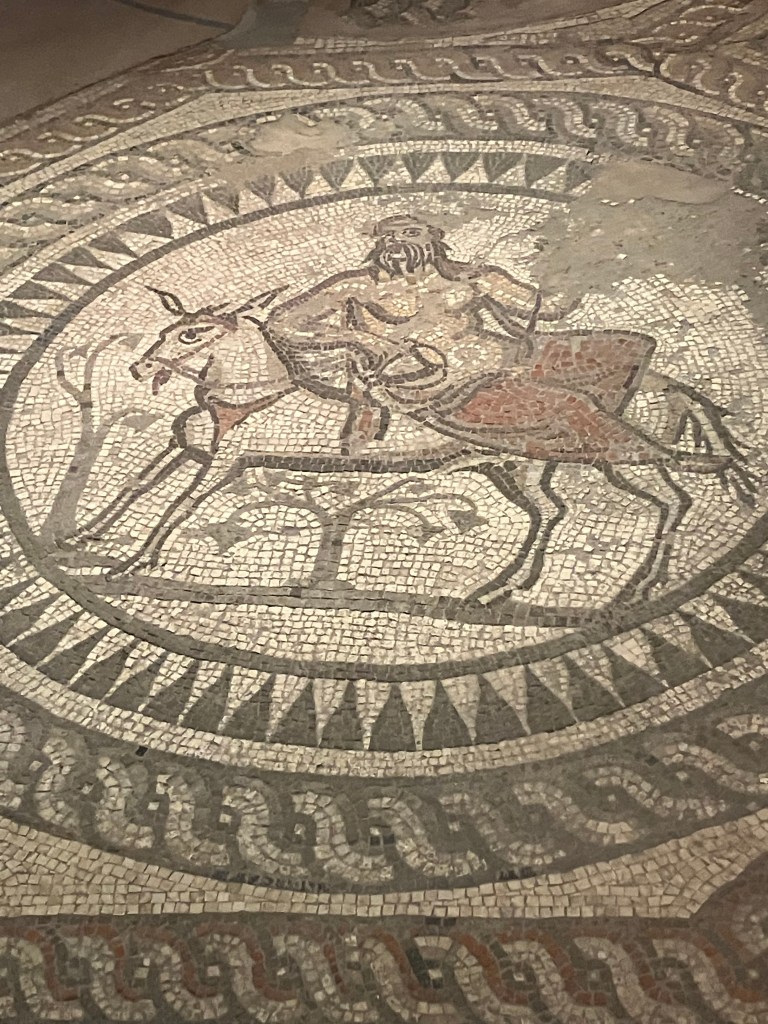
Beautiful mosaic flooring is a constituent of any wealthy Roman household and the museum has some amazing examples.
Moving onto Early Saxon times. These type of settlements are rare in Britain but two were discovered locally. The first at at Sherborne House, Lechlade and a second at Bourton-on-the-Water. Excavations at Sherborne House revealed a large settlement stemming from the late 5th to the early 8th century AD.
Analysis of the remains here show that beef was the main source of meat in their diet and soil analysis shows they produced barley, wheat, flax and Celtic bean. There was also evidence of weaving, metal working and leather working.
Further information follows bringing the visitor into the reign of Henry 1 and then onto the development of the wool trade which began in the 11th century and flourished in the 14th century throughout The Cotswolds area. Cirencester was at the centre of this and wool was exported from here abroad through London, Bristol or Southampton.
More information follows bringing you into the modern era.
I was really surprised by the quantity of exhibits and how much history sits within a few miles of this Roman town. The extent of the historic exhibits was worth the entrance fee and the couple of hours we spent there. I left with a greater appreciation of the history that surrounds me.
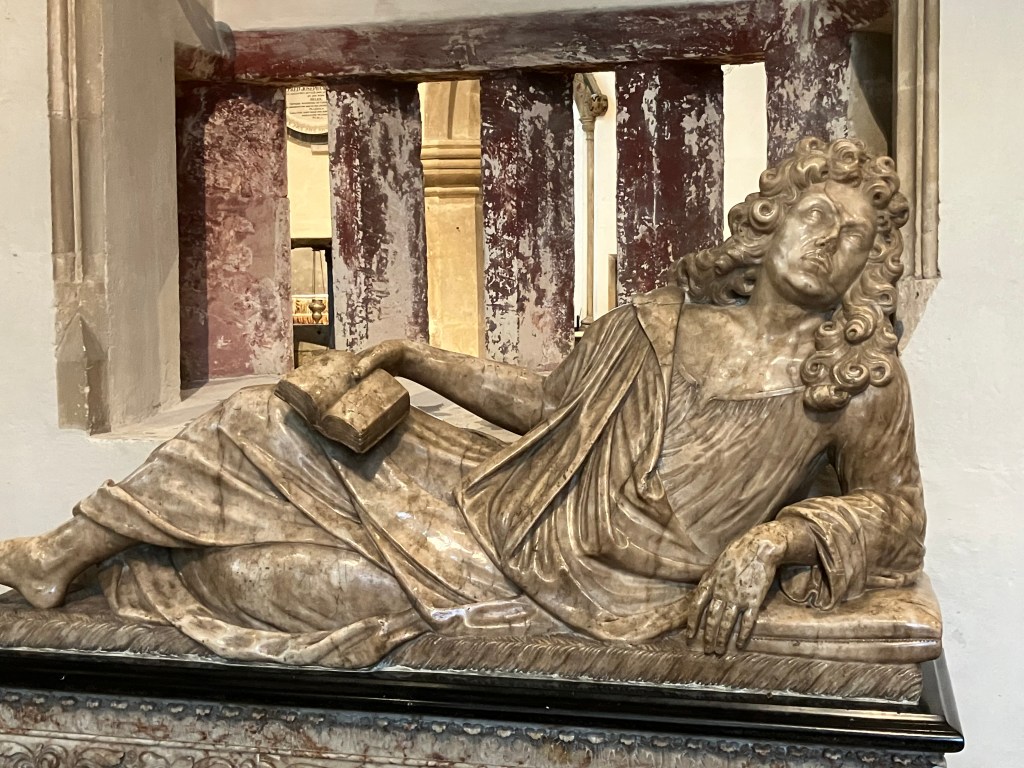
From the museum we walked less than five minutes to the medieval Church of St. John Baptist which stands proudly in the centre of this market town. This grade 1 listed building is well worth a visit reflecting various architectural styles since the 12th century. The oldest parts being the chancel and attached chapel.
Built from Cotswold stone, it is one of the “largest parish churches in England” and contains various tombs and monuments along with some fragments of medieval stained glass and wall paintings.
You can pick up a guided leaflet on entry and there is also normally a volunteer guide to hand to whom you can direct any questions. Don’t miss The Boleyn Cup made for Ann Boleyn in 1535.


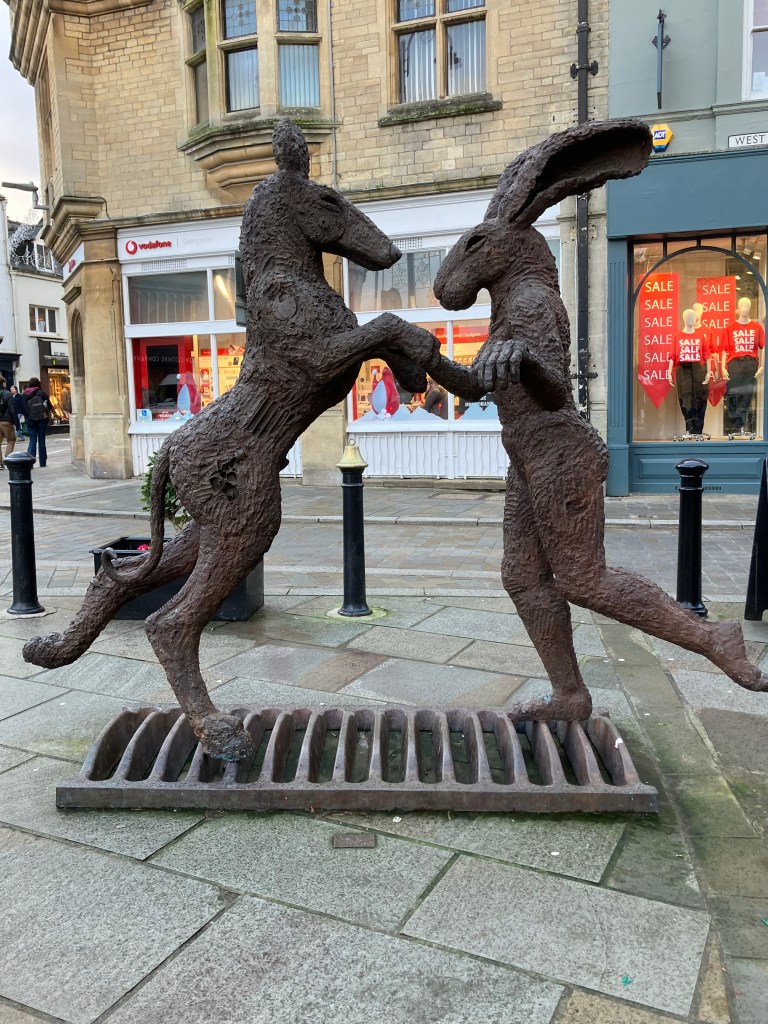
From the church we wandered around the market place, admiring the statue of the two hares before partaking of some lunch and heading off to explore some of the small independent shops and the Cornhall Indoor Market.
Heading back towards the museum there are various side streets that branch off on your left with more modern, chain shops before you reach the end of the market place. Here you will find Castle Street and Black Jack Street which run parallel to each other and feature another array of independent shops, cafes and eateries to explore.
Once you have finished wandering around the cobbled streets you can return to the car park.
NB: This is the seventh post in my series about the wonderful “Cotswolds”. An area in the UK that you really shouldn’t miss out on visiting if you are coming to the UK. It’s full of olde world charm, history going back to the Roman era and beautiful architecture. Check out previous posts in this series plus more to come soon.
Please don’t forget to comment and/or like. I love to hear what my readers think. and also look forward to your recommendations of places to see in the Cotswolds for my future adventures Thank you
 A Midlife Adventure