The English Royal Horticultural Society owns and runs five gardens scattered around the country in addition to organising and delivering some major horticultural shows throughout the year such as Chelsea Flower Show, Hampton Court Palace Garden Festival etc. Check out their website for more details.
Having joined the society back in November 2023 it was my intention to visit at least three of these during 2024 and my first choice was Rosemoor. I chose this one first for no other reason than it was here in the West Country and gave us the opportunity to venture down to Devon for a couple of days.
As RHS members we get free entry to this beautiful garden nestled in a valley near Great Torrington in North Devon. Opening times and prices can be found on line. Please note dogs are not allowed with the exception of registered support dogs. We didn’t see any evidence of visitors having picnics so you might need to check this out beforehand. They do have several eateries which again can be accessed on their website.
Historically the Rosemoor Estate was gifted to the RHS in 1988 by Lady Anne Berry. At this point in time it consisted of the 18th-century house, the eight acre garden and 32 acres of pastureland.
Lady Anne Walpole was born in 1919; her father was the fifth (and last) Earl of Orford, Robert Horace Walpole. The first Earl of Orford, was the famous Sir Robert Walpole (1676-1745) who became Britain’s first prime minister in 1721; generations of the family have remained an established part of the British political, cultural and literary world throughout history.
In 1923, Lady Anne’s father bought Rosemoor as a salmon fishing lodge. When her father died in 1931, Rosemoor became home to Lady Anne and her mother and they lived here until World War II. At that time the garden was, as Lady Anne described it, ‘dull and labour-intensive, typically Victorian with a great use of annuals in beds around the house’.
During the war the house was used by the Red Cross as a refuge from the bombing for evacuees from London’s East End.
In 1939, Anne married Colonel Eric Palmer and returned to Rosemoor in 1945 with her family and ran the estate as a dairy farm for many years. Her inspiration for gardening was born accidentally whilst in Spain back in 1959. She was recuperating from measles, (caught from her children) and whilst there she met the plant collector and gardener Collingwood ‘Cherry’ Ingram of Benenden in Kent. He was a great authority on Japanese flowering cherries and became her gardening mentor, opening her eyes to the beauty of a well tended garden. He invited her to his garden in Kent where she took some cuttings and young plants away with her to help start her own garden and plant collection back at Rosemoor.
We decided to visit midweek and were immediately surprised at the welcome we received and advice given as to how to navigate our way around the garden utilising the paper map provided.
I was immediately struck by the layout which was similar to that which we had viewed in Spain the previous year. The first section of Rosemoor which is the formal gardens are like small garden rooms of which there are six. Self contained with more than 1,200 hedging yews and paths etc. to separate each area.
When the RHS took over Rosemoor they employed the vision and skills of landscape architects, Elizabeth Banks Associates, in order to create the formal garden out of the existing pastureland. First, the sloping site had to be re-graded to achieve a gentle fall to the river. More than 13,000 tonnes of soil were removed from the new entrance area and car park, and redistributed in the Formal Garden area to level off the site.
We began our walk at The Queen Mother’s Rose Garden which features modern hybrid tea roses and floribundas mixed with climbing roses and ramblers. Each rose has been chosen for their scent, stature and colour range. This garden sits adjacent to the Shrub Rose Garden which is planted with old traditional historical roses that have been blended with some modern shrub roses. Unfortunately we were too early in the season to see them in full bloom but other plants provide colour and interest before the roses start flowering.
The RHS is such a useful institution for gardening advice and I wish I had known this and joined before planting roses in my own garden. Being in the South West which has a warm, damp climate and a lack of air pollution means that roses grown here can be susceptible to diseases such as black spot. Rosemoor have, therefore, chosen varieties that are more disease resistance, that grow vigorously and are of a free-flowering nature. Having spoken to one of the gardeners on duty I did come away with a few tips to eradicate such diseases from a couple of my rose bushes.
Below the rose gardens are the Cold and Hot Gardens, again side by side. The Hot Garden is again at its best during the summer. Created by Roger Webster in 2007 the idea was to create prairie style planting, and many of the plants used are from the grassland habitats of North America. To give it more impact and intensity and to tie the design together bold blocks of the same plant are repeated throughout the garden.
During the summer months visitors can marvel at its beauty whilst also taking time to stop and take in the smells, sights and sounds including bees and other pollinators which give this whole area it’s own atmosphere.
The Cool Garden is centred around water and, therefore, for me a lot more attractive. It was created by multi-award-winning garden designer Jo Thompson and opened in July 2019. It is Rosemoor’s first and only garden designed around an ornamental water feature. The curved terrace, allows visitors to look down across the garden with five water blades that feed rills running through the area into a teardrop-shaped pond. This garden was specifically designed to deal with heavy rainfall and give home gardeners an opportunity to view the various techniques used if they too have gardens that suffer in this way.
There are around 3,000 plants in this garden with cool-coloured flowers of blue, white and pastel shades which contrast the more fiery shades next door in the Hot Garden, and continues the link between the two neighbouring areas.

We then moved across to the last two parts of the formal gardens – the Herb Pottage and Cottage Garden and above this the Foliage and Plantsman’s Garden.
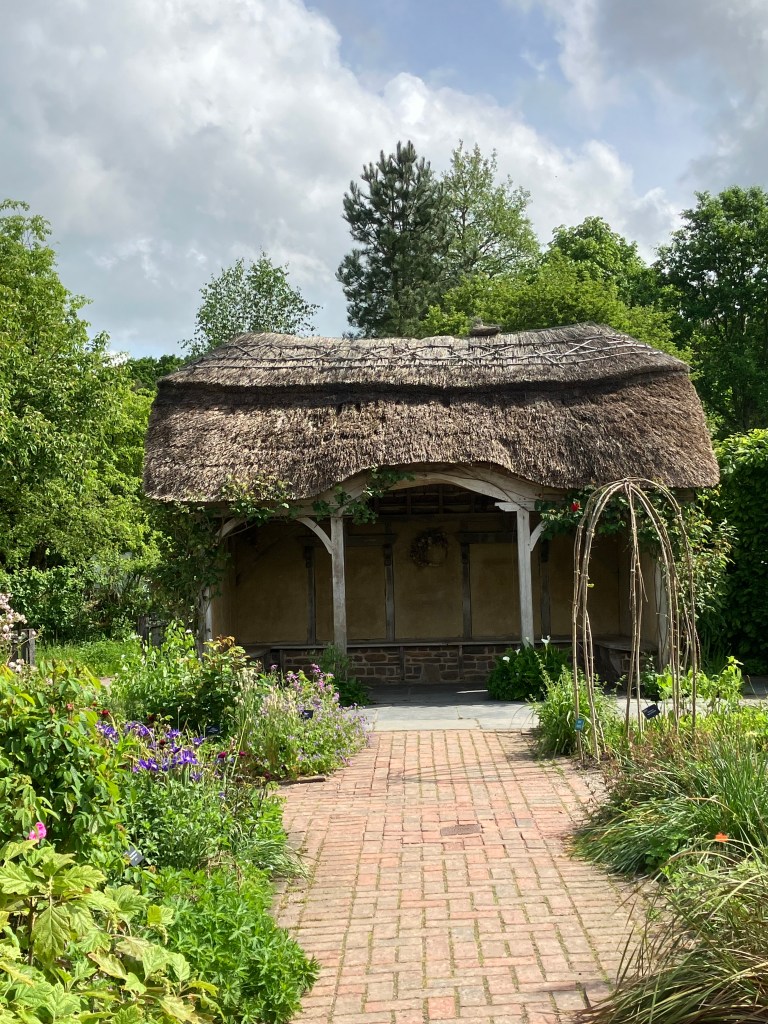
The former was one of my favourite parts of this formal area maybe because it illustrates so well the types of gardens I saw as a child growing up in the countryside. One of the focal points is the thatched summer house (see photo above), wouldn’t we all like one of those in our garden? Built using traditional West Country techniques and materials the summer house is made from local oak and authentically constructed without the use of nails or screws, the walls are of wattle and daub.
Next to this is an ornamental kitchen garden which was historically seen during the French Renaissance period. Look around and you will also see grape vines on tall wrought iron arches and at the centre of all this is a lovely stone pond complete with fish and a statue of a small girl.

From the formal area we headed along the path behind these gardens and into the woods. Shafts of sunshine were making their way between the tree branches, the birds were singing around us and it was lovely to sit down on a strategically placed bench and just stop and listen to nature.
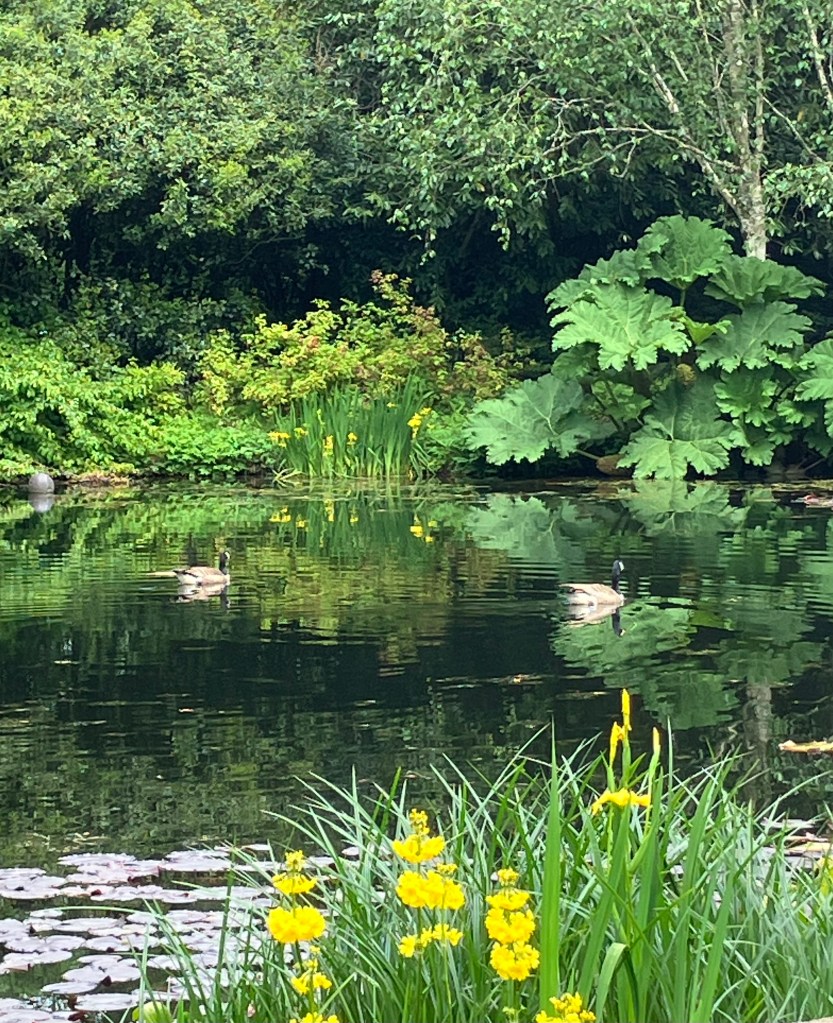
The path through the woods leads to the lake. Historically when the RHS took over here, for the first couple of years the gardens were just a sea of mud and this brought attention to the small stream that sprang up seasonally coming in from above the estate. Work was completed to divert this water and create dams to form small pools and waterfalls which ultimately led down into the lake. Plants were placed strategically around the lake and being able to hold 400,000 gallons of water also meant it could be used as a reservoir from which they could irrigate the garden.
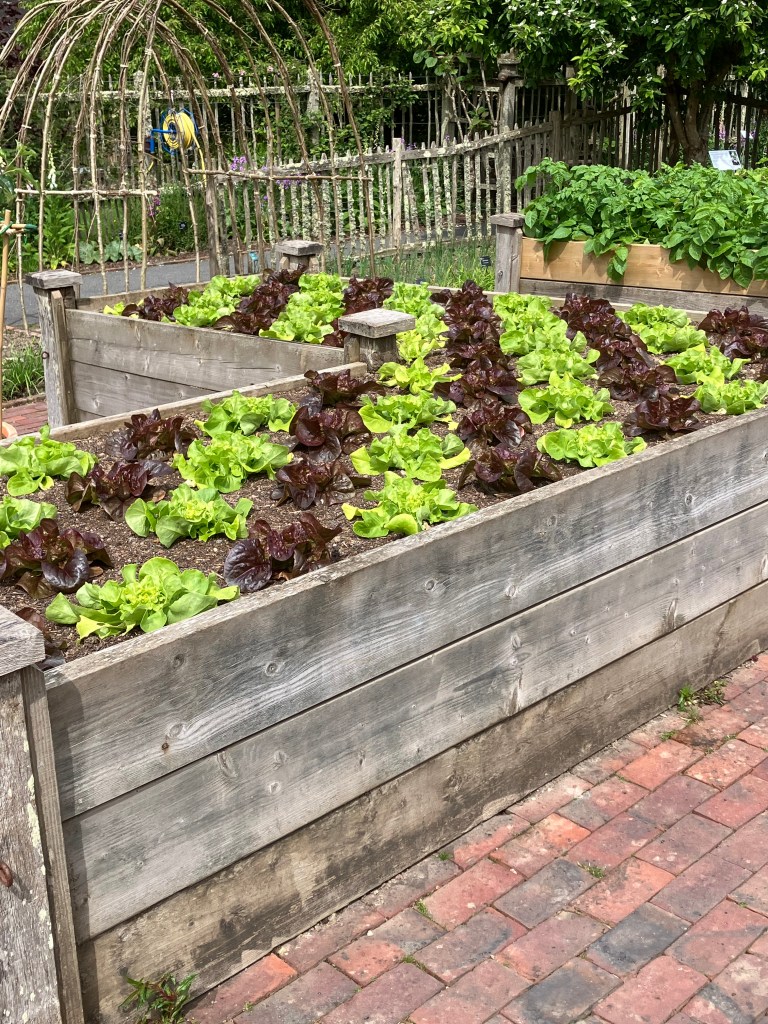
From the lake we headed through the Devon Apple Orchard and onto the fruit and vegetable garden. As my interest in cultivating our garden at home has begun to ignite and reminiscent of the vegetable plot my parents had at the back of our house when I was a child growing up I have, myself, begun to cultivate edible produce. It’s early days but I currently have lettuce, peppers, tomatoes, herbs and strawberries, so I’m enchanted by everything they are growing here. Most of their produce is utilised in the various four eateries on site but strolling around my head is full of ideas of what I can do next year assuming my plants this year come to fruition.
We head back the way we have come and walk upwards past the Lower Rock Gully, Stream Garden and Rock Gully itself. I love the sound of water, however quiet or loud and so again take a minute to stop and admire this area before passing through the Underpass.

The underpass was built to link the new and the old gardens opening to visitors on 1 June 1990. Entering into this second area there is a circular path which winds its way around so you can either go clockwise, as we did, or anti-clockwise. The area to our right is Lady Anne’s Historic Garden including the arboretum.
Lady Anne was fastidious in recording the correct name of every plant and providing a historical record of its growth and cultivation. She began planting in 1959 and her arboretum contains a number of rare and unusual trees grown from wild-collected seed from Hurricane Valley in the USA.
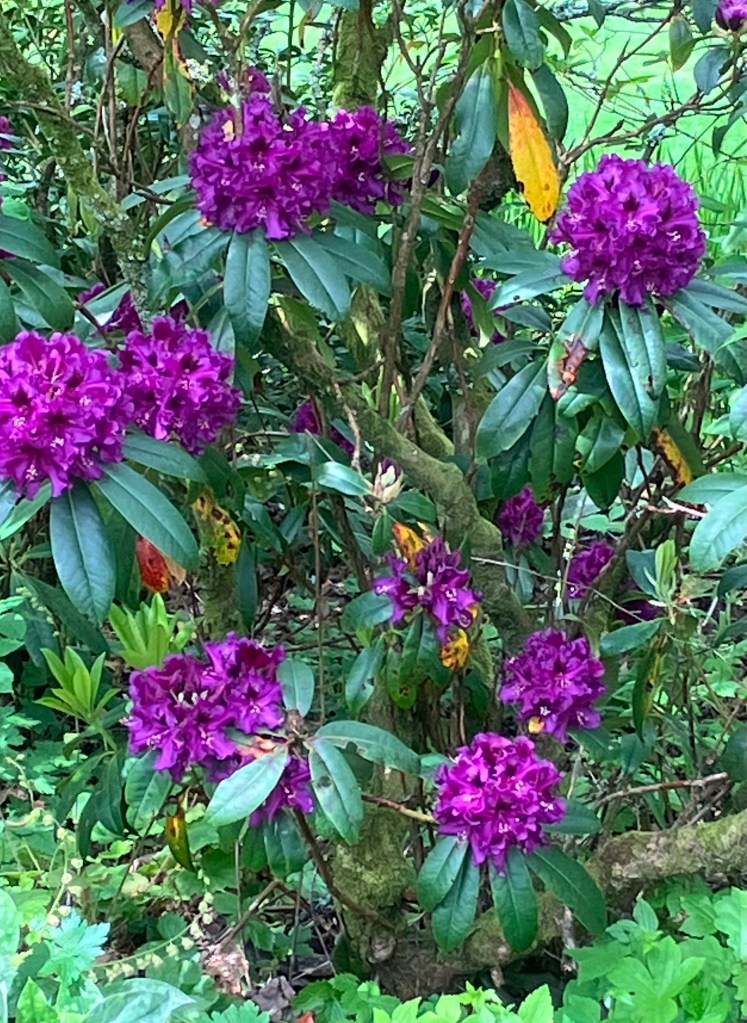
The RHS continue to expand the collection, especially with trees and shrubs that contribute spring colour as you can see here.
It is also worth stopping to admire the view across the immaculately cut lawns to the house itself.

Reaching the house and tucked around the corner is a lovely little tearoom where we happily take a break and gorge ourselves on scones with jam and cream whilst sitting on the patio. Ignoring the fact we are in Devon, where the cream should go on first, we added jam and then cream which is the Cornish method.
Accustomed to visitors dropping crumbs the wildlife soon made an appearance with first a female thrush poking its nose out of the bushes, then a small mouse creeping out between the stones on the wall and this closely followed by this beautiful little robin. It had no fear and sat quite comfortably on the spare seat at our table awaiting a few titbits.

Rested we set off to complete our tour of this area by walking, firstly, through the Exotic Garden. I can’t imagine it is easy to grow these types of plants with English weather but tree ferns abound alongside bananas, hostas, lilies and cannas.
As we walk on around, above us stretches the Woodland Garden, lying between the woodland on the upper slopes and Lady Anne’s main garden. This steep, west-facing slope forms part of Lady Anne’s original garden, where some of Collingwood Ingram’s first cherry introductions still survive.
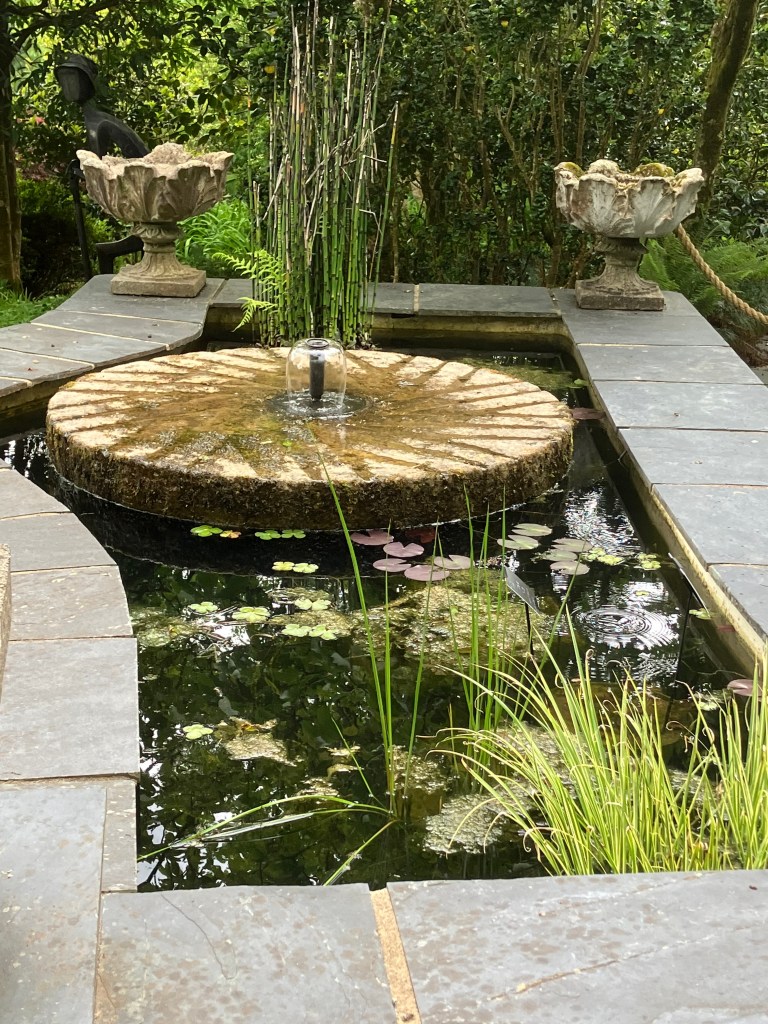
As the sky begins to blacken and rain starts to slowly fall we finish our tour at the Stone Garden. This section was actually designed by Lady Anne’s mother back in 1932 and was in fact the first area of hard landscaping. They built the walls from the lime kilns that stood at the edge of Rosemoor back in the 19th century and the paving made of slate came from the western boundary of the estate.
As the skies truly open we make a mad dash back to the entrance, sorry that we are leaving so quickly but really pleased we decided to visit.
NB:
This is the second of a series of posts I will be writing about Gardens in England. Since my visit last year to Keukenof in Holland (see my post -Keukenhof -Beauty, Imagination and Inspiration) it has sparked an interest in me to visit other beautiful spaces. As hubby loves to photograph flowers, bees, birds and just nature as a whole it gives us an opportunity to take some time out and just appreciate the calm that such spaces can give you.
I will also be writing a second post about the North Devon coastline which also formed part of this visit to the county of Devon
 A Midlife Adventure
2 thoughts on “Gardens of England and Wales -RHS Rosemoor”