Back in the Spring we visited Blenheim with our annual membership and had a really enjoyable day strolling around the main gardens.
https://amidlifeadventure.org/2024/04/16/the-cotswolds-visiting-blenheim-palace/
Unfortunately on that occasion we were unable to access the house itself and so we returned this Summer to finally get a much wanted peek inside.
The History of the Palace:
Historical houses have always held a fascination for me particularly those that have lovely architectural features. Blenheim is the only non -royal, non -episcopal country house in England to hold the title of a Palace and was built in the English Baroque style.
One of England’s largest houses, it was built between 1705 and 1722, and designated a Unesco World Heritage Site in 1987.
Queen Anne rewarded John Churchill, 1st Duke of Marlborough, with the estate for his military triumphs against France and the Bavarians in the War of the Spanish Succession which culminated in the Battle of Blenheim.
With her husband John away at war, Sarah, Duchess of Marlborough, oversaw the construction of Blenheim Palace which began in 1705. Sarah was a powerful woman. As Keeper of the Privy Purse, she effectively controlled the Queen’s budget. It was rare for a woman to reach such heights.
Sarah’s first choice of architect was Sir Christopher Wren, architect of St Paul’s Cathedral and later of Sarah and John’s own London home. John, however, disagreed and instead appointed Sir John Vanbrugh to create his Palace.
Previously a playwright, Vanbrugh was keen to present the palace in an opulent and decorative English Baroque style and chose only the best and most expensive materials, seeking out master craftsmen to deliver his ideas. Sarah felt he was too extravagant and ignored her instructions and soon took a dislike to the man. Their relationship eventually became so stormy that it disrupted the project.
The Marlboroughs troubles, unfortunately, didn’t stop with Vanbrugh. Their relationship with Queen Anne also broke down, and they were dismissed from their royal posts. As a result in 1712 they left England for Antwerp and the Queen ordered all building work on Blenheim to stop. This remained the case until Anne’s death in 1714 when John and Sarah were able to return to England and restart the project, this time at their own expense. The Duke died in 1722 and thus never saw his palace completed. Sarah continued with the project, completing its construction as a dedication to her much loved husband.
Following the palace’s completion, it became the home of the Churchill ( later Spencer-Churchill) family for the next 300 years, and various members of the family have made their own changes to the interiors, park and gardens. The Palace went on to become the birthplace of Sir Winston Churchill. There is an exhibition on site (to the right of the main Palace entrance) dedicated to this world famous head of state with photographs, letters, artefacts and excerpts from his most famous speeches.

Touring the Palace:
With our free admission we didn’t have to book our visit but did arrive early at 10.15. The gardens currently open at 10 and the Palace at 10.30. Being the school summer holidays the car park was already busy.
It’s always worth checking their website in advance of any visit because they do shut the Palace for filming (part of the latest series of Bridgerton was shot here). There is currently an additional tour that can be booked (up to September 30th) entitled The Bridgerton Trail if you are a fan!
There are also special events during the year, including weddings of the rich and famous, when the Palace isn’t open and exhibitions are scheduled which may affect your visit.
There is a map available on their website which you can utilise to plan your visit or alternatively you can pick up a leaflet on arrival.
Guided Palace State Room tours also take place daily at 12:00 and 14:00. These are included with a valid Pass or Palace day ticket, starting in the Great Hall. No need to book, you just turn up!
If you are intending to see the Palace and explore the grounds my recommendation would be to allow up to six hours. If the weather is in your favour it’s a great place to bring a picnic or there are places to buy food from a coffee to afternoon tea (this needs to booked in advance).
To arrive at the Palace entrance you need to walk through the East Courtyard into the Great Court and the entrance is then on your left. You can download an audible tour inside but you ideally need your own headphones and plenty of phone battery.

Walking in you immediately are met with the magnificent Great Hall. This brings to mind all those stories I read as a school girl written by the Bronte sisters and films I’ve watched based around the Royal family and their ancestors. If you stand there for a moment you can just imagine the carriages drawing up to the front steps and those ladies resplendent in their gowns and jewellery making their grand entrance to a ball.
The ceiling which is 20 meters high was painted by Sir James Thornhill who also painted the dome in St Paul’s Cathedral. The entrance door is the original oak door made in 1715 with a key that weights 3.5 lbs! The arch windows above the door are beautiful letting in the summer light as we begin our tour.
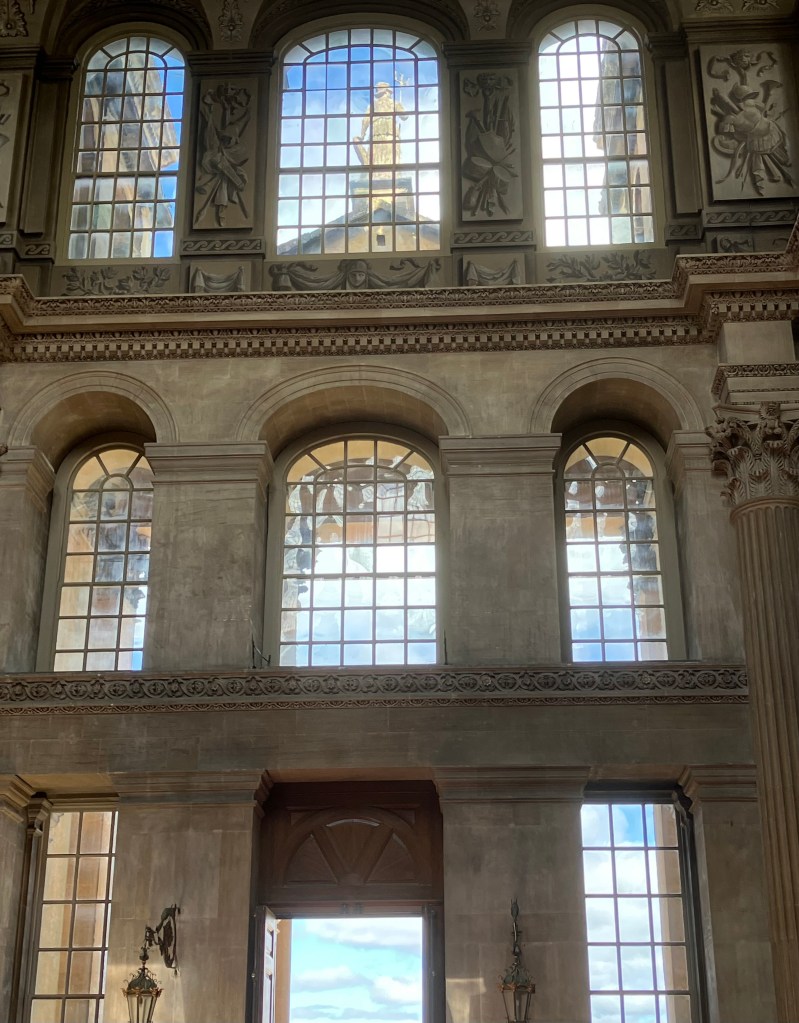
If you look up you will also see a ledge around the edge of the room. During WWIl boys from Malvern College were evacuated to Blenheim Palace and during the blackouts, these boys would have to climb the staircases hidden in the columns either side and climb onto the 2ft wide ledge to close the curtains!
The tour of the State Rooms is very easy to follow and you can listen to every description of each room on the audio tour or skip if there are elements that don’t interest you. A couple of my highlights were:
The fantastic paintings of those who have lived here set amongst some beautifully decorated rooms with priceless furniture of the time.
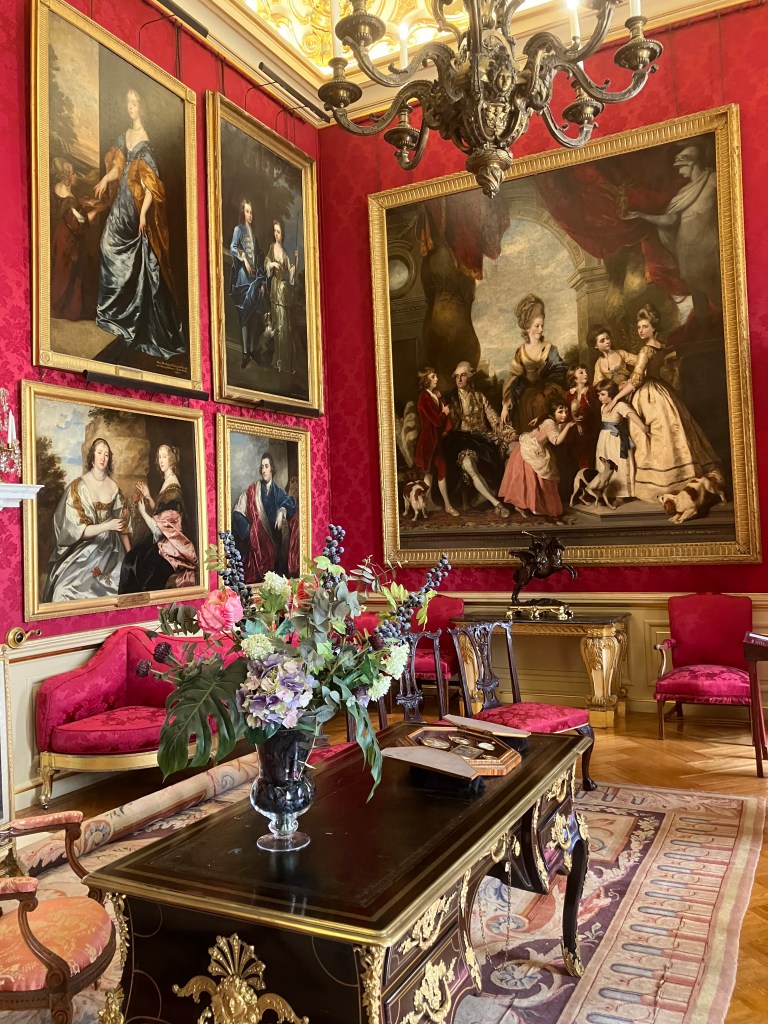
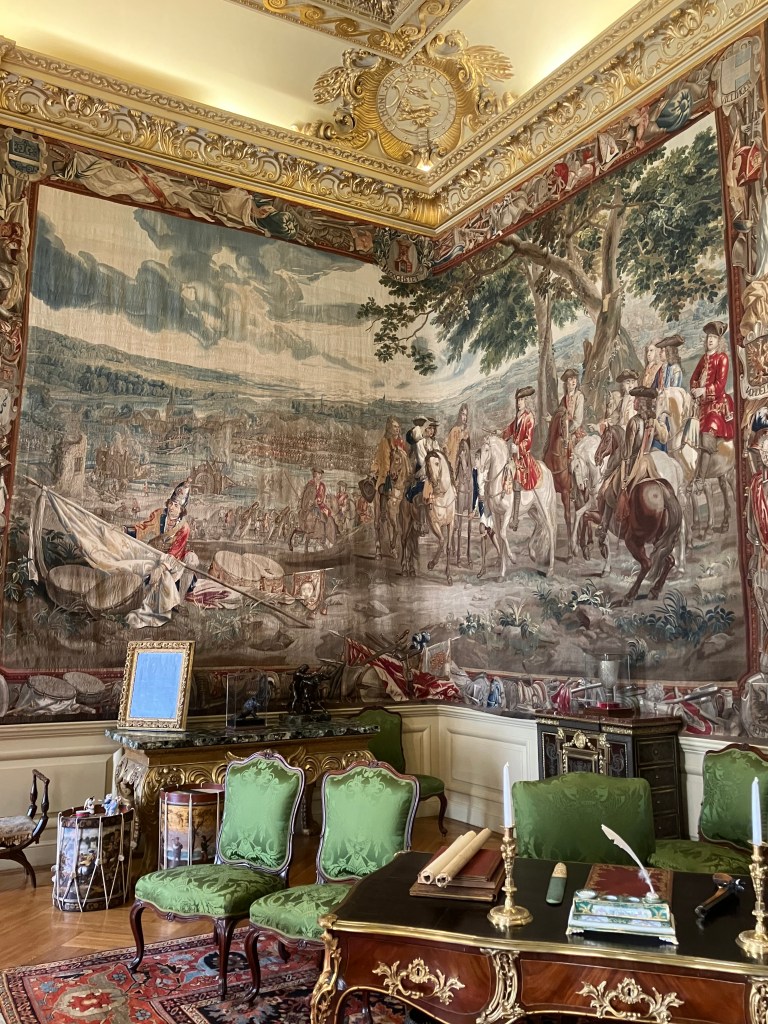
The original tapestries lining some of the walls in place of wallpaper
The statue of Queen Anne in the library along with the astounding collection of books. Again it harps back to an era when before television and radios were invented gentle folk had to find their own pastimes and would happily spend time reading.

It is worth noting that you can buy an additional ticket in advance if you wish to visit the Upstairs or Downstairs of the Palace. Both of these tours run individually and are currently scheduled at 11.00, 12.00, 14.00 & 15.00.
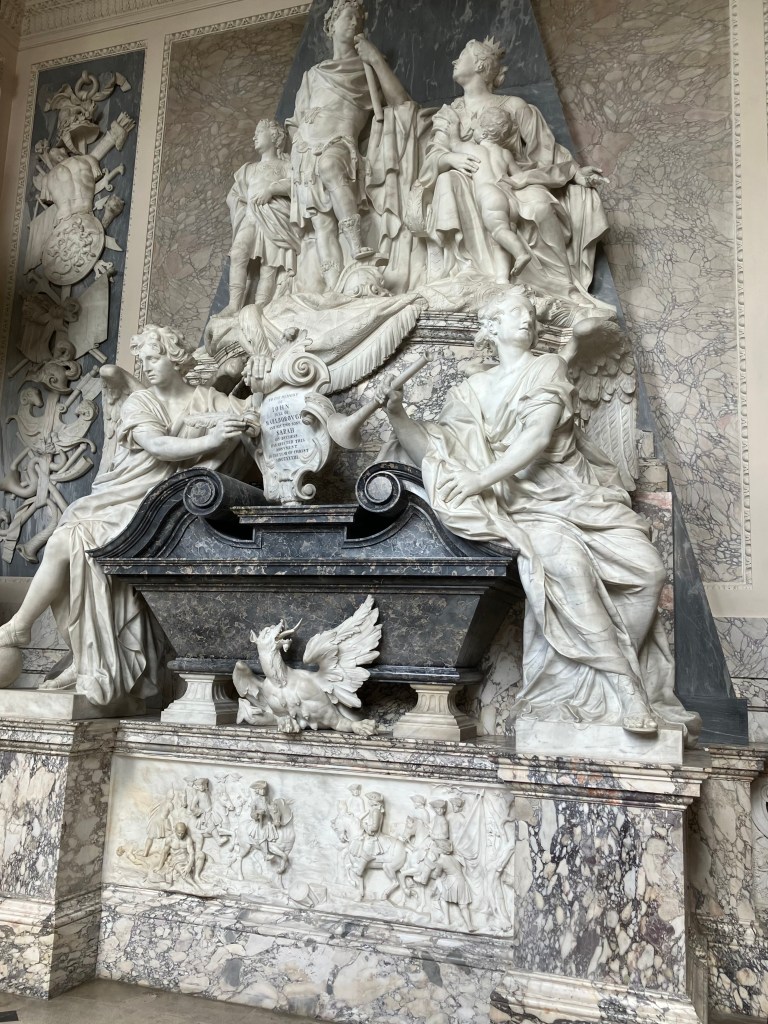
When we had finished the tour of the State Rooms we made our way into the chapel. Following the death of Duchess Sarah in 1744 the Duke’s coffin was returned to Blenheim from its temporary resting place at Westminster Abbey and husband and wife were interred together. A tomb was erected and completed and Blenheim Palace then became not just a Palace and Gardens but also a mausoleum with successive family members also being placed here after death.
We spent the remainder of our day strolling the gardens. We had already visited the Formal Gardens and Water Terraces on our previous visit along with the Walled Garden and so we made our way to Vanbrugh’s Grand Bridge in order to begin the Queen Pool walk. The bridge is thus named because the architect designed and created a bridge originally of such huge proportions it was reported to contain some 30 rooms!
The 4th Duke of Marlborough in 1764 employed the now famous Capability Brown to transform the landscape into something more natural. Brown is forever associated with the redevelopment of the lake here at Blenheim. This huge stretch of water was created by damming the River Glyme and enhanced by a series of cascades, where the river flows in and out, which we had previously visited. He then narrowed it at the point of Vanbrugh’s grand bridge, but the three small canal-like streams that originally trickled underneath it were completely absorbed by one river-like stretch. Brown’s greatest achievement at this point was to actually flood and submerge beneath the water level the lower stories and rooms of the bridge itself, thus reducing its great height and achieving what is regarded by many as a quintessential English landscape.

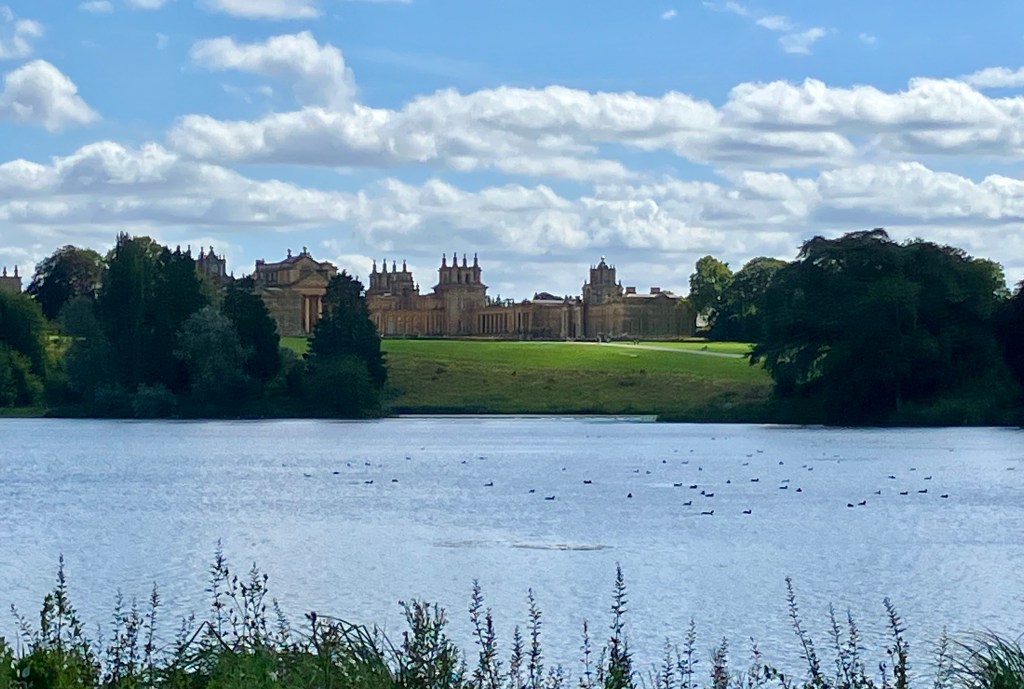
The walk was easy to follow and allows you views across to the small islands within and back across to the Palace itself.

Again your imagination can run riot and imagine those genteel folk strolling in the summer sunshine admiring the views and magnificence of this astounding Palace.
NB: This is the eleventh post in my series about the wonderful “Cotswolds”. This is an area of England that you really shouldn’t miss out on visiting if you are coming to the UK.
It’s full of olde world charm, history going back to the Roman era and beautiful architecture.
Check out previous posts in this series. Please don’t forget to comment and/or like.
Thank you
 A Midlife Adventure