Where travelling further afield isn’t currently possible for us it’s nice just to get away for an overnight stay which is what hubby and I decided to do this week.
We firstly travelled to Evesham before a bargain overnight stay at the Premier Inn at Evesham Country Park and then moving on to Stratford-upon-Avon on the second day.
Whilst the town of Stratford-upon-Avon isn’t officially in the Cotswolds it sits on the northern most edge so I have chosen to include it in my series about this wonderful area.
Parking:
I merely researched parking on Google Maps and discovered that it is uniformly priced. Preferring to avoid multi storey car parks given that some have entrances too low for a truck I opted for the Arden Street Car Park next to the Hospital. We paid by card but you can also use the Ringo App.
From here it was only a five minute stroll to the starting point of our walk.
GPSmyCity App:
We have used this app on many occasions in order to take an informative walk around a city or town. On this occasion it offered three different walks:
City Introduction Walk – 10 sights
Tudor History Walk – 8 sights
Shakespeare Tour – 8 sights
The app has many other useful facilities including creating your own walk but to date I have been happy to use the predetermined options. They offer an opportunity to explore a town or city with as little or as much expense as you want. You will often come across what I would describe as hidden gems which you would otherwise not necessarily have found.
As the sun shone down on an autumnal morning we opted for the first walk which began at:
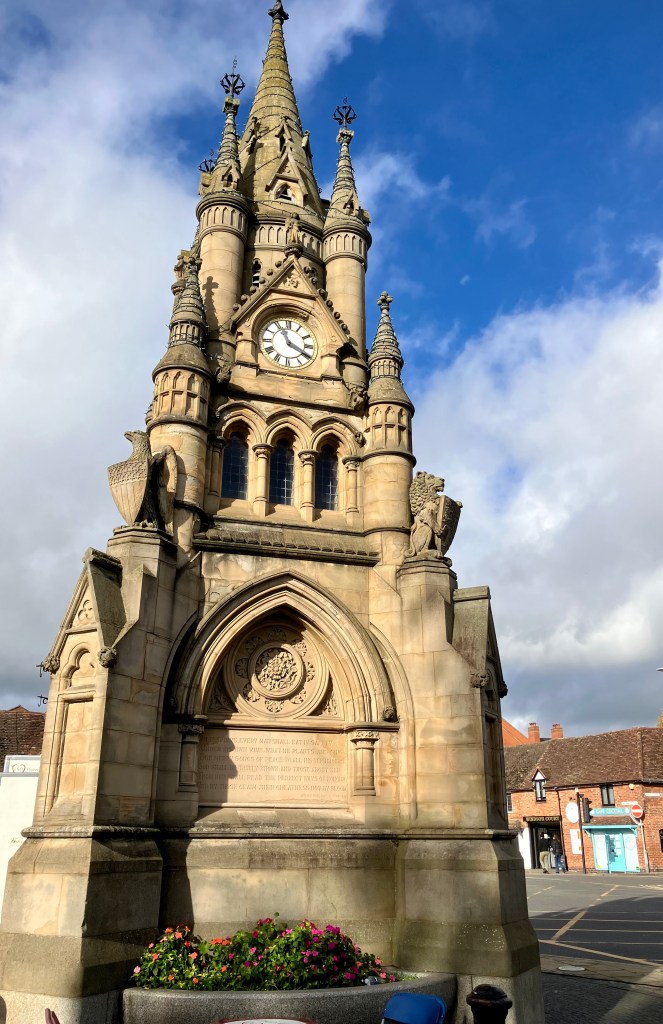
The American Fountain or Shakespeare Memorial Fountain.
Immediately I was side tracked by the presence of a small and unexpected market. Further research shows this to be the Rother Street Market held every Friday and Saturday. Tarpaulin covered stalls offer locally grown fruit and veg, gifts, clothes and crafts. I enjoyed a wander around, keeping my eyes peeled for possible Christmas gifts before examining the monument properly.
It’s a lovely decorative piece created to celebrate the Golden Jubilee of Queen Victoria, as well as to Shakespeare and to the relationship between the USA and England. Looking closely you can see it is heavily decorated with quotations and sculptural details which enforce these messages.
Gifted by an American newspaper publisher and philanthropist George Childs who was known for his deep love of England and its writers. He had erected other memorials to authors such as William Cowper, George Herbert, John Milton, and a monument to the great critic Leigh Hunt.
The fountain was started on 20th June 1887 and unveiled less than four months later on 17th October by the actor Henry Irving. The fountain and clock-tower are Victorian gothic in style and contain many lovely details such as tudor roses, floral roundels, grotesque imps and even an owl.
When it was first created it had horse-troughs on each side to provide water for horses and other animals but these are now filled with flowers. Unfortunately the fountain also no longer provides water but the clock was restored in 2022 and thus now works with its bell gently chiming.
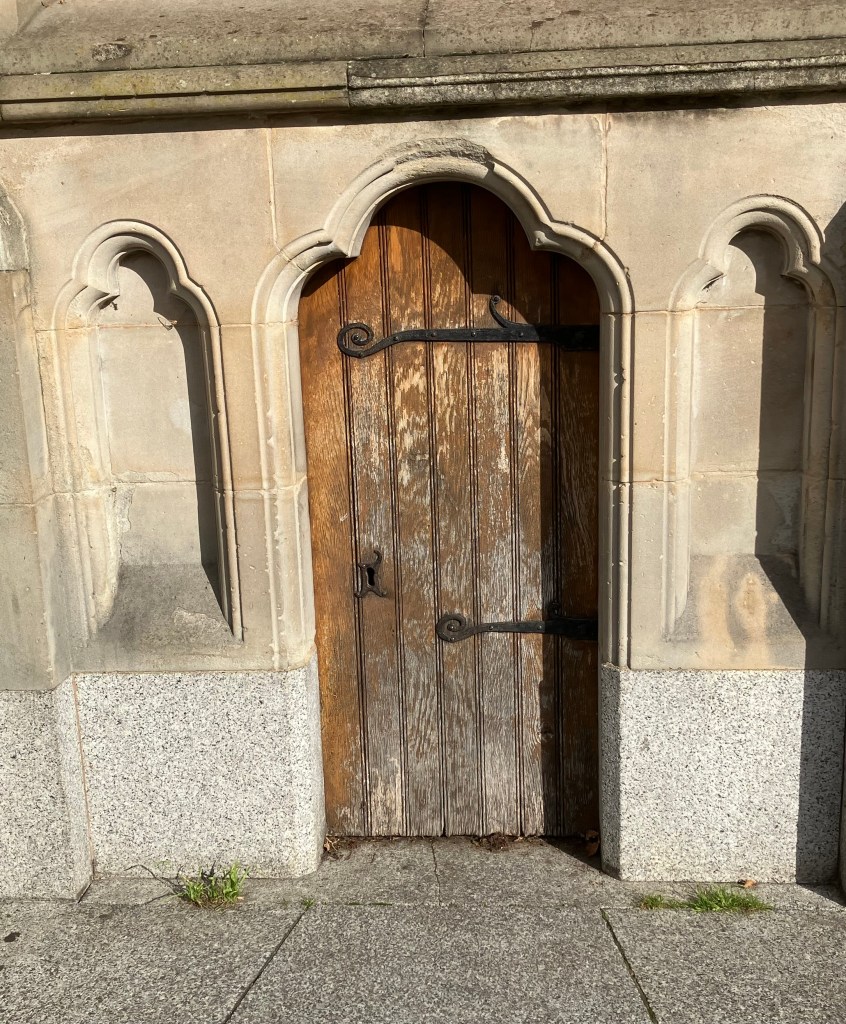
I was most amused by this tiny door on one side of the fountain that looks like it’s been constructed for someone from Tolkien’s “Middle Earth”!
From the fountain we walked about five minutes to Henley Street and the birthplace of William Shakespeare.
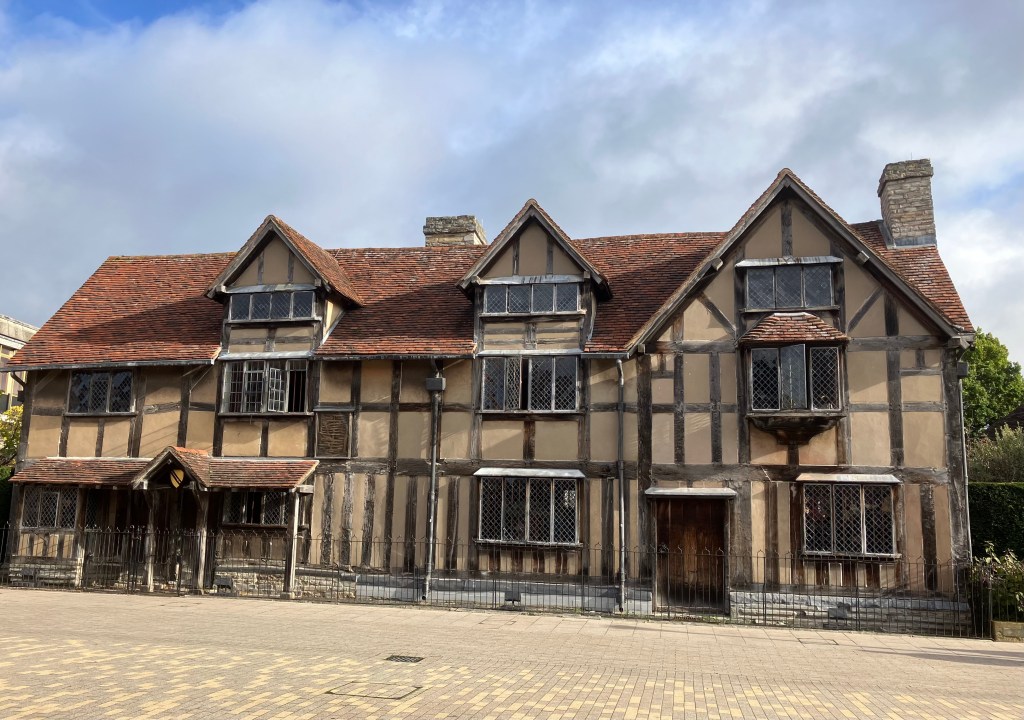
Shakespeare’s Birthplace
It is said that William Shakespeare was born in this restored 16th-century, half-timbered house in 1564 and that he spent his childhood years here.
The house itself is relatively simple, but for the late 16th century it would have been considered quite a substantial dwelling. William’s father, John Shakespeare was a glove maker and wool dealer, and the house was originally divided into two parts to allow him to carry out his business from the same premises.
The house remained within the Shakespeare family until 1806. Under the terms of his will, the ownership of the whole property passed to his elder daughter, Susanna. In 1649 it passed to her only child, Elizabeth and then in 1670 to Thomas Hart who was the descendant of Shakespeare’s sister, Joan.
It is now a small museum which is open to the public and a popular visitor attraction, owned and managed by the Shakespeare Birthplace Trust.
Cost of entry for the combined ticket to this, Anne Hathaway’s Cottage, Shakespeare’s New Place (open seasonally) and the Shakespeare Centre are currently £18 per adult. Alternatively you can buy individual tickets for each place.
We chose not to do this as today, for us, was all about exploring the town rather than expending money.
Wandering in and out of various independent retailers we made our way down to the river front.
Bancroft Gardens:
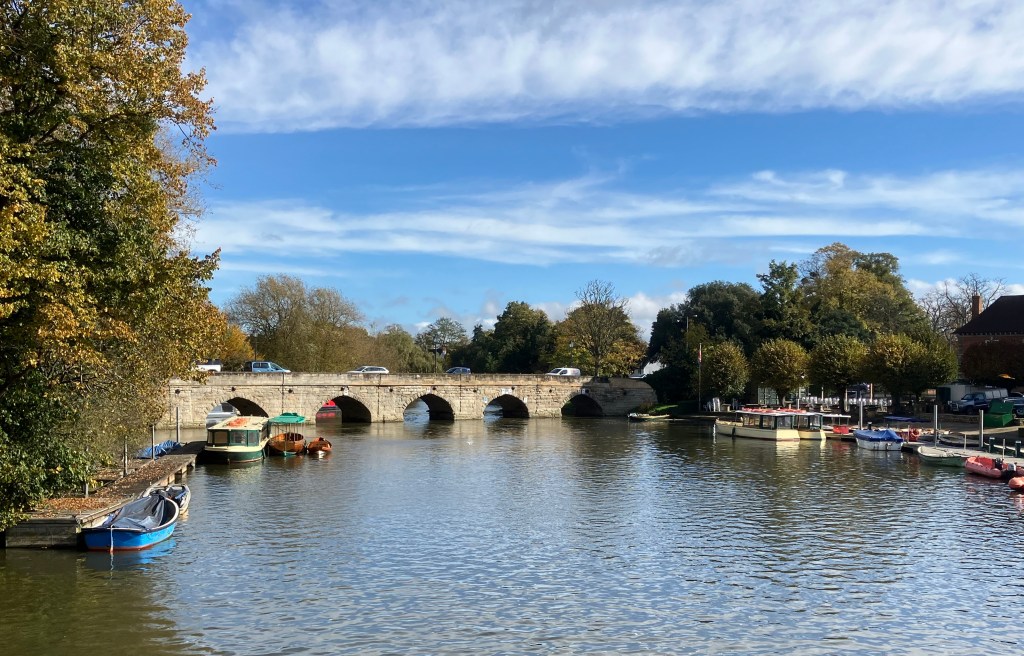
It was lovely to arrive at the river amidst the sunshine and autumnal gold of the trees. This was originally an area of land where the townspeople grazed their animals, and the Canal Basin was the end of the Stratford-to-Birmingham canal, completed in 1816.
We initially seated ourselves on a bench adjacent to the Swan Fountain admiring its filigree swans with water cascading down. Made for the 800th Celebration of the granting of the Charter for Market Rights by King Richard I in 1196, the fountain was designed and created by the sculptor Christine Lee. Made of stainless steel and brass it was opened by Queen Elizabeth in November 1996. I have to say I personally quite like it but then I have an affiliation, for some reason, with water. Whatever the format it brings me peace and calm.

Moving on we walked to the water’s edge noticing the boats touting for trade to take tourists on a river cruise before doubling back on ourselves to cross over the canal basin and lock. We were hoping to find another bridge a bit further down to allow us to avoid turning back but this wasn’t the case. The grassy expanses on this side offer an opportunity for a riverside picnic during more warmer weather.
Returning to the other side we branched right and wandered into the flower garden where you can find the Gower Memorial. This Grade 2 listed monument was erected in 1888 and was created by Lord Ronald Sutherland Gower. I quite like sculpture, definitely preferring it most of the time over paintings. The centrepiece of this statue features a seated bronze sculpture of William Shakespeare. Detached from the main statue are smaller pieces on pedestals representing four characters from Shakespeare’s plays: Lady Macbeth, Hamlet, Falstaff and Prince Hal.
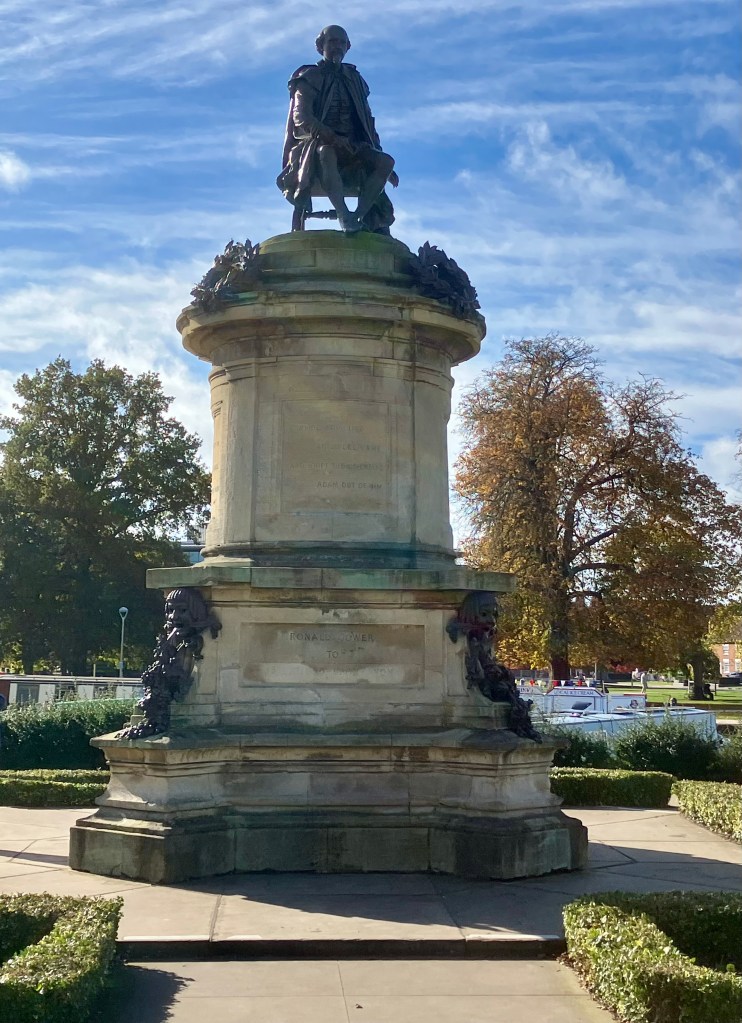
The gardens were still quite bright and cheerful despite the current change of seasons and there are places to sit, take a breathe or even contemplate what this area would have looked like back in the day of the bard.
Leaving the gardens behind us we headed to our next landmark….
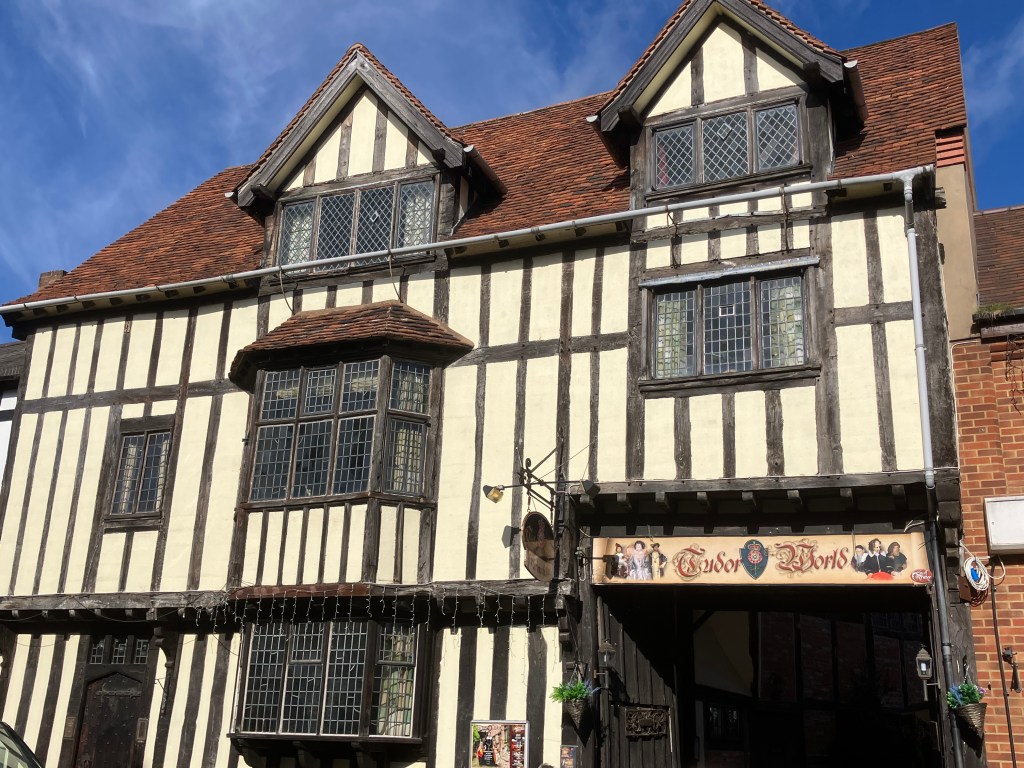
Tudor World
Less than a five minute walk along Sheep Street is this living, historical museum. Admission for adults is from £9 depending upon which activity you wish to book.
The museum, housed in a beautiful 16th century Grade 2 listed building, offers visitors the opportunity to experience Tudor England through historical settings. They also offer Walking tours with William Shakespeare and ghost tours allowing you an opportunity to experience the more sinister side of Stratford-upon-Avon!!!
Alongside the museum there are other fine examples of Tudor buildings before you double back to walk to the Royal Shakespeare Theatre.
The RST
My last visit to this theatre was way back when hubby and I knew each other the first time so about 40 years ago. It’s definitely changed since then!
This newer theatre with it’s 1040 seats was officially opened in March 2011 by Queen Elizabeth and Prince Phillip and is referred to as a ‘one room’ theatre allowing the audience and actors to be close together in the same room, giving a more intimate experience as it was in Shakespeare’s day.
In addition to the theatre, itself, there is a Rooftop Restaurant and Riverside Cafe and Terrace and to the right you will see the 118 feet tall tower which allows for fantastic views of the town and countryside.
Walking past the theatre and then turning right into Chapel Lane, you walk to the end and then turn right into Chapel Street. Immediately on this corner you will find….
Shakespeare’s New Place
Shakespeare moved here in 1597 and it became the new family home. He remained here until his death in 1616 but unfortunately the house was demolished in 1759 by the then owner -Reverend Francis Gastrell. It was said it was an action of spite after Gastrell had upset the people of Stratford-upon- Avon who described certain actions of his as “cultural vandalism. His wife, for example, had cut down a mulberry tree in the garden that was said to have been planted by Shakespeare. He, himself, was irritated by the constant tourists coming to visit the house and garden and invading his privacy. He was also in dispute with local officials over taxes and the extension he had made to the garden. He was ultimately forced to move out of town and the demolition was in effect seen as his revenge!
As a result in place of the house there is now a registered garden that has been designed here to commemorate the importance of the site and allow visitors to make their own personal connection with Shakespeare.
The re-imagined site gives an impression of the scale of New Place and its relationship to the surrounding buildings, such as the neighbouring King Edward VI School and the Guild Chapel. Both of which would have been familiar to the young William Shakespeare.
To the rear of where the house once stood, you can discover the Great Garden. Once part of Shakespeare’s estate, this tranquil and beautiful garden displays sculptures inspired by Shakespeare’s writing.
The admission charge is £14.50 per adult.
Across the road from these gardens is the Guild Chapel which is still in use and provides services for the adjoining King Edward VI School. Hugh Clapton, a former owner of New Place, prior to Shakespeare, presented murals to the chapel which ironically William’s father -John was paid to whitewash away. These murals are now being restored in particular the mural of Doom over the chancel arch.
Shakespeare’s Schoolroom and Guildhall
This building is adjacent to the Guild Chapel and open daily, Entry into this beautiful 16th century building allows visitors to explore Shakespeare’s childhood. This building played an important role in William’s life. You are able to sit in the very room that William Shakespeare sat as a pupil in the 1570s. It would have been here that he first acquired an interest in literature that possibly led him on to become the world’s greatest playwright.
The museum claims to provide an interactive and engaging visitor experience as well as the Guildhall playing host to a series of rare medieval wall paintings and over 400 years of civic history of Stratford.
Admission tickets cost £13.50 per adult
Personally I was totally enamoured with the beautiful black and white timber framed exterior and length of this building. This is an era of history that I studied back in my senior school days and I enjoy looking at the architecture of this period.
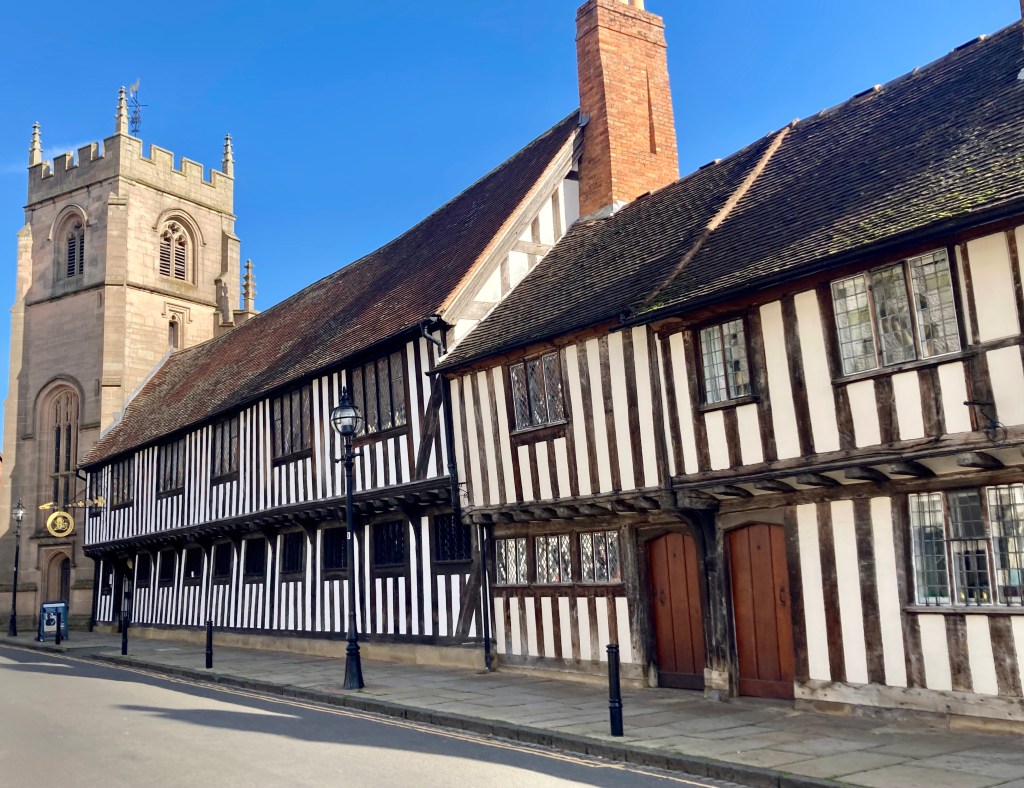
Leaving this behind we walked on down Chapel Street and took the next left into Old Town. As you walk down this road you will come across Halls Croft on your left. This was the home of William’s daughter, Susanna Hall and her husband, physician John Hall. The oldest part of the existing house was constructed in 1613, and therefore would have been newly built when the Hall’s took up residence. They only lived here for three years from 1613-1616 at which point, on the death of her father William, they moved.
Holy Trinity Church
From Susanna’s home it is only a five minute walk down the road to this church where the family attended services. This is the final destination on the walk we undertook and fittingly the place where William chose to have his grave. He died on his 52nd birthday -23rd April 1616.
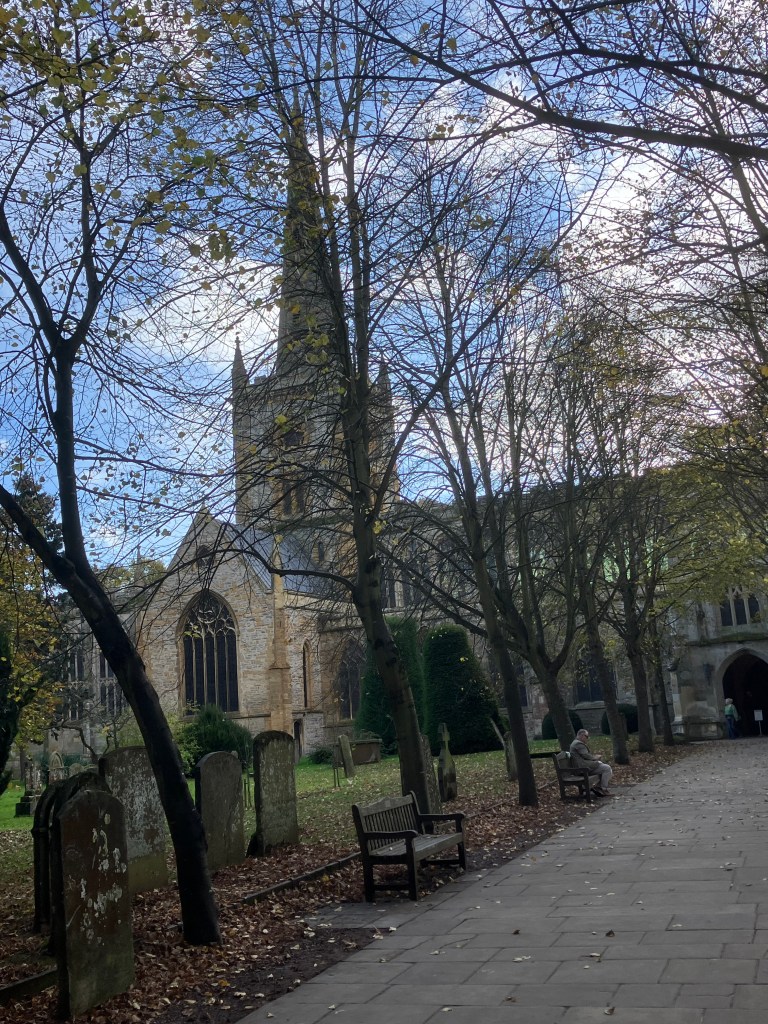
This was a period of history when relic hunting was very popular and, therefore, aware of his status as a leading writer he feared his bones would be dug up by one of the hunters. As a result Shakespeare insisted on having a curse as an epitaph on his gravestone which he himself wrote. The curse reads as follows:
Good friend for Jesus sake forbeare,
To dig the dust enclosed here.
Blessed be the man that spares these stones
And cursed be he that moves my bones
In addition it was unusual for anyone to be buried inside the church (rather than in the surrounding graveyard), but Shakespeare managed this by buying a tithe deed for £440 which gave him the right to have a grave in the chancel of the church and thus to also have his final resting place alongside other family members.
Five years after his death his son-in-law commissioned The Holy Trinity Bust – a monument to The Bard made by Gerard Jansen which stands above Shakespeare’s grave in the church. It was made while Shakespeare’s wife was still alive, so is generally thought that it is a good likeness of the great Bard.
There is a charge to view the grave of £5.
And thus ends our wonderful walk around Stratford. We had a lovely day and whilst we didn’t spend time and money in all the Shakespeare museums etc we left having fully appreciated this wonderful town that certainly holds its most famous resident in high esteem.
NB: This is the twelfth post in my series about the wonderful “Cotswolds”. This is an area of England that you really shouldn’t miss out on visiting if you are coming to the UK.
It’s full of olde world charm, history going back to the Roman era and beautiful architecture.
Check out previous posts in this series. Please don’t forget to comment and/or like.
Thank you
 A Midlife Adventure