As traffic to my blog increases I’m aware that a lot of my visitors/readers are not resident in the UK. I feel it is important, therefore, to write about quick trips that we have taken here which might perhaps be added to an itinerary on a future visit to these islands. I am also going to try and include ideas to decrease cost when I’ve used them.
This particular two day trip stemmed from firstly our Royal Horticultural Society (RHS) annual membership and secondly an offer that The Premier Inn Hotel brand sent me via email which advertised reduced rates for Sunday Evenings.
The RHS annual membership was purchased back in November last year for the reduced rate of £53.25. It has allowed me and hubby to enter the five RHS sites free of charge and to choose additional partner gardens to visit. There are over 200 to choose from, where I have free admission and hubby gets in either free, for a reduced amount or occasionally for full price.
Membership also gives you priority access to tickets for any of their famous annual Garden Shows, for example, the Chelsea Flower Show. See my previous post: https://amidlifeadventure.org/2024/05/31/top-events-to-attend-in-the-uk-chelsea-flower-show/
We booked the Premier Inn in Cobham for a Sunday in late August for £45, which to be frank is around the same price as a lunchtime meal these days and less than an evening out. Luckily the sun was shining as we left and made our way to the county of Surrey. With about 110 miles to cover it took us about 2.5 hours and we were soon parking up at our first destination at about noon.
Painshill
This astoundingly beautiful park created during the 18th century by Charles Hamilton is, for me, a real gem of a place to visit. Imagine ladies and gentlemen dressed in their long, Regency finery strolling the lakes. The ladies with their delicate lace parasols protecting them from the heat of the day and together with their male companion unpacking mouth watering picnics on the grass and you will start to understand what this 160 acre park has to offer. I’m not surprised it was used for the famous Netflix Bridgerton series.
Admission:
Parking is free, from where entry is just across the bridge over the River Mole. We paid for our tickets (aged 60+ concession) on line, in advance, which reduced the cost to £10 each. We were not able to utilise our RHS membership here but did use it on day two which I will write about and post next.
There are toilets directly inside along with Mr Hamilton’s Tea Room and the Gift Shop. Picnics are also permitted, which we had checked prior to arrival, and so armed with a coffee each we made our way to the covered picnic area. There was a small jazz band setting up their instruments as we took our seats and it wasn’t long before this area became quite busy.
You are issued with a map which allows you to decide upon the route you might want to take. There is an Accessible Route (approx 1.5 miles) marked on the map alongside the Historic Route ( 2.5 miles).
We began by following the accessible route to the south of the lake. Strolling alongside this serpentine lake was a lovely introduction to Painshill Park which is a leading example of the English Landscape Movement.
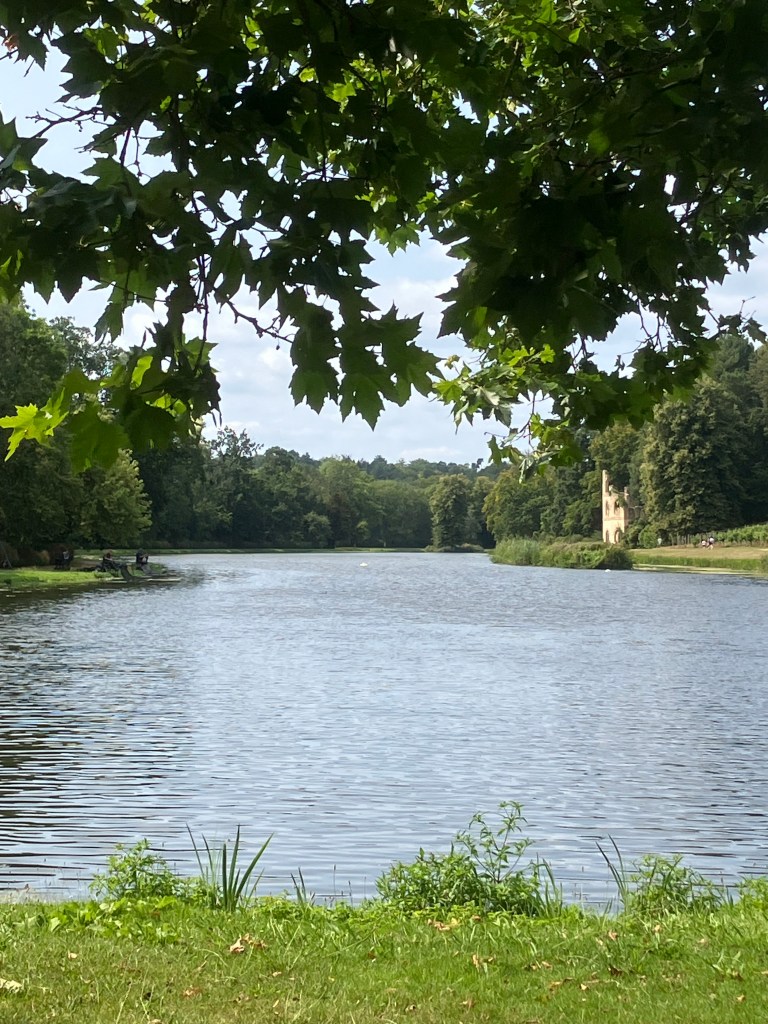
The building you can see on the right of the photo is the Ruined Abbey which stands next to the rows of vines which were replanted in 1992. When Hamilton prepared the landscape he placed buildings strategically throughout the park which were designed to be seen from different angles.
The Ruined Abbey:
Designed as a ruin and built in 1772, Hamilton wanted to add an element of history, reminding the visitor of the past. Back in the eighteenth century, monasteries and abbeys would often produce wine so the architecture complements the vineyard planted next to it.
Painshill was requisitioned during World War II and, as a result, Hamilton’s design was lost and the park fell into decay with many of the “follies” falling into ruin. Painshill Park Trust was formed in 1981 to restore the landscape to it’s 18th century design and Painshill was given Grade I listed status as a garden of international importance.The Ruined Abbey was actually the first building to be restored . More information about the park’s history is available on their website.
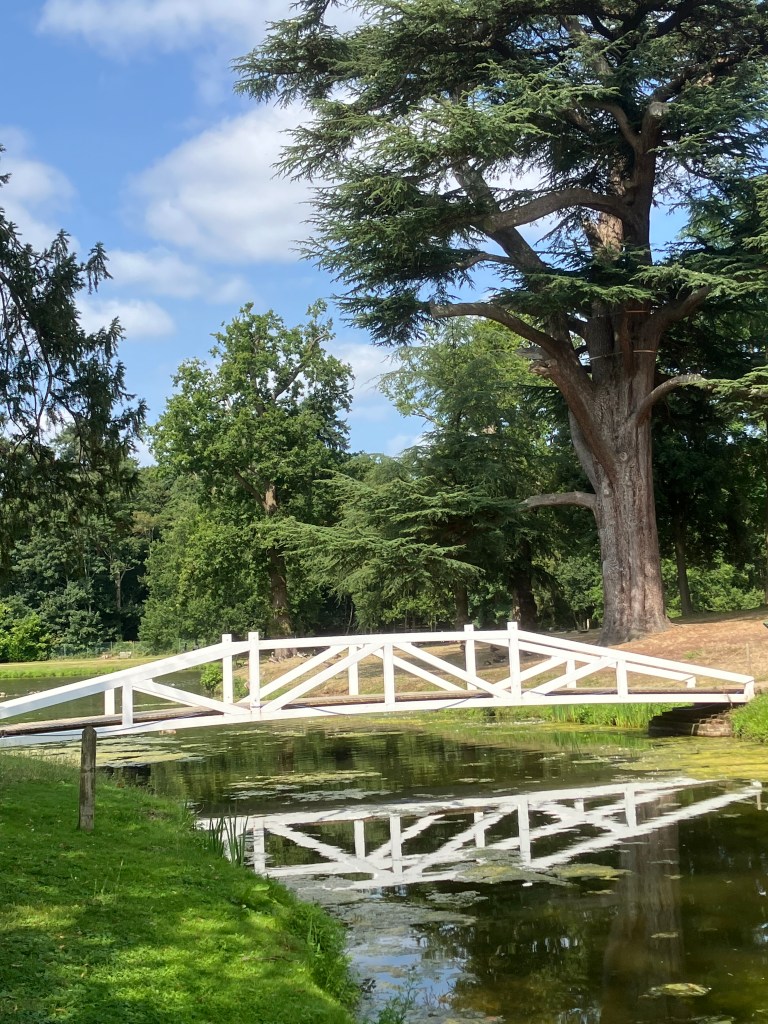
Continuing on our walk we strolled past the Chinese Bridge which was visible on our right and is currently under restoration, followed by the Woollett Bridge, pictured above, which was restored and reopened in December 2022. Hamilton certainly had a knack of placing his bridges at points where the water reflected the image back to you.
From here you can meander along past the Ruined Roman Arch on your left which still awaits restoration.
Five Arch Bridge:
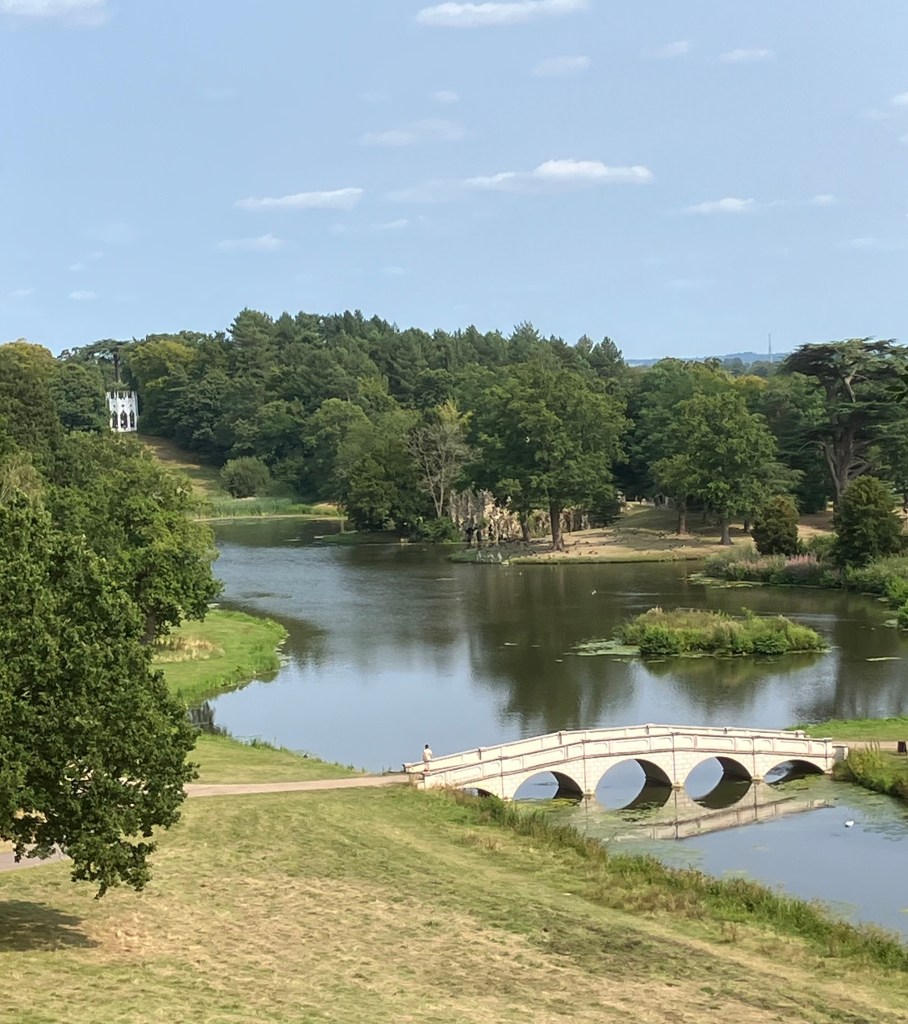
Further along, on your right, this bridge is known by modern visitors as the “Bridgerton Bridge” due to it being a location in the hit show. This, in turn, means it’s quite hard to get a good photo due to the amount of visitors who want a photo taken on it. I was fortunate, however, later in the afternoon when numbers decreased to manage to snap it from afar. It definitely adds an element of romance to the landscape.
Water Wheel:
At this point we moved onto the Historic Trail and made our way past the end of the lake to the Water Wheel. The 14 acre lake we have just walked past is filled by raising water from the adjacent River Mole. This water flows out of the wheel entering the lake at the cascade.
The wheel was originally constructed by Hamilton from timber and his plans are on display inside. It was then replaced in the 1830s with the Bramah Wheel, made in cast iron and at 10.6 metres in diameter, it is one of the largest working wheels in the UK. In 1987 the Bramah Wheel was repaired and the pump house, which had been neglected while Painshill was lost, was rebuilt.
Gothic Tower:
Walking on through the Alpine Valley you reach a fork in the path. If you take the left turn you meander up through the Hermitage until you reach the Gothic Tower, poking above the Alpine wood of evergreens and standing proudly in front of you.
You are now at the park’s highest point and can climb to the top up the narrow 99-step circular staircase.
Built in the 1750’s, in the style of a medieval watch tower, it is 27 meters tall. Hamilton hoped to create a fairy-tale castle emerging from the trees below. On a clear day four different counties can be viewed from the top and sometimes even Canary Wharf and Windsor Castle.
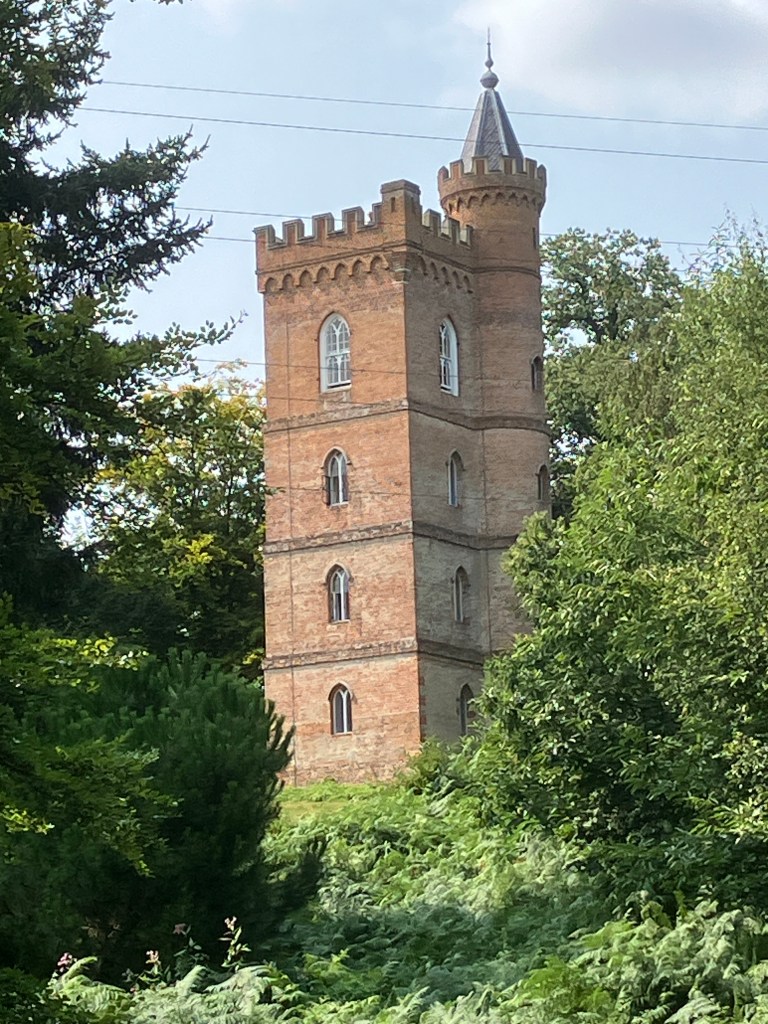
Leaving the tower behind we descended down the path whence we had come and at the first junction turned left following the path through the Elysian Plains. Still following the Historic Route you are now heading back on the opposite side of the lake.
Temple of Bacchus:
The Temple of Bacchus was originally designed and built in the style of classical architecture in 1762 and housed Hamilton’s collection of antiques along with the statue of Bacchus and twelve busts of Caesar. The Statue of Bacchus, which stood on a pedestal in the centre of the room, had been brought back by Hamilton from his Grand Tour. The ceiling was originally decorated with motifs of vines to highlight Bacchus as the God of Wine.
The contents of the temple were sold in 1797 and the temple was left to ruins with only the footprint remaining surrounded by thick undergrowth.
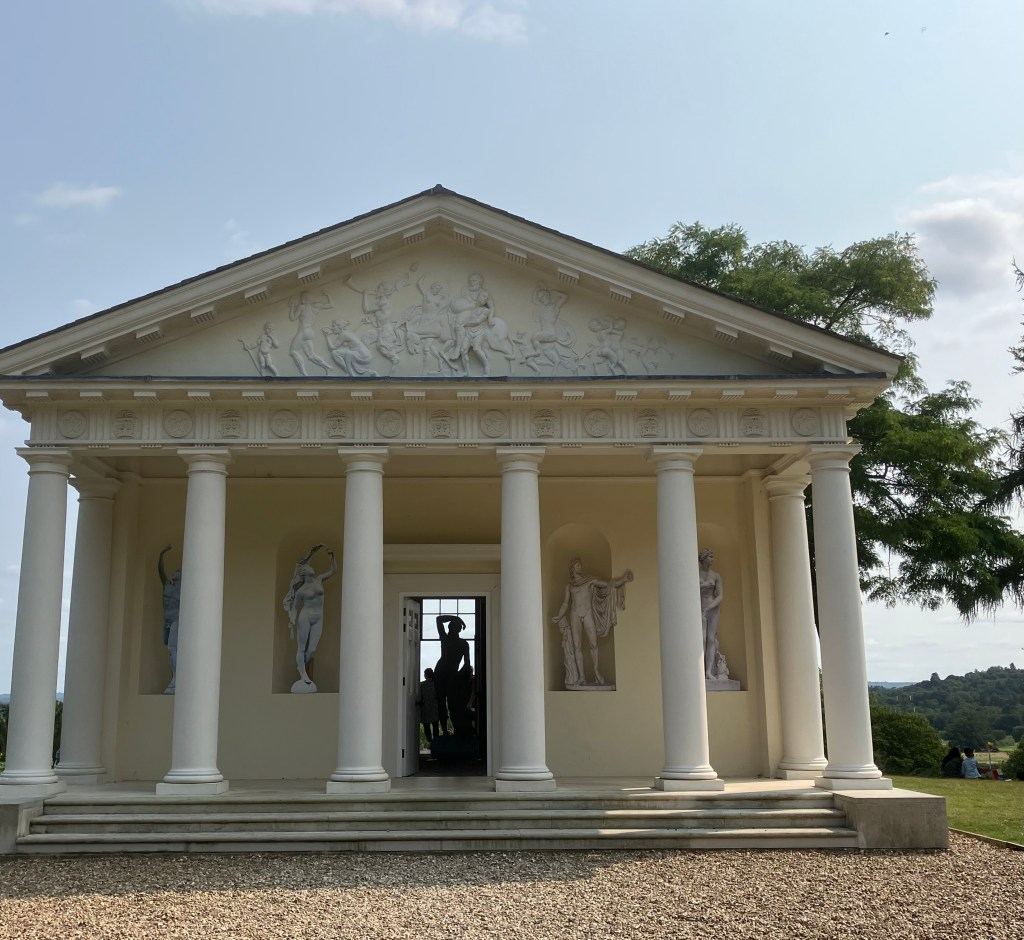
This beautiful building which has now been restored externally with the interior still being worked upon sits atop the hill allowing you to marvel at the vista of the Surrey Hills. The flower borders have also been restored and strategically placed seats allow you to savour the scents.
The Turkish Tent:
Following the path you soon come upon the Turkish Tent, possibly the oddest structure, in my opinion, created by Hamilton. Built in 1760 and originally built from brick, wood, canvas and papier mache, this was originally the final spot on the historic route. 18th century guests would have finished here at the Turkish Tent and stopped to admire the view.
Hamilton was keen to ensure that his guests and visitors were given the best possible opportunity to admire the landscape or living painting in front of them regardless of the time of day or season. It was said to be his favourite vista at Painshill and he even pondered upon the idea of building a house here although he apparently changed his mind.
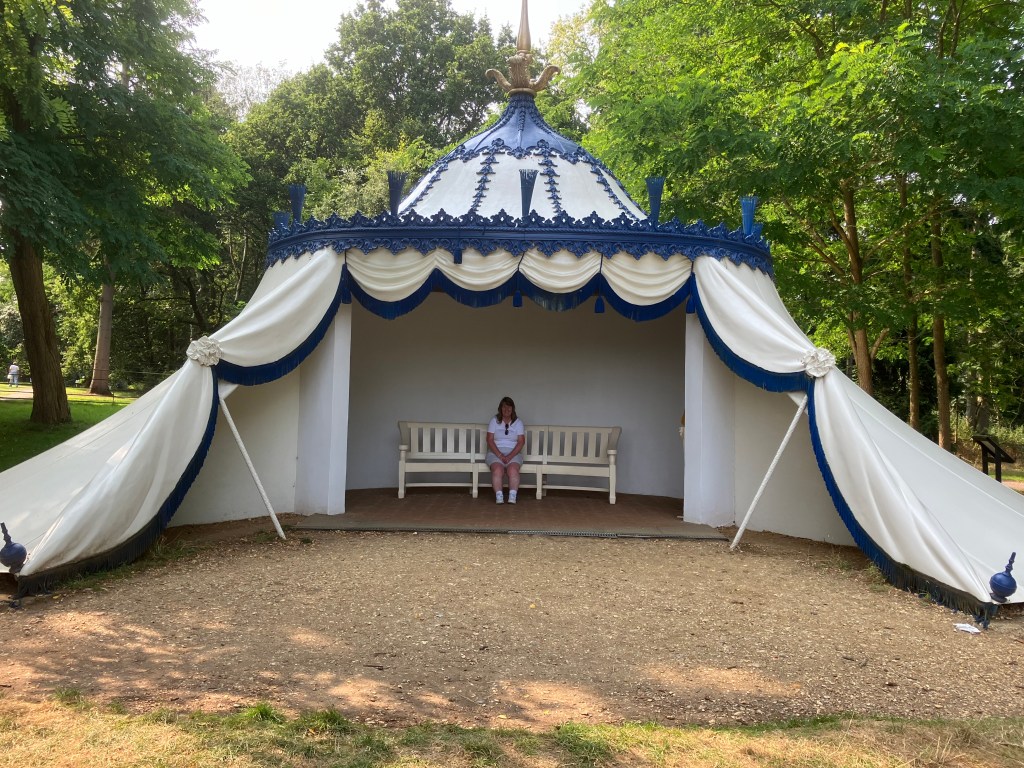
All that remained after the estate dissolved into rack and ruin was the brick floor. The building was restored in the 90’s and is made of brick, wood and fibre glass to ensure it continues to survive.
From here we made our way down to the Arch Bridge, where you can then continue on the Accessible Route back along this left hand side of the lake. We, however, crossed over the bridge and retraced our steps to the Woollett Bridge in order to access the grotto.
The Crystal Grotto:
For the majority of visitors this is undoubtedly a highlight of any day out at Painshill. The Crystal Grotto is included in your entry but is sometimes closed for maintenance so it is worth double checking before embarking on a trip here.
To wander through here and actually take on board that nothing you are viewing is actually real is quite awe inspiring, it is an incredible man-made feature.
We were fortunate to visit towards the end of the afternoon and so there were very few people around which made it even more special. It felt very serene and quite magical with bubbling water, a very natural looking cave and stalactites covered in sparkling crystals. Imagine what Hamilton’s 18th century visitors must have thought!
It was so cleverly designed that on a sunny day, shafts of light pierce the interior through carefully placed openings in the ceiling. The light then bounces off the coral pools and lake water making the crystals sparkle.
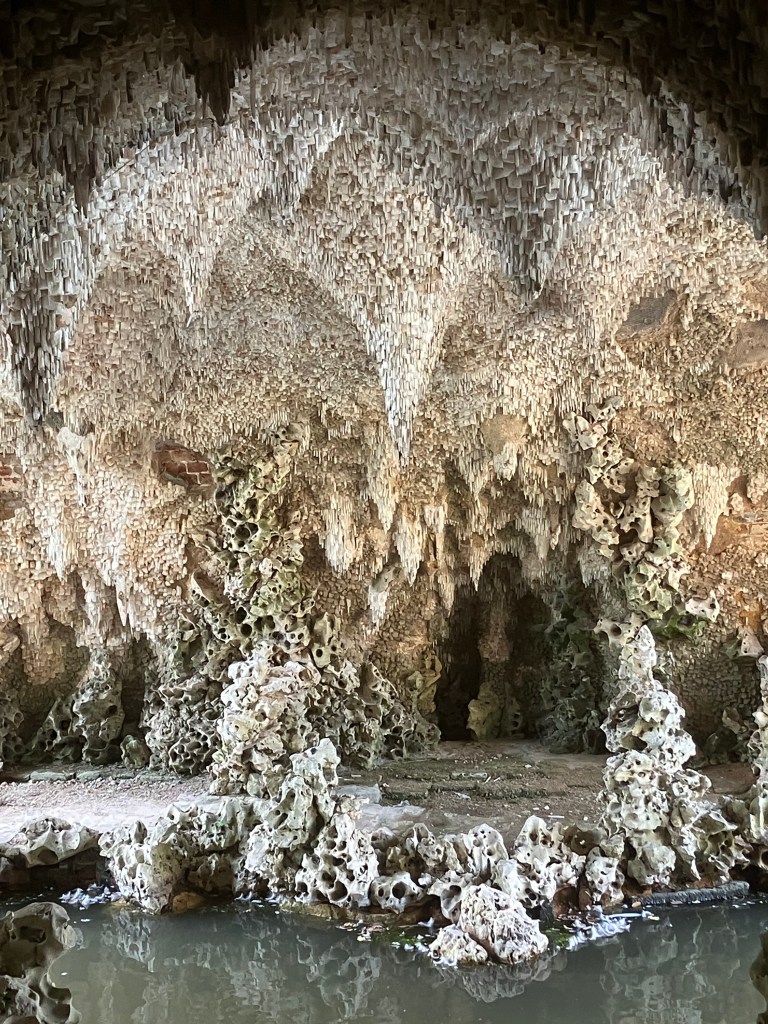
Following the path we left the grotto behind and made our way across the Chinese Bridge, which is currently under restoration and uphill through the trees.
The Gothic Temple:
Back in Hamilton’s day this was the first stop on his walking circuit for visitors so not surprisingly it offers one of the best views in Painshill. Made originally from wood and rendered to look like stone this is exactly how it was restored.
Cleverly designed this ten-sided folly has five sides panelled in order to direct your eye to the open archways. They, in turn, frame the view including many of the features we have seen today including the lake, the Grotto, the Turkish Tent and the Five Arch Bridge.
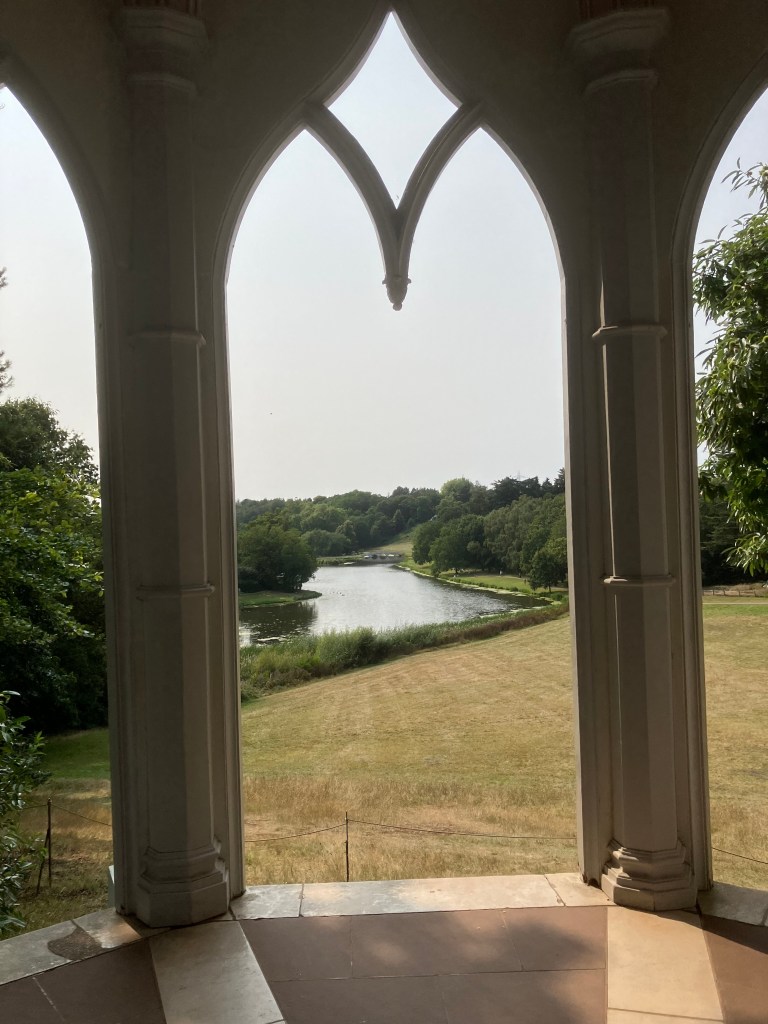
Whilst this had been Hamilton’s first stop, for us today it was the final point at which to look back and admire everything that he had designed. What an astoundingly creative and imaginative man he must have been. We thoroughly enjoyed our visit and left feeling as if we had walked back through history.
NB:
Since my visit last year to Keukenof in Holland
https://amidlifeadventure.org/2023/05/12/keukenhof-beauty-imagination-and-inspiration/
it has sparked an interest in me to visit other beautiful spaces. As hubby loves to photograph flowers, bees, birds and just nature as a whole it gives us an opportunity to take some time out and just appreciate the calm that such spaces can give you.
This is my fourth post in a series about Gardens in England and Wales, why not check out the other three that I’ve previously posted and share with me on the comments any that you would recommend for us.
 A Midlife Adventure
One thought on “Gardens of England and Wales – Discovering Painshill Park, A Hidden Gem in Surrey”