In my previous post I explained how we had set off for our two day adventure in Surrey and visited Painshill Park. We had secured a great deal for an overnight stay at the Premier Inn in Cobham which, I have to say, was lovely and quiet and had pleasant surroundings.
Refreshed we set off the next day to visit the Royal Horticultural Garden at Wisley in Surrey.
As previously mentioned we joined the RHS back in November 2023 and have found it to be a worthwhile annual membership both in order to get free access to their own five gardens situated throughout the UK and also to get discounted entry into over 200 partner gardens. The sun was starting to peak out from behind the clouds and we arrived fairly early at 10 am in the hope that we would not get too caught up in the crowds.
History:
The garden was founded in 1878 by Victorian businessman George Ferguson Wilson, who established the “Oakwood Experimental Garden” on the site. Purchased in 1903 by Sir Thomas Hanbury it was then gifted by him to the RHS.
It is one of the UK’s most visited gardens, attracting around one million visitors annually and covers some 240 acres. The gardens feature some renowned plant collections, glasshouses, and RHS Hilltop which was opened in the summer of 2021. This is the Home of Gardening Science, a state-of-the-art science building surrounded by three spectacular new gardens that embrace the latest ideas in horticulture.
Finding Your Way Around:
Armed with the official garden map the first thing we did was to grab a coffee and a seat and decide on the best route to follow to successfully circumnavigate the gardens ensuring we saw everything we were interested in.

Old Laboratory and Jellicoe Canal
We began our exploration here with the beautiful Grade II-listed Old Laboratory building which was purpose built, as a training hub for horticultural students, back in 1907. The exterior of the building has been recently repaired and the new landscape to the front of the building certainly filled me with a great first impression. From here you can also see the beautiful Jellicoe Canal which houses the second largest collection of water lily cultivars.

The Wisteria Walk and Mixed Borders:
Catching sight of the Wisteria Walk it was hard not to be tempted to stroll across the Conifer Lawn and under the beckoning archways. Obviously we had missed the actual blooming of the wisteria but even so the borders alongside were resplendent with colour.
Open since May 2018, the Wisteria Walk is 245ft long and 10 ft wide and linked us to the impressive Mixed Borders.

Strolling along the Broadwalk with flowers of all colours and hues filling the borders, on our left, you cannot help but be reminded of more historical times when walking on a sunny Summer’s day was seen as a great pleasure. It proceeded television and computers and was beautiful in it’s simplicity.

Battleston Hill:
The walk slopes upwards towards Battleston Hill and the 420 ft long horticultural wonder is broken up by simple pieces of sculpture, finally reaching the magnificent horse’s head at the top. The sculpture is changed every two years but acts as a wonderful focal point as you walk ever closer.

Whilst we didn’t wander through the woodland garden the winding paths do allow you to explore plants from far-off climes. It is planted to provide year-round interest from the colour splash of camellias, magnolias, rhododendrons and azaleas in the Spring to the agapanthus, lillies and hostas in the summer months. Autumn sees wonderful foliage not least that of the delightful acers and then even in the winter wondrous barks and winter flowers abound.
We made our way back down the Broadwalk diverting off to our left to explore the Exotic Garden.
Exotic Garden:
Created and opened in 2017, this garden was actually designed by the on site Garden Team showcasing plants that have a tropical look and feel, but still flourish outdoors in a typical UK summer.
It certainly adds something different to a traditional English landscape with large leaf palms, bright colourful flowers and bananas existing alongside vibrant dahlias and gingers. During the Winter months many of the plants remain in situ with thick mulch protecting the gingers and a protective layer of straw being placed around the bananas, for example, to stop their stems freezing.
I’m a sucker for a waterfall or fountain and particularly liked this one in the centre of this unique garden.

Moving further along we then explored the Cottage Garden, again on our left.
The Cottage Garden:
Laid out in the early 1990’s by Penelope Hobhouse, the Cottage Garden has quite a formal layout but maintains an English cottage garden feel and certainly inspires ideas to take back home.
I particularly liked the central water feature and the eight 10ft tall pergolas which support climbing plants, a great way to section off areas within your own garden. An avenue of sixteen cherry trees flank both sides of this garden that is full of herbaceous perennials, shrubs and bulbs ensuring that every season has some colour to offer.
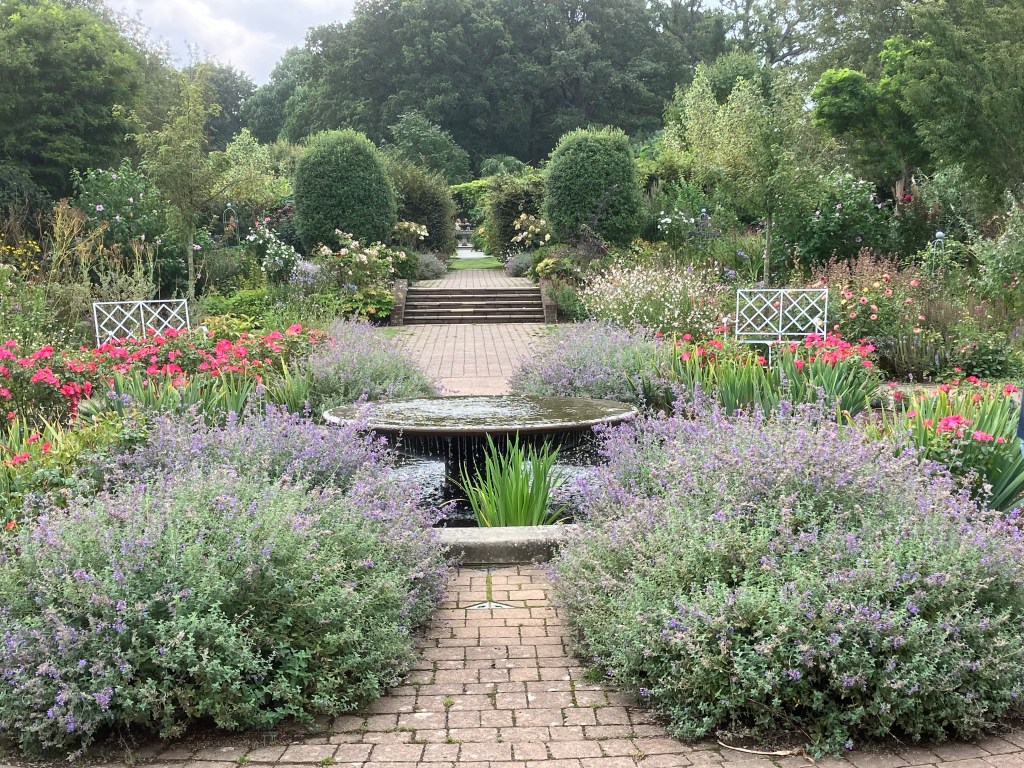
From here we headed away from the Broadwalk and into the rose garden.
The Bowes-Lyon Rose Garden:
I have to admit I’m a bit of a traditionalist when it comes to rose gardens. I love to wander around borders crammed with rose bushes displaying an array of colours and that all too familiar exotic scent.
This rose garden, which began life in 2007, has more of a contemporary design, with roses flowering amongst an array of herbaceous plants, bulbs, perennials and evergreen shrubs. Blue agapanthus caught my attention but I still felt starved of quintessential roses.
The Viewing Mound:
With tummies starting to rumble we headed uphill from here to the Viewing Mound. A great vista is revealed from walking to its summit alongside the colourful butterflies floating above the lavender and the constant buzz of the bees enjoying the nectar.
A winding path takes you back down the other side through the Oudolf Landscape.
This new, redesigned landscape opened in May of this year, allowing visitors to wander through borders of flowers and foliage whilst descending ever forward to the Glasshouse clearly visible on the horizon.

The Glasshouse:
We took a break before entering the Glasshouse and bought lunch in the adjacent cafe enjoying the luxury of being able to sit outside in the sunshine.
A Glasshouse is always a must do in any large garden and this is no exception. With three different climates all under one roof from the heat of the topics to the moist temperate cloud forest and finally the dry semi-arid and desert environment.
This huge cathedral-like Glasshouse, covers an area equivalent to ten tennis courts and rises to 40ft in height. With many difficult to grow, rare and endangered species available to view alongside tree ferns, tall palms, creepers and wonderful flower displays your senses are certainly awakened.
The East side is shadier, heated to 8–12°C and kept humid which allows the growth of a range of species native to the southern hemisphere. Australasian tree ferns, South American climbers, pitcher plants from North American bogs, South African lilies and Asian gingers all abound. The impressive waterfall is not to be missed and adds to the subtropical feel whilst also creating a moist, cloud-forest atmosphere.

The Dry temperate zone is not as richly planted but still offers a diverse range of tough, slow-growing, often prickly plants such as desert cacti and succulents adapted to conserve every drop of moisture. Species from Chile to South Africa, Madagascar to Australia all thrive alongside each other..
The Tropical zone is needless to say hot and steamy with plenty of lush plants including bananas, bromeliads, palm trees and fast-growing climbers. Alongside these are familiar houseplants growing to their natural sizes, such as the Swiss cheese plant and fiddle-leaf fig. This area is full of huge leaves, extravagant flowers and fast growth – in fact, plants here need regular pruning to keep them to size!
There is also a warm jungle pool with tropical waterlilies and other aquatic and wetland plants which thrive in this environment.
Above you is a viewing platform which you can climb in order to admire this wonderful display before moving onto the Orchid House.
I’m a massive fan of orchids, often rescuing those left to wither and being discarded by friends and family. My oldest orchid was given to me as a present in 2005! A visit to an orchid house is, therefore, something I’m not likely to miss.
Wisley has a collection of over 3,000 orchids which they have been collating since the 1980’s. Many familiar “supermarket” favourites live alongside more rare species such as the large orchids standing at an impressive 2.5 m tall which have been in the collection since 1991!
The Rock Garden:
Leaving the Glasshouse behind we wandered back towards the exit stopping at the Rock Garden en route. Attracted by the twisting pathways and little pools linked by streams and cascades I was intrigued to explore.

This is actually one of Wisley’s oldest features. It was constructed between 1910 and 1912 and showcases a wide range of alpines and other plants that flourish in alpine conditions, alongside small weeping trees and dwarf conifers. Some of the Rock Garden’s original features still exist, including a grotto where ferns such as the ostrich fern and cinnamon fern still flourish.
Leaving the Rock Garden behind it was time for us to depart and drive home. We really enjoyed our day and there is definitely more to explore. It’s one of those gardens where every revisit would highlight another marvel that you will have missed before.
One of the key highlights of any RHS garden that I love is that you can ask the staff on duty about the various plants or seek advice from them when you are a fairly inexperienced gardener, like myself, just starting out on your quest to create your own unique and wondrous garden space at home.
There is so much inspiration I always leave with a mountain of photos and feeling relaxed and happy having spent a glorious day in such a beautiful space.
NB:
This is my fifth post in a series about Gardens in England and Wales, why not check out the other four that I’ve previously posted and share with me on the comments any that you would recommend for us.
 A Midlife Adventure
2 thoughts on “Gardens of England and Wales -Top Attractions at RHS Wisley”