Having spent seven days on Barbados and wanting to experience a smaller, less commercialised island we headed to the airport and caught a Caribbean Airways flight to Grenada. Considered one of the top ten safest islands in the Caribbean we were welcomed to the island with fantastic sea views as our plane landed off the Caribbean Sea and hit the runway with continuous views of the beautiful azure waters to our right.
Introduction and Origins:
Historically Grenada was inhabited by the peaceful Arawak Indians before the Carib Indians took over by force. Then when Christopher Columbus sighted the island in 1498, he named it “Concepción”. The island, however, remained uncolonized for over a century due to the Caribs’ resistance.
In the 17th century, French settlers established a colony here and the island became a key producer of sugar, and then later nutmeg and mace. Control then shifted between France and Britain until finally Grenada was formally ceded to Britain in 1763 under the Treaty of Paris.
Grenada then went on to become a self-governing state in association with Britain in 1967 and gained full independence on February 7, 1974.
Unfortunately post independence, in 1979 the island experienced a left-wing Government bloodless coup. This led to strained relations with the US and it’s allies culminating in 1983 with the US invading Grenada following the overthrow and execution of Prime Minister Maurice Bishop, leading to the reinstatement of the 1974 constitution and free elections in 1984. The island is now a member of the Commonwealth and continues to be involved in international affairs.
English is the country’s official language but, if like us, you occasionally struggle to understand the local people outside of the main tourist areas, it’s because the main spoken language is one of two creole languages: Grenadian Creole English and, less frequently, Grenadian Creole French or ‘patois’ which reflects the African, European, and native heritage of the nation.
Today Grenada’s economy relies heavily on agriculture, particularly spices and also tourism. It is a main stop off point for cruise ships with hundreds of passengers being dispensed daily, Monday to Friday, onto the shores of the island. The island still maintains early closing on a Saturday and the majority of shops are closed on Sunday.

Grenada is nicknamed the Island of Spices with an endless amount of independent stalls being set up to tempt visitors into buying a souvenir. Nutmeg, cinnamon, cloves and cocoa are grown in the country for export, along with various vegetables and fruits. Spices are such an important part of the island’s heritage that nutmeg even features on the island’s flag.
Interestingly every third resident of the state is a fisherman and the island exports tuna to the US and Europe.
The currency is The East Caribbean Dollar although prices are also often quoted in US Dollars to accommodate the US Cruise ships.
Geographically the island is 21 miles long and 12 miles wide and in 2023 recorded a population just over 117,000. Grenada is made up of six parishes of which St George’s in the south west is the main tourist area and includes both the capital city and international airport.
They drive on the left hand side of the road, most hire cars are automatic and whilst the roads are quite narrow and can be very steep they are reasonably well maintained. Look out for the bus drivers though who seem to compete with each other to reach the next bus stop quickest! I just pulled over and let them go by.
One of the island’s most famous residents is Sir Kirani James who was born in Gouyave in the north west of the island. In 2011 James won the 400m at the World Championships in a personal best of 44.60 seconds, becoming the youngest 400 metres world champion at the age of just 18. The following year in 2012 he took the gold medal in the 400m final at the London Olympics in a time of 43.94, a national record, earning Grenada its first-ever Olympic medal and becoming the first non-US runner to break the 44-second mark. He will forever be famous on the island with the new athletic stadium in St George being named after him.
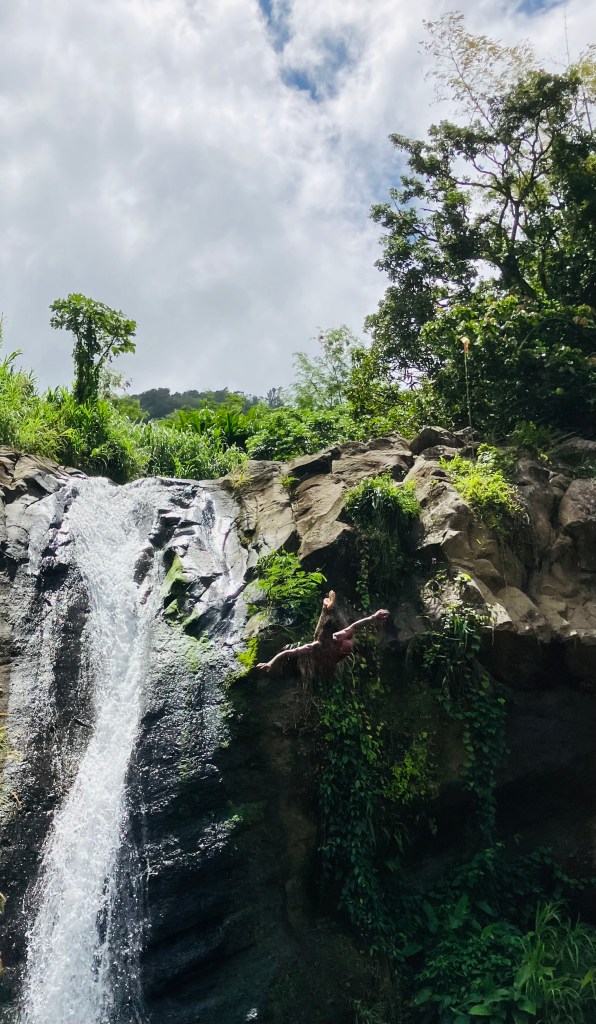
In conclusion the island is a haven of rolling hills drenched in rainforest and waterfalls. We visited both Annandale and Concorde Falls- the latter being our favourite. Be prepared for the locals diving off the top in exchange for a cash donation!
The island disappointingly for us was very lacking in wildlife. Grenada definitely felt a little more ‘undiscovered’ than many of the Caribbean islands although the people were incredibly friendly, welcoming and helpful.
Top Three Must-Do Experiences:
Over the next couple of posts I will give you my personal highlights from our trip to the island starting with……
Go To The Beach and Explore The Caribbean Sea:
No trip to Grenada is complete without a visit to the beach.
If you are looking for sun loungers and umbrellas then the best place to go is Grande Anse. With two miles of beautiful white sand and the transparent waters of the Caribbean it is definitely a beautiful place to relax.

Quick Tip: Try and sit away from the wooden jetty, which is just in front of the Spice Market because this is where all the cruise ship passengers are dropped off starting at about 10 a.m. They are greeted by what seems like two separate groups of locals vying for their trade and leading them left or right to empty sunbeds. To be fair the cost of the sunbeds etc are pretty static regardless of where you decide to sit.
Other locals will offer to bring you drinks and food from the market but be aware prices are higher than if you venture there yourself. They are very friendly and do not take offence if you do not take up their offer.
The water is warm and inviting with smooth sand underfoot most of the way out. I spent time snorkelling and happily saw a variety of small to medium fish.
If you are based in this south west area and want somewhere less crowded and where you are happy to DIY, throw down your towel and bring your own picnic then venture around the headland to Morne Rouge / BBC Beach or Magazine Beach.
If you have a hire car and wish to venture out around the island then try Levera Beach and Bathway Beach which are both in the far north east of the island. Again these are DIY beaches.
If you fancy combining one or both of these with a full day out then it’s worth contacting the Petit Anse Hotel and Restaurant. They have an organised three mile walk on Sunday Morning through David to Duquesne Bay. You then get picked up and taken back to the hotel and can stay to partake in their weekly BBQ before heading out afterwards by car to spend the rest of your day on the beach.
On my next post I’ll be chatting about getting under the sea to the famous Sculpture Park……………..
 A Midlife Adventure
2 thoughts on “Discovering Grenada: The Spice Island of the Caribbean”