Having discovered the key points of interest in the main city of Rotterdam
https://amidlifeadventure.org/2025/05/09/exploring-rotterdam-a-guide-to-its-must-see-attractions/
We caught the metro to Marconiplein which took us about twenty minutes. Alighting at the metro station we headed down Schiedamseweg towards the Aelbrecht Waterway and it wasn’t long before we came across an example of the modern art that I had previously mentioned the city of Rotterdam was famous for:
“A sign of its modernity is its love for unconventional art. The city reserves space for experimental artwork standing out maybe for its size or even its subject”.
On the right hand side of the road standing tall and proud is the:
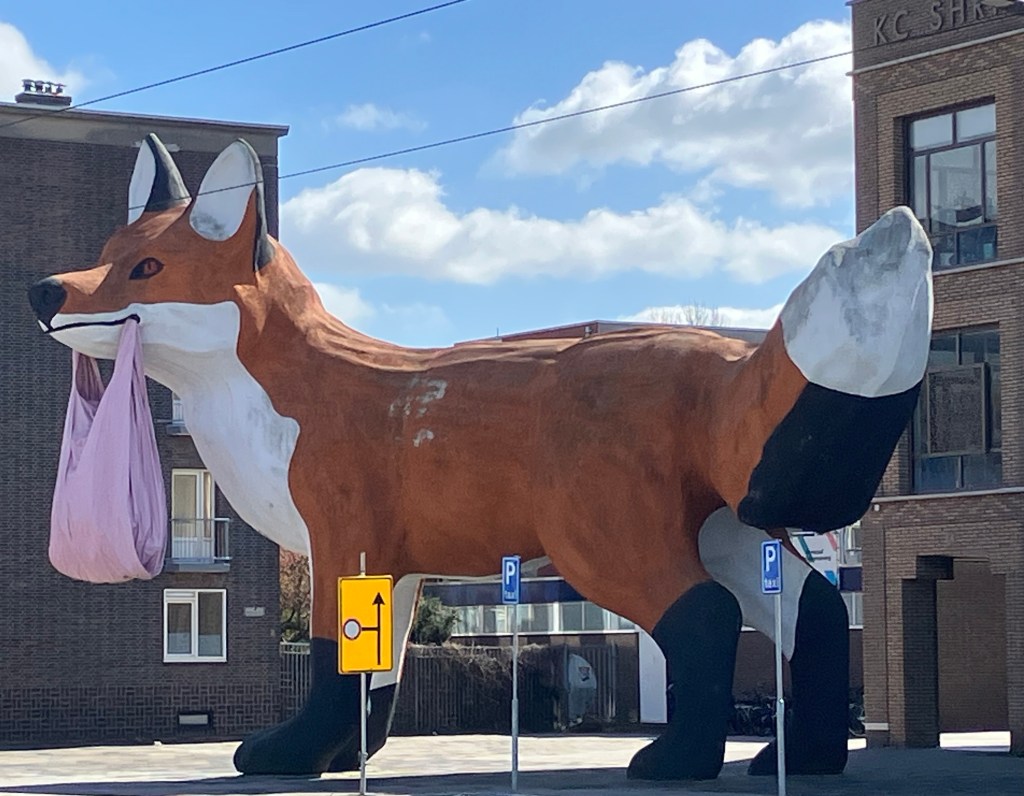
Bospoldervos by Florentijn Hofman erected in 2020.
The Forest Polder Fox, as it is known, stands 10 meters high and measures 16 meters in length and holds a large plastic bag in its mouth. With the increasing visibility of foxes in urban spaces Hofman wanted to create a connection between the city and nature whilst also commenting on the ban on plastic bags. To give you some idea of the scale of the Fox the photo below shows genuine road signs alongside!
Schiedamseweg Shopping Street:
Walking along this one mile street which stretches from the metro station all the way to the Aelbrecht Waterway we were met with an assortment of both splendid architecture and an example of Rotterdam’s broader demographic profile. This is a diverse area with a significant ethnic mix.
Built in 1910 the Schiedamseweg connected Delfshaven and Schiedam with beautiful Neo-Renaissance style buildings. These still remain on the east side of the road but the west side is far simpler in build. The reason for this is that in 1943, during the war, this side of the street fell victim to bombing, leading to the loss of around 400 lives and leaving approx 16,000 people homeless. Post the war, in the 1950’s reconstruction took place but alas the original architecture was not replaced.
Being fans of architecture we couldn’t fail to stop and admire the buildings still remaining.

Aelbrecht:
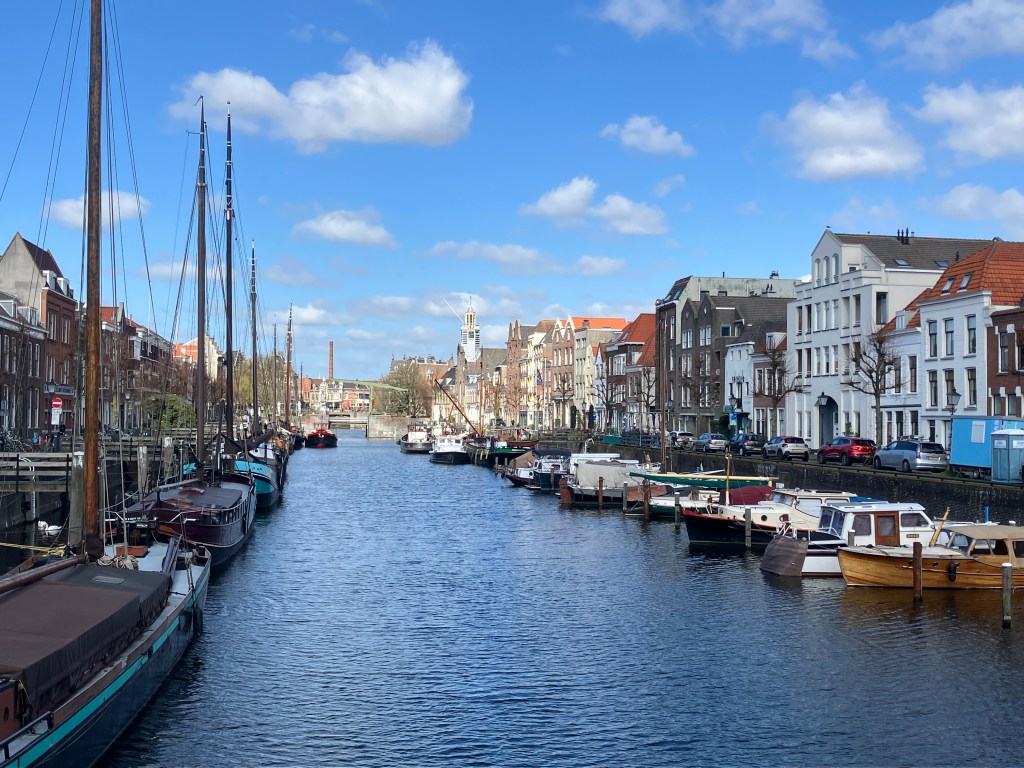
Reaching Aelbrecht we were immediately met with not just a picturesque panorama but also a real sense of tranquillity. This area is a former canal-lock, built in the 15th century with the original lock situated where today’s Cafe De Oude Sluis is sited. Reflecting the rich maritime history of this area this cafe is a lovely place to pop into, particularly on a sunny day where you can while away time sipping on a drink or partaking in some food whilst admiring the surrounding architecture and watching life meander by on the canal-side.

Also on view here, in the far distance, is the historic Voorhaven or Outer Harbour which was built in 1389 as part of the the construction of the Delfshaven Waterway between Overshoe and the Nieuwe Maas, functioning as the outer harbour for the then inland city of Delft.
We walked along the right hand side of the canal soaking up the pure history of the area and catching a glimpse of life on the water from the many boats moored alongside.
Reaching the end of the pathway you have to look back from whence you have come and just soak up the view.
“The Distilling Kettle Mill”
This windmill stands at the end of the canal and is the only surviving windmill in the city of Rotterdam. In order to access it you need to turn around, walk back and cross over the water via the first bridge and then turn right to walk to the end of the opposite canal path.
The windmill was originally built in 1727 to grind malt for the distilleries with an upright cylindrical tower standing 10 meters tall, it is constructed from stone and topped with a cap. Whilst it was partially destroyed during the bombing of 1940 it was restored by local citizens in 1986.
Since 2018 the windmill also has a small shop inside where you can gain access to views of historic Delfshaven and Rotterdam from the upper deck for a small fee. It was unfortunately shut when we visited on a Monday but is open Wed-Sat from 11-6 pm
Leaving the windmill behind we strolled along the canal path heading back towards the start of our walk.
The Pilgrim Fathers Church:
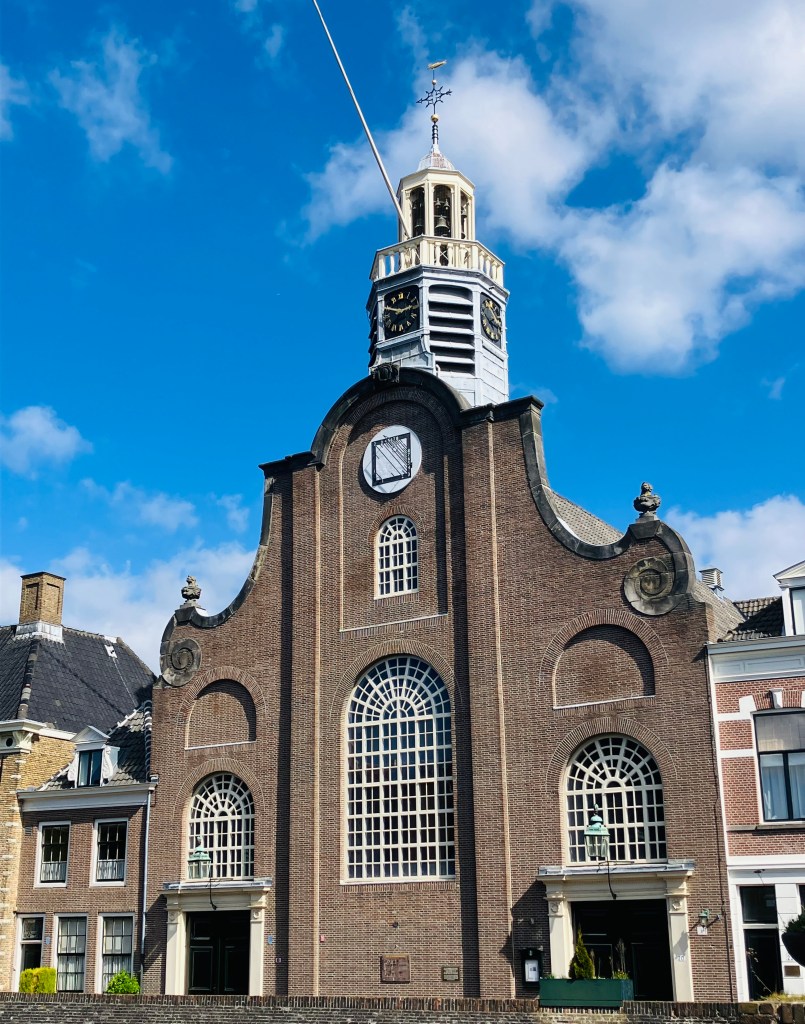
En route we came across the above church whose origins date back to 1417 when it was consecrated as a Roman Catholic Church. During the Reformation of 1574 it changed to a Protestant Church.
In 1608 a group of English Dissenters left England to form their own religious group, making their home in Leiden where they lived for eleven years and became known as Pilgrims.
In 1620 this group gathered on the dock here, adjacent to the church, and prayed for a safe voyage, setting off for America in the ship “Speedwell” with the aim of reaching this new land and being able to worship freely whilst maintaining their English identity. Their plan was to meet the Mayflower at Southampton in England en route but unfortunately the Speedwell developed leaks and thus the group had to leave the ship and join other Pilgrims aboard the Mayflower. Together they left Plymouth in Devon on 21 August 1620 disembarking five months later at what then became Plymouth, Massachusetts, where they established the Plymouth Colony.
The church was later renamed by American visitors “The Pilgrim Fathers Church”. You can visit the interior of the church and read more about it’s history and admire the stained glass windows should you wish.
Other points of interest along this side of the canal include the Dutch Pinball Museum and the De Pelgrim Brewery but we didn’t stop off here.
Piet Heynstraat and the Monument of Piet Heyn:
We finished our walk by taking a wander along Piet Heyn Street, a small but historic street where the 17th century Dutch Admiral Piet Heyn was born in 1577 at number 6. The street is only about 50 meters long and ends at the Piet Heyn Square where there is a statue to commemorate the man himself. Piet is famous for his naval career including his triumph over the Spanish in 1628 when he captured a large part of a Spanish treasure fleet which transported huge amounts of gold and silver from Spanish America to Spain.
Although Delfshaven is a fairly small area of Rotterdam it made a welcome addition to our explorations and utilising the metro we were able to return to Rotterdam Central. With a quick change at Schiedam Central we were back there in just twenty minutes!
My next post about our trip to The Netherlands will feature the town of Gouda, famous for its cheese and surprisingly for us a very pretty city!
This post forms part of a series based upon a recent trip we took to The Netherlands. Please feel free to continue reading this series and contact me should you want any more information.
.
 A Midlife Adventure