On Day Five of our visit to the Netherlands we once again set off by train from our base in Utrecht and headed South West to Gouda. Alighting at the train station we google mapped our route to the town hall in order to start a self guided walk.
It was a bright sunny Spring day and as we walked along I soon became aware that Gouda was not what I had anticipated. Instead it was very quaint, with the old medieval city centre surrounded and traversed by gorgeous canals. It seemed like a really happy place to live, if that is possible from a first impression but I knew immediately that I was going to enjoy this visit.
A Little Bit About The City
First it is a city and not a town and has held official city rights since 1272, making it older than cities such as Amsterdam and Rotterdam! The city grew up on the banks of the Gouwe River and became known for its cloth trade and later for being a hub for cheese production.
The economy began to diversify in the 17th and 18th centuries to encompass the making of clay pipes and pottery. In the 19th century candle factories were established here but with the advent of the Second World War the city was badly hit by the Luftwaffe.
As the war became part of history the city needed to rebuild and efforts were made to preserve its historical heritage while accommodating modern development. The architecture in Gouda is stunning and made for a lot of photos for us to preserve memories of our visit.
Of course today when anyone mentions the city everyone thinks about the cheese, named after the city itself and for which the city is very famous. The cheese market still takes place every Thursday Morning from April to the end of August starting at 10 a.m. and finishing at 12.30 p.m. Its worth getting your timings right to experience it!
Highlights of Our Self Guided Walk
We like to follow self guided walks around cities as this allows us the freedom to stop and start when we wish should something particular take our fancy and require further investigation. We don’t have to worry about following the narrator with the flag on a pole or jostle to get the best position when wishing to take photos.
Here are my highlights of Gouda:
The Town Hall
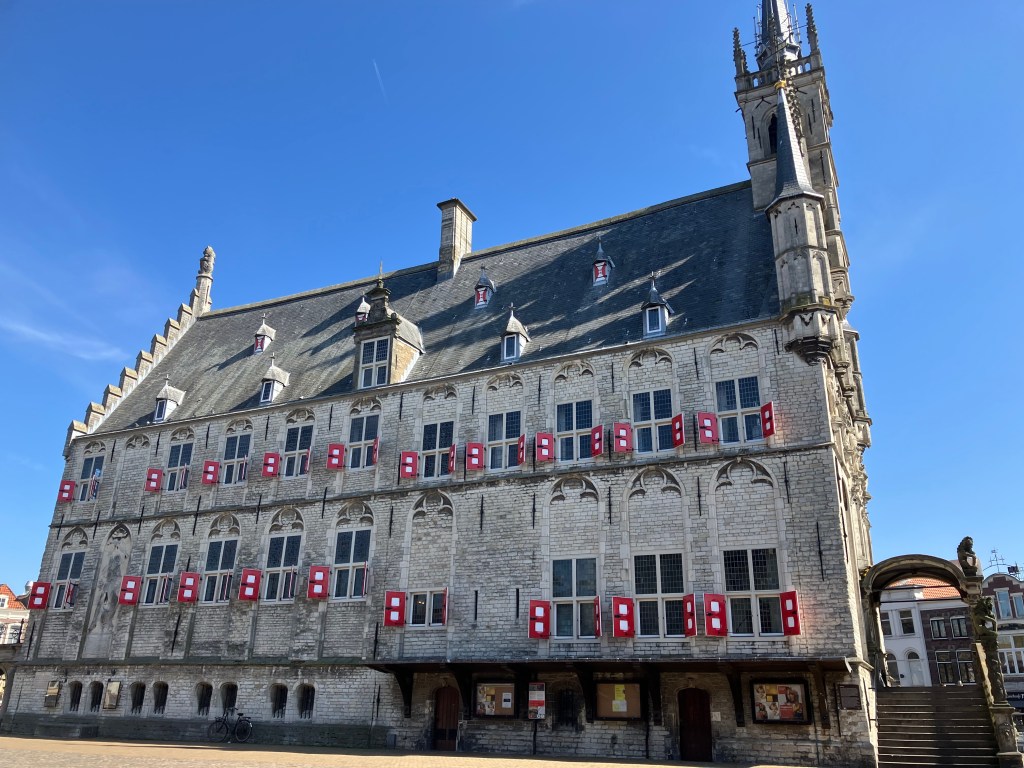
We began at this famous and beautiful building situated on the central plaza. It was deliberately built centrally following a great fire in the city in 1438, the plan being to ensure that with no adjoining buildings it would avoid such a fate again in the future.
It is truly remarkable to behold, built in late Gothic style with sculptures on the facades based upon Lords and Ladies of the region at the time and beautiful red and white shutters. This is the oldest Gothic city hall in the Netherlands and looks like something straight out of a fairytale!
St John’s Church
Heading away from the town hall at the end of the plaza we came upon this wonderful, fully enclosed church. The surrounding buildings appear to be cosseting it from the outside world and really exemplify how small everything was back then with the houses encroaching in upon each other and doorways reflecting the human size and height at the time they were built.
Originating in 1280 but destroyed by lightening in 1552 and then rebuilt the church was named after the patron saint of Gouda -St John the Baptist. Inside you can admire the famous 72 stained-glass windows as well as the actual length of the church which at over 400 feet makes it the longest church in the Netherlands. Many of the windows were financed by wealthy families and benefactors including the window financed by William of Orange from whom the current Dutch family originate. Needless to say those windows, financed in this manner, bear images of their patrons memorialised in the glass itself!

We walked around the church which also features a lovely quiet garden at its rear containing two statues.
The first represents Gerald Leeu, who was a pioneering book printer in the late 1400’s. The layout of books are somewhat taken for granted nowadays but Leeu was the first person within his trade to develop a technique whereby images and printed text could both feature together on the same page. Prior to this they had to be printed separately. He also devised the idea of a title page at the front of every book. Prior to this book text just began immediately on the first written page!

The second sculpture is of Erasmus, the famous European scholar who translated books, prayers and letters making him one of the most influential and famous European “thinkers” of the Northern Renaissance. His school education took place here in Gouda.
The Museum
We left the church behind us and headed through The Lazarus Gate. At over 400 years old the gate was relocated here in the 1960’s from an old leprosy house outside of the old city walls. Leprosy was often referred to by the Dutch as Lazarus disease hence the name of the gate.Passing through the gate we found ourselves in a courtyard.
Originally established to care for the poor the buildings that now make up the museum were once a hospital, the St Catherine’s Guest House, a pharmacy and a chapel before being formulated into the main hospital for the city. Whilst we chose not to visit the museum I was entranced by the collection of sculptures that can be seen on the outside wall of the museum. These were collected from other buildings in Gouda which have now disappeared.
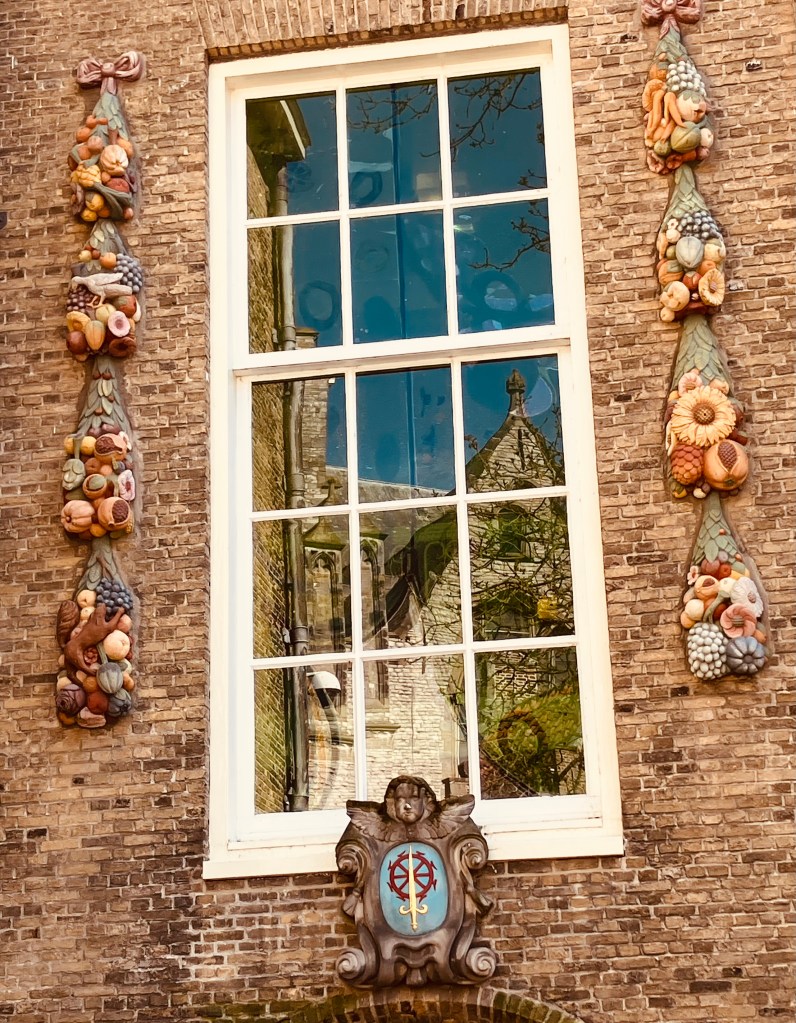
There is also a small sculpture garden to the right of the Lazarus gate which we took a wander around. Gouda seems to have many little nooks and crannies, moments of peace and tranquillity amongst the normal more hectic life of a city.
The Fish Market
Further along our walk we came upon the old fish market, another beautiful historic building. Fish was sold here until about 1879 at a weekly Friday fish market. What is really interesting is that the market was split into two sections. The gallery on our side of the water was for local fishermen and the one on the other was for strangers! There is a small hut on our side which is where the overseer would assess the fish and decide upon the taxes to be charged.

Wandering Past The Beautiful Houses
As we wandered along on our walk it is often the little titbits of information that I find most enlightening particularly when they relate to everyday life.
Many of the inner city houses, for example, do not possess a garden so to compensate for this the locals often put their own bench or floral display outside the front of their homes or “on the stoop” as it is known in The Netherlands. Everyday moments that we maybe take for granted such as a morning coffee or afternoon tea at a patio table outside the kitchen door or a family meal around an outside garden table are transferred here onto the street directly outside their homes.
The New York idea of having hooks, to which strong ropes can be attached, at the first floor level of a home enabling furniture etc to be lifted in through the windows of the upper floors directly from the street also exists here in Gouda.
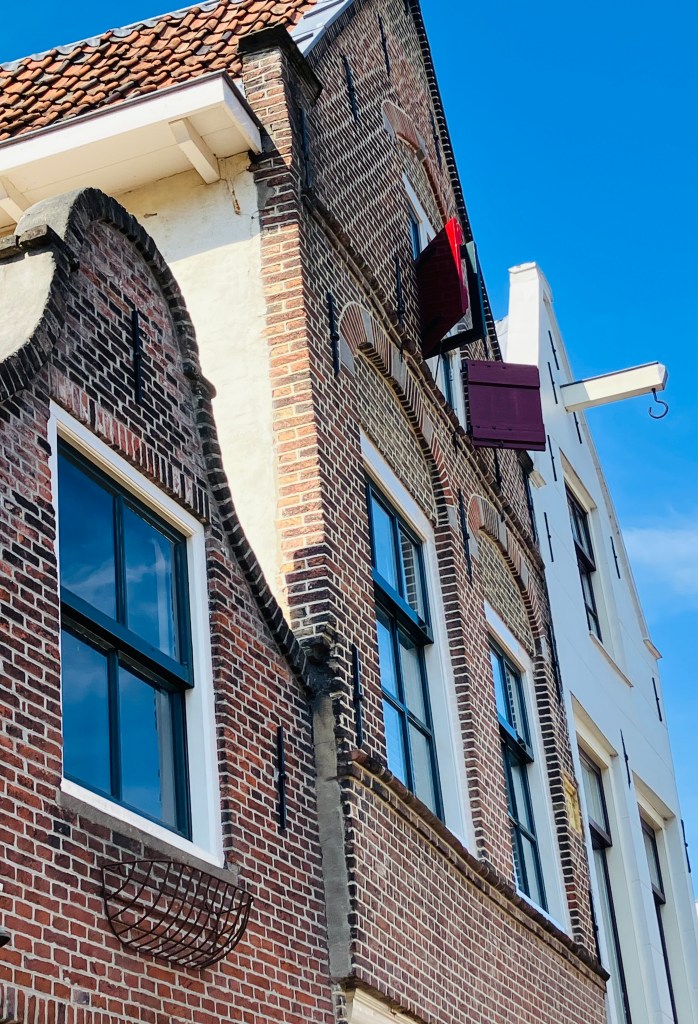
I’m not sure who thought of this first but I’m guessing it probably originated from The Netherlands.
Stolpersteine
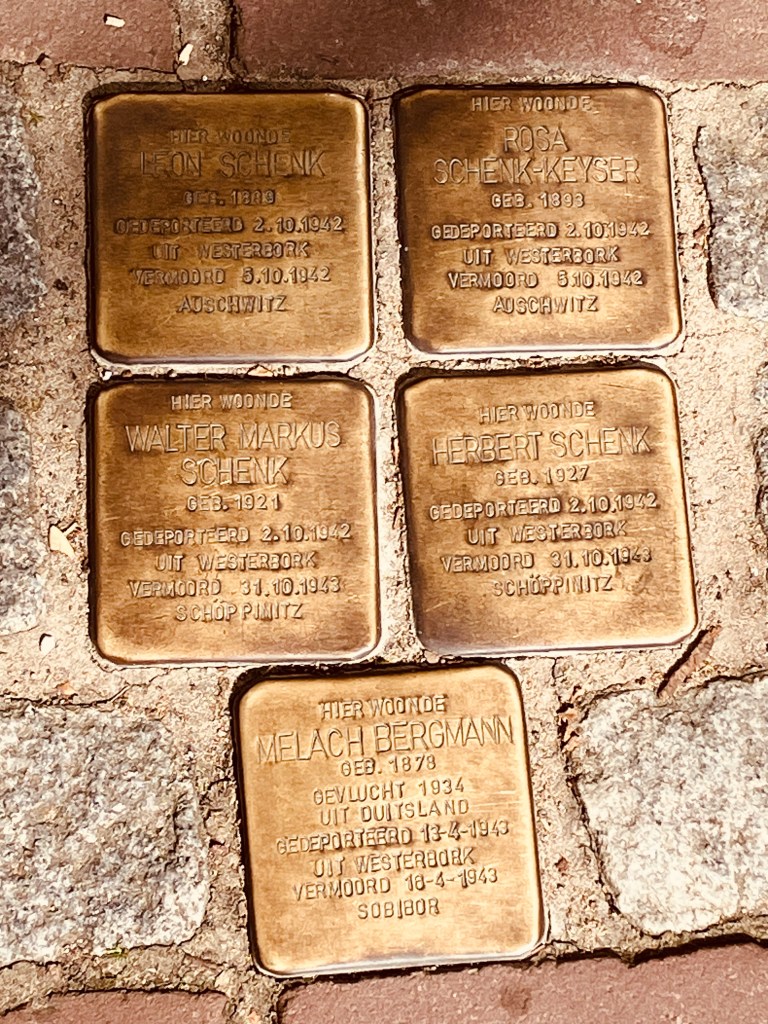
Whilst walking along the beautiful cobbled streets and taking in the views of the canals as we stroll along, our guided walk also brought our attention to the Stolpersteine found laid into the pavements at our feet. These “Stolpersteine” or “stumbling stones” are the creation of the German artist Gunter Demnig who is committed to keeping alive the names of those who perished in the Holocaust. Over 100,000 of these stones have been laid across Europe, and we have personally seen examples in many of the places we have visited previously e.g. Paris, Amsterdam and Berlin.
The names engraved upon the stones are of the Jewish people who used to live here before the Second World War. In this example the top two are the parents and the middle two are the young sons of the Schenk-Keyser family, all of whom were forced to leave on October 2nd 1942. The parents died a few days later in Auschwitz, while the sons survived a year in a labour camp in Poland . The final stone is for Melach Bergman, who had already fled the troubles in Germany in 1934, was then picked up in April 1943 and murdered a few days later in Poland.
Will we as a world ever learn the lesson portrayed by these stones?
Gouda Castle:
Our walk also brought us to the riverside, to the Hollandsche Ijssel and from here to the former Gouda Castle where a windmill now stands.The castle was built back in the mid 1300’s complete with six towers overlooking both the river and the then town. The count who built it rarely lived there feeling it was too cold and damp.
Eventually, some 200 years later it was torn down by the city council and permission was given to build the windmill that stands on the site today. It was here that we learnt that every windmill in The Netherlands has a name in this case “t Slot” or The Lock referring to the locks that allowed passing boats to access the inner city from the river we had just passed.
To the right of the windmill is the miller’s house under which some of the castles cellars are still located. There is a park to the rear of the windmill which in the Spring is full of traditional Dutch bulbs. This allowed us a welcome rest and a quiet place for reflection before continuing on to finish our walk.
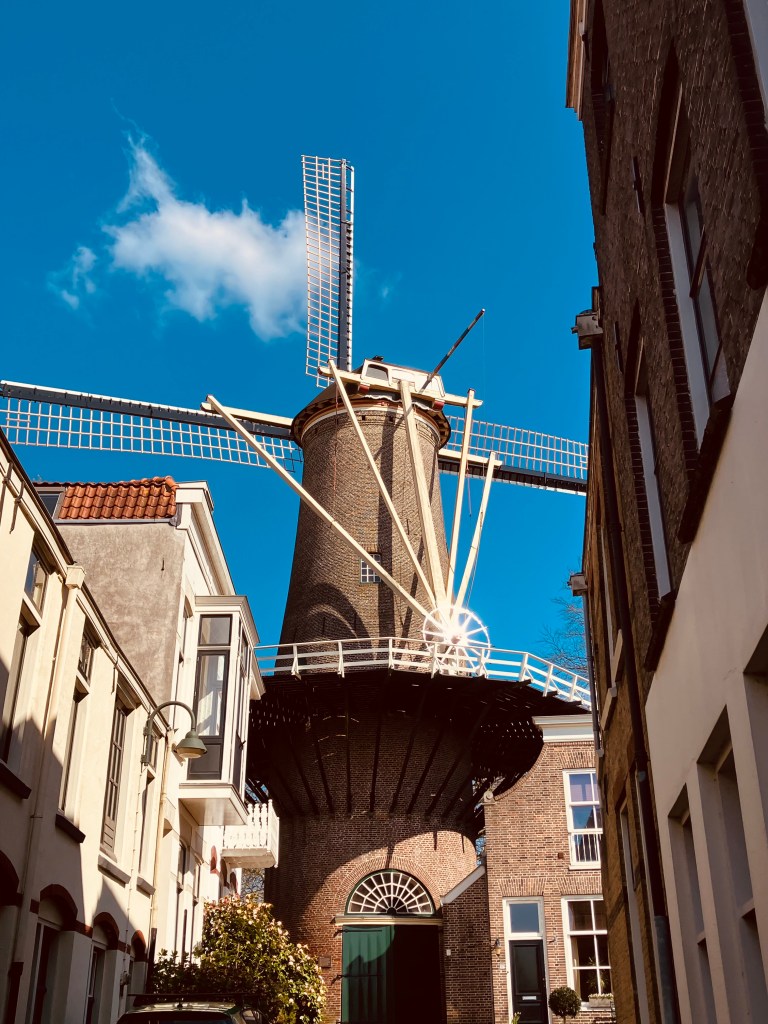
This is a picture of the windmill from the front
The Former Orphanage:

This beautiful building, which marked the end of our walk, operated as an orphanage from 1586 for some 350 years until 1948. The children who lived here were taught practical skills thus enabling them to later join the workforce and earn money. They were cared for and taught by church-appointed regents.
The building now houses the Weeshuis Hotel resplendent with these lovely red shutters and an external courtyard where on a sunny day you can partake of afternoon tea. Alternatively inside cosy tables invite customers to have a snack or a relaxing drink.
We returned to the Market Place and browsed the shops. No visit to Gouda would be complete without a visit to a cheese shop and there are several to choose from. All Gouda cheese is made from unpasteurised cows milk with a yellow wax rind but it doesn’t have to originate from Gouda itself, it is only a style of cheese rather than a cheese specifically originating from Gouda.

We also found ourselves a nice restaurant, flanking the square, to sit down outside in the last of the afternoon sunshine and partake in some traditional food such as this Gouda Cheese Soup!

From Gouda we then ventured to the famous tulip fields and Keukenof, my story of which will be coming soon!
This post forms part of a series based upon a recent trip we took to The Netherlands. Please feel free to continue reading this series and contact me should you want any more information.
 A Midlife Adventure