Travelling to Kew by underground:
Day 2 dawned sunny and bright and we jumped on the Jubilee line at Canary Wharf station and made our way to Westminster. Changing onto the District line to reach our destination -Kew Gardens. From the tube station it is only about a five minute walk to the Victoria Gate entrance.
Entry tickets for Kew can be bought on line which is always slightly cheaper than just turning up on the day. We took advantage of a special offer from National Rail where tickets are currently 2for1 if you travel to London and back by train. It doesn’t have to be a day trip it can, as with us, be a longer trip but it’s worth having your outward and return train tickets available with you in case you get asked.
Whether you live in the UK or are here visiting it is always worth looking at their website National Rail.com for offers particularly during the summer and any other main school holiday.
History of Kew Gardens:
Kew Gardens can trace its history back over 250 years to 1759, when Augusta, Princess of Wales, founded a nine acre botanic garden within the pleasure grounds of Kew Palace. Over the years, the Gardens have seen a huge amount of change, but incredibly, some of the plants from the original grounds still survive today. It is now not just a beautiful garden but a globally renowned scientific institution for plant and fungal research employing over 1,100 staff.
It is one of London’s top tourist attractions consisting of 330 acres of gardens and botanical glasshouses. As a World Heritage Site it also contains four Grade 1 listed buildings and 36 Grade II listed structures on site. It’s not surprising that Kew Gardens is listed Grade I on the Register of Historic Parks and Gardens.
Planning Your Day:
There are four gates through which you can gain entry:
The Lion Gate -this is the nearest to Richmond Station which has both underground and overground rail links
The Victoria Gate -which links to Kew Gardens Underground Station
The Elizabeth Gate -this is near Kew Pier if you are using river bus services or Kew Bridge Station which is on the overground
The Brentford Gate -next to the car park if you are travelling in by car. Parking charges are available on the Kew Gardens website.
It is worth pointing out that Kew Gardens can get very busy particularly at weekends and in school holidays with numbers increasing in the middle of the day. We chose to come on a Thursday (mid-week) and arrived as it opened at 10 a.m.
It’s also worth mentioning that school parties tend to arrive early but, from our experience, they quickly disperse once inside.
At the entrance it is worth picking up the map and guide pamphlet and then grabbing a bench nearby and planning out what you want to see and in what order you wish to do this. You can, of course, do this beforehand as the map is accessible on the Kew Garden website.
There is a lot of walking involved in exploring these beautiful gardens so trying to encapsulate everything of interest to you in a circuitous route does have its advantages.
If walking isn’t for you, you can catch the”Kew Explorer” for an easier way to travel around. Up to date ticket prices are again available on the website.
The pamphlet also highlights key attractions and seasonal highlights and gives you details of Free Guided Walking tours including timings. Check with on site staff at the entrance gate before setting off into the gardens as to how and where you join one of these.
Finally if you haven’t brought a picnic or lunch there are details within the pamphlet of the various six eating places on site. There is somewhere for all price ranges and for those with or without children.
Our Day At Kew:
These are my highlights of our day and some of the rationale we used for what we saw but don’t forget this day is your day to explore as you please.
We started our day with the two main glass houses as we didn’t want to have to contend with crowds of people later on.
Palm House:
This beautiful glass building, shaped like the upturned hull of a ship, was the first of its kind as no one had ever built a glasshouse of this size before. Designed by Decimus Burton with Richard Turner and completed around 1844 they actually borrowed techniques from the ship building industry in order to complete its structure hence its shape. There are 16,000 panes of toughened glass some of which are curved and very expensive . What you see today is the result of the second renovation which took place between 1984 and 1988 when the original building was completely dismantled, restored and rebuilt.
The temperature is maintained to a minimum of 18C. There is no maximum but the vents are opened when it gets above 28C .
They also have a misting unit designed to keep the relative humidity above 75%. Apart from the vents everything is controlled by a computer sited downstairs so when the water sprayers suddenly come on you know it’s not some ghost you cannot see but a pre determined event. The staff also manually water the plants every day.

Many rare and threatened species grow in the Palm House including several palms endemic to tropical islands, such as one from Comoros, an island nation in the Indian Ocean. There are very few left in their natural habitat.
Another critically endangered, very beautiful palm originates from French Polynesia.
We entered this Palm filled oasis from the left as you look at the map, splitting up as is often the case. This allows us to admire the plants individually in our own way. Hubby is very into photography and so tends to look from that perspective whereas I like to wander around, usually in a uniform fashion i.e. up and down the rows, ensuring I don’t miss anything and grabbing photos on my phone. It’s easy to feel like you are in a different world when inside with all the different species growing merrily.

I was fascinated by all the flowers and fruits that were growing. I had no idea what some of them were but I still took delight in photographing them for myself.
This was one of the stranger flowers I saw?

Keep your eye open when inside the Palm House for the world’s oldest potted plant, a prickly cycad, which was brought from South Africa to the UK and planted in 1775.
Don’t forget either that important scientific work also takes place in the Palm House, including DNA research and finding new medicines. For example a study took place here on water retention in palms with relation to climate change.
The Temperate House:
Leaving by the same entrance from whence we had arrived we then made our way to the Temperate House originally created to house frost-tender plants.
The first thing you will notice is its pure size. At more than twice the size of the Palm House, the Temperate House covers nearly 5000 square metres and is 19 metres high at its tallest point. Like the Palm it was designed by Decimus Burton and completed between 1845 and 1848,
Architecturally the oldest part of the house is the central block with the two octagons being completed and opened in 1863. The north and south ends were added much later and completed in 1899.
The building was last refurbished in 2018. It took five years to complete and now houses 1,500 species and more than 10,000 individual plants, all from temperate regions of the world. The world’s rarest and most threatened temperate plants are housed here. Six species in the Temperate House are considered Extinct in the Wild.
The tallest tree in the glasshouse is a pink trumpet tree which began its life here at 9 meters and can potentially reach 30 metres when fully mature. Three plants arrived here back in the 1800’s!
Being temperate plants the temperature inside must be above 10 degrees celsius in order for them to survive. On cold winter days, the glasshouse is heated by boilers and radiators, while the windows are kept shut. Conversely on warm summer days, the windows are all opened. If the temperature exceeds 12°C inside the building, vents in the glass roof open, all controlled by a localised sensored mechanism.
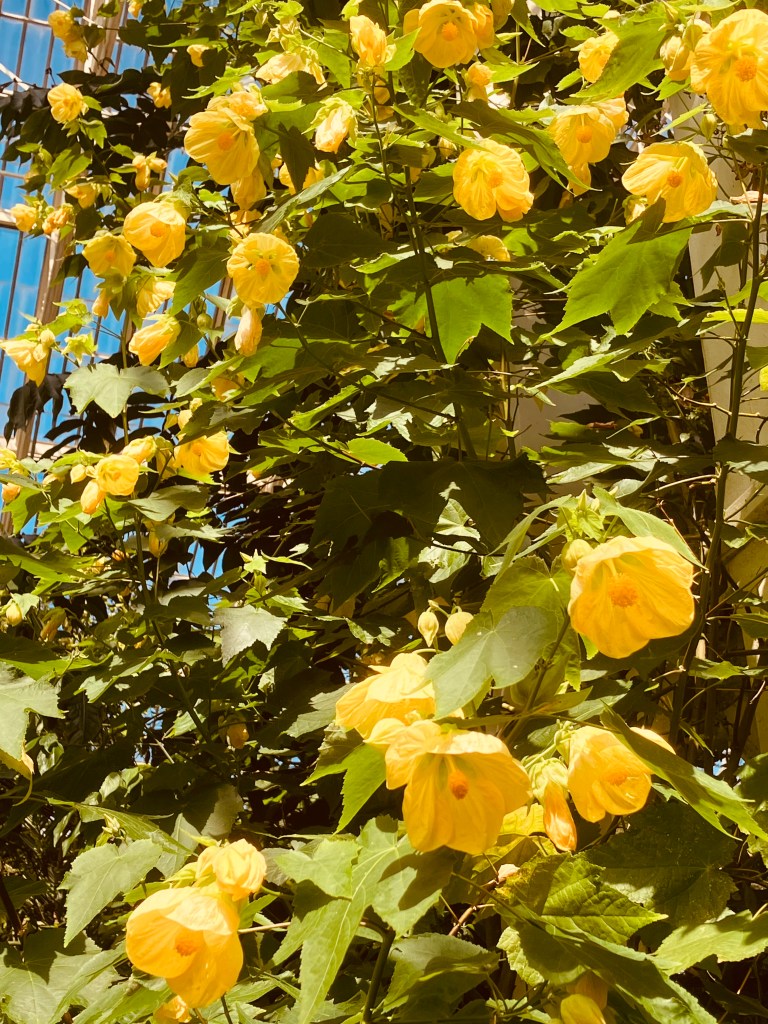
Being from temperate zones there were more species that I recognised such as these beautiful yellow flowers:
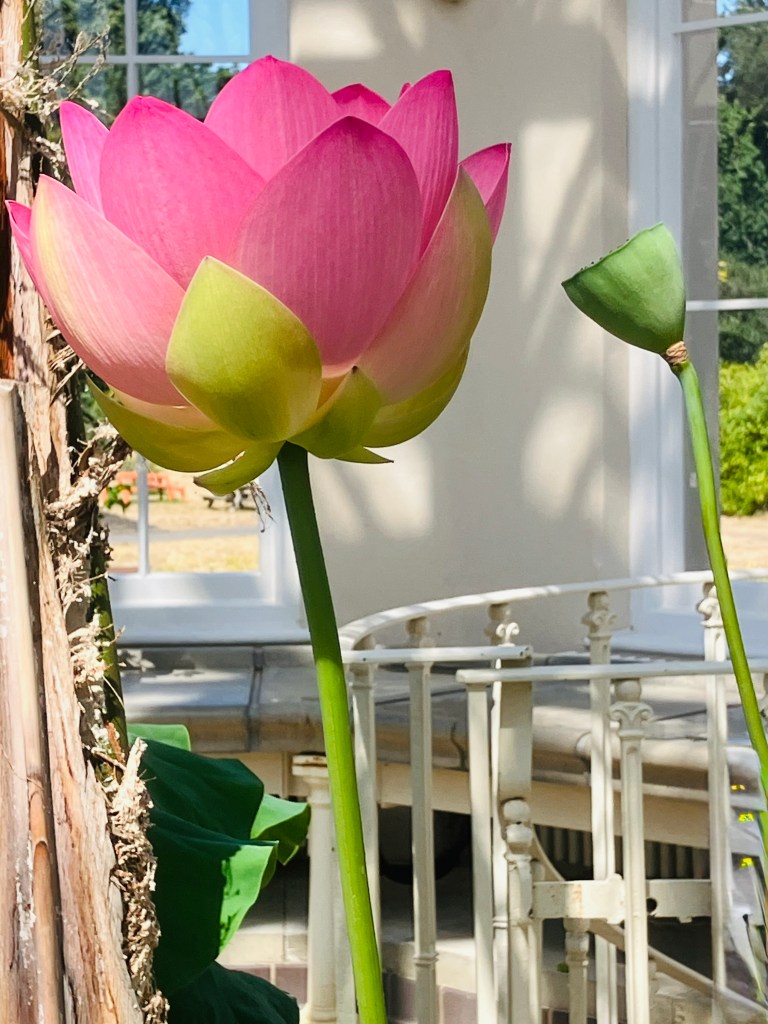
Conversely there were some flowers that I’d never seen before like this giant pink flower that looked like something from a sci-fi movie.
Being a larger environment it has also been possible to include man made embellishments such as statues and a lovely waterfall:


The Great Pagoda:
Having entered the Temperate House from Cherry Walk we left via Thorn Avenue and made our way to the Great Pagoda.
Built in 1761 by Sir William Chambers as a present for Princess Augusta, the founder of the gardens. Chambers had spent time travelling and studying the architecture of East Asia and thus it is a beautiful and striking example of chinoiserie architecture. Most pagodas were designed as a religious monuments but Chambers instead intended it to be a window for the British people into Chinese culture.
The pagoda is made of grey brick and stretches up 10 storeys, totalling 163 ft in height, A popular ‘folly’ of the age, it offered one of the earliest and finest bird’s eye views of London.
Like many of the buildings here at Kew it had to undergo restoration and thus was returned to its former splendour in 2018. Adorning the building are 80 dragons, which were removed in 1784 when repairs were undertaken to the building’s roof. Lost for 200 years they are now back thanks to 3D printing technology and hand wood carving techniques.
Access to The Great Pagoda requires a separate ticket, in addition to your Kew Gardens ticket and a degree of good health to climb the 253 steps to the viewing gallery.
We chose to take a break here and eat our picnic relaxing on one of there nearby benches with the glorious view of the building in the foreground.

Treetop Walkway and Lake:
Walking past the pagoda we set off along Cedar Vista, stopping off at the Treetop Walk before moving onto the lake.
The treetop walk is fairly self explanatory. Catching the lift to the top and at 18 meters off the ground you get a birdseye view of the gardens and the landscapes of London beyond.
The Lake is definitely worth walking around, we went clockwise from Cedar Vista and with many benches strategically placed on the circumference it offers a peaceful interlude from an otherwise fairly full on day.
It was created in 1856 in an area that was excavated to provide gravel for terracing the original Temperate House and covers five acres of water with four islands. Underground channels connect the Lake with the Thames, and it was filled for the first time in 1861.
The Sackler Crossing, designed by architect John Pawson, opened in 2006 and became the first ever bridge across the Lake. He designed it to mimic the Lake’s rounded banks. It also provides a great spot to stop and check out all the fish in the lake below.

Having crossed over the lake we went left onto Boat House Walk and then left again onto Princess Walk following this all the way to The Orangery.
Walking in front of this restaurant which is housed within a magnificent eighteenth-century Grade I listed building, you get a feel for the sheer grandeur of Kew. Designed by Sir William Chambers, and was completed in 1761, it measures 92 by 33 ft. With i’ts tall glass windows looking out over the grounds it has a very light and airy feel.
Princess of Wales Conservatory:
We walked on and turned right onto Ginkgo Lane leading us down past The Hive and onto The Princess of Wales Conservatory on the left.
The building was designed by architect Gordon Wilson, replacing 26 smaller buildings and opened in 1987 by Diana, Princess of Wales in commemoration of her predecessor Augusta’s associations with Kew.
With a floor space of 4,500 square metres, the glasshouse contains a whopping 10 different climatic zones and a huge variety of plants, from cacti and carnivorous plants to orchids and bromeliads.
Each of these climatic zones, from the cool desert to the tropical mountain and rainforest, is maintained by a computer which adjusts heat, ventilation and humidity automatically.
I struggled inside this conservatory to remember where I had been and where I hadn’t. It is definitely a bit of a maze and takes longer to meander around than either of the previous glasshouses.
Interestingly during its construction Sir David Attenborough buried a time capsule in the foundation of the building containing seeds of important food crops and several endangered species. It will be opened in 2085, when many of the plants it contains may be rare or extinct. People will be able to use those seeds and understand how much we cared about the future of our planet.

Leaving the conservatory behind we made our way back onto Broad Walk and returned to our starting point admiring the lake and gardens in front of The Palm House.

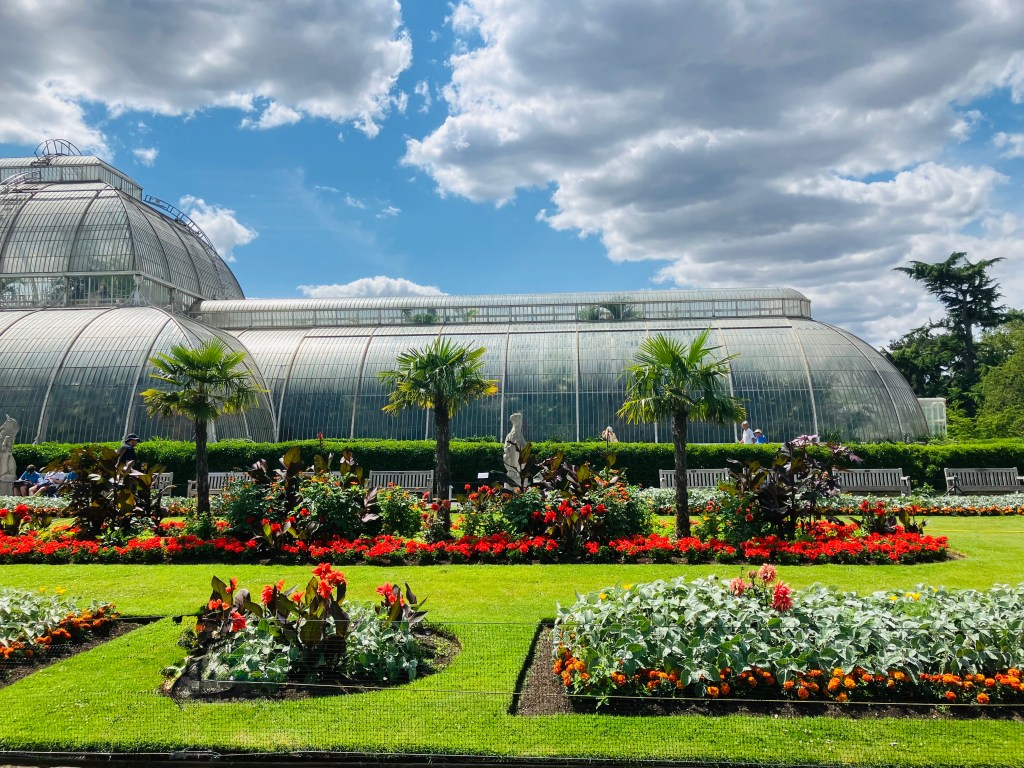
With over 6 miles walked we bade our farewells to this wonderful piece of botanical history and headed back to our hotel to prepare for Day 3…………………
.
 A Midlife Adventure