Having spent day three immersing ourselves in art we left our hotel for our final day of exploration and caught the DLR once again from Westferry, jumping out at Tower Hill and transferring onto the District Line to Westminster.
Exiting from the Tube station we are immediately met by the sheer magnificence of Big Ben and alongside him the Houses of Parliament.
Tickets for the Houses of Parliament:
Having never visited the Houses of Parliament we purchased tickets on line. In so doing you need to pick both your day of visit and time. The early morning slots sell out quickest as visitors fight to miss the usual tourist melee of central London and so booking well in advance is a good idea.
The U.K. House of Parliament or Palace of Westminster is open Monday to Friday from 9 am to 5 pm. You have a choice of guided tours and multimedia tours. Multimedia tours allow you up to 90 minutes inside the Parliament buildings using their audio guides. The guided tours last 75 minutes and these sell out quite quickly, another reason to plan your visit well in advance. All tours mostly take place on weekdays and Saturdays. We opted for the self guided multimedia tour.
We cross over the road from the station to the other side of Westminster Bridge and keeping Parliament Square on our right and the Houses of Parliament on our left we walk straight down the road to the visitors entrance at Cromwell Green. They suggest you arrive about twenty minutes before your chosen time to allow for queuing and once inside the building there is an airport security check so it is worth making sure you have read what you are allowed and not allowed to bring with you, including the size of any bags.
Westminster Hall:
Once inside the building you step straight into Westminster Hall where we picked up our audio guide. Fully equipped and working I turn around and just stand and look around me, this magnificent entrance hall built between 1097 and 1099 immediately immerses me in it’s history, imagine what history the walls have been privy to!
In 1189 Richard I held the first recorded coronation feast here.
It was here in 1606 that the trial of Guy Fawkes and the Gunpowder Plot conspirators took place, followed by the trial of King Charles I in 1649.
Fast forward to 1910 and the body of Edward VII was the first royal to lay-in-state here prior to his Royal funeral.
In 1960 President de Gaulle of France addressed both Houses of Parliament within this space as did Nelson Mandela in 1996.
Finally in 2022 our longest serving monarch Queen Elizabeth II also lay in state here. It is estimated that over 250,000 people queued up and bade their last farewell to her across the four days that she lay in state.
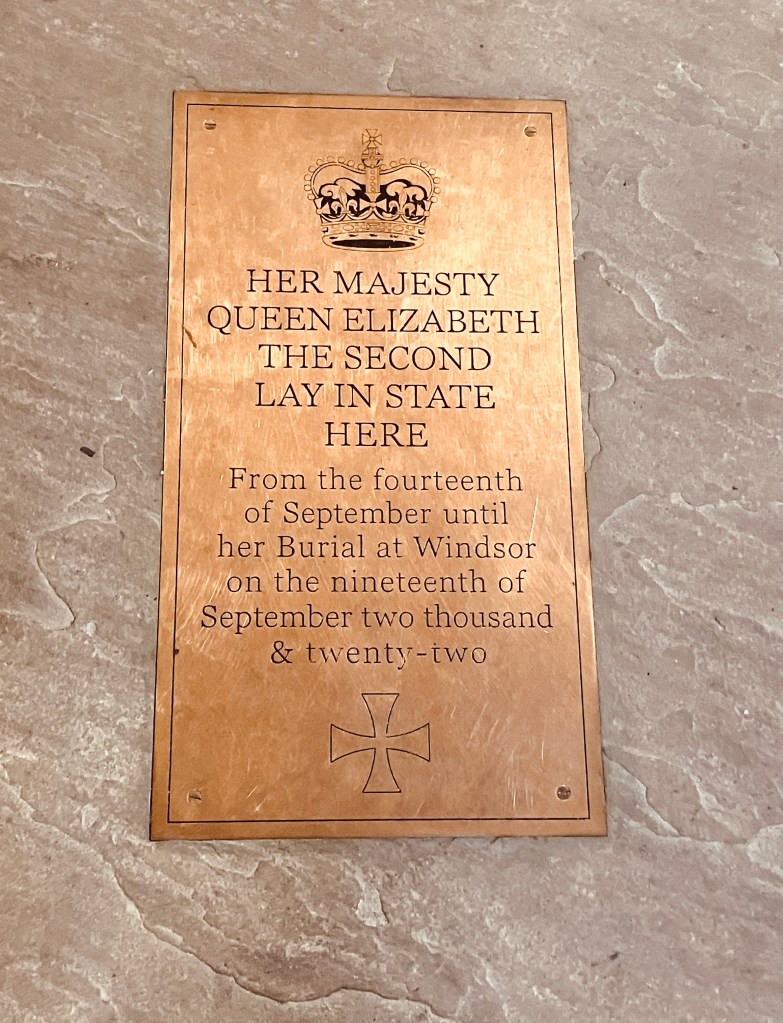
Westminster Hall is the oldest building in Parliament and almost the only part of the ancient Palace of Westminster which survives in almost its original form. The Hall was indeed by far the largest hall in England, and probably in Europe at that time. Measuring 240 by 67 feet, it had a floor area covering about 17,000 square feet and walls that are some six feet thick.
The roof is in itself a bit of a mystery, made of wood timber the roof is the largest hammer-beam roof in the world. However it wasn’t until the 13th or 14th century that carpenters could create roofs significantly wider than the length of the available timber. So how was it built? Well it was assumed that a single or double row of columns was put in place to support it. However, recent archaeological explorations found no evidence of these, and that the roof may have been self-supporting from the beginning?
Following the audio tour I walk up the stone steps at the opposite end of the hall and turn left into St Stephen’s Hall.
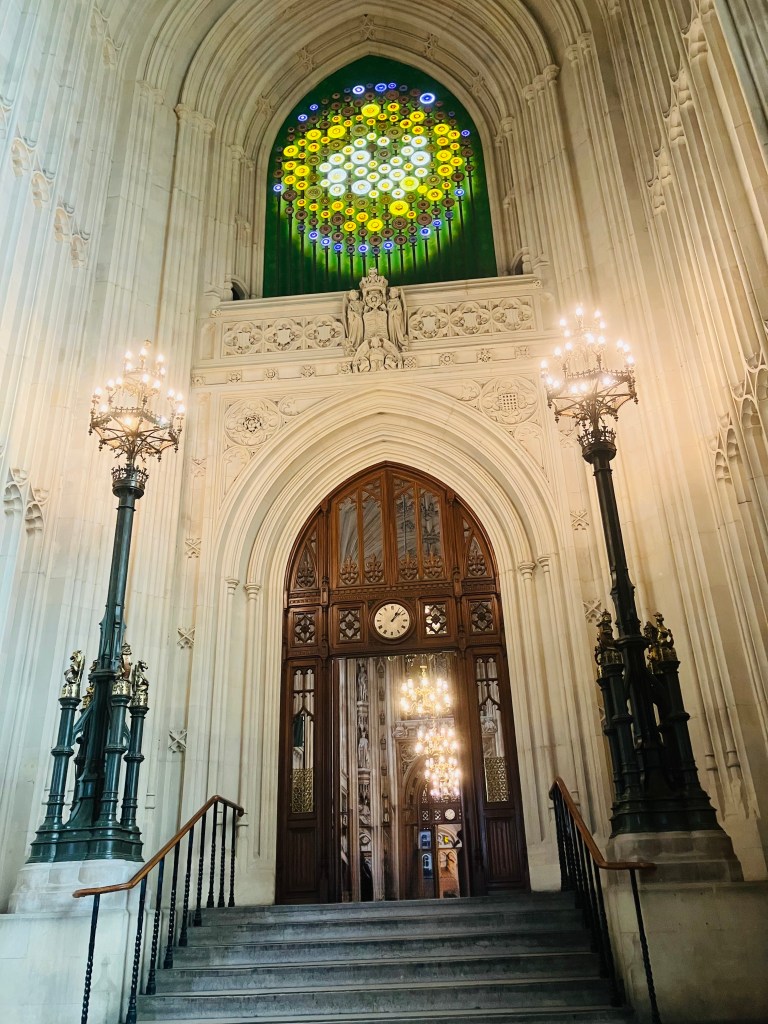
St Stephen’s Hall:
The hall was built to replace the chapel of the same name which was destroyed in 1864 due to a fire. The chapel was actually the original home of the House of Commons and beneath the hall the original undercroft of St Stephen’s chapel still survives. The hall was the creation of Charles Barry who decorated it with sculptures of famous parliamentarians and paintings of great events in British history.
Lined with seating it gives me a welcome pitstop in my tour on a fairly hot, stuffy summers day. This is also the last point at which you are permitted to take photos.
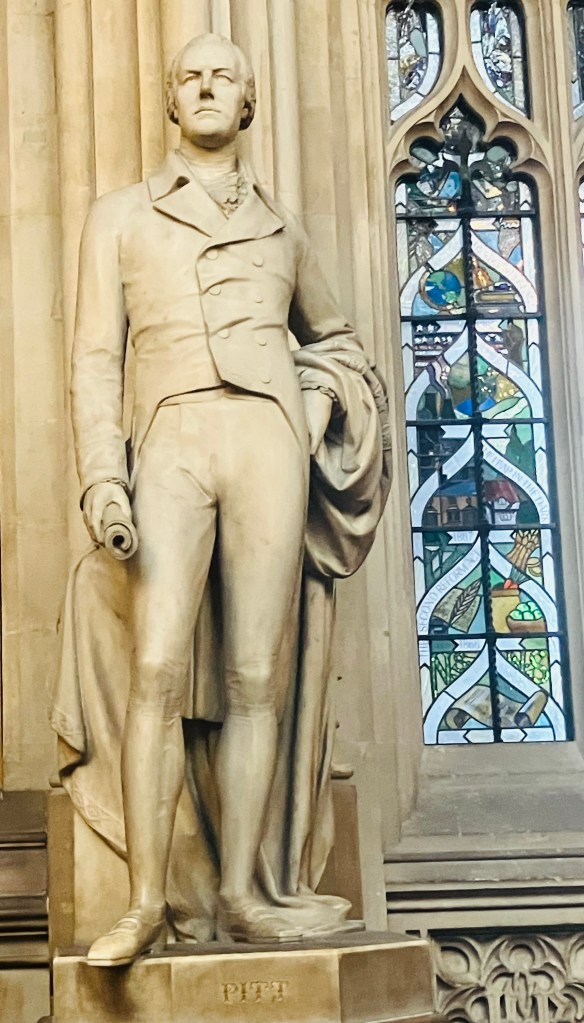
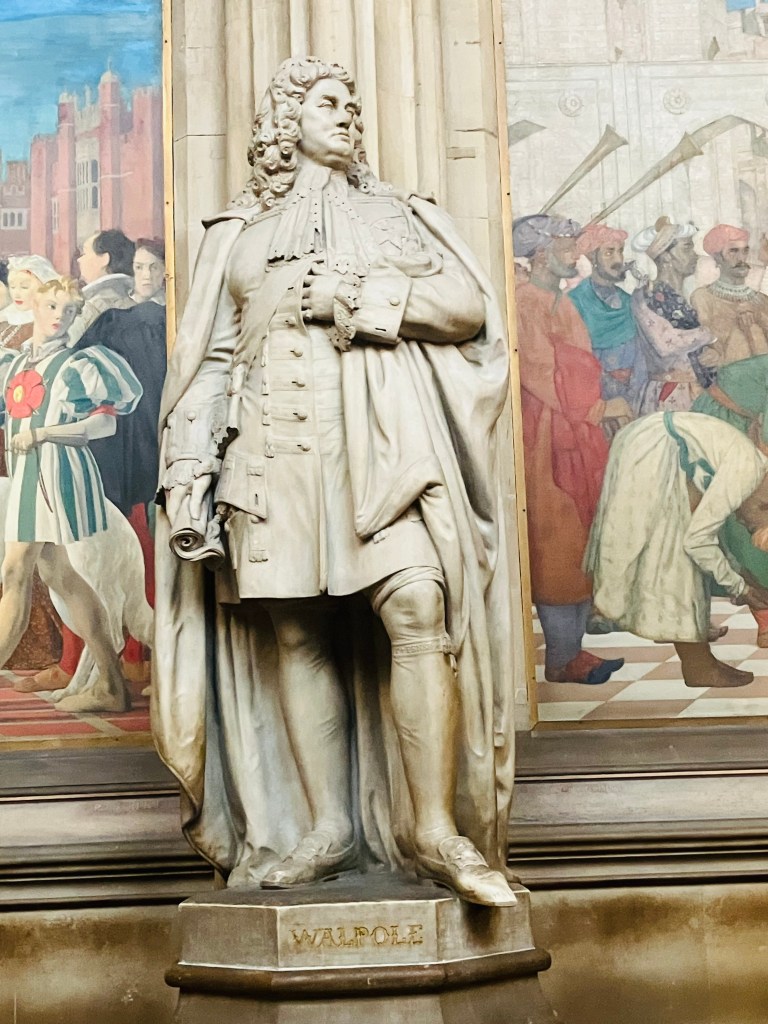
Exiting from this beautiful, corridor like space you then come to the Central Lobby.
The Central Lobby:
This is the very heart of the Palace of Westminster, acting as a crossroads between the two Houses and Westminster Hall allowing members of the House of Commons and the House of Lords to mingle and also serving as a meeting point where MPs can meet their constituents.
I’m happy to stand and take in the wonderful architecture. Designed once again by Charles Barry this area is octagonal in design, made of stone with an intricately tiled floor.
I love the feature that has been made of the four exits from the Lobby. Each has a large mosaic panel, depicting the patron saints of each of the four constituent countries of the United Kingdom: St George for England, St David for Wales, St Andrew for Scotland and St Patrick for Northern Ireland. The audio guide utilises this feature to ensure you follow the route in the correct order.
House of Lords:
This is the upper house of the Parliament of the UK and currently there are about 800 members who are eligible to take part in the work of the House of Lords. As the second chamber of the UK Parliament, the Lords play a vital role in examining future legislation, whilst also investigating public policy. They can challenge the government and hold the government accountable through debates and questions. With a broad range of expertise with members having successful careers in business, culture, science, sports, academia, law, education, health and public service, they can provide expertise in their given areas.
Whilst Charles Barry designed the Palace of Westminster as a whole, Augustus Pugin supplied the detail and had the passion to deliver the complex gothic interiors that can be seen here today.
The House of Lords is full of red upholstery and looking around the chamber I cannot help but notice the large and majestic royal throne which stands at the far end on a raised platform. Designed upon the 14th century coronation chair in Westminster Abbey it is here that the monarch delivers the ‘speech from the throne’, which is written by the government, in the chamber during the State Opening of Parliament.
House of Commons:
Leaving the upper house behind the tour takes you back out to the central lobby and into the House of Commons. Suddenly the red upholstery has been replaced with green benches, a colour that has apparently been associated with this chamber for over 300 years.
The current Chamber was actually rebuilt after the World War 2 by the architect Sir Giles Gilbert Scott at a cost of some £2million and to be honest is rather austere and certainly of a more simple and plain Gothic design. I wonder if it is to remind the occupants of their status compared to the chamber next door?
Scott, to be fair, did introduce modern heating, lighting and ventilation and enlarged the galleries to provide more seats especially for the press and public.
The audio guide explains the manner in which the Government works in the UK so hopefully visitors can leave with a better understanding of a system that stems back to its roots in Anglo Saxon times. The idea of the Commons meeting separately from the nobility and clergy began back in 1341.
Leaving the House of Commons behind I follow the defined route back to St Stephen’s Hall and thus back to the start of the tour. There are both a gift shop and cafe on site off Westminster Hall along with public toilets.
Bidding a farewell to this historic building at the centre of UK politics our London adventure comes to a close. I hope if you haven’t done so already you will have read my other posts about this adventure and if you have any comments or questions you would like to make/pose please feel free even it is advice about other things to do and see in London…..
 A Midlife Adventure