Good Morning:
I slept quite well on our first night and was woken the next day by the call to prayer at about 4.30 a.m. Rather than being annoyed at such an early disturbance I marvelled at this new culture I was now part of and just drifted back off to sleep, waking a bit later to the sounds of people outside on the street. Washed and dressed we made our way down to breakfast early, wondering what we would find to eat and drink.
Pandering to the needs of us foreigners there was a choice of coffee or tea. I always bring my own decaf teabags so I asked and received a teapot of hot water or on another morning asked and received Moroccan mint tea.
We were also offered freshly squeezed orange juice and again, as is our normal, we both accepted this offer and then hubby drank his before swapping his empty glass for mine and consuming that as well. Juices are acidic and, therefore, to avoid inflammation that enhances the swelling on the inside of my arthritic knees I never indulge.
There was a selection of tiny serving bowls with honey, two types of jam and butter. Yoghurt and fruit were laid on the table alongside spongy, honey-comb like pancakes which we later discovered were called “Baghrir”.
Every morning at the Riad breakfast took the same format except the pancakes were substituted for “Batbout” – a small, fluffy bread, similar to a pitta or “Msemmen -a flaky, square-shaped Moroccan pancake and sometimes we were also given small Moroccan cakes. Everything, we discovered, was cooked fresh on site by Said’s wife.
Exploring:
Armed with the map that Said had given us (hubby still loves a map!), my itinerary and my trusted Google maps app we set off early at about 8.45 a.m. on our first morning ready to explore the city. Despite what I had previously read, whilst back at home researching, it soon became apparent that it was really easy to follow Google Maps in order to reach any destination in Marrakech we wanted to see.
Making our way back to the main street “Rue De Bab Aylan” we turned right and within about ten minutes arrived at our first stop.
Ben Youssef Medersa:
This theological college was built here in the 14th century before being rebuilt in 1565 by the Saadian Sultan Abdullah Al-Ghaleb Assaadi. This is the largest Medersa in Morocco and for 400 years it remained a central part of Marrakech, attracting scholars thirsty for knowledge in various fields but particularly the religious sciences.
With 136 rooms spread across its ground floor and upper floor, a prayer hall, a courtyard, and an ablution room, visitors now flock here to admire the beautiful and outstanding Moroccan architecture.
The Courtyard:
Entering through latticed doors the courtyard is spread out in front of you. With a large pool set in the marble floor, surrounded by channels that keep the water flowing and an Arabic inscription on the entryway which reads “You who enter my door, may your highest hopes be exceeded”.
It is truly a masterpiece, displaying Moroccan architecture. through the ages with diverse motifs, vibrant colours, and astounding tile work. The walls and columns are covered with “zellige” -colourful, geometric mosaic tile work with friezes of calligraphy above, then intricate stucco carving and finally everything is topped off by carved cedar wood.

At either end of the patio are two porticos with sturdy pillars, perfectly symmetrical and facing each other. They complement the open-air courtyard and also provide shelter from the sun and bad weather.
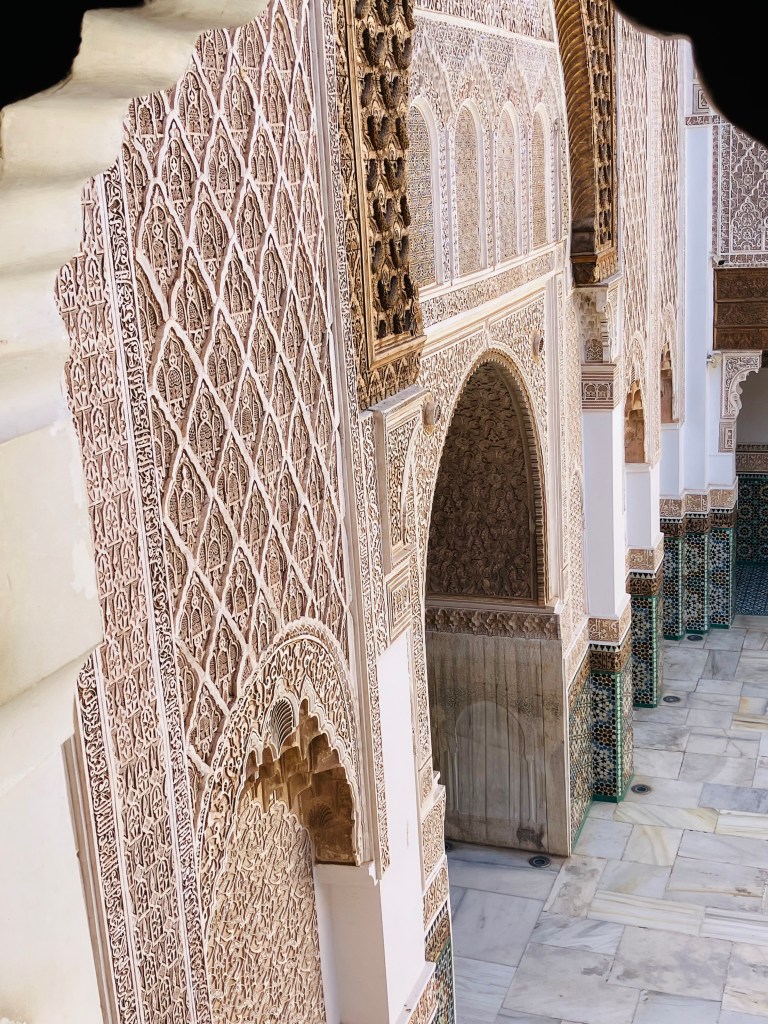
Unfortunately there are very few seats on which to sit and admire the incredible craftsmanship on display here, I felt like I just wanted to drink it all in and create a forever indelible memory to return to in the future.
Before leaving the courtyard behind to explore the upper quarters where the students lived it’s important to enter the prayer room at the far end of the courtyard, opposite the entrance. Look up and you will see beautiful honeycombed “mugarnas” on the domed ceiling.

Students Lodging:
All the students who studied here also lodged on the second level. With 130 rooms, up to 800 students could be accommodated at any one time spread out in dormitories arranged on different levels around the main courtyard and also around six other courtyards open to the sky to provide light (as shown in the photo below).
The stone pillars once again display the attention to detail adopted here with intricate patterns and engravings.

It is possible to walk through the corridors that the students would have used and enter many of the bedrooms. Those overlooking the courtyard are particularly worth looking into. No expense was spared here with some outstanding wooden engraving and decoration.

Both of us admire architecture and to see something so marvellously unique was a wonderful start to our trip.
Maison de la Photographie:
Less than a five minute stroll from the Medersa is this wonderful photography exhibition.
French Influence:
Historically France established control over Morocco from 1912 to 1956 making French the dominant language in official capacities such as in the government, education, and the media. It also influenced daily life and infrastructure within the country.
As a result the French language became a significant second language in Morocco, a trend that continues today. This led to a lasting influence where many Moroccan locals still speak French, especially in urban areas and the tourism industry, resulting in French names being used for some historical sites, businesses, and attractions.
The Maison de la Photographie de Marrakech has been open since 2009 and was established by Parisian Patrick Menac’h and Hamid Mergani from Marrakech itself. They both realised that they had individually been collecting vintage Moroccan photography and as a result opened this gallery in order to show people their collections. Their primary aim was to show the extraordinary diversity of Morocco, as seen by those, anonymous or famous, who visit it from the beginnings of photography until the modern period : 1860 – 1960.
Whilst parts of this three storey exhibition change every 6-12 months, the ground floor courtyard with rooms fanning off it are devoted to portraiture. Everyday life is dominant in the photos on display here. Below is one of my favourites of a little girl and her lamb.

Throughout the exhibition you also get to see once again some great examples of Moroccan interior design such as these wonderful windows.
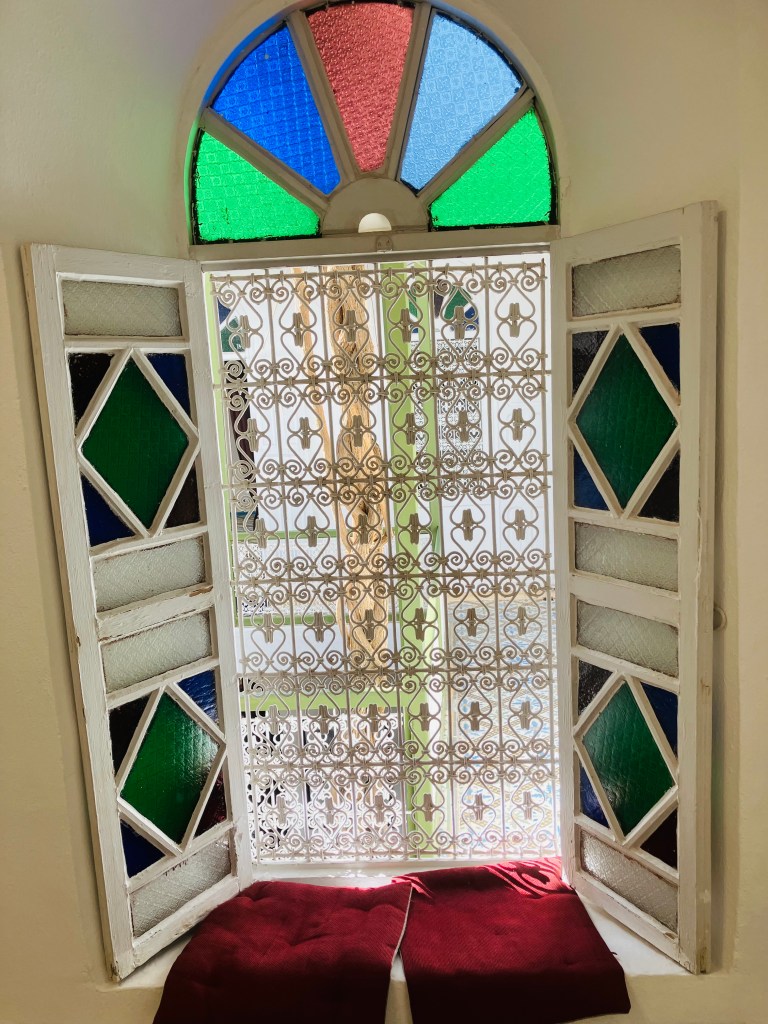
And these balustrades….

Also on the ground floor you get to see the oldest photos on display here. Photographs which show how photography started here in Morocco when the first Europeans arrived with cameras and began documenting life here with images of Tangier taken between 1870 and 1900.
On the rooftop terrace you will find a cafe where we decided to purchase our first Moroccan food outside of the Riad. The cafe is at one of the highest points in the Medina and so affords some fantastic views alongside a cosy and comfortable area to sit and just take a breath.
As we do just that I’m going to take a pause in our adventure and let you join us on my next post as we continue our exploration of this wonderful city.…………………….
 A Midlife Adventure