Our second day in Marrakech was spent at our Riad learning some wonderful Moroccan cookery which I will happily tell you about on another post where I intend to cover “Feasting in Marrakesh”.
On Day 3, therefore, we set out fairly early once again finding ourselves on the quiet streets of Marrakesh before all the traders are set up to sell their wares. Our first stop of the day is the……
Bahia Palace:
La Bahia or ‘the beautiful” is an 8000 sq metre floor to ceiling palace of fabulous Moroccan marquetry, painted wood known as zouak and amazing plasterwork.
Opened to the public in 1998, the palace began it’s life back in the 1860’s under the guardianship of the Grand Vizier Si Moussa but it was his son and successor, Abu ‘Bou’ Ahmed, who went on to finish it’s construction. Not only did he expand the large Riad which sits at the centre of the palace but also built the small Riad. It is a true example of how powerful families lived in Morocco during the 19th century.
It was still reasonably quiet when we arrived at 9.15 am, although the sun was already shedding it’s warmth on our skin as we entered through the small external garden resplendent with colourful tree blossom and the smell of oranges ripening above us.
Petit Riad:
Closest to the entrance, this area has two separate large rooms which are richly decorated with floral, geometric and written motifs and is similar in layout and size to traditional houses found in the Medina.
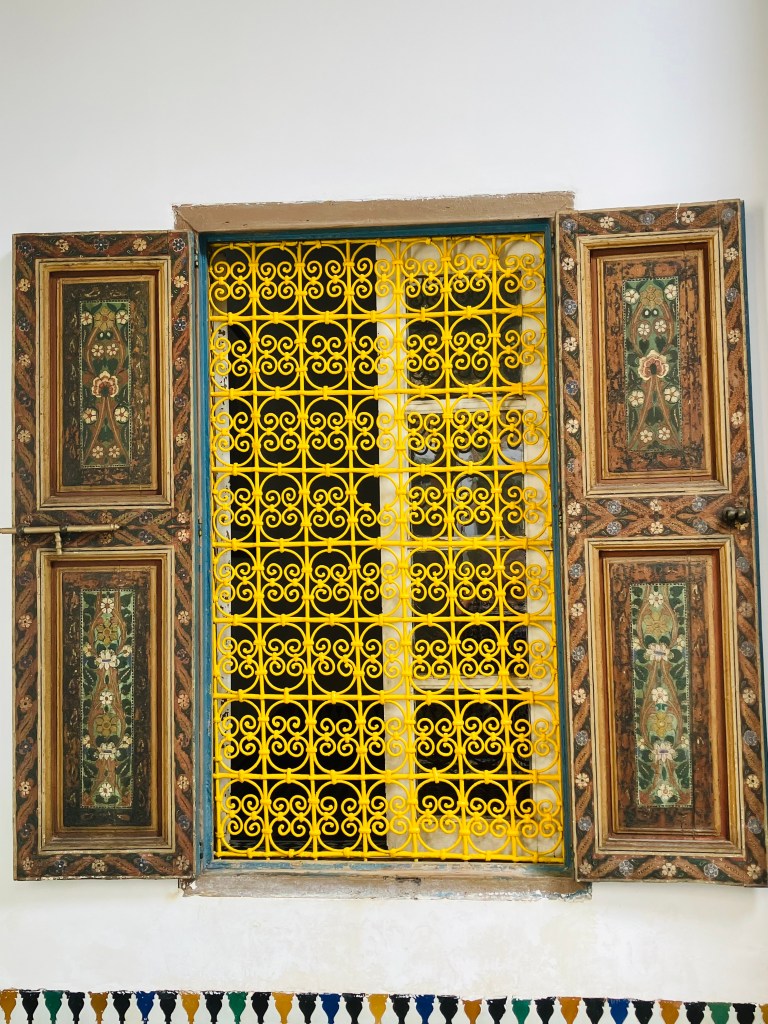
The white plasterwork walls, however, have been painstakingly crafted and inscribed with verses from the Quran.
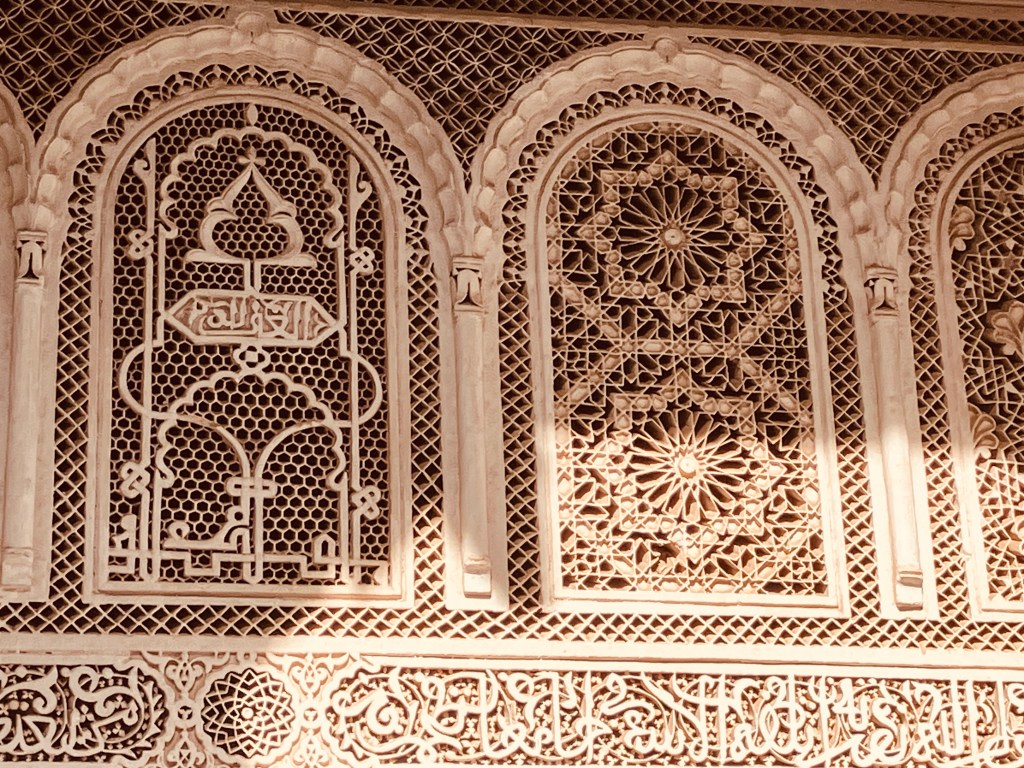
In the 19th century when it was originally decorated, this plaster would have been carved in situ while wet!
At the centre surrounded by this artistry is an open-air courtyard furnished with a four-part garden known as a “charbagh” with a white marble fountain at its central point. This quadrilateral garden layout is divided into four smaller plots by walkways. This design originates from Persia and represents the Paradise Garden with four rivers described in the Quran.

Cour d’Honneur:
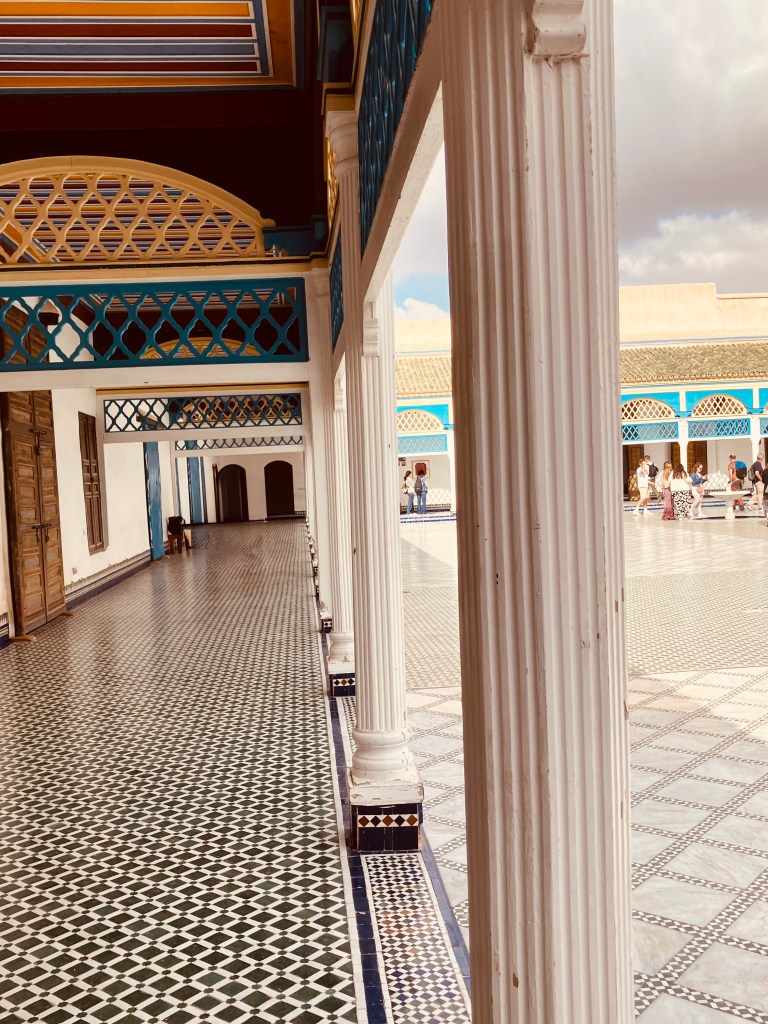
Between the Petit Riad and the Grand Riad we also walked through the Cour d’Honneur which is undoubtedly the “heart” of the Palace. At 1500 sq metres in size it is seen to be one of the most spectacular open spaces ever to be conceived in Morocco.
Despite being restored to its original brilliance in 2018, there was more work in progress in this area when we were visiting but we were still able to admire the vast expanse of Italian Carrara marble on the floor along with intricate zellige mosaics and the bright blue and yellow plaster and woodwork.
This area originally served as part of Ba Ahmed’s harem, providing access to around 80 rooms that housed his concubines.
Grand Riad:
As we wandered on and into the Grand Riad the restoration continued into it’s large courtyard. Although studded with fountains and lush foliage there were sections of the gardens cordoned off which restricted access.
The Grand Riad is the oldest part of the palace complex and I marvelled at the carved wood lintels, zouak artistry and stained-glass detailing – Bahia Palace was thought to be the first building in North Africa to use stained glass as a decorative feature.
The art of Zouak is a traditional wood painting technique native to Morocco. Zouak craftsmen work with only a handful of materials, but draw on hundreds of years of history and heritage. The materials that go into producing Zouak crafts may seem simple enough: fine wood, talc, and a handful of bold colours. But though the materials seem simple, the art of Zouak transforms them into a stunning and intricate finished product.

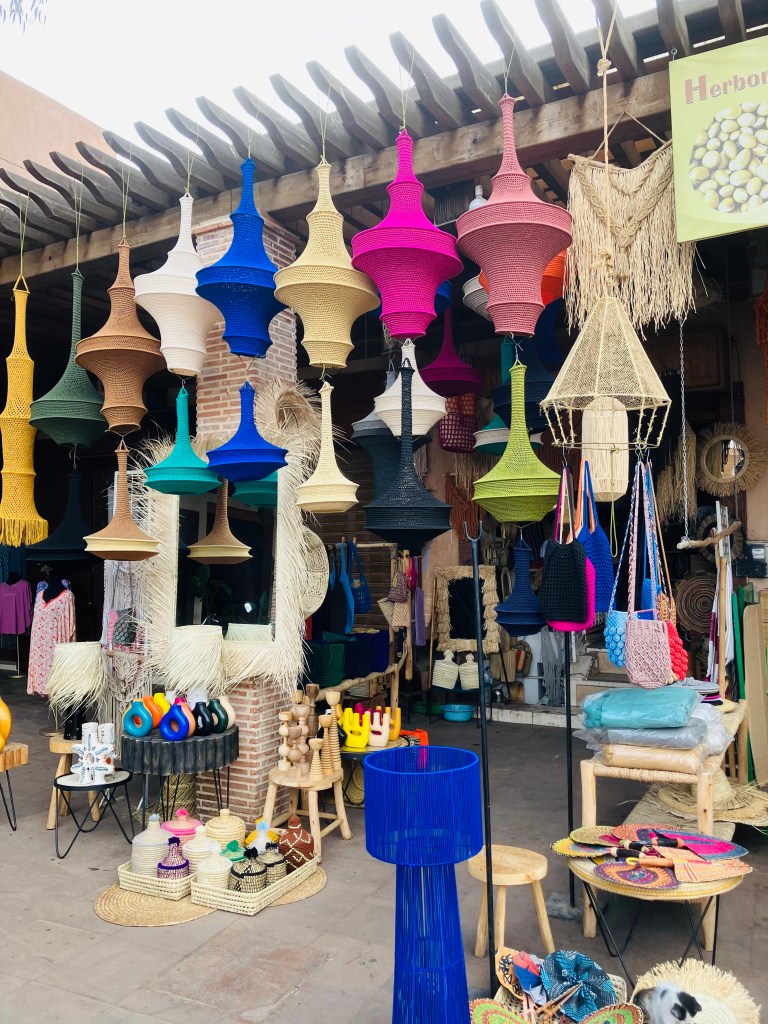
We both really enjoyed this fine example of Moroccan artistry and architecture and on leaving the palace behind walked past shops now open for trade, selling brightly coloured Moroccan herbs and spices and unique hanging lanterns amongst others.

We were in need of sustenance by this point and thus headed to our next destination……
Moroccan Culinary Arts Museum:
Arriving here at 10.45 am the small downstairs tea salon was quiet but invitingly beautiful. The staff were super friendly, helpful and courteous and we were soon settled at a table with liquid refreshments and a plate of traditional Moroccan biscuits.

This Museum of Culinary Arts claims to be the first of its kind in Morocco and has been established within the confines of a large 18th century palace.
Having finished our break we wandered across all three levels of the museum. Each area focuses on a different type of traditional Moroccan cuisine covering everything from the often seen couscous to soups, pastries and even street food.
Couscous originates from the Berber people with couscous or seksu meaning semolina of wheat in Berber. It is traditionally cooked in couscoussiers. This is a traditional double-chambered food steamer with the lower part, the pot, usually containing water, vegetables, red or white meats and the upper section the actual couscous. Examples of these cooking pots have been found in the excavations of the Numid kingdom from the 2nd century BC.
Couscous is not an accompaniment as we often see back in the UK but an actual full dish with chicken, meat and vegetables, not dissimilar to how we might serve rice in the Western world.
It is very prevalent in Moroccan households often described as “a dish that accompanies us from birth to death, a festive dish, a dish of mourning, a dish of Friday after prayer, a dish of sharing.”
Not surprisingly the interior architecture of this museum is once again astoundingly beautiful………..
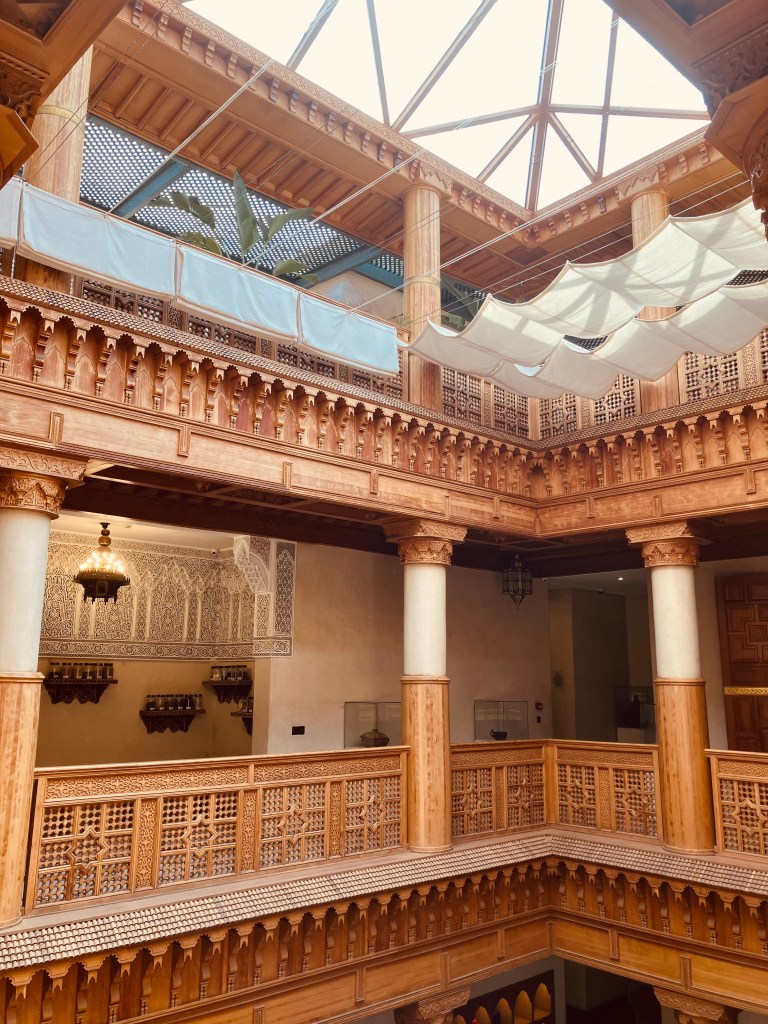
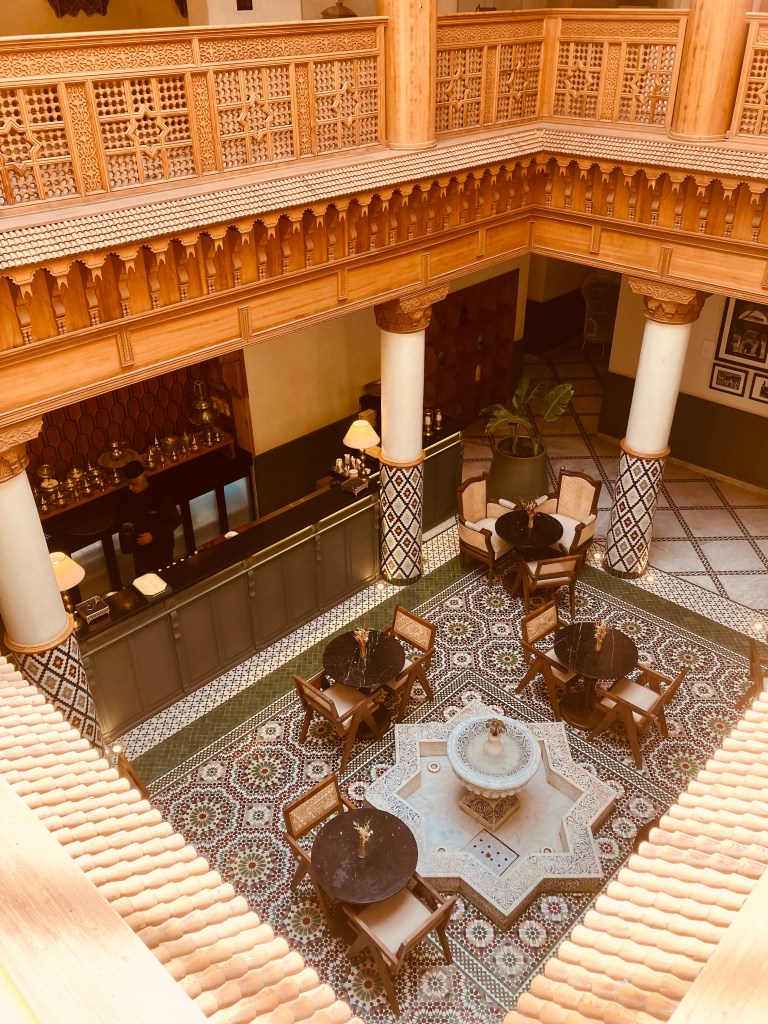
There is also a rooftop restaurant which gives you memorable views across the Medina opening at midday.
Having finished our tour we made our way back down and through the tea salon to the external areas. The Riad has two interior courtyard gardens/patios paved with zellige (enamelled terracotta mosaic tiles) with decorative columns and friezes.

At the centre of the first courtyard is a Carrara marble fountain framed by four olive trees and around the perimeter we explored two salons with ceilings more than 16 ft high and traditional elegant furniture.

Having sat within the courtyard and taken in both the sights and sounds of this beautiful Riad we made our way out through the shop, back out onto the street and headed to the
Badi Palace:
Built in the 16th century and taking nearly 25 years to complete, this palace was designed as a testament to the grandeur of the Saadian Dynasty and the beauty of Moroccan art and design.
Built in 1578 by Sultan Ahmad al-Mansur, the ruler of the Saadian Dynasty, the palace was built as a symbol of the Sultan’s power and wealth, and it was meant to be a grand display of his wealth and influence. The palace was built with a combination of traditional Moroccan and European styles, and it was decorated with intricate mosaics, marble columns, and ornate carvings. Featuring Italian marble, gold leaf from Sudan, and onyx from India, the palace was said to have 360 rooms, each adorned with the finest materials available.
The grand courtyard, with its sunken gardens and reflecting pools, was the heart of the palace, where banquets and celebrations were held.
The palace was also home to the Sultan’s harem, which included over 500 women.
At the beginning of the 18th century the palace was, however, destroyed by Sultan Moulay Ismail and all the precious interior decorations and valuables were carried off to the city of Meknes where Ismail intended to build his capital city.
The once magnificent palace was left in ruins, and over time, the site fell into disrepair.
All that remains today are the remnants of this once beautiful palace, one of Marrakech’s most significant historical landmarks, it’s towering walls and the palace’s vast courtyard are now overlooked by the pairs of nesting storks which have made the walls their home!
We, unfortunately, could not get inside!
It can be closed for events, weddings and film shoots and it would appear without notice. We had checked the site only the night before and had not seen any notifications of closure.
However had we decided to buy our tickets in advance we would have found that tickets were not for sale for three days beginning on Day 3 of our trip!
It was disappointing but serves as a learning curve for us and an education for others who may also not necessarily want to buy tickets in advance that it is worth checking availability even if you are not buying!
Day 3, thus, came to a bit of an abrupt end but we happily wandered back to our Riad and instead spent a little time relaxing on the top floor in the sunshine on a couple of sunbeds!
My next post about Marrekech centres on the beautiful beachside resort of Essouira, coming soon…………….
 A Midlife Adventure
One thought on “A Third Day in Marrakech: From Bahia to Culinary Adventures”