As we dipped our toes into Morocco in order to decide whether this was a country that we would want to explore further it was important for us to venture outside of Marrakech itself. We decided to take a road trip with Said, the Manager of our Riad, to the picturesque seaside port and town of Essoiura. The city is a UNESCO World Heritage site, famous for its 18th century medina, fortified ramparts and bustling fishing harbour.
The Journey:
We set off in Said’s car early on our last day, which was a Saturday, and as he navigated his way out of the city of Marrakech we soon realised that he was open to chatting and was a great ambassador for his home country. I knew, therefore, that this was going to be an ideal opportunity to gather more of a perspective of Morocco itself, where to visit if we came back and maybe where also to avoid.
Essaouira graces Morocco’s Atlantic coast, roughly 120 miles west of Marrakech, about 2.5-3 hrs drive by car. Though the two cities may look close on a map, the road (N8) linking the two, as we discovered en route, weaves through semi-arid plains, small Berber villages, and stretches of argan forests. Unfortunately we didn’t manage to spot any “goats in trees”!
A Moroccan Service Station:
Service stations when you are on a road trip in a foreign country are really important. You need a place to refuel, take a toilet break and grab a snack or lunch particularly if you are on a long journey.
It was helpful, therefore, when our first stop, about an hour and a half into our journey was at a Moroccan service station in Chichaoua. We were both astounded at how organised and friendly the place was. There was a small supermarket area where you could buy provisions, a place to sit and eat/drink as well as toilets.
We opted to order some cold drinks as it was already proving to be quite a hot day. The waiter was so welcoming and soon brought them to the table. The price for two sodas was about half the price of what we had been paying in Marrakech!
Whilst we relaxed for a while, Said had gone to the rear of the services and taken a seat at the counter had ordered a typical Moroccan breakfast explaining that he had been out early that morning dropping some guests at the airport before coming to pick us up.
I thought it was a good idea to pick up some bottles of water whilst we were there and to pop to the toilets before leaving. Again I was astounded how clean they were. You would never believe that you were not in a first world country.
Cooperative Marjana:
Back on the road we soon reached the Cooperative Marjana which was founded to provide economic opportunities and financial independence to women, including widows, divorcees and single mothers.
As part of the tour provided to all visitors you can observe the meticulous and physically demanding process of cracking the argan nuts and grinding them by hand to create the oil, which is a testament to the women’s hard work and skill.
Following this element of the stop you then get an opportunity to sample some of their products and take a stroll around their shop. I’m going to be honest here and say that their products are quite expensive but I’m not a beauty connoisseur so maybe they just exceeded my price expectation. I did come home with a few extra items in my luggage, however, to try when I returned home.

Arriving in Essouira:
We stopped momentarily on the hill above Essouira which gave us a great panoramic view of the city and coast line before descending into the town itself. Said dropped us off adjacent to the car park on the sea front and directed us to the fish market and harbour.
While Essouira can be described as a town due to its relaxed atmosphere and relatively compact size, its designation as a “port city” reflects its historical and ongoing importance as a maritime centre.
It’s design and architecture show significant European influence, particularly Portuguese and French.
Essouira Harbour:
We crossed over the road and made our way to the harbour where I was immediately struck by both the hustle and bustle of the vibrant fish market on the opposite side and the wonderful sea blue fisherman’s boats bobbing around on the water in between.

Making our way around to the market we passed fishermen mending their nets, traditional wooden boats being cleaned or repaired, whilst a couple of bigger boats were still landing the day’s catch. Historically boat builders here in Essouira have supplied fishing vessels for the entire Moroccan coast and even as far away as France.
Stands lined the narrow street, some backing onto the water whilst others opposite backed onto an open space with a couple of what looked like bars with tables and chairs.
We soon learnt from one of the tradesmen that you could buy fish for lunch and then take them across to this area and request for the fish to be cooked for you, taking a seat at one of the tables to enjoy your fishy fare.

We were not, unfortunately, hungry at this point so having wandered up and down taking in the wonderful atmosphere and photographing various stalls we made our way around to the Sqala du Port.

Sqala du Port:
This honey-coloured bastion was built during the reign of Sultan Sidi Mohammed ben Abdallah in the 1760s as part of the city’s defense system. Its primary purpose was to protect the port of Essaouira from potential naval invasions and it was part of a larger project to establish Essaouira as a major trading port and military stronghold.
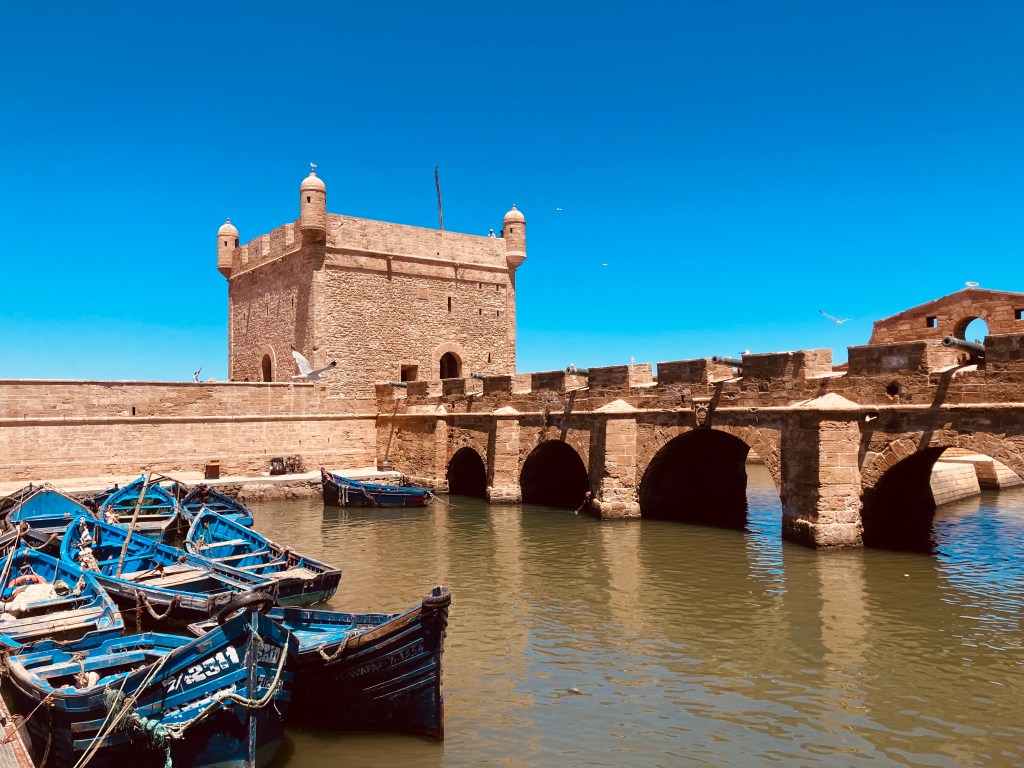
For a small fee you can go inside its thick stone walls and explore. We initially looked around the ground level before climbing one of the narrow staircases to the upper level to check out the well-placed and meticulously preserved cannons that still stand guard, aimed at deterring any naval threats.
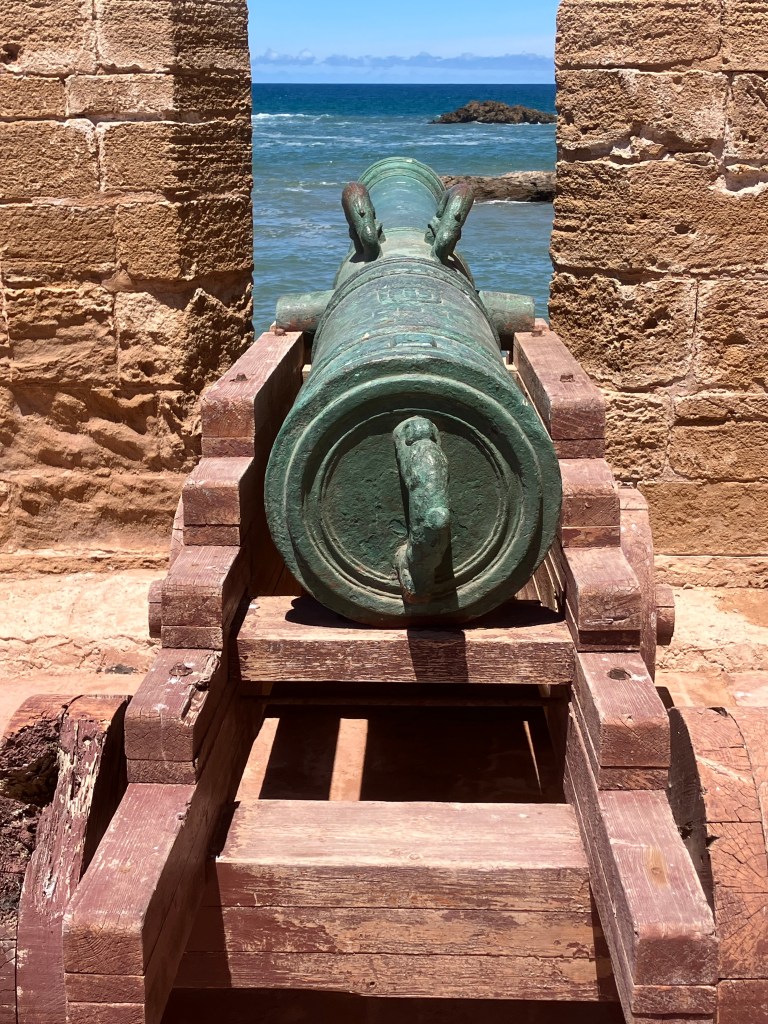
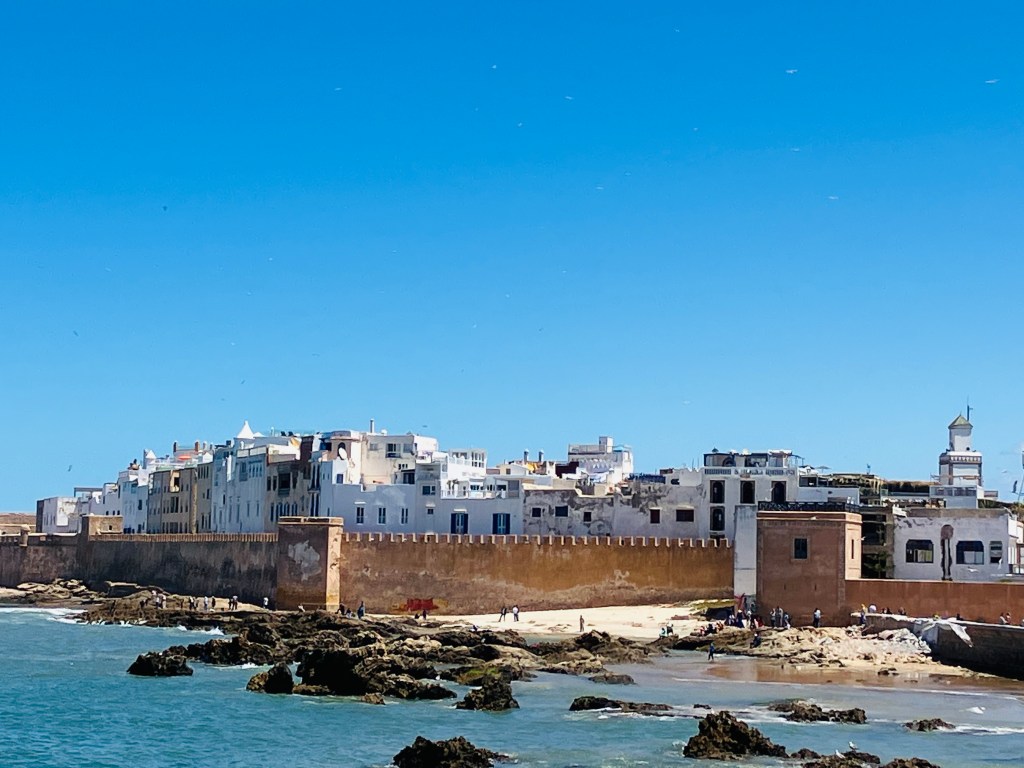
There are also strategic lookout points which give panoramic views across to the city walls on the right, the Atlantic Ocean below, the bustling port from whence we have come and the whitewashed buildings of the Medina.

Fans of “Game of Thrones” may also recognise the ramparts as those in scenes of Astapor.
The fort’s design not only served a defensive purpose but also adds to the aesthetic charm of the area, blending seamlessly with the surrounding landscape. I really enjoyed walking around aware of those who would have trodden here before me whilst no doubt defending their city from incoming marauders.
Unfortunately due to our time constraints we weren’t able to return here to see the sunset but have stored that idea for a future trip.
Île de Mogador:
Standing as far over to the left as you can, the fort’s elevation also allows you to catch a glimpse of these two islands with several tiny islets that lie just off the coast. Also known as the famed Îles Purpuraires or Purple Isles in ancient times, the Romans used to extract the purple dye from molluscs plucked from the bay to dye their imperial togas.
Today you cannot land on the islands without special permission. They are uninhabited and act as a protected sanctuary for Eleonora’s falcons.
The Eleonora’s falcon is a small raptor that takes its hunting abilities to the next level — by catching small birds, then stripping them of their flight feathers which prevents them from being able to fly away. They then stuff the birds into rock fissures or deep holes, from which they cannot escape and come back to feast on them later! That in itself sounds like some mythical creature from days of yore!
Lunch and a Toilet Break:
Before heading off to the Medina and as we left the fort behind I spotted a sign for a public toilet. Summoning up all my courage hubby and I went to find said ablutions knowing that other toilets were probably few and far between.
Spotting both men and women, both local and tourists alike, queuing alongside a brick built building we went across and joined the queue. For a fairly minimal fee we both paid to enter two separate brick built cubicles with wooden doors. You can imagine my naive surprise when I was faced with a hole in the floor, no loo paper or washing facilities. By this point my bladder was fit to burst so squatting over said hole I proceeded to relieve myself, happy in the knowledge that all I needed was a pee!
I had wet wipes in my rucksack which needless to say came in handy once I was back outside where I then watched as an attendant took a bucket of fresh sea water into the cubicle after me assumedly to wash away my pee .
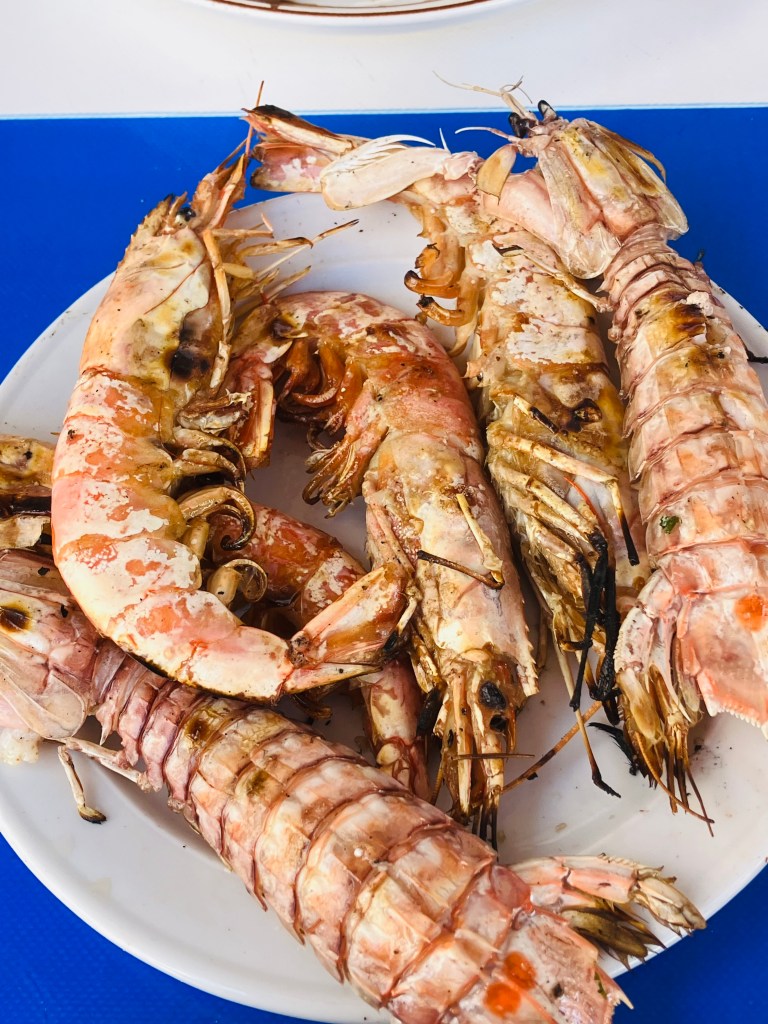
Just after the public toilets we came across a line of food outlets winding their way around in an “L” shape”. With predominantly blue and white facades each separate tented area offered visitors and locals alike the opportunity to choose a selection of fish and shellfish which then would be cooked on a grill to the rear.
This looked right up our street and so we browsed the whole line before selecting the place we wanted to eat. We tend to always work on the theory that if locals are eating somewhere it’s probably a good choice and in this scenario we chose Restaurant de Grillade de Poissons which was one of the last we had looked at.
Conversing, as best we could, with the gentleman selling the fish we chose a selection before taking a seat at a table inside. Our drinks arrived fairly quickly and then the platter of fish and shellfish as ordered, along with some local bread. We seriously could not fault the quality and it’s probably some of the freshest fish we have ever eaten.
The Medina:
Crossing over Moulay Hassan Square we walked up the street opposite to us -Pl Moulay Hassan stopping off to take out some cash from the bank on our left. From here we walked to the junction and turned right passing Patisserie Driss and then by continuing straight ahead it wasn’t long before we turned left onto Av Oqba Ibn Naafia. By following this clean, honey coloured street with patches of trees and squares of greenery, we soon started to see the small alleyways on the left that represent the outskirts of the Medina.
It’s not as busy or as congested as we have seen in Marrakech and immediately I can sense a more bohemian vibe with shops set amongst the most amazing sparkling, whitewashed buildings with blue shutters.
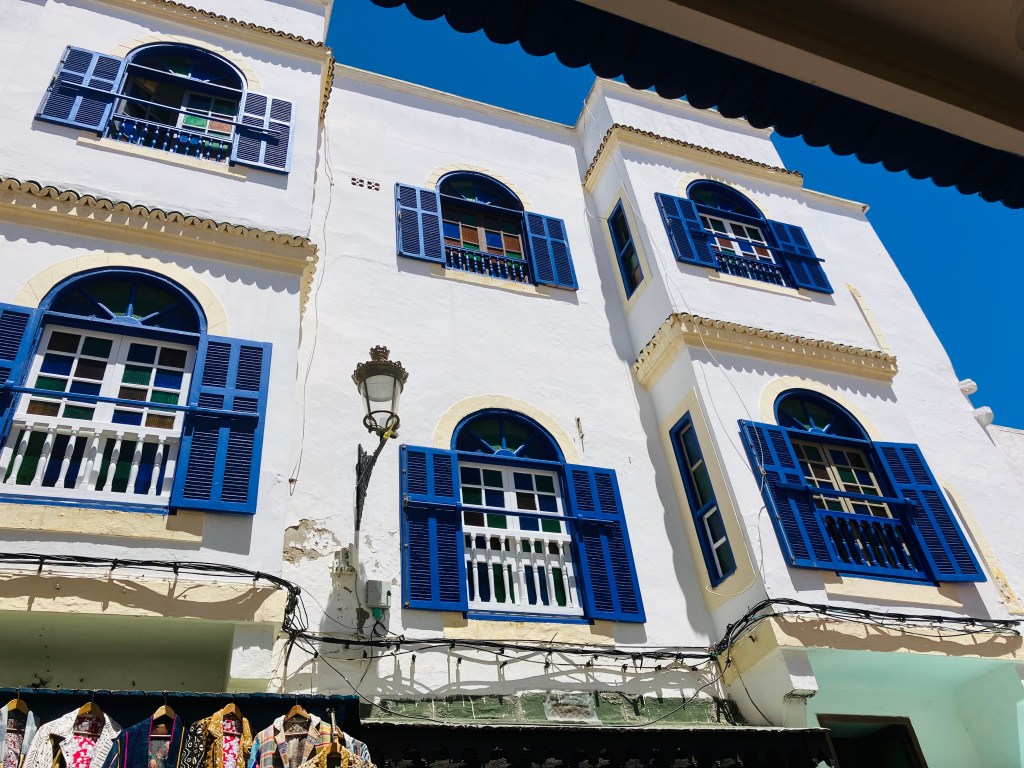
Just like Marrakech though it is surrounded by honey coloured fortifications making it a UNESCO World Heritage site. The maze-like streets are filled with local artisans, spice stalls, and traditional crafts.
Browsing the small shops isn’t as frenetic as it feels in Marrakech. I’m not as conscious of the people surrounding me and have no real desire to follow Google Maps but instead we just wander somewhat aimlessly.
On our travels we spot Patisserie La Charlotte and decide to sit outside in the afternoon sun and feast upon a couple of beautiful pastries each accompanied, in my case, by traditional mint tea. It offers a welcome respite before we need to head back to the seafront to meet up with Said and our return journey home.
Essouira Beach:
It’s a 20 minute walk back to the beach, semi-directed by Google. Enough time is left for us to sit on the sea wall and take in the beachfront vibe.
Essouira is a prime location for windsurfing, kitesurfing, and surfing. due to the strong trade winds but on this occasion the beach is full of sun worshippers and paddlers. In the far distance we can spot some horses and camels which look to be offering treks along the beach on the other side of the bay.

Reflecting on our day spent here there’s a real blend of Arabic, Berber, Jewish, and French cultural influences which together have created a somewhat unique and cosmopolitan atmosphere. It’s a place that will definitely be on our road trip of Morocco when we return here in the future.
The final episode in our trip to Marrakech will be a summary of all the wonderful food we have eaten whilst here including our very own cookery lesson……………
 A Midlife Adventure