We are have just flown into Bilbao which is our starting off point for a three month exploration of Western Europe by train. This city came to my attention when I was reading a piece of travel journalism which focused on the wonderful architecture of the city and variety of food specifically the pintxos.
In order to explore the architecture I utilised an app I have downloaded called “GPSmyCity” which suggests self guided walks to follow, complete with narrative. As a result I then also came across the world famous Guggenheim Museum which opened in 1997.
This museum possibly single handedly lifted the city out of its postindustrial depression and into the 21st century and gave a lot of tourists a reason to visit the city.
From the exterior you are met with a monolith of titanium tiles, created by architect Frank Gehry, which as you walk around you will find that the patterns and colours change with the light.
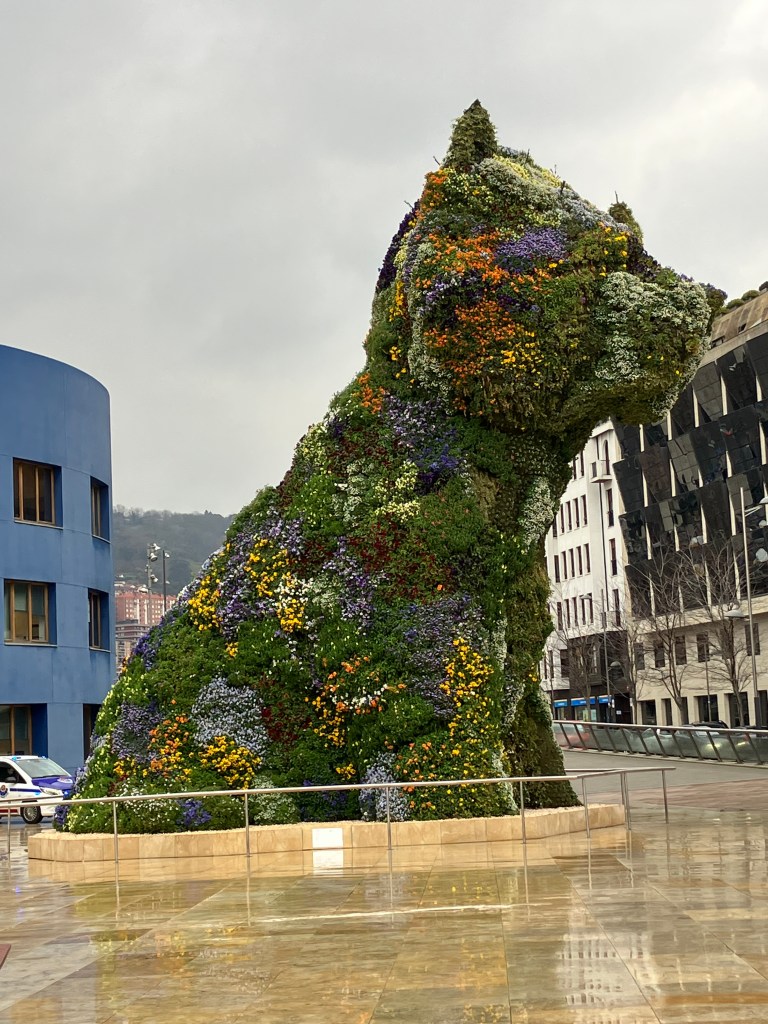
On the city side of the museum, prior to descending to the entrance, is “Puppy”. This 12m high Highland terrier is currently made up of thousands of spring flowers. Designed by Jeff Koons it sort of welcomes you to the museum.
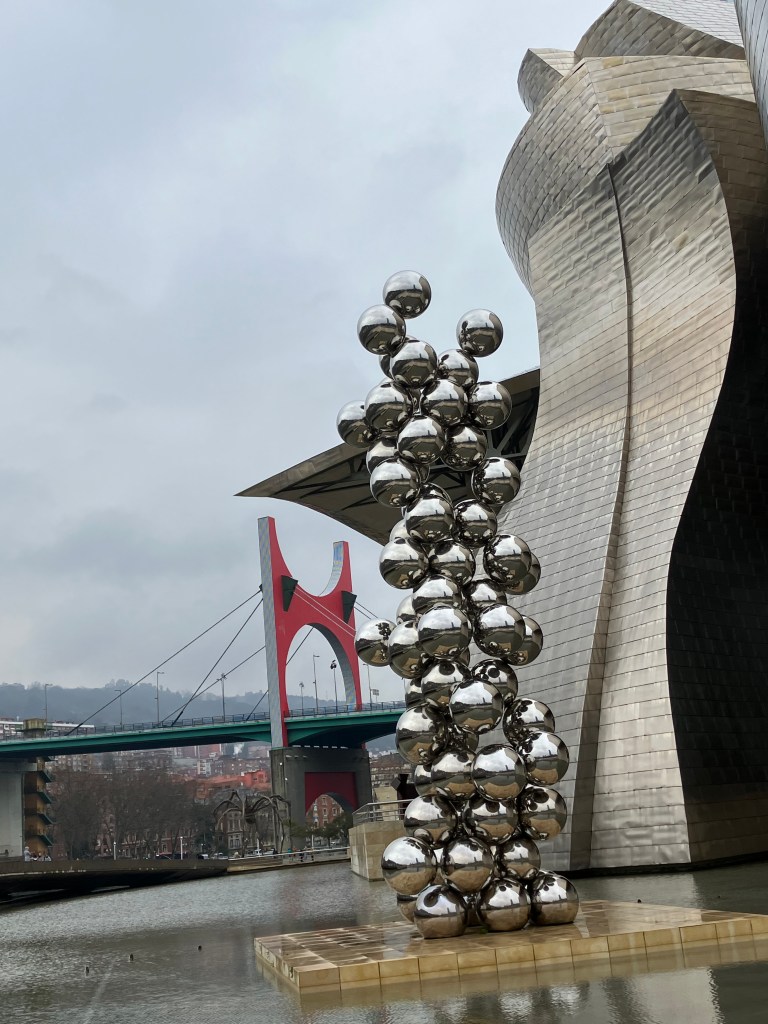
On the opposite side, next to the river, you can view Anish Kapoor’s “Tall Tree and the Eye”. This consists of 73 reflective spheres anchored around three axes which individually distorts reality as you look into them.
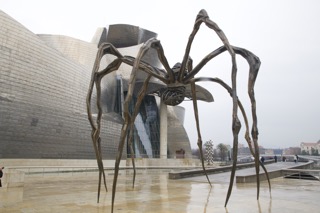
Nearby, on the riverbank, is “Maman”, Louise Bourgeois’ sculpture of a skeletal spider said to symbolise a protective embrace
Alongside many others I admire all three of these sculptures before even paying my entrance fee.
Inside the museum there are three levels. Architecturally they are unique. They meander around the inside of the building, leading you from one zone to another, whilst a central glass lift sweeps you ever higher. There are walking platforms between the zones which allow you views of the cleverly designed interior.
Within the zones you are introduced to modern art from Joan Miró, Richard Serro, Jenny Holzer, Jeff Koons, Mark Rothko and Jean Michel Basquiat amongst others. This is where I become unstuck. I look at some of these “paintings” and I’ll use a Mark Rothko as an example and firstly question “how can you call this a painting?”
It looks like a child has painted a frame and then inside the frame has created three horizontal boxes which have then been painted three different colours.

Rothko’s art sells for millions. A similar piece to this entitled “Orange, Red, Yellow” sold for 86.9 million dollars back in May 2012 at a Christie’s sale in New York.
I stand and stare at it and wonder if someone, at some point in history, decided to play a practical joke on the art world? Did they rock up with one of these paintings and start wittering on about how truly artistic it was, how clever the brush stroke, how individual the talent? Did they talk about how expressive the artist was feeling at the time of painting and did the group of art collectors assembled, not wishing to appear as philistines, agree and suddenly modern art was born?
Or worse still was it, as some theorise, that modern art was a “scam” created for money laundering and tax avoidance purposes, by people far more astute than the artists being presented as world class?
I guess we are all entitled to an opinion and, to be honest, if it was the latter then no one is ever going to know. Are they?
 A Midlife Adventure
Couldn’t agree with you more about the Rothko ‘painting’ & also some of those of his contemporaries . Carry on ‘blogging’ & enjoy your adventures. x
LikeLike