As part of our first day in Cordoba we visited the Mosque-Cathedral of Cordoba and I seriously cannot even begin to describe its beauty. A beauty that is not only defined by it’s architecture but also by the unity of religion created within.
In a world where so many countries have experienced or are experiencing religious warfare this cathedral bears witness to the fact that regardless of your religion (or in my case lack of religion) you can exist alongside each other in harmony.
Our first day in Córdoba didn’t ease us in gently—it went straight for awe. The moment we stepped inside the Mosque-Cathedral, I felt completely disoriented in the best possible way. Everywhere I turned, there were arches—rows and rows of them—stretching out like an optical illusion, red and white stripes drawing your eyes further in, as if the building itself was inviting you to get lost.
And honestly, you do get lost. Not just physically, but mentally too.
Because this place isn’t just about how it looks—it’s about what it means. In a world that often feels divided by religion, this building quietly stands as proof that different beliefs don’t have to clash. They can overlap, evolve, and even coexist beautifully. As someone without a religious background, I didn’t feel like an outsider here. If anything, I felt included in something bigger—something calm, layered, and surprisingly hopeful.

What makes it even more fascinating is that this sense of coexistence isn’t just symbolic—it’s built into the very fabric of the place. Long before the arches and intricate details, this was a Christian basilica, San Vicente, dating back to the 6th century. When Muslim rule arrived, the space wasn’t erased—it was shared. For a time, two religions existed under one roof, which feels almost unimaginable now.
As the city grew, so did the mosque. It expanded again and again, each ruler adding their own vision—more arches, more space, more grandeur. And yet, even with all these changes, it never feels chaotic. Somehow, it works.
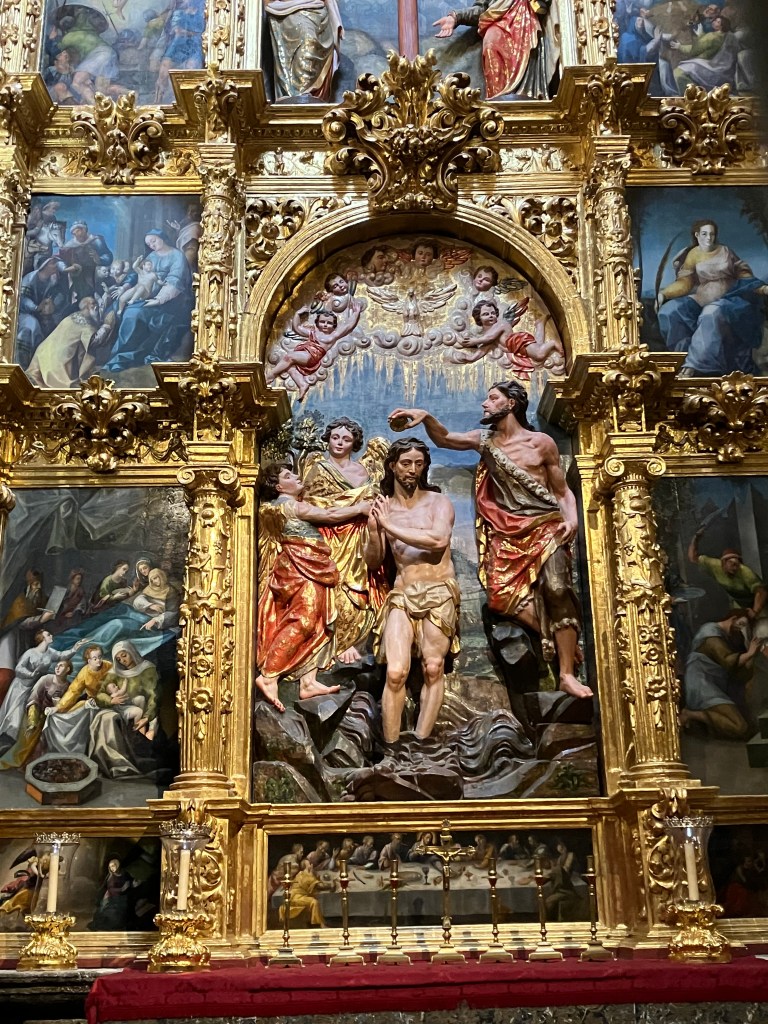
One detail I loved: the mihrab—the focal point indicating the direction of prayer—is stunningly ornate, as you’d expect. But unlike most mosques, it doesn’t actually point toward Mecca. It faces south instead. A small detail, maybe, but one that quietly reminds you that history doesn’t always follow strict rules.
Then, in 1236, everything shifted again. Córdoba was conquered, and the mosque became a Catholic church. Later, a Renaissance-style cathedral was inserted right into the middle of it—vaulted ceilings rising upward in dramatic contrast to the low, endless symmetry of the mosque. From the outside, you can even see this clash of styles: the vertical thrust of the cathedral pushing up against the horizontal calm of the original structure.
And yet… it still works.

I read a description inside calling it “one of the most exceptional monuments in the world,” a place where art and faith intertwine across centuries. For once, that didn’t feel like exaggeration. If anything, it felt understated.
Mass has been held here every single day since the 13th century. And remarkably, much of the original Islamic design remains untouched. It hasn’t been erased or overwritten—it’s simply been absorbed into something new. Not replaced, not hidden—just… existing alongside.
If you visit (and you absolutely should), there’s an audio guide, plenty of information, all the usual things. But here’s my advice: skip it, at least at first and enter this sacred place with an open mind, let the atmosphere draw you in, let the sheer beauty of the architecture awake your senses and let the peace and tranquillity surround your soul. If you allow this Mosque-Cathedral to envelope you, believe me you will leave this place with a feeling of a greater sense of harmony and an aura of peace.

This my second post of a series of three about Cordoba as part of our tour of Western Europe. Want to know more about this fascinating city? Why not check out the other two posts?


This blog really brings the history to life. Love your descriptive words & the wonderful photos. Carry on enjoying your ‘ Midlife Adventure’. x
Thank you 🙏
LikeLike