Wow! What an amazing place!
We arrived yesterday afternoon and settled into our hotel for three nights. Sequestered in the old part of town with cobbled streets, beautiful but varied architecture and an atmosphere of conviviality and somehow tranquility .
Our day began with a 15 minute walk from our hotel through newer parts of the town and then into the Jewish Quarter.
Cordoba Synagogue
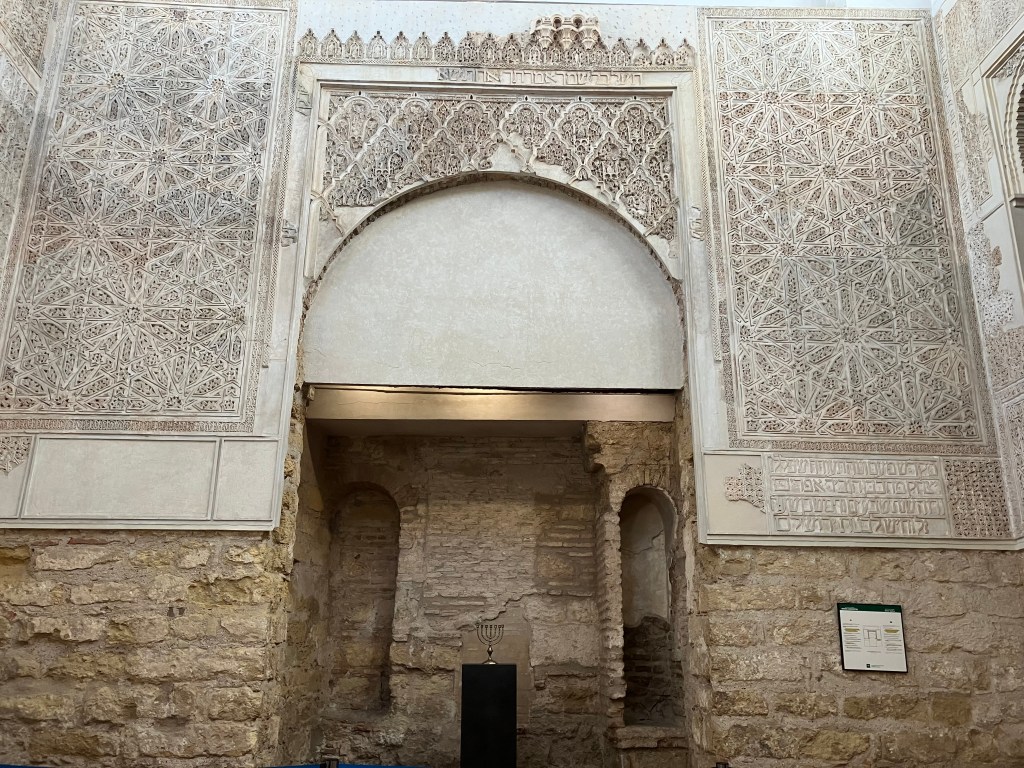
It’s only small, free to go in and takes only about 10 minutes to view but is one of the most well preserved Jewish history sites in Spain. Built in 1315 this sacred site features Mudéjar-style plasterwork and detailing throughout with original Hebrew inscriptions that adorn the walls of the main hall. After the expulsion of the Jews in 1492 only three synagogues remained throughout Spain and this is one of them with restoration beginning as far back as 1885!
Walking on from here we headed to the Banos del Alcazar Califal de Cordoba or……
Califal Baths.
This Islamic bath house is located underground so you have to walk down the stairs or slope to the entrance. Within the historic centre of Cordoba and part of the Unesco World Heritage Site the baths formed part of the Caliphal Palace of the Umayyads (which is now the Alcazar de los Reyes Cristianos) .
Built in the 10th century to serve those who lived in the Palace when bathhouses were a common feature of Muslim cities the baths were frequented both for ritual purification purposes and also for hygienic and social purposes.
The layout was very similar to that of Roman baths in that there would be a cold room, a warm room and then a hot room.
Latrines were also accessible near the cold room, with underground running water washing away the waste. Bathers visited the cold room first, then moved to the warm room and finally the hot room, the purpose of which was to induce perspiration as part of the cleaning or purification process. Visitors were also cleaned with vigorous rubbing and massaging by bathhouse staff.
In contrast to other versions of steam baths, Muslim bathers did not actually immerse themselves in water but instead washed themselves at the end of the process by having warm water poured onto them.
Furnaces provided hot water for the steam rooms, and also generated hot air and smoke which was then channeled through pipes under the floors of the hot and warm rooms, similar again to the Roman hypocaust system before being released through the walls and up to the chimneys. This was over 1000 years ago and yet they had already mastered these techniques!

During the 11th century a reception room was added which is still present today, in front of which was a sunken garden. The garden was likely planted with orange and lemon trees along with myrtle and other plants. Water was brought to the baths from the aqueduct along the city walls and also stored in a cistern.
Following the takeover of the city by the Christians in the 12th century the baths remained in use with a water basin specifically for bathing being added. Alas in the 13th century the baths fell into disuse when King Alfonso XI built a new set of baths within the royal palace itself. As a result the baths were buried in order to create a small square known as the Campillo del Rey.
It wasn’t until 1691 that the baths were rediscovered by accident when building work was taking place around the square. Covered over again they did not resurface for over 200+ years in 1903 and despite being dated back to the reign of Al-Hakam II’s reign they were again covered over. They finally saw the light of day when they were excavated in the early 1960’s and eventually converted into as museum, which opened in 2006.
The marvel of the baths for me, other than the engineering ability is walking upon some of the original marble floor and thinking about all those who went before me.
Alcazar de los Reyes Cristianos
The present day Palace was begun in 1328 by Alfonso XI of Castile on the site of an old fortress and appears Islamic due to the king adopting the Mudejar style.
In the reign of Henry IV of Castille it became involved in the civil war and his successor Isabella and her husband Ferdinand of Aragon used the Alcazar as one of the first permanent tribunals of the Spanish Inquisition. In 1482, as it became the headquarters of the inquisition, much of the Alcazar was converted into torture and interrogation chambers which continued for another three centuries.
On a lighter and more positive note it was here in 1486 that Christopher Columbus had his first audience with Isabella and Ferdinand in order to gain support for his expedition to find a western sea route to Asia.
The alcazar again came into its own, serving as a garrison for Napoleon Bonaparte’s troops in 1810, before returning to a prison in 1821. It became a national monument in the 1950’s.
Gardens
These are the piece de resistance of the Palace. As you walk out you cannot help but be amazed. Created in the mid 20th century they are just stunningly beautiful and well kept. Ignore the map of the layout and just let yourself wander at will amongst the beautiful fountains, well kept flower borders and contemporary glass sculptures. It’s hard to get photos without other visitors present but be patient, take your time and you will achieve it. If you have the time take a book with you and just sit and read or better still take a breath and just treasure the moment. Trust me you will not be disappointed.

NB:
This is part seven of our tour of Western Europe. Why not check out all the previous posts and follow us as we learn more about this fascinating area of the world?
 A Midlife Adventure