As I said in my previous post I didn’t really do a lot of research into Crete as we were coming here on holiday primarily to relax, sunbathe and take a break from life and everything 2024 had thrown at us to date.
Having been island hopping on two previous occasions I do have the Lonely Planet Guide to the Greek Islands. I, therefore, gave Crete a quick read and decided if we went anywhere I would try to visit Knossos and/or Spinalonga. The coach company assigned to our resort offered both of these historical places of interest but the trips to Knossos were both at times during the day when I perceived there would be an avalanche of tourists and this was not something I wanted to subject us to based upon our experience of Hersonissos. Thus a half day trip to Spinalonga with a couple of additional stops seemed to fit our needs.
En route to Spinalonga we were introduced to our female guide for the excursion who was very friendly, knowledgable and welcoming. The drive down to Elounda from where our boat would depart for the island went by quite quickly with an interesting narrative given about Crete as a whole.

Crete – As An Island
Crete is not only the fifth largest of the islands in the Mediterranean Sea but is also the largest and most populated island in Greece.
It lies approximately 100 miles south of the Greek mainland and about 62 miles southwest of Turkey, surrounded by the Aegean Sea.
Because of its size and population, it is one of the most important economic zones in Greece.
The island is divided into four provinces or administrative regions running east to west across the island. These are known as Lasithi (East Crete), Heraklion (Central Crete), Rethymnon and Chania (West Crete).
The vast majority of the island is covered in mountains with some beautiful beaches along the coastline. There are several natural reserves on the island along with a tremendous amount of culture and history.
Approximately 670,000 people live on the island with the largest city being Heraklion, home to one of the two international airports and also a ferry port, from where you can travel both to mainland Greece and other islands. About a fifth of the population live in the city of Heraklion.
It is a relatively long and narrow island, stretching for 160 miles on its east-west axis which takes approx five hours to drive without stopping and varying in width from 7.5 to 37 miles wide.
In addition to the people who live on the island permanently, there are a lot of tourists who visit Crete every year. In 2023 this topped just short of five million with people visiting not just for vacations but also for archaeological and cultural exploration. Within this 5 million are around three quarters of a million Brits.
Crete has a rich history and culture that dates back thousands of years. The island was once home to the Minoan civilisation, one of the earliest civilisations in Europe.
Needless to say one of the key sections of the economy is tourism but agriculture is also important. Crete is proudly self sufficient growing a variety of crops. Olives and the resulting production of olive oil are really important but vegetables such as tomatoes, potatoes, cucumbers, peppers and courgettes also play a role. Fruits such as grapes, pomegranates, oranges and limes are also clearly visible on the island and they even grow their own bananas.
Carob beans are also grown and made into flour. Not particularly popular here in the UK, carob powder has more calcium and fiber than cacao (from which chocolate is derived). It also has lower levels of saturated fats and is caffeine-free, so it’s healthier for your body and heart.
The Cretan people are world renowned for their longevity. It is a global phenomenon that has long been the subject of numerous scientific studies over the years. All of these studies and research have concluded that they live longer for two main factors: The first is the quality of food, and the second is the way of living.

The History of Spinalonga
Spinalonga Island has a weird and wonderful history. This now uninhabited island was originally a stronghold of the Venetians, who built a massive fortress in 1579 to protect the bays of Elounda and Mirabello. Unfortunately this effort failed when in 1715 the island fell to Ottoman rule.
Fast forward to 1901, when the Cretan government passed a decree for the isolation of people affected by leprosy and with Spinalonga’s isolated location off the northern tip of the Spinalonga Peninsula they decided to establish a leprosy quarantine colony here.
Also known as Hansen’s Disease, the condition causes skin lesions, nerve damage and muscle weakness and has been around since ancient times. As many as 1000 Greeks were quarantined on Spinalonga, initially in squalid and miserable conditions. This changed, however, in 1936 with the arrival of Epaminondas Remoundakis, a law student who contracted leprosy at the age of 21, and who fought passionately for better medical care and infrastructure on the island. A cure for leprosy was finally discovered in 1948 and the last person left Spinalonga in 1957.
The island then underwent a cultural popularity resurgence with the release of Victoria Hislop’s 2005 bestselling novel The Island with a subsequent Greek TV series spin-off called “To Nici”. Thanks to Hislop’s tale about her own family’s connection to the island, interest in Spinalonga has risen expotentially and thus boats depart regularly from Elounda, Plaka and Agios Nikolaos.
Our Visit:
The ferry crossing was included in our coach ticket for the day but the cost to sail across is 14 Euros with an entrance fee onto the island of 8 euros. Subsidies are available for children and senior citizens with photographic proof.
The journey only took about ten minutes with the fortress on the hill coming ever closer and we were soon docking beside a small, pebbly beach.
Having paid our entrance fee we entered the island, as the lepers before us would have done, by walking through Dante’s Gate – a 20m-long tunnel.
If you are visiting independently you can join a guided tour. However as we were booked on a return boat back to our coach we chose to go at our own pace and followed the pathway right around the island which took about an hour.
Leprosy is an ancient disease and has been feared since biblical times when lepers were treated as ‘unclean’. Lepers were cast out by society with the disease creating unsightly deformities affecting faces and limbs. These were thought to be physical evidence of past sins. This unfortunate belief remained in place for centuries and right up to the early 20th century leprosy was considered to be a highly contagious and incurable disease. Many of Crete’s lepers used to live in caves. At least on Spinalonga there was a hospital with nurses, a caretaker and a priest, but living conditions were poor and often squalid, much of which is described in Hislop’s novel, which takes place in the last years of the leper colony in the 1950s.
The trail takes you past the main sights including the church, the disinfection room, the hospital and eventually the cemetery. These are obviously now mainly in ruins but you can still get an incredible insight and feel for those stranded here.

The remains of the Venetian fortress still stand atop the hill and at the end of the Ottoman occupation of Crete, the island became a refuge for thousands of Ottoman families. They formed their own community here in the 19th century and you can still see some of their houses, shops and workshops as you wander around the island today.
The houses were two-storey structures with inclined roofs, whitewashed inside and out. They had ornate openings and wooden door and window frames painted in bright colours. Each house had its own courtyard, surrounded by a high wall, which usually housed small ancillary buildings, such as a cooking area and a toilet. Floors were tiled and the courtyards were often pebbled. The most well-to-do houses also had their own rainwater cistern.
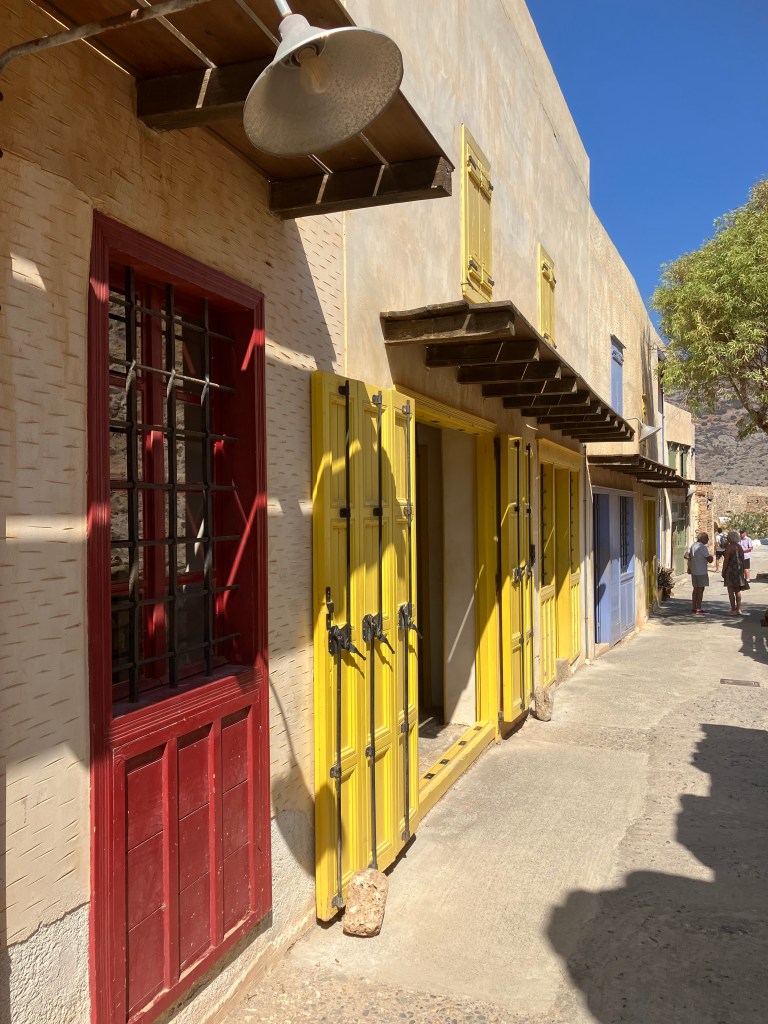
At the southernmost end of the main street there was a sizeable number of shops and coffee houses with large shop doors and glazed openings in their facades. Almost all of them had an ancillary room on the upper floor.
Part of a shopping street has been reconstructed to give visitors a better idea of what it would have looked like when the island was a leper colony. Despite the streets and shop buildings now being empty, if you take a minute to sit and take in the ambiance, you can still feel the sense of community that was once here. It’s nearly 70 years since the lepers were living here in Spinalonga, walking these same streets, buying bread from the shops and attending the church.
They were responsible for earning their own livelihood. They lived and fell in love on this tiny island. They cultivated land, married and had children here.
In some respects it also reminded me of Alcatraz in so much as the people living here would have been able to look out of the windows from the walls of this island prison to the clear, blue sea beyond and the mainland in the distance perhaps longing and wishing for a different life.

As you near the end of your circumference of the island you come across the graveyard, a testament to those who arrived but never left when eventually a cure for the disease was found. Unesco describes the island as a “monument to human pain” and to be honest I could see it and feel it as I made my way around. There is an eerie silence to the place with silent bells and vegetation strewn rocks that is hard to avoid.

Returning to the start and in our case awaiting the arrival of our return boat you can pop into the small museum, with information about the various historical periods and occupations.
There is also a small café beside the water, serving drinks and snacks.
There is no doubt that the island played a significant role in the history of Crete and even Greece itself so I would truly recommend a visit. I left the island desperately needing to read Victoria’s book and wanting to transport myself back to those times I had imagined on my visit.
 A Midlife Adventure