I initially wanted this post to be a bit like a travel log, sort of a “what to expect when you visit this Grand Palace” which stands at the centre of UK society. But my visit raised questions within me which I’ve not been able to exclude so I have included these within the text where I feel it is pertinent.
Tickets:
Tickets are limited so if you wish to visit any of the Royal Palaces in the UK it is always best to buy tickets when they are released as they often sell out really quickly. The most simple method for this is to join the Royal Collection Trust and opt into updates. The different palaces are open at specific times of the year so it is worth exploring the website to understand when each Royal accommodation is open.
In the case of Buckingham Palace this is the summer months. This may change in the future as our new King Charles III has lived at Clarance House for 20 years, where he has said he will continue to reside until renovations at the Palace are complete. At a cost of £369 million the work began back in 2017 and is estimated to take ten years.
Charles is reported to share his mother’s lack of affinity for the 775-room Palace as an actual home despite housing his private office and communications team there.
On this occasion we purchased a combined ticket to view the King’s Gallery, The Royal Mews and the State Rooms inside the palace itself back in November 2023. Our original visit was planned for July 2024 but unfortunately due to ill health I had to telephone them and delay the visit. I only mention this because the lady I spoke to was extremely helpful, understanding and courteous. There were no challenges or awkward questions. She just wanted to ensure our new date in September allowed us plenty of time, without being too exhaustive.
Each element is assigned a timed entry. It is worth ensuring you have read the information on their website prior to your visit to ensure you walk to the correct entry point. Entry is not via the big gates at the front!
The Royal Gallery:
Our entry was at 1.30 p.m. and there was no queue.
Every section of the Palace that you go into requires, not unsurprisingly, airport style security checks and each one also offers a complimentary multimedia guide. This particular guide lasts about an hour depending upon how much information you want to listen to or conversely skip.
Beautiful, clean toilets were available throughout all of the three stages of our visit.
Unfortunately due to copyright laws, photography is not allowed in this exhibition.
As stated on the website “For centuries, portraiture has played a vital role in shaping the public’s perception of the Royal Family. This exhibition charts the evolution of royal portrait photography from the 1920s to the present day, bringing together more than 150 photographic prints, proofs and documents from the Royal Collection and the Royal Archives.”
Displayed in date order you can view portraits taken by Cecil Beaton, Annie Leibovitz, Norman Parkinson, Mario Testino and Hugh Burnand to name but a few.
There are also explanations throughout detailing how photography has evolved through the last century.
My personal favourite was the last Royal photo taken of Princess Diana, before her untimely death, which was taken by Mario Testino.
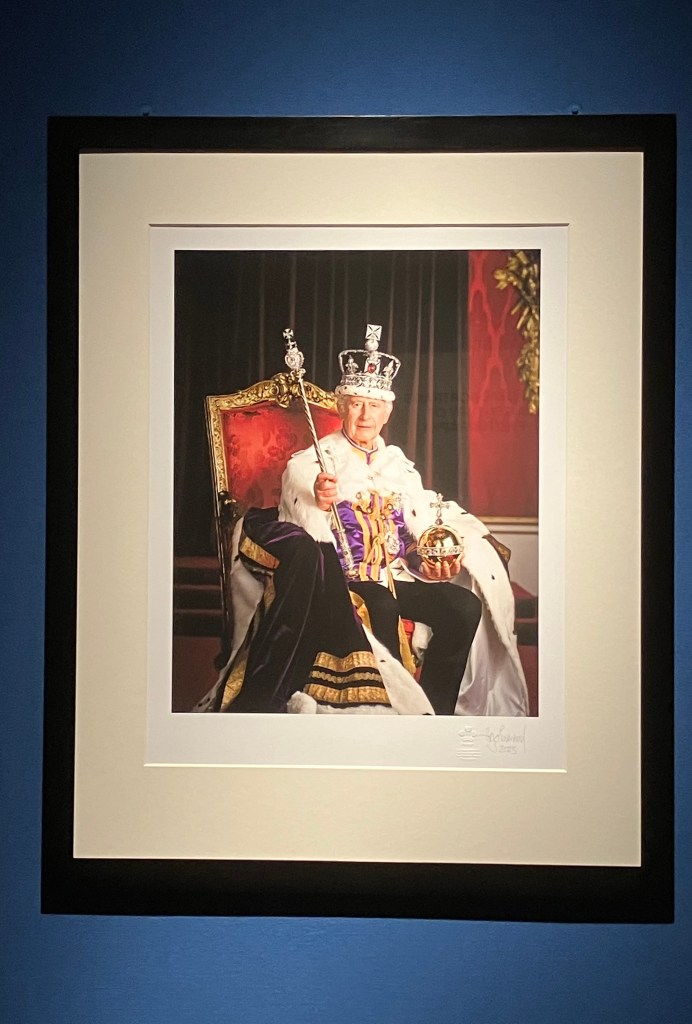
The final photo in the exhibition is, however, of King Charles on his coronation.
I look at it and I’m afraid I don’t see the rationale for all this pomp and circumstance. I understand it is borne from centuries of tradition, servitude and dare I say public subservience but is it really needed in this day and age? Will Prince William really organise something similar to this when he succeeds to the throne? Or is he more in touch with the younger members of society?
Latest polls show 43 percent of Gen Z would choose to replace the king with an elected head of state. There is a sharp divide between the opinions of those over the age of 50, who on the whole fully support the monarchy and those under that age who are wavering from this opinion. As you progress down through the generations and ages the monarchy looses favour and this is an opinion that has not changed for several years.
The Royal Mews:
Our entry was at 2.45 pm, there was no queue and we arrived earlier but they happily allowed us in. The multimedia guide is 45 minutes and photography is allowed.
Brief Description:
This area of the Palace is the central hub of transportation whether that be by horse, carriage or car and has responsibility for all livery and harness.
The description of a Royal Mews comes from the reign of Richard Il who was the first king known to have established a permanent home for his hunting falcons and hawks at Charing Cross, one mile from the Royal Mews. The birds were kept there whilst they were mewing, or losing their feathers, which happened naturally with the changing seasons but made them temporarily unable to hunt.
In 1825 George IV, permanently moved the royal horses from Charing Cross to this current location with space for 100 horses. The buildings we see today still have space for over 70. We didn’t unfortunately get to see many horses on our visit but the State coaches are definitely something to be admired.
State Coaches:
No one, really does pageantry, pomp and ceremony like the British and the coaches on display certainly give you an insight into how this is achieved from a transport perspective.
One of the smallest carriages on display, but still worthy of a mention is the brougham which was designed in the 1830’s and only accommodates one or two passengers.
What made me smile about this small coach and why I come to mention it here is that a brougham is still used today to carry the post between Buckingham Palace and St James’s Palace. I cannot imagine there is anyone else alive on the planet who receives their post in this manner!
The main exhibition begins with the Town Coach (pictured below) and then Queen Alexandra’s State Coach which since 1962 has been used during the State Opening of Parliament to carry the Imperial State Crown, the Sword of State and Cap of Maintenance in its own procession. When the Crown and regalia are travelling to Parliament, they are entitled to a Household Cavalry escort and royal salute. The Crown sits in the coach on a crimson cushion and is lit by an electric light.
Is it just me who thinks this is slightly bizarre? The words why? are you for real? and surely not? spring to mind.

The second carriage in the procession behind The King’s carriage for the State Opening of Parliament is the Glass Carriage.
This coach, however, has a far more romantic history in that it originally carried Lady Elizabeth Bowes Lyon, later Queen Elizabeth The Queen Mother, to Westminster Abbey for her wedding to The Duke of York (later King George VI) on 26 April 1923. Twenty four years later it then carried their daughter, the future Queen Elizabeth Il, to her wedding.
The coach has been used for several royal weddings since usually to convey the bride to the ceremony. It’s like something out of a fairytale, the young bride conveyed to her wedding by horse drawn carriage and this still resonates with some young girls today.

The newest coach in the Royal Mews is The Diamond Jubilee State Coach (pictured above) and created for Queen Elizabeth lI to commemorate this state occasion in 2012. The coach is not driven by a coachman but is instead postilion-driven which means there is a groom on each pair of horses who guide the coach in its transportation.
The interior of the coach is lined in yellow silk but what makes it truly unique is that the structure was inlaid with various historic timbers and artefacts:
- The seat handrails are from the Royal Yacht Britannia
- Sections of the window frames were sourced from historic structures including Caernarfon Castle, Canterbury Cathedral, Durham Cathedral, Henry VIlI’s flagship The Mary Rose as well as fragments from the Antarctic bases of Captain Scott and Sir Ernest Shackleton.
- It also includes a fragment of the Stone of Scone which is the sandstone block that has sat under the Coronation Chair at all coronations since 1308
- Also included in the build are a British lead musket ball from the battlefield at Waterloo, and a piece of metal from the casting of the Victoria Cross (the highest award for military bravery)
- The metal comes from Russian guns captured at Sebastopol and, finally, there is a specimen Dickin Medal, which is awarded by the People’s Dispensary for Sick Animals (PDSA) to animals who have shown great courage whilst serving in the armed services and police force.
- The crown on the top is made in oak taken from HMS Victory, Admiral Lord Nelson’s flagship, and is hollow to allow a camera to be fitted to film the crowds lining the carriage’s route.
- And finally the frieze around the top of the carriage features the national emblems of the English rose, Scottish thistle, Irish flax and Welsh leek. It was carved in Australian beech wood and gilded.
I really like the idea that something so new (in coach building terms) acts as protection for so many elements of the country’s history.
The piece de resistance of the carriage display, however, has to be the Gold State Coach which is displayed in it’s own separate cavernous space to allow visitors to view it as if in action complete with horses and grooms.

This is one of the most magnificent royal coaches in the world and was commissioned during the reign of George Ill.
When you stand behind the coach you can see that the rear wheels are angled outwards.
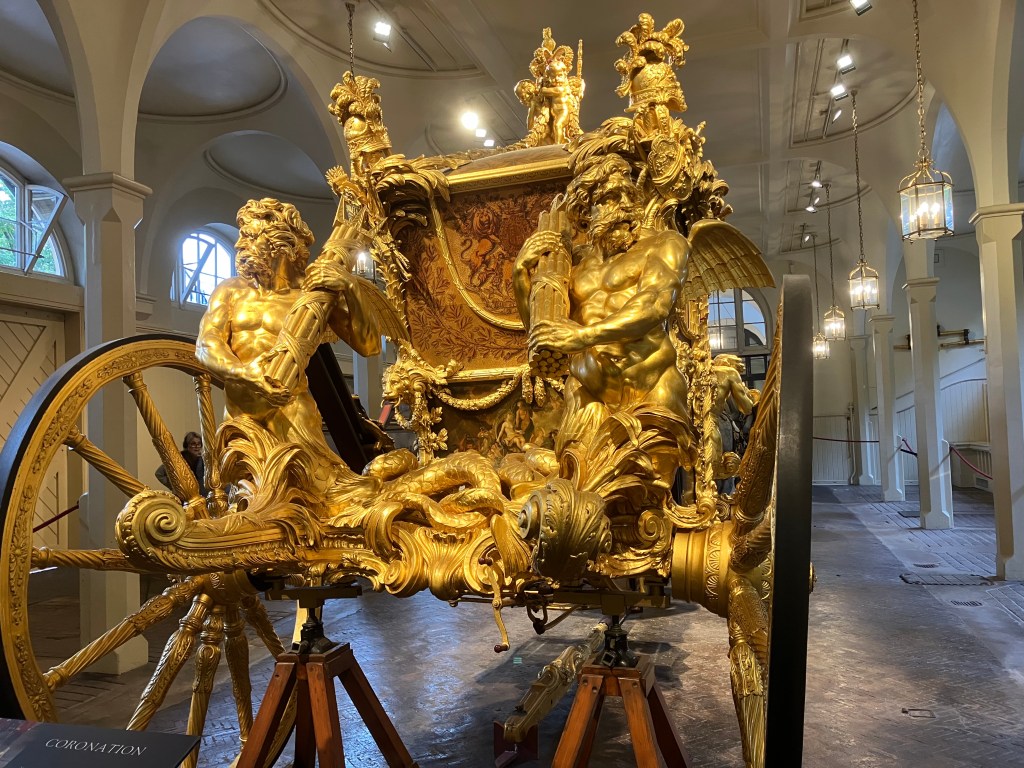
As a result each spoke hits the ground at 90 degrees which is best for taking the weight and strain of the four-ton coach. Due to its weight it can never travel faster than walking speed.
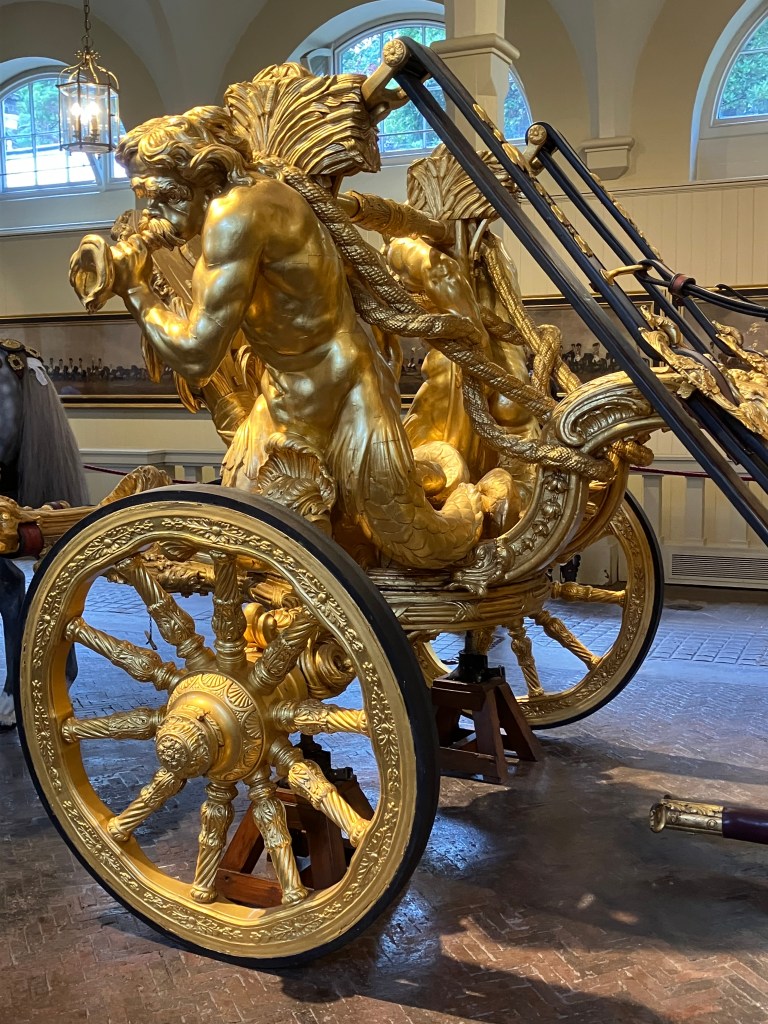
Following their coronation on May 6th 2023 The King and Queen travelled in this coach, drawn by eight Windsor Greys, from their coronation at Westminster Abbey to Buckingham Palace.
I have to ask why? Was it to draw attention to themselves? Was it Charles making a grand gesture to his new Queen and reaffirming that in his opinion Camilla was entitled to be his Queen? Was he merely having the final say on what had been a contentious issue for many years both within the royal family and amongst the public, over which he would ultimately reign?
His mother, the late Queen Elizabeth, expressed in 2022 that it was her “sincere wish” that the Duchess of Cornwall becomes Queen Consort when Charles becomes King.
Camilla is not entitled (excuse the pun) to be a Queen. The constitution clearly states that a “queen consort is a woman who is married to a man who is king,” and a “queen is a woman who is born to be queen and is head of state — not the wife of a monarch.”
It makes me feel that this decision was very underhand and I don’t think the general public knew about it until the invitations to the coronation were sent out. I imagine many people don’t care either way which somewhat sums up the feelings about the monarchy amongst parts of the population. It seems like a contradiction in that someone like Charles who steadfastly aligns himself with upholding the pomp and ceremony and royal traditions then goes against everything written on the subject and just does what he wishes.
Motor Cars:
King Edward VIl was the first member of the royal family to purchase a motor car back in 1901. All the official motor cars used by the Royal Family are also housed here at the Royal Mews. They are all painted maroon and black and currently include three Rolls-Royces, two Bentleys and two green Jaguar stretched limousines for use at less formal events.
The oldest car in the collection is the 1950 Rolls-Royce Phantom IV, ordered by Princess Elizabeth and Prince Philip, Duke of Edinburgh soon after their wedding.
Whilst the most recent cars are the two maroon Bentleys, one of which was presented to Queen Elizabeth Il as a Golden Jubilee gift in 2002.
Many of the cars feature modifications necessary to their unique use, such as engines which can run at three miles per hour for long distances during processions and Perspex roof fittings to enable crowds to see the occupants.
The King’s car flies the Royal Standard from the roof attachment whenever His Majesty is travelling in the vehicle.

The State Rooms:
Leaving the Royal Mews behind we walked back down the street to gain access to The State Rooms. There was no queue and our ticket was for 4.15 pm but again we were slightly early and were allowed in. The on line advice is to allow between 2 and 2.5 hours for this element of your visit.
Photography is not allowed. A fellow guest asked one of the admittance staff why this was the case and the answer was ” Because this ultimately is a family home”. Whilst I understand the no photography rule I have to beg to differ on this rationale but more on that later.
The State Rooms are the public rooms in the Palace where the monarch and members of the Royal Family receive and entertain their guests on State, ceremonial and official occasions. Last year, as part of a Western European tour, we visited the Palace of Versailles and came away really disappointed:
https://amidlifeadventure.org/2023/04/25/adventure-a-tail-of-two-chateaus/
Buckingham Palace has everything that Versailles should have but didn’t The rooms are furnished with many of the greatest treasures from the Royal Collection, including paintings by Van Dyck and Canaletto, sculpture by Canova, Sèvres porcelain, and some of the finest English and French furniture in the world.
Buckingham Palace was built in 1703, in pre-dominantly Neo-Classical design, for the Duke of Buckingham and has been the official residence of the British monarch since 1837. On your visit you enter into the Palace in the same manner as all visiting guests of the Royal family do and, therefore, you are met with the fairly immediate vision of The Grand Staircase. Sweeping up and around are a pair of red carpeted elegant stairways with bronze balustrades which are just beautiful and no doubt many other stately folk have fashioned their hallways accordingly.
As part of our tour we were able to visit the White Drawing Room which is probably one of the most beautiful rooms. Aptly named after its colour scheme of white and gold with large windows which allow in plenty of natural light, beautiful ceiling mouldings and a magnificent crystal chandelier hanging from the centre of the ceiling.
The Green Drawing Room, which is the room where guests assemble before a dinner or a banquet and the Blue Drawing Rooms were also part of the visit.
The wonderful parquet floor of The Music Room is worth a mention. Made of satinwood, rosewood, tulipwood, mahogany, holly and other woods it was completed in 1831 and has not been altered since. In more recent times this room has also staged royal christenings including that of the King when water was brought from the River Jordan.
The Picture Gallery was a stand out moment for me. Created by the architect John Nash in 1825, this 47-metre room was designed as a setting for King George IV’s picture collection. Paintings change quite regularly as the King happily lends out works of art to exhibitions both at home and abroad. The paintings on display are currently mainly 17th century Italian, Dutch and Flemish with artists including Titian, Rembrandt, Rubens, Van Dyck and Claude.
It’s not surprising that King Charles and other members of the Royal family use this area for receptions and for recipients of honours to wait before being led into the Ballroom for their investiture.
The Ballroom with its regal red carpet, multiple chandeliers and sheer size was completed in 1855 during the reign of Queen Victoria. It’s not hard to imagine the State Banquets that take place here and the awe that invited guests must feel on entry. I found it amusing that such guests are notified in advance on their invite where they will be seated. I wonder how it feels when you are the furthest seat away from the host?
Finally I cannot finish without mentioning the Throne Room which, to be honest, reminded me of some historical movies where the big double doors are opened and the subjects are invited to make their entrance. It felt like nothing had changed.
Before them and central to the room is the pair of throne chairs which are known as Chairs of Estate. They were made for the Coronation ceremony of Queen Elizabeth II and Prince Philip in 1953 and were also used for the Coronation of King Charles III and Queen Camilla.
This was the final port of call on our visit and for me the most eye opening both in terms of the inordinate splendour and also as an insight into where the reigning monarch is suppose to live.
Whilst the Palace, no doubt, has a historical place within the country it also makes me question how anyone brought up in this environment can relate to ordinary folk. There have been many mistakes made by our current Royal family that have been splashed across the media across the years. At times these errors of judgement seem to be borne out of a life of privilege and I now feel like I understand why.
This part of the Palace is not a home! There is nothing about it that is inviting, cosy or dare I say “normal”. In fact I came away feeling that if King Charles really sees this as a home then he is even farther removed from the British people than I probably ever imagined.
It also helped me to understand the changes that are faced by those marrying into the Royal family who don’t have this type of upbringing. The steep learning curve they must endure just to “try and fit in”. The etiquette they have to learn to adopt so as not to offend.
I am a midlifer and, therefore, certainly not of the younger generation and even I wouldn’t be able to conform to the expectation, should it ever be necessary, that I am expected to bow to the King.
End of the Tour:
The tour finishes at the on site cafe which, even if I say so myself, does produce some excellent scones. Then as you take the 20 minute walk back out alongside the gardens you can stop at the gift shop which amusingly had sold out of English print copies of the official guidebook. Must be the amount of Americans who come and visit! As we discovered last year when road tripping in the US they do love our Royal family!
 A Midlife Adventure