In 2015 my daughter turned eighteen and, like her brother before her, I gave her a choice of where to go for our annual two week holiday. Having decided that she wanted to go to the Caribbean I short listed three islands for her to choose from and thus we arrived in Grand Cayman for the first time.
I fell in love with the island and hubby and I visited together in 2016 and again in 2018.
Just over 7 years later we are returning for one last time.
Whilst a lot of joy comes from travelling the way that we do, you also have to sometimes make some tough decisions and wave farewell to some favourite haunts in favour of discovering new places. As I’ve said previously we are now in the last quartile of our life and there are still many places on the list to cross off!
Just a little exert from our Very Long List of Cities and countries we still want to visit
Introduction and Origins:
Originally named Las Tortugas in 1503 by Christopher Columbus due to the numerous sea turtles. The Caymans were later called Caimanas for the alligators (caymans) found there but now extinct from the islands.
Grand Cayman is the largest of the three Cayman Islands and is a British Overseas Territory, with the UK’s King Charles III as head of state. The residents joke about the fact that taxes from the UK pay for their garbage disposal 😊.
The island is roughly 22 miles long and up to 8 miles wide, stretching from West Bay along the coast past Camana Bay and Seven Mile Beach, to the capital George Town then through to the East End and finally to the North End.
Known for its world-class diving and credited with developing scuba diving as a recreational sport in the 1950s, Grand Cayman is situated in the Western Caribbean. Lying approximately 450 miles south of Miami, Florida and only an hour and a quarter flight time from Cuba which sits to the north east with Jamaica to the south east.
The Cayman Islands are the world’s fifth-largest financial centre, hosting around 600 banks and many of the world’s hedge funds. Cayman is well known for being an international tax haven. The island imposes zero direct taxes—no income, corporate, capital gains, or withholding taxes—on individuals or corporations. As a British Overseas Territory, it offers a stable, business-friendly, and secretive legal framework that allows multinational firms and high-net-worth individuals to shield income and assets.
Additionally there are no restrictions on foreign ownership of a single property and there is no property tax levied.
It is perhaps no surprise that Cayman is currently home to 12 billionaires and 102 centi-millionaires – people with more than $100 million in personal wealth.
Cayman has a a tropical climate with a rainy season from mid-May through October and it also sits within the hurricane belt from late August to October.
The worst hurricane to hit the island was back in September 2004 when “Hurricane Ivan” passed about 25 miles southwest of George Town as a Category 5 hurricane. The town reported sustained winds of 150 mph. The storm surge from the hurricane flooded the whole island leaving behind US$2.86 billion in damage.
English is the official language, driving is on the left side of the road and there over 68,000 residents here, the majority being native Caymanians but with people also from over 100 countries!
The Cayman Dollar (KYD) is the local currency roughly 1:1 with the English pound.
100 US dollars currently equates to about 82 KYD.
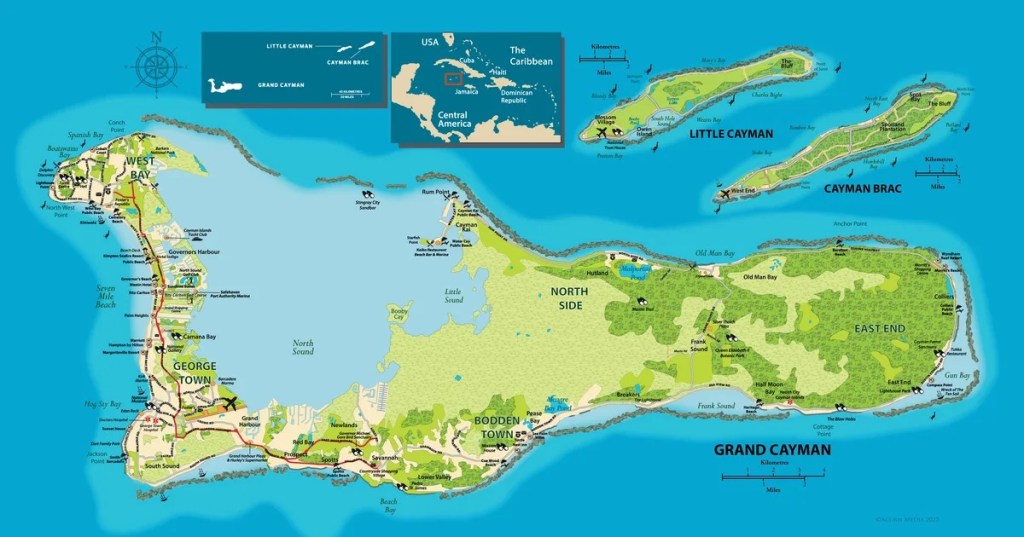
Visting Grand Cayman:
82% of visitors to the island in 2025 came from the USA with 7% from Canada and just 3% from the UK. With direct flights now coming in from all over the USA with flight times varying from 1.5 to 5.5 hours it’s not really surprising that Americans make up most of the tourist market.
In comparison having woken up with an alarm at 4 a.m. and arrived at Heathrow airport at 6 a.m. our flight is at 9.
Due to runway restrictions in Cayman larger planes cannot land and so a stop in Nassau in the Bahamas to refuel is necessary, making the total flight time around 13 hrs. We disembark at 4.30 p.m. Cayman is 5 hrs behind the UK so for us it’s 9.30 at night. Hitting midlife means that this really feels like a long journey!
Despite the fact that the airport was extended in 2021 the queues at immigration are very long! It’s peak season and there is just one very polite, fairly well organised lady trying to control the chaos as visitors snake their way to the immigration desks.
Interestingly in May 2025, the Cayman Islands government approved a $91 million redevelopment plan for the airport. The project will include building a new terminal, extending the runway, and modernising the air traffic control system.
The East End:
From our very first trip to Cayman we settled on accommodation in the East End away from the crowds who flock to Seven Mile Beach every year and the cruise ships that land in George Town every day.
Leaving the airport behind our first stop was a large supermarket. We were going to need food to make breakfast, alongside some snacks for lunch or evening depending upon when we ate our main meal each day.
We are travellers, don’t forget, not holiday makers and as such we are not here to eat out at fancy restaurants.
Having not been to the island for 8 years, en route to our accommodation, and despite the lateness of the hour, we realise that the road system has changed with a brand new road (“Frank Sound Road” ) now open across the island. We decide to avoid this and maintain our normal route around the coast.
Interestingly our hire car displays the speed in km per hour but the road signage still matches the UK and is, therefore, in miles per hr!
The roads here are smooth, modern and well maintained and as we speed onwards we notice the evolution of far more modern housing taking over from the old Caymanian style homes. Instead of modernising these existing and often beautiful houses it appears that people are just tearing them down to open up the ground space and build brand new homes. This makes me feel a little sad and I wonder if the native Caymanians will one day regret these decisions and wonder why they didn’t protect their heritage.
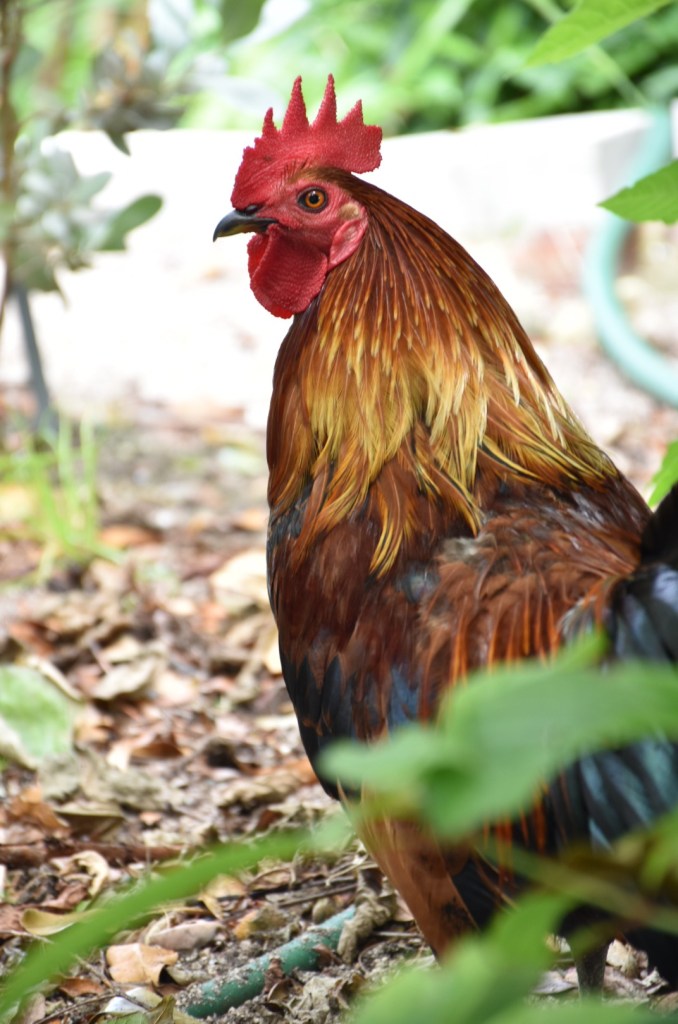
This fellow was actually outside the supermarket when we visited later in the week!
Chickens and Iguanas:
Luckily as it is nighttime we don’t have to look out for the ever-present chickens or iguanas on the roads.
I love to see chickens during the day pecking away on the side of the road and it’s unusual if you don’t hear a rooster crowing first thing in the morning.
The high number of chickens on the roads in Grand Cayman is primarily due to Hurricane Ivan back in 2004 when coops were blown away and domesticated birds escaped into the wild!
With no natural predators on the island, a warm climate, and an abundance of food, these birds have flourished, becoming a common sight on roadsides, in parking lots, and near restaurants.
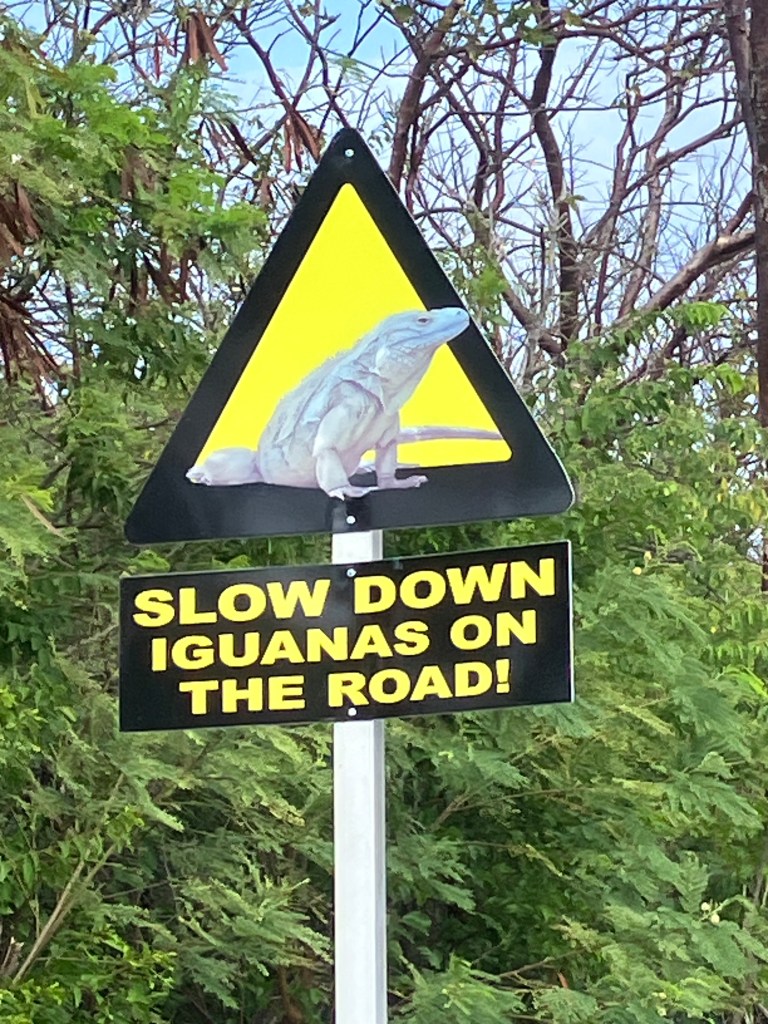
Green iguanas are a non-native, invasive species that has proliferated on the island particularly in the East End. These cold blooded reptiles use the hot roads to regulate their body temperature, especially in the early morning. Luckily it’s not breeding season as male iguanas travel significantly at this time of the year in search of a mate, which increases the likelihood of them crossing roads.
Weirdly it is the very presence of these chickens and iguanas that make the roads in the East End of Cayman so special, they just seem to welcome you home. And as we finally arrive in our accommodation for the next 7 days I’m going to bid you good night and leave you with a promise to share with you some of our explorations on my next post………………
A real road sign on Cayman!
I look forward to your comments and hopefully “likes” and if you have any suggestions of how to manage long distance flights so you don’t arrive at your destination completely shattered I’m all ears!😊
 A Midlife Adventure