Touring Western Europe -Spain- Aranjuez

The Renfe Cercanios Madrid Network:
When we were waiting for our return train yesterday in Avila we discovered there is another train service separate to the Metro and also not part of the Renfe intercity fast train network -the Renfe Cercanios Madrid network. It’s a bit like the London Underground in that it serves outlying regions of Madrid but instead of it being part of the Metro, as it is in London, it is separate.
Weirdly if we Google map from our present location to Avila, for example, it does not show Cercanios as an option. Despite research we have not yet discovered why, maybe Google maps doesn’t have it in its system?

Anyway having discovered this network exists we picked up a pocket sized map of the lines it runs, labelled line C2 up to C10 which take you out of the city of Madrid on metro style trains. They are, obviously, slower because they stop at every station but more convenient if you are not sure how long you are going to be visiting a destination and do not want to be confined to certain pre bought train times and tickets.

We decided on Saturday to give this service a trial. We had already booked our train tickets, as normal with Trainline, and had a fast train to take at 09:10 from Madrid Atocha to Aranjuez with a return ticket at 18:30. More of this later.

The Royal Palace of Aranjuez:
Leaving home to walk the 20 minutes to Atocha station we boarded our planned service and arrived into Aranjuez 45 minutes later. There were a couple of buses waiting outside the station on our arrival but we opted to walk in the spring sunshine down the tree lined Carr de Toledo instead. The entrance to the Palace is fairly easy to locate and being so early there wasn’t a queue. Our tickets were available on hubby’s mobile, having booked them in advance, and I picked up my audioguide which was on a tablet. You need to utilise the separate email you receive for this.

The site was originally established as a royal hunting lodge in the 16th century before Philip II of Spain built the palace itself and it became one of the four seasonal seats of the court.
The palace was almost destroyed by fire in 1748.
Ferdinand VI rebuilt the palace and although still respecting the original foundations, the new structure reflects late baroque style and an 18th century aesthetic with a series of beautifully furnished rooms within
The current building we view today, however, is mainly as a result of the work completed by Charles II. The architect of this modern palace was the Italian Francesco Sabatini.
During the 18th and 19th centuries it was enriched with paintings by various artists, hardwood furniture in the halls and collections of clocks, lamps, tapestries and sculptures were installed.

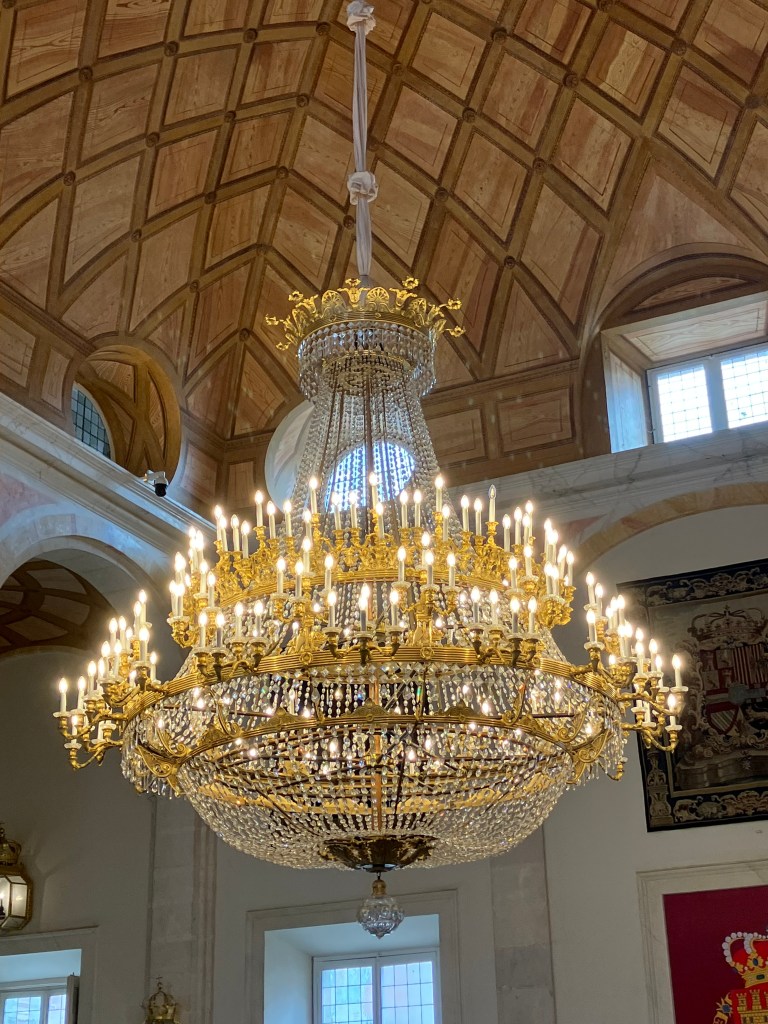
The tour begins in the hallway with its grand central staircase over which hangs a chandelier of gilt bronze and crystal. This is merely the starting point of what is to come as you follow the designated route through both the King’s and Queen’s various chambers with all they have to offer. Alas you are not allowed to take photos!
My two personal favourite rooms were the Moorish room or Salon Arabe which was made for Queen Isabel II between 1847 and 1851 and is decorated throughout with a Moorish style similar to that seen in the Alhambra Palace in Granada. The minimalist furniture consists of a porcelain central table and a bronze and crystal lamp. It was used as a smoking room mainly for men. The decoration of the walls being made of brightly coloured plaster work.

Secondly the Salon de Porcelana which was created by Charles III. The walls and ceilings are completely lined by plaques, attached to timber walls by screws, of white porcelain and reliefs with motifs of fruits, flowers, monkeys, vases, birds and dragons. The floor is marble and 8 large mirrors against the walls multiply the effect of the decorations.
In the centre of the ceiling is a lamp that looks like a palm, while a Chineses man with a hand fan and a monkey on his shoulders climbs the trunk. The room was originally for the purpose of playing games. It honestly is awe inspiring.

Jardin de la Isla

The audioguide includes coverage of the exterior of the Palace. I found this really helpful but a little astounding considering I was basically walking around outside with a tablet around my neck!
The Garden of the Island was given this name because it is surrounded by water on all three sides: the Tagus river, an artificial inlet from the river, and the Royal Palace.
Created originally by Philip II it is a lovely example of a Spanish Renaissance garden.
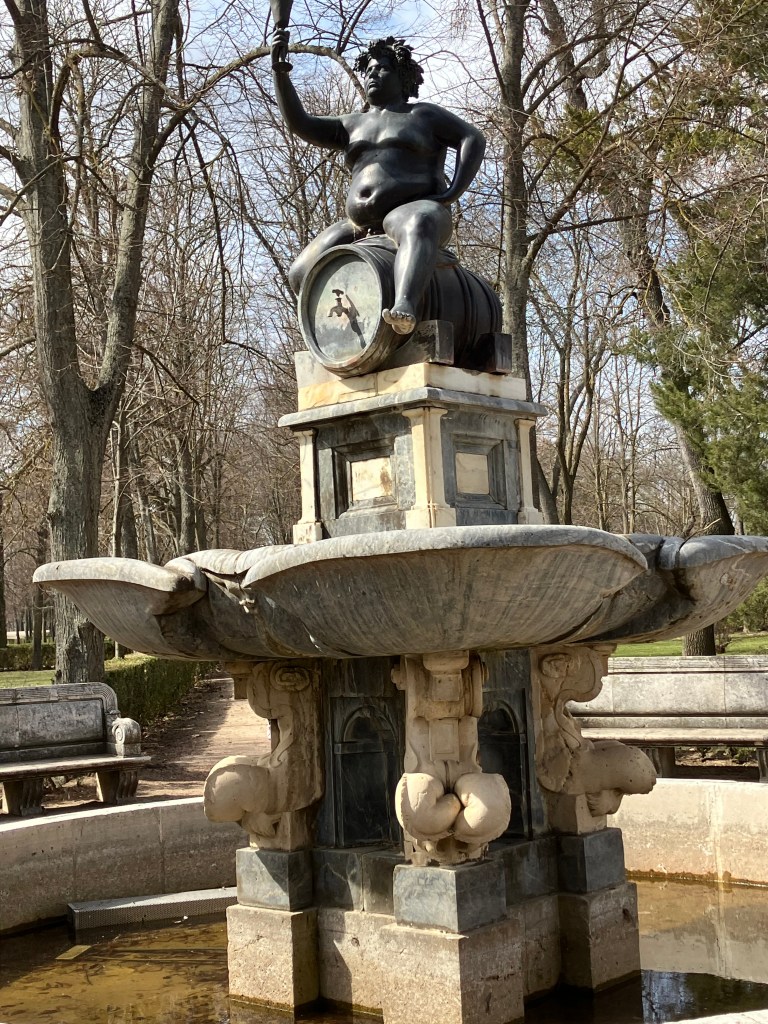
Laid out in a rectangular fashion it comprises a variety of different areas bordered by box hedges, each featuring a statue with a fountain dedicated to a god. My favourite was Bacchus.
Unfortunately of the 13 fountains only 4 apparently still work which is sad because seeing them all working would greatly enhance your visit.
There are two other gardens worth visiting whilst you are in Aranjuez, firstly the Jardin del Parterre which sits right next to the Palace and was originally designed to be the Queen’s formal flower gardens, although it is somewhat lacking in flowers today.
Secondly the Jardin de Principe. This large picturesque green space features manicured gardens, fountains, statues and monuments, To access it walk through the Garden del Parterre towards the El Rana Verde restaurant. As you walk to the left of this restaurant you will find several other popular restaurants should you want to stop to eat.
Continue walking and the entrance to the Garden del Principe is just a little further down on your left. There are rows of cars parked here and you can walk through the gardens to the Casa del Labrador. This is a Neo classical palace designed to complement the Royal Palace. Unfortunately it is was temporarily shut when we visited.

Picnics
Another slight adjustment we are having to make here in Spain is the organisation of a picnic, It was, here on Saturday, that we discovered it is easier to design and create it yourself before you leave and carry it with you.
We walked, what felt like, around the whole of Aranjuez looking for a bakery/cafe that made or had ready to purchase fresh rolls or batons filled with meat, cheese, fish etc. Unfortunately there weren’t any! Whilst fresh bread is plentiful in Spain this type of premises is not.

Returning Home
Due to the Casa del Labrador being closed we found ourselves ready to return home 2 hours earlier than expected. Armed with our new information about the Cercanios we walked back to the station and enquired about the possibility of returning using this method. The Customer Services man tried to replace our tickets but because we had booked them on line was unable to do so. He found our idea of purchasing two new tickets instead of waiting 2 hrs a bit odd but this we duly did. Whilst travelling back on the countryside metro I checked my purchase on Trainline and found we were covered for a 65% refund of our return journey. Ok it wasn’t the full price but it was something!

NB:
This is my fourth contribution detailing our tour of Western Europe. Why not check out all the previous posts and follow us as we learn more about this fascinating area of the world?


.

.[1]


Visit Avila: Discover Spain’s UNESCO Heritage City

We set out early on Friday morning to catch the metro just down the hill at Lavapies or Lava Pies as I tend to refer to it!
With a quick change at Plaza de Espana we soon arrived at Principe Pio to board our train going 70 miles, more or less, due west of Madrid to Avila. Avila lies on the right bank of the river Adaja and is the highest provincial capital in Spain. The city was declared a Unesco World Heritage Site back in 1985.
Alighting at the train station in Avila, 90 minutes later, we began our 15 minute walk towards the Old City. The sun was shining, it was a lovely Spring morning and as if to reaffirm the season we caught sight of three stork nests balancing precariously either side of a church bell tower. The storks sat proudly on their enormous nests adding the odd twig or two as we watched.

It wasn’t long before the looming city walls came into view and although we had an idea of what we wanted to see today we decided to head to the tourist information office.
These are not always very evident in Spain so you often have to revert to Google maps to actually locate one if you need it.
We picked up a map of the old city. Hubby was in his element, he does love a map! 😊
Before we met he’d never used a sat nav in his car instead there was one of those big AA road map books of England and he still doesn’t like relying on Google maps when we are out. Is this a man thing? Does it revert back to caveman days when the man was the hunter gatherer I wonder?
In broken Spanish/English we also managed to understand that there were two parts of the walls open for walking and viewing: a short stretch or a longer section and where to access the office for tickets etc.

Las Murallas de Avila:
The walls were built to completely circumnavigate the city back in medieval times in Romanesque style and stretch for 12.5 miles. Work began in 1090 but it took until the 14th century to actually complete them and they encircle 77 acres of land. The city, itself, has been inhabited since pre-Roman times around the 5th century BC.
There are 87 semicircular towers with an average height of 39 ft and 9 gates which allow access.
You can walk nearly half of the original walls.

We entered at La Puerta de la Catedral, at the entrance in the Casa de Carnicerías. The towers that you pass throughout the walk, some of which are open, are numbered based upon the site of the cathedral ,this being tower number 1.
Between towers 8 and 9 is the Puerta da San Vicente or Gate of St Vincent. This is a monumental gate with very strong turrets flanking the entrance. You can climb to the top of some of the towers and take in the extensive views across the outer city and beyond as well as key sites in the inner city. The longest part of the wall that you can walk takes in 41 towers and covers the northern side. You finish the walk at the turret of San Segundo so-called because it looks onto the Shrine of San Segundo.
Access to the second walled section is through the Puerta del Alcázar. This is a lot smaller section and you can buy a ticket solely for this section if you don’t wish to walk the longer part. I took up the offer of a free audio guide and found this useful in terms of giving me some background history and highlighting parts of both the inner and outer city as we walked.

Lunch:
The Spanish way of life is very different to us in the UK. Most families back home will eat breakfast (before work or school), lunch (around 12 noon to 1 pm and dinner (after work/school, anytime from 5 – 8 pm).
In Spain the day usually starts with breakfast and lunch is often between 2-3 pm. The whole town/city shuts down except for some tourist sites for siesta and everything then re-opens at 5:00 pm and everyone goes back to work until 8 pm.
Most restaurants open for lunch around 1:30 and the crowds start pouring in around 2. On weekends, tables will stay full until well past 4:30 as friends and family keep talking long after the meal is over.
Dinner time is also very late at 10:00 pm
It isn’t abnormal for Spaniards to also eat snacks between breakfast and lunch and again between lunch and dinner.
My daughter did a Spanish exchange when in school and found the eating customs quite hard to adapt to as did her Spanish exchange student when she arrived in the UK.
We are also finding it harder than we thought on this trip.
It might be due to it being a midlife adventure and our bodies are already a bit stuck in their ways!

As lunch is often the biggest meal of the day restaurants sometimes offer a 3 course lunch at a set price with various choices of starters, mains and dessert. Restaurants often have very few tables inside instead they spill out onto the street or plaza.
For the first time since arriving in Spain we decided to take advantage of this offer whilst in Avila. The sun was still shining bright and it made a pleasant rest sitting directly outside the walls, be it we were early for lunch as it was only 12.30 pm! Oddly English rock and pop music from the 80″s seemed to be the chosen background to this lunch.
To give you a flavour of what was on offer we had tomato and goats cheese salad and mash potato with paprika for starters followed by chicken stew and fried dogfish for mains with strawberries and cream and lemon mousse for afters. This was all for the sum total of 15 euros each and we left completely stuffed!

Catedral de Avila
After lunch we walked inside the walls and visited the cathedral. There is an entrance fee and an audio guide is offered via your mobile phone.
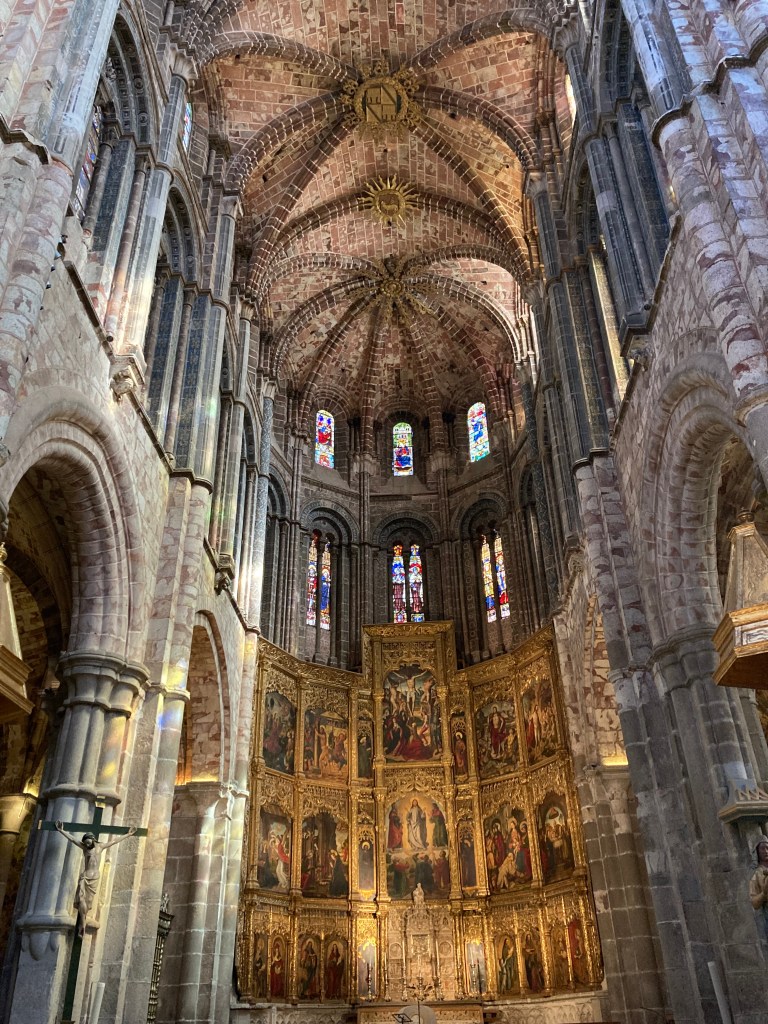
Built as a planned cathedral-fortress and incorporated into the city walls, there is a mixture of Romanesque and Gothic architecture. Said to have been built between the 11th and 14th centuries, the earlier Romanesque parts are made of a striking red-and-white “blood” limestone, while the Gothic parts were built with pure white stone.
The cathedral features 24 pieces depicting the life of Jesus, the Evangelists and the Apostles hanging in the altar. There is much to admire including the stained-glass windows that date to the 15th century, and the choir section carved out of walnut, which was completed in 1546.

Plaza del Mercado Chico
Markets are a common sight in Spanish towns/cities. As we had eaten lunch early, before siesta, the market was slowing down when we arrived after our cathedral visit but there were still stalls offering fruit, vegetables, fish, pastries etc . If you are self catering like us you are never spoilt for choice in terms of fresh produce. The plaza or square of any Spanish town always exudes atmosphere and this one is made more unique by the thoughts of those who have trodden the cobbles before you.

There are many more historic sites and parks to see in Avila both inside and outside of the walls but far too many to mention here. You really have to plan your visit, however, as some attractions close during siesta. On this occasion this included the Convent of St Teresa which we would have liked to have visited. Unfortunately we came away with just a photo of her!
If you are planning a visit to the Castile region of Spain, Avila should be on your list!

This is part three of our extended trip to Western Europe and also the third post about Spain. There will be more to follow on this tour.

Opinion and Sexual Prejudice

When I first worked in London and the South East back in the late 80’s, HIV was just taking a hold. I lived through that era when heterosexuals were starting to question their lifestyle. I remember sitting at the bar one night, after work, having that discussion about how many people have you slept with, now multiply each of those people by just 10 and then multiply that new group by 10 and before you know where you are you are heading into the 100’s. The pie chart of sexual connections, just from your own life, started to become scary. No one really knew how HIV was caught or how it was spreading, they just knew it was connected to sex.
Suddenly homosexuality, which ad become legal in 1967, was out there in the public eye. Opinions were beginning to segregate society with those believing “what they do is wrong and God is punishing them for their deeds” at times seeming to be in the majority. This was being fuelled by the tabloid media who had very little positive to say. then there were others like myself who were convinced that no one was specifically to blame for this and that a cure would be found.

Throughout my career I have worked with staff of different sexual persuasions and, again, have always taken the view that everyone deserves to live their life as they see fit, as long as they are not directly affecting others. I have, unfortunately, worked with people who have questioned my decisions about employing people of different sexual persuasions, people who tried to tell me I was bringing “problems” into the working environment and questioning how our customers would react!

I’ve seen the effect that homosexual prejudice has had on people who I was fortunate to call friends.
One friend of mine, back in the early 90’s, came to London looking for a way to live his life happily. He had been brought up in a small village in Scotland and knew from an early age that being gay wasn’t something he could be open and honest about. Like so many others he had a girlfriend, got engaged and tried to be “normal”. But he couldn’t live the lie and instead moved away so he could be himself. He left everything he knew and moved to a huge metropolis which quite frankly was really scary for him. The gay scene in London, that he described, was like walking on a tightrope between the good and the bad and falling into the bad scene was hard to avoid. “I never know who to trust and who not to trust” was a common lament of his.
He drank to avoid facing the person he was. He constantly prayed to be “normal”. Life as a gay guy back then was just so difficult and if he had a choice, a life he would rather not have to lead.

One of my best friends came from a seaside town in Yorkshire. We met in about 2001 and worked together many times over the next 5 or so years. He also went through periods of being unable to cope wit his sexuality. His family fully accepted him for who he was but the town he had been brought up in was less forgiving. He found life hard and after a few long term relationships which left him picking up the pieces of his life, he eventually went home permanently to seek solace with people who truly loved him. Unfortunately we lost touch when I moved back to Gloucestershire and I found out later he had died an early death back in 2012. I still remember him fondly.

When my own son started to talk to me at 13/14 about his sexuality. My response was “make sure you are not being forced into a pigeon hole because of your enjoyment for performing arts and not the rugby/football that all the other boys at your school are playing but if you are certain that your preference isn’t the female of the species I don’t care a dam. You are my son and I will always love you regardless.”
I’m not going to lie and say I wasn’t concerned about what the future held for a mixed race queer guy, given my previous experiences of society’s prejudices, but I could only do what I’d always done and that was to try my best to support him.
There is no doubt, though, that my son leaving home at 19 to pursue his own career in London was mainly borne out of the narrow minded outlook prevalent at the time in this area of England. London gave him a chance to be himself and although he returned home three years ago with the onset of Covid, he is 100% happy now with who he is and lives his life accordingly which makes me incredibly proud.

Sexual prejudice is just another prejudice that divides society and I return again to my mantra of “everyone deserves to be happy and, therefore, should live their life as they see fit”.

Discover Segovia: Top Attractions and Travel Advice

A Little Background to our Trip:
When we left our home in the UK we cancelled every fixed bill that we didn’t need to pay whilst away. Unfortunately there is no reprieve from council tax or utility bills and so we have budgeted to pay these bills alongside the expense of our trip.

Money that would normally be spent on variable expenses such as petrol, food, clothes, personal expenses etc has instead been placed into the travel fund.
To keep costs down we have committed to using local/inter city trains and, for stays of 3 nights or more, have rented airbnb’s to minimise accommodation cost and ensure we are self sufficient food wise. Where we have booked hotels for the shorter stays we have ensured that breakfast is included. This should cut down our food intake when out and about.

We could have invested in inter-rail passes but hubby calculated all the rail fares, in advance, and has told me there is very little difference in costs. Additionally inter-rail spaces on trains are limited, have to be booked well in advance and in Spain and France, despite having an inter rail pass, you have to then pay to book your seat. Time will tell if his calculations are correct!

We arrived in Madrid after a 4.5 hr, seamless train journey from Bilboa and checked into our second Air BnB.
We have visited Madrid before, back in May 2018, when we brought my daughter here as part of her 21st birthday present. It was somewhere she wanted to go and was a great choice. Madrid still features in our top 3 cities in the world to date and we were happy to come back.
However having completed all the tourist attractions in the city that we want to see we are this time using it only as a base. From here we can venture out into the Spanish countryside and visit other places of interest. Today’s city of choice is Segovia.


Getting to Segovia from Madrid:
Using google maps I managed to plan the journey firstly from our temporary home to Madrid-Chamartín-Clara Campoamor train station via the Madrid Metro.
The metro is fairly easy to use. You have to purchase a transport card from a machine at the first metro station you enter. We only needed one card between us because you can pass it across the barrier and reuse it when you enter the relevant metro line. They are very much like Oyster cards in London so for us not unfamiliar.
Once you have purchased your card, which at the time was 2.50 euros, you can then either load individual trips onto it each time or you can purchase a group of tickets in one transaction and load them onto your card, utilising them until they are finished. A trip on the metro wass 2 euros per person and the package we bought today was 10 trips for 6.10 euros, so a bargain!

We would suggest you arrive at the main train station 30 minutes before departure as Spanish trains leave on time and you still have to tackle security.
Once at the train station you need to check the board for the platform from which you will depart. Unlike the UK it does not show all the stops, only the final destination, so you need to utilise the departure time and the number of the train shown on your ticket to find your correct train.
When you reach the platform entrance your ticket and ID are checked and your belongings have to go through a security scanner like being at an airport. It’s a fairly quick process.

Our train is bound for Salamanca but Madrid to Segovia Guiomar station takes only 30 minutes. This is a fairly new station on the outskirts of the city. It appears as if they are trying to take traffic away from the historical interior and also facilitate easier commuting into Madrid for work.
As we leave the station there is a number 11 bus standing outside waiting. For 2 euros per person you can travel the 20 minutes into the centre and be dropped off right next to the astounding Aqueduct. The journey into the centre takes you past “New Segovia” and I must admit it was slightly off putting to begin with. I was sat there thinking “where is this glorious old town I’ve read about? Are we in the right place?”
It seems as if money has been injected into housing and to attract more business. I do wish these beautiful old places were left alone but I guess you can’t always stop modernisation!

Aqueduct:

This amazing piece of Roman architecture is a sight to behold. Roman remains always fascinate me, mainly because of the sheer engineering ability they had. This aqueduct was built to bring water from the mountain to Segovia. Originating from the 1st century BC it was in continual use until quite recently. 36 of the 166 arches were damaged back in 1072 during an attack on the city but were restored in the 15th century and you can still walk all 11 miles of the aqueduct should you wish.

Leaving this masterpiece behind we wander up the olde world street past an array of shops. The Old Town including the aqueduct is a Unesco World Heritage site so take your time and marvel at some of the beautiful buildings en route including the library. Also check out the masonry and decorations on the houses.

Segovia Cathedral:
As you reach the top you cannot miss the 16th century Gothic style cathedral that towers above the city and can be seen from everywhere. We wandered around the outside first just to be able to marvel at the craftsmanship used to create it.
There is paid entry and audio guides are available if you want to learn more about the interior.
You might find it a bit odd that a non religious person such as myself (assuming you’ve read other parts of my blog) visits religious buildings but for me it’s not about the reason for the build but how it’s built. The amount of artistry that goes into the statues, paintings, wooden artefacts and most importantly the ceiling adornments just leaves me breathless. How were they capable of creating such beauty so long ago? It always begs the question “have we actually developed anything better than this since?”.

Inside the cathedral I was drawn to two specific paintings.
The first is this really odd picture of Jesus and a skeleton under a tree with some sort of party taking place on top of the tree?

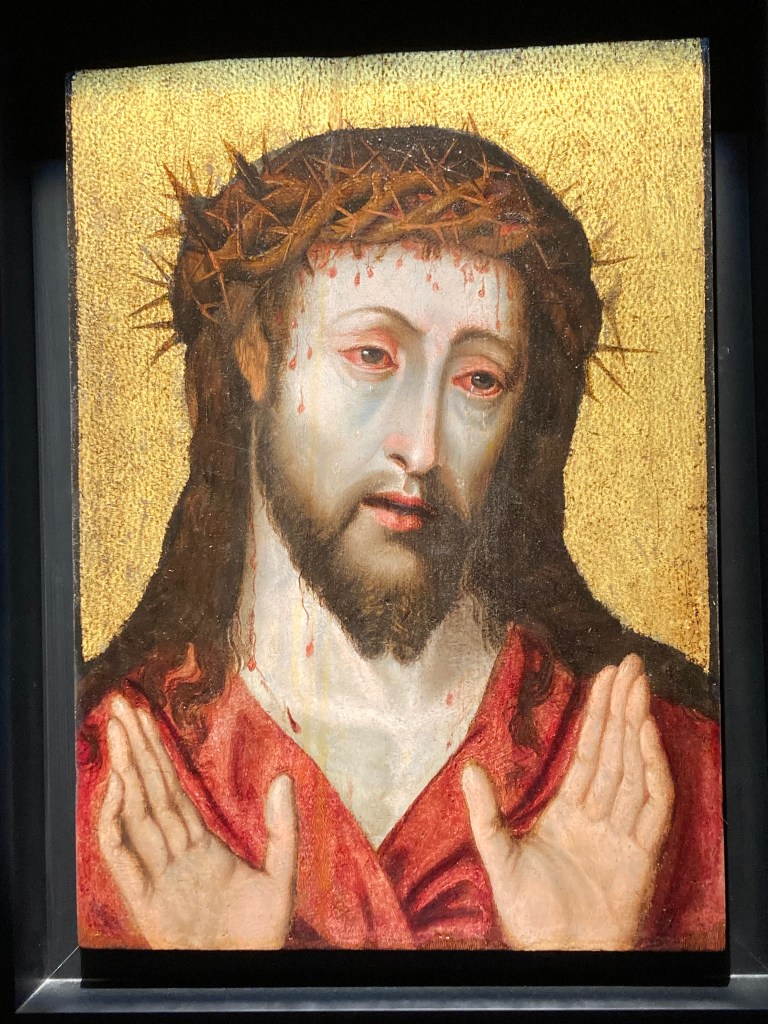
The second highlights for me how brilliant the artist was in showing Jesus with tears in his eyes. The tears are just so realistic and emphasise to me what art really is. The ability to convey in a picture an emotion that looks real.

Leaving the cathedral behind there are signs to follow to reach the third key attraction in Segovia -The Alcazar.
The pathway takes you through the oldest part of the city and there are other clear examples of Roman architecture and engineering en route.

The Alcazar:
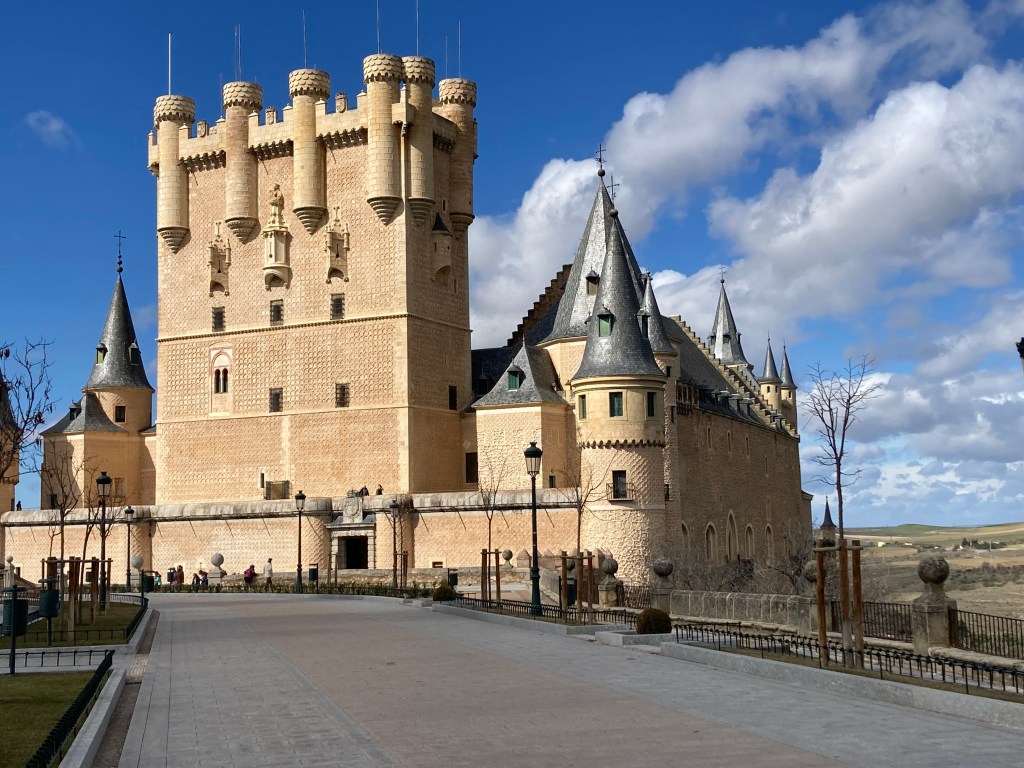
This beautiful medieval castle, rising out of a rocky crag, stands prominently with 360 degree views overlooking the valleys below. Shaped like the bow of a ship it was originally built in the 11th century as a fortress.
Alphonse VIII and his wife Eleanor of England (sister of Richard the Lionheart) were the first monarchs to make it their home and it subsequently served as a royal palace for 21 further generations.
Entry tickets are purchased in the building to the left of the Alcazar and there is also an audioguide available.
This building also contains a cafeteria where we sampled some traditional Segovian fare before making our way back over to commence our self guided tour.
There is much to marvel at from the beautiful external architecture, traditional armoury, to the Hall of the Kings and the unique tapestries and of course the amazing views all around.

Next time you are in the Castile area of Spain take a trip out to Segovia. It has a lot more to offer, I have only included three key highlights.
There is also an alternative train journey which is cheaper than the direct train we used which takes 2 hrs and meanders its way from Madrid through the mountains to Segovia Central train station. Our Air BnB host strongly recommended it but time was not on our side on this particular day.

This is my second post on our extended trip to Western Europe and also the second in Spain. There will be more to follow on this tour.

Opinion and Race Discrimination

In my personal life, having been brought up in a very white conservative middle class area, I found myself exploring the various areas of the country that I subsequently lived in and achieving a real multi cultural, cross generational, open mind.

Racial prejudice arrived in my life when I fell in love and lived with an Asian guy in 1988, who bravely gave up his family to be with me because they vehemently didn’t approve. I never questioned my choice. I didn’t see his colour, his religion or his previous way of life, I just loved him for who he was and, perhaps naively, couldn’t understand what the issue was. My Dad and my Step Mum were bewildered.
At the time we both worked in South East London and lived in Romford in Essex. On the whole we didn’t receive any outright prejudice but it was always there bubbling under the surface and every now and again it would raise it’s head. This was the first time in my life that I realised such racial hatred existed.
When we first met he used to have to walk from South to North Woolwich at the end of his evening shift. A journey that took 15 minutes and involved descending down a flight of stairs until you reached the bottom of the tunnel, under the Thames and then walking through and ascending the stairs the other side. One night two older guys behind him started shouting abuse. He heard them drawing closer and ran, literally for his life, only just making it up the stairs and onto the bus, which fortunately was waiting at the stop, when he emerged from the tunnel.
We got spat at, when we were out one night at the cinema, by the people sitting behind us and I remember him using serviettes to remove the spital from my hair. On the rare occasion that we went out clubbing it was always with a group of work colleagues so we could blend in.

This racial discrimination didn’t go away, when in 1994 I met the guy who became the father of my children. He was of Caribbean descent. However this was when I learnt that prejudice could work both ways.
Just one week before the wedding my future father-in-law told me he had hoped his only son would marry a girl of similar descent and that he wasn’t overly happy with the match. My family refused to attend the wedding and my Dad struggled to come to terms with my subsequent mixed race children.
The night before my son was born, my husband and I were out at a karaoke pub in the East End of London. At the end of the night I had to stop my husband from getting involved in a fight, when a white guy of similar age to us started referring to me “as black man’s meat” It was a fractious situation. My son wasn’t due for another 12 days but my waters broke less than 2 hours later.

I always remember going out as a new Mum, walking into Romford and around the market, with my precious little bundle wrapped up in his blankets in his pram and older ladies peeking in the pram, loving the idea of a new baby and then being shocked by his colour. This didn’t change when I had my daughter. Neither of my children look like me, they have strong Caribbean genes and later in their life when they invited friends home for tea etc it was obvious that their school friends didn’t expect me to be white.

I always proudly displayed beautiful framed photos of my children on my desk at work. One Christmas Eve, after I’d moved back to the South West, I was sat at my desk, at the end of the afternoon shift, working my way through the clock cards that staff needed signing for overtime. I made enquiries of them as to what their plans were for Christmas and I’ve never forgotten one young lady saying to me “What are you doing for Christmas?” . “Oh it’s just me and my children” I replied. “Oh you are so nice, you’re like that Angeline Jolie adopting children from other countries” came the reply. When I then told her they were my children, that I’d given birth to them, her expression was one of total bewilderment. I could literally see her brain trying to work it out!

When my children were 7 and 5 years old, I became a single Mum having ended my marriage based upon my husband’s constant infidelity. Despite our divorce I always ensured that my ex mother and father in law remained part of my childrens’ life. This was their ancestry and something I wanted to ensure remained a constant in their lives. Once I moved away from the South East I still kept that culture alive and to this day we still celebrate our own Caribbean Christmas, the weekend before Christmas, with home cooked Caribbean food.

Racial prejudice then spread into my childrens’ lives which is a whole other board game. Experiencing it first hand is so much different to seeing it being directed at your children. How do you explain to them that the comments being directed towards them are born out of ignorance, when they are still innocent and confused and don’t understand why they’ve not been invited to a party despite being friends with that person at school? How do you help them to fit in when their skin is a different colour and grows darker in the sun, particularly when they have been abroad on holiday? When getting your hair wet in the rain can be a major deal and when adults stare at you when you are in unfamiliar surroundings? It wasn’t something I was well prepared for. I’d lived a life where the colour of your skin meant nothing to me.

My children are part of the 1.2 million people in the UK who are mixed race and I didn’t foresee that this brought it’s own unique dilemma. They weren’t black, so some people of African/Caribbean descent, didn’t feel they fitted in either. My daughter still deals with this, particularly from business acquaintances in the USA.
Conversely they are not white, so as explained previously, they don’t fit into this group either. The book “The Mixed Race Experience: Reflections and Revelations on Multicultural Identity” by Naomi and Natalie Evans released in July 2022 really helps in this situation but was 20 odd years too late for me as a parent.

I’d like to think that my experiences of racism as a white Mum with mixed race children allows me to understand the world a bit better, particularly at a time when systemic racism is being openly questioned throughout the media.

Touring Western Europe -Spain -Bilbao

We arrived last Thursday, by plane, and treated ourselves to a taxi ride to our “home” for the next 6 nights. An Air BnB in the middle of the “Old Town”. -Casco Viejo.
At the heart of the city are Bilbao’s original seven streets, Las Siete Calles, which date back to the 14th century.

We are in the centre of the Basque Country and you soon begin to appreciate how important their heritage is to them.
Signage is in Basque and then Spanish. English is not spoken to any degree and we have to use Google translate to help us along. It actually makes me feel slightly inadequate that I cannot even contribute!
Football is as important a game as in other parts of Spain, but Athletico Bilbao have a unique rule where only players from the Basque region of Spain can play for the club. The result? They’re only one of three teams never to be relegated from LaLiga!
Whilst its history is centred around the port and thus the transfer of goods you don’t see a huge amount of ethnic diversity certainly not compared to some English cities.
They appear to be proud people, Basque first and Spanish second.

The culture seems centred around a cafe/bar experience where locals and tourists alike mingle for morning coffee (black or white, no decaf or specialist milks), a social drink and pintxo at lunchtime before afternoon siesta where most shops etc close down for about 3 hrs. Then everything reopens and the small bars in the old town spill out onto the streets. Standing in the street, sipping a drink and socialising is an everyday night time activity and lends a background buzz to any evening spent inside your home.
Our first night was accompanied by a punk rock band performing outside a bar two streets away but clearly audible in our historic apartment above a shop.

Friday:
The city is full of architecture, which we both enjoy, as we stroll the streets of the “New Town” on Day 1 and take a walking tour courtesy of our Lonely Planet pocket guide. The weather is drizzly but, at least being out of season, we aren’t having to wait ages and fight the Instagram crowds for our photos. Our day out incorporates a visit to the Guggenheim- see my separate post:

https://amidlifeadventure.org/2023/03/07/opinion-modern-art/

and a trip up the funicular railway (although the views were extinguished by the mist).

Saturday was spent out with locals in the “Old Town” beginning with the fabulous Mercado de la Ribera where stalls upon stalls arrest the taste buds with fruit, vegetables, meat, fish etc. Everyone is out buying their weekly shopping. This is farm to fork at its best! And we return to the apartment with everything needed for our fish supper.


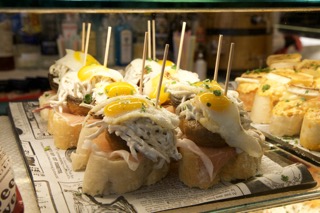
Within the market is a large food hall where everyone seems to congregate for lunch and having perused the various counters, laden with pintxos of all descriptions, we settle down to try our first foray into this Basque delight. Unlike those around us we settle for a coffee each whilst the locals are sipping martinis and aperol spritz.

Elsewhere families utilise the parks and open spaces along with the historic plazas to entertain the children. In the afternoon the Plaza Nueva is full of little footballers, balance bikes and people congregating for social interaction whilst their children play nearby.
The Plaza del Arenal, next to the river, is teeming with every age group relaxing on a weekend. The play park, which on a weekday is probably invisible, is the focal point. The river, itself, is empty. We didn’t see a single boat, kayak, canoe etc throughout our stay?

Sunday-we are up and out early to try out the metro. It’s fairly straight forward once you get the hang of it. It helps when you feed the tickets through the machine in the direction of the arrows. Talk about getting old!!!
There aren’t a lot of staff about, so help is not really at hand, but Google Maps provides us with all the info we need in terms of which train to get on.
30 minutes later we alight in Bidezabal where a seaside ramble in Getxo awaits. We are now in the suburbs, so to speak, and there is no doubt that the houses look newer and more expensive than the city.
Our walk takes us right along the coast line with clifftop views and a sandy beach. We meander through the Cornish style narrow streets of the old fishing village of Puerto Viejo before continuing on past the architectural beauty of the Paseo de las Grandes Villas. Heading across the unique Unesco World Heritage bridge of Puente Colgate we finally finish our sunny afternoon in Portugalete.
Throughout our walk we were surrounded by locals, all out enjoying the Spring sunshine. Dogs abound and it’s apparent that most ladies wear slacks and trousers and not jeans like me. Needless to say this English woman stood out a bit like a sore thumb!

Monday morning we hop on another metro train and head off to the bus station for a 7.30 bus (coach in England) to San Sebastián. Tickets are bought in advance and weekend tickets sell out quick, as we discovered, when we originally tried to book seats for Saturday on Thursday night’s arrival.
The bus station, like the rest of Bilbao is immaculately clean. You could eat your dinner off the floor! As we have discovered before you don’t get awoken by the bin men in Spain but by the street cleaners. The old streets around our apartment are cleaned down every morning and then every shopkeeper steps outside, before opening, and cleans their specific area of cobbled stones just to make sure!
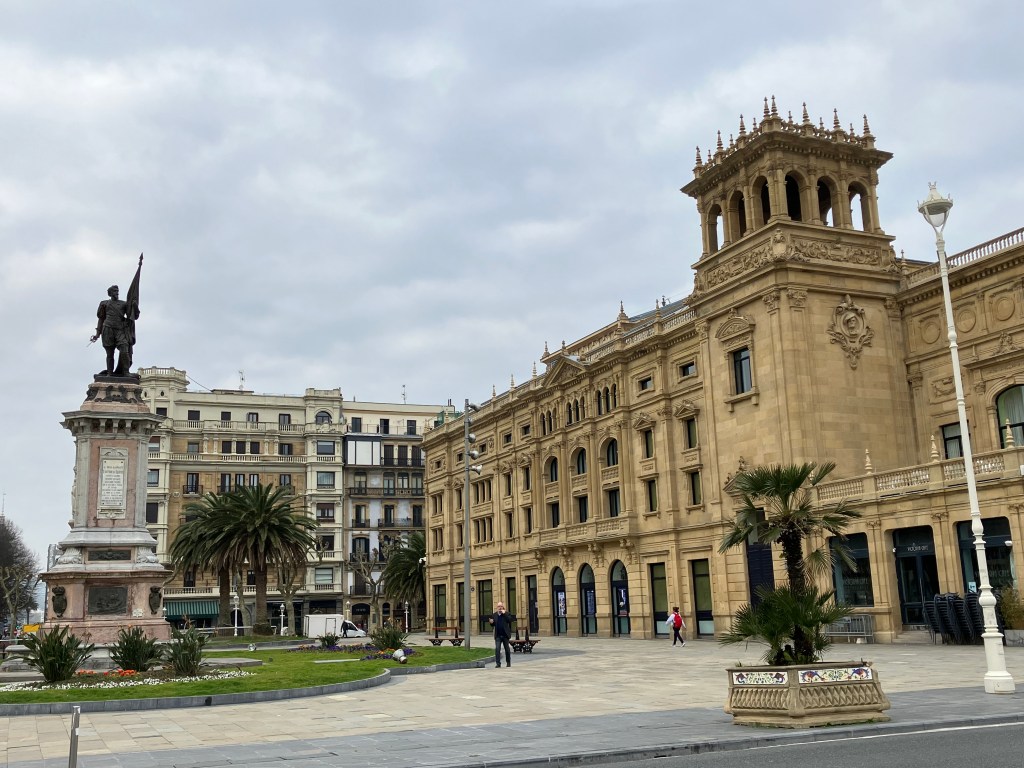
The 90 minute journey goes without a hitch and we arrive into San Sebastián bright and early. Like Bilbao nothing really happens here until after 10 am but this gives us time to begin our walking tour of “Old and New” before it gets busy.

I’m trying to be honest on my travels, so I have to say San Sebastián is like Bilboa’s posh neighbour. It’s like the difference between a well looked after set of teeth, there is nothing wrong with them, they are clean, hygienic and useable and a set of teeth that have been brightened and whitened to sparkle. San Sebastián sparkles!

The beach is probably the best urban beach I’ve seen to date! The town is compact and welcoming. Designer clothes shops mingle with elegant bridges such as Puente de Maria Cristina. The 20th century, belle époque, 5 star Hotel Maria Cristina, designed by Charles Mewes, the architect responsible for The Ritz in London, stands proudly on the river front.

We managed to walk to the top of the 123m Monte Urgull topped by the old castle and a slightly grandiose statue of Christ. The spectacular views across the bay and the city were a just reward for the climb up there, although the steps back down to the old town fully exercised my midlife knees!
The streets in the old town are wider than Bilbao and again everything is that bit more spacious and bright.
I can imagine families packing up their bags of a weekend in Bilbao and popping across here by car or bus for a weekend of sun, sand and relaxation.

Our foray into life in Bilbao is coming to an end and tomorrow we board an early train to Madrid.

This is my first post on our extended trip to Western Europe and also the first in Spain. There will be more to follow on this tour.


Modern Art-Is This A Reality or A Joke?

We are have just flown into Bilbao which is our starting off point for a three month exploration of Western Europe by train. This city came to my attention when I was reading a piece of travel journalism which focused on the wonderful architecture of the city and variety of food specifically the pintxos.
In order to explore the architecture I utilised an app I have downloaded called “GPSmyCity” which suggests self guided walks to follow, complete with narrative. As a result I then also came across the world famous Guggenheim Museum which opened in 1997.
This museum possibly single handedly lifted the city out of its postindustrial depression and into the 21st century and gave a lot of tourists a reason to visit the city.

From the exterior you are met with a monolith of titanium tiles, created by architect Frank Gehry, which as you walk around you will find that the patterns and colours change with the light.
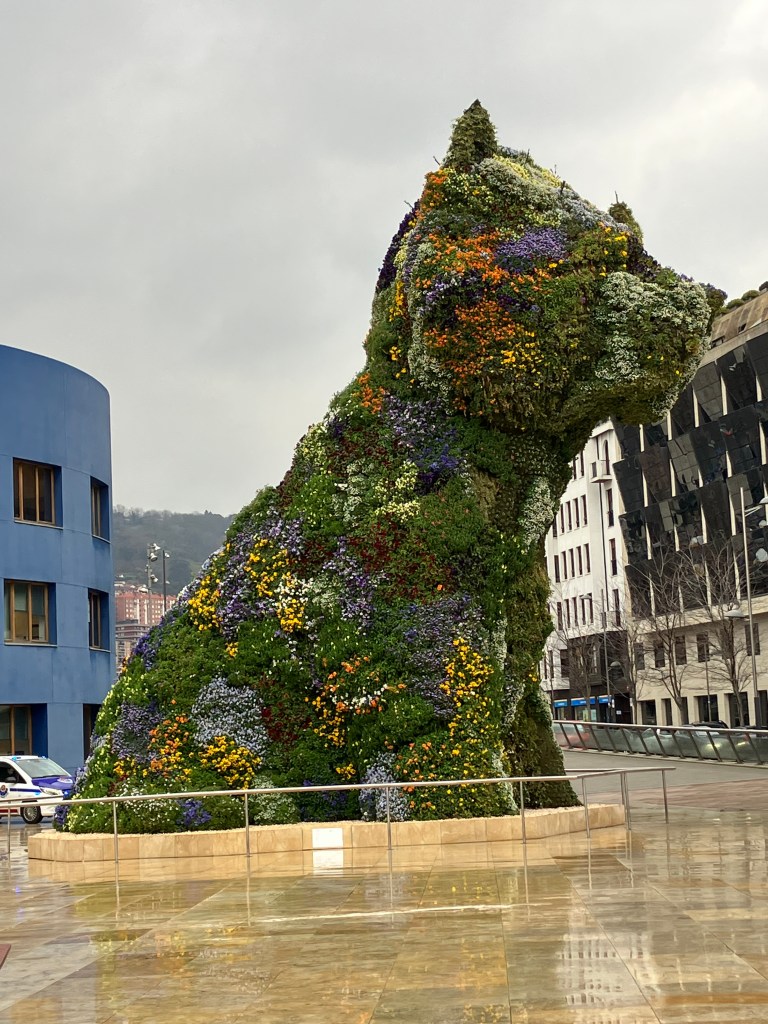
On the city side of the museum, prior to descending to the entrance, is “Puppy”. This 12m high Highland terrier is currently made up of thousands of spring flowers. Designed by Jeff Koons it sort of welcomes you to the museum.

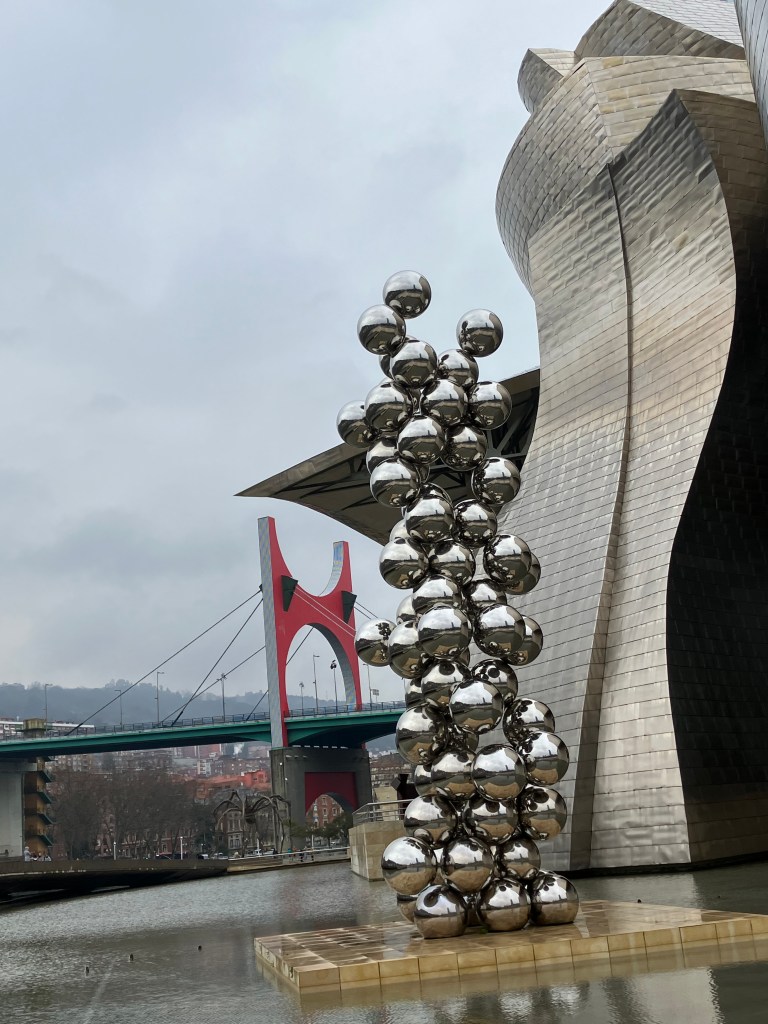
On the opposite side, next to the river, you can view Anish Kapoor’s “Tall Tree and the Eye”. This consists of 73 reflective spheres anchored around three axes which individually distorts reality as you look into them.

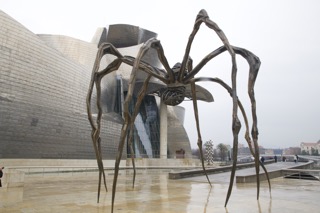
Nearby, on the riverbank, is “Maman”, Louise Bourgeois’ sculpture of a skeletal spider said to symbolise a protective embrace
Alongside many others I admire all three of these sculptures before even paying my entrance fee.

Inside the museum there are three levels. Architecturally they are unique. They meander around the inside of the building, leading you from one zone to another, whilst a central glass lift sweeps you ever higher. There are walking platforms between the zones which allow you views of the cleverly designed interior.

Within the zones you are introduced to modern art from Joan Miró, Richard Serro, Jenny Holzer, Jeff Koons, Mark Rothko and Jean Michel Basquiat amongst others. This is where I become unstuck. I look at some of these “paintings” and I’ll use a Mark Rothko as an example and firstly question “how can you call this a painting?”
It looks like a child has painted a frame and then inside the frame has created three horizontal boxes which have then been painted three different colours.

Rothko’s art sells for millions. A similar piece to this entitled “Orange, Red, Yellow” sold for 86.9 million dollars back in May 2012 at a Christie’s sale in New York.
I stand and stare at it and wonder if someone, at some point in history, decided to play a practical joke on the art world? Did they rock up with one of these paintings and start wittering on about how truly artistic it was, how clever the brush stroke, how individual the talent? Did they talk about how expressive the artist was feeling at the time of painting and did the group of art collectors assembled, not wishing to appear as philistines, agree and suddenly modern art was born?
Or worse still was it, as some theorise, that modern art was a “scam” created for money laundering and tax avoidance purposes, by people far more astute than the artists being presented as world class?

I guess we are all entitled to an opinion and, to be honest, if it was the latter then no one is ever going to know. Are they?

Opinion -Sex Discrimination

Basing my opinion on my own life experience includes experiencing sexual discrimination.

During my 30 year career I worked in a male dominated, customer facing industry where you worked mainly 4 days out of 7, on a rota you devised yourself, ensuring you delivered the needs of the business. We worked shifts of anything from 8 hrs (which was counted as a half day) and 12-15 hrs (being a full day).
When I started we used to begin work around 10.30 a.m. and finish a full day around
11.30 p.m. As time moved on and more and more money spinning activities were added into the working environment, mornings could sometimes start as early at 8 a.m. and evenings could drag past midnight.
It was tough but enjoyable and you became absorbed into this way of life.

We were all autonomous Business Managers, with no one looking over our shoulders. We dealt with all facets of Management from recruitment and training to devising and delivering promotional campaigns worth £1000’s whilst coming face to face with up to 6000 customers a week and also complying with numerous Government legalities. Our customers were of every nationality and came from all walks of life as did our staff.

I was really focused and dedicated to my career, climbing the ladder through hard work involving numerous moves around the country but I was in the minority as a female.

Despite the sexual revolution of the late 60’s women were still fighting for independence, much less equality at work and there were certainly very few role models for us to look up to.
This was summed up nicely back in 1994. I’d been with the company for 9 years, at this point, when I had a visit from my male Operations Director and the current male MD of the company. With no regard for my feelings, the Ops Director introduced me not by name but with ” This is our first female Manager to go and get herself pregnant!”
From this point on, the path that lay ahead of me was one of continual struggle. Instead of enjoying my first pregnancy, I had to fight to keep my company car, pension contributions and to know what my entitlements were. I received no assistance, support or help and was taken out of my role as Manager as I was seen to be a HASAW risk!

On my return from this pregnancy, when my son was 4 months old (financially I couldn’t afford to stay off work any longer on my £52.35 a week SMP) there was no job for me.
I, therefore, had to work as a Regional Relief Manager until something became available.
It was a nightmare trying to juggle child care with no daily base. I was travelling all over London (by car due to the late finishing hours) working 4 full days (about 48 hours a week).
Eventually I was given a Managerial post but at Level 3, when prior to my maternity I had worked as a Level 2 Manager for 3 years in Liverpool, Kingston upon Thames and Leyton.
My male Regional Manager had the audacity to say to me” Be happy at least we are allowing you to keep your current salary and car!” As if that should make me happy when it felt as if my whole career, thus far, that I had worked hard for was about to implode. None of my male colleagues would ever have been treated in this way unless they had received a disciplinary demotion.

Despite my despondency I had enough sense to ensure I had a letter stating that this “temporary placement” wouldn’t affect my on going career and then I joined a union which was totally unheard of in my working sector particularly at my level.
After the birth of my daughter, 2 years later, the letter came to the fore when on returning from my second maternity leave, I worked in a Level 3 business for about 6 months and then applied for a promotion to a Level 1 business. My application was turned down based upon the fact that I had no Level 2 experience. Time to call the Union rep!

So yes, I’ve experienced sexual discrimination which ultimately resulted in taking action despite possibly alienating myself in the process, winning an out of court settlement and I’d like to believe paving the way for other female managers that followed my career path.