Touring Western Europe -France-Old Man Notre Dame

We arrived in Paris on Tuesday after a 7 hr train journey from Barcelona. Having booked our tickets before we even left the UK, we had secured first class tickets for a minimal increase on the second class price. 
On arrival on the train we discovered that there was very little difference between the two types of seats except perhaps a bit more space. The configuration in the cheaper seats is two seats on either side of an aisle whereas first class is two on one side and one on the other. What would have been useful was Wi-Fi that actually worked!

Stupidly I had planned on posting some photos on both Instagram and Facebook and typing a couple of blog posts. It took me the first ninety minutes to post my photos and my blog would not auto save! The train Wi-Fi was rubbish and my own UK network connection which chooses a local country network to connect into was no better. I learnt an important lesson. Next time chill n relax and don’t rely on the internet!

The train (our first evening train journey) pulled into Gare De Lyon twenty minutes late at 9.40 pm,  due to police boarding the train at the French / Spanish border. Having searched the whole train they left empty handed! 
We had left Barcelona on a warm afternoon at around 22 degrees and on arrival into Paris it was dark, cold and raining! The queue for taxis was horrendous. I’m not exaggerating when I say there must have been 150 people in front of us and probably another 100 people behind us in the queue, that snaked around the pavement and back into the station itself. We had arrived during Ramadan and there was a shortage of taxi drivers.

Our Air BnB host was getting more and more frustrated, given she had a check in window of 6-8 pm and had given us a concession for a late arrival, expecting us at 10 pm and it was 11 before we got there!

With a full list of key sites to explore and three trips out of the city planned over the next nine days, we were tired midlife adventurers waking up on our first day in an overcast, set to rain, Paris!

If you had asked me, beforehand, what I was likely to write about from our Paris adventure I would probably have said a précis of all the places we have covered. However as with a lot of my posts, I am instead focusing on the one that has evoked the biggest emotional reaction so far and that believe it or not is Notre Dame! 
Notre Dame I hear you question. Wasn’t it burnt down? Yes! Has it been reopened ? No! However much to my amazement it brought tears to my eyes. 

On April 15th 2019 it did indeed catch fire whilst the spire was already under refurbishment. Like so many people around the world I watched it on the news. I had no reaction to this except perhaps a little sadness, that such an historical building that I had once visited with my children on a cultural tour of the city probably about 15+ years ago, was going up in flames. 
Over the following days the news regularly featured the money being wired across the world to help with the restoration. If I’m honest I remember thinking – wow imagine what that money would do for refugees all around the world trapped in countries where they don’t know the language, have little or no access to basic facilities and currently no future. People who have left their homes because war has been forced upon them, with often only the clothes they have on their backs. What could all this money do to help them? Why are people sending it instead to rebuild a cathedral which isn’t even in their own country? 

Initially I wasn’t even going to include Notre Dame in our plans whilst in Paris but given we were in the locality on one of our days in the city centre I did. 

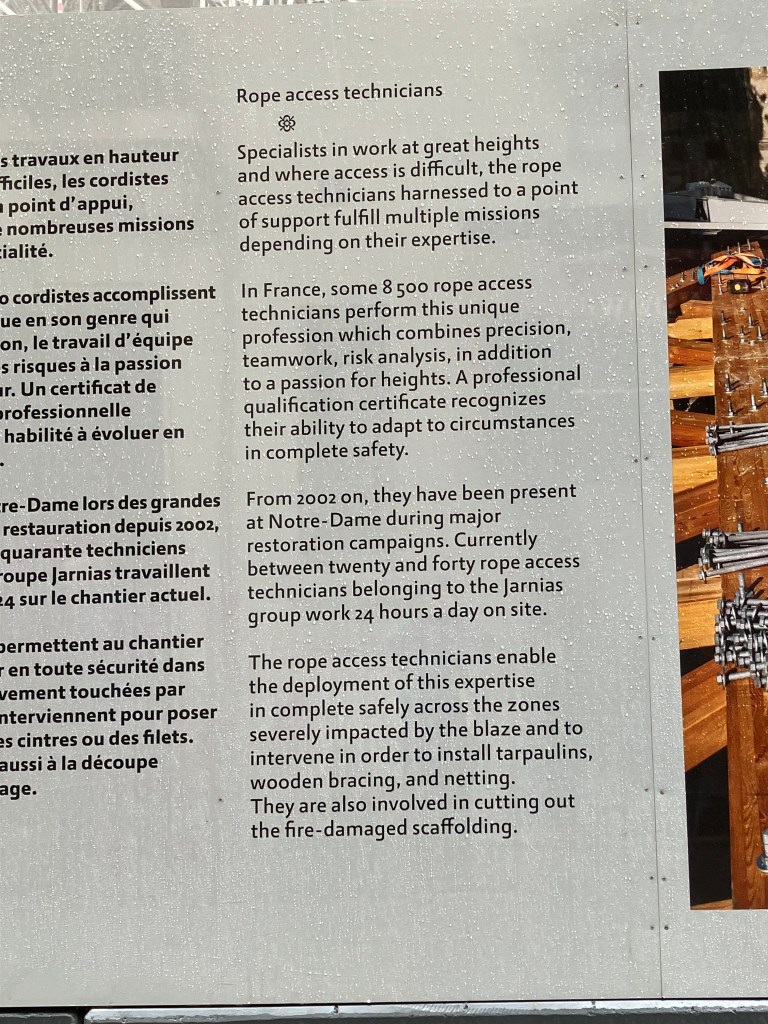
To my surprise whilst the cathedral is obviously completely blocked off to the public and still looking far from it’s former self, the Parisian authorities have erected a series of display boards that surround the reconstruction to explain how they are going to rebuild it.

Systematically working around the site reading this information, and despite my coat zipped up to my chin in the drizzling rain, I was enraptured and was totally surprised by the emotion that overcame me. 

Notre Dame, originated in medieval times on the Ile de la Cite, (an island in the Seine River), as a Catholic Cathedral. Dedicated to the Virgin Mary it was considered one of the finest examples of French Gothic architecture and a widely recognised symbol of both the city of Paris and the French nation.
Whilst it was completed in 1260 this magnificent old masterpiece lived and breathed through many historical events.  In the 1790s, during the French Revolution it suffered extensive desecration with much of its religious imagery damaged or destroyed.
In the 19th century, the coronation of Napoleon I was held here and with the publication of Victor Hugo’s book “The Hunchback of Notre Dame” in 1831 it attracted more interest which led to restoration between 1844 and 1864.

It was also here on August 26, 1944 that the French celebrated their Liberation from Nazi occupation. In 1963, the facade of this old beauty was cleaned of centuries of soot and grime. A second cleaning and restoration project was carried out between 1991 and 2000.

Over time, it was stripped of many decorations and artworks. However, the cathedral still contained several Gothic, Baroque, and 19th-century sculptures, 17th- and early 18th-century altarpieces, and some of the most important relics in Christendom – including the Crown of Thorns and a sliver and nail of the true cross.

No doubt, like my children, when Disney released their film “The Hunchback of Notre Dame” in 1996 the story of Quasimodo ignited new interest in this masterpiece and suddenly not just adults but children alike wanted to explore its gargoyles and bell tower. The film, taken from the book, gave this piece of architecture life, suddenly it took on its own character and it soon became the most visited French monument.

Having reminded myself of all this history and, if I’m honest, with pictures of Quasimodo in my head, to then see pictures of it going up in flames (it burned for fifteen hours) it did feel emotional. As if France was losing an old friend.

It sustained serious damage and so how do you rebuild this faithful friend?
Initially it was suggested that the cathedral should be modernised but this idea was rejected by the French National Assembly and instead, on 29 July 2019, a law was passed that required the restoration preserve the cathedral’s “historic, artistic and architectural interest”.
Firstly the building had to be stabilised against potential collapse, this work was completed in November 2020. The reconstruction could then begin in earnest.This is where the information displayed at the site comes into play. It doesn’t focus on the planning committee or the hierarchy involved, instead it focuses on the trades people without whom none of the reconstruction would be possible. I photographed some of the information to use in this blog. They might not be fantastic photos taken in the pouring rain on a Parisian afternoon in April but they say it all and for me they yet again humanise this grand old building and take me back to Hugo’s story.

Such was the heat generated during the fire that the scaffolding, that was in place for the restoration at the time, melted.

Largely gutted and damaged by heat and water, Notre Dame’s immense vaults are extremely fragile. Since the fire the nave, the transept, and the choir have been inaccessible so robots have been brought in and are currently clearing them. I wonder what old Notre Dame would be thinking about this new technology?

It was hoped that the reconstruction could be completed by Spring 2024, in time for the opening of the Paris Olympics, but it is now expected that the building will remain closed until December 2024. President Macron actually visited the site the same day we did!
He has confirmed that Notre Dame will be formally returned to the church on April 15th 2024, five years since the fire and that the first mass would be held in the cathedral nave on that day, even if the reconstruction has not been finished.

I will be watching the news with interest. To see this grandfather of a cathedral back, filled with music and life will no doubt once again bring a tear to my eye!

NB:

This is part twelve in my series of posts about our tour of Western Europe. Why not read the previous posts and then follow us on our journey as we continue to explore this lovely part of the world?

Barcelona: Saved by Modernist Architecture

Whilst I left Barcelona feeling as if it had sold it’s soul for the tourist dollar ( see my previous post published on April 11th) I also left appreciating and acknowledging that the city has some rare and beautiful modern architecture.
You cannot help but be in awe of Gaudi’s work, Barcelona’s most famous Modernist architect, and whose buildings are targets for the flocks of tourists that come to the city. I have personally decided not to write a post about his work for no other reason than I honestly could not do it justice and if you are in Barcelona, despite the crowds, you have to visit Palau Guell, Casa Mila and Las Sagrada Familia.
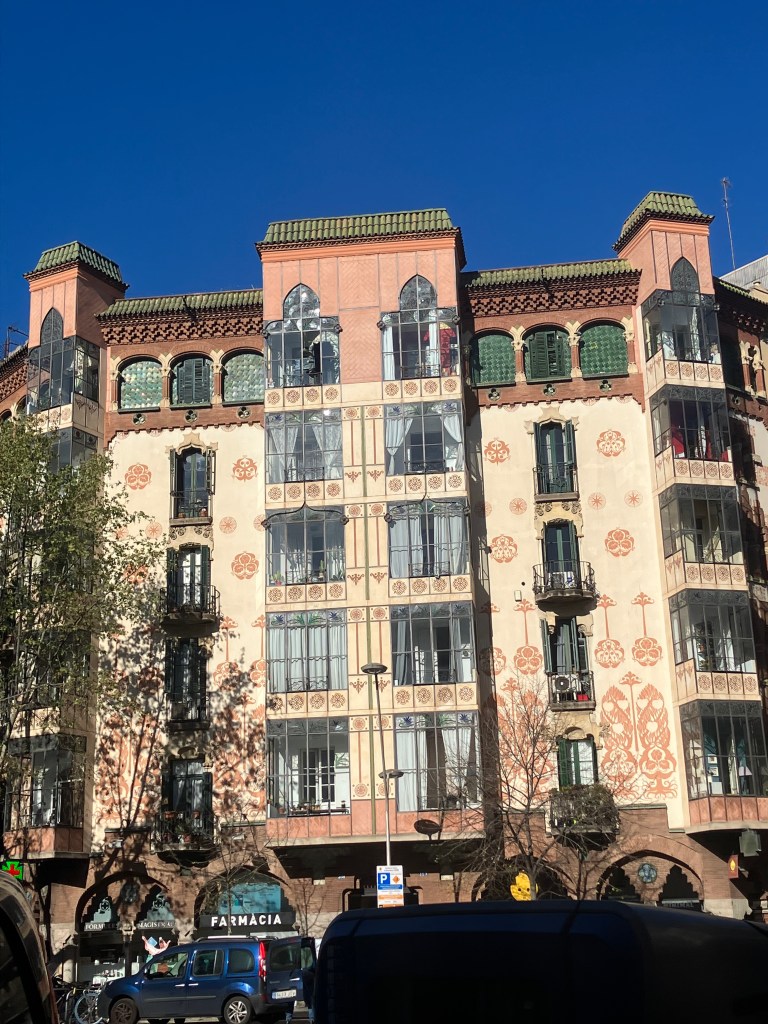
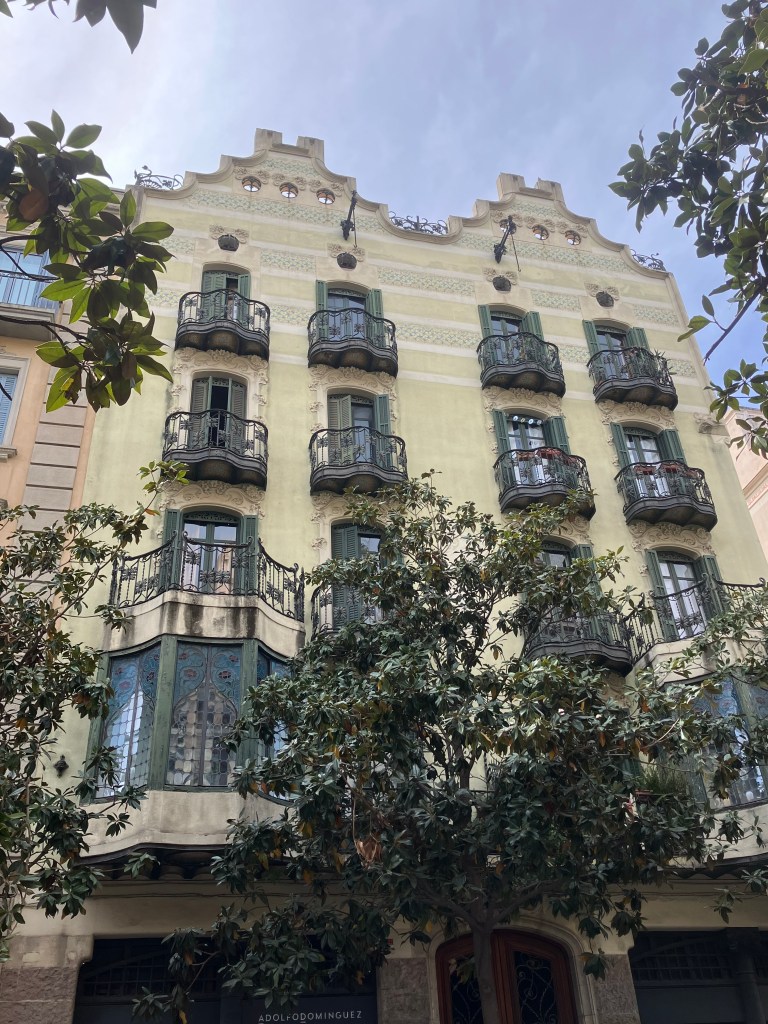
There is also, however, a great deal of art nouveau architecture to be seen in the city aside from his, examples that are tucked away in everyday streets, which also deserve credit.

As midlife adventurers we don’t always want to follow the tourist trail and so will quite often look out for unusual self guided walks which allow us to see a bit more of a city. In this case we took in some Modernist architecture whilst also learning a bit more about the Gracia area of Barcelona, where we were staying, before heading down into the centre.
I make no apologies for the amount of photos included in this post as the beauty of the architecture should be displayed.

Some highlights of our walk included Casa de les Punxes or Casa Bartomeu Terrades i Brutau which is three houses in one. It was built in 1905 by Josep Puig i Cadafalch and Terrades’ three daughters each lived in one section of the house. It looks like it could belong in Bavaria and yet somehow tourists wander past without blinking an eye.
Cadafalch built many houses in and around Barcelona so this is just one example.

We also saw examples of sgraffito which is defined as a form of decoration made by scratching through a surface to reveal a lower layer of a contrasting colour, typically done in plaster or stucco on walls. Casa Manuel Llopis (below) is an example of this, built in 1903 by Anton Gallissa i Soque with sgraffito by Josep Maria Jujol, who also worked on several of Gaudi’s projects.

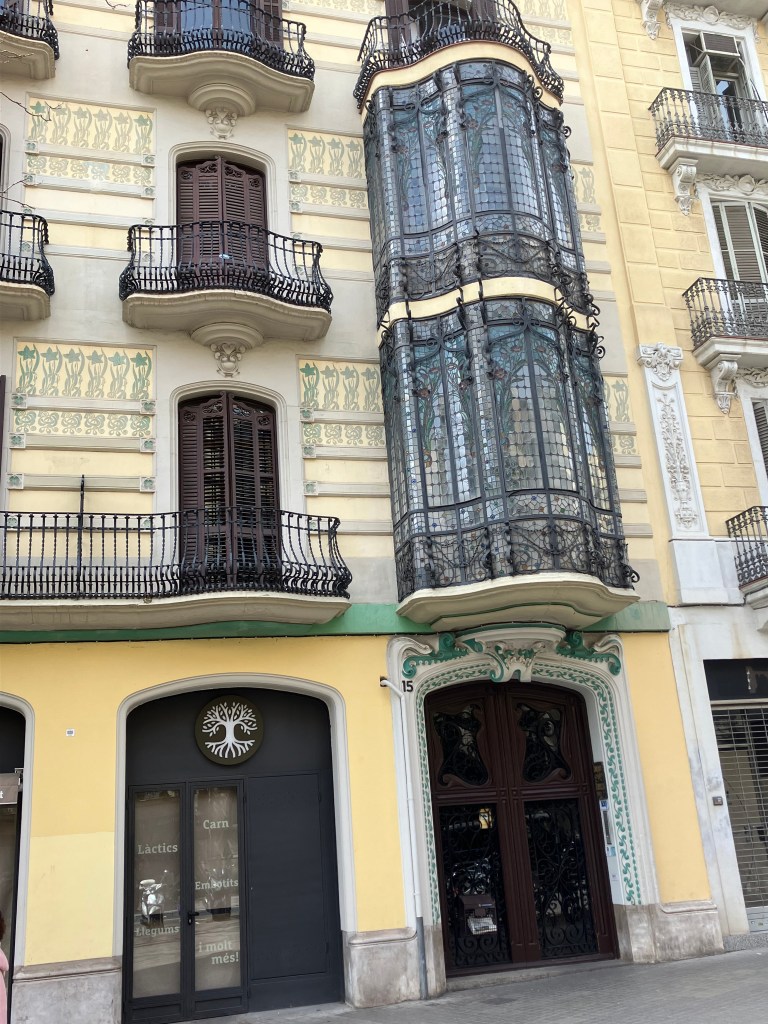
Another example of sgraffito was evident at Casa Francesc Cama built by the architect Francesc Berenguer i Mestres in 1905. Unfortunately he couldn’t actually sign the facade because he didn’t possess a university degree so it bears his boss’s signature Miquel Pascual i Tintorer. This house also features some beautiful stained glass windows in the lower section.

Another example of Mestres work is Casa Cama i Escurra which has beautiful stained glass oriels. Imagine what those windows look like on the inside!

All of these houses are sitting on ordinary roads in Barcelona, clearly visible and yet invisible to the majority of tourists.

One of Gaudi’s first commissions, however, is in the Gracia neighbourhood -Casa Vicens on Carrer de les Carolines, where we saw our first small gathering of tourists that day. It was built between 1883 and 1888 as a summer house for the tile manufacturer Manuel Vicens. When Gaudi first visited the site he found a yellow zinnia flower and used this as the motif for thousands of tiles that clad the exterior of this Moorish-style building.
He also used a palm leaf discovered on the ground to inspire the wonderful iron railings that surround the courtyard. This was an idea that Gaudi went on to use again at Parc Guell.

Further into the centre of the city, surrounded by people, we admired the Manzana de la Discordia. Here you find three houses built by three leading Modernist rivals forming one of the most famous architectural bodies of work in Barcelona.


On the far right, as you look at the houses, is Casa Lleo Morera, an ornate remodelling of an existing building by Lluis Domenech i Montaner completed in 1905. I’ve not included a photo as his work features later.
On the far left, built by Josep Puig i Cadafalch five years earlier in 1900, is Casa Amatller. Built to resemble an extravagant version of a Dutch or Flemish step gabled house he utilised sgraffito but then enhanced it with fanciful ceramic motifs which I, personally, felt took this art to a higher level.

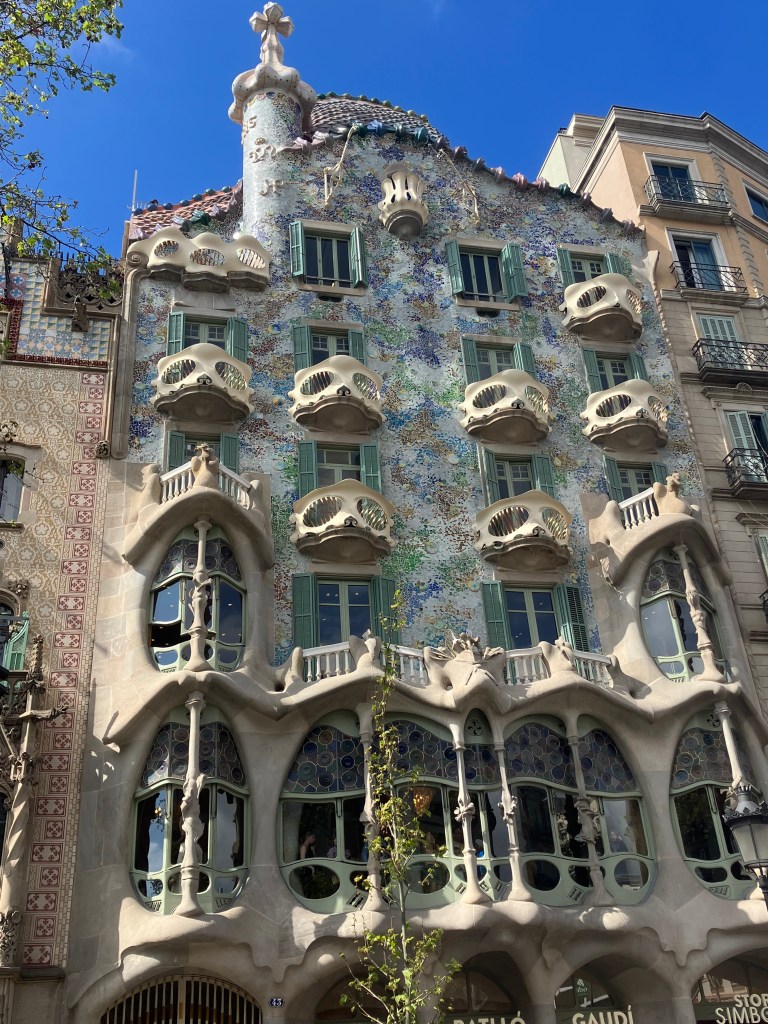
Finally the third house, in the middle, is Casa Battlo designed by Gaudi and completed in 1907. It is several metres taller than the other two and Gaudi’s idea was to utilise the exterior to illustrate the legend of St George (who is Catalonia’s patron saint) The green and blue ceramic cladding on the walls represents the dragon’s scaly skin, the curved roof-top it’s crested back and the balcony railings and pillars the bones of the dragon’s victims. He had quite an imagination!

Finally our walk ended at the Palace of Catalan Music where we had organised to join an English speaking guided tour. We are not massive fans of choral, chamber, symphonic or classical music for which the internal Palace is famous. But the building itself is widely regarded as a masterpiece of Catalan architecture, a majestic example of the Modernist style and a magnificent end to our day. The architecture throughout is to die for!

Built in 1908 by Lluis Domenech i Montaner, the outside is currently undergoing refurbishment work and is partly covered with scaffolding and plastic shielding but you can still admire some of the mosaic covered columns.

Internally much of the work is on a floral theme. Roses, lilies and other beautiful flowers climb up pillars, trail across the stained glass windows and cover the ceilings. The Modernist style abounds and the auditorium is the central masterpiece.
Viewed from the upper floor, celestial stained glass windows surround the organ below which behind the stage you can see muse-like figures with mosaic tile bodies and terracotta statues for heads.
On either side of the stage are marble sculptures. On the right hand side Richard Wagner’s Valkyries ride over a bust of Beethoven whilst on the left a tree of traditional song provides leafy shade to Anselm Clave, a Catalan composer.

Finally look up and you see the piece de resistance, the absolute gem that is the blue and gold stained glass skylight encircled by forty women’s heads to represent the heavenly choir.

What an ending to our exploration into Modernist architecture!

NB:
This is my second post about Barcelona. Why not have a read of the first post?

We are currently on a tour of Western Europe, why not catch up with where we have been and then follow us as we continue to explore this lovely part of the world?

The Valencia Fallas Festival

As part of our explorations of this wonderful city we visited the Museo Fallero or Fallas Museum. From the outside the museum looks fairly small and unassuming. It costs just 2 euros per person to enter. The attraction for us stemmed from a previous visit to New Orleans where you can visit Mardi Gras World which gives visitors a behind-the-scenes look at the magnificent floats used during the Mardi Gras parade.
We had no expectations on entering this museum other than to view the sculptures that had been saved from the flames.


Wow! What a surprise! I left not just with loads of photos of my favourite figures but also with an insane desire to learn more about this Valencian Festival which I’d previously known nothing about.

Every Spring, from March 15th-19th, Valencia celebrates Las Fallas in honour of Saint Joseph, the patron saint of the carpenters. This festival stems from the mid-18th century when carpenters disposed of pieces of wood they had saved during the winter. As spring arrived they would apparently celebrate it’s arrival by burning it.
As this tradition grew over time so these pieces of wood were made to look like human figures, using clothes and wax (presumedly from candles), a bit like the scarecrows we have at home.

Gradually the characters became more complicated and became known as fallas, which is derived from the medieval Valencian language meaning “torch”. Each fallas would have a theme or “title” and were built by the people living in each neighbourhood working together with help from carpenters and painters.

As cardboard gained in popularity during the first half of the 20th century, the wax was replaced by this more pliable material and the fallas would be made up of several characters known as “ninots”, each ninot forming part of the story being told.
As we learnt in the museum from the 1970’s expanded polystyrene started to be used for the outer shell of the ninots and instead of dressing the figures they began painting on the polystyrene instead.
This picture shows the ninot from 1935.

As the festival gained traction so the demand for specialist creators grew and the profession of artists fallers (fall artist) emerged in the city. These artists have their own workshops and continue to develop and evolve their own style.

The festival grew and more and more people were supporting and sponsoring the creation of these yearly fallas. These groups of people known as “comisiones falleras”, began to compete against each other with the winning fallas creating great pride amidst the neighbourhood that had created it before being burnt on the evening of March 19th.

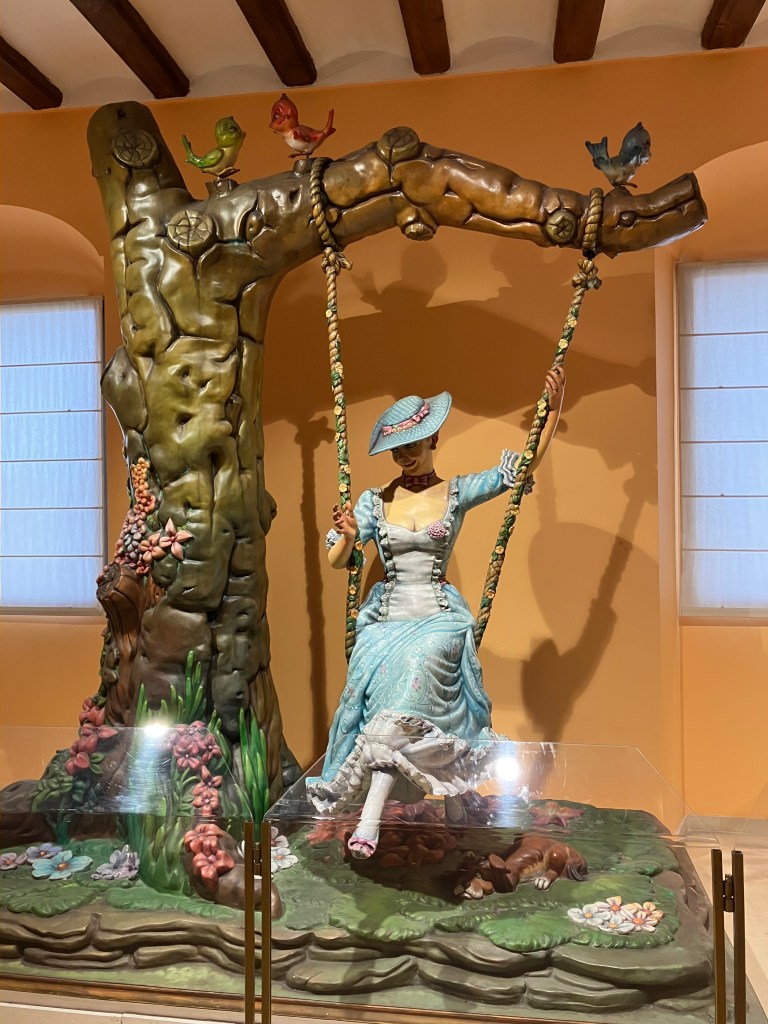
Fast forward to today and there are over 350 “comisiones falleras” in Valencia each building not only the main falla but also a falla infantil which is a smaller falla, family friendly and thus aimed at entertaining children. This is one of my favourite falla infantil called Solidarity saved in 2009.

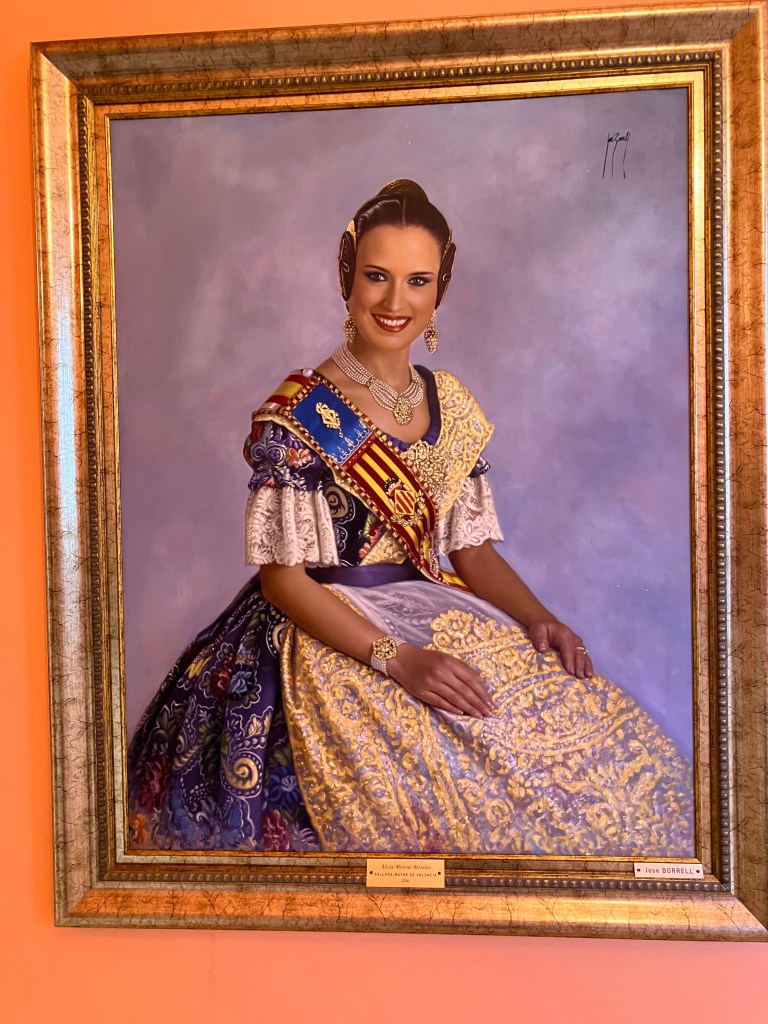
Each community also elects a Fallera Mayor -a Queen of the Faller neighbourhood and a Fallera Mayor Infantile who is the child equivalent. From these a Fallera Mayor de Valencia and a Fallera Mayor Infantil de Valencia are chosen. This is a great honour with many responsibilities. Painted pictures of previous Fallera Mayor de Valencia, dating back to 1995, are on display in the museum and I’ve attached a picture of my personal favourite here.

To give some idea of how big this festival now is. The most impressive fallas form part of sección especial and they cost well over €100,000 each. The most expensive falla ever built was in 2009 and cost approx. 1 million euros.
The two main winners are placed next to each other and burnt the same night, first the falla infantil, then the falla principal. The winning fallas are the last ones to burn.

The ninots on display in the museum date back to 1934 after a new tradition, in recognition of the skill and dedication used to create them, of pardoning ninots from the fire was started in the 1920s.
In 1934, the first Ninot Exhibition was organized so that the people of Valencia could choose by popular vote which ninot to pardon from the fire. This ninot receives the name of ninot indultat.
Nowadays the Ninot Exhibition is organized inside the City of Arts and Sciences. Anyone can vote, even visitors and the winning ninot infantile and ninot indultat are spared from the flames!
It is interesting to view them all in the museum in chronological order. You can clearly see how everything has developed and improved over the years including the themes that have been used.

This spectacular yearly event has grown from the burning of fires on March 19th to a full five day festival. Posters advertising the events taking place started back in 1929 and, as a result, the museum displays a collection of these across the years.

This festival is an essential part of the city’s culture and heritage bringing together communities to party and celebrate Valencian music, costumes and food.

It excites me to learn that in a world that is so disparate at times here in this Spanish city communities are still working together each year to create their own bespoke fallas.
I cannot wait to return and savour it for myself!

NB:
This is my third post about the great city of Valencia. Why not have a read of the other two? And then catch up on our tour of Western Europe thus far?


Touring Western Europe -Spain -Barcelona Has Sold It’s Soul!

I would normally be sat here writing about our adventures in Barcelona rather than an opinion piece.
We had arrived here by train from Valencia on Monday and settled into our Air BnB late afternoon with a view of La Sagrada Familia from our balcony.
I guess this is still an adventure but it’s hard to know how to write a positive piece when for me it is so marred by the reality. I know my opinion is going to be contentious. I’m sure there are people who have been here and loved it. I, however, am slightly at a loss.

The city, itself, is the second largest in Spain with 1.6 million people living within the city limits but put it into google and the first thing that comes up is FC Barcelona, what does that say about it? Is the football team it’s saving grace?

I came here expecting so much more. This is the capital city of the Catalan region of Spain. An area that historically has been proud of its heritage to the point that it has looked to seek independence from Spain itself.
My first impression is of dirt and grime. Every city we have visited thus far has kept their “old town” streets clean with daily cleansing but not Barcelona. This city is being spoilt by tourism. Suddenly it’s like we are back in London again with litter on the streets and pollution discoloured buildings but with the added ingredient of just being totally underwhelmed despite the fact it dates back to pre Roman times.

Las Ramblas
This is the description I was given by my Guide book in advance of our visit:
“To stroll through this bustling district is to walk through the history and culture of one of the world’s most exciting urban centres. Celebrated poet Federico Garcia Lorca once described it as “the only street in the world which I wish would never end” . Famous for its throbbing urban energy, this colourful avenue and tree-lined walkway are one of the busiest areas in the city so it’s not surprising that it is constantly thronged by tourists.”

The only part of that narrative that is true is the latter part. Yes it is full of tourists but why?
Something is definitely missing because I didn’t experience any atmosphere. I was expecting Covent Garden in London but in avenue format. With pavement cafes, independent traders selling flowers, souvenir sellers, street performers, human statues and benches with people watching the world go by.
Did Covid have an adverse effect on trade which never recovered? Have the police clamped down on the street performers to such an extent as they are no longer welcome?
Las Ramblas is as dried up as the old river bed it was built on. There are many pavement restauranteurs plying for your trade charging exorbitant prices for food and drink, a few trading stands selling souvenirs and flowers and some cartoon artists down the far end near the port but that is it! There is no excitement, no atmosphere and it just seemed pointless to me.

Mercat de la Boqueria
This market housed in an airy and glass structure is about halfway down Las Ramblas on the right hand side if you are walking towards the port. My guide book quotes it as “the place that the city’s top chefs come to buy their ingredients”.
Are you sure?
Maybe in it’s heyday that was the case but now around 50% of the stalls sell food purely devised and aimed at the tourists. Pre made fruit smoothies, pre prepared fruit selections in plastic cups, ready prepared meals that the stall holder can throw in a microwave and zap on reheat before exchanging for tourist cash, Barcelona burritos, chocolate fruit on sticks and so it goes on.
Don’t get me wrong I can understand how this has happened. The market opened in 1836 selling a wide range of local products including fish, meat, vegetables and fruit but ultimately traders need to make money particularly since Covid hit and so they give up their traditions and trade it in for tourist food.
To describe this as the country’s most well known market is probably true but NEVER describe it as the country’s best market because it is definitely not. It’s a market that has sold its soul to commercialism.

The Cathedral
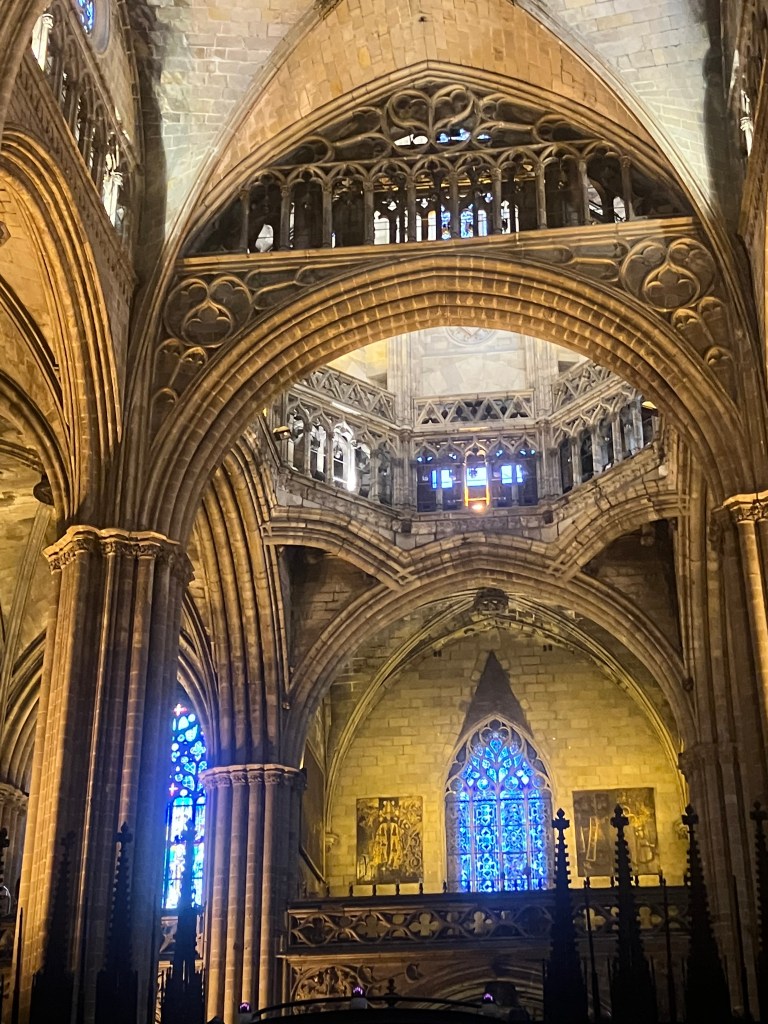
This is described as ‘Barcelona’s Gothic gem, at the spiritual and physical heart of the city. The cloisters are listed as one of the best parts with orange and medlar trees, palm trees, a mossy green fountain and the thirteen geese kept as the cathedral’s tradition to honour St Eulalia’s life.
The reality is that the building is so affected by pollution it has to be systematically cleaned which no doubt costs a fortune. I managed to get a picture which shows the variation.

The interior compared to many other cathedrals we have visited on this tour lacks the wow factor but this is a typical situation where an ecclesiastical building is being held up as a tourist destination when in fact it is purely what it set out to be, a church of god.


The garden in the cloister looks bedraggled and in desperate need of water and as for the geese? I just felt sorry for them in their stone floor enclosure with no grass and only cabbage/lettuce leaves to remind them of what green food actually is and a dirty, smelly, equally green pond to swim around in. Sorry but I’m sure St Eulalia would agree with me, let these poor birds go free.

The Beach
Barceloneta beach is the nearest to the city centre and accessible from the end of Las Ramblas. A statue of Christopher Columbus pointing out to sea sits atop the Monument a Colon marking the end of Las Ramblas itself. From here it’s about a 15 minute walk into the centre of Barceloneta.
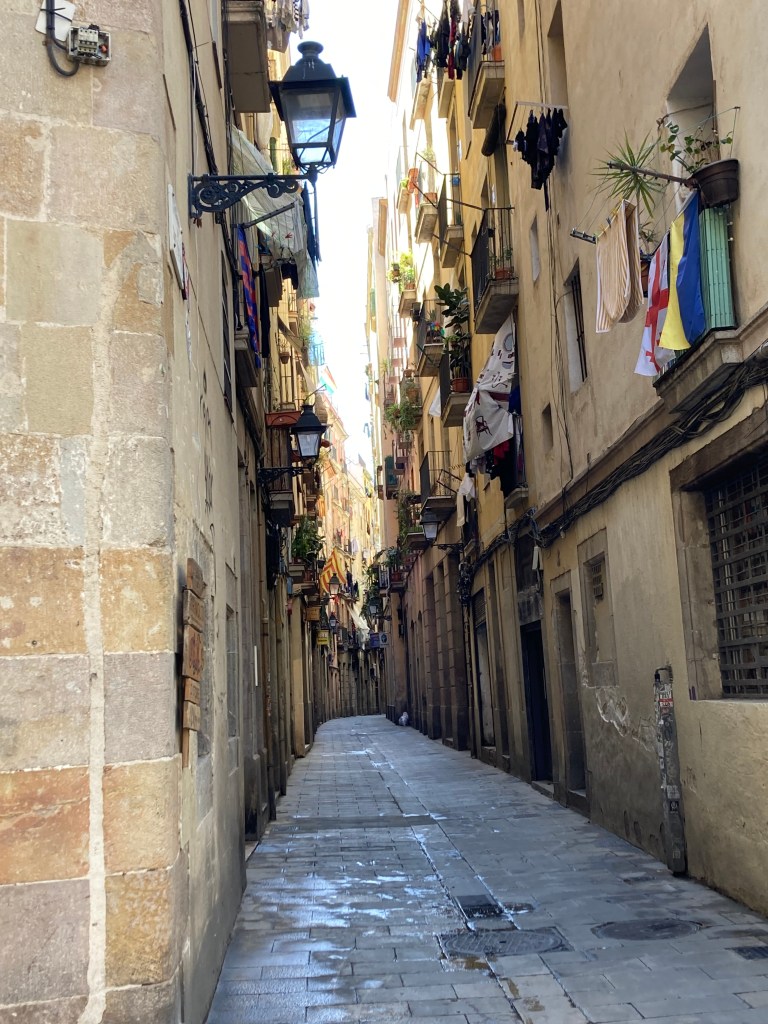
Traditionally this was the fisherman’s quarter and this still looks like a very working class neighbourhood with apartment buildings strewn with balconies full of washing hung out to dry alongside children’s toys and other stored items.
In front of the market is a plaza where locals congregate to play table tennis, young aspiring Messi’s play a game of footie with their mates and the older generation chat with friends and watch the world go by.
Also on this square, to one end, are two or three restaurants overflowing with tourists sipping wine by the glass whilst enjoying tapas and other traditional Spanish fayre.
It’s a huge contradiction and one I couldn’t fail to notice when I stopped on a bench here for a breather.

We reached the beach early afternoon. It is nothing like the beaches you see all around Spain. This is probably because it is manmade. The city built the beach for the Olympics back in 1992 creating around two miles of sand.
It’s the start of Easter week and even though the temperature is still in the low 70’s it is rammed. Not only is the sand full of people but so is the boardwalk! It is nearly at the point where you are queuing up to walk.
We have just left Valencia with it’s lengthy avenue bordering the beach allowing visitors to walk, cycle and skate and I’d go back there tomorrow rather than face this heaving mass of humanity.

According to Google, 27million people come to Barcelona every year – about 16 times more than its standing population.

I cannot help but conclude that this is a city that has given up its heart and soul in favour of tourism.

I’m sure during Covid when the streets were empty and the beach was clear, many local Barcelona inhabitants took pleasure in having their city back and no doubt wish their Government would stop selling their identity in exchange for the tourist dollar!

NB:

This is part eleven in my series of posts about our tour of Western Europe. Why not read the previous posts and then follow us on our journey as we continue to explore this lovely part of the world?


Valencia, It Just Has It All!

So what else did we see or do which made us want to stay in this wondrous city?

We took a break from the Jardin de Turin to visit the Museum Faller. This museum is all about the art of carnival sculpture and to which I am dedicating a separate article on Tuesday because it simply deserves its own space!
Instead, following on from my previous post, I’m going to chat about where we went next and hopefully you will share my enthusiasm for this city that just seems to have it all!

The City of Arts and Sciences
Firstly this construction is probably one of the most contentious architecturally in the whole of Spain. Personally I love it but I can understand that some people would feel it is a blot on the landscape.
The City of Arts and Sciences sits at the eastern end of the Jardin de Turin just before you reach the coast. It is made up of six distinct areas and was designed by Valencian architect Santiago Calatrava.
Started in July 1996 the first section was opened in 1998 but the final part was not inaugurated until 2009. Originally budgeted at €300 million in 1991 for only three structures, it has expanded about three times the initial expected cost. In 2019 it was reported, however, that the economic impact of the complex is €113 million a year and generates over 3500 jobs!

Hemisferic was the first site to open and the centre piece of the City of Arts and Sciences.
It is also known as the Eye of Knowledge. It is so hard to describe it but the design resembles an eyelid that opens to access the surrounding 24,000 square meters of water pool. The bottom of the pool is glass, creating the illusion of the eye as a whole.
Within the structure there is a Laserium, a Planetarium and an IMAX cinema with over 900 square meters of screen.
My only question if I lived here would be where do I start?

Prince Felipe Museum of Science opened in 2000 and is an interactive museum of science built to resemble a whale skeleton. The architecture is known for its geometry, structure, use of materials and its design around nature. At 42,000 square meters the building houses 26,000 square meters of exhibition space, the largest in Spain.
It occupies three floors and is dedicated to learning science through experience so everything is graphically displayed with plenty of interaction.
I’m sure it is geared towards school age children but I’d still love to visit!

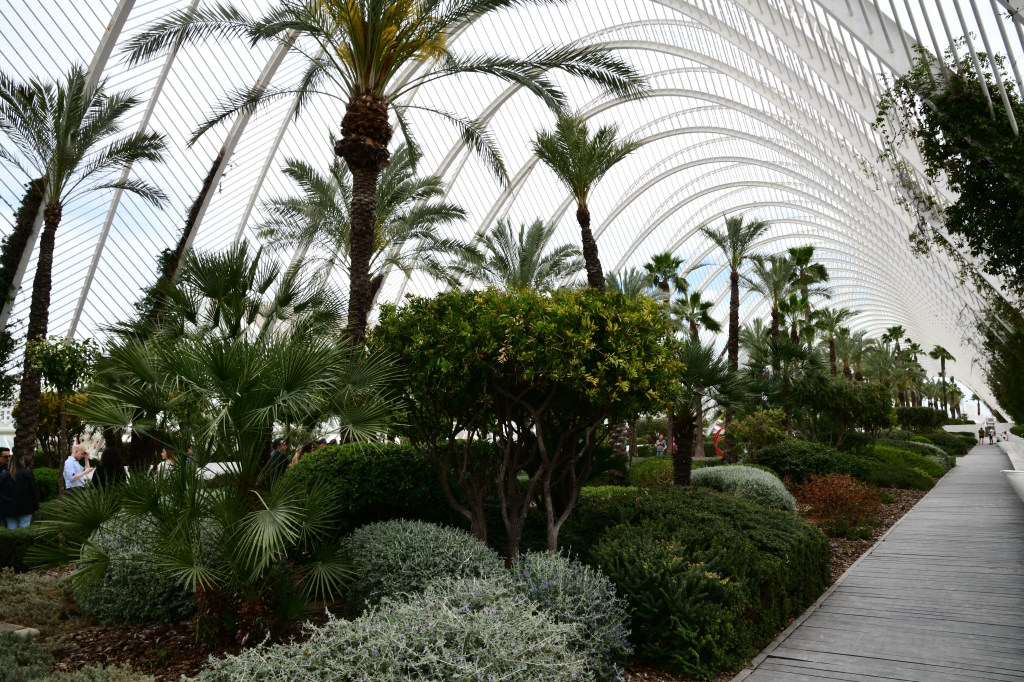
L’Umbracle was the third to open in 2001 and designed as an entrance to the City of Arts and Sciences. At 320 meters long and 60 meters wide it was designed as an open structure with 55 fixed arches and 54 floating arches that stand 18 meters high all encircling a landscaped walk with plants found in Valencia. The plants being specifically picked to change colour with each season.
Internally there is also The Walk of the Sculptures which is like an outdoor gallery with sculptures by artists including Yoko Ono.
We were able to walk around here whilst on our visit, the bougainvillea was just beginning to flower, the honeysuckle scent reminded me of home (it was one of my Mum’s favourites) and the smell of rosemary and lavender filled the air.
What would it be like to return each season and watch the changes?

Oceanografic opened in 2003. Built in the shape of a water lily, it is the largest oceanographic aquarium in Europe with 110,000 square meters and 42 million litres of water. More than 45,000 examples of 500 different marine species inhabit nine underwater towers spread over two levels. Each represents a different aquatic environment including the Mediterranean,  wetlands, temperate and tropical seas, the Antarctic, the Arctic, islands and the Red Sea.
My all time favourite aquarium is in Monterey, California but I’m open to having my mind changed

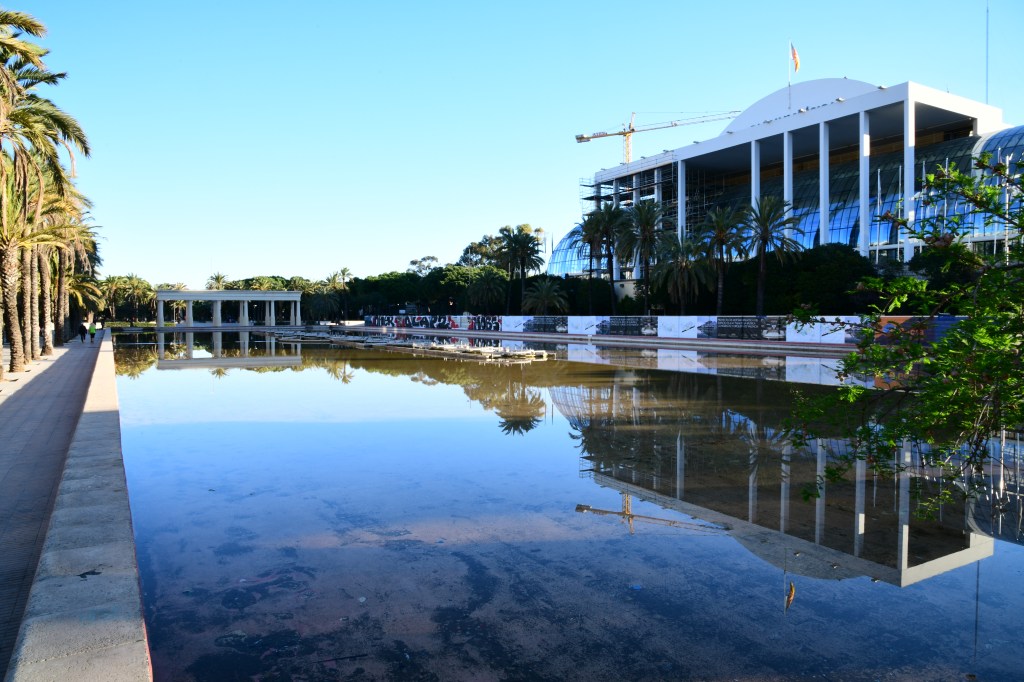
Valencia Opera House which opened in 2005 is not just an opera house but a centre dedicated to music and performing arts. Personally I feel it looks like a fish with it’s mouth open?
Measuring over 70 metres in height, the Palau de les Arts is divided into four separate halls, all boasting the latest technology in order to stage all kinds of opera, musical and theatrical performances.
It is surrounded by 87,000 square meters of landscape and water, as well as 10,000 square meters of walking area. To add to the theatre, panoramic lifts and stairways connect platforms at different heights on the inside of the metallic frames of the building.
Culture on your doorstep, what more can you ask?

Agora, the final part to open in 2009 is a covered plaza in which concerts and sporting events can be held. It is, however, completely versatile so there is no limit to the type of performances that could be held here.
Wow, they seem to have thought of it all!

Surrounding all this magnificence are pools of water with walkways all with plenty of seating and just inviting you to sit, take a breathe, maybe read a book or have a picnic.
I really cannot wait!

From Oceanografic you can either walk for forty minutes or jump on a bus to the beach. We, however, opted to visit on a different day, giving us a chance to test out the theory that our apartment was indeed thirty minutes walk to the old town or to the beach in the opposite direction.

Playa de las Arenas
Firstly before reaching the beach it’s worth having a look around the harbour since this is where the Americas Cup was held in 2007.
Additionally The European Grand Prix was held at the Valencia Street Circuit from 2008 until 2012. The Formula 1 circuit used public roads near the Port of Valencia as well as a purpose built section nearby.
After the last race, the track was abandoned with the purpose built section remaining as it had been and there is evidence of the race still throughout the port area including the abandoned pit building.

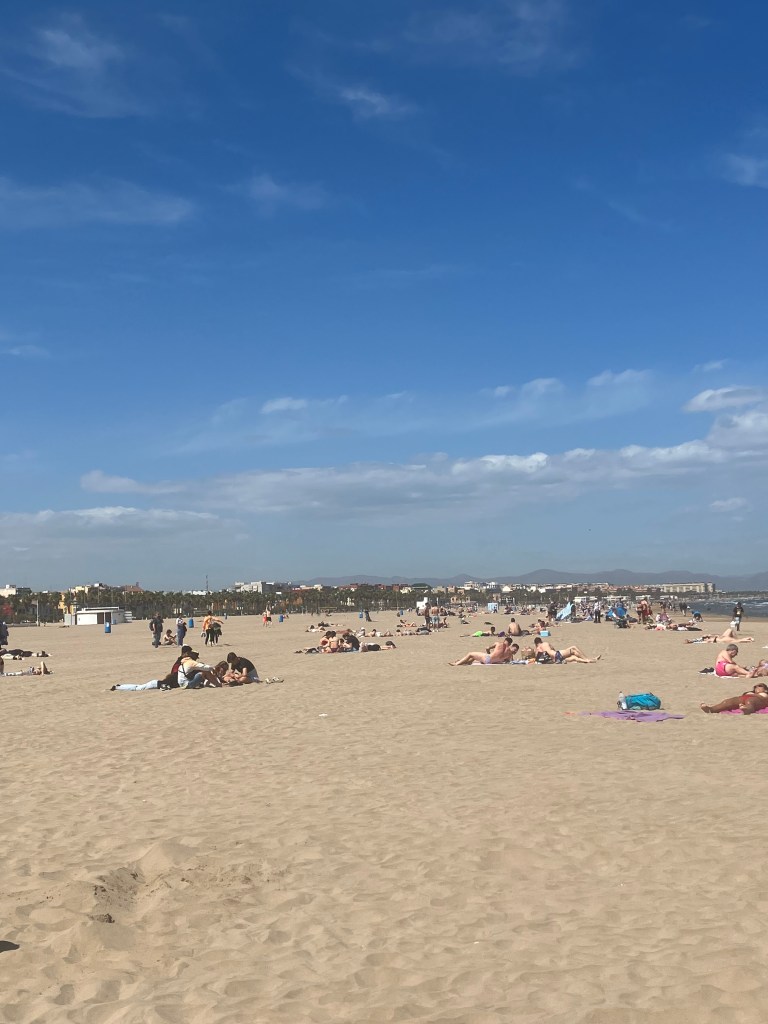
Leaving the port behind we walked from here to the beach which stretches north from the marina. The first thing we noticed about the beach is its pure width ranging from an average of 60m up to 100m in places, there is definitely no shortage of space.
Secondly, which to be honest, is something I always check out before taking off my trainers and socks to put my feet in the sand is how clean is it? Valencia’s beach is super clean.

This is not the best photo but it gives some idea of the size.
Behind the sandy beach is an impressive boardwalk, known as the paseo maritimo. Although this is lined with bars and restaurants, some with an unobscured view of the sea beyond, it is spacious. There are plenty of benches to stop and rest whilst watching other visitors taking a stroll, riding a bike or a scooter or even skating, without causing any interference to each other.
On the beach, itself, we took a moment to watch the volleyball players. Whilst there were evidently people sharing a court for an informal game between friends there are also some serious games to watch. Beach volleyball is a very popular sport in Valencia with players competing at local, national and international level.

As you walk along the beach it is hard to know where one beach ends and another starts. Playa de las Arenas blends into La Malvarossa and ultimately Patacona Beach. There are roughly 2 miles of sand.
We couldn’t come to the beach without tasting a traditional Valencian paella. Whilst paella is popular throughout Spain it is nationally recognised that the Valencia region is responsible for the original recipe. It consists of round-grain rice, specific varieties of green beans, rabbit, chicken garrofó (a variety of lima or butter bean) and it is cooked in olive oil and chicken broth.
There is a second variety based on seafood but paella that is mixed i.e. seafood and meat is not traditional although it is available in some restaurants. We chose to stay with the meat variety and left the beach with our tummies happily full.

So there you have it a City of Arts and Sciences and 2 miles of beautiful beach with traditional paella. Any more reasons why we want to stay?

NB:
This is my second post about the great city of Valencia. Why not have a read of my first post? And then catch up on our tour of Western Europe thus far?


£140 for a Pee!

Given I have posted about midlife itself, the menopause and midlife health I thought I would follow up with a wonderful story about the joys of all three! Being menopausal and embarking on midlife adventures.

Sitting on a long haul flight to Barbados in March 2022 I’m engrossed in my kindle and the variety of films on offer on my TV unit and all the while my inner uretha is deciding to play silly games. I find my normal one wee, let’s avoid the flight toilet, is disturbed by the need to pee several times. This is a side effect of menopause for some of us ageing women, an inclination to develop more than the average number of infections. Unlike when this happened in my twenties and an easy solution, to avoid the use of condoms, solved the problem, this isn’t going to do the trick this time.
And so I find myself standing in baggage reclaim thinking and hoping that this need to pee doesn’t develop into the now familiar burning sensation when I next visit the loo, hopefully when we finally arrive at our apartment some forty five minutes drive from the airport.
I drink gallons of cold water on arrival, from the freshly filtered jug in the fridge, and take a couple of paracetamols before retiring to bed.

It’s 2.40 in the morning (6.40 UK time) and the need to pee wakes me up which is a double whammy as I know my body is now going to think its time to get up and I won’t be able to get back to sleep. Parking myself on the loo my body then alerts me to the dreaded UTI and I immediately start to think “how on earth am I going to get antibiotics out here?”
I grab some more cold water and another couple of tablets and silently ask for it to just disappear while I sleep a bit more. Morning comes too quickly at 5 am and my first pee of the day doesn’t seem too bad.

We have a planned trip to the nearest large supermarket about thirty minutes drive away and within it’s walls is a pharmacy. I decide to talk to the pharmacist in case I’ve been lulled into a false sense of security and the burning returns. A very no nonsense Bajan lady tells me that I have to go to a doctor if I want antibiotics!

Back in the apartment we make lunch and again there’s the urge to pee and the burn is back. Referring to the guide book, the owners have thankfully supplied us with, I ring the medical centre. They suggest I ring my travel insurance company. This phone call back to the UK takes nearly fifteen minutes and at £2 a minute ( Barbados is not part of our Go Roaming) the bill is already starting to stack up. Finally with a reference number we set off to see a doctor who is based about one block from the supermarket we went to this morning! It’s at this point that I start to appreciate the NHS.
We wait around for a while before seeing a doctor. In the interim I learn my temperature is normal ,along with my pulse, oxygen levels and blood pressure. It’s like they have to do these vital checks not just to satisfy themselves but so we think something is happening. It’s like those queues at theme parks where you wander up and down, around and around to get to the start of the ride and they think by doing this you will be distracted enough not to think you have queued!


I then pee in the pot but its not your normal plastic bottle here in the Caribbean it’s a metal dish like you’d find a pie in at home! Pee duly dispensed we wait for it to be tested and to see a doctor. I manage to read a third of my magazine I brought with me, in case there is a wait, before getting bored and asking if my husband can come in to keep me company. This seems to jog them into action and we finally speak to the doctor who delivers an in depth explanation of their findings -the end result being you have a UTI and a bill for 345 Barbadian dollars which in English is about £140!!!!
What a great start to our holiday!


Luckily, when we returned to the UK, the travel insurance covered the bill for my pee (minus the excess) but the joys of midlife and the menopause still prevail and I now have to ensure I have a supply of antibiotics to take with me on my travels.

How do I stay healthy in midlife?

I’ve not written a piece about midlife for a while and whilst I am enjoying my current adventures I think it is important to recognise that I am traversing Western Europe whilst being middle aged. Is this a sensible idea? Am I fit enough to do this? 

Historically I was that child who at school would do anything to avoid being outside in the cold playing netball or worse still hockey in my sports shirt and minuscule skirt. Conversely I would happily get up at the crack of dawn to jump over the back garden wall, walk across the playing field to reach the farm my Dad rented and attend to my horse. I loved horse riding and showjumping and after ten years I’m guessing I was fairly physically fit.

But then life took over. My career became all consuming. Going to the gym was something I got no pleasure from. I just felt inferior and frumpy when all the super fit, slim, sporty types exercised in their clingy sports clothes alongside me. 
I’m not sure why I worried so much because even when I fell pregnant with my first child I was still a size 10 but then I put on three stone! I managed to lose two stone before falling pregnant for my daughter. But by the time she was born I was another stone heavier.    Overall nett result from pregnancy, two stones extra!

By the time single parenthood came along five years later I had managed to lose weight and was fitting back in my size 10’s. I had actually joined a gym for about six months in order to prepare for a charity trek, completing the Inca Trail to Machu Picchu in November 2001. It was actually being away on this trek that finally ended my marriage!
Once I was on my own the weight started creeping back on. I tried addressing it a few times, trying various slimming groups but life was hectic enough with two children and a full time career without counting calories or syns or fat units!

Fast forward to 2015 when I met Phil and I was probably nearly five stone heavier than when we knew each other back in the early 80’s. The biggest problem was I could look in the mirror and see myself as I’d always done and not as an overweight, clinically obese, middle aged woman!

Amongst all the many conversations we had in the first three months of our relationship health and fitness did rear its head. We knew we wanted to be together forever but how long was forever going to be? Neither of us was fool enough to think we could live forever without making some changes but it still took us another couple of years to be serious about it. 

New Year’s Day 2017 was a turning point. We made a commitment to each other to ensure we would have twenty good years together, fulfilling our dreams of seeing the world. To do this we both knew we needed to have a better balance. We needed to eat healthier, lose some weight and exercise more. 

We started by taking the decision to give up processed food but we still allowed ourselves the odd takeaway. Bear in mind, at this stage, Phil had given up alcohol in 2001. I had given up caffeine in the same year and had changed my diet in 2004, to alleviate a medical condition, eliminating alcohol and spicy food.

Cooking from scratch became the norm for us and to be honest with both of us happy to cook, either separately or together, it wasn’t a hardship.

January 1st 2018 we gave up takeaways completely and I joined Slimming World. I wasn’t intent on losing weight so much as maintaining a healthy lifestyle.

Slimming World
Food optimising is the central mantra of following this way of life. It’s not a diet, you don’t have to count calories but it does mean you have to change what you eat forever. 

Every day you can have two healthy extra A’s – this is your dairy allowance. I struggle to do this as I have a problem with dairy. I’ve never been properly tested but I cannot drink milk, it just makes me feel sick. I manage with skimmed milk in my tea but that’s about it for the day.
I can’t eat cheese except goats cheese or cooked cheese when I’m guessing the enzymes have been broken down. Eating cheese will make my gums swell up, my whole mouth and throat itch and I start to develop a rash on my arms. 
I can eat eggs but not to excess.

You also get one healthy extra B which is your bread allowance. If you actually eat it as bread it has to be wholemeal, which is fine with me. I tend to eat mine at lunchtime unless I’m planning to have homemade burgers or wraps for dinner.

Most fruit, veg and salad count as free foods and within this certain items count as speed food. Speed food can be eaten the most as they are very low in calories and ideally should make up a third of your plate at every meal.

Finally you can eat 5-15 syns each day. This can be spent on non free foods at meals or snacks and sweet treats. There is a really useful app where you can look up the syn value of any food that’s not free using the supermarket bar code.

I have lost weight, over two stone at my last check in, but not as much as I would like and probably not as much as people reading this would maybe expect. However for me it was more about healthy eating and if I lost weight this was an additional benefit. I have never eaten so much fruit, veg and salad as I do now. The recommended daily allowance is five pieces a day and I eat double that. I try and eat thirty different types of fruit and veg a week. 

Slimming World is also about the camaraderie you develop with your fellow Slimming World members that you meet through your group and see each week when you weigh in and stay behind for IMAGE Therapy. IMAGE stands for Individual Motivation And Group Experience. I feel really lucky because the people that attend my group on Wednesday morning at 9.30 are all super friendly and helpful. We share ideas, hopefully inspire each other and together motivate each other to stay on track.

The final piece of the jigsaw at Slimming World is Body Magic which is all about exercise.

Exercise
In September 2021, three and half years into my retirement I finally retired properly. As I’ve explained on a previous post, retirement didn’t really come easy to me but at this point I felt I could finally take control of my own life and in so doing decided to try exercising on a regular basis. 

Up until this point Phil and I had been walking regularly and trying to hit 10,000 steps a day. We have probably half a dozen books at home that cover local walks from 2 miles to 10 miles and had reached a point where 7-8 miles was within our reach. We had walked both the Sharpness to Gloucester canal over two days and the Stroudwater canal from Saul to Sapperton over another three days. Our peak was over 27,000 steps in one day whilst on a city break visiting Prague. 

However the stress on my knees pounding the pavements was beginning to take its toll and I needed to find some other form of exercise to keep myself fit which wasn’t so hard on the joints.
I honestly never thought I would change my perception of exercise or become one of those middle aged ladies that exercise every day but here I am!  

I started in September 2021 with one aqua aerobics class on a Wednesday morning after Slimming World. After two weeks I increased this to two classes a week and then gradually within ten weeks I was doing five classes a week (Monday to Friday) including Aqua Zumba on a Monday, which I love. It was a complete change for me not just the exercise but the positive effect it had on my mental health. I felt so much better in myself. I felt like I had a purpose again.

By June 2022 I felt comfortable enough to have a full Boditrax assessment which gave me an overall analysis of my body. 

By July 2022 when we got married I was at my lowest weight since I’d had my children 25 years earlier. I wasn’t at target, as I’ve previously explained, but I felt so much better, my shape had changed and I felt fitter than I had for years. 

On my return from honeymoon in August I started trying some different classes: yoga, pilates and aerobics. Soon my voluntary weekly regime was made up of three aqua classes, two aerobics classes, two pilates classes, a swimming lesson and even a session in the gym itself! 

I suffered a few set backs over the winter with a bad chest infection, a couple of UTI’s and a stinking cold but my motivation is still intact. When we are home, for three weeks in May, between our two big adventures, I will be back to five aqua classes a week to ensure my fitness stays level. 

In the meantime Phil and I walk just about everywhere while on our adventures averaging at least five miles a day. This includes the fact that in every eight day period we include a day off to recuperate when we try and relax and walk very little. 

With a little help from some deep heat my knees are bearing up and we are over halfway through this midlife adventure in Europe!

Touring Western Europe -Spain-Valencia, Please Can I Stay?

Wow! Oh my goodness! This is it! We have been looking for a city that makes us want to return and actually try life as a local for three months and this could be it! I am so excited…………………

On Wednesday, we travelled from Granada back to Madrid Atocha and then using our previously learnt Cercanias train knowledge (see my blog on Madrid) we transferred across the city to Madrid Chamartin. We boarded our train to Valencia, heading south east out of Madrid towards the coast. Arriving into Valencia, it’s a quick transfer by taxi to our Air BnB -a one bedroom accommodation on the fourth floor of an apartment block, ideally located thirty minutes walk from both the old town and the beach!

Thursday morning dawns bright and clear, the temperature is set to hit 32 degrees and we are heading into the historical old town. Armed with my trusty Lonely Planet guide we arrive at the Plaza de Ayuntamiento. The plan is to complete a one hour self guided walk giving us an introduction to the major historical sights and monuments. Then we are going to head to the park for lunch, before moving onto the Museu Faller de Valencia and the Ciudad de las Artes y las Ciencias.
Little did we know that having completed our first day in Valencia we would be returning to our apartment talking about when to return. Here are the first two reasons why…………….

Mercado Central
All the cities in Spain we have visited on this trip have had markets. These vary in size but not totally in content. Valencia seems to have many markets but Mercado Central, in the old town, is the largest, housed in a wonderful Modernista building.

Hubby and I live, for different reasons, a non alcoholic lifestyle. Additionally we have never smoked and so food is our thing. Not your fancy “pretty food” restaurants but just tasty, healthy, farm to fork style food.
We love trying food from all different countries, as well as regional specialities, and have a plethora of recipe books which we dip into regularly to create food together at home. Life is never boring for us when it comes to food, we probably eat at least 200 different meals a year!

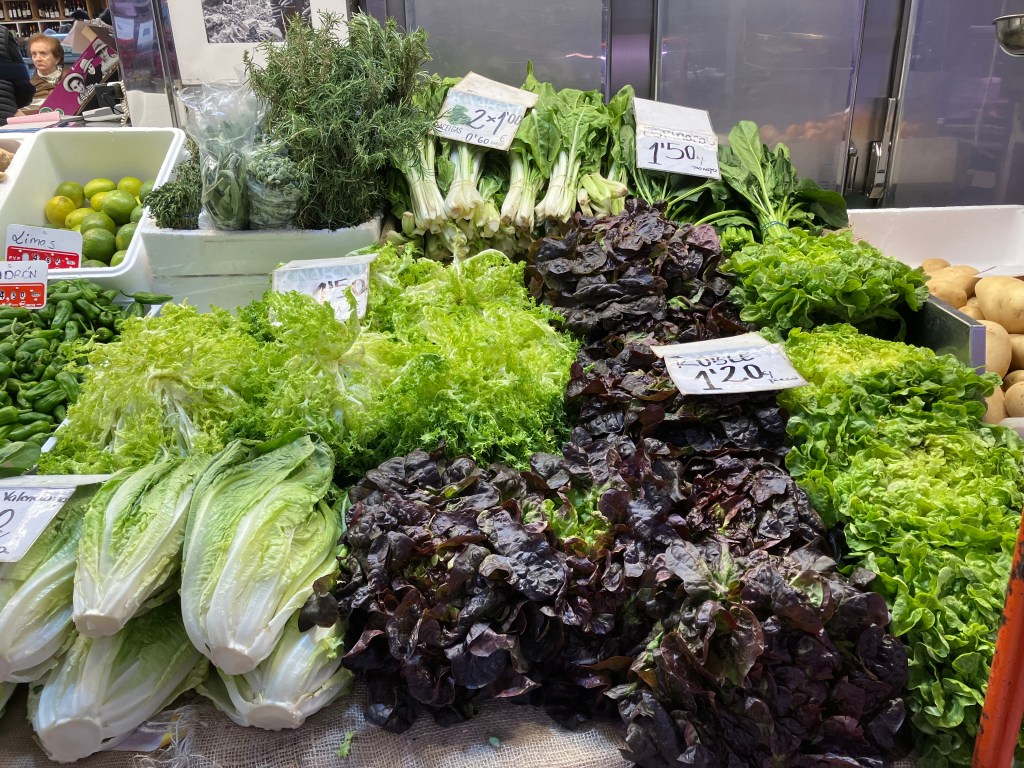
When I walked into this market it just felt like I had died and gone to heaven! There was so many beautiful raw ingredients laid out with care and attention and the smell was just an assault on the senses.
The market is buzzing with a mixture of locals buying their shopping, with an array of pull along trolleys, and tourists wandering at will. I’d read beforehand that there are two invisible rules -Don’t touch the food and photos don’t pay the bills, so be discreet when using your camera.
I have to walk around in a regimented fashion, up and down the aisles, for fear of missing something. It might seem a bit mad but I am so excited, everywhere you turn there is fresh food.

What happened back home? Where did markets like this go? Are we, as a nation, so caught up in consumerism that we cannot shop for food anywhere but in a supermarket?

This market alone gives me an incentive to return. I want to experience this, jumping on the bus outside my apartment, riding 20 minutes into town and then having that freedom to choose my food for the next few days. Not having to plan, just being inspired by what is there, allowing my imagination to create tasty meals, before catching the bus back again.

As it is we shop purely for lunch today and put together a picnic for our trip to the park later:-
We buy a boccadillo each (1.40 euros). If you are not familiar with this type of bread snack I came across an article on line which explains the difference between this and a sandwich “https://www.thespruceeats.com/sandwich-vs-bocadillo-3083603”.
Contrary to this article my tuna roll has chopped olives in it!

Next we pick up two plastic pots of pickles at 1 euro each. These come with a cocktail stick and contain a variety of pickled gherkins, olives, cauliflower, carrot, beans etc.

Then we purchase two chicken empanadas. Spanish empanadas are half-circle shaped pastries that contain different meats, seafood, vegetables and sauces as fillings.
Finally we pick up a dessert. Hubby opts for home made cookies and I buy a home made slice of tiramisu.
Everything is safely stowed in a carrier bag we had brought with us and secured in the rucksack. Walking back out the door through which we had entered we bid a sorrowful goodbye to the market and continue on our walk.

The walk takes us to the Plaza del Tossal, the Torres de Quart, the Torres de Serranos and up the Calle de Caballeros to the Plaza de la Virgen before turning back on ourselves and entering the park.

Jardines del Turia
The city of Valencia had always been subject to flooding from the River Turin which snaked its way from west to east across the city. In 1957 the city was devastated by dramatic flooding with over sixty lives being lost.
Determined not to let this tragedy happen again, the river was diverted south of the city.
Local authorities wanted to turn the old river bed into a highway. But the city’s inhabitants fiercely opposed this idea, won their case and in the 1980s, the old river bed was transformed into a vast park area: the Tùria Gardens.
The gardens cover 270 acres and extend for 7 kms. Dotted with pine and palm trees, fountains, benches and picnic tables the park provides an oasis of calm and a refreshing break from the city’s hustle and bustle.
Wherever you go in Spain, whichever city you are in there is always a park. Every park offers benches and you often see someone reading a book, they could be eighteen or eighty years old, it could be a normal paperback or a kindle. It’s like they all just value this open space that they can come to and relax.
It is here we settle down for our picnic, enjoying the fabulously fresh food purchased at the market whilst relaxing on the grass in the sun and watching the world go by. Everyone is here- the midday joggers, skaters and electric scooters, the dog walkers and the couples catching time together having lunch.


Valencia is a city committed to encouraging alternative modes of transport. Electric scooters are rife and being a fairly flat city, bike hire shops are everywhere. Interestingly the cycle lanes in this city are a sub section of the pavement and not the road which to be honest seems a whole lot safer.

The Catalan architect Ricardo Bofill is primarily recognised for the development of the park and it was inaugurated in 1986. It is still crossed by the eighteen original bridges that stretched across the river. It passes by the city’s main museums and monuments on either bank.
The Cabecera Park and Bioparc border the huge gardens to the west, neither of which we have had time to visit, whilst the futuristic City of Arts and Sciences border it on the opposite side, near the mouth of the river. This is mentioned in my second article about this wonderful city.

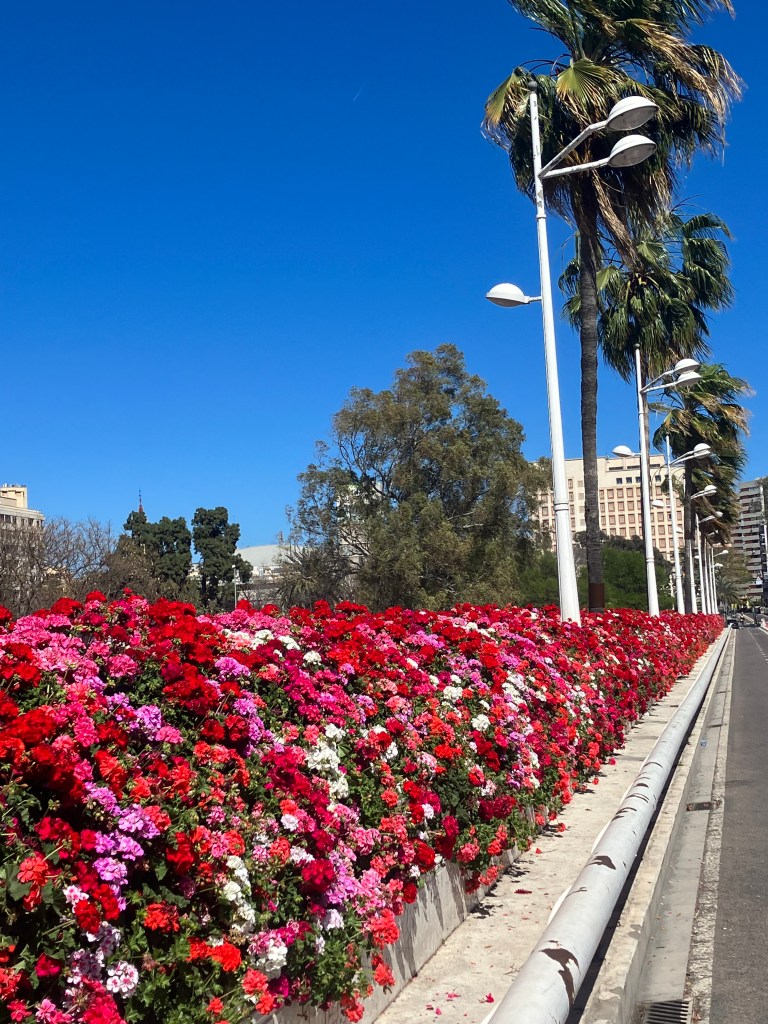
We force ourselves back to our feet and heading east we pass under the beautiful Pont de las Flores or Bridge of Flowers, followed by the Puente del Mar with its ten pointed arches. We stop briefly to admire the Palau de la Musica in its lovely lakeside setting. This musical venue for concerts and orchestra performances again adds to the park’s attraction.

In every park we have visited, thus far, in Spain there is always a playground. The playgrounds are clean, they are not vandalised or graffitied, it’s like there is just this respect for what has been provided that we don’t see that often in England.
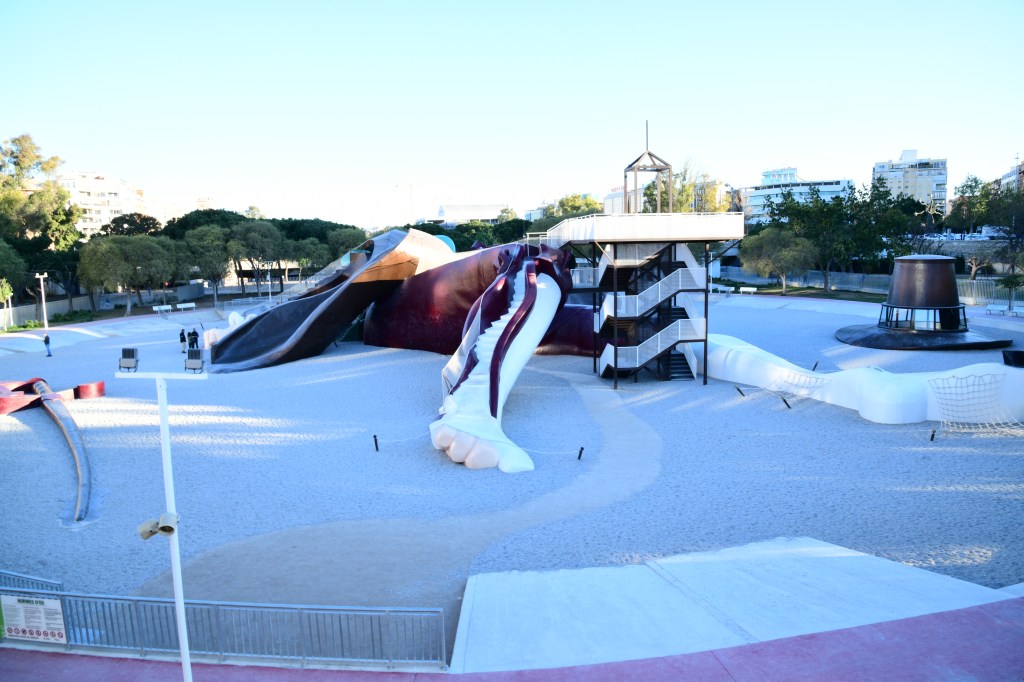
The Jardines del Turia is no exception and just before we leave to head away to the Museu Faller de Valencia we come across Gulliver.

From ground level you would not perceive that this massive play structure featuring a multitude of stairs and slides is a giant sculpture of Gulliver. Almost seventy meters long and nine high, covering an area of 15,000 m2, he is led on his back, tied to the ground and motionless. But view it from above from one of the walkways at street level and all becomes apparent.
Children can climb onto the fingers, hair and legs of this giant and slide down them like Lilliputians.
This is seriously a “one of a kind” children’s play park and I am in awe of the design and its size. Those are people just to the left of this monolith in my picture!

On leaving the park, which we return to again later in order to visit the Ciudad de las Artes, we both realise we have experienced something quite phenomenal. Somewhere that warrants further exploration, a place where we can see ourselves enjoying retirement in quiet seclusion for a while whilst also inviting others to experience this wonderful city.

NB:

This is part ten in my series of posts about our tour of Western Europe. Why not read the previous posts and then follow us on our journey as we continue to explore this lovely part of the world?

.


Granada -A View to Remember

In modern day society it’s sometimes hard not to be a tourist. As I’ve mentioned before all the key sights want you to book tickets in advance for a specific day/time.
It started during Covid so numbers of entry could be limited and a 2 meter distance could, therefore, be guaranteed between strangers when visiting. When we finally left the Covid era, continuing this pattern of entry ensures that numbers are still limited and places are not over run by the ever increasing numbers of tourists wishing to visit.
However the cynic in me also feels that this allows for staffing numbers to be predicted and I’m guessing, as a result, these numbers have often been cut. If you know how many visitors you are having in each hour organising staff rotas becomes prescriptive rather than haphazard guesswork.

In this new world it’s lovely sometimes just to throw away the guidebook and plans and to take time out to wander at will and that’s what we did on our second day in Granada. We left our hotel and browsed the shops along Calle Elvira before arriving at the Plaza Nueva. This is actually the oldest square in Granada and around the square are the Royal Chancellery and the House of Pisa.
From here we headed past the Plaza de Santa Ana and along Carrera del Darros following the river. This is the river that supplied water to the Alhambra via aqueducts.
The road soon starts to narrow but it’s nice to feel the cobble streets underfoot. At times like this my imagination reaches back in time and I become aware of all those who have trodden these streets before me. There is barely enough room for the small local bus to get through which reminds me that these streets were made for horses and carts and not modern day transportation.

Several small stone bridges cross over the river and we pass the El Banuelo, preserved remains of 11th century baths, and outside is a black shield shaped sign which explains in both Spanish and English historical information about the site. For some reason that we haven’t been able to ascertain at the bottom of the narrative is the number 85 and an earphone sign.
It soon becomes apparent that all places of interest have these signs posted nearby. I’m guessing you can do some sort of self guided tour and the numbers refer to an audioguide you can download on your phone. Maybe check it out at the local tourism office if you are visiting.

We reach another small plaza and take a breather whilst photographing the glimpse we have of the Alhambra Palace up on the hill to our right.
As we continue the streets on the left like Calle Zafra and Calle Gloria are old and narrow curving upwards away from us, inviting exploration. We resist the temptation and follow Calle Chapiz as it curves around a bend to the left.

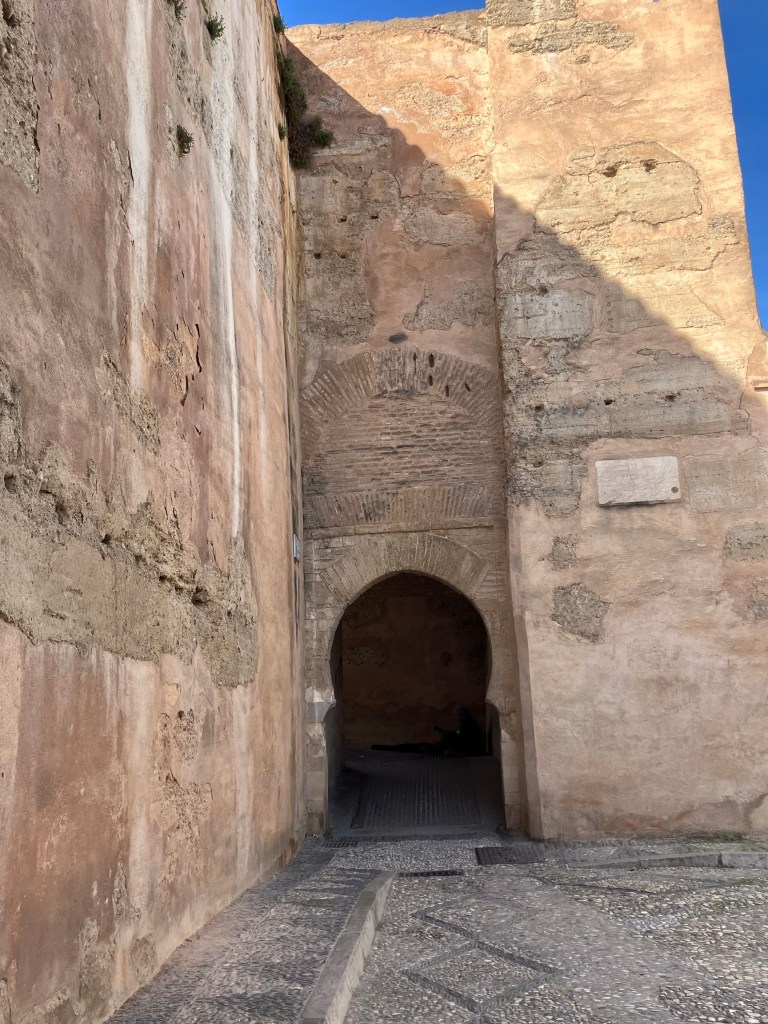
The hill becomes a little steeper but we follow it onwards. Just past the Iglesia Parroquial de Nuestro Salvador (Church of our Saviour) we bear off to the left into Calle Panaderos following a signpost towards Plaza Larga. We had previously read this was where some of the old city walls remained and decided to take a look.
Reaching Plaza Largo we found a small market which was beginning to close down and in the far left we finally spotted a stone archway which would take us through the old wall.

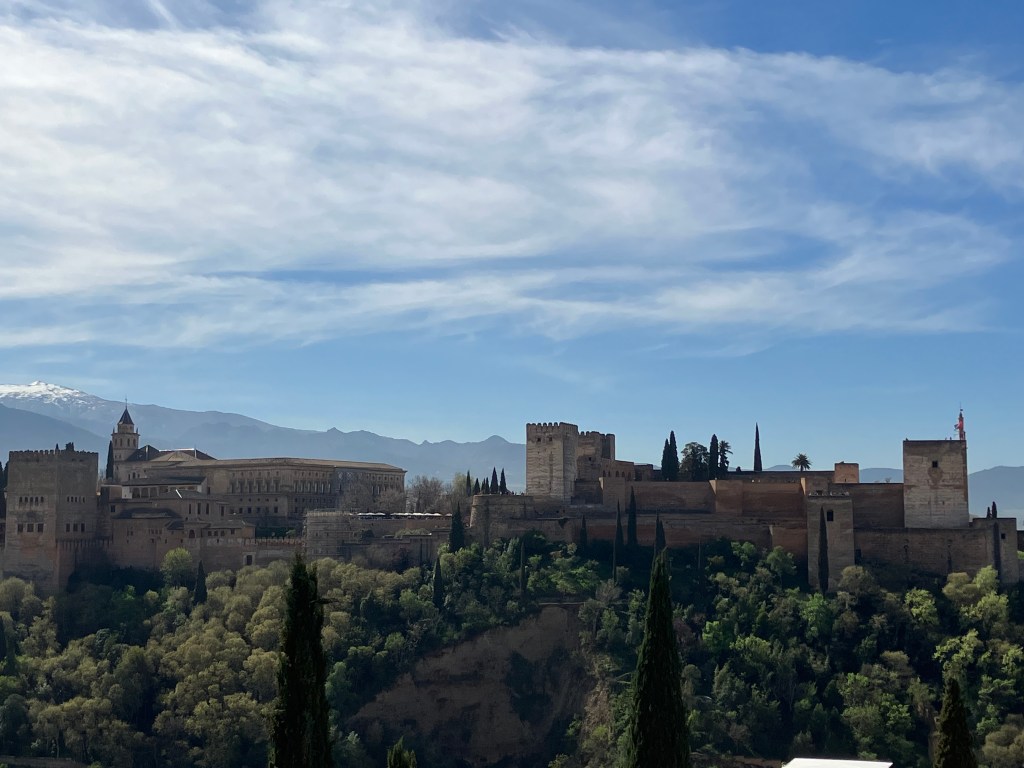
We found ourselves at the back of the Church of San Nicolas. As we came around the side of the church there before us was an unforgettable panorama. We had chanced upon the Mirador de San Nicolas.
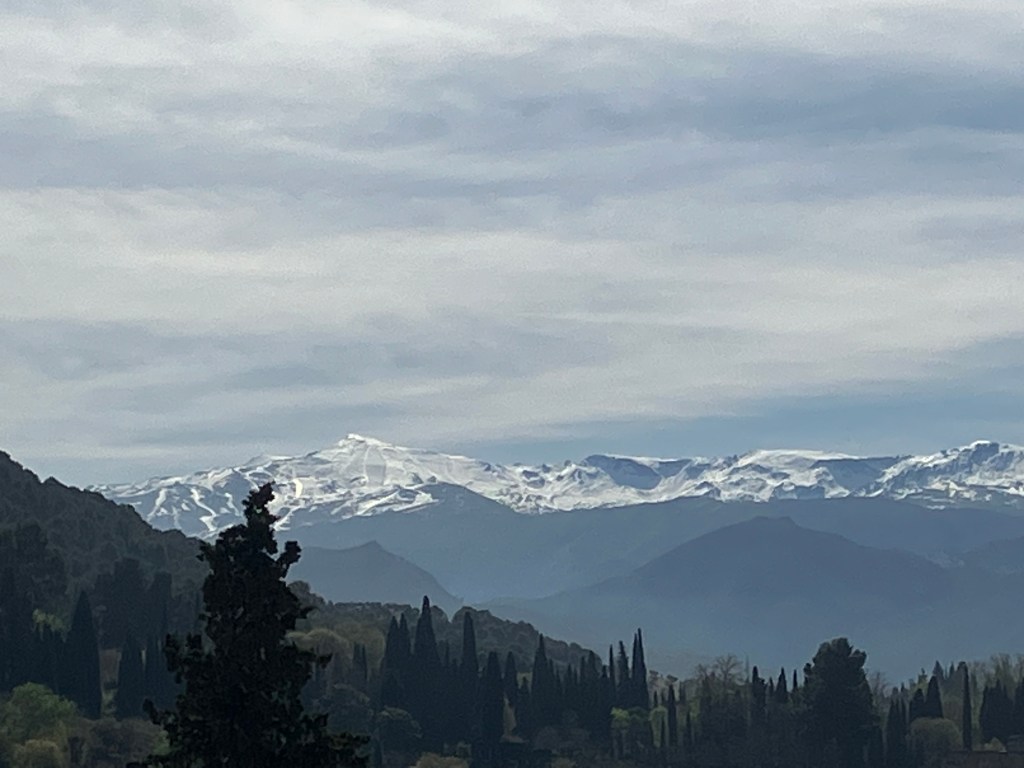
I honestly could not believe my eyes. The whole of the Alhambra Palace was laid out before me with the beautiful snow capped mountains of the Sierra Nevada nestled behind. Suddenly everything I had read and seen the day before made sense. The Palace dominated the skyline, leaving everything below in its wake.
There are not many views in the world that you see and know are going to stay in your memory forever but this is one of them. It probably ranks in my top three!
Finding a vacant stone seat and ignoring the crowds I settle down and just stare in front of me. I feel at peace.

NB:

This is my second post about our stay in Granada on our tour around Spain. Granada is a beautifully unique city. Why not read my first post and then catch up on our journey around Western Europe?