Weston-Super-Mare -The Great British Seaside

Like most people in England, at the moment, I’m wondering whether climate change has finally hit the country hard. The rain just doesn’t seem to stop falling! In fact rainfall over England in the last six months has been the wettest on record.

The average UK winter has become around 1C warmer and 15% wetter over the past century, new Carbon Brief analysis shows.
This analysis covers more than 100 years of data on temperature, rainfall, wind speed and snow, to assess how UK winters have changed.
The data shows that extremely warm and wet winters are becoming more common. Six of the ten warmest winters on record were in the 21st century, and four of these also rank in the top ten wettest years on record.

As a consequence of all this rain it feels like Spring has not sprung! Here we are starting May, the third month of Spring and only now are we seeing some warmer weather.

With the first rays of sun finally poking through the sky we ventured down to Weston-super-Mare in North Somerset for a nostalgic day out at the great British seaside.
We parked at the Uphill beach car park in order to be able to walk the full expanse of the beachfront. Weston is famous locally and even sometimes nicknamed Weston-Super-Mud because of how far the tide goes out. It has the second highest tidal range in the world, only being beaten by the Bay of Fundy, located in Canada, between the provinces of Nova Scotia and Brunswick.
The town’s name is made up of two Old English or Saxon words meaning the west tun or settlement. Because there are several places called Weston in Somerset descriptions were added to tell them apart. Super (with small s) means on or above, and mare is Latin for sea.

The weather forecast didn’t include any rain but alas it wasn’t correct yet again and during our first venture across the sandy bay we soon got caught in a downpour.
The extensive beach is incredibly clean despite often featuring in the Top 10 Dog Friendly beaches in the UK. Dog walkers at Weston are evidently very careful and happily clean up after their pooches.
Dogs are not allowed on the area of the beach between the Grand Pier and Royal Sands from the start of May to the end of September, but are free to go on the rest of the beach.

The views out to sea are quite captivating with Bream Down off to our left and Steep Holm island in front of us.
Whilst visits can be made to the island from Spring to Autumn organised by the Trust who now own it, the island is now uninhabited, with the exception of the wardens. It is protected as a nature reserve and Site of Special Scientific Interest (SSSI) with a large bird population and plants including wild peonies.
Just tucked off behind and to the right of Steep Holm is Flat Holm. This island is just four and a half miles from Cardiff, the bay of which we can spot on the horizon, but the island itself is only half a mile wide. Flat Holm is designated a Site of Special Scientific Interest and Local Nature Reserve. Run by Cardiff Council, the Flat Holm Project conserves the island’s natural and cultural features, from maritime grassland to Victorian barracks, from seabird colonies to wartime bunkers. There are pre-organised boat trips to the island that depart from Cardiff several times a month. The trips allow you up to three hours on the island, depending on tide times. Longer stays, retreats and workshops are also available.

Walking on across the sand there is no sign of the donkeys for which Weston is also famous. Donkey rides have been available since 1886 in Weston Super Mare and certainly feature amongst my childhood memories. The tradition started in Victorian times, but is now much less popular.
When I was a child Weston was my local seaside resort and my Mum would organise day trips by coach and on occasion, when money would allow, even a whole week away at Weston during the summer. Weirdly I never remember it raining. My memories are just full of hot summer days.
Being fair of skin my Mum used to slather us with suntan cream, pay to hire a couple of deck chairs (my sister and I had to share one) and the day would be spent building endless sandcastles, trips in and out of the sea and picnics complete with sand in my sandwiches. As we became older we were permitted to go to the ice cream kiosk alone for an obligatory cone with a flake. Then as late afternoon drew in we would pack up our belongings and head off to the nearest chip shop for our fish and chip supper, eaten out of old newspaper of course whilst sitting on the cold concrete balustrade watching the tide come in.

I often smile at today’s coffee culture and reflect back on those seaside trips when tea came in a flask and not out of a cup. On the odd occasion that we were on holiday for a week my Mum would walk along the sea front in an attempt to find the cheapest cup of tea for sale at a cafe. Children didn’t drink coffee back in those days, it was tea or maybe as a treat pop. Mum would honestly turn in her grave at the prices now charged at Starbucks, Costa and the like!

The pier, although clearly visible from the onset of our walk is about two miles on from our starting point. No visit to Weston or in fact any British seaside resort is complete without a spin on the slot machines. We pay our pound to enter the pier and venture out to the Grand Pavilion at the end. The pavilion has, in fact, been destroyed by fire on two occasions, in 1930 and 2008. This latest version was opened in October 2010 having cost £39m to rebuild.

It is, in fact, one of two major piers in the town. Birnbeck Pier, known locally as the Old Pier is situated further along the coast beyond Knightstone Island and was built between 1864 and 1867 some 37 years before the Grand Pier. Birnbeck is a unique structure, being the only British pier that links the mainland to an island. It unfortunately closed in 1994 and now stands derelict.
Thirty years later this old pier is starting to make a comeback. Purchased by the local council in 2023, architects and engineers were appointed in September 2023 and restoration work is planned to be carried out in phases between 2024 and 2027. A planning application for the first phase was submitted in April this year.

Back on the Grand Pier which features indoor rides and arcade machines year round as well as the ubiquitous candy floss stall, ice cream kiosk and a tearoom also has a land train during peak holiday season. The attraction for us today, along with being inside out of the less than hot weather, is a trip down memory lane on the old two pence machines. Like all those around us we slip out two peas into the slots and watch them whisk themselves down the tube to the moving step at the bottom. The knack is to ensure your two pence falls flat on the step so when the machine next pushes all the coins forward your two pence falls down onto the step below. This is turn is then pushed forward in the hope that the coins on the step all move forward releasing those teetering on the edge of the bottom step to fall off and into the tray below. It’s hard to believe that all these years on these machines are still in popular given the movement of arcade machines towards ever more modern equipment in line with games played at home on X-boxes etc.

Hubby, who has far more experience than me on these machines, having been brought up within easy travelling distance of Southend-on-Sea, another large seaside resort on the Essex coastline soon hits the jackpot and loads of paper of tickets start flowing from the machine he is playing. Whilst he gathers up the reams of tickets I try and find an attendant to discover what we actually do with these tickets. We are directed upstairs to the gift/prize shop. I can’t believe like two excited school kids we are rushing upstairs to spend our bounty!
Despite having 600+ tickets we soon realise our only option is to exchange them for sweets. But laden with several white mice, maom packets and a couple of large sherbet lollies we still leave the arcade happy and feeling as if we have won something.
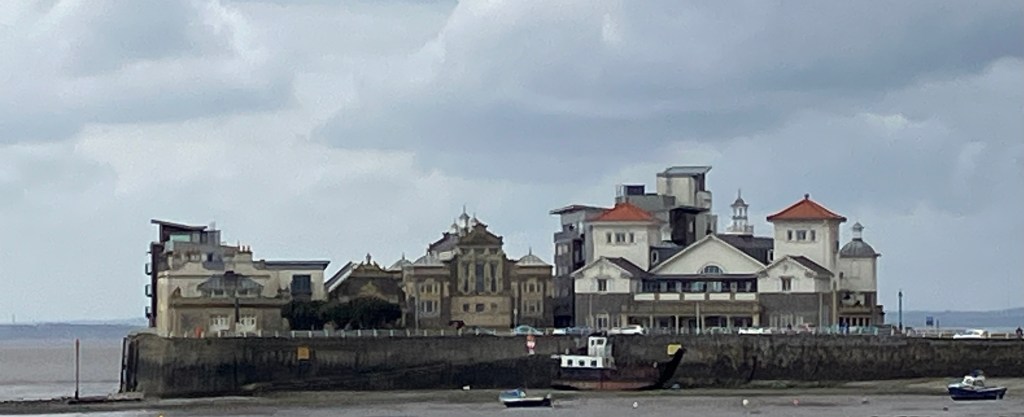
Turning left out of the pier we head towards Knightstone Island and Marine Lake. This is a lovely little part of Weston seafront. Knightstone Island was the location for Weston’s first purpose-built seawater baths. A public pavilion, theatre, and swimming baths were added in the early 20th century. it was underused for many years and when I used to visit as a child, I don’t remember much about it. The buildings were then revived in 2007 with the whole island being redeveloped primarily as flats and offices.
As noted on their website “Marine Lake is nearly 100 years old, it was originally equipped with a diving stage, rafts, rubber boats, water chutes, and children’s paddle boats. There were hundreds of bathing tents and dressing enclosures to protect bathers’ modesty. When it opened the lake was an instant success, being used by more than a quarter of a million people during 1929.
It still offers a safe and clean method to swim whilst visiting Weston seafront. At its deepest point it is about 15 metres deep but it varies according to the tidal height. Occasionally the whole Lake will go underwater. If you look carefully at the sea walls along the lower walkway you can see the height markings.”

I still get an odd bolt of happiness going across the walkway. For some bizarre reason it always takes me back to RE at school and the story of Moses parting the sea.
Reaching the other side if you turn left you can make your way around to the old Birnbeck Pier but with tummies rumbling we head off, instead, to “Papas Fish and Chip” shop. Highlighted on a programme we watched featuring Pam Eyres called Cotswolds and Beyond we felt that a day out at the seaside wouldn’t be complete without finishing it off with a fish and chip lunch. Papas was founded by Photio’s Papas in 1966 and boasts many other seaside outlets around the UK.

We chose to sit in the restaurant rather than to pay for takeaway, purely because we felt in need of a rest and the wind on the seafront was beginning to blow. We couldn’t fault the service, staff or food and on leaving we were ready to walk back along the seafront to the car.

There are many seaside resorts around the coast of the UK we have visited on our travels. We’ve walked from Ramsgate to Margate down in Kent and revisited Southend in Essex when Jamie Oliver was making his programme “Jamie and Jimmy’s Friday Night Feast” . Southend boasts the longest pleasure pier in the world. We popped into the seaside and university town of Aberystwyth when visiting West Wales, stopped off at Saltburn by the Sea in North Yorkshire en route from York to Edinburgh and spent a weekend when we first met down in Brighton. These are only a few memories that I’m mentioning here. The point is we live on an island and the seaside is such a great part of our traditions, it’s worth making the effort and paying a visit.
Retirement -How Do You Get It Right?

Whenever I thought about retirement when I was younger and it seemed a long way off, I just imagined a time when work was history and I would be totally free to wander at will. Do what I want, when I want.
However what I’ve discovered is that retirement isn’t that easy.

My first thoughts about retirement occurred when I was 45 years old. Work was getting harder and harder. As a company, and I’m sure we were not unique, people were being lost through natural wastage and not being replaced. I found myself doing more and more and working longer hours.
I worked in an environment ruled by legislation whether that was Health and Safety at Work, Employee Legislation, Health and Hygiene Legislation or more specific laws relating to Customs and Excise and Gaming. Any major change was always accompanied by a one day workshop or if more complicated and in-depth by up to a week away being retrained. Suddenly the internet and more importantly powerpoint displays and email replaced these in person training sessions with missiles of training material displayed on the computer to print off and read or just read and store. There was no interaction and more importantly no one to answer your questions. This was apparently evolution. I began to question for the first time ever whether I wanted to be part of this anymore but with two children depending on me it felt like there was no escape so I plotted my exit. Ten years and counting……
My children by then would be 21 and 23 and, therefore, hopefully off hand. I dreamt of selling my house and buying a two bedroom flat and more importantly a motorhome. Off I envisioned going, in my motorhome, to explore initially the UK and then Ireland and ultimately Europe and beyond. That dream kept me going until two major changes occurred. Firstly I left my career before my planned retirement and secondly five months after this I met my now husband.

I retrained and began a new work life in a completely different arena ultimately working for myself. However it became so successful that hubby and I became like passing ships in the night and never really saw each other except sometimes at weekends. As a result with very little notice we booked a week off and took ourselves off to Cornwall to take a breather and to dedicate one entire day to the future. Could this current lifestyle continue? Were we happy? How could we change it?
Completely out of left field we realised we could survive without my income and that my pension pot could temporarily remain untouched whilst hubby worked for another five years to pay the bills. His financial contribution over those five years meant that this money combined with his pension pot was nearly in line with my own and so, with just two weeks notice to my clients, on February 19th, only six days after I had originally planned to retire all those years ago, I stopped working.

I had no plan. I’d not thought about what I was going to do as a lady of leisure. Suddenly it had happened and my paid working life was behind me. The lists that had ruled my life in order to keep me on track both at work and at home could perhaps now disappear.
Initially it felt like being on holiday but this feeling soon wore off. There was an element of guilt that he was going out to work each day and I was at home. There was that old fashioned view in my head that now I wasn’t working I should be filling my time being a dutiful housewife so he could come home to a home cooked meal, a neat, tidy and clean house and that I was somehow accountable to him for my time.
Instead of ditching the “to do lists” I found myself filling my time with them. Tasks that I’d always meant to do when I was working but never got round to. Those jobs when you are working where you say to yourself “oh I’ll do it on my next day off” or “When I have a week off from work I’ll get that done”. But you never do get them done because life is already hectic enough and weirdly when you get time off you actually want to spend it being happy and enjoying yourself.
It began to feel like I was working at home for no pay. After six months this all came to a head and I actually began to talk about going back to work.

Just as we were beginning to unraffle all these feelings, life took another turn when my sister became ill and I had to take on her care. Suddenly my time was being filled travelling up and down the motorway, ensuring she was fed and comfortable whilst picking through the end of her ten year relationship and securing her somewhere new to live. Time at home was spent chasing the social services, mental health team and learning about her ailment -disassociative amnesia, which I’d previously had no knowledge of. Professional support was sporadic and I found myself falling back on my management skills to devise strategies and implement aids to make her daily life easier and of course there were the inevitable lists. I didn’t want to “drop the ball” so to speak balancing her care alongside our life at home.

Fast forward eighteen months and Covid took over the world and suddenly both hubby and I were at home and our lives took on another new dimension. In terms of my retirement it forced me into relinquishing some of the responsibility for my sister as I couldn’t visit so she had to take more care of herself, within a supported style living environment, with me solely on the other end of a telephone.
Hubby returned to work after three months but Covid rolled on with the final lock down releasing us back to normal life another thirteen months later.

I did manage to take up some exercise once local leisure facilities reopened but with a wedding to plan, that had already been postponed twice due to Covid, the lists came back into play. Returning from the honeymoon having decided that we should head off travelling for six months in less than a year’s time, the lists came back again. “Microsoft To Do” was my fallback zone. Add it to a list so you don’t forget Tina!

Wedding and honeymoon over and travelling complete, hubby then retired. Suddenly we were both at home full-time. It felt odd. The reality of retirement seemed to be staring me in the face. We planned to go out once a week to enjoy ourselves and revel in this new found combined freedom but the weather or some other seemingly urgent task meant we didn’t have time and the lists kept being ticked off.

Roll forward to hubby’s recent serious illness and it was as if nature was once again taking control and making me take stock. With hubby in hospital all those things to do on those lists were suddenly my sole responsibility. Trying to balance visiting him which took a minimum of two and a half hours a day, maintaining my exercise schedule to help my own health issues, keeping on top of everything at home whilst also ticking things off the “to do lists” very quickly became a strain. It was as if once again the universe was talking to me and telling me something needed to change.
What happened next sounds so simple but whilst hubby was in hospital I took myself off to visit a friend one Sunday. Whilst we had worked in entirely different careers she had also experienced the balancing act of hitting deadlines at work whilst overseeing her home and family and understood “the list” phenomenon.
She is still working having retired for three months and then taken up a temporary position for three months that grew into six months, nine months and beyond. Her one question to me was “who is putting this pressure on you to deliver on these to do lists?” The realisation was “Me”. I was doing this to myself. It was the way I’d worked for nearly forty years. It was ingrained.

When I got home that day it was as if I had truly had an epiphany. One of my philosophies in life has always been “Everyone deserves to be happy and if you aren’t happy then only one person can change that, you!’
Here I was in charge of my own happiness, my own destiny and all I needed to do was change my outlook. Stop using to do lists and just do what I want. I set about condensing the lists, then removing any dates attached to the tasks and weirdly just this process changed my mindset. This wasn’t a to do list anymore this was merely a reminder of things I needed or wanted to do. No one was controlling me. I could actually be retired as I had planned, doing what I want when I want and so six years on from retiring I now actually feel retired. My life is happier, definitely has less pressure and time spent on my hobbies increases each week.

Life is a continual learning curve and there, no doubt, will be many people out there reading this and thinking “Why did it take her so long to realise this?” or ” that’s hardly revolutionary”. But I’ve learnt that retirement is an evolution not a revolution. There is no right or wrong way of doing retirement, it’s about creating a new world for yourself that you are happy with. That allows you the freedom, having shaken off the shackles of work, to be happy in your own new world.

I do appreciate that some people would consider us lucky to have visited the places we have already and done some of the stuff we’ve done. But we are not lucky, we were just sensible. Money buys you freedom and we both worked hard to pay into a pension fund so that we didn’t have to rely solely on the state pension. The UK OAP pension scheme doesn’t pay us out anything until we are 67 and yes it, on its own, will give you freedom from work but not necessarily happiness and a stress free lifestyle.

The lesson that the universe has recently taught both hubby and I is one we thought we already had under our belt ” life is not forever”.
When you are listening to a heart surgeon tell you “had you not collapsed you would never have had these tests and you would never have known about this anomaly you have with your heart and in two years, three years tops you would have collapsed and died” is a sobering, some would say, life altering moment.

It makes you stop in your tracks and really ask yourself the question “If this is your last day on this earth, what would you regret?” It sure as hell isn’t that you failed to mop the kitchen floor today or forgot to empty the dishwasher. It isn’t the wall you never got around to painting in the bedroom or the lawn that never got mowed on its two weekly schedule. It’s missing out on what makes you happy. It’s not being able to create any more memories with the people you love. If you are like us and enjoy holidays and travelling, it’s running out of time to tick off all those places you wanted to visit and explore.


The Cotswolds – The Gardens of Blenheim Palace

On the far right or Eastern side of The Cotswolds, only nine miles from Oxford, is the wonderful English Baroque Palace of Blenheim. It is the only non -royal, non -episcopal country house in England to hold the title of a Palace.
Sited adjacent to the village of Woodstock, which in itself is worthy of exploration given it was mentioned in the Domesday Book of 1086, the Palace was built between 1702 and 1722.
Named after the 1704 Battle of Blenheim it was originally intended to be a reward to John Churchill, 1st Duke of Marlborough for his military triumphs against the French and Bavarians in the War of the Spanish Succession which culminated in the Battle of Blenheim and the Palace has housed the Marlborough dynasty ever since.
 It is currently the home of the Twelfth Duke of Marlborough, Charles James Spencer-Churchill. Historically the Palace was also the birthplace and ancestral home of Winston Churchill, whose father Randolph Churchill was the third son of the 7th Duke of Marlborough.

With the sun finally making an appearance following what feels like months and months of rain we utilised our annual membership, received as a result of tickets purchased for their Christmas Light Show back in December 2023, to visit. Our original plan was to explore both the interior of the Palace and then its grounds.
We discovered, however, the day prior to our visit that the Palace was closed due to filming commitments. This is not a rare phenomenom. In fact a survey in 2021 noted that Blenheim made 71 appearances in film and television, more than for any other English country house, so it is worth checking their website before making plans to visit.

Armed with a paper leaflet complete with map we were quite happy to walk off our lunch purchased at the onsite Oxford Pantry which sells salads, sandwiches, hot savoury snacks, hot and cold drinks and wonderful cakes. We do love a cake!
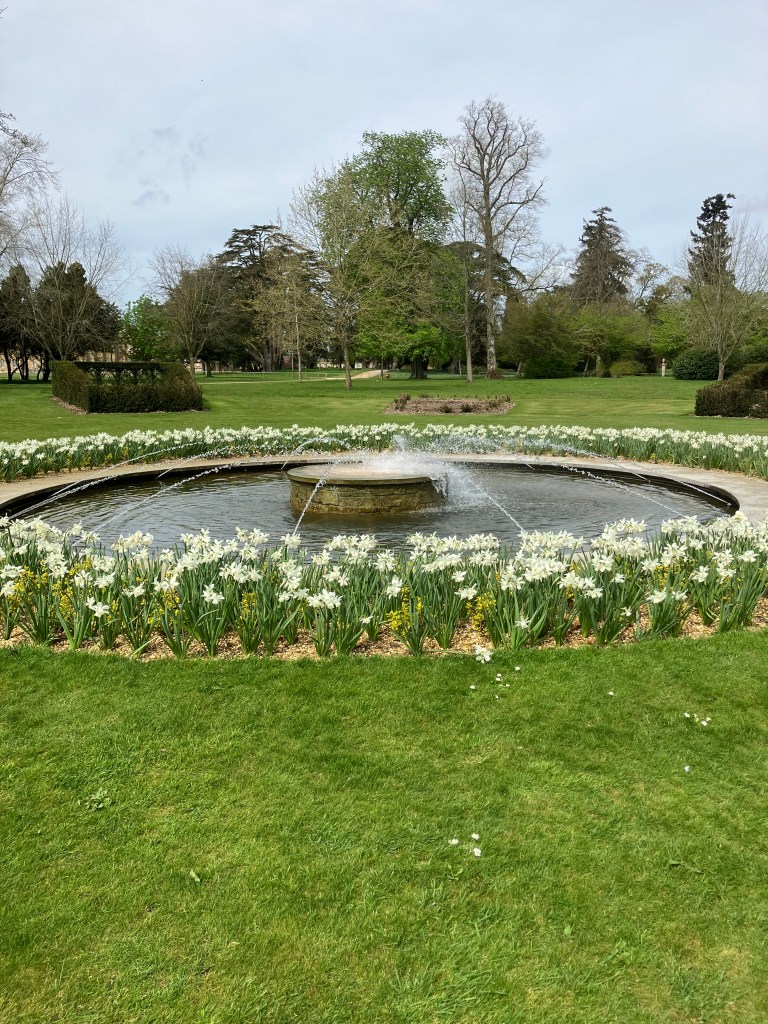
We began our wander of the extensive grounds, which cover 150 acres, with an exploration of the Formal Gardens walk and it wasn’t long before we came across The Secret Garden.

Designed originally as a private garden for the 10th Duke of Marlborough it is now open to the public. Despite the multitude of cars we had seen and experienced on arrival the gardens appeared, on the whole, to be pretty empty. This gave us the opportunity to sit and really enjoy the peace and tranquillity that this small oasis allowed. We would have quite happily sat and read a book in the sunshine had we come prepared.
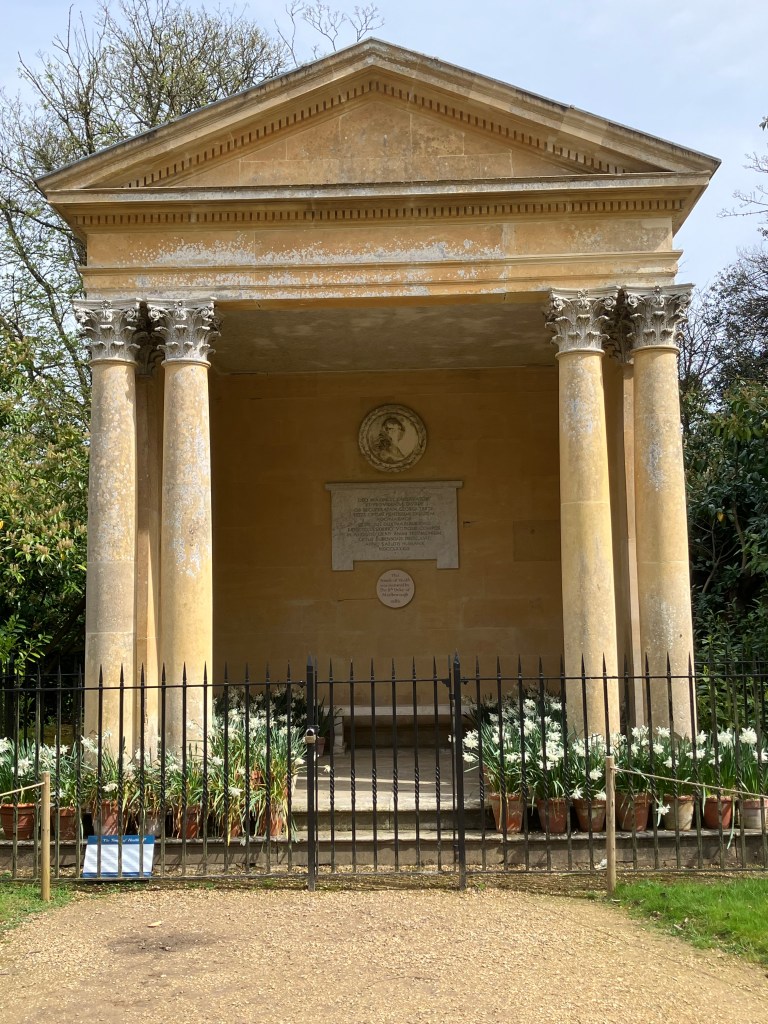
Leaving the Secret Garden behind we walked onto the Temple of Health. This Corinthian temple was designed by John Yen and built in 1789. It celebrated George III’s recovery from illness.

Branching off on a slight tangent we ventured off to the left and entered The Walled Gardens. This immense kitchen garden surrounded by a 14 ft high wall to protect the fruit and vegetables from hungry deer is one of the original features of the Palace Gardens designed by Henry Wise. Today this area incorporates the Butterfly House which opened in the 1980’s and is home to many species from around the world. Refreshed this year they have endeavoured to make it an even better environment for both the tropical butterfly species present and the zebra finches.
Spring flowers abound including Amaryllis and Fritillaries which happily sit alongside exotic plants from Africa, Madeira and South America. There is a greater emphasis on tropical fruits including pineapple, mango and papaya for the butterflies’ diet, to closely resemble what they would eat in the wild.
Alongside the Butterfly House you can also visit The Lavender Garden which has been specifically set out to enhance the native butterflies and you can spot plenty of nectar enriched plants growing here.

The final highlight of this area is the Marlborough Maze, the world’s second largest symbolic yew hedge maze. Two miles in length and made up of hundreds of yew trees, the design was inspired by the history of Blenheim Palace. We decided to give it a miss on this occasion but will definitely come back here on a future visit and hope we don’t get lost and can find our way out.

Exiting the walled garden back through the same way we had entered, we made our way to The Roundel. This was originally a statue, but was converted to a water feature in 2012. Another lovely place to sit and rest awhile or to unpack your lunch and take a break.

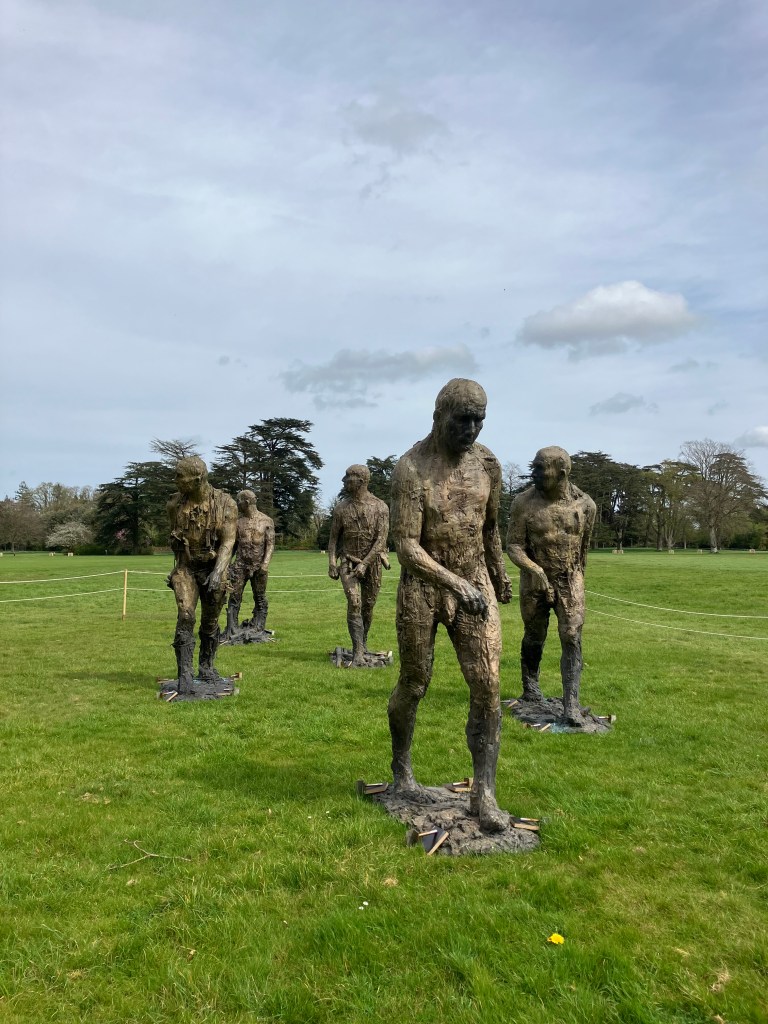
Heading past the South Lawn with a beautiful view of the Palace off to the right we came across a recent installation -“The Walking Men” figures. Cast in bronze by British sculptor Laurence Edwards they made me feel like they had somehow been born from the Palace lawn. Astonished and confused with branches, leaves, and clods of clay woven through them the leader is hell bent on escaping the area whilst the final figure of these five, eight foot Neanderthals is mesmerised by the Palace and lags behind .

Reaching a crossroads we opt to go left and follow the Lake Walk. It is less than a mile in length but takes you down past the Rose Garden and arboretum. The former is unfortunately currently shut , no doubt in preparation for the summer display. You can branch off to the right and actually walk through the trees but we opted to remain on the path and visit the Grand Cascade and Pump House. Designed by the famous landscape architect, Capability Brown, in the 1760s the flow of the River Glyme over the cascade is augmented by pumps.
I love waterfalls, there is something about the water thundering over the rocks and down stream, the natural and sheer scale of the water’s power forming foamy islands below that entrances me. This is definitely another place to take a few minutes rest or if you haven’t done so already to unwrap your lunch.

The path then meanders back up the hill past the Boathouse which only opens seasonally and looked a little dejected on our visit. The remaining formal gardens soon come into view and we stopped to admire The Water Gardens. These, along with the Italian Gardens next door, were created by the French landscape architect Achille Duchêne who was employed by the 9th Duke of Marlborough. His marriage in 1896 to wealthy American heiress Consuelo Vanderbilt, allowed him to make further changes in and around the Palace. The Water Gardens were begun in the late 1920’s and involved moving many tonnes of earth to create the two terraces complete with statues and topiary which we admire today.
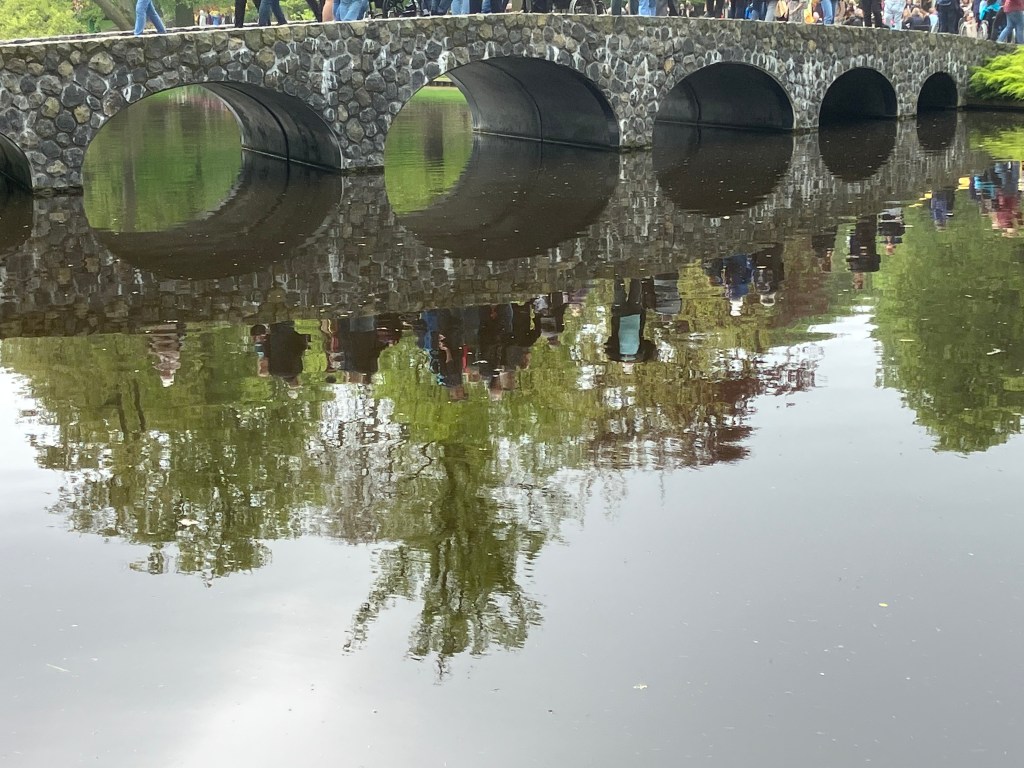
The 10th Duke added moving water to the Water Terraces by creating fountains in the basins of the upper terraces.

I am a big fan of beautiful gardens such as this and really enjoyed our walk. I did capture the spring flowers in bloom with cherry blossom, daffodils, cowslips and even bluebells starting to make an appearance.


Whilst the map details the distances of each trail we actually walked four miles. We have a tendency to wander off piste to admire the flora, fauna and additional statues etc. This contributed greatly to “Project Knee Recovery” -see previous post (New Year’s Resolutions Have Come Early This Year!).
Walking whilst being able to admire the views etc always makes the miles evaporate. We will return to Blenheim during the summer in order to view the interior of the house and more of the gardens.

NB: This is the eighth post in my series about the wonderful “Cotswolds”. An area that you really shouldn’t miss out on visiting if you are coming to the UK. It’s full of olde world charm, history going back to the Roman era and beautiful architecture. Check out previous posts in this series plus more to come soon. 
Please don’t forget to comment and/or like. I love to hear what my readers think. and also look forward to your recommendations of places to see in the Cotswolds for my future adventures Thank you

Thank you

The Cotswolds: Shopping in Burford

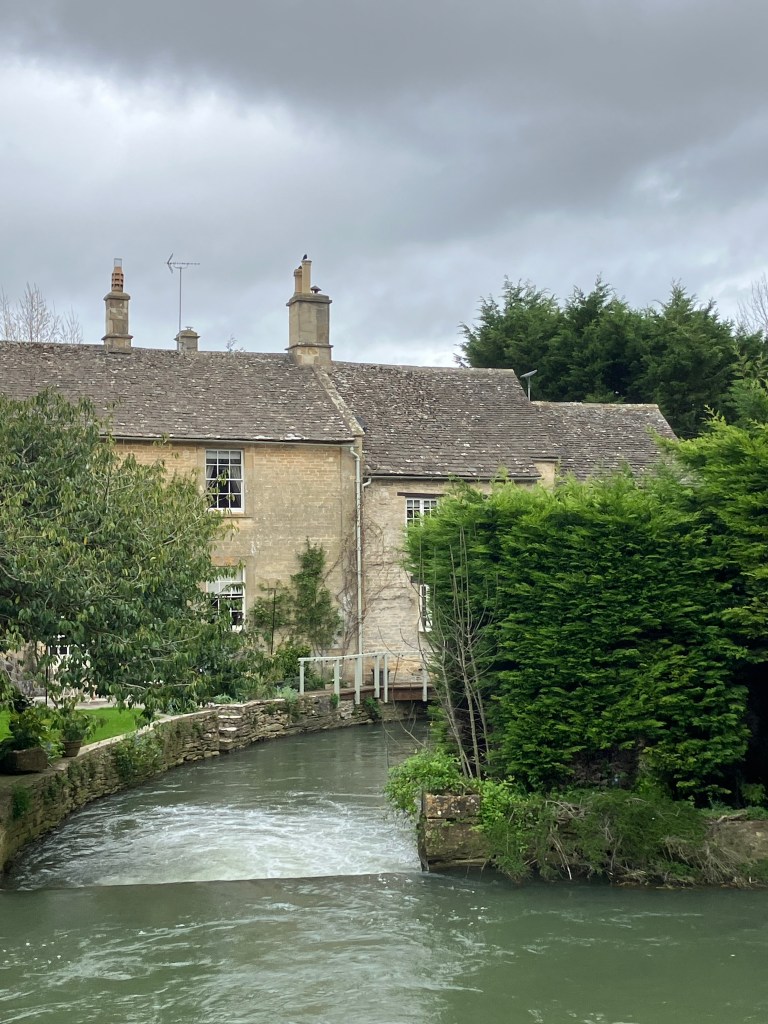
Burford sits on the River Windrush, just inside Oxfordshire.
The Cotswolds cover 800 square miles and is the largest Area of Outstanding Natural Beauty ( AONB) in England and Wales.
Burford sits at the Eastern edge of this area and is quintessentially Cotswold with beautiful honey coloured houses, dating back to the mid Saxon period, between the 5th and 11th centuries.

We travelled in from Gloucestershire but it is also easy to reach from Oxford being only 18 miles west of this university city. Parking is free – both on the street and in the public car park. Parking on the East side of the High Street is limited to 2 hours but there is no time restriction on the West side of the High Street. We parked on the left side driving in from the A40. Be prepared for it to be busy, this small town is popular with visitors and locals alike.

Burford, from a shopping perspective, is primarily made up of one street but don’t be fooled into thinking there won’t be much to see because this small town definitely packs a punch when it comes to browsing the shops. Considering how much the High Streets in England are generally on the decline there is little evidence of this here with a great variety of independent shops to choose from.


We began our explorations at the La Bulle. This beautifully laid out fashion accessories shop specialises in Italian leather bags at affordable prices and that wonderful fresh leather smell greets you as soon as you walk through the door.
Their new Eden Cross Body bag comes in at a very reasonable £39.95 in a variety of colours. There is no heavy salesmanship either, instead just a cheery “Hello” as you enter, some great quotes on the walls whilst you are browsing and a “Thank you” when you leave.

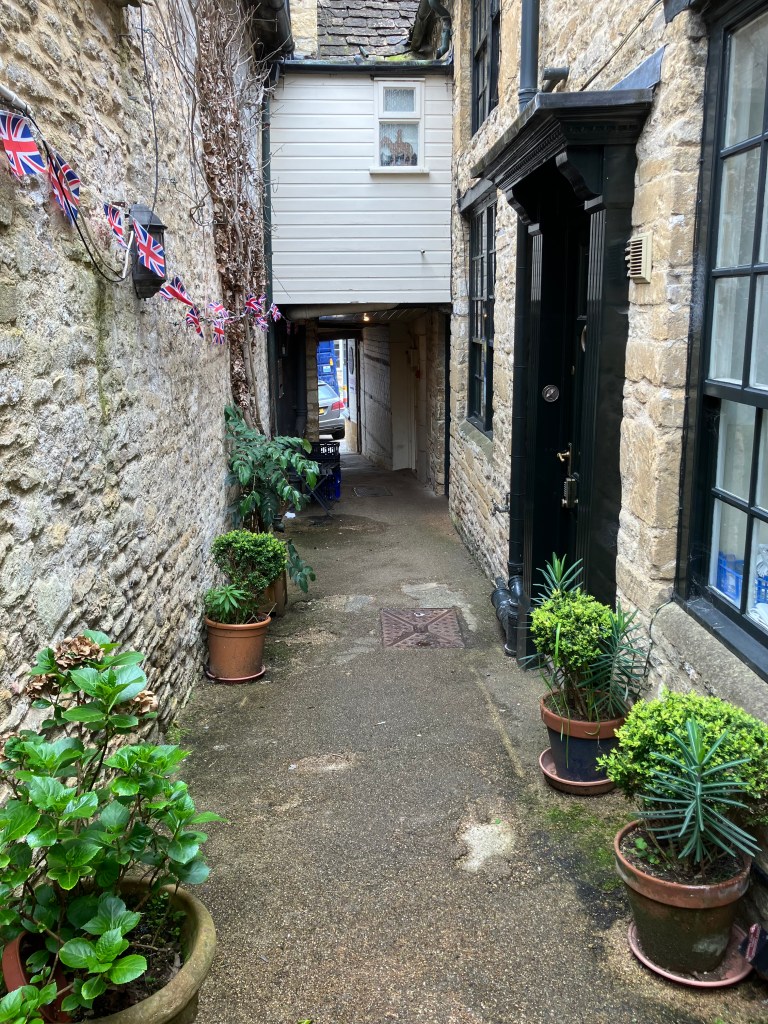
Keep your eyes peeled as you wander down the High Street as there are a few small alleyways that meander away from the Main Street that are worth exploring architecturally.

We passed by The Tolsey Museum, which is a museum dedicated to local history and housed in a Grade II listed Tudor style building, that was formerly the market and town hall of Burford.


Our next stop was instead The Madhatter Bookshop.
Anyone who knows me or has read my previous posts knows I cannot walk past an independent bookshop. Whilst most of my reading these days is on my Kindle, more for ease of transportation, I always like to support local businesses and particularly bookshops that were greatly effected by the evolution of the giant monster that is Amazon.
The Madhatter arrived in Burford some twenty plus years ago, whilst it’s current owner -Kim took up the mantle fives year ago just before the pandemic! The shop, itself, is cosy and inviting. It’s not huge but don’t be afraid to chat to the Assistant because even if they don’t have what you might be looking for or maybe don’t know what you want and need some help or guidance, they have a wealth of experience and are more than happy to help including ordering a book and having it delivered to your home address.
Additionally they hold Book/Bar evenings and a virtual “Book Club” that you can join wherever you are in the world!
Kim is also the founder of the September Burford Literary Festival which delivers a range of chats and talks. As Kim says on her website “Events take place in bijou rooms with their own special ambience. Numbers are kept small and personal to enable events to feel like a conversation between author and audience.” So if literacy is your thing why not include a visit to Burford while the festival is on?
On a final note don’t leave the shop before checking out the literary range of handbags, they are truly unique.

Leaving the bookshop behind we crossed over Sheep Street, which is home to various inns and places to stay, and made our way past Huffkins. This Cotswold tearoom is well worth a visit if you are looking to have elevenses, lunch or afternoon tea whilst visiting. We have been here before so didn’t stop today.
It’s been here since 1890 and has developed across time, producing such pleasurable cakes, and sandwiches etc that the business has expanded to envelop another eight tea rooms including locations in London.


A little further on, just down one of the side alleys I spoke about, our next stop was Craft & Curious. This pottery painting studio offers hand made, hand painted and personalised pottery keepsakes and homeware whilst also selling anything Christmas, year round! If you like to spend time doing something “crafty” whilst away for a couple of days it’s worth giving them a call in advance as you can paint your own pottery and they also run “Paint and Prosecco” evenings. I was personally tempted in though by a “gonk” which delivered on a forthcoming birthday gift.
Tucked away in the corner of this alleyway is also “Nutmeg & Thyme” a 100% gluten free and vegan cafe which we will no doubt try on a future visit.
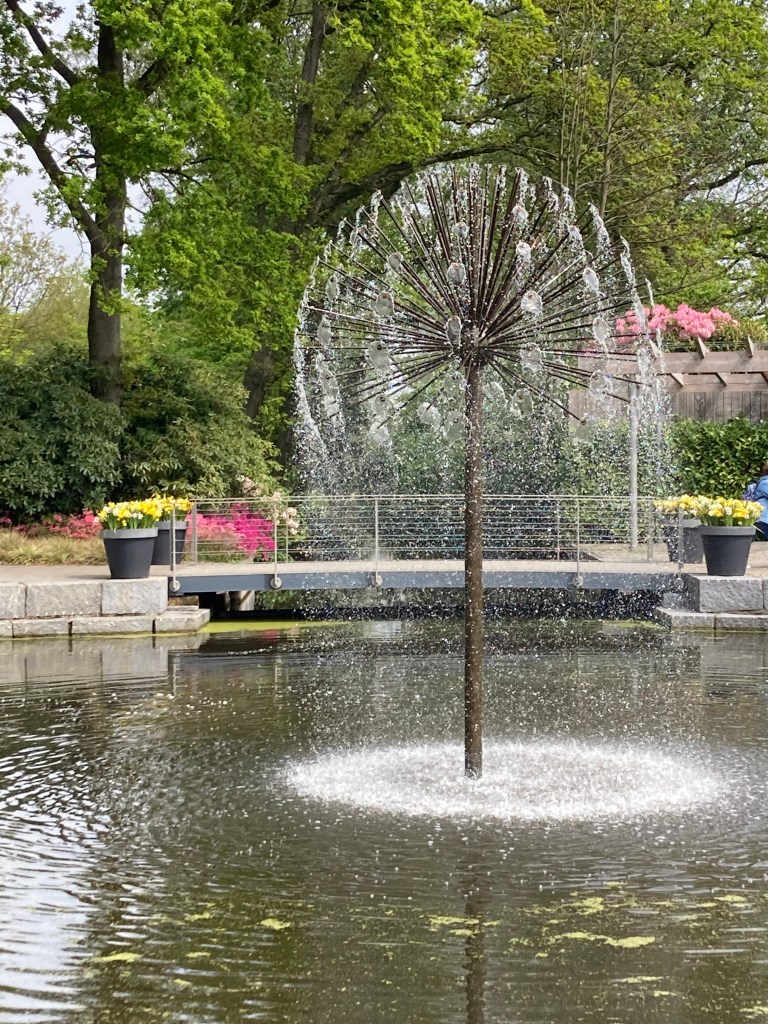
Just past this alleyway is “Burford’s Traditional Sweet Shop”. For over ten years this shop has remained in business tempting it’s visitors into a “sweety wonderland”, with over 200 varieties to choose from alongside local handmade chocolates and gifts.
I love a proper sweet shop, with rows and rows of sweetie jars where you pick your favourite so the Assistant can weigh out 100g or more. Discovering old favourites like Sherbet Dips, Gobstoppers and Aniseed Balls alongside more modern introductions such as Fizzy Cola bottles, Giant Strawberries and Vegan varieties is fairly unique these days when most sweet treats are just purchased from the local supermarket.

Staying on the left side of the road we headed down towards the river stopping off at The Cookshop. I’m always tempted by a shop selling kitchen items. Not your run of the mill superstore style but small and independent, normally stocked to the rafters with unique items that you didn’t even realise you needed!
This shop doesn’t disappoint and I nearly left with a matching pair of beautiful blue hummingbird tins -one for biscuits and the other for cake. They would have looked great on my kitchen island but I was slightly afraid of then filling them with tempting goodies, no doubt full of calories and destroying my healthy eating habits forever!
Unfortunately they don’t have a website. I say this because a couple of the reviews I read mentioned how customers had purchased items whilst visiting and then wanted more of the same range on returning home but then couldn’t facilitate this.

At the bottom of the High Street is the bridge across the river. Take care because even though there are traffic lights to regulate the flow of vehicles it is quite busy. If like me you still want to gaze upon the river below, head to the right of the bridge as there are a couple of inlets where you can stop and take in the views whilst avoiding the traffic.

Heading back up the High Street, on the opposite side, there are some great views to be had of the traditional Cotswold stone houses. I also like to check out the doorways. Some of them are so old that they cleverly display the difference in stature that has evolved over time. Being quite a short person they don’t faze me but an average height person today would probably struggle to fit through!

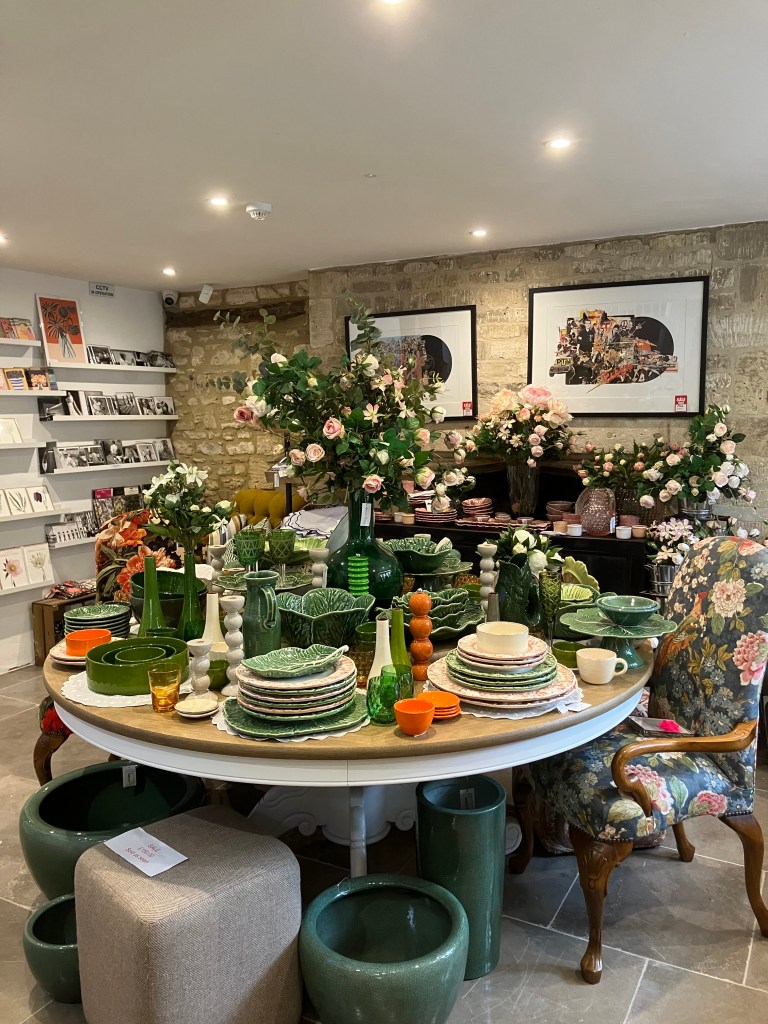
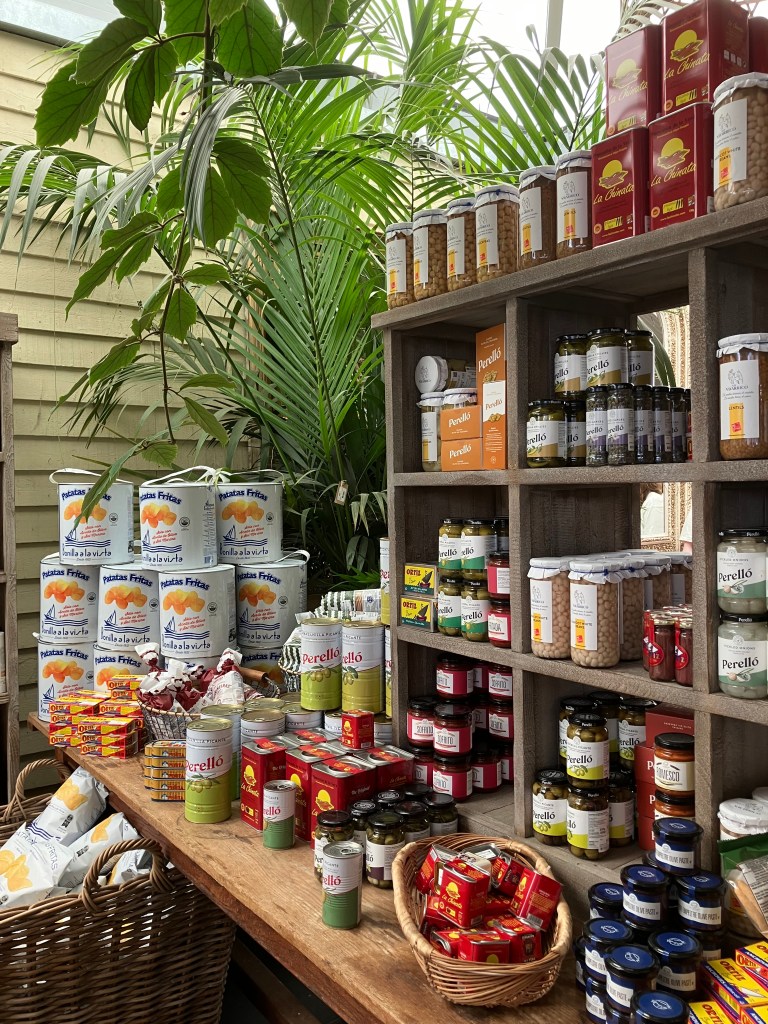
Crossing over Church Street we pop into Hanley’s Lifestyle and Delicatessen. This shop offers “a clever combination of home design, bespoke furniture, cabinetry and upholstery, gifts and accessories, luxury homeware and a delicatessen”, which was the main attraction for us. The freshly baked pies and patisserie were tempting.

We pass by the 17th century building that houses The Priory Tearooms which again we have frequented previously. On that occasion it was a beautiful sunny day and we sat in the nicely laid out gardens at the rear soaking up the sunshine whilst eating a lovely lunch.

We pop into “Three French Hens” gift shop, check out the proverb on their sign, for a quick peruse of their quirky wall notices etc before heading on up the street.
We were hoping to stop at an Antique Centre which used to be housed in the Methodist Church but has now unfortunately ceased to exist as the building is up for sale.


Instead we move on up to “The Burford Farm Shop” and next door “The Cotswold Cheese Company”. The Farm shop is, unfortunately, closed on a Sunday but we normally pop in here when in town as they are part of the “Jesse Smith” group of butchers which I’ve mentioned before on my post about Tetbury.
The Cheese Company, however, is open. Founded 18 years ago, this specialist purveyor of cheese began it’s days in Moreton-in-the Marsh but following its success here, the company expanded to two additional shops -this one in Burford and another in Stow-on-the-Wold. Their shops stock over 120 different cheeses, obviously centred around Cotswold cheesemakers but with other British cheeses available as well as some continental diehards. It doesn’t stop at cheese you can also find fresh bakery items alongside a range of deli products.

Having not eaten all day we left the High Street behind and drove back up to the A40. Taking a left towards Oxford and then the next right turn off onto the B4020 we headed to the Burford Garden Company.
Despite passing this venue many times, as we traverse the country and head towards the M40 in order to connect into London and beyond, we had never ventured inside. Having now visited, the first thing I can tell you is this is not your normal garden centre!

The founder, Nigel Johnson, originally purchased a derelict farm just above Burford and transformed it into a plant nursery. In 1976 Nigel and his wife Louise then extended the idea and created Burford Garden Co. Since then, the company has gone from strength to strength.
It now covers over 15 acres of land, employs over 170 staff in peak season and, contrary to most peoples’ perspective of a garden centre being a large warehouse style cavern, this has an intriguing sprawl of spacious glass houses. These have changed greatly over the five decades since it’s inception, including the construction of behind-the-scenes warehouses and offices that were required to keep Burford Company ticking over.

The car park is huge, laid out with directional signs and with a childrens’ play area at the far end. As you walk towards the entrance you pass a bookshop, garden buildings company and a couple of coffee outlets etc
Inside you will find not just plants for sale but a veritable array of goods. The website proclaims “it has grown into a one-of-a-kind destination store for those seeking a unique, curated mixture of plants, gardenalia, home decor, furniture, art, clothing and food.”

Think of a garden centre fit for Bond Street and you won’t go far wrong. They even have a piano player set amidst the pots and clothing!
There is no doubt that this garden centre caters for the rich and famous that live within driving distance of it’s doors. Unfortunately despite keeping my eyes peeled I didn’t see Mr Beckham or any of his associates!

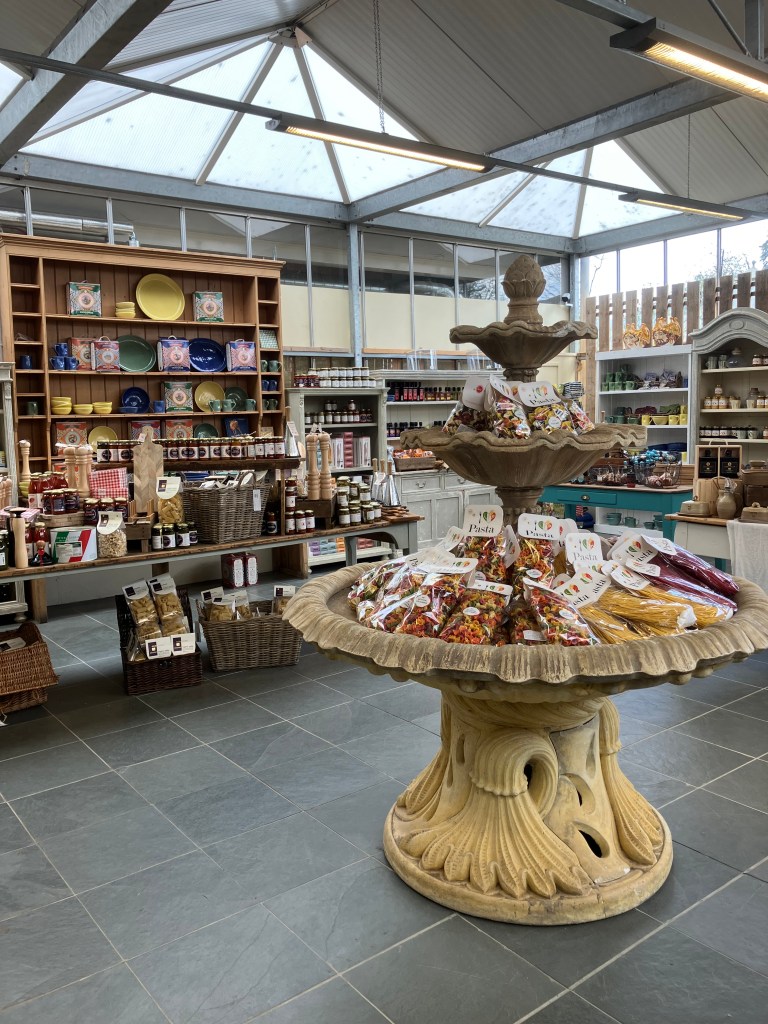
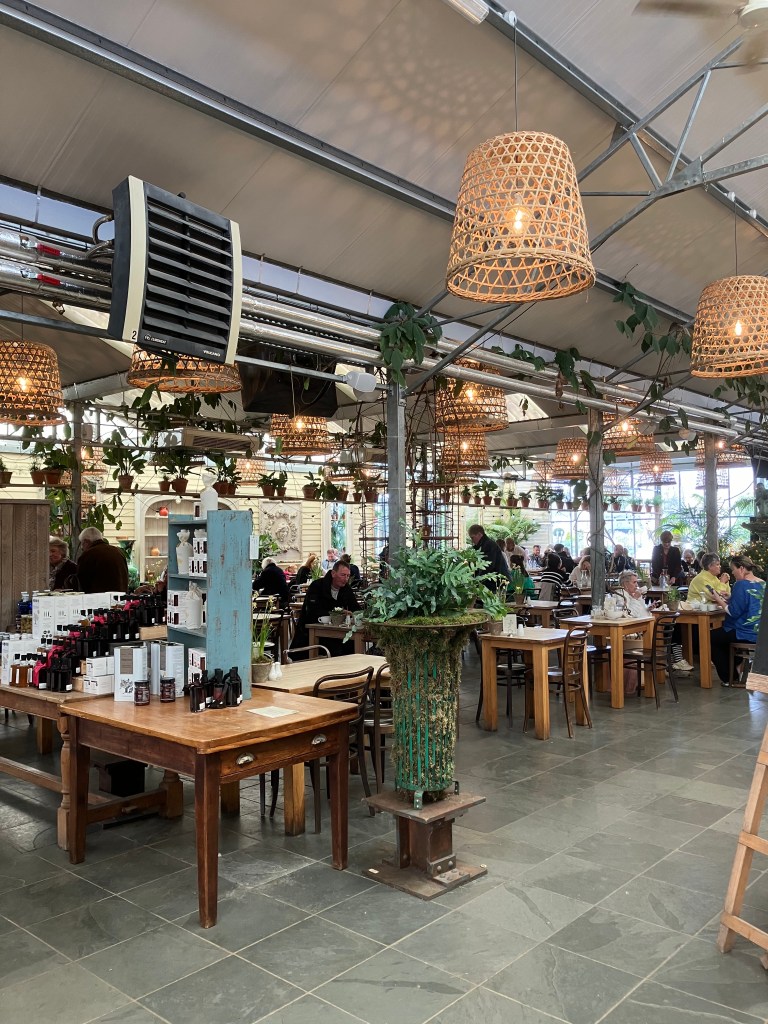
We did, however, buy lunch in their Glasshouse Cafe, which sits at the heart of the centre and offers fresh, healthy food made from scratch. We were impressed by the food but to be honest, perhaps because of its size and position it lacked the atmosphere and coziness we would have found in one of the many cafes and tea rooms in Burford itself.

Burford is a beautiful example of a Cotswold town and I urge you to include it in your itinerary. Spend a morning or afternoon here and you will, no doubt, leave as I did feeling joyous and happy.

NB: This is the seventh post in my series about the wonderful “Cotswolds”. An area in the UK that you really shouldn’t miss out on visiting if you are coming to the UK. It’s full of olde world charm, history going back to the Roman era and beautiful architecture. Check out previous posts in this series plus more to come soon. 
Please don’t forget to comment and/or like. I love to hear what my readers think and also look forward to your recommendations of places to see in the Cotswolds for my future adventures Thank you


Should Zoos Still Exist?

When I was a child going to visit a zoo or wildlife park wasn’t really on my family’s radar. Don’t get me wrong my Mum, Dad and my Godmother all taught us about nature from growing our own vegetables and fruit to taking regular countryside walks.
My children are still amazed when we go out walking and I can name most of the wild flowers, birds and animals we come across.
When I was a child being brought up in the country this was just second nature, excuse the pun.
Crocuses, bluebells and wild garlic welcomed in the Spring, whilst fresh peas, tomatoes and lettuce from the garden meant summer was here and watching the leaves turn colour and drop off the trees heralded the onset of Autumn. Ultimately the absence of hedgehogs and squirrels meant hibernation for Winter had begun.

Our nearest zoo was in Bristol but I can’t remember my Mum ever taking us there. In fact I think my first visit to a zoo was when I was nineteen and my boyfriend -Phil (who I later became reacquainted with 33 years later and subsequently married) took me to London Zoo. It was my first ever trip to our capital city and I remember being amazed by the quantity and variety of animals on display.
That’s an interesting analogy “being on display” because actually on a recent visit to a local wildlife park (from which all the photos here were taken) that feeling that some of the animals and birds we saw were “on display” really hit me.

Having not been to my first zoo until I was nineteen I have more than made up for this since, having visited and then taken my own children when they were young, for example, to visit Bristol Zoo, Woburn Safari Park, Whipsnade Zoo and our favourite in the UK -Chester Zoo. To be honest there are so many animal sanctuaries, wildlife parks, zoos etc in the UK that we have visited I would be here forever listing them all.

On my travels abroad I’ve been to Paris Zoo, San Diego Zoo, Chicago Zoo to name but a few. I’ve also been fortunate to go on safari in South Africa twice.

But this most recent visit to a wildlife park really made me want to look into this idea further. Should zoos still exist?

The actual dictionary definition of a zoo is “an establishment which maintains a collection of wild animals, typically in a park or gardens, for study, conservation, or display to the public.”
There’s that phrase again “display to the public”.

One of the most important functions of modern day zoos, when you read all the literature on their websites, is supporting international breeding programmes, particularly for endangered species. In the wild, some of the rarest species have difficulty in finding mates and breeding, and they might also be threatened by poachers, loss of their habitat, predators and more so today by climate change that can actually bring about starvation through lack of food.
But there is a part of me that feels that whilst this sounds like a worthy argument to keep these species in captivity, is it really? I mean although breeding programmes enable a species to survive it’s not like the offspring will one day be put back into the wild. Surely in the majority of cases they would be too used to human contact? Additionally what right do we feel we have to capture, confine or breed them? If an animal is endangered does that justify us removing its freedom or should nature just be allowed to take its course?

The Freedom for Animals Organisation (freedomforanimals.org.uk) displays some interesting facts and statistics about conservation. By focusing on zoos in Wales, they carried out research which unearthed that just 9% of animals held captive are endangered and 17% are threatened in the wild. Have a look at their website, it makes interesting reading.

Another consideration is that in removing certain animals from the wild in order to conserve them, are we endangering those remaining by decreasing the gene pool and actually causing an increase in depopulation as a result which in turn could lead to an increase in extinction.

It must be incredibly challenging for an animal or bird to be stuck in a zoo. Surely it goes against their natural instincts? Will they ever find real happiness regardless of how much room they have, if inherently they are used to living in the wild? Are we doing this primarily for our own entertainment?
I like so many others have visited Sea World in Florida and sat and watched sometimes in awe as dolphins and whales performed for the vast audiences. I have also been fortunate to experience the joy of watching dolphins in the wild leaping out of the ocean as they swam alongside the boat in the Caribbean or watching whales breach the surface of the water in Monterey, California. I know which I would prefer but like I said I have been fortunate to experience this. Should others miss out because they cannot afford such adventures?

You often still see animals constantly walking back and forth, polar bears spring to mind. These animals in captivity can suffer from boredom and stress. Captivity can in no way compare to being free in the wild. It just seems so against their natural instinct and we even expect certain animals to exist outside of their natural climate. How on earth does an animal which by nature is used to a tropical rainforest manage in a cold, wet, windy English winter?

I can see the benefit from an educational perspective of the existence of zoos. Where else can a school age child learn about this vast array of animals etc and actually see them in the flesh? With the effects of climate change all around us, worldwide, this education also hopefully encourages empathy. Visitors may be more likely to readdress their outlooks and understand better the idea of an animal becoming extinct or may even change their habits to ensure environments currently being destroyed by the human race are saved.
But is this enough to substantiate their captivity?
There is an argument that with more and more technology children can acquaint themselves with wildlife through programmes such as “Planet Earth” rather than visiting zoos. Another option is searching the net for live webcams.
Having visited the elephant seals on the West Coast of California, for example, we became aware of “elephantseal.org” which allows you to watch the beaches live and also has access to Youtube videos and virtual field trips. This is not unusual, numerous wildlife organisations now transmit this type of media. The joy of this type of viewing is even though it is not there right in front of you, it is live and the animals are in their natural habitat.

Good zoos have high standards of welfare for their animals. Visiting an accredited zoo is better than visiting one which isn’t. For example, BIAZA ‘members are dedicated to “achieving the highest standards of animal care, conserving the natural world through research and conservation, and educating and inspiring their visitors.”
BIAZA , founded in 1966, is the British and Irish Association of Zoos and Aquariums; the professional body representing the best zoos and aquariums in Britain and Ireland. “We have over one hundred zoo and aquarium members who pride themselves on their excellent animal welfare, education and conservation work.”
“BIAZA contributes approximately £24 million to conservation projects each year.

Some wildlife centres and zoos even take in abandoned exotic pets and rehabilitate animals back into the wild. I think that is where my heart lies, actually releasing animals back into their natural environment.

Despite being in captivity it is not unusual, in fact it is sometimes common by nature, for animals to bond with each other. These bonds are then often broken when animals are moved for breeding purposes or sold to another zoo. How would you feel if you suddenly found yourself without your Mum, brother, sister or even friend? The stress this must cause animals doesn’t bear thinking about.
Again there are arguments that not all animals live in close proximity with others of the same breed in the wild so this is nothing different. However I’m not wholly convinced that this knowledge bears any weight if suddenly a zoo finds itself overrun with one particular breed of animal which then by necessity perpetrates a need to decrease the population and thus create movement.

There is also an argument that animals are better off in established, accredited zoos than being kept by private individuals who may not necessarily have the right knowledge or in depth understanding of such wild creatures.
Back in 2019 The Guardian reporter, Alex Hannaford, wrote an interesting article about the different rules prevalent in the USA: (https://www.theguardian.com/global/2019/nov/10/the-tiger-next-door-americas-backyard-big-cats#:~:text=An%20oft%2Dquoted%20statistic%20is,though%20there%20might%20be%20more.) .
The continent of North America is made up of a series of state, federal and county laws governing the ownership of such animals. The programme “Tiger King” which was watched worldwide exemplified this absurdity.
Whilst we were touring America last year we visited “Keepers of the Wild” wildlife conservation park who gave homes to many of these tigers. We actually began to understand from this park the main difference between this and a zoo. They basically give homes to such animals for the rest of their lives. They don’t breed them and they don’t sell them.
Whilst there is still an argument that these animals are being kept captive for the rest of their lives, isn’t this better than the alternative which would have been euthanasia?
This article is nearly five years old but has anything changed?

My research also uncovered other documentaries and films such as the 2013 Netflix film “Blackfish” which is a documentary about the killer whale “Tilikum” which brought into worldwide focus the issues with Seaworld and why changes needed to be made to these wild mammals kept in captivity.
I also came across an old Horizon programme which aired on BBC2 back in 2016 entitled “Should We Close Our Zoos?”. Whilst the full programme is unavailable you can watch excerpts from it still: Should We close Our Zoos?

It is not my place to conclude this post with directives to say it is ok to frequent zoos or not to visit zoos. This is your choice but as someone who grew up in the era when zoos were a normal part of childrens’ entertainment I would ask you to maybe stop, do a bit of your own research and come to your own conclusion. Think for yourself rather than being led by the crowds.
I do feel two things we should all be doing, however, is taking David Attenborough’s documentaries seriously and protecting the habitats of wild animals to ensure their survival in the wild. 
Secondly accepting our contribution both individually and as a collective for climate change and doing something however big or small to minimise it’s effects on the natural world within which these animals currently exist.

Spring is Here! Let’s Start Afresh

I’ve never really known when the first day of spring is. Have you?

Research tells me that the meteorological spring season started on March 1. However if you focus on the spring equinox, Tuesday March 19th marked the official start and for those who prefer the first full day of spring after the equinox then it was on Wednesday.
During the spring (or vernal) equinox in March, the sun’s direct rays cross Earth’s equator into the Northern Hemisphere. While it’s the first day of astronomical spring in North America, Europe and Asia, summer transitions to autumn in the Southern Hemisphere.

As a child brought up in the country for me it was far more than this.
It was that transition between the fire being lit every day to warm the living room and heat the water to days returning home from school with no more crumpets toasting on the fire and baths on a Sunday heated by the electric emersion heater.
It was and still is the first leaf buds appearing on the trees with the simple beauty of snowdrops gathered around the trunks and yellow and purple crocuses scattered amongst the grassy lawns. Walking through the woods and seeing the wood anemones closely followed in late March/early April by the distinctive smell of carpets of bluebells.

For me spring is definitely a time to say goodbye to those long winter months, often nowadays filled with endless rain and cold blustery weather rather than the drifts of snow I remember as a young child and teenager. It’s a time to beckon in warmer weather, to think about the new life we see all around us from the bouncing lambs in the fields to the nesting birds in the hedgerows. It definitely symbolises to me an opportunity for reflection, for taking stock of life and moving forward.

2024 has not been kind to my family thus far with a series of health issues, both mental and physical and a cancer that cut short a friends’ life within six weeks of diagnosis. It would be easy to dwell in this murky world full of tears, discontent and feelings of anger, hurt and even frustration with our NHS service but life does go on. You have to pick yourself up, look around you and be grateful for what you do have. If I ever need to capture that gratitude for life I venture out into the countryside.

As part of our plans for 2024 we decided to organise some one day visits to exhibitions, shows, sporting events and even a music festival.
Having previously been members of the National Trust here in the UK we opted this year instead to join the Royal Horticultural Society (RHS) as we do love to visit gardens full of different flowers giving off an array of beautiful smells and eye popping blooms. Being a member entitles you to free unlimited access to the RHS’s five main gardens but also over 200 partner gardens. As a result I recently found myself exploring Batsford Arboretum near Moreton-in-the-Marsh in the North Cotswolds..

Batsford Estate:
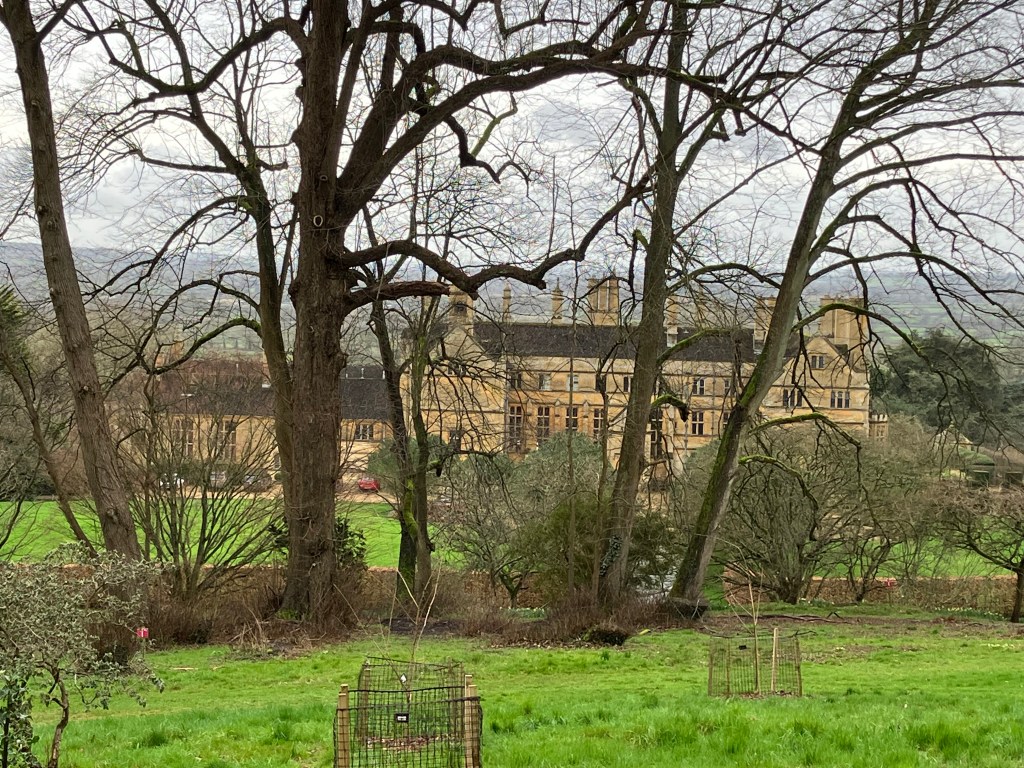
Spread across 60 acres the arboretum is not only home to a unique collection of some of the world’s most beautiful and rare trees, shrubs and bamboos but also allows fantastic views across the Batsford Estate. Although the house and grasslands are private and not accessible we still managed to stand and watch a beautiful herd of deer grazing on the new Spring grass.

The estate was inherited in 1886 by Algernon Freeman-Mitford, 1st Barton of Redesdale who travelled widely in Asia and, as a result, developed the garden as a “wild” landscape with natural plantings inspired by Chinese and Japanese practice. Mitford also built the 600 metre artificial watercourse which runs down the western side of the gardens as well as other features such as the hermit’s cave, rockeries, the thatched cottage and a Japanese Rest House, complete with rooftop dragon to ward off evil spirits! 

Towards the end of his life Algernon wrote his memoirs and described his garden and the significance of the Buddha statue, the bronze deer and the Rest House which he brought here in 1900 and are still in the Arboretum.

When he died in 1916, he was succeeded by David Freeman-Mitford, who was father of the famous Mitford sisters who lived at Batsford during World War I. Nancy Mitford based the early part of her novel Love in a Cold Climate on their time at Batsford.

The gardens were somewhat neglected during the two great wars and it was in the hands of one of it’s successive owners, Frederick Anthony Hamilton Wills, the 2nd Lord Dulverton, that it was brought back to its former glory. He was passionate about forestry and trees and set about restoring the garden to its former glory, replanting the garden with trees in particular and creating the bones of the arboretum you can see today. 

With a choice of paths and walks to navigate depending upon your ability, our Springtime visit brought forth impressive displays of spring flowering bulbs – from carpets of snowdrops, aconites, hellebores, daffodils and narcissi, to the just budding blossom of the magnolias and the occasional grape hyacinth.

If you ever need to reevaluate life take yourself off into nature. Focus on what you have rather than what you don’t have. Listen to the birds, the gentle trickle of the stream as it flows downhill and the beauty all around you.
Life goes on, the Spring flowers peak through the soil, the leaves bud on the trees and the birds continue to line their nests ready for their new offspring.
Like winter shrug off all those cold, hard feelings and look towards the sunshine.
I’m an Aquarian so the future will always hold wonderment to me but as I stand on the bridge overlooking the flowing stream I remind myself to be grateful for the love of my family, for my happiness and well being and most of all for still being here welcoming in another Spring.


The NHS War Zone

Before I begin this post, based upon my opinion, I want to preface it by referring you to a previous post I wrote, back in February 2023, entitled “Life Experience vs The Tabloids: https://amidlifeadventure.org/2023/02/18/opinion-life-experience/

The opinion I am voicing here is based upon fact not on what I have read in the media or listened to on the TV.

I am in my midlife, as is hubby and we have both contributed fully each month, throughout our working lives, to the National Insurance fund with the expectation that should we, at any time, need NHS care it would be provided free, efficiently and effectively. We are both physically fit, eat healthily, don’t drink and have never smoked and until last Friday night had barely ever needed NHS care.
In my case I was given BUPA private health care throughout my thirty year career so I was, it could be argued, contributing throughout that period of time in my history, to an NHS that I didn’t actually need.

Fast forward to 3 am on Friday March 8th and hubby feeling sick, got up and went to the bathroom. We think he got as far as the bathroom doorway before collapsing forwards and face planting the floor, hitting his face on the bath on the way down!
My daughter and I were awoken by the bathroom door ricocheting off the toilet and having found him bleeding, with part of his lower lip hanging off (excuse the graphics) and initially knocked out, we called an ambulance.
The Ambulance Service, in the UK, is funded by the NHS and as funds have become more and more stretched various county ambulance services have been amalgamated together to save on costs. In our area we share our ambulance service with parts of the neighbouring county of Wiltshire.
From the time of our call at 3:07 a.m. to assessment on scene and then transportation to our nearest Accident and Emergency (AnE) Hospital in Gloucester, about thirty minutes drive away, it took about an hour and forty minutes, arriving at 4.45 a.m.
With the ambulance service under more and more pressure this is actually quite an achievement and both female attendees were fantastic.

The AnE was busy and having been booked in, we joined the queue to be seen.
As the night wore on and the sun began to rise we took advantage of the fact that my daughter had accompanied him in the ambulance and I had driven in separately. This had given me an opportunity to pack some water, coffee and tea along with our iPads to keep ourselves occupied.
Others were not so prepared and relied on the ever decreasing vending machine supplies. Once my son was up and about he came to pick his sister up to avoid her waiting with us and taking up more room.
At 9 a.m. ( four hours into our visit) I took myself off to the main hospital and located a coffee shop for more hot drinks and a couple of morning pastries.
By 11 a.m. (six hours in) I dared to actually go and enquire at the nurses’ station how much longer we were going to wait. Luckily my husband’s mouth had stopped bleeding although it was now swelling along with his left eye. I was dutifully told the wait from arrival was 8 hrs!
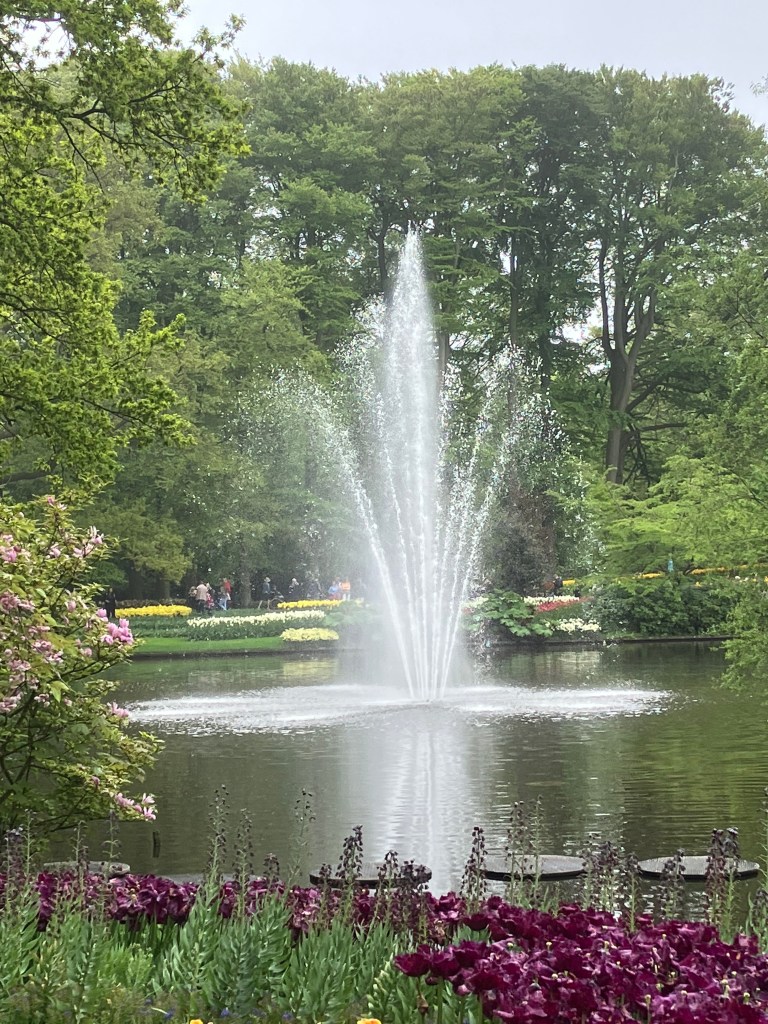
The waiting room had continued to fill up and patients were now sitting on the floor, leaning against the walls and clogging the corridor from the entrance. Looking around me I just couldn’t believe I was actually sitting in an AnE in the UK.

The staff were doing their utmost best and at no time would I criticise their professionalism, friendliness or aptitude but they were so outnumbered, it was honestly unreal.
The throng of patients waiting ranged from late teenagers to quite elderly folk who had been parked in wheelchairs and just left. No one to look after them, no relatives with them, just left to wait with the rest of us. At least two of these gentlemen were affected by a dementia type illness. One thought he was in a World War II air raid shelter and the other kept telling everyone that his sons had deliberately left him here and how evil they were.
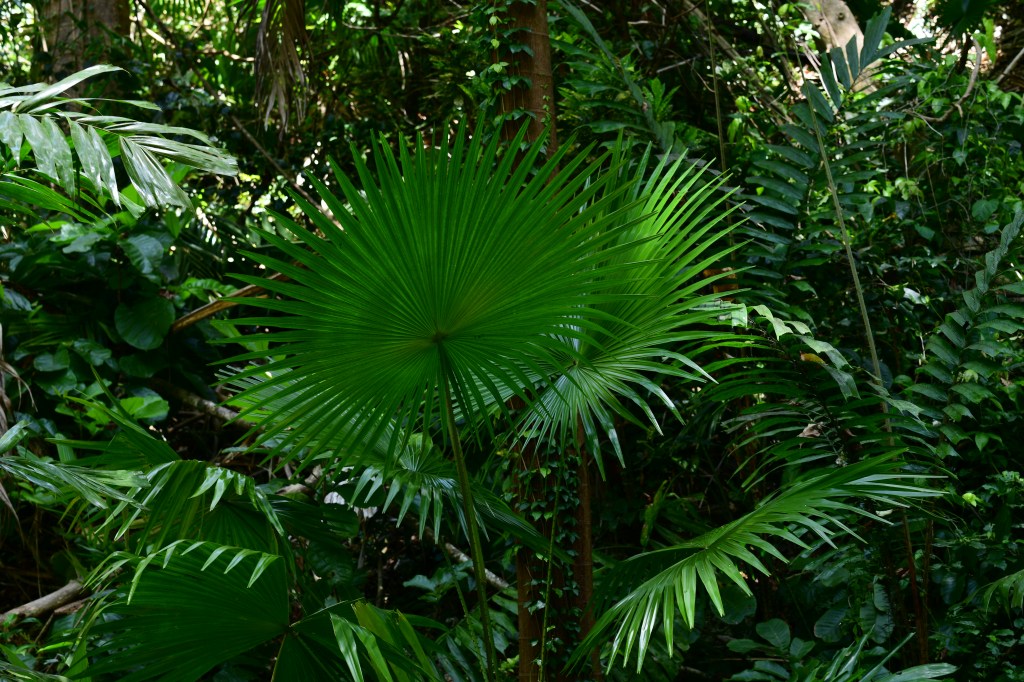
Some people were evidently affected by drugs or alcohol with one young lady constantly being sick into the cardboard bowls provided. Others were suffering from mental illness with one lady arguing with her imaginary friend.
The alarm for the public toilet went off twice during our stay and on neither occasion did anyone come to investigate? The first time I went around to the nurses station and the second time someone else did. This second time the man inside came out and then collapsed on the floor having a heart attack!
It felt like a war zone, like we were all taking refuge within these four walls in the hope of getting some help at some point.

At 12.45 p.m. (eight hours after arrival), my husband, as projected, was seen by an AnE doctor She was concerned about the reason for his collapse more than his wounds and it soon became apparent that he had a heart murmur. Something we had previously never had a clue about.
This meant he wasn’t going to be allowed to leave so she suggested I went home and gathered toiletries and clothes for his imminent stay. In the meantime she would contact the specialist cosmetic consultant needed to stitch up his face.
During this initial eight hour stint in AnE we were offered only one drink. I made sure, therefore, I returned with food and drink reinforcements and grabbed myself a shower and a change of clothes, arriving back at the hospital at 5 p.m. (12 hours since original arrival).
The stitching had been completed but the consultant was concerned about the impact of the fall and requested an X-ray on his face as well as his chest, along with a CT scan of his head.
These were duly completed and then we had to wait for a bed.
At 7 p.m. (14 hours since original arrival) I took another trip to the nurses station and determined that all beds were taken for the night and that we would have to wait in AnE until the morning!
As the night stretched before us and being a Friday night it just got busier and busier so hubby suggested that I go home. I felt incredibly guilty for leaving him alone amongst the chaos.

Saturday morning dawned and on telephoning I found he had been taken out of the main AnE room overnight and placed in an area with half a dozen reclining chairs where he had spent the night fitfully sleeping.
He suggested I didn’t rush back so I returned early afternoon in the hope that he would have some good news.
Armed with more food and drink and a face cloth and soap I headed, with my son, back to the hospital.
Arriving at 2.30 p.m. (31.5 hrs since first drop off) and using the public toilet I washed hubby’s still bloody face and assisted him in changing out of his blood stained clothes into fresh underwear and pyjamas. No progress had been made in finding him a bed and so the AnE room became home again for the afternoon, with the three of us taking it in turns in trying to relieve the boredom and ensuring hubby was fed and watered.
Finally a nurse came across to him and told him to prepare for transfer upstairs to a ward. It took 38 hours for him to finally be placed in a bed connected to a heart monitor!

Having visited him every day since we are no further forward. He has been checked over by three different consultants who have all told him the same “You have a heart murmur and need an echocardiogram, however, there is a queue! If we allow you to return home there is a risk that you could collapse again and the current waiting list for this procedure if completed via outpatients is eight weeks!”

This folks is the state of our current NHS. It’s quite honestly frightening. I want to make it clear that the staff are not to blame. We cannot fault anyone we have met thus far.
The fault, instead, lies with successive Governments who have not budgeted correctly for a free service that continues to evolve, in terms of its capability to cure patients and discover ever more evolutionary operations and procedures. It hasn’t built sufficient hospitals to manage the ever increasing need from an expanding population that lives longer.

Gloucester Royal Hospital, for example, lies within the South West NHS region, is one of the six noted trauma hospitals for this region and is one of the largest trusts within the South West. The county is predominantly rural, with an area of 1,220 sq miles.

The hospital opened in 1912 with 149 beds serving a population of just over 321,000, it now has 683 beds serving 916,000 people. However we have an increase in life expectancy. In 1912 a man was expected to live until 51 years, now this stands at 81 years. Therefore a bigger percentage of the population is utilising the NHS for longer.
Significantly when you look at the historic figures in 2018, 106 years after it had opened the population reached 633,500 nearly double that of 1912 but in the last 5 years it has grown by another 45% and herein lies part of the problem. As a country we are consistently building more and more houses without the supporting infrastructure.

Gloucestershire has a growing population and more people living longer, all drawing on the same NHS resources. The opportunities to expand the hospital are limited.Like other hospitals built in the last century it sits in the middle of a major city where land is now limited.
So where do we go from here?

Having contributed to the NHS via my National Insurance for nearly 40 years I’m angry that in reaching this stage in my life when I’m most likely going to need it’s services I don’t feel it is fit for purpose and probably never will be again.
In my opinion there is no longer a choice for younger people. If you want efficient and effective medical care you are going to have to join BUPA or some other similar scheme and pay monthly for it. My only hope is that in doing so you get the opportunity soon to opt out of that part of your National Insurance that currently goes towards the NHS.

Why Do I Struggle To Put Myself First?

When I decided to set up this blog I thought it would be so easy.
After all I enjoy writing and how hard can it be to write about activities I’ve enjoyed, places I’ve been to or to express an opinion about something?
The answer is Hard! Sometimes Very Hard!

Why? Because even though I’m a midlife adventurer who has retired from full time employment, finding time for myself is still no easier. Sometimes I wonder how I ever had time to go to work!

I’ve read several articles on the subject of “Putting yourself first” and attempted to delve into the reasons why this might be the case for me but I still find it so hard. I’m coming to the conclusion that it’s a learnt behaviour. The good news is anything learnt can be unlearnt but where to start? How has this learnt behaviour come about?

For me it’s that “Manager and Mum” syndrome that I’ve spoken about previously in my posts.
I was a single Mum for thirteen years with two children to raise. I got up each day as a “Mum’ and tried to ensure my children had a nourishing breakfast before getting them ready for school, dropping them off and then changing “hats”.
Heading back to my car I would take off the “Mum” hat and put on the “Manager” hat and head off to work for a minimum of eight hours. I was fortunate to afford a daily nanny but she only worked when I was working and the children weren’t at school. Anytime outside of this I swapped “hats” again and became “Mum”.
Don’t get me wrong I loved spending time with my children. The school holidays were an absolute joy because on my day off I didn’t have to put an alarm clock on to wake us up and we just got up when we woke up.
I got myself in a rhythm. As soon as the day arrived each year when we could book our holidays for the forthcoming year my pre-prepared holiday applications went in. It tended to work on a “first come, first served” basis and with plenty of paid holiday to take I would book February Half Term, May Half Term, October Half Term, two weeks in the school Summer Holiday and one week at Easter. This still left me an odd week to take elsewhere or break down into days if I needed them at short notice should one of the children become ill.

Holidays at Christmas, a busy period in the entertainment and gaming industry, were off limits so I would ensure I was off at least a half day on Christmas Eve, Christmas Day when we were closed and Boxing Day and then would happily work New Year’s Eve and New Year’s Day.
It was far from easy and as previously mentioned, in one of my early posts, when I was asked how to describe my life on a company development course I attended, I quite aptly described myself as “a professional juggler”. I often had so many balls in the air that it wasn’t a case of being careful not to drop one but more a case of which one to catch first!

I had little or no familial support as the first ten years of their lives was spent on the opposite side of the country to my own family. I smile these days when I listen to millennial parents talking about “date nights” or “a night away” where grandparents look after their children so they can be alone together. Maybe this is the future, maybe divorce rates for this new group of parents will decrease because they understand the need to spend time together as a couple without the children in tow.
The first time I left my children to do something for myself, a weekend away in Jersey, was when my oldest child was about eight years old and that came about because I had a really good daily nanny who also became a friend and offered to give me this time off.

Days off in the week were spent catching up on the normal boring household tasks like housework, washing, food shopping and home admin.
Days off at the weekend or in school holidays were centred around the children. I always strived to give them as normal a life as I could despite being a single parent. In school holidays when I was working I would take every Wednesday off so the children knew that at least one day during the week we would always have time together to go out and enjoy ourselves. I tried to keep a balance between paid days out like theme parks, bowling, cinema etc and free days out where we would go walking, have a picnic, visit country parks and immerse ourselves in nature etc. It was important for them to grow up understanding that fun wasn’t only associated with money.

In the days before computer diaries existed I also remember keeping a Filofax where I would keep a track of my life by writing entries associated with the children like parents evenings, nativity plays, children’s birthday parties etc in red.
Red, because it stood out and my children were a priority. I spent a lot of time each week away from them and key events in their life were really important to me.
Entries associated with work were in orange and those relevant to my own life like doctor’s appts or the odd coffee with a friend when the children were at school were in green.

When I reflect upon this life I can blatantly see why “putting myself first” wasn’t a priority. I simply didn’t have the time. I barely had time to fit everything in. If I was working a full day, returning home between 11.30 pm and 12.30 a.m. was not unusual. The children would be fast asleep in bed and my alarm still went off at 6.20 a.m. regardless to get up and start again.

I know I am not unique. There are hundreds of parents out there in a similar situation or worse but maybe that is why so many of us Mums are rubbish at putting ourselves first.
On the odd occasion when I was so tired that I would return from the school run, make a cup of tea and then find myself engrossed in a good book or a series I might have recorded on TV, I remember putting down the book or switching off the television and feeling incredibly guilty. Guilty that I had wasted time that I should have spent doing other home related stuff.
Guilt wouldn’t be the only feeling though. I would also feel stressed later because, by not attending to my home workload, I would have doubled my tasks for my next day off or have to catch up in the evening when the children were in bed. There always seemed to be a price to pay for putting myself first!
When I used to discuss my dilemma with friends they often used to ask me “What happens when you run out of steam? Who will take care of the children then? I never had an answer and to be honest it didn’t really resonate with me so nothing changed.

So given my history and this learnt behaviour how do I start to change this now I’m retired? Slowly!
It takes time to plan self-care and often you’ve already run out of time in the day and its bedtime before you know it. Then you’re restless and not sleeping properly because all those thoughts go through your head about the things you didn’t get done today and what’s facing you tomorrow. You beat yourself up because you feel like you’ve failed or you’re not on top of everything. This behaviour becomes a self-fulfilling prophecy and begins to feel like the hamster wheel that you can’t get off.

I have tried so many times to address this issue since I’ve been retired. What I have realised is that the more I do and the less I take time for myself the more unhappy I become, so it is becoming important to find a solution.

I know that trying to take a moment for myself doesn’t work. I might sit down with a cup of tea with the intention of taking a breather and then a thought will pop into my head about getting something done or I’ll notice something in the room that needs doing. Then instead of staying in the moment, relaxing and enjoying my tea, I’ll get up and do whatever it is I’ve thought about and once again I’m on the go and that break in my day is lost.

That also applies to taking holidays. When I was working it was very hard to take a holiday at home because it never turned into a holiday, it just became another long list of things to do that I’d not had time to do in normal life. That still somewhat applies now I’m retired. We had made plans, in our joint retirement for example, to go out one day a week, spend time together doing something we enjoyed. Since last September we’ve probably done this about half a dozen times!

During my working life I often had to make changes to the way I worked maybe because some legality changed or my new direct report had a different way of working so I know I’m capable of change.
I always found the “divide the cake up into slices” worked for me. Trying to manage a complete change all in one go didn’t work but break it down into a dozen smaller tasks and address them one by one and it did.
I’m in the process of trying this at the moment. My previous post ” New Year’s Resolutions Have Come Early this Year” highlights the changes I need to make to my health and wellbeing in order to self medicate my osteoarthritis and I’m gradually delivering on these by addressing one change at a time and then gradually building on this. Admittedly this will take me longer to deliver the whole plan than if I did it all at once but the end goal is to deliver and I know if I try and make all the changes at once which all require me to focus upon myself I’ll fail, so gently does it.

I think one of the other failings of putting yourself first is that its such an alien concept to you that you don’t actually know what you need, what will help you or even what will make you happy.
Ultimately that is the first thing I’ve realised I need to figure out.
My priority over the last couple of weeks has been to switch off the television in the evening. We never watch it when we are away travelling so why do we do it when we are at home?
I’ve then been using this time to start doing some hobbies which have ranged from Sodoku to knitting whilst listening to my many unopened vinyl records to reading to learn. I have a few specific topics that I’ve always wanted to learn more about. I’ve bought the books when we’ve been away travelling or received them as Christmas/ birthday gifts and they have just sat on the bookshelf. I’ve now taken them down, dusted them off and begun to read and increase my knowledge.
When I was talking to a single friend recently she enlightened me that the reason I’ve not adopted hobbies, in the past, is probably because I’ve had children. She looks around at all her friends with families and has noticed this trend.
Parents particularly Mums, and even more single Mums, spend so much time amusing their children and catching up on mundane tasks after their children are in bed, that they don’t have personal hobbies.
This same friend is loving retirement because she is spending even more time than she did when she was working doing things she enjoys and increasing both her hobby time and the hobbies she does. It sounds so simple but what a revelation that conversation was to me!

I feel she is right also in that no one knows exactly what you need but you. But what if you’ve never had the time to figure that out because you have spent all your time running around ticking off those home to-do-lists and caring for family? What if you’ve never lost yourself in an enthralling hobby that has caused you to totally lose track of time because you couldn’t afford to lose track of time?
Furthermore when you don’t know what you need, what hobbies you enjoy and therefore what makes you happy then the people around you soak up your time because they are used to you having that time for them.

I’ve actually started to take time for myself in the mornings. This feels really rewarding after previously rushing out of bed to the sound of the alarm. Now I have a cup of tea in bed whilst catching up on my social media or reading a book/magazine. It sets me up far better for the day ahead. When I have to get up, grab a shower, dress and get out the door I feel so rushed and it can actually put me in a bad mood for the rest of the morning.

I love a bubble bath. I think this also stems from being a single Mum. To run a bath, chill out and read a book particularly of an evening when the children were asleep always felt like an enjoyable indulgence. It’s something I’m trying to consciously do more of. It’s like hanging up a sign on the bathroom door and saying “I’m Not Available or Do Not Disturb”. People just leave you alone. Peace n quiet!

One thing that does work for me is to pencil in time for myself to do something specific. For example I often find writing a post is easier if no one else is at home or if I can take myself off to a coffee shop. It allows me to focus on what I’m doing and I don’t suffer the aftermath guilt because I’m proud of what I have produced and posted.

As time moves on and I begin to enter what is probably the last quarter of my life, being in control of my time and maximising my happiness becomes even more important. I’ve never wanted to be one of those people who vegetate at home, whiling away my time and basically sitting in God’s waiting room. It’s really important to me to do things I enjoy.

Whilst we have no major trips planned this year, we have decided to pursue a number of one day events that we’ve previously expressed an interest in but rarely if ever managed to go and do. I guess you could call them mini adventures.
We managed that this week when we took my daughter, as part of her birthday celebrations, to the “Wildlife Photographer of the Year” exhibition which is currently on tour and available quite local to us. The photos included in this post are all from there.

One other idea that lies dormant in my mind is rekindling something I used to do before I met my husband, when my children were old enough to be left on their own for a few days, and that is to get away on my own.
I enjoy my own company and sometimes still crave that “alone time”. It’s like your own personal adventure. Time to think, to relax, to not have to think about anyone else and most of all to chuck away the clock. Have you ever tried that?
Have you ever got up when you wake up with no regard to the time, eaten when you are hungry and not because its lunchtime or dinnertime, gone to sleep when you are tired and not because its bedtime. It’s a very freeing experience to return to a simple life when the time of day was not relevant and everything was governed by nature. Perhaps I’ll do that again one day, put myself first and take myself off on my own little adventure……..

The Cotswolds -The Roman Town of Cirencester

I was recently visiting my daughter, who at the time was in Lincolnshire.
Traversing across the country from West to East I found myself bypassing Leicester and then driving along the A46. This is weird I thought, the A46 runs from Bath to Stroud back in The Cotswolds from whence I have come?
When I returned home I had to research this and I discovered the A46 is basically an old Roman Road that runs from Bath, in the South West to Cleethorpes and Grimsby in the North East. It’s amazing how much the Romans built in order to move their armies across Britain. This peeked my interest and so I headed off to Cirencester, my nearest Roman town to discover more.

Parking in Cirencester isn’t that easy. It’s worth checking it out on line before you arrive. We parked in the long stay car park at Sheep Street. Compared to other towns and villages nearby it is also more expensive at £7.90 for five and a half hours.
The advantage for parking here though is that it is only a four minute walk to our first destination –The Corinium Museum in Park Street and also presents an opportunity for a good circular navigation of the town.
Look out for Laurence Llewelyn-Bowen’s interior design shop en route. Also nearby you can see the blue Historic Cirencester sign denoting the original Cirencester Grammar School frequented by Edward Jenner, founder of the smallpox vaccine and often credited with saving more lives than any other man in history.

Corinium was the Roman name for Cirencester. The joy of this museum is that it is presented in chronological order and takes you right back to the beginning of prehistoric times and brings you all the way through the ages up to modern Britain.

Starting our journey through the museum, aided by an audioguide, I am firstly impressed to discover that people existed in this area from around 900,000 years ago, a period known as the Palaeolithic (Old Stone Age). There was extreme climatic change at this time with ice sheets advancing and retreating and sea levels rising and falling. Britain was joined to mainland Europe during the coldest spells.

Early modern humans adapted to these climatic conditions and exploited the natural resources available in Britain. In the Cotswolds, the evidence for the first people comes from the discovery of a small number of handaxes. These were butchery tools made and used around 200,000 years ago, probably by Neanderthals. Modern humans first appeared in Britain around 40,000 years ago.

Around 10,000 BC the environment became warmer and temperatures stabilised. Sea levels rose and, by 6,000 BC, Britain had become an island. This period is known as the Mesolithic Era or Middle Stone Age.
The local woodlands provided an ideal environment for hunting animals and gathering plants, fruits and nuts which attracted hunter-gatherers to the Cotswolds who set up seasonal camps. .

In addition over 70 Neolithic long barrows have been discovered in Gloucestershire, the majority of which sit in The Cotswolds. A display within the museum clearly shows one such long barrow -the South Chamber of the Hazleton North Long Barrow, the excavation of which took place between 1979 and 1982. This long barrow had two stone chambers, north and south. The chambers contained human bones, which were moved around when further bodies were added. A small number of stone tools, pottery shards and items of jewellery were found alongside the human remains.

An early Bronze Age Beaker burial, dated to 2,400 – 2.100 BC, was also discovered at Kingshill North on the edge of Cirencester. This has revealed interesting information in that the teeth of the female skeleton, aged between 30-40 years old, showed that she was born on the chalklands of southern England. This means that she was not from the Cotswolds and had travelled a long way to live here. A fine decorated Beaker vessel was found within the grave and a cow hide was used to cover it. This was then covered by a large round barrow measuring 12 metres across.

The museum leads us on into the Roman era. The first two campaigns to Britain were in 55 and 54 BC led by General Julius Caesar himself. For the majority of Britons this would have been their first sight of an organised army, which must have left a lasting impression. It was almost a hundred years before the Romans returned to Britain.
In 43 AD Emperor Claudius sent an army of 40,000 men to conquer Britain. These men were well equipped, trained and disciplined. Within this army were separate legions each consisting of 5,300 men, who were in turn supported by auxiliary regiments drawn from all over the Roman Empire. The recruits included specialists such as slingers, archers and cavalrymen.
The Britons were defeated in two major battles which resulted in the surrender of a number of tribes from across Britain. One of these was probably the local Dobunni tribe.

Corinium Dobunnorum, Roman Cirencester, was the second largest town in Roman Britain. Its walls eventually enclosed 96 hectares. The town was the tribal capital and administrative centre for the Dobunni, the pre-Roman local tribe. It has been estimated that it had a population of between 10,000 and 20,000. This compares to modern day Cirencester which has a population of around 18,000.
Soon after the conquest of Britain, the Roman Army established forts and later a road network to help with communication and supplies. The main Roman roads identified in Cirencester are Ermin Street, the Fosse Way and Akeman Street.

Corinium had one of the largest amphitheatres in Roman Britain. Oval in shape it had two entrances on the long axis, one in the northeast and one in the southwest. Constructed in the early 2nd century AD. it was a centre for entertainment and events, which could hold the entire free adult population of the town. Favourite attractions probably included gladiatorial combat, bear-baiting, animal hunts, boxing and wrestling.
The seating banks, originally rising to 10 metres, had tiers of wooden seats laid on low dry stonewalls.It is assumed that the rear terraces were for standing spectators and it is estimated that this amphitheatre could accommodate 8,000 people. Whilst it fell into disrepair during the 4th century, its impressive remains are still visible to the southwest of the modern town centre.

Beautiful mosaic flooring is a constituent of any wealthy Roman household and the museum has some amazing examples.

Moving onto Early Saxon times. These type of settlements are rare in Britain but two were discovered locally. The first at at Sherborne House, Lechlade and a second at Bourton-on-the-Water. Excavations at Sherborne House revealed a large settlement stemming from the late 5th to the early 8th century AD.
Analysis of the remains here show that beef was the main source of meat in their diet and soil analysis shows they produced barley, wheat, flax and Celtic bean. There was also evidence of weaving, metal working and leather working.

Further information follows bringing the visitor into the reign of Henry 1 and then onto the development of the wool trade which began in the 11th century and flourished in the 14th century throughout The Cotswolds area. Cirencester was at the centre of this and wool was exported from here abroad through London, Bristol or Southampton.

More information follows bringing you into the modern era.
I was really surprised by the quantity of exhibits and how much history sits within a few miles of this Roman town. The extent of the historic exhibits was worth the entrance fee and the couple of hours we spent there. I left with a greater appreciation of the history that surrounds me.

From the museum we walked less than five minutes to the medieval Church of St. John Baptist which stands proudly in the centre of this market town. This grade 1 listed building is well worth a visit reflecting various architectural styles since the 12th century. The oldest parts being the chancel and attached chapel.
Built from Cotswold stone, it is one of the “largest parish churches in England” and contains various tombs and monuments along with some fragments of medieval stained glass and wall paintings.
You can pick up a guided leaflet on entry and there is also normally a volunteer guide to hand to whom you can direct any questions. Don’t miss The Boleyn Cup made for Ann Boleyn in 1535.


From the church we wandered around the market place, admiring the statue of the two hares before partaking of some lunch and heading off to explore some of the small independent shops and the Cornhall Indoor Market.

Heading back towards the museum there are various side streets that branch off on your left with more modern, chain shops before you reach the end of the market place. Here you will find Castle Street and Black Jack Street which run parallel to each other and feature another array of independent shops, cafes and eateries to explore.

Once you have finished wandering around the cobbled streets you can return to the car park.

NB: This is the seventh post in my series about the wonderful “Cotswolds”. An area in the UK that you really shouldn’t miss out on visiting if you are coming to the UK. It’s full of olde world charm, history going back to the Roman era and beautiful architecture. Check out previous posts in this series plus more to come soon. 
Please don’t forget to comment and/or like. I love to hear what my readers think. and also look forward to your recommendations of places to see in the Cotswolds for my future adventures Thank you

The Cotswolds – The Roman City of Bath Spa

When you reach midlife it’s hard to think of something you want to do on your birthday.
We were suppose to be in Rome, a city I’ve visited twice before but hubby has never been to.
However following the arthritis diagnosis (see previous post: New Year’s Resolutions Have Come Early This Year!) and having still not seen a physio or consultant, at the point we should have flown out, I decided it was best to postpone this trip.
The last thing I wanted to do was to walk 5-7 miles a day for four days and then return to the UK and find one or both my knees had returned to the levels they were at last September. We have a preference on city breaks, in particular, for walking rather than taking public transport. The consequence would have no doubt been, that I would have had to start the resting and slow build exercise process all over again.

I decided instead to travel to Bath for the day with an overnight stay.
Bath is subject to the new Ulez regulations and charges and unlike anywhere else we have been before also bases its car parking charges on emissions as well. Payment for long term parking has to be done by cash or on line via an app and once you type in your car registration number it tells you how much you need to pay. You can only pay for 4 hrs, 6 hrs or 24 hrs.
It began to feel like we were being ripped off. Having arrived in the city at 10.30 we only really had the choice of paying 6 hrs or 24 hrs. If we paid for 6 hrs then we wouldn’t have time to eat an early dinner before returning to our Boutique BnB for the night so 24 hrs it was!

We had booked tickets for the Roman Baths for 11 am. It was school half term holidays and so it was busy. The theory of booking a date and time is a hangover from the Covid era when tourist places needed to limit the amount of people within the building. However this is obviously not the reason for this now as the first main room we entered was absolutely packed and you had to shuffle along at a snail pace in order to try and see the exhibits. I decided to skip this room and get ahead of the crowd which actually worked and I felt very little pressure for the rest of the tour.
Free audio handsets were a benefit although the narratives were a little extensive.

The spring at Bath was known to the pre-Roman Celtic people of Britain and was presided over by the Celtic goddess Sulis. When the Romans arrived, they called the site Aquae Sulis, “waters of Sulis,” and created a spa that became famous throughout the Roman world.
It was one of the great religious spas of the ancient world; the people of Roman Britain came to the site to bathe in the waters of the natural thermal springs, which still flow with hot water today. The hot mineral springs bubble up from the ground at temperatures well above 40 °C and the main one produces more than 1.3 million litres a day. 

Back in those days people attending would progress through the tepidarium, or warm room, and then through a set of increasingly hot baths-the caldarium before plunging into the cold bath or frigidarium and finally finishing by walking down the four steps into the warm, steamy water of the Great Bath. The Great Bath stood in an impressive hall and people would meet to chat whilst bathing or stroll along the paved floor around the pool. There were strategically placed corniches in the walls for sitting and watching the bathers without getting splashed.
The facilities were gradually enlarged over time to accommodate the number of pilgrims who traveled here from further afield and the complex remained in use until the fourth or fifth century, when the Saxons gained control of the area.

The baths were abandoned when the Romans withdrew from Britain with the complex being excavated from the 1870s onwards. Sited below the current street level, the Great Bath is now open to the sky and visible from the street.

It is an amazing feeling to be walking where so many ancient people trod before you.

From the baths we strolled along the road to the right to Bath Abbey.
The Abbey was founded as a Benedictine Monastery when the Saxons built an abbey on the site and in 973 AD Edgar was crowned the first king of all England. The Normans subsequently rebuilt the church between 1088 and 1122, transferring there the diocese they had founded at Wells. The bishop’s throne returned to Wells in 1206, and there was a long rivalry between the canons of Wells and the monks of Bath, of which the bishop was titular abbot. The diocese is still styled Bath and Wells.
The monks were committed to community life, a rhythm of prayer and welcoming visitors and although the Abbey is now a church it remains devoted to these principles.

It’s worth picking up a leaflet to guide you around the Abbey, to its eleven key points of interest.
To the right of the entrance you will begin your tour at the West window .Completed in 1894 it tells the stories of the first five books of the Bible.
Other highlights include the tomb of Bishop James Montague who requested to be buried here in order to encourage others to support the church.


As well as the 635 memorials that line the walls commemorating people from the 17 and 1800’s.
The fan vaulted ceiling is spectacular and was created by King Henry VII’s master masons.

The Abbey is well worth a visit, if for no other reason to once again tread where ancient feet have trod before you.

Leaving the abbey behind we headed off towards Milsom Street stopping off en route for a coffee and pastry. Our walk then took us past Union Passage and other small lanes of independent shops which are worth browsing en route.
Milsom Street, itself, was built in 1762. The buildings were originally grand town houses, but the majority are now used as shops, offices and banks. Most have three storeys with mansard roofs and Corinthian columns.
Being book readers our main focus was Waterstones which is the largest bookshop in the city. Since opening in the 1980s it boasts the largest range of books in the city with more than 55,000 titles spread across three floors. Being an ideal venue for book events it supports the annual Bath Literature Festival held in May each year.

From here we walk around the corner to the Jane Austen Centre at 40 Gay Street.
Housed in a beautiful Georgian house dating back to between 1735 and 1760 this is definitely the place to visit if, like me, you were enthralled by Jane’s novels when you were a teenager or watched the period dramas and films produced from her works.
The centre focuses upon the five years that Jane spent living and socialising in Bath, where she resided, the places she visited, as well as the locations which feature in her novels inspiring her lively wit and sharp satire.
The tour begins with an aptly dressed host explaining the Austen family tree within which Jane sits with some worthwhile background information on the key members. You are then released into the exhibition itself which includes a short film highlighting the places that Jane lived within Bath. The Souvenir Guide includes the map should you wish to explore these further after your visit.
There are some interesting exhibits including an explanation of monetary income during Jane’s era, a feature that arises many times in her books when various mothers are looking for appropriate suitors for their daughters.


Another highlights the custom of drinking tea and you can book, in advance, to take Afternoon tea in the Regency Tea Room after your visit if you so wish.

I’m not a massive supporter of gift shops when visiting exhibitions, museums etc but I couldn’t not take a wander into this one, choosing to purchase a special copy of “Pride and Prejudice’ as a birthday present to myself.

From the Jane Austen centre we then chose to take an early dinner at a local tapas restaurant -Pintxo which I would definitely recommend before retiring to our BnB for the night.

Thinking my birthday was over for another year I arrived home to a few more cards through the post. Yes I am still of that age where an actual card is the wisher of a “Happy Birthday” rather than just a social media post.
My son was unable to partake in my actual birthday due to work commitments and so invited hubby and I to an Afternoon Picky lunch on Saturday instead. In case you are not familiar with this term ‘a picky tea or lunch” is basically a selection of all those lovely foods, that in normal circumstances perhaps wouldn’t be amassed together since they derive from a variety of countries, but which on a special occasion are just lovely to indulge ourselves.

We love to pick at items such as various types of stuffed olives, crunchy dried broad beans, crostini and pate, small pork pies and slices of Gala pie, sausage rolls, Italian and Spanish deli meats, pitta slices, Greek dips such as humous, taramasalata and tzadziki along with thick slices of olive bread and a few samosas. Basically a variety of foods that can be “picked” at with no regard to country of origin or whether these items should in fact be devoured together.
With a plate laden with goodies it’s just nice to retire to the living room and chat whilst appreciating this wondrous variety of tastes.
Following our lunch my son presented me with his birthday gift. Have you ever had one of those moments when you unwrap a gift and it is so completely unexpected it nearly takes your breathe away? Inside the carefully wrapped gift paper was a published copy of my blog covering the whole of 2023.
My son had done it all. An actual published book which will, forever, live on in our family with every post I had written, including a complete account of everything we had done on our 6 months of travels, with all the photos, accurately compiled with the help of a publishing company, edited by my son within a hardback book cover! The work he must have put in to do this single handed is a gift in itself.
This is a birthday I will never forget x

NB: This is the sixth post in my series about the wonderful “Cotswolds”. An area in the UK that you really shouldn’t miss out on visiting if you are coming to the UK. It’s full of olde world charm, history going back to the Roman era and beautiful architecture. Check out previous posts in this series plus more to come soon. 
Please don’t forget to comment and/or like.
I love to hear what my readers think. and also look forward to your recommendations of places to see in the Cotswolds for my future adventures Thank you