The Cotswolds -Shopping in Nailsworth

I was born and bred in the Cotswolds in what was once a small village -Minchinhampton.
I left the area when I was eighteen (see previous post “All About Me”) and didn’t return until later in life when I was divorced with two children.
We settled here in 2005 and despite having all these wonderful Cotswold villages on our door step we soon got absorbed in everyday life and they just became the “norm”.
Now I’ve taken early retirement I have more time to actually explore all these wonderful places properly, in tourist rather than local mode. This week I visited Nailsworth:-

This market town lies in a wooded valley on the A46, just over 20 miles north of Bath and to the east of Stroud, in the Southern Cotswolds.
Nailsworth is a small but very welcoming town and like its nearby neighbour Stroud was once noted for its involvement in the Cotswolds wool trade. Many mills were built and used during the successful wool and cloth trade, but they have now been converted to new uses such as restaurants and hotels, like Egypt Mill, which stands near the centre of town. As a result of this history it is said to have the largest number of working water wheels per square mile in the country.

The centre of Nailsworth stands at the union of two valleys and nearby you will find Badminton and Gatcombe Park, both world famous for their horse trials, and High Grove, the country home of King Charles, is a few miles away near the historic town of Tetbury which I will cover on a separate trip.

On our midweek trip to the town we managed to park in one of the free two hour parking spaces on Old Market directly off the A46 and adjacent to our first port of call “Domestic Science.
This is a classic example of how you can live somewhere nearby and not even know about the existence of such a fabulous shop which opened way back in 2011. As a local you have a tendency to just keep revisiting the same places you have always been and not actually exploring to find something new.
This was originally a 2000 sq ft shop, half of which existed in the basement of the original mill building. Now it stretches over another two new floors filled with natural light and with views over the stream at the rear. It is home to an eclectic mix of vintage, homeware and lifestyle. They even have additional branches in Tetbury and Stow-on-the-Wold.
It’s like an “Aladdin’s Cave”. I loved it and spent ages meandering around the different floors with their specialist dressed rooms such as “The Bathroom” full of original, quirky and off-beat vintage pieces sourced from their personal travels.
There is plenty to pick from including Candles, Clothing, Jewellery, Lighting, Stationary, Bath and Beauty items and even Toys!
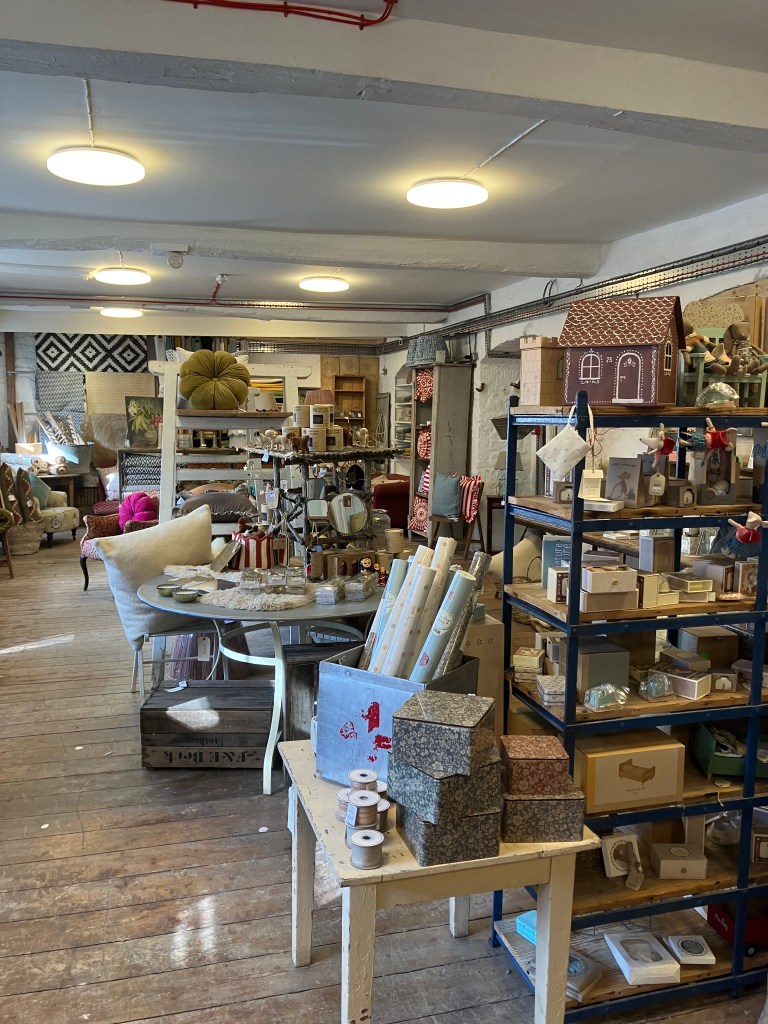
The staff are super friendly and helpful and I left with a new ochre rug for my bedroom, a beautiful smelling “Illumens Poire Diffuser” and some Ecobath Lemongrass, Peppermint, Eucalyptus, Black Pepper Epsom Salts in which to soak my currently dodgy knees!

In the basement there is an adjoining cafe “The Canteen” which serves the best locally sourced food, cakes and coffee. Like the rest of the building the cafe follows the interior room placement of the mill and stretches across two completely separate rooms. With it’s quirky interior and comfortable sofas, chairs and tables I thoroughly enjoyed my restful lunch of smoked mackerel pate, sourdough bread, capers and rocket followed by “Persian Love Cake” and as requested an extra hot decaf, skinny cappuccino!
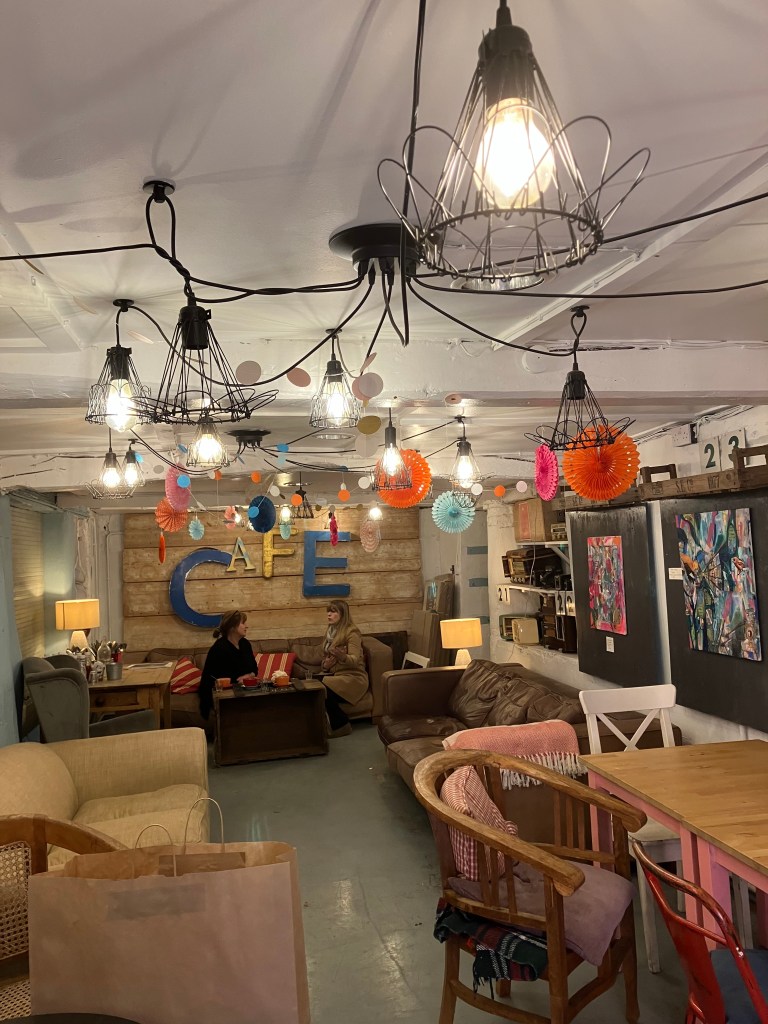
With 90 minutes of our free parking already eaten up in just one visit we moved the truck further up the road into a small car park which also offered 2 hours of free parking and we set off to explore the remainder of town.
Passing the Natural Cookery School, which I’ve not yet visited, but has excellent reviews on TripAdvisor for running cookery classes, supper clubs and outside catering from their beautiful culinary space since 2007, we reached our next stop which was “Joya”.
I’ve been visiting this small shop for many years. It’s a great place to find something for a birthday or Christmas gift, they stock items such as jewellery, bags, soaps and clothes. The shop owner is really friendly and chatty, on this visit we landed up talking about the differences we see in the Millenial generation!
I left with a bunch of pure woollen socks. A great first Christmas present for my daughter who spends part of her time away from home pet sitting and now appreciates the need for comfortable but warm socks to put inside her wellies!

From here we wandered along Market Street past a selection of other shops including a couple of large charity shops until we reached Bath Road (A46). We stopped here at The Yellow Lighted Bookshop.
We both read voraciously. I’m currently on my 67th book this year to date and no doubt my husband has exceeded that! Although we do both have Kindles, bought originally to alleviate the need to pack books when we travel, we are also great supporters, when the opportunity arises, of buying from independent bookshops. I guess we are all guilty, at one time or another, of buying from Amazon but there is nothing quite like the feeling, smell and cosiness of a local bookshop.
The Yellow Lighted Bookshop opened its first shop in Tetbury in 2008, and Nailsworth a year or two later. As stated on their website the name is from a book called The Yellow-Lighted Bookshop by an American called Lewis Buzbee. It’s a history of bookshops, and why they are socially, culturally and economically important.

Buzbee got the image from a letter that Vincent van Gogh (who had worked as a bookseller) wrote to his brother not long before he died. Van Gogh wanted to go back to Paris, and on a wet November evening, paint the yellow light of the bookshop pouring onto the street outside.

The owner Hereward has worked in bookselling all his adult life, from central London, to Liverpool, Cheltenham and all over the country. Their core team of booksellers have more than 100 years’ experience, with a range of librarianship, hospitality, event and retail experience as well.

A carbon-neutral business with an ethical approach to everything they do, they raise money to support a variety of causes ranging from books for children at the local foodbank, the local Women’s Refuge, and a variety of refugee charities whilst also supporting local schools on a regular basis.
I just love the history behind bookshops, it’s always worth exploring.

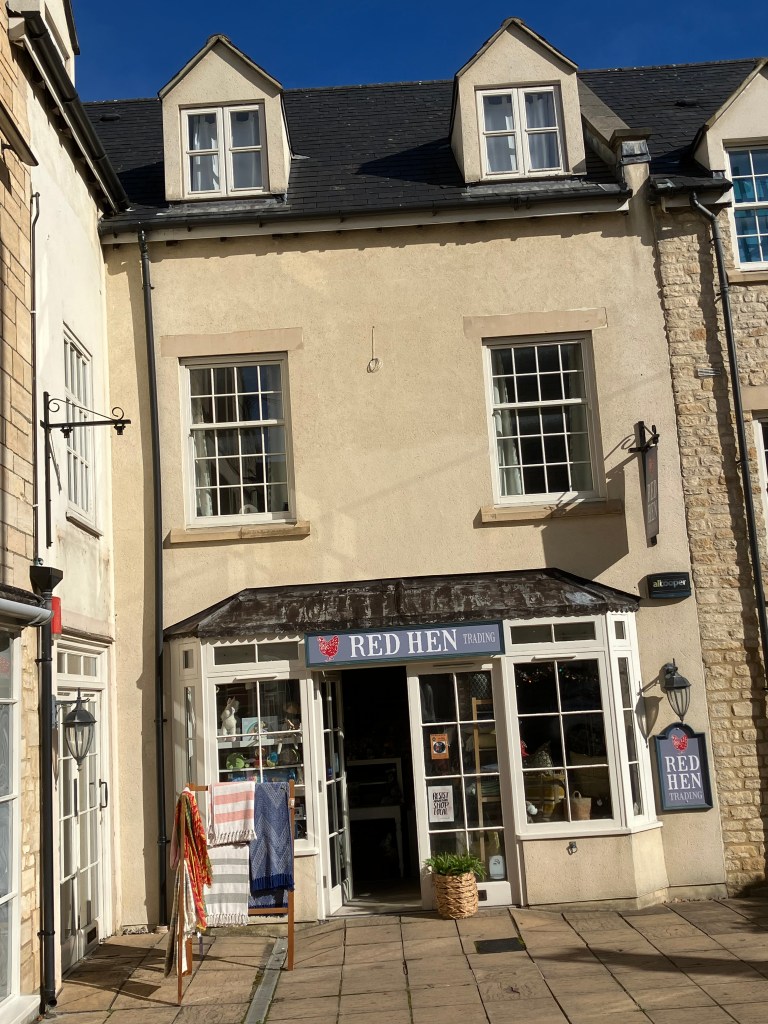
Further down the road on the right is “Red Hen”. We always pop in here every time we are in Nailsworth. It’s another fine example of a quirky shop with stationary, toys, home accessories and decorations as well as unique gifts. Definitely worth a visit!
Nailsworth was selected by The Sunday Times newspaper (March 2014) as one of the best places to live in Britain and the coolest place to live in Gloucestershire, according to a recent survey to discover the Top 50 Coolest places to make your home. Not surprisingly, therefore, the town is renowned for its selection of award-winning restaurants, pubs and cafes.

Eating out in Nailsworth means you are spoilt for choice and just opposite Red Hen on the same side of the road as the bookshop is William’s Food Hall which has helped turn Nailsworth into a bit of a foodie haven. It not only invites foodies through its doors to dine on fresh seafood and local produce, it is also renowned for hosting the odd celebrity.
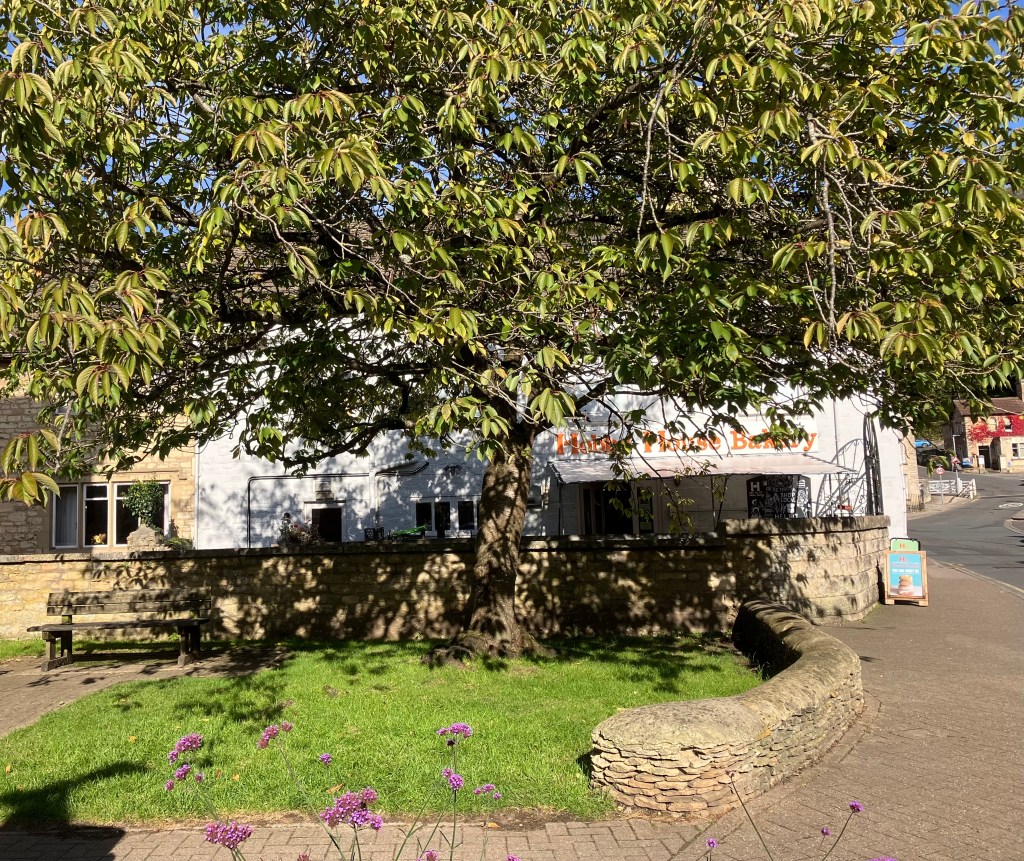
On the opposite side of the small roundabout, tucked away behind the pretty Penny Rupert Gardens is Hobbs House Bakery. Famous for being owned by the Fabulous Baker Brothers – Tom and Henry Herbert – it was featured on their TV show.
Further up this road past the bakery, just before Morrisons, is the corner shop that is Walkers Butchers. It’s always worth taking a peek in their window even if you don’t need to buy anything, just to see the array of meats etc on offer. Today minced venison and fresh grouse attract my eye. You know you are truly in the heart of the countryside when such items are available over the counter.

On the subject of food to purchase, this area of the Cotswolds is renowned for its regular Farmers Markets and Nailsworth is no exception. They hold an artisan market on the second Saturday of each month from 10 a.m. until 2.00 p.m. in the Mortimer Gardens which is just behind the bus station in the centre of the town.
Selling local seasonal produce and with 30 plus stalls you can browse freshly baked bread, cakes, locally made cheese and pies as well as an award winning butchers alongside garden plants and freshly cut flowers plus gifts such as jewellery, soaps and wine/beer.
They even have musical entertainment on most Market days.

Walking back to the truck we loaded up and drove a little way outside of town towards the village of Avening in order to drop into the local garden centre. Owned and run by Blue Diamond it was originally built on the site of an orchard with the wonderful Gatcombe Stream running alongside the bottom of the car park.
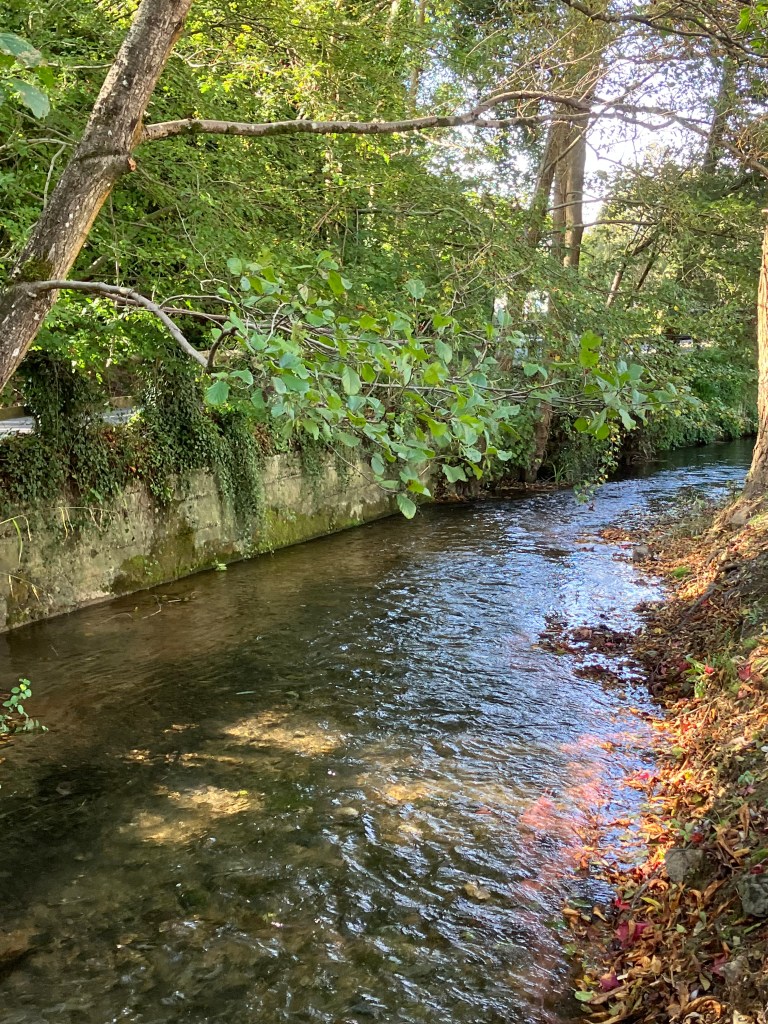
This garden centre is a veritable oasis of shopping with everything you would expect from a traditional garden centre and more. It is always one of my stop offs pre Christmas and didn’t disappoint even though it’s a bit early in the season.
I love perusing the decorations and tree ornaments, the candle and diffuser area, kitchen accessories from cookbooks to mixing bowls, bath time specialities and locally made food and drink. They also have a recently refurbished cafe with a rich history (mention the name “Tubbys” to anyone local and they will know where you mean!) which is complemented by outdoor seating overlooking the beautiful waterside and waterfall.

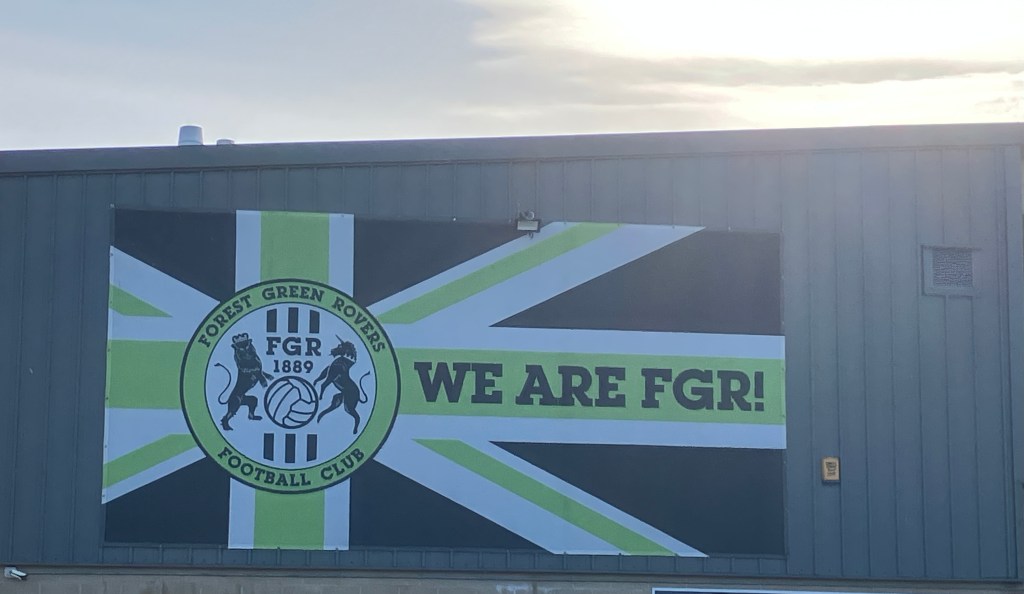
What a great way to finish our day and as we set off home I make a point of driving up Spring Hill away from Nailsworth and stopping off at Forest Green Rovers home ground. This is where our most famous local football team play.
Equally renowned for making their way into the football league in 2017 as the smallest place to ever have a club in the Football League. Nailsworth has a population of just under 5800, it is also famous for being recognised by the The United Nations as the world’s first carbon-neutral football club and it was described by FIFA as the “greenest team in the world”.
As part of the efforts of owner Dale Vince who is famous for also owning Ecotricity the world’s first company to sell green energy, he introduced vegan only food at the football ground in 2015!
Perched on top of the hill it is probably one of the most weather battered football grounds in the league as well although In harmony with nature they also have an organic pitch that captures rainwater and recycles it back for irrigation, saving precious tap water.
If you visit Nailsworth during the football season try and include a game. It’s definitely a new experience.
NB: This is the second of a series of posts about the wonderful “Cotswolds”. An area in the UK that you really shouldn’t miss out on visiting if you are coming to the UK. It’s full of olde world charm, history going back to the Roman era and beautiful architecture. Check out my previous posts in this series plus more to come soon. 
Please don’t forget to comment and/or like.
I love to hear what my readers think. and also look forward to your recommendations of places to see in the Cotswolds for my future adventures Thank you

The Cotswolds -Castle Combe

I am very fortunate to live in the South West of England. This part of the UK is full of quaint villages, rugged coastlines, homely pubs, amazing scenery, beautiful countryside walks and unique food.

Made up of six counties: Gloucestershire in the north of the region, Cornwall in the far south west and Devon, Dorset, Wiltshire and Somerset in between. The South West is the largest of the nine regions in England covering 9,200 square miles and houses approx 5 million people. Within its borders are the magnificent cities of Bristol, Bath, Cheltenham, and Plymouth. It includes two entire National Parks : Dartmoor and Exmoor, World Heritage Sites at Stonehenge and the Jurassic Coastline amongst others and the longest coastline of any English region.
It is well known for it’s ancient folklore from King Arthur who was born at Tintagel Castle in Cornwall to the ancient stone circle at Amesbury in Wiltshire and the myths and legends of Glastonbury Tor.
Visit in the summer and you can see the spectacle that is Bristol Balloon Festival, mingle with the rich and famous at the annual Badminton Horse Trials or singalong to your favourite band at Glastonbury Festival (ticket willing).
If it is food you are after then you need to sample a traditional Cornish pasty, a cream tea in Devon or Cornwall (but make sure you know the etiquette of which goes on first; the jam or the cream?), some real cheese from Cheddar or some Somerset cider.
If reading is your hobby then seek out the landscapes featured in Daphne Du Maurier’s books or those of Thomas Hardy or the Bronte sisters. It is also where Agatha Christie kept her country home and Enid Blyton set many of her children’s books.

I forget how lucky I am to live in this area and even more that I live surrounded by the Cotswolds countryside of rolling hills and golden stone villages. The vibrant market towns of Stroud, Cirencester, Tewkesbury and Tetbury are all within a short driving distance of my home. This richly rural area also boasts 3000 miles of footpaths and bridleways which I have been walking and riding since I was a child.

Until we set off on our next international adventure I thought I would introduce you to some of the wonderful places to visit here in my corner of the UK.
I thought we would start with a small Cotswold village:

Castle Combe in North Wiltshire:
I visited on Wednesday Afternoon with a couple of my friends -Debbie and Janette and Debbie’s one year old granddaughter . We arrived at about 11 am.
Parking is at the top of the village. If you drive down into the village itself you will find most of the allocated parking taken up by locals who quite rightly wish to park outside their homes.
Leaving the car park behind you its a short stroll down into the village itself. Castle Combe is known for being a quintessentially English village and often named as the ‘prettiest village” in England. The village has a rich history and the houses happily show off the honey coloured Cotswold stone, typical of the area.

We began our visit by strolling the length of the main road running through the centre. This ultimately takes you to Water Lane. Everyone takes photos here because quite frankly it is beautiful. It’s worth doing a full 360 and capturing the village from every angle. The small stream running through the village is most evident here and in case you need a quick break there are toilets on the right hand side.

Returning to the centre of the village we decided to stop for coffee and cake. There are a few places to choose from including The White Hart and The Castle Inn but as a group of friends we tend to try and support the more independent nooks and seeing a sign on our right opposite the central Market Cross we followed it down a small lane to The Old Stables Coffee Shop. They have a website if you want to check the opening times and offer indoor and outside seating.
We were lucky, as despite being on the cusp of Autumn, the sun was shining and so we parked the buggy up and settled ourselves on a table outside. Between us we sampled a bacon n cheese turnover, a pain au chocolat and a slice of apricot and pistachio cake with edible flowers on top.
Sustained, we wandered back into the village and took a look at the Market Cross. A lot of English towns and villages feature this central construction. In days gone by markets were often granted by charter and as such it was important to mark the central point for the market to trade. The cross was there to remind folk to do business fairly and honestly under the watch of God. They were also used as sites of proclamation and often for punishment of criminals, usually in the form of public humiliation.
The Market Cross in Castle Combe was built in the 14th century but was recently restored at a cost of £100,00.

Directly across from this central marker is St Andrew’s Church. Dating from the 13th century, this Grade 1 listed church houses a faceless clock which is reputed to be one of the oldest working clocks in the country.
It’s worth noting that long before the arrival of the Romans in Britain in 43 AD, there is evidence of an early Celtic tribe’s pagan temple where St Andrews now stands.
In this modern era you can scan a QR code on entry into the church which picks up a digital tour giving you the history of things you can see and stories about the church as well as the village itself as you walk around.
As a bare minimum take a look on the north side of the church where there is a superb carved stone monument of Sir Walter de Dunstanville, Baron of Castle Combe, a Norman Knight, who died in 1270.
Leaving the church behind we spent sometime outside exploring the graveyard where there are a number of tombs, memorials and monuments, 25 of which are Grade II listed. I always find it interesting to look at the gravestones, sometimes you come across something totally unexpected. In this case it was clearly evident how the advances in medical care have prolonged life and how back in previous centuries people died so much younger.

If you walk to the back of the church you will find an exit out onto a beautiful lane and the car park of the Manor House Hotel.
Although the grounds of the hotel are only open to residents you can get a sneak peak at the wonderful waterfall which forms part of the same stream that runs through the village as well as the lawned areas surrounding the hotel.
If you turn right away from the hotel you can stroll along the lane. It is hard not to admire all the wonderful Cotswold mews cottages here which form part of the accommodation on offer at the hotel. If you fancy a touch of luxury check out the hotel on line. It offers an 18 hole golf course and a Michelin star restaurant.

The lane leads you back into the centre of the village and so to top off our visit we headed back to The Stables to grab a late lunch. They offer a range of products but we all chose a baguette made to order with freshly baked bread from The Old Bakehouse in nearby Malmesbury. All served with salad and a side of crisps. We chose the cheddar & country garden chutney, salami & mozzarella and hummus & roasted vegetables.
One of the friendly staff at The Stables pointed us in the direction of a small childrens’ park tucked away behind the buildings opposite the cafe. This gave our little companion a chance to run around and be free before we had to walk back up the hill and head home.

Castle Combe is also home to the famous race circuit and we could hear the roar of the engines as we walked back to the car. Based upon the perimeter track of an old World War II airfield it opened for racing in 1950. The track offers a number of different experiences for car enthusiasts including passenger rides, driving experiences and car shows. It’s worth having a look at their website if you are visiting the area.

Castle Combe is just south of the M4 and is within driving distance of Bristol, Bath, Tetbury and Cirencester if you are looking to do a bit of a tour of this southerly end of the Cotswolds.

NB: This is the first of a series of posts about the wonderful “Cotswolds”. An area in the UK that you really shouldn’t miss out on visiting if you are coming to the UK. It’s full of olde world charm, history going back to the Roman era and beautiful architecture. Check out further posts coming soon.
Please don’t forget to comment and/or like.
I love to hear what my readers think. and also look forward to your recommendations of places to see in the Cotswolds for my future adventures Thank you


Real Life -When The Trip Is Over!

We are home, we drop our bags in the guest bedroom and try and work out what time of day it is inside our bodies.
We had woken up on our last day at 7 a.m. which is pretty normal for us and left our hotel in New York at 2 o’clock in the afternoon, travelled by taxi (as a treat!) to JFK airport which seemed to take forever. No wonder they charge so much for a taxi, it was only 18 miles and yet it took the best part of an hour and a half!
Our driver was from Central America, we knew because he spoke Mexican Spanish on his mobile to his wife twice whilst we were in the car. His English wasn’t great so we had that awkward trip where you aren’t sure whether to talk to each other whilst ignoring him or attempt to make conversation with him in stilted English. We chose the former.
Our flight wasn’t scheduled until 7.30 p.m. but we had decided to camp out at the airport rather than hang around the hotel lobby. Both of us are very much the type of people that once the day to go home arrives we just want to leave. We hate having to hang around. It’s definitely one of those “beam me up Scotty moments” where you just want to press a button and land in your living room without everything else in-between.
In between for us was an overnight flight into Heathrow, a train journey with two changes and then a trip by car from the train station to the front door. It is 9 a.m. in New York and with about 3 hrs sleep on the plane, which in itself is a miracle for me, I’ve been awake for the best part of 24 hrs.
We decide to lock the front door, draw the bedroom curtains and take a 3 hr nap. It’s nice to be back in our own bed having slept in more beds than I can remember in the last 6 months.

The next day, week and month envelop me in a cloud of unreality. It has felt really weird. We have been alone, just the two of us against the world, for the last 6 months whilst travelling. I’ve loved it. I am so lucky to have found my person whilst in the midlife stage of life. We are so compatible, intellectually on the same wavelength, both able to compromise and wanting the best for each other. It is so easy being in this relationship. But suddenly we have neighbours, family, friends, acquaintances and most of all life to deal with.
Everyone reacts differently to our being home.
Some are genuinely interested in our travels and cannot wait to hear about it. Others brush over the subject as if we’ve only been away for a weekend and have very little to say. I can feel a mixture of awe, excitement, disparity and even some evidence of envy in our conversations. Some friends have stayed in touch over the internet or by phone during our travels, a few we haven’t heard from?

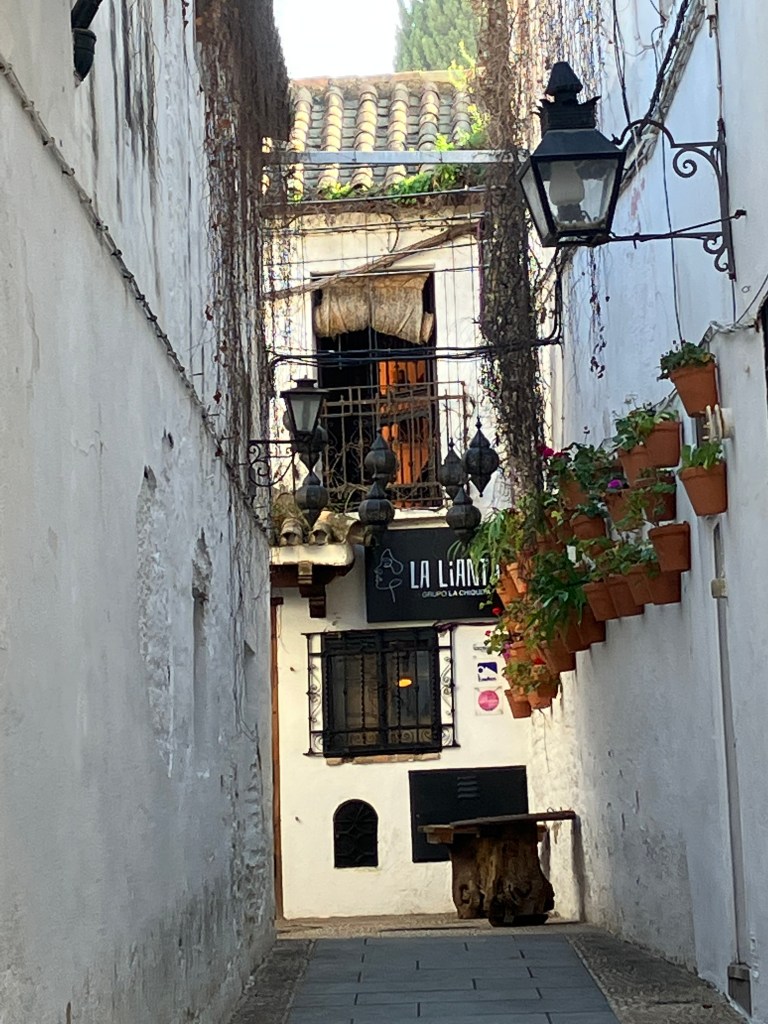
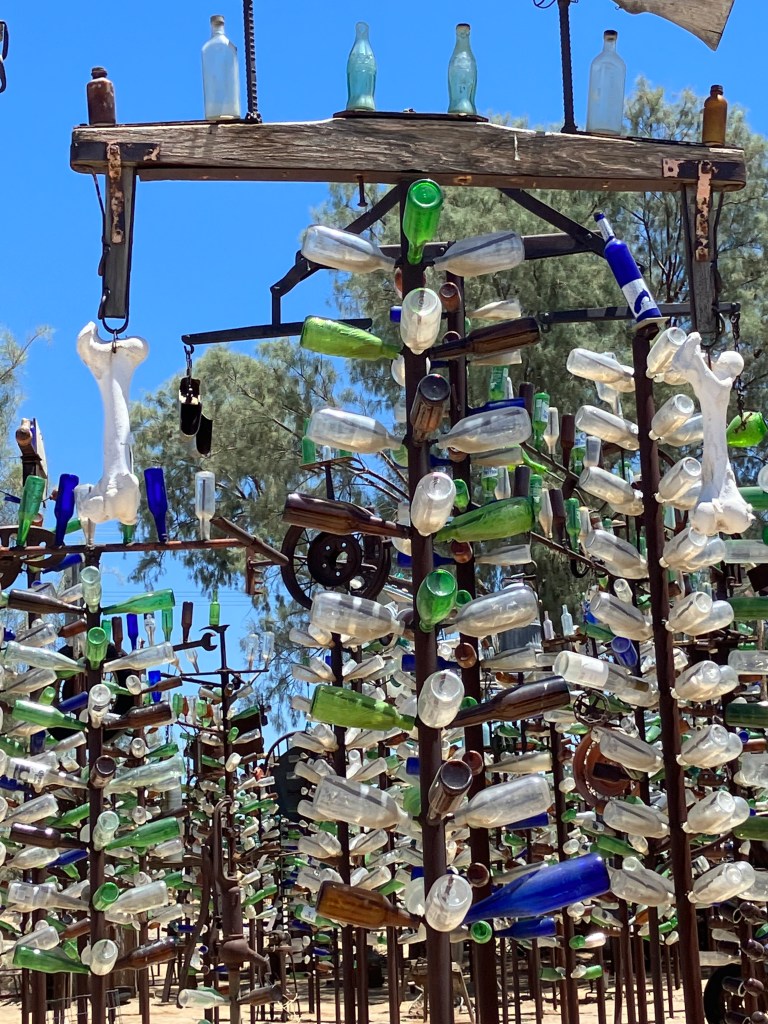
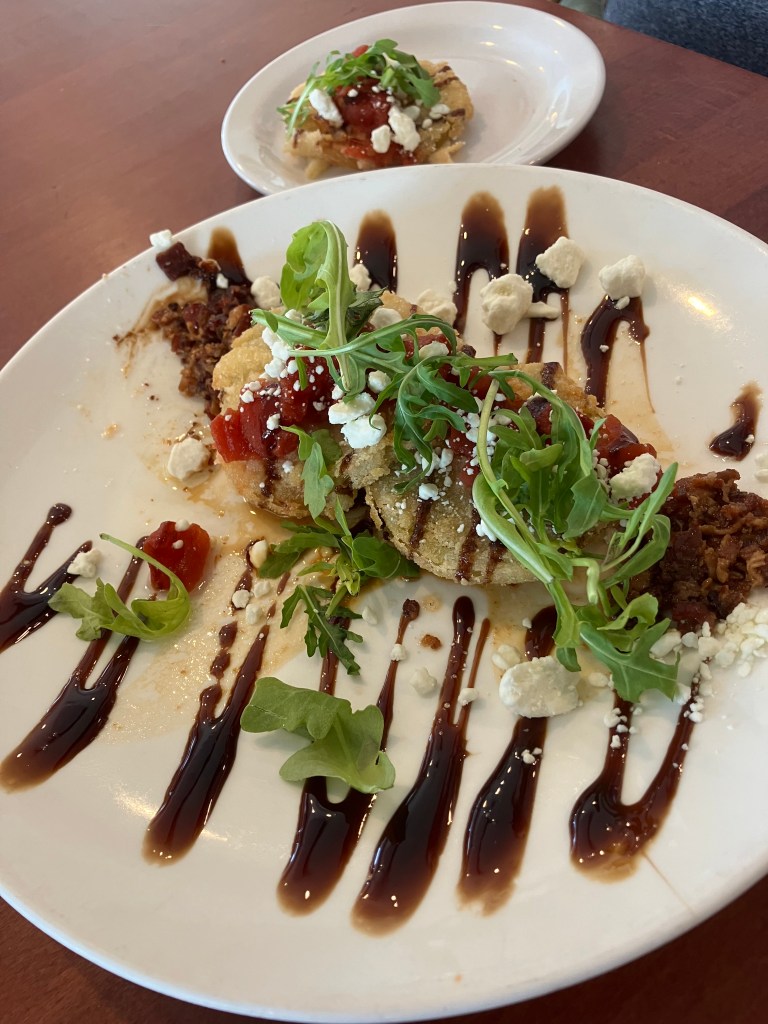
There are definitely moments when I want to press that “Scotty button” and transport myself back to lunch in the Turia Park in Valencia, the winding cobbled streets of Cordoba, Elmers Bottle Tree Ranch in Orio Grande or Hudson’s Seafood House on Hilton Head sitting eating a seafood broil and fried green tomatoes.

I hadn’t thought about what it was going to be like to be back home in our own house, in the Cotswolds, in England, in the UK! I certainly didn’t imagine I would feel so lost.
During the trip I had read little news. My husband is a bit of a news fiend but he knows better than to impart what he reads to me. He knows me well enough that if I want to know something specific I’ll ask or research it myself.
I had taken a day off to watch the King’s Coronation on television in Holland in May but it had all seemed a bit surreal, a bit like watching a true episode of The Crown! I felt totally detached from it.

The reality of being home really hit me about three weeks in. I wanted to pick up our house and transplant it somewhere else. Where ? I didn’t know. I just knew I didn’t want to be where we were.
I wanted to be close to my family and friends and able to restart my hobbies and interests. My husband had sold his work’s vehicle before we left in March and was now definitively retired and I have to say adapting well to the transition. He also has his own hobbies and interests.
I found myself envying the Americans purely for the space. The country is so huge there is just endless amounts of space.
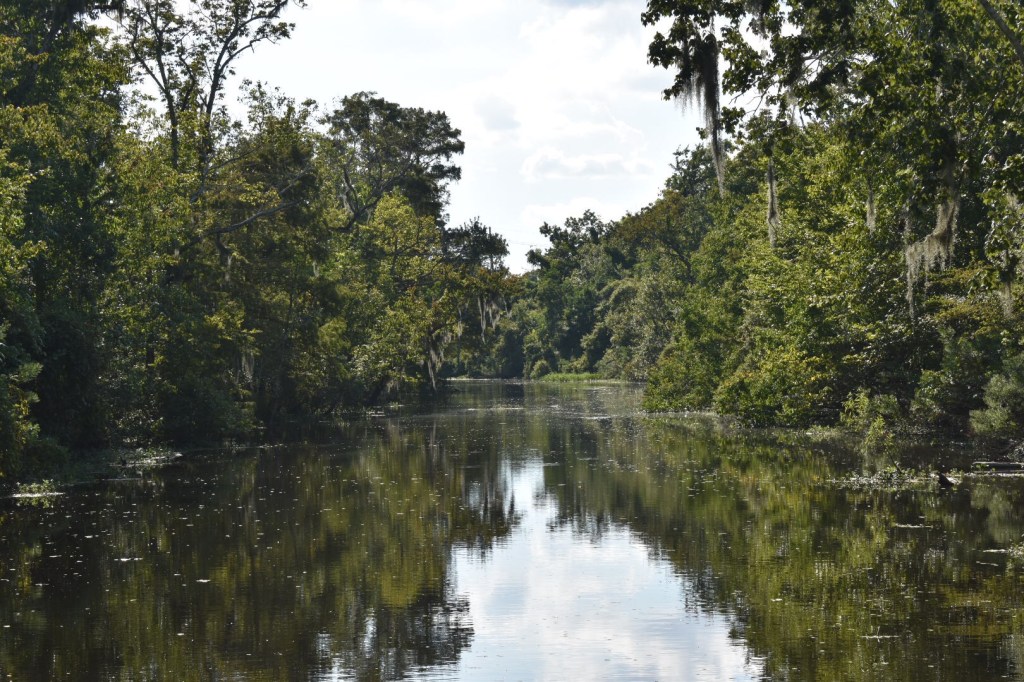
Memories of driving through Georgia with its thick forests on either side and steaming swampland remind me of books like “To Kill a Mockingbird” or ‘Where the Crawdads Sing”. Neither were based in Georgia but the landscape felt the same. Impenetrable and solitary.
You could basically buy a mobile home or wooden lodge and put it down anywhere in the “sticks” and to be honest no one would know. You could easily stay hidden from society.
England suddenly felt really claustrophobic. Even in the countryside, unless you have loads of money to buy a secluded cottage, it suddenly feels like we are all living on top of one another. I definitely feel discombobulated.

I know I’m lucky that I don’t have to go back to work but in some ways it might have been easier to just return to a routine and work my way out of this post travelling bubble.

There is a part of me that is angry. Looking at the state of our country. Having been away for 6 months it’s like returning to somewhere I no longer recognise. I feel like I’m the only one who wants to challenge the status quo, to ask all the questions that I’m sure a lot of folk have on the tips of their tongue, but are too afraid to utter. What is happening here? Why are we concreting over the beautiful countryside to constantly build more and more houses. Why are the Government being allowed to continue this path of outright corruption and disregard for the everyday people? When is someone going to wake up and realise that two party politics no longer works?
They just basically spend their time undoing what the previous Government has done, blaming all their problems and issues on previous right or left wing parties in power depending upon who is currently in control. It was no different in America.

I want the young people, the 18- 40 year olds to wake up. To use all their social media knowledge to create a political storm that makes all these MP’s who are so out of touch with reality to wake up and change or be overthrown in favour of someone younger. Someone who isn’t a Labour or Conservative believer but who cares about the things that matter: the NHS, the housing crisis, immigration, the reality of climate change, the failure of Brexit, the demise of a country so stuck in it’s past and most of all -the lack of hope for our under 40’s. What will it take to wake everyone up?

In the meantime I want to pick up my house and drop it on some remote island somewhere where we can go back to just us two against the world!

I have to make a conscious effort to push all this negativity away and focus upon our future. To imagine what our little house can be once we have been home for a year. How wonderful our life is together and I have to make a concerted effort to settle back in to real life! Part of real life for us is planning our next holiday or period of extended travelling. Canada beckons. Driving from East to West and everything in between.
I need to find another planning website. I’ve always used Inspirock but Klana took it over a year ago and after, I’m guessing not making an equal success of it, shut it down with no notice on August 23rd. All my previous trips and some we had already started to look at in the future were lost at the press of someone’s button. I’ve tried to ask them why but being a massive conglomerate they don’t care about us mere travellers. Even though people are raising the issue on line, all around the world, including one poor couple who lost their honeymoon plans, Klana continues to remain silent and ignore us!

Posting on my blog still brings me joy. It’s lovely to know people are out there reading it and I have a few more posts from this latest trip to write about plus plenty of previous adventures already in draft so stick with me, give me your feedback, tell your friends and family about it and I’ll see you again soon x

America -The Home of Politics and Religion

Apologies to those who read my blog regularly. I have been somewhat remiss since coming home to the UK.
When you return from a lengthy trip away there is so much to deal with on your return:- unpacking, washing n drying, post, post n more post!, the over run garden, trying to settle back into real life etc
It is definitely weird being back and is taking some adapting to.
There are a few more posts I would like to write about our time in America and this is one of them.

Throughout our three month road trip in America two subjects kept rearing their head in conversation: religion and politics.
Given that I was brought up not to mention these subjects in polite society this was a little alien to me. I would not have a clue whether my neighbours or even family relatives are religious and I definitely wouldn’t know how they voted politically. It just isn’t talked about here in the UK, well certainly not as much as it is in America!

Religion:
The “Bible Belt” in America is used to describe the 10 states of Mississippi, Alabama, Louisiana, Arkansas, South Carolina, Tennessee, North Carolina, Georgia and Oklahoma. This was a new concept to me.
I look around the UK and this type of affinity doesn’t exist here. I suppose Southern Ireland is seen as the most religious as Catholicism is stronger there than anywhere else but other than that there isn’t really a particular area where religion is more prevalent than another.

As we travelled along Route 66 and then up the Eastern Seaboard we passed through four of these Bible Belt states which are known for being socially conservative where Protestant Christianity plays a strong role in society. Church attendance across the denominations is generally higher here than the nation’s average.
In plain English this means that those attending seek to preserve traditional values and beliefs.
Religious conservatives also typically oppose abortion, LGBT behaviour (or, in certain cases, identity), drug use, and sexual activity outside of marriage. In some cases, conservative values are grounded in religious beliefs, and conservatives seek to increase the role of religion in public life.

This narrative tends to be that of the current OAP (65+) community here. They have a tendency to want to hang onto tradition, struggle to manage change, are often technophobic, have deep rooted respect for the armed forces and monarchy.
Statistics post the coronation of King Charles III show 62% of society support the monarchy but in the 65+ age group this climbs to 80% whereas in the under 50’s this drops by age group until you reach the 18-24 year olds where the percentage is 32%.

As we drove across America on Route 66 the sheer amount of churches and the diversity of religion was mind blowing. We drove through one small town, we would probably call a large village here in the UK and counted 24 churches. It honestly left us with our mouths agape. How can one community of this size need 24 different places of worship?

I had to examine this on my return to the UK and my research shows according to the National Congregational Study Survey, there are an estimated 380,000 churches in the U.S. I actually find this hard to get my head around.

When people spoke to me about religion whilst on our trip I tended to talk about the fact that religion is decreasing in the UK.
On census day, 21 March 2021, which was during a Covid lockdown and as such is probably one of the most accurate census we have had since everyone was at home, it shows 46.2% of people identified themselves as Christians. For the first time ever this showed that less than half the population were Christians. This compared with 59.3% of the population in the 2011 census, a 13-percentage point drop in a decade.
Based on previous analysis in 2015 that shows of those stating they were Christians, less than 5% attended church regularly, the projection is that this has fallen still further.

A key finding from the census was the significant rise in people identifying as of no particular faith at all -across England and Wales, 37% said they had no religion, around 10% of the population are of non-Christian religions mainly Muslim.

When I mentioned these figures in America the overall reaction was one of shock. I actually felt like some people were suddenly seeing us a bunch of heathens!

To give some comparison on this The American Religious Landscape in 2020 shows seven in ten Americans (70%) identify as Christian. Nearly one in four Americans (23%) are religiously unaffiliated, and 5% identify with non-Christian religions.

Churches are shutting down in the UK due to non attendance.
In my home area when I was a child, back in the late 1960’s, every church held a service on a Sunday morning. Sixty years on the smaller churches are closed and those still wishing to attend a service have to travel to one of the larger churches where a vicar is still in attendance.
Some churches although depleted of a regular Sunday congregation remain open but may have a Sunday service once a month held by a circuit vicar who travels around taking service in one of four different places on a given Sunday each month.
Those that are shut down, particularly those that are not owned by the Church of England or The Roman Catholic faiths, who are notoriously richer in monetary terms, often sell them off for repurposing into housing, entertainment or retail.

Figures show that The Church of England is declining faster than other denominations; if it carries on shrinking at the rate suggested by the latest British Social Attitudes survey, Anglicanism will disappear from Britain in 2033. That’s in ten years time!

One of the other key questions we were asked in America was about the monarchy and often alongside this the future of the monarchy since the death of Queen Elizabeth II. I tended to respond by explaining that one of the monarch’s key roles is “The Defender of Faith and Supreme Governor of the Church of England”, titles that date back to the reign of King Henry VIII. Without Christianity where does that leave the role of the monarch?

A survey by the National Centre for Social Research (NatCen) just prior to the coronation showed public support for the monarchy has fallen to a historic low. A total of 45% of respondents said either it should be abolished, was not at all important or not very important.
An additional concern is that just 12% of 18- to 34-year-olds view the monarchy as “very important”, compared with 42% of those aged 55 and older. The challenge going forward will be for the monarchy to deliver its relevance and appeal to a younger generation to maintain this support.

In conclusion culturally where religion is concerned the UK and America are currently sitting in very different places which is probably why I found, during our travels, the focus on religion in America to be slightly too intense for my liking.

Politics:
If I thought religion was intense, how would I describe the political field in America? Probably all encompassing.
It came to a point, quite quickly, that I had to consult my husband every time we crossed a state line to know which political affiliation the new state voted, purely so I could avoid difficult situations and conversations.

The openness and strength of belief about politics in society was really quite overbearing.
As soon as we left Chicago and headed out onto Route 66 evidence of political belief became visible and sometimes stared us in the face. For example out in the Illinois countryside surrounded by acres of corn you couldn’t help but see the roof of the farmhouse painted red with large white lettering showing allegiance to Donald Trump.

When we had to use a taxi during our travels it wasn’t unusual, once the driver knew we were English, to then start asking about our political standing.

We heard comments in independent shops particularly book shops which we found odd, from local tourist guides whose political leanings sometimes showed in what they said about eras of history, over breakfast in BnB’s and often if the subject of Covid was being discussed.

We just don’t see anything like this here in the UK. When election season is on us you may see small flags outside peoples’ houses showing affiliation to a certain political party or sometimes purely stating “Vote Labour” or “Vote Conservative”.
Voting, here in the UK, is very personal. It’s not unusual for people within the same family to be unaware of how each other have voted.

Interestingly the percentage of people that voted at the last election in the UK in 2019 (67.3%) wasn’t vastly different to the US election in 2020 (66.8%).

It became apparent to us that because of the sheer size of the USA the vote for a president is economically beyond anything we in the UK can imagine. This, in itself, raises the stakes.
A lot of cash is needed in America to spread the word.
Conversely there are tight controls on what parties can spend here on campaigning during a general election, and private contributions are relatively modest.

In the US, the size of the country alone demands far more from private investors to get a candidate’s message heard. The 2019 -2020 campaign ran into billions of dollars overall.

The size of US rallies, also tends to dwarf public appearances by party leaders in the UK.
In each type of election, key states in the US or constituencies in the UK are usually chosen for stops on the campaign trail, but US candidates tend to focus heavily on the “swing states” where a change in affiliation from one party to another can have a huge impact on the outcome of the election.

Although it is becoming more common in the UK, TV debates are not guaranteed.
In America, however, they seem integral to the election process. Not only do presidential candidates from each opposing party debate on live TV (moderated by a prominent broadcast journalist), but there are also several televised debates before the primary elections take place.
In the UK, politicians are not necessarily expected to take part in televised debates, although a growing public interest in media has put pressure on party leaders to engage.

With elections due in both countries in 2024 it will be interesting to see how each election is conducted and ultimately what if anything changes in terms of those who win power.

Returning to our adventure in America and the subject of both religion and politics it was interesting that in Oklahoma which is part of the Bible Belt we often heard religion mixed up with politics.
As of 2023, the Oklahoma Republican Party controls all 12 statewide executive offices and holds majorities in both the Oklahoma Senate and the Oklahoma House of Representatives; Republicans also hold both of the state’s U.S. Senate seats and all five of the state’s U.S. House seats.
It was like a double whammy for us to which a change of subject was often neatly negotiated by either myself or my husband.

In a country so hung up on these two subjects we personally would find it very hard to be happy here. Culturally our two countries are very different and this was probably one of the biggest learnings from our trip.


I Am Sam -I Am For Sale!

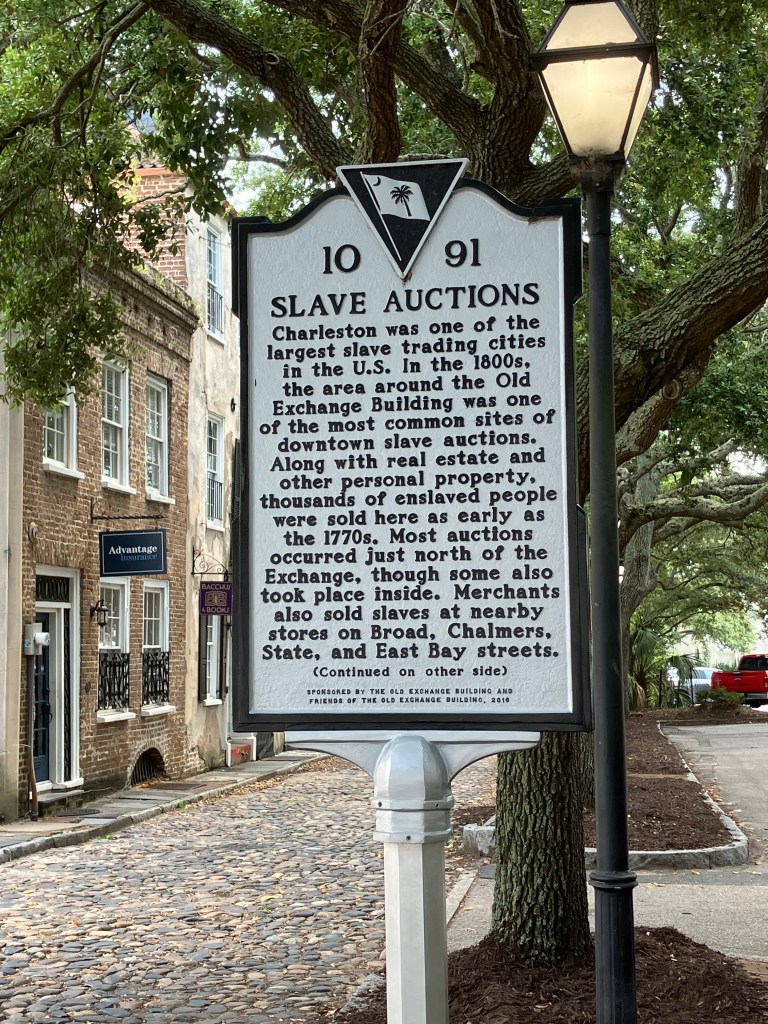
My story continues in a city that I later learn is called Charleston. It is here that all three ships land and once again we are shackled together and marched out of the bowels of the now stinking hold.

As we walk through the streets of this city white people dressed in fancy clothes stop and stare, they make comments that I don’t understand and once again we are locked together in an overcrowded wooden pen. It’s not dissimilar to the type of enclosure I built back home in the village to secure our animals.

Time moves slowly and I lose count of how many days we are confined here. The heat is unbearable, sweat sticks to my body and although we are fed, it is mainly with bread and water.
When it rains, it is a relief to feel the cold water on our bodies but at the same time I fear becoming ill as I have seen others suffer. I need to stay alive. My companion from the boat is shackled nearby and our whispered conversations add brightness to my days. He speaks several African languages and is often able to pick up snippets of conversation that he conveys on to me. It is through him that I learn about the other boats that sailed with us. One of the vessels carried just women and children and whilst I hope that my wife managed to escape captivity, I also wish her to be here so I can once again set my eyes upon her face and know she is alive.

One morning bright and early we are shackled together in a line of six and marched out of our compound. Lined up in a row we are each forced to strip off our clothes, wash our bodies with a bucket of cold water, a rough cloth and a cake of white soap .
Still naked we are taken to a small hut, inside is a white man with a blade. We are each forced to sit down on a chair, our heads and faces are shaved. There is no point in struggling, this only leads to punishment from the canes and leather straps held by the guards.
As I leave the hut I feel like my manhood has been stripped away from me. I have never been bold since I was a baby.
Leaving the hut we once again line up and are given a small cup containing oil and one of the guards demonstrates we are to put this over our bodies. Only then are we given some clothes to wear that cover our manhood.

Once this process is complete each chain of men are led through the street. There are groups of white men gathered alongside, they prod and pinch us as we proceed, sometimes they stop the procession to look at our teeth or to check our arm muscles. What is happening to us?
I try and ask my friend but he cannot hear me and soon we come to a rest. In front of us in the middle of the street is a raised platform. There are several lines of African men in front of us. I have completely lost track of some of the men from my village that came off the ship with me but eventually I see some of them being individually unlocked from their leg irons and hauled up onto this wooden stage.
It reminds me of the small markets back home where we would go to buy and sell our vegetables and crops. But these white men are competing to buy us!
My spirit, at this point, feels broken. I am not for sale I want to shout but I know my words will be spoken in vain. We are totally outnumbered here and the punishment for disobeying these men is not worth the fight. My friend is now for sale. I look into his eyes and I can feel his pain. A white man on the far left eventually ends the bartering and my friend is led away.

My turn comes all too quickly and I pray to my gods back home that if I am to be sold in this way it is to the same man as my friend. Together I know we can survive but without him life will be harder. I make a point of looking at the white man, trying to catch his attention, I smile, I flex my arm muscles to show how strong I am and when the bidding finishes I am lucky and join my friend. We are in a new pen alongside several other young African men awaiting our fate.

As the sale of the men finishes there is a brief pause in activity before I see women and children also in chains being marched down the street towards us. Some of the children look no more than ten years old. They are scared and frightened and do not understand this new world they have been forced into. I had no idea these white people were selling young boys and girls in the same manner as I myself have just been sold. Some of the children are chained to their mothers but are separated at the point of sale. The cries of the children and screams of the mothers resound all around us, this is a living hell.

Then suddenly I recognises a couple of the women, they are from my tribe. My eyes search the lines behind them in the hope of seeing my wife. Suddenly I see her. I am so happy that she is alive. My instinct is to shout out to her, to get her attention but she cannot hear me above the noise of the market.

Soon it is her turn to stand on the platform and she is sold too but I cannot see the man who has bought her. I hope against hope that she will soon join us and I scan the crowds of people but she does not appear…………

Sam, along with his fellow Africans are now slaves. They are moved to a plantation on the coast of South Carolina, cut off from the mainland and accessible only by boat, the chances of escape are minimal.

They work to create rice fields from the swamplands that surround them. It is a continuous fight to stay alive, to avoid the punishments metered out by the overseer for acts he considers defiance. The swamps are full of alligators and snakes, of which half a dozen are venomous. The heat and humidity during the long hot summers bring endless swarms of mosquitos.

They are forced to forgo their heritage, their language, their beliefs and customs and to adapt to this New World. Sam learns English in order to understand those who have enslaved him. His basic needs along with those enslaved with him – rest, cooking, making and mending clothes, tending the sick, the young and the old – are met in the short hours at the end of the working day or sometimes on Sundays.

Sam never saw his wife again. He had no idea what happened to his unborn child. His life expectancy on entering the plantation was five years. Sam was a slave for eight years, he died alone and in hope.

I Am Sam -The Reality of the Slave Trade

When we were planning our trip to America, in addition to spending time travelling from coast to coast and exploring the Eastern seaboard, I wanted to extend my social historical knowledge and learn more about:

The Demise of the Native American Indians
The Slave Trade

My previous posts “Our Navajo Spirit Tour Guide” and “The Western Movies Lied to Me” outline my new knowledge of the first sector. I still have more to learn and have two books to read on my return to the UK which may well spur me into delving even deeper into this subject.

Back in 2019 we had ventured to the North West of England on a short road trip and whilst travelling we had stayed in Liverpool. Here I spent a considerable amount of time one day at The International Slavery Museum based right on the waterfront at Liverpool’s Albert Dock, at the centre of a World Heritage site and only yards away from the dry docks where 18th century slave trading ships were repaired and fitted out.
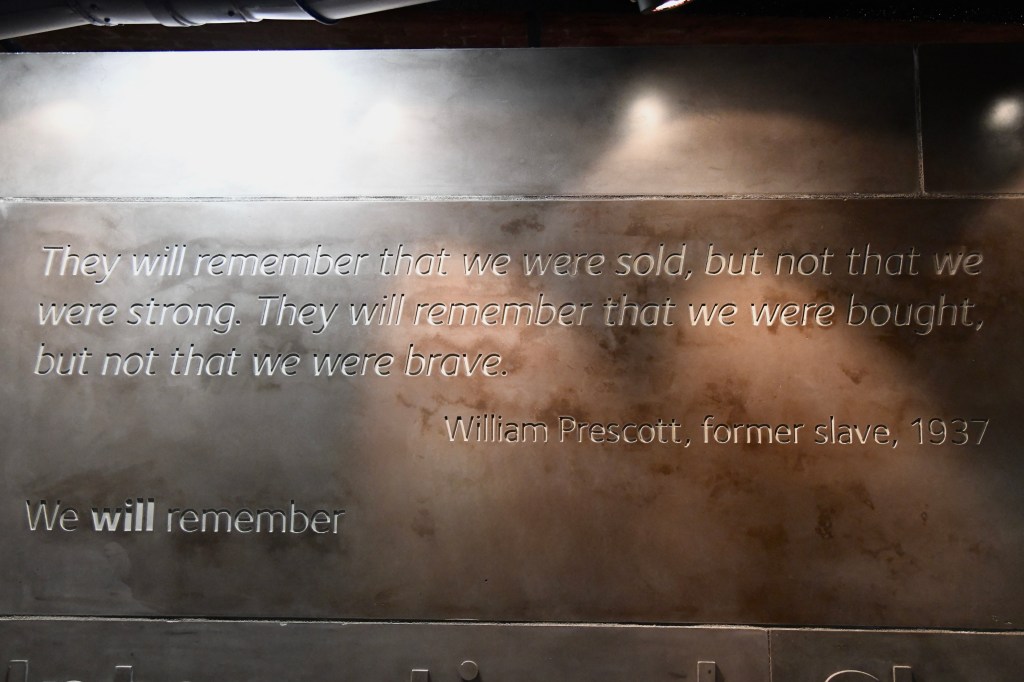
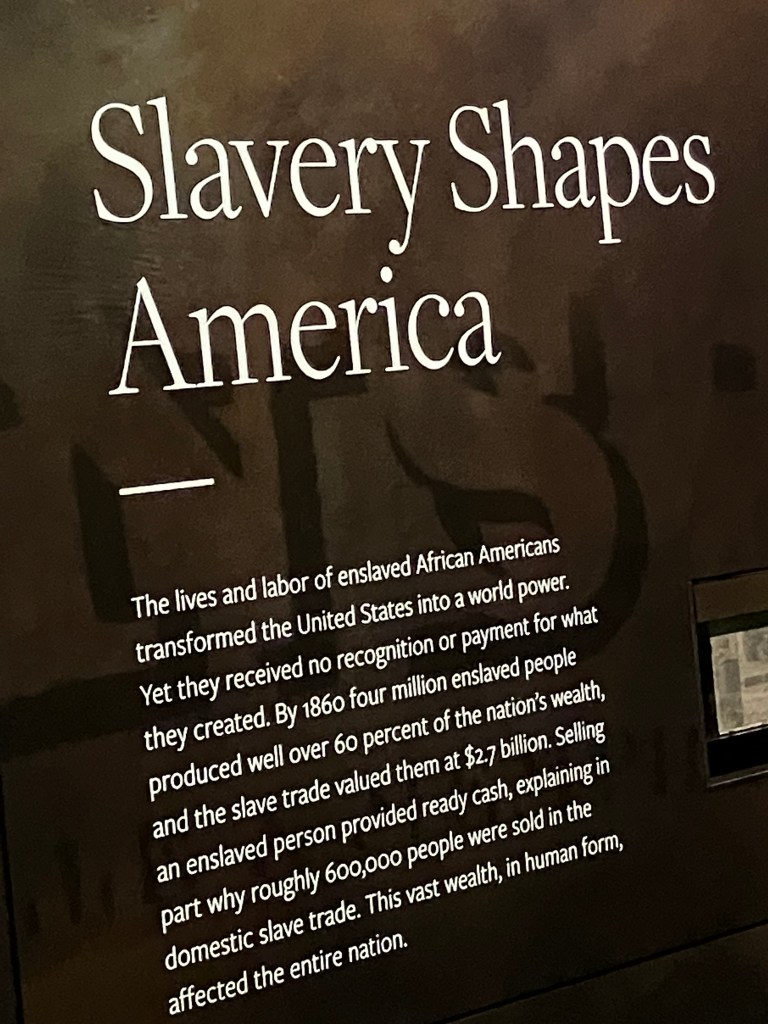
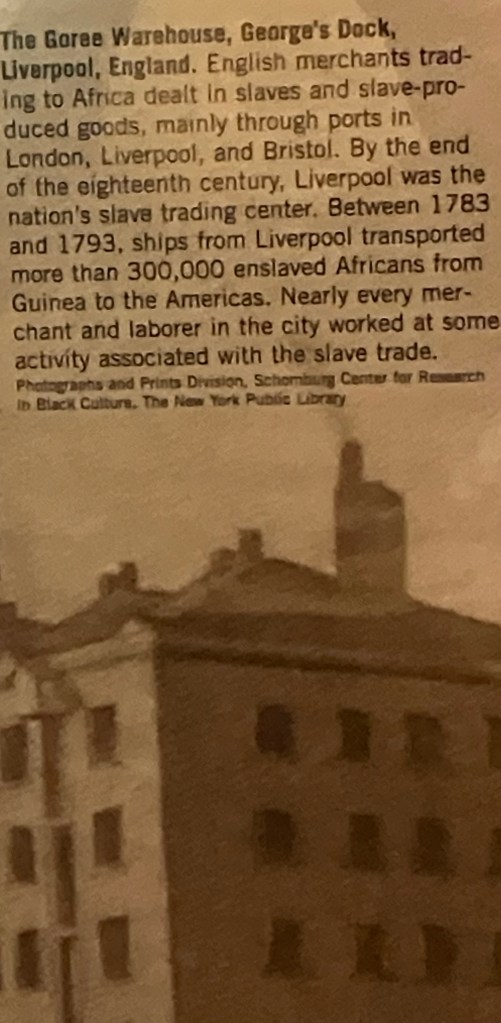
I had worked in Liverpool in the early 90’s before this museum ever existed and never realised it was a major slavery port and that its ships and merchants dominated the transatlantic slave trade in the second half of the 18th century. The city’s wealth was derived from this sickening trade and it laid the foundations for the port’s future growth.

From about 1500 to about 1865, ships from Liverpool carried about 1.5 million enslaved Africans across on approximately 5000 voyages, the vast majority going to the Caribbean. Around 300 voyages were made to North America – to the Carolinas, Virginia and Maryland and it was this I wanted to explore whilst we were here in the USA.

As part of our travels up the East Coast of America we stopped at Hilton Head to take part in a Gullah Heritage Trail Tour. The Gullah/Geechee people of today are descendants of enslaved Africans from several tribal groups of west and central Africa forced to work on the plantations of coastal North Carolina, South Carolina, Georgia, and Florida.
Hilton Head was separated from the mainland by many waterways which made travel off of the islands difficult and rare. The slaves who worked this land, therefore, were cut off from once they had arrived.
It wasn’t until 1956 that a bridge was built that allowed cars to travel across these waterways.

We also visited the Magnolia Plantation in Charleston. This is one of the country’s oldest plantations dating back to 1676. Thomas and Anne Drayton built a house here and owned the rice plantation for the next 15 generations utilising slave labour to build a network of irrigation dams and dikes.

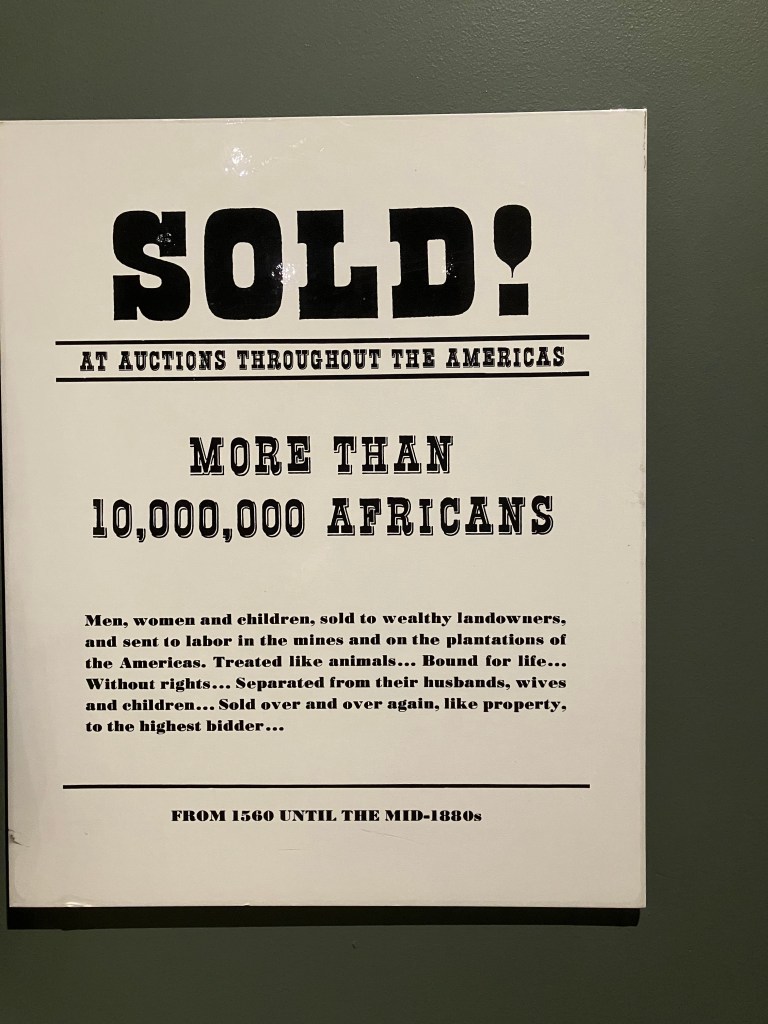
The Old Slave Mart Museum is also in Charleston and covers an important part of Charleston history. This is one of the few remaining buildings once used for securing slave labour. It was constructed in 1859 and once formed part of a much larger slave market taking up an enclosed space between two major streets. It was established by a local sheriff after a ban on public slave auctions and operated until 1865 when it was closed down by the Union forces when they occupied the city.

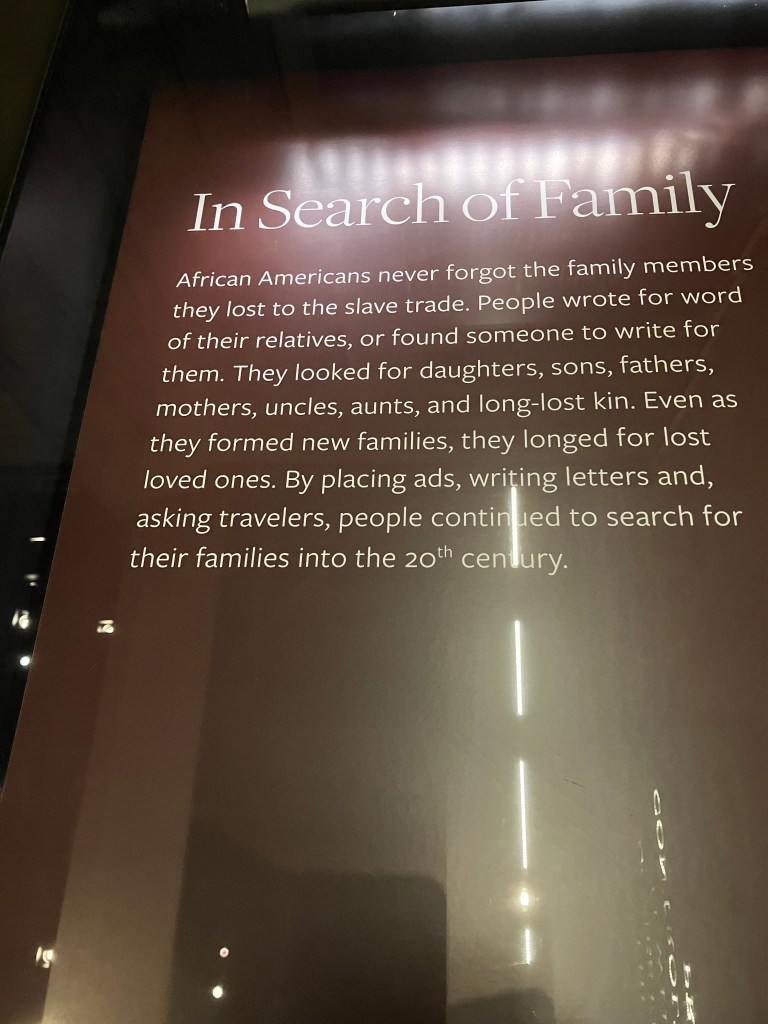
Finally we visited the National Museum of African American History and Culture in Washington DC which devotes a whole floor to the slave trade ensuring that all visitors can be educated on this part of American history.

I still feel that people, particularly those in the middle to higher classes of our society here in England, fail to even try to understand how these people felt or to accept our responsibility as a kingdom for it’s existence. Maybe this story will help you, the reader, to understand…..

” My name is Sam.
This isn’t my real name but the name I have now been given here in this New World.
I am originally from West Africa. It was a wonderful place full of sunshine and laughter.
I am in my mid twenties and I lived a happy life with my wife. She was expecting our first child. We had a home together in the village, that provided shelter from the blazing sun and the yearly rains that fall.
My father taught me how to propagate rice. Food was plentiful and I enjoyed the camaraderie that I shared with my fellow peers. Young men and women that I had known all my life. The traditions and cultures of my ancestors were passed down through the generations. Life was good.

One day whilst I was busy working on our land, my life as I knew it was torn apart. I’d heard tales from other tribes of the marauding English merchants who were capturing local tribespeople and taking them away in chains but not for one moment did I believe they would venture this far inland and arrive at our village.
With the onset of gun shots I immediately ran back towards the village intent on finding my wife and escaping somehow into the surrounding bush. I tore across the rice fields, my feet treading without thought on the crops I have nurtured and grown. Smoke started to rise from the village and my heart was beating fast within my body as I ran faster and harder.

The screams of the women and children can be heard as I approach the outskirts of the village. I have no form of defence and then I see them, the white enemy has arrived. They use their weapons to force the villagers to their knees in the centre of the huts. My wife is crying and clutching at her pregnant belly looking all around for me. I run towards her but before I can reach her, to protect her, something hits the back of my head and I crash to the floor.

When my eyes reopen I am on the ground, it is nearly daylight. My ankles are chained together along with my wrists and I can barely move. My head is sore and I can feel the dried blood coagulated where I was struck. There is no sign of the women and children, only the male villagers remain.
Many, like myself, are nursing injuries brought about while defending their homes and families. As dawn breaks so I am forced to my feet and more chains are used to bind us all together in one long snaking line of humanity.
Leaving behind my home, my village and my way of life we are forced to march from sunrise to sunset for many days. A share of water is distributed two or three times a day. Food maybe once a day and even then it is nothing I recognise, no taste or flavour but I know I have to survive for no other reason than to have the strength to find my wife.

Days melt into one another, my feet are sore and wounded. Older less fit members of the group struggle to stay with the pace. The men who have taken us have no feelings. Those who collapse on the journey are left to die with no water and no food. I estimate that about a third of those who set out from the village are no longer with us. I knew them all, elders who I was brought up to admire, who shared stories of our heritage but there is nothing we can do but move on. Eventually we arrive in a bustling town, large boats, bigger than anything I have seen, are moored to the quayside.

These men who have captured us speak their own tongue and we cannot understand their commands but they make them known through their actions. Pushing and shoving us into a stone building. There are many others already inside and as the door is shut and locked behind us we all want to sit down on the dirty floor and rest, but there is very little room. Some of those already inside look ill and it is hard to avoid staring at them. Everyone is quiet but I try to converse and at first no one answers me, but eventually someone responds.
He understands my tribal language and begins to explain that some of them have been there for many days and nights even weeks. Food and water are scarce.
He explains that the boats arrived over the last few days and the cargo from within has been off loaded. He has heard that we are to be loaded onto the boats tomorrow.
I try and explain about my wife and tell him I cannot go on the ship, I cannot leave this land, my home and my family.
He laughs and asks me who I think is in charge. We have no choice he says.
“Do you want to die” he asks me? I consider this question for a few moments before nodding my head in refusal. “Then do as you are told” he says to me.

Dawn breaks the following morning and with no food and only very little water since our arrival I can feel my body weakening but I must remain strong.
As predicted we are led out of the gate and onto a ship. We are taken down into the depths where it is dark and damp. More and more tribesmen from other villages are brought down. We are packed together below deck and secured by leg irons. The space is so cramped we have to crouch or lie down. The man I had spoken to the previous day is close to me.
“There must have been more stone buildings we could not see” he whispers “there are too many to fit!’
Eventually the door is closed and we are left here not knowing our fate. I try to rest, to close my eyes and sleep.

When I awake I can feel the boat moving from side to side and back and forth and I realise we have left and are now at sea. My country is now far behind me, once again I wonder what has become of my wife. I must find her and to do that I must remain strong. The air down here is foul and putrid. Men are being sick as a result of the constant rocking and the heat is oppressive.
The journey is tortuous but a routine is soon established by our captors. It seems in good weather, when the sun is shining and the boat is steady we are brought on deck midmorning and forced to exercise. We are fed twice a day and those refusing to eat are force-fed. The food is unfamiliar and tasteless but without it I know my strength will weaken and I must stay alive. Those who die are thrown overboard.
It is evident also that we are not alone as when we go on deck we can see two other ships, in close proximity, heading with us across this great expanse of water.

As our journey progresses some of the men become sick. I try to avoid them and focus solely upon myself and my need to remain alive. Others make attempts to escape often during our time above board. Their punishment when unsuccessful is not worth the act. They are tied to wooden posts and we are all forced to watch as they are whipped and then often thrown overboard!
The actions of these men also result in daily inspections of our quarters below deck by the crew and even minor acts of resistance are punished severely.
Some of my fellow Africans cannot cope with this imprisonment and throw themselves into the sea wishing for death over this existence.

Time passes slowly and each day seems to blend into the next until one day there is great excitement above deck and it is not long after this that the ship finally stops. There is a loud noise as if something heavy is being dislodged from the core of the boat and then suddenly the light streams in from above and we are being marched up onto the deck and off the ship. About 50% of the men who came from my village are now dead. I feel lucky to be still alive”.

Sam’s story continues in my next post …………………………


America v England -The Good, The Bad and The Ugly

I’m currently sat with my right leg raised on the sofa. My knee started to complain shortly after we had embarked upon this next phase of our adventure. The rental car was dispatched on Sunday and the remaining journey up the Eastern side of America is planned on Amtrak to avoid having to navigate our way through city traffic. Given this section includes a lot of walking having to rest isn’t exactly great!

As previously mentioned in my post “Discovering the Differences between America and England” we are definitely culturally different. Here, in no particular order are a few more of my observations/opinions:

FOOD:
When we planned this extended trip of adventure starting in Europe for three months, popping home for a couple of weeks and then flying across the Atlantic to discover America, everyone who knew us and thus our normal eating habits warned us about America. “The portions are huge!” “The food is unhealthy!” ” It’s all takeaways and processed food!” were just a few of the comments aimed our way.
The reality has been something different.

There are huge amounts of fast food both on offer and no doubt consumed.
According to the World Obesity Federation you might be surprised though to hear that the USA ranks at no 14 worldwide, not number 1, with 36.47% of it’s male adult population categorised as obese whereas the UK is at no 29 with an obesity rating of 27.88%.
The “good” thing for us, however, is that contrary to popular belief in the UK, healthy options are not hard to come by in America.
Every supermarket we have been in offers fresh fruit, vegetables and salads and more to the appoint, for us as travellers, a really good array of prepacked/ pre-made salads. There is a far wider choice here than I’ve ever seen in the UK and despite trying a huge variety we haven’t, as yet, found a single one we haven’t enjoyed.

Buying protein to sit alongside this is also not difficult whether that is chicken, salmon, seafood or meat. The shrimp here has been decidedly cheaper than in the UK, much better quality and cooked in a bit of garlic, really yummy!

However nearly everything in supermarkets is expensive here when compared to back home and, in the case of fruit and vegetables, often not as fresh. Maybe this is because it has to travel longer distances?
A lot of the fruit doesn’t taste the same? We have struggled, for example, to get strawberries that taste like fresh strawberries or in some cases a mango that is just ripe enough to eat and not as hard as a rock! We gave up on raspberries fairly early on.
We happily bought from roadside vendors when we were on Route 66 in the hope that we were buying home grown.

The “Bad” part is there is a huge amount of processed food here. It doesn’t feel as if the ordinary American is as conscious as we are about what goes into their food. Maybe the average family cannot afford to make that choice?
Hotel and motel breakfasts are often geared up to the majority. We struggled to eat healthily when breakfast was included in the nightly rate. So much of what was on offer was highly calorific and/or processed such as the liquid batter that families were happily queuing up to place in waffle and/or pancake making machines!

Bacon is unreal. It’s just pure fat. We even tried buying some ourselves and cooking it under the grill or in the oven in the hope of creating a healthier option but the amount of fat that poured off would have kept my Dad, bless his soul, in “dripping” for a week!

Soda machines at breakfast are again just “alien” to me. How can you offer such high sugar content drinks at breakfast? It’s like feeding a sugar addiction.
Over the past three decades, childhood obesity rates have tripled in the U.S., and today, the country has some of the highest obesity rates in the world: one out of six children are obese, and one out of three children are overweight or obese. Watching some of the children at breakfast in America filling themselves up on processed food, sugar laden drinks and manufactured cakes and muffins this really doesn’t surprise me!

The UK is governed by the Trade Description Act which clearly states that you cannot advertise an item of food or otherwise as something it is not. My best example within the food category in America is scrambled eggs.
Advertising and offering guests scrambled egg which are, in fact, made from egg powder whilst out on Route 66 became quite common. It wasn’t long before I could spot them without tasting them. There is no comparison, these scrambled eggs honestly taste as if they’ve never actually seen an egg and back in the UK would have to be described as “like scrambled egg” or even “artificial scrambled egg”!
Not really knowing what is on your plate, for me, is the Ugly side of American food.

VISITOR ATTRACTIONS:
Maybe because America has the benefit of lots of space, visitor attractions don’t feel as confined as in the UK.
Museums, for example, are huge. Most would take at least one day or more to visit properly. They also appear to be much better set up for families than we are in the UK.
There are more than adequate clean and stocked rest rooms (toilets in the UK).
There are always places set aside indoors and outdoors for visitors to eat their own picnics. If your own food is not allowed it clearly states this in the description on the website.
There are always interactive elements within museums geared at families as well as question sheets or treasure hunts to complete. The whole experience feels more inclusive.

The only negative is that maybe because there is so much space some of the museums go into information overload! I can normally cope with four hours of input and then after that my midlife brain starts to frazzle and thus I am sometimes leaving feeling as if I need to come back and finish it later.

THE GREAT OUTDOORS:

Again maybe because everything is so vast Americans have this down to a tee.
When they go to the beach they don’t turn up with a beach bag and a towel or more importantly expecting to find deckchairs, sun umbrellas or sunbeds to hire. They “pack it out” as we started to call it. We found this such an amazing sight to behold.
Arriving early, predominantly before 9-10 am they have everything for a complete day at the beach which doesn’t usually end until the sun starts to go down!
They bring chairs (that even come complete with back carriers)
Family size gazebos, to provide shade, with muck buckets they fill with heavy sand to secure the legs in so they don’t blow away.
Buckets and spades for the younger children, footballs and/or bats n balls for the older ones.
Boogie boards, surf boards, inflatables and kites.
Adults often read or play cards at a plastic table with detachable legs.
There are multiple cool boxes for food, soft drinks and alcohol. Paper or plastic plates or picnic sets to eat off.
Portable barbecues if they are permitted.
Fishing gear to catch their own tea and so the list goes on………

Americans, on the whole, maybe because their average official working holiday entitlements are less than ours really know how to make the most of every day out!

When it comes to National Parks, these are again huge compared to most of what we have in the UK.
They are again really well organised and we were quite shocked on our first visit to one.
Entry is by ticket only and you pay per car not per person. Annual passes are available even for UK citizens if you purchase them in advance of travel from the UK.
Camp sites and even RV parking are commonplace in some of the larger parks and I assume you pay separately for this.
There is a lottery system for entry into some of the more popular parks, information can be found on line. They are doing this, quite rightly in my opinion, to limit tourism numbers and preserve the land for the future.

There seems to always be a visitor centre where you can acquire all the information you need before going any further.
You can pick up a map and information about the driving routes as well as the trails leading off of these. We imagined these would be like “public footpaths” back in the UK but they are actual trails that are clearly marked and properly laid allowing you to venture further by foot and explore more. (An example is shown below.)

We didn’t try any hiking trails but assume these are more like” do-it-yourself” paths where you need to be armed with a proper map, some adventurous spirit and an awareness of being “out in the wild”.
As I told one park ranger during our trip ” I come from another country where no animal can kill me unless you include a human!’
Here in America we visited The Magnolia Plantation and Gardens, it’s not a National Park, more like a National Trust property back home except the lakes come complete with alligators and 38 varieties of snakes live within the woodland and swampy areas! This was a bit of a learning curve!

TRAVELLING:
My final section on this post covers travel itself.
Maybe because, as previously mentioned, the Americans, on average, don’t get as much paid time off from work as we do they like to travel everywhere as quickly and as easily as possible.
When President Dwight D. Eisenhower signed the Federal-Aid Highway Act of 1956, the Interstate System became part of American culture. An adequate highway system was vital to the continued expansion of the economy to support the expected population growth and is now an integral part of the American way of life.
Freeways and Interstates criss cross America allowing cars etc to move freely and often at speed (as mentioned in my previous post – “Discovering the Differences between America and England”).
Rest stops alongside what we would call Service Stations are plentiful and well advertised. Again you don’t have to spend huge quantities of money on “Golden Arches” produce, you can bring your own cool box (es) and take a break at a clean picnic table

Families seem accustomed to travelling great distances to make the most of their holiday time and with petrol (gas as it is called in the USA) costing a third of the price it does in the UK it’s cheaper to drive than fly!

We met a retired couple, for example, at the Midpoint Cafe in Northern Texas who were travelling from Houston to Colorado for an annual Independence Day break. “It only takes about 17 hrs they explained. We tend to take an over night stop now we are older!”
A family at Lauderdale by the Sea had travelled from Oklahoma City for their annual one week break, a journey of about 1500 miles and 21 hrs (71 miles an hour)!

As Brits these distances are somewhat unbelievable. If you drove from Cardigan in West Wales (on the Atlantic Coast) right across to Great Yarmouth in the East (on the North Sea) it would take nearly 7 hrs to cover 335 miles (about 48 miles an hour). Alternatively Lands End (the furthest point in the South) to John O’ Groats in Scotland ( the furthest point north) is 854 miles. This would take you nearly 16 hrs, that’s about 53 miles an hour.

This is definitely a case where the road system in America is just bigger and quicker. Not all of us, however, wish to take advantage of this and we are proud to say we traversed America from Chicago to LA on Route 66 with only small parts of the journey spent on freeways when Route 66 just disappeared!

There is a heavy reliance on cars in America. In 2021, 91.7% of American families had access to at least one car. Compare this to the UK in the same year and you are looking at half this with only 45% of households.
This becomes very apparent when you start looking at the supply of public transport in the USA. America is recognised as having very poor public transportation when compared to Europe.
Instead of building highways first, which tends to make neighbourhoods auto-centric and de-prioritises transit, European cities tend to put transit first when they built new neighbourhoods.

Interestingly the US has the most railroad tracks in the world, the majority of that infrastructure, though, is used for freight. While the US was a passenger train pioneer in the 19th century, after WWII, railways began to decline. The auto industry was booming, and Americans bought cars and houses in suburbs without rail connections. Highways (as well as aviation) became the focus of infrastructure spending, at the expense of rail. The amount of money to now upgrade this becomes cost prohibitive

The major cities in America do operate public transport and we certainly found it easy to travel around Chicago and Washington for example.
In Florida, however, when we needed to travel around the Lauderdale area we found bus drivers on the whole unfriendly, unhelpful and routes hard to follow. It’s certainly not like jumping on a bus at home where drivers usually smile, say hello when you get on and, if asked, are usually happy to let you know where you need to get off.

When you do need to use public transport in the US we found you definitely need to read up beforehand. Every city is different in terms of how you pay for your fare and often paying for a tube or metro is different again to paying for a bus.

Looking to the future diverting car owners from gas to electric certainly seems like an upward struggle for the USA but this is a subject along with recycling that I might touch on later.

My third post about our differences will surely be politics and religion so look out for that in the future!


Our Navajo Spirit Tour Guide

When I was planning this trip with its two different adventurous road trips, I also had a couple of subjects in the back of my mind that I wanted to learn more about. One of these was the Native American Indians.

Having visited the Museum of Westward Expansion in St Louis my knowledge of these people who roamed throughout America for up to 20,000 years before Columbus arrived and their consequent removal from their lands following the Louisiana Purchase of 1803 had improved.
However my opportunity to understand their unique culture and heritage came to fruition when we were up in Monument Valley and booked a sunrise excursion with the Navajo Spirit Tours.

We left the comfort of our hotel room to meet up with our Navajo Guide at ten past five in the morning!
It was still dark outside and the surrounding landscape was eery as we drove to our meeting point – The Navajo Welcome Centre.
Arriving early we sat alone in the deserted carpark until spot on time we saw a safari style truck pull up along the roadside with headlamps on full beam. Our guide had arrived and it transpired that we were the only two on the tour!

He introduced himself as Sean and gave us the typical Native American handshake. In their culture a strong handshake is deemed to be overbearing and even offensive and so only a light handshake is used.
Similarly Navajos value personal space and have a larger area of personal distance than non-natives. They consider eye contact as impolite and admittedly I did find it slightly disconcerting on first meeting Sean that he looked down or away and never at me, but weirdly I soon became accustomed to it.

After a brief introduction to the tour we set off at a pace towards the entrance to Monument Valley. There is a 17 mile drive that anyone can do, once the park is open, but by joining a tour you not only get a Navajo guide but you protect your car from the dry, rutted, dirt roads and have an expert who not only knows how to navigate the tracks but can take you beyond what everyone else sees.

The Valley itself is truly breath taking and Sean happily explained its spiritual significance to the Navajos.
It was of course brought to the public’s attention by John Ford, the master Director of Western movies.
This is ancestral Navajo land. When the Navajo were forced out of Canyon De Chelly in New Mexico by the U.S. Army during the “Long Walk”, some took refuge in Monument Valley.
An 1868 treaty allowed their return to their ancestral homeland and established the Navajo Reservation with other parts being added in 1884. Monument Valley, itself, wasn’t given back in its entirety to the Navajo until 1933 after it was declared useless for mining by the white people!.
Today the Navajo Reservation stretches over 26,000 square miles, a portion of which we had passed through travelling here from Flagstaff, 180 miles away. A desert style landscape with scattered homesteads, scrubland and virtually no signs of working life or schools.
Four Corners where the four states of Arizona, Utah, New Mexico and Colorado meet also sits on Navajo land.

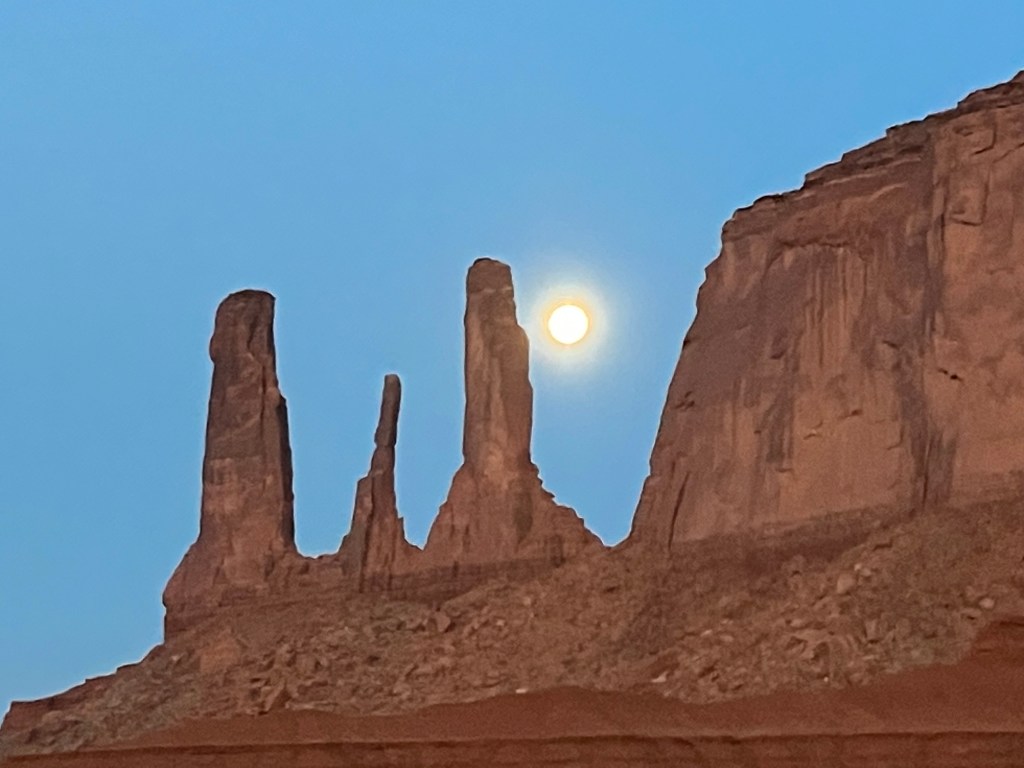
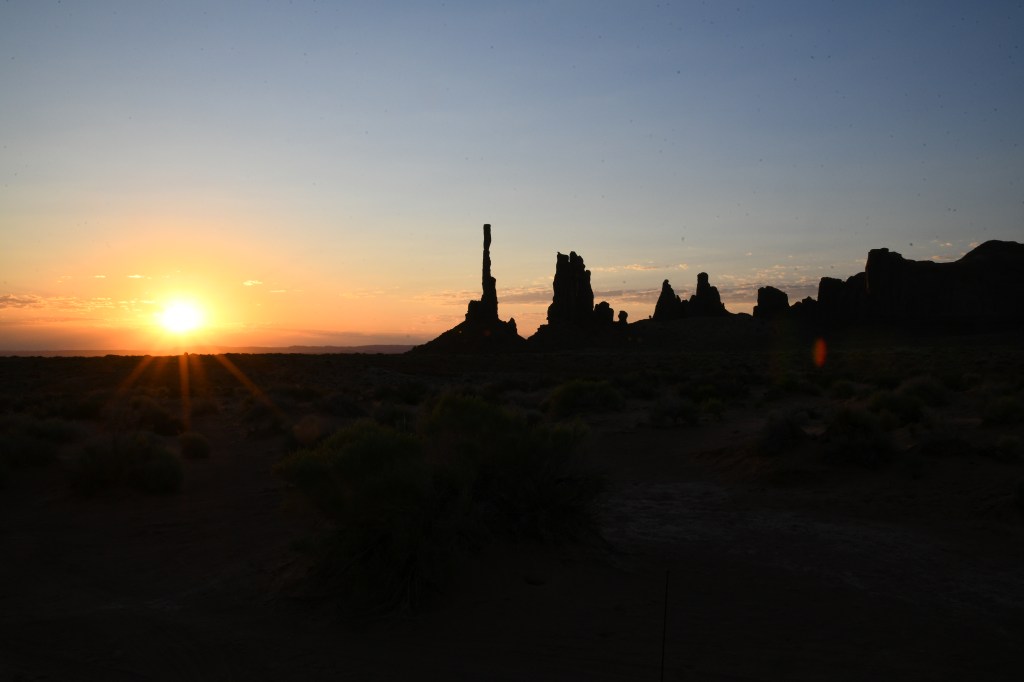
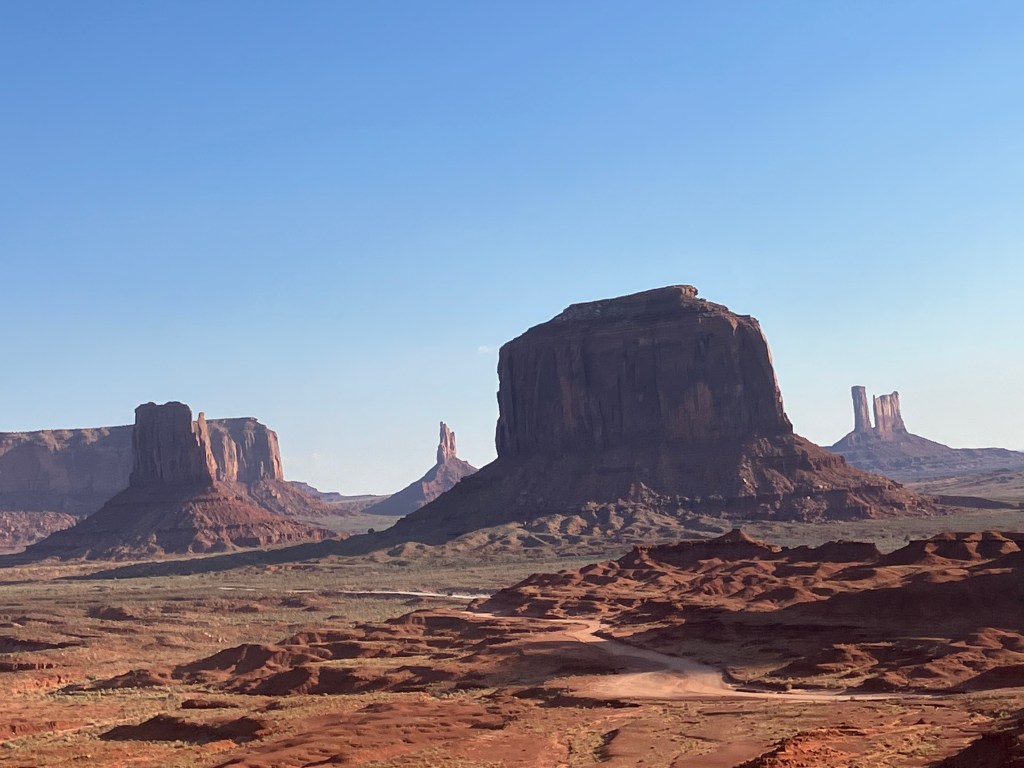
The sandstone buttes, for which the Valley is so well known climb from a height of 400 feet up to 1000 feet and at this time of the morning we were fortunate to see the moon still glowing to the west, framed by two such buttresses whilst the sun was rising on our left, to the East. It was a once in a lifetime sight.


Throughout our journey Sean stopped to point out various sights, talked about the geology of the region and the fauna and flora.

Up to 100 Navajo still reside in the Valley, depending upon the season, most without electricity or running water! Over 400,000 people from around the world visit here each year thus tourism is a high income generator for the Navajo who live in the area.

Sean was happy to share his hobbies and interests with us. He carried his camera with him in the front of the truck, sometimes taking photos alongside us if there was a particular vista that caught his eye.
He talked about his hiking trips out into the park during the low season when the sun is not beating down on the sand and rocks all day. A keen archeologist he spoke about the ancient Ancestral Puebloan (also known as Anasazi) sites and ruins dating prior to 1300 A.D that have been identified here. The valley was abandoned by the Ancestral Puebloans in the 1300’s, as were other areas in the Four Corners region.

The date of the first Navajo settlement in Monument Valley is unknown. For hundreds of years, the Navajo raised sheep and other livestock, and farmed small quantities of crops in the valley.

Sean explained to us the significance of the houses or hogans still being used on the valley floor. Traditional Navajo homes are called a “hogan”, and vary slightly in appearance depending on whether they are “male” or “female”. Male hogans are square or conical, with a rectangular entrance, whereas female hogans are six to eight-sided houses. Both are made of wood and covered in dried mud, and their doors always face east to welcome the sun each morning.

Traditionally, male hogans were used for sacred or private ceremonies, and female hogans housed family life – where children would play, women would cook and weave and men would socialise. 

Sean was happy to answer our questions. I was keen to understand what life was like here on a reservation so I spoke to him about the vast emptiness of the region and how hard it must be to gain employment.
Outside of the tourist industry Sean explained how many fathers, including his own, had been forced to leave the reservations to go away to work to earn money for their families. They worked in the oil and mining industry or took work trucking.

Given the matriarchal structure of Navajo homes the absence of his father didn’t vastly affect his homelife.
Descent and inheritance are determined through one’s mother. Navajo women have traditionally owned the bulk of resources and property, such as livestock. In cases of marital separation, women retained the property and children.

He had also explained to us earlier that whilst Sean Holiday was his name, when a child is born Navajo they receive four additional names. As they grow up and have to introduce themselves, it is more than just telling someone their name, it’s about sharing who they are and where they come from. This starts with their clans. Each clan comes from a different area of the Navajo Nation, with their own meaning and a story. Each person belongs to four different clans. 

“When you meet someone and shake their hand, you are telling them your whole story,” explaining that a person’s story is told by their hand, each finger representing a clan. “You are your thumb and then you introduce your four clans. The first finger is for the clan of your mother (nishłį́), the second is the clan of your father (bashishchiin), the third is the clan of your maternal grandfather (dashicheii) and the fourth is the clan of your paternal grandfather (dashinalí).

The grandparents play an important role in educating their grandchildren in Navajo life and ensuring they grow up within the cultures and traditions that have been passed down through the years. They often take full responsibility for the child’s upbringing allowing the parents to work and earn money to support the household.
Unlike many tribes, the Navajo have succeeded in keeping their cultural heritage alive. Over 97% of adults still speak the Navajo language, and many tribal members continue to practice the ancient religious and ceremonial ways. 

I was intrigued to know where his Mum shopped for food in the wilderness that surrounds his home or where he went to school.
“My Mum shops every 2-4 weeks. She drives to the nearest large Costco in Flagstaff” he explains. That’s a 5 hour round trip! The roads may be straight and easy to navigate but 5 hours to buy food! 

In America children from kindergarten through grade 12 in high school can go to public school for free. The city, state, or federal government fund public schools so you do not have to pay. Education law says everyone has a right to free education.

But how did that work in areas such as this where there were vast expanses of seeming wilderness?
Progressive educators viewed buses as a step toward modernising rural education. By 1932, there were 63,000 school buses on the road.
Sean describes to us the rigours of a 2 hr bus journey to school because at that time there weren’t any schools nearby to educate him or fellow Navajo students. He tells us about the new school that has opened in Monument Valley funded not by the Government or the State but by donations!
Given the enormity of the task faced by Sean to gain an education I was truly amazed by his knowledge, his thirst for more understanding of the land he called home and his appreciation for life!

Surrounded by the magnificent vistas of Monument Valley when the sun was rising in the sky I had taken a moment to just stand and breath. To really take in the panorama of the country around me and in that moment I felt more at peace that I probably ever have. There is something unique about this place, a peacefulness, a history, a spirituality that calls to me.

Armed with a better understanding of this wonderful land and the people who call it home I left it behind taking with me only the photographs I’d managed to capture of its beauty but with a deep yearning to one day return.

Discovering the Differences between America and England

When you come to America on holiday for a couple of weeks, as we have done previously, you don’t really take a lot of notice of how daily life plays out. You are solely focused upon the plans you have to enjoy yourself and take in the key sights wherever you are visiting.

On this trip, however, we are travelling right through the USA from East to West, meeting loads of people en route and definitely absorbing our differences before embarking on another drive up the East Coast. There are no right or wrong ways to live life but considering we fundamentally share the same language I hadn’t expected to learn so much on this trip about how different our lives are, but they are! There are so many differences that I know already that I could probably write a small book!

Let me start with the one thing that I currently experience every day and to me is probably top of my list of differences:

DRIVING:
We have already spent a week in Chicago, then driven Route 66 sticking as much as possible to the original road and definitely avoiding freeways and interstates. We have detoured to Monument Valley, The Grand Canyon and Las Vegas and we have celebrated reaching the end at Santa Monica Pier.
In total I drove 3409 miles before departing LAX for Fort Lauderdale where, after a week chilling out, we picked up our second car to drive the Eastern Seaboard from Lauderdale to Richmond, Virginia. Here we pick up Amtrak to finish our trip in Washington, Philadelphia and New York before flying home with about five days left from within the ninety day time allowance permitted with our ESTA.

There are significant differences between driving in England and driving in the States beyond the obvious that we drive on the left with the steering wheel on the right and predominantly a manual gearbox.
We cannot learn to drive until 17 and we have to pass a two stage test – Theory and Practical. Once we have our licence registered at our home address we have to follow the Highway Code, this is basically the law of the road.
One of the major key differences is we get fined for disobeying the law, speeding being the first of these.

Additionally once a car is three years old it must be tested each year to check it meets road safety and environmental standards. This Ministry of Transport test is commonly known as an ‘MOT’ and without it you cannot drive your vehicle on any UK road.

You also get fined for failing to tax the car. Everyone has to pay an annual fee to the Driving and Vehicle Licensing Authority (DVLA) to have their car on the road.

You also get fined for failing to have insurance.

All of these rules alongside the obvious, driving under the influence of alcohol or drugs, are rigidly enforced. How?

Apart from the section of the police force that is dedicated to monitoring traffic particularly on motorways (the equivalent to the US freeways and interstates) we have cameras. Cameras are everywhere in the UK!

In towns and cities there are big yellow boxes on the side of the road monitoring your speed but on motorways they can be on tall poles to the left of the traffic lanes, on bridges over the carriageway or in a traffic police car. Sometimes, particularly during roadworks on motorways, they have boxes similar to the big yellow ones that measure your speed between two points in order to calculate your average speed. This average speed is then measured against the speed currently displayed for drivers to follow.
If you get caught on camera the police just send you a letter through the post with the photographic evidence and you get an immediate fine which rises if you don’t pay within a certain time. You cannot avoid the fine because the number plate of the car in the photo is registered at the DVLA in your name, at your address and you are in the picture!

If you have moved address and failed to notify the DVLA and get caught you have to pay £1000 fine!

It is illegal to drive without a front number plate in the UK. If caught you will face 3 points on your licence and up to £1000 fine.

In addition to the fine for speeding you also get a minimum of 3 points on your license which stay on your licence for 3 years. Once you accumulate 12 points, at any point in your lifetime, you lose your licence for a minimum of 12 months.

If you fail to pay your fine you get prosecuted and ultimately can land up in prison.
I’ve known people get caught on the same camera going to work and then coming home in the same day!
If you are caught going 50% over the speed limit e.g. 45+ in a 30 mile zone you can get an automatic ban depending upon the circumstances.


The end result is the majority of people conform!

In the USA it feels like the huge majority of people just totally ignore speed limits.
In fact when I have driven at the speed limit I’ve often been tailgated.
The rationale behind this is that people know the likelihood of being caught is low!

Speed isn’t the only difference.
In the UK we have different levels of driving licence. Once you pass your test you have a full driving licence (category B) which entitles you to drive conventional, rigid-axle vans or pick-ups that weigh up to 3500 kgs and have up to eight passenger seats. Additionally you can tow a trailer up to 3500 kgs.

In comparison a newly qualified driver in the USA can drive a vehicle up to 26,000 lbs, that’s 11,793 kgs, nearly three times the size before needing a CDL!!! You can also tow a trailer weighing up to 10,000 lbs which is about 4500 kg.
If you want to drive the large coach style RV’s in the USA that is fine as long as it doesn’t exceed 40 feet.
In the UK you would need to sit a test to get a higher level of certification, called a C1 licence. It takes three separate tests and the case study part alone is a 75 minute test!

I find it so hard to believe that I’m currently out on the road surrounded by drivers who constantly speed and feasibly that a newly qualified driver at just 18 years old could be driving the massive coach style RV next to me!

Finally there are the lorries or trucks as they are called in the USA. A lorry in the UK is limited to 60 mph on a motorway. In the USA it varies from state to state but like cars the truck drivers seem to take little or no notice.
In the UK lorry drivers are limited as to how many hours they can drive for.
The key rules include: 9 hour daily limit on driving. This can be increased to 10 hours, but only twice a week. 56 hours is the maximum weekly driving limit.
In the USA this rises to between 11 and 14 hours of driving depending on the amount of hours off in between and 60 hours over a 7 day period.

When we were on our detour to Vegas and actually on a freeway, at one point I was going just over the speed limit of 75 mph doing 77 mph and was overtaken by an enormous truck!

My final comparison in this post is the lack of kindness. I’m used to people showing common courtesy to other road users. For example if someone is pulling onto a motorway in England the driver on the inside lane will either pull across to the middle lane to let the incoming driver on or if this is not possible they will slow down and maybe even flash their lights to indicate you can pull onto the carriageway.
The same occurs when the traffic is heavy and someone is trying to change lanes or in towns when someone is pulling out of a side road onto the main road or overtaking a stationary vehicle.
In America very, very few drivers show any courtesy, they will just not give way at all. I actually find this really disappointing.

I guess it’s not surprising, therefore, that the USA experiences 16.1 deaths due to traffic accidents per 100,000 cars on the road per year compared to only 5.7 in the UK.

Look out for more differences to come…………………………..

The People Along Route 66

One of my fondest memories of Route 66, alongside the road itself and the differing landscapes, will always be the people we met en route. This was brought home to me even more having flown down to Fort Lauderdale where I used my holiday ownership to secure a week at the beach in Lauderdale by the Sea. The photos I’ve included were taken on a river boat trip around Fort Lauderdale known as the Venice of America.
The plan was to rest up for a week before embarking upon the second half of our road trip along the Eastern seaboard from Lauderdale to New York. 

When we were out on Route 66 everyone we met was either a fellow traveller or someone who owned or worked on the Mother Road. Without exception they were all friendly and welcoming. Suddenly we were thrust back into a world where we were the “odd ones out”. We were travellers, the word itself didn’t resonate with the people now surrounding us. 

We arrived mid evening at our accommodation in Florida and the keys were left in a lock box ready for us to check in the following morning. On leaving our apartment the next day at 10 am we aimed to pop into reception to get the formalities complete before heading out on foot to the supermarket for groceries. Descending the stairs we found ourselves amidst an unannounced “Welcome Meeting”.
We politely stood to one side as each individual announced their name, where they came from and their favourite drink. 

Given we hadn’t sat down amongst them I figured they would pass us over but no that wasn’t happening. I tentatively gave my name, said I was from England and didn’t drink. Amidst some astonishment at our non alcoholic lifestyle we were then suddenly declared the winners of longest journey. I decided to rectify this mistake saying we had flown down from LA . This led to me explaining why we had flown from LA. 

Driving Route 66 from Chicago didn’t even register with these new visitors. They were proud timeshare owners who were part of the “Week 28” club. Guests who came back here the same week(s) every year. Don’t get me wrong I had done the same in the past. 
When I bought my first holiday ownership in 1999 I returned to my home resort every year for two weeks in the school summer holidays for about six years. The actual weeks I owned were in the spring but I could easily internally exchange them to weeks that suited my childrens’ summer vacation from school. 

It suddenly came home to us that we were no longer holidaymakers but travellers and we were simply not on the same page as these people. 

Memories of wonderful old Rose at the Route 66 Museum in Pontiac came flooding back. She was so friendly, so welcoming along with Robyn who worked in the shop and shared her own travel plans with us – see previous post “The Essence of Route 66″.
Robyn fully understood our motivation and why we were heading out on the journey across America. 

Whilst some of the guests at the apartment complex had travelled across states to get to Lauderdale, they had driven 12+ hours on the interstate, ploughing through the miles, SUV laden down with family, food and everything they were going to need for the beach and their one or two week break from normal life. They didn’t understand our need to take it slow, to follow old Route 66 and arrive maybe six hrs later at our next destination having only driven 200 miles. To them this probably seemed a waste of time.

People who owned businesses on Route 66 were genuinely pleased to see us.
Robert at The Blue Swallow Motel in Tucumcari cheerfully showed us and a French family around the property before giving us the keys to our room for the night. Leaving us with the declaration that he made the best coffee in New Mexico and “be sure to come to reception in the morning and get a cup!’ My husband duly did so and as a bit of a coffee connoisseur declared it the best on Route 66 at the end of our journey!!

Cindy way out at the Jack Rabbit Trading post in Joseph City, Arizona greeted me with a cheerful smile and welcomed me to her store. She didn’t know me from Adam but she was genuinely pleased when people called in.

Mirna and Clarissa in Seligman at the Original Route 66 Gift Shop were busy taking an inventory of their stock when we popped in early one Thursday morning. They both stopped what they were doing, gave us a big smile and welcomed us, pointing us in the direction of Angel’s barber shop.

In contrast the owner of the Lauderdale property, in response to us being British said “we usually have a couple from London here this week but for the first time this year they haven’t booked. The Brits aren’t coming to Florida anymore!” My immediate response was “well the pound is back up against the dollar so maybe that will change”.
I could have launched into an explanation of how inflation is still at 9%, utility bills have trebled and mortgage repayments have gone through the roof which has meant lots of families are refraining from taking holidays this year or if they are, they are keeping the cost down by only venturing to Europe but I chose to keep my response brief.
Despite encountering the owner a couple more times during our week long stay her mood towards us didn’t improve! Instead of being pleased that we had chosen her resort she seemed to hold us accountable for the absence of fellow British holidaymakers.

As the week wore on it became obvious that the “Week 28” club had their own routines, events and get togethers.
We, meanwhile, enjoyed our own company and reflected even more upon our Route 66 travels. Our conversation included new plans for the future, for example traversing Canada, travelling The Oregon Trail or even returning to Route 66 which brought to mind a previous conversation we had with fellow travellers.
When we had been in Cuba, Missouri at The Wagon Wheel Motel there was a central area provided for guests to sit, chat and even gather around a fire pit if the weather was chilly. We were sat out there mainly because it provided better wifi than in our room but were soon joined by Brennan Matthews, his wife Kate and later his son Thembi.
Brennan is the editor of Route Magazine and this was their third or fourth trip along Route 66. He had even written a book, recently published called Miles To Go about his first Route 66 encounter which I had duly purchased and read whilst we were completing our own journey.
At this early stage in our Route 66 trip we thought this was a bit odd, why would you want to do this again and again? But here we were in Florida not even a week after finishing it and contemplating a return, talking about the parts we wanted to explore further, the detours we might do next time and how our plans would be more fluid second time around.

When we left our accommodation at Lauderdale it wasn’t with a feeling of regret but one of anticipation as to what our next adventure was going to bring as we set out on the road once again, knowing it would eventually end at JFK airport in another six weeks time.

We wouldn’t unfortunately be greeted here with delight as we had at the specially placed booth on Santa Monica Pier when we finished Route 66. Ian Bowen was so pleased to see us, we chatted to him for ages before entering our names in the Route 66 role of honour and receiving a signed certificate of our achievement alongside two other families who arrived around the same time, one from America and the other from Norway!

The people who drive Route 66 are travellers, a unique band of brothers who enjoy the open road, who share a camaraderie and welcome new members to their invisible club. We were now members and how we missed that feeling when sat amongst the holiday makers of Florida.