Touring Western Europe -Spain- Granada

We arrived by train into the city of Granada on Sunday Afternoon. At the foot of the Sierra Nevada mountains, but only one hour by car from the Mediterranean coast, it is of course famous for the Alhambra Palace.
The Alhambra is one of the most revered monuments of Islamic architecture and one of the top visitor attractions in Spain.

Our hotel for the next three nights is situated in the Albacin neighbourhood, which is also full of Islamic influence and Moorish architecture. Even on the drive from the train station it is evident that like so many ancient cities in Spain, Granada is divided into the old and the new. With the new part of the city harbouring apartment style living and business premises.
Approaching our hotel we realise that the old cobbled streets are off limits to normal traffic and the taxi driver has to “buzz” himself in through a set of lights where a hydraulic barrier disappears downwards to let him through.
Our bedroom looks over the street and has two balconies. With the doors thrown open the afternoon sun shines in, along with the chatter from the small shops below clustered together like a “souk” and the distinct aroma of Middle Eastern food. 

The receptionist has armed us with a map of the city to hubby’s delight and we settle in unpacking and preparing for an early start the next day.

Tickets for the Alhambra Palace
These can sell out a month in advance and acquiring them is a minefield all of its own. There are so many sites that indicate, at first glance, that they are the real site but are, in fact, companies offering accompanied tours. Once on the official site (alhambra-patronato.es)  you then have a choice of about nine different tickets. The key is to ensure your ticket includes access to the Nasrid Palace.

If you read my blog about the Real Alcazar in Seville you would have learnt, that having arrived in Seville, we had to wait a couple of days for tickets to this attraction.
For this reason, despite it only being March, we started addressing all tickets for the next month and, in so doing, had discovered that we couldn’t get any tickets for the Alhambra Palace for the days we were going to be in Granada!
Although I do all the planning, I had given the responsibility of tickets to hubby. He finds it so frustrating that you can no longer just turn up in a city and spontaneously visit an attraction you wish to see. Having to plan the day and even sometimes the actual time of your visit is somewhat anathema to him. Thus he had not been as “on it” as he perhaps should have been.


What ensued was a desperate search of the internet for another site that had tickets. We trolled through all sorts of companies offering guided tours, not that we really wanted to do a group visit. We eventually, however, came across the Granada Card. The price per person (for a 48 hr pass) was substantially higher than a normal ticket for the Alhambra Palace but it did include entrance to other sites and some other benefits such as bus tickets. More to the point, having indicated which day we wanted the pass to begin, we could get into the Alhambra Palace on the Monday after we arrived, at a time that suited us.
It opens at 8.30 a.m and so we chose 9 a.m. in the hope that it wouldn’t be totally swamped with tourists.
Be aware that you have to show your ID (in our case our passports) at every checkpoint, into every different area, throughout the day. If you turn up without your ID they won’t let you in!
Additionally you have to arrive 30 mins earlier than your ticket time to get through security checks and actually walk to the Nasrid Palace. The time on your ticket is your entry into the Nasrid and if you are late they advertise they have the option to refuse entry!
I guess it depends on the security guard on the day and how busy they are but personally I wasn’t prepared to take the risk and so we were there at 8.30. a.m.

Getting to the Alhambra Palace
The Palace was built on the Sabika hill, an outcrop of the Sierra Nevada mountains. It had been the site of earlier fortresses and of an 11th-century palace which Nasrid rulers continuously modified.
To walk up to the palace from the old town takes about 30 minutes but it is a fairly steep uphill climb. Given that we knew there would be a lot of walking throughout the day (we did 6 miles that day in total) we opted to take a cab but walk back down. There are also buses though that run from Plaza Nueva.
The Nasrid Palace
To try and give you some idea of the size of the palace, throughout the Nasrid era, the Alhambra was a self-contained city separate from the rest of Granada below. Within its walls could be found most of the amenities of a Muslim city such as a mosque, public baths, roads, houses, workshops and a sophisticated water supply system.
As a royal city, there were at least six major palaces, most of them located along the northern edge where they commanded views over the Albacin neighbourhood. 

The most famous and best-preserved are the Mexuar, the Comares Palace and The Palace of the Lions. All of these basically form the main attraction to visitors today.
I should probably say, at this stage, I invested 6 euros in an audioguide. I found it really easy to operate and really helpful in terms of the information it gave, alongside the suggested route to follow which is indicated throughout the Palace.

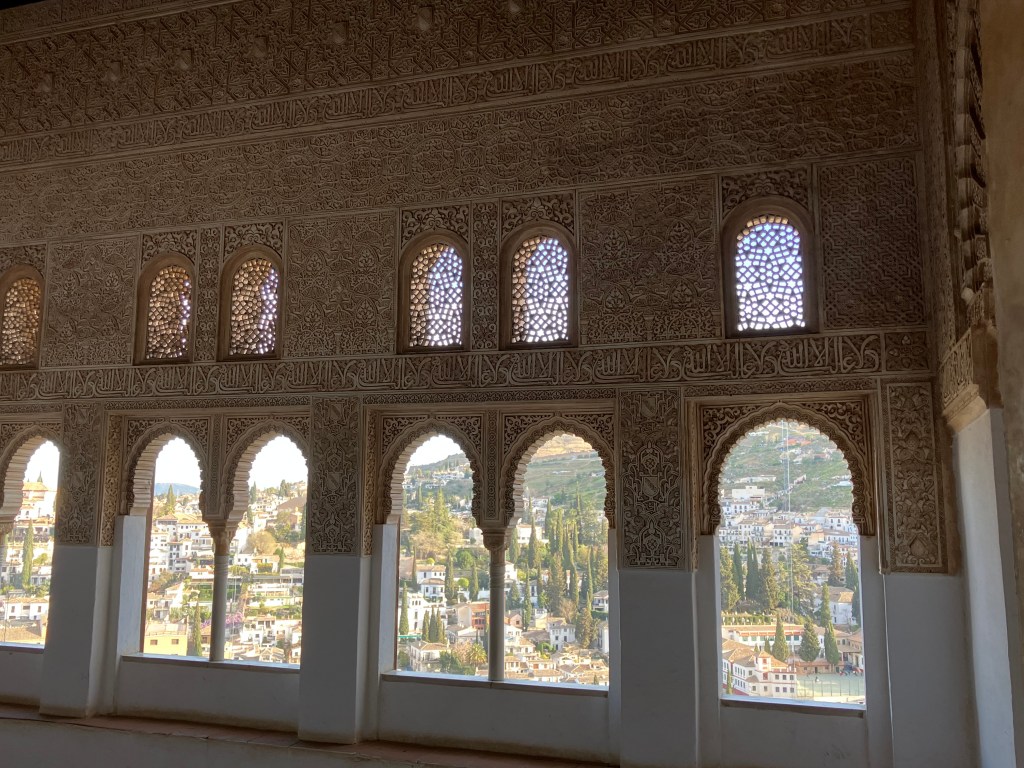
The Moorish architecture within the Nasrid was developed over centuries. There is a central courtyard around which other halls and rooms were placed. The decoration on the inside of the building is made up of tile mosaics on the lower wall and carved stucco on the upper walls. There are decorative motifs of geometric pattern, patterns based on plants and flowers found in the natural world and Arabic inscriptions.

What I found most fascinating and unique here were the ceiling sculptures which reminded me of “bee hives”. They are known as mugarnos and with their stalactite sculpting lend a three dimensional feature to the vaulted ceilings.

Palace of Charles V
Having finished our exploration of Nasrid we walked to this massive square structure of stone which looks really big from the outside but internally it encloses a perfectly circular courtyard.  Personally I was reminded of the Roman colisseum.
The construction of this Italian-influenced palace in the heart of the Nasrid-built Alhambra symbolises the triumph of Christianity over Islam. The building began in 1527 but wasn’t actually finished until 400 years later around 1923.
Internally is the Alhambra Museum, which holds objects and artefacts relating to the Alhambra’s history, as well as the Fine Arts Museum of Granada, with it’s collection of paintings from Granada dating from the 16th to 20th centuries. Unfortunately both were closed on the day we went.

Alcazaba
We then moved across to this central fortification which is the oldest part of the Alhambra today.
You can not only view the remains of this residential district where elite guards of the Alhambra lived but you can climb both the Torre de la Vela which acted as a watch tower and also the Tower of Homage which, at 85 ft, was the tallest tower and military command post. The views from both are extraordinary and it’s not hard to stand there and imagine how this city ruled over the surrounding areas.

The Partal Palace
We then walked back towards where our Nastrid tour had ended to view this pavilion on the edge of the Alhambra walls with it’s portico facing a large reflective pool.

From here we wandered amongst the gardens which follow the northern walls. Throughout our visit I have to say we were both really impressed with the care and attention put into the gardens, they are beautiful.
In addition to the gardens you can also view several towers (from the outside) which were converted into small palatial residences. All of these have a narrative on the audio guide.

Generalife
This is the area outside of the palace walls which was originally developed as a country estate. It has undergone several developments from the Nasrid period right up to the 20th century.
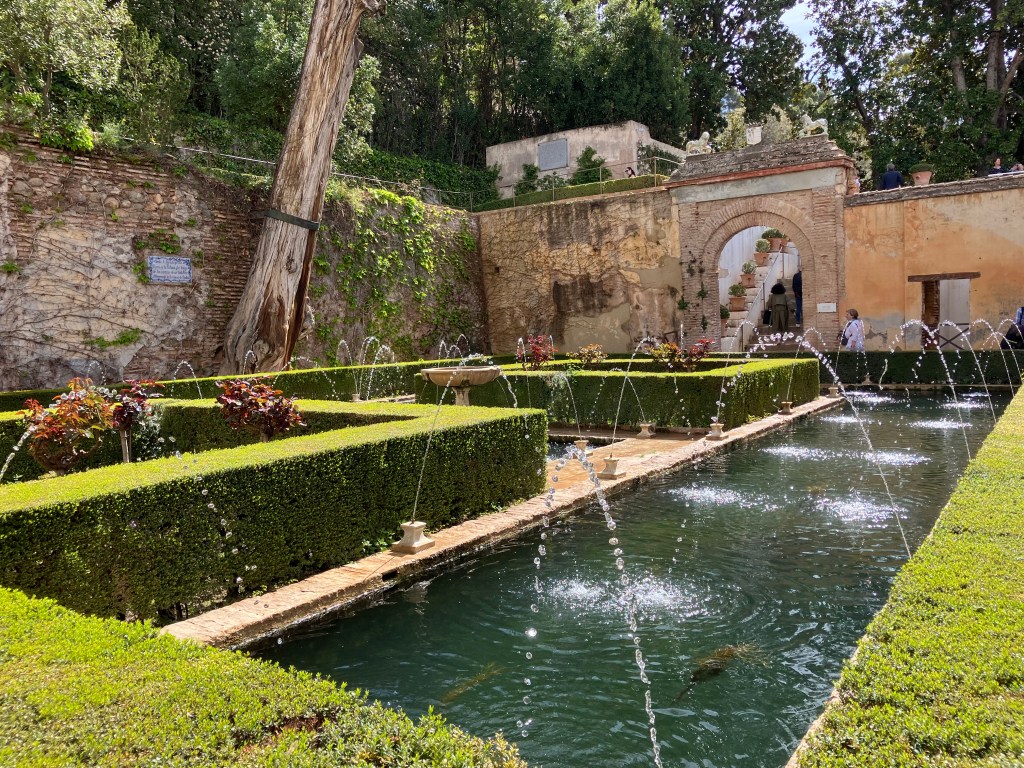
Meandering along you often come across rectangular garden courtyards with decorated pavilions, then there is the landscaped gardens with the central full length pool and fountain, not to mention the rose garden which I’m sure must smell unbelievable when the roses bloom. Then just as you think you’ve finally completed your tour you have the wonderful fountain filled courtyard.

NB:

This is part nine in my series of posts about our tour of Western Europe. Why not read the previous posts and then follow us on our journey as we continue to explore this lovely part of the world


More Adventures in Seville

We stayed 40 minutes walk outside of the “old town” within a fairly densely populated area surrounded by Spanish families, in an apartment on the sixth and top floor of a block of flats.
Over 65% of Spanish people live in flats because they are more affordable, with reduced living costs, and it has been culturally the norm since the mid 20th century.
The two bedroom apartment was light and airy with everything we needed but it was time to see if we could actually “live like a local” for a week.
Our washing was hung out on the rooftop shared by those living in the same block. Our rubbish and recycling was taken down to the communal bins located on the roadsides, which has been a common theme throughout the cities we have visited, and collected here at 1 a.m. every day by the bin men. No one leaves their rubbish on the streets.
We shopped at the local supermarket complete with ultra fresh fish counter, meat area, in store cake shop and bakery and cheese island.
Living as they do encourages a sense of community. We wandered past many local cafe bars where people gathered during siesta, particularly at weekends, for drinks, socialising and sometimes food.
We also learnt how to use their local buses which on the whole run on time, are often quite crowded and cost 1.40 euro per person for a trip into the city. Buying multiple tickets/travel card saves money.

I must admit I’m normally a bit of a Lonely Planet fan but on this occasion we used the DK EyeWitness guide to Seville and Andalucia. This book divides Seville into five key areas and we spent four days exploring them all. Day One, which I’ve already shared, was spent in El Arenal bounded by the River Guadalquivir and also included the area of Parque Maria Luisa.
I could, probably, fill another four posts with everything that we visited but instead I hope to give you a taste, which just might awaken your souls and prompt you to add Seville to your travel plans.

Santa Cruz
This is the old Jewish quarter, where the Jewish community lived from 1248 until they were driven out of Spain in 1492.
Real Alcazar
This is listed on Tripadvisor as the number two attraction in Seville and nearly 28,000 people class it as excellent so it would be a little remiss of me not to include it in my blog.
As we discovered on Monday, Seville is often a “long weekend” jaunt” for tourists and despite being March the streets were very busy. Timed ticket entry prevails at the Real Alcazar and everything was sold out two days beforehand so if this is somewhere you want to visit buy your tickets on line well in advance. Once you have a ticket you still have to queue up to gain entry so be there 15-30 minutes before and remember, don’t be late, and bring the ID you used to book the tickets or you may find yourself being declined entry even with a ticket!

It took five hundred years to actually build the palace and as a result, whilst being a leading example of Mudejar style it also combines Romanesque, Gothic and Renaissance elements.

I paid for an audioguide rather than downloading the narrative from a QR code but to be honest, for the first time on this trip, I didn’t find it particularly useful. There is no suggested route to follow either with or without an audioguide. Some of the rooms have lost their numbers and have names that do not match with the guide and I found the whole site a bit baffling.

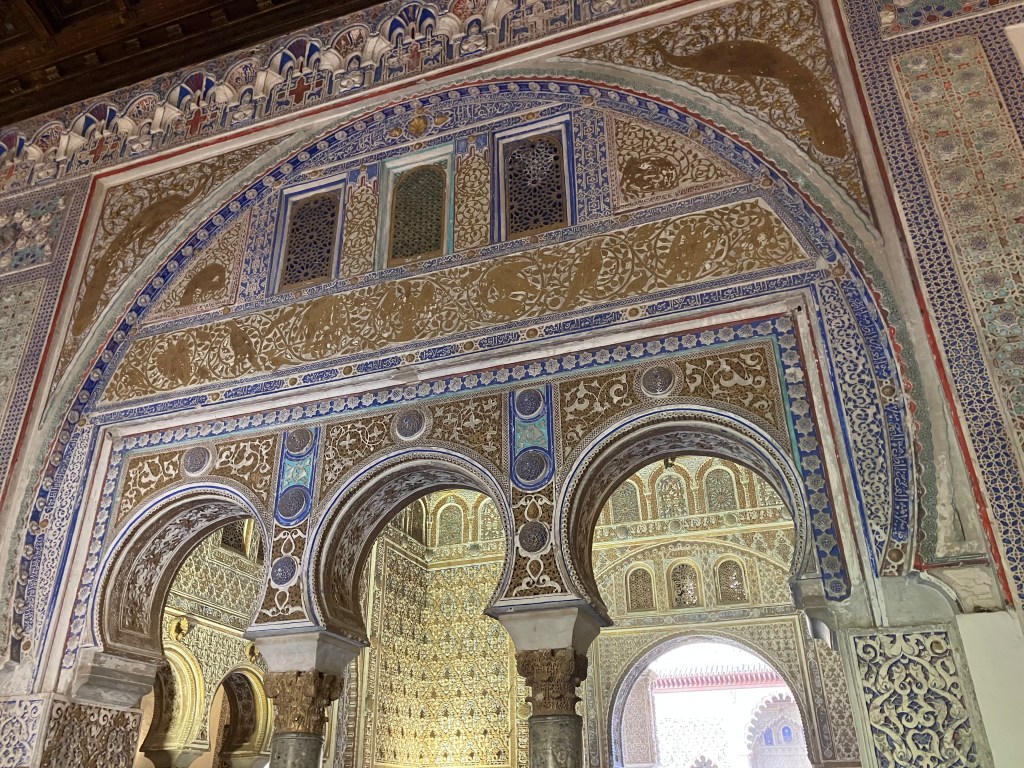
Notwithstanding my confusion there are some fine examples of tile decoration for which the palace is famous, as seen below. It is hard to capture personal memories of the interior due to the crowds and the inescapable “selfie brigade”. The palace and grounds were also used in the fifth series of “Game of Thrones” so fans of this drama are looking to photograph themselves where specific scenes were shot.

Stepping out into the gardens, however, it is easier to leave all the visitors behind and just revel in some solitude.
There is a plan of the gardens that you can follow but with more than 20,000 plants, some were planted from seeds brought back from South America by explorers, I just enjoyed going for a stroll. Taking in the scents of the jasmine, admiring the wisteria which was just starting to flower, being slightly amazed at the amount of orange and lemon trees whose fruits gathered on the grounds and occasionally catching the herby smells of amongst others myrtle, rosemary and sage.
You could easily lose yourself here amongst the 60,000 square meters of pools, fountains, water basins, and tiled benches.

La Macarena
This area of Seville has thus far avoided development and so walking around here gave us more of an insight into everyday life. It allowed us to avoid the constant parade of tourists that you see elsewhere, as well as an opportunity to glimpse the remains of the original city walls.

Basilica de la Macarena
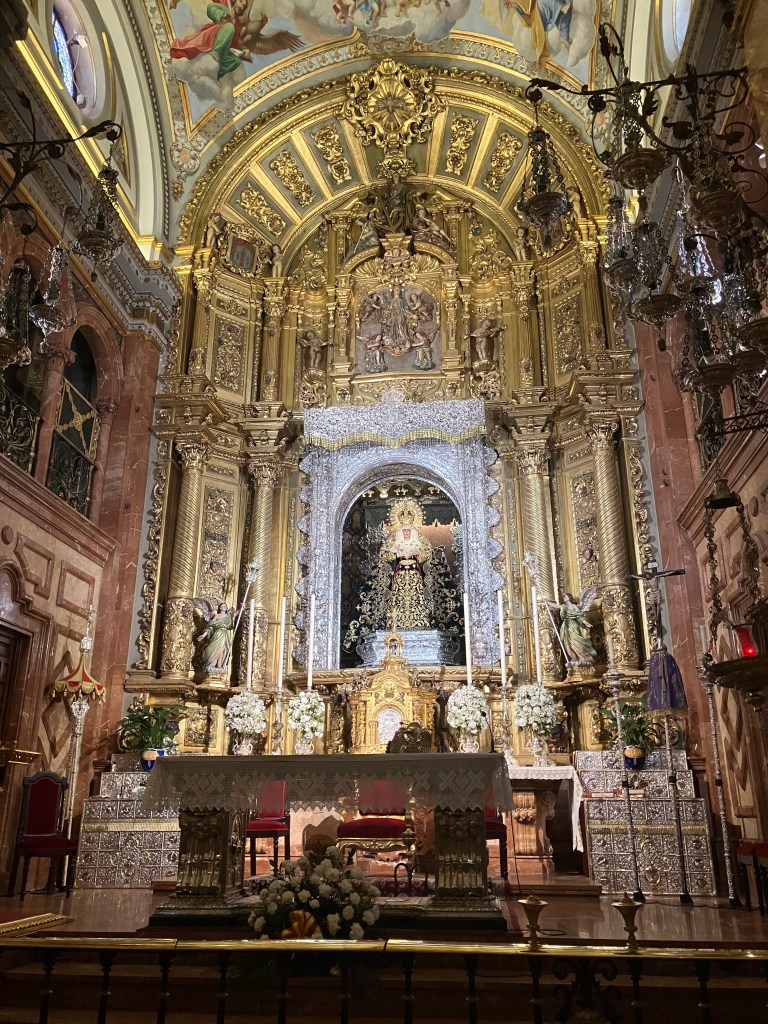
No visit to this area is complete without a visit inside the Basilica which houses the famous statue of the Virgen de la Esperanza Macarena, standing above the main altar amid waterfalls of gold and silver.
The “weeping virgin” takes centre stage during the Easter processions or Semana Santa.
If you’ve never seen videos of this spectacle have a look on line.
Organised by religious groups and brotherhoods that date back hundreds of years, it is during the small hours of Good Friday morning in Seville, the Hermandad de la Esperanza Macarena, the biggest brotherhood in the city, will take out the famous Virgen de la Macarena for an epic 13-hour tour.
Carried through the streets on heavy floats (pasos) — often weighing over a ton — by their members, they are accompanied by the Nazarenes in their cloaks and traditional pointed hoods. Seeing these garments displayed within the Basilica it’s hard not to think about the Ku Klux Klan.
Whatever your religious beliefs you have to admire their dedication and fortitude.

We left the Basilica in search of a light lunch and made our way further into La Macarena. it wasn’t long before we came across a traditional cafe/bar with tables, chairs and umbrellas lining the roadside. The locals were gathered inside avoiding the midday sunshine but savouring the weather we sat outside alongside a couple of other evidently local retirees! Orders are placed at the counter for simple Spanish fare with staff who are authentically friendly and helpful.

Palacio de Las Duenas
I cannot complete our highlights of La Macarenas without mentioning this Palace. Built in the 15th century, it was the favourite home of one of Spain’s most famous aristocrats, the late Duchess de Alba, who died in 2014. It was opened to the public by her son and primary heir in 2016.
One of my guilty pleasures is reading “Hello” magazine in which the Duchess of Alba was often featured and always fascinated me for her independent spirit and overwhelming joie de vivre.

Born in 1926 into the Fitz-James Stuarts, the most powerful aristocratic dynasty in Spain, who always enjoyed a close relationship with the Spanish Royal Family, her godmother was Queen Victoria Eugenie, a granddaughter of Queen Victoria.
The Duchess was also a descendant of King James II of England (VII of Scotland) through the illegitimate son he had with his mistress, Arabella Churchill, the sister of the 1st Duke of Marlborough.
The Albas are also distant relatives of Queen Elizabeth II, Sir Winston Churchill, and Diana, Princess of Wales.


The Duchess of Alba, Head of the House of Alba from 1953-2014 and Spain’s richest aristocrat at the time of her death, had a fortune that some experts estimated to be over €3.5 billion. It was rumoured that she could travel from northern to southern Spain without leaving her own property. She was well known throughout Spanish society for her strong sense of independence, style, and irreverence, famously refusing to pose nude for Pablo Picasso and fraternizing with some of the most famous people of the 20th century. Her social circle included Princess Grace of Monaco, Jackie Kennedy, Princess Margaret, Walt Disney, Audrey Hepburn, and Yves Saint Laurent. The palace was also visited by Edward VIII and Wallis Simpson.
She was also well known for her love of bullfighting, horses, and flamenco.

Widowed twice, the Duchess of Alba caused a huge scandal by marrying for the third time at the age of 85 over the objection of King Juan Carlos. He cautioned her against marrying Alfonso Diez Carabantes, a civil servant 25 years her junior that he suspected was after her immense wealth, a sentiment shared by her children. She married Carabantes in 2011 anyway, opting to give her children their inheritance early, including several palaces, land, and a first edition of Miguel Cervantes’ Don Quixote. Carabantes agreed to renounce any claim to her fortune.
She died at the age of 88 after a short illness having been named by Guinness World Records as the world’s most titled person. She was 14 times a Spanish grandee, five times a duchess, once a countess-duchess, 18 times a marchioness, 18 times a countess and once a viscountess, according to the entry.

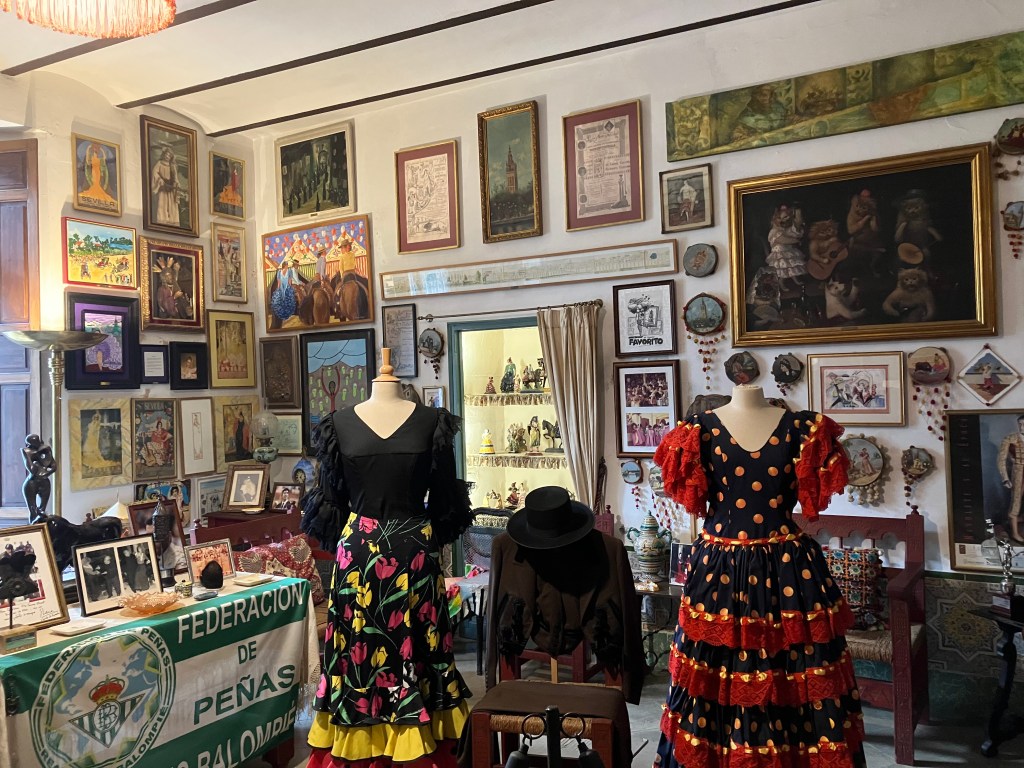
As you tour the grounds and downstairs rooms evidence of her flamboyant lifestyle and photos of her many friends remain on view.

Across the River
A trip to Seville is not complete without venturing across one of the bridges to Triana. Since Roman times this area of Seville has been famous for pottery. It has traditionally been a working class area famous for bullfighters and flamenco dancers but it appears to be experiencing something of a renaissance.
We took a walk through the traditional narrow streets, with beautiful tiled houses and flower filled outdoor displays which presented a reprieve from the activity across the river in the centre of Seville.


There are still workshops producing and selling tiles and pottery but be aware they tend to close for siesta. There are plenty of inviting cafes, restaurants and bars spilling out onto the streets which somehow have a different atmosphere to anywhere else we had experienced in Seville.
We also took a walk along the riverbank and settled into a small cafe/restaurant overlooking the water. If you want something a bit more expensive and exclusive then keep walking and you will find some more private choices to eat.
As a midlife adventurer this was honestly one of our favourite parts of the trip to Seville and if we had our time over again, despite this area being the furthest away from the train station, we would have found an Air BnB here and happily stayed.

Outside of Seville
We ventured out of the city, again by train, on two separate days visiting Cadiz down on the coast and Jerez for the unique show, “How the Andalusian Horses Dance”.
This is an equestrian ballet accompanied by authentic Spanish music and 18th century styled costumes. As an equestrian enthusiast this was a visit I really wanted to make.

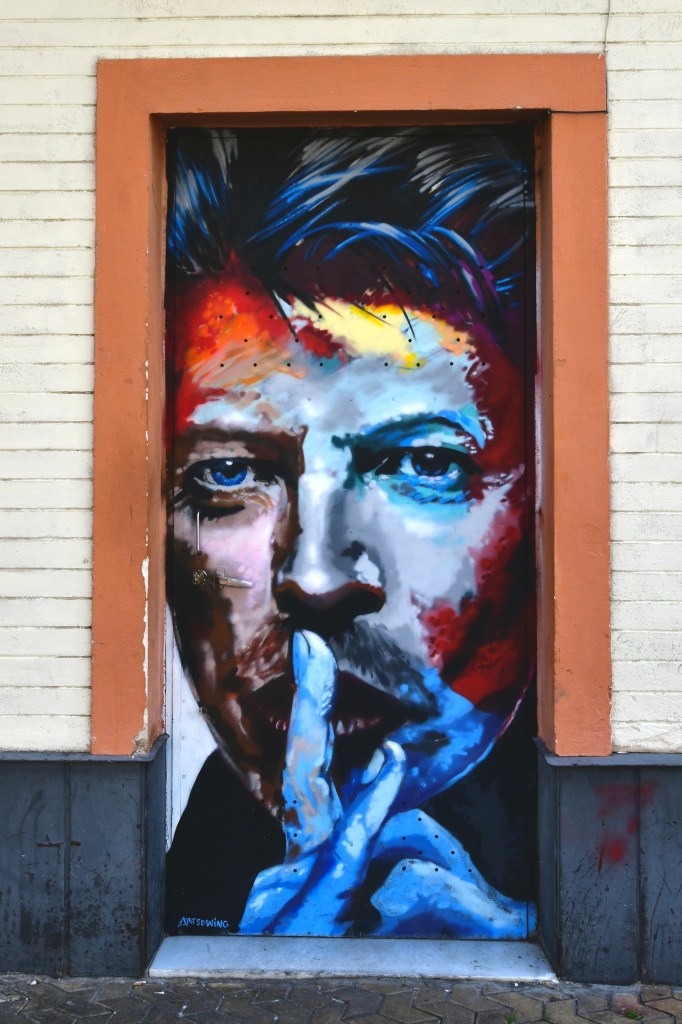
Before saying a final goodbye to Seville I’d just like to share this fantastic piece of street art with you which we came across accidentally while visiting Alameda de Hercules.

NB:
We are currently touring Spain as part of our journey around Western Europe and this is my second post about Seville. Why not have a read of my first post about this marvellous city and then catch up on our journey thus far. Why not follow us as we continue discovering this lovely part of the world?


Prince Harry-Journalism vs Reality

Phil and I are both avid readers. Here we are three weeks and 4 days into our West European adventure and we haven’t watched television once.
This year to date I’ve read 23 books and one of the latest is “Spare”. I had purposely not bought it before we left the UK because I knew I would want to be in a position to fully absorb what Harry was going to tell us about his life. I wanted to be able to weigh this up against what the media had been reporting about him. 

In giving my opinion I should say immediately that I realise I am just a “midlife adventurer’. I’m not a journalist, I’m just a normal, everyday person but we are all entitled to an opinion. I am also quite simplistic. I like to “boil things down to a basic level”. It’s how I’ve managed to solve my own personal troubles during my life and not allow myself to get embroiled in the what, why, when and if, grey murky waters of life. 

It’s probably worth mentioning that Phil is a dedicated newsreader whereas I have no time for the “stories” that the tabloid media spin. I probably look on line about once a week, normally at the weekend, when you can get a summary of the key events that have taken place in the last seven days. 

I grew up in an age where newspapers were printed and were not just on line competitors. I was one of those children, who at thirteen, had a paper round and would wobble up the road on my bike, the heavy paper sack flung over my shoulder. Health and Safety was non existent and no one cared about how much it weighed, it was just part of the job. As long as you could get yourself out of bed early enough before school to deliver your papers then that was all the newsagent cared about. 

I dreaded Thursday because that was when the local newspaper came out which doubled the load and also Sunday. 
Sunday was a nightmare with customers often taking two-three different newspapers complete with supplements. The newsagent, if he was considerate, would employ extra help on Sunday and normal rounds were divided up so you had less houses to deliver to otherwise no one would be able to lift their sacks!

Having read Harry’s autobiography, for me, I feel there are three key questions to answer:

Why did he write the book?
Do I personally believe what he has written?
What is the key message? 

Why did he write the book?
Harry definitely has an issue with the media, it is a consistent thread throughout the book. He still blames the paparazzi for his Mother’s death nearly 26 years later. If I was in his shoes I would too. 

He is also incredibly protective of his wife and children and will do all he can to ensure they are kept safe and there is no repetition of the tragedy that befell him and “Willy” as a result of his mother’s demise. Would I feel like this if I was him? Yes I would. 

From my personal experience of being a single Mum I still have that protective nature. There is a reason my daughter refers to me as “Mama Bear”! 

I believe Harry wrote the book because he was fed up of all the stories being spun in the media. Tabloid newspapers were making immense sums of money from his family. He saw this as an opportunity to tell his own story in the hope that the general public would read the book, believe what he was saying and maybe just wake up to the fact that some journalists are no longer committed to writing the truth. Instead they sensationalise and dramatise because they are put under pressure to write stories that will sell newspapers basically catering to the purchaser to secure retail sales. They can’t afford for the truth to get in the way of a good story. 

In the UK alone, print newspapers are read by 1 in 4 adults over the age of 15 every day (13.6 million daily) and reach larger audiences weekly (24.9 million) and monthly (30.8 million). 

When they are not selling newspapers these same journalists are creating on line content

According to a recent survey, almost 80 percent of UK news consumers between the ages of 18 to 24 considered the internet their leading news platform, and as of 2020, roughly 70 percent of the UK population read or downloaded news content online. That is a huge audience. 

In telling his truth did Harry achieve his goal? 
The problem is the same journalists who made money from his family also then read his book and wrote their own “story” about it in the paper and on line. How many of those people reading these summations actually went on to read the book themselves? Or did they just, once again, merely believe what was written in the news?
Too many people in the world today believe what they read without question, without listening to both sides of the story and they base their opinions on this. The general public, through no fault of their own, don’t have enough personal experience of the world as a whole to formulate their own opinions based upon real life and so they are easy prey for the journalists creating stories for a pay check. I challenge you, do you believe what they write without question? 

Although the book broke records becoming the fastest selling non fiction book of all time, because this type of opinion exists, I guess the jury is still out as to whether he achieved his goal.

Do I personally believe what he has written?
He certainly lays himself bare. He doesn’t gloss over how he felt about his mother’s untimely death or how he tried to cope afterwards. He talks frankly about his feelings and how he tried to convince himself that Diana had faked her death in order to escape the media spotlight and that she would, therefore, one day reappear.

From my own experience of losing my Mum at just fourteen, I can easily see how this worked in his head. It’s a proven fact that trauma of any description affects the brain. How we cope with these periods in our life is very individual. 

He covers all aspects of his life:-school, drugs (which he started taking in his teenage years), how the aristocracy and upper class world works, his time in the army, the royal family and his individual relationships within it and of course his own personal love story. 

I can understand how journalists have decided to pick and choose what they want to write about regarding his book in order to sell further news. How they have conveniently avoided anything Harry has written about their involvement in his life. After all they can’t publicly admit that they have lied, dramatised, or worse still deliberately sold fake news. 

I believe Harry was born into a world not of his choosing. It didn’t fit with his personality, rightly or wrongly he didn’t feel he had to tow the line because he was never going to be King and ultimately he didn’t want to be part of it. 

He is his mother’s son. He doesn’t want to hide his feelings behind the “never complain, never explain” royal mantra. He wants to show those feelings, share those feelings and demonstrate through his charitable causes where he sits morally.

He might not have lived a normal life like you and I but at the same time I believe he is now happy. He has found a world where he belongs, where he can be himself and be the best man, husband and father and in so doing I personally wish him well.

What is the key message?
In my opinion and it is only my opinion, there is one key message that stands out to me and this is not about Harry himself or his life. The book brings into focus how the royal family and ultimately a large percentage of the older generation in the UK think/feel and alongside that a lack of understanding or even denial of the world in which we now live.

I was, as previously described in my blog, brought up in a white conservative area. I have been subject to social prejudice and racism so I feel I have some life experience to draw on.

I have always been in favour of the monarchy. I can see the benefits they bring particularly to the UK economy. Is the new King, his wife, eldest son and family in touch with reality? I think they believe they are but I feel they are missing one valuable change in society. 

The older generation, and I include myself in this equation, are dying out and, therefore, if the royalty want to remain relevant and maintain their position, they need to be appealing to people aged 40 and younger -the Gen Z and Millenials.
Attitudes to the royal family amongst the younger generation have changed substantially since 2019. 

Over 40% of 18-24 year olds now say Britain should have an elected head of state.
The news that surrounded Prince Andrew in 2019, the interview that Harry and Megan did with Oprah Winfrey in 2021, the on going serialisation of the Royal family through “The Crown” and now Prince Harry’s book in 2023 have all had an effect. 

Just as the older generation brought up on printed newspapers delivered to their door believe what they read in the tabloids and the news broadcast on terrestrial television so does this younger generation believe what they read on line and watch on Netflix etc.

Gen Z and Millenials have been brought up in a world where they expect everyone to be treated equal. They don’t remember a time before men and women were entitled to equal rights, when it was illegal to practice your sexual preference, when schools were not multi racial. 

Harry’s book brings into the spotlight how the Royal family operate, where all of the above ideology is apparently taken into account, but when push came to shove they didn’t uphold those beliefs. They did what they had always done and stood back, allowing it all to play out including Harry and Megan leaving the family. 

There is no doubt that both Camilla and Catherine have suffered art the hands of the media as did Diana and Sarah Ferguson before them. However there was a difference this time and that difference centred around Megan’s ancestry. She is a woman of colour. 

Other key people saw what was happening. It wasn’t a figment of Harry and Megan’s imagination. More than 70 female parliamentarians signed an open letter stating that they “stand with Meghan in saying such behaviour “cannot be allowed to go unchallenged” and praising her for “taking a stand”. 

The racism Megan experienced unfortunately went unchallenged by those who should have protected her, her new family, the Royal family. How would you have felt if that was your new in laws?
Would you have felt accepted and supported or would you have been unhappy and stressed and been waking up each morning wondering what awful tabloid malevolence today was going to bring?
These are people we are all suppose to look up to. Through their lack of visible support and continued silence it could be said that they condoned the behaviour of the press. Is this because, as Harry says in his book, the Royal family depend upon their relationship with the media to maintain their prominence and therefore to some degree their position? 

I think this will come back to haunt them. The younger generation will be asking why they didn’t protect or even question the manner in which Megan was treated by the media? They will see the media racism for exactly what it was or, as so often happens now, they will make their opinion known by dismissing the royal family from their lives.

Whether you like it or not Megan represents everything about modern day society. 
A society where 50% of marriages end in divorce including three out of four marriages within the Royal family itself. 

Where the country of your birth doesn’t matter because we are one world.

Where the colour of your skin is irrelevant because everyone’s life matters.

Where love crosses all barriers. 

 That is the key message from this book.

Touring Western Europe -Spain- Seville

On Saturday we took the train from Cordoba and travelled 45 minutes south to Seville and settled into another Air BnB just a 10 minute walk from the main train station but alas 40 minutes walk from the main city sites.


Our first adventure into the city began early on Sunday morning visiting the art market outside of the Museo De Bellas Artes De Sevilla. Scattered around the small square, local artists display their wares to the admiring and hopefully generous public. Whilst Mothers Day was being celebrated back home, it was in fact Father’s Day here in Spain and maybe as a result the streets were fairly quiet.
It was a pleasant introduction before entering the actual museum. It is free to enter, unless you come from a country not in the EU! But even then it is only 1.50 euros each.


I am not a massive fan of art and although hubby loves French Impressionism visiting art galleries isn’t necessarily “his cup of tea” either but I had thrown it into the schedule as a break from architecture, cathedrals and stately homes.
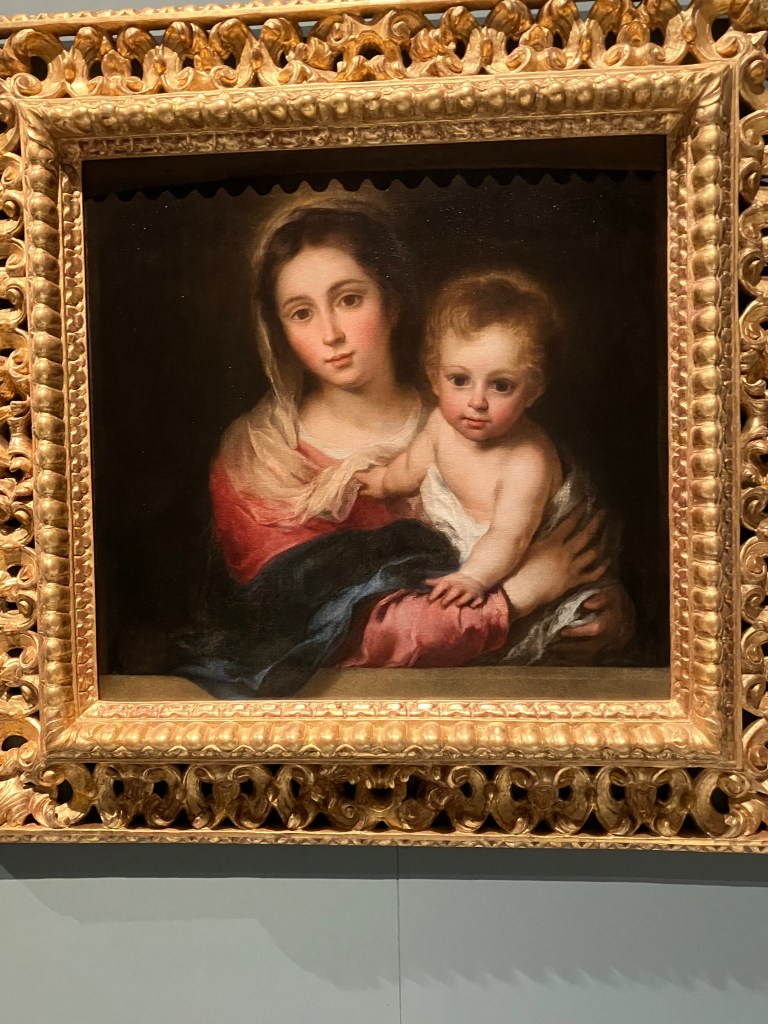
Housed in an ornate former convent dating back to 1594, the art is arranged chronologically throughout the museum and thus downstairs the walls are full of religious paintings and fresco ceilings whilst upstairs there is a greater variety. The highlight for art lovers is the painting of “Virgin of the Napkin” by Murillo painted 1668-69. My particular favourite, however, was “Moorish Ambush” painted in 1880 by Fernando Tirado, which at first glance looked like a photograph!

Heading away from the art museum we visited the Iglesia de la Magdalena before walking towards the river and the site of the Real Maestranza de Caballeria de Sevilla. Bull fighting is a major event in the Spanish calendar starting each April and this 12,000 seat venue is one of the oldest in Spain. You can take a guided tour to learn about the history of bullfighting whilst also visiting the museum, the stables and walking into the massive arena.
We chose to merely view the imposing Baroque architecture from the outside. I’m afraid my morals wouldn’t allow me to join the ever growing queue to enter.

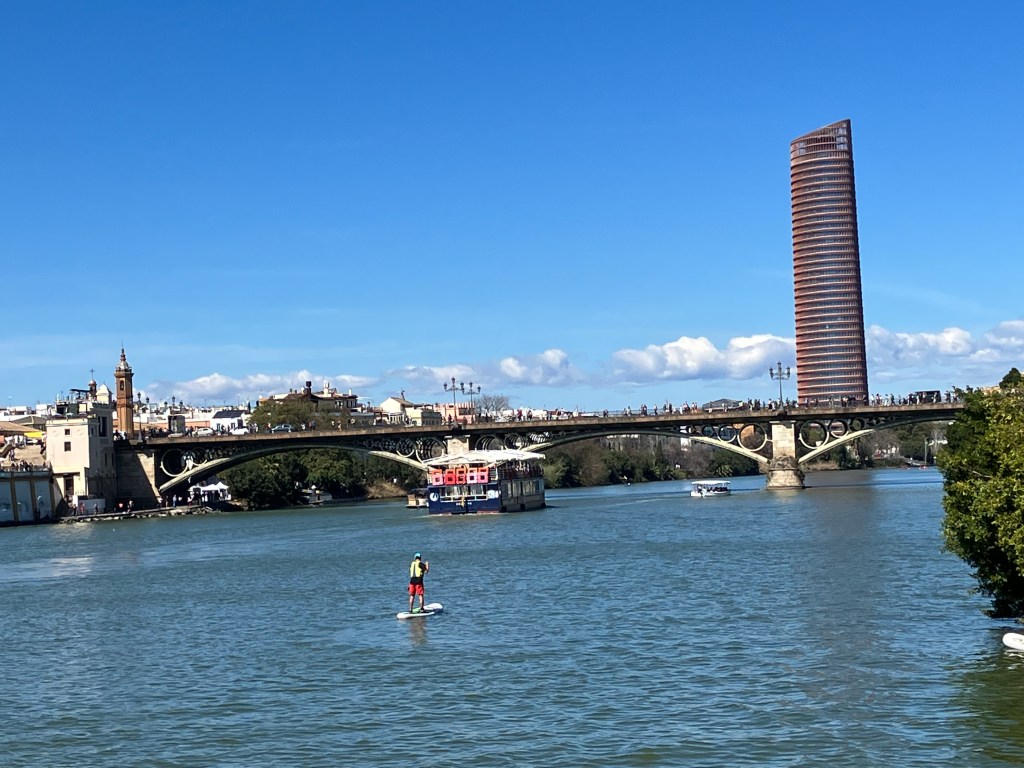
Like so many visitors and no doubt Sevillanas alike we then strolled along the riverfront in the sunshine, admiring the houses of Triana across the water, the outside of the Maestranza theatre and the Torre del Oro.
You can pay to go inside where Seville’s naval history is on display in the maritime museum and the top of the tower also offers outstanding views of the city and river.

Instead we headed to  Parque de Maria Luisa and the Plaza de Espana
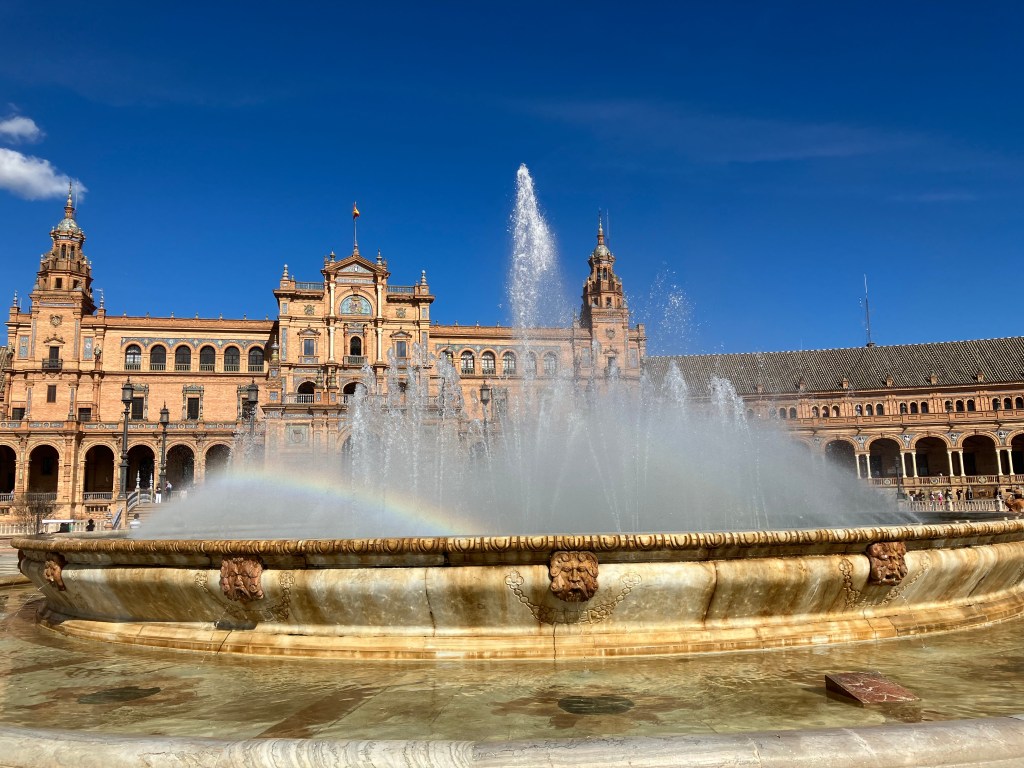
Like many I had seen pictures of the Plaza de Espana but nothing prepares you for the reality. As we rounded the corner I caught my breath as the magnificence of this Renaissance Revival plaza spread out in front of me. I am so pleased that we came here at the end of our day as there was no pressure on time and we could wander at will absorbing the atmosphere, taking a break whenever we wanted to and just being in the moment.

The square was originally built in 1929 but after years of neglect it needed restoring to its original splendour and intertwines elements of both Moorish and Christian culture. Adorned with tiles it is connected by bridges over a moat.
Take a moment to either hire your own rowing boat on the moat or like me just sit and watch the world go by at the central fountain, ensuring you pick an area that doesn’t get wet from the constant spray!

As you wander around there are so many little extras that are so easy to miss:-the beautiful tiling on the lampposts, the floral decoration on the bridges, the wooden ceiling above the walkways or the individual tiling on the ground floor dedicated to specific Spanish cities. All of this is accompanied by the haunting sound of a violinist playing “Nessun Dorma”, the loud clacking of the castanets as a small group of flamenco artists entertain the crowd and the strumming of a Spanish guitarist.

The Plaza faces the Maria Luisa park which was built at the same time. The park stretches along the Guadalquivir river and scattered amongst the vegetation are many important monuments including the famous statue of Miguel de Cervantes. Historical structures such as the Mudéjar Pavillion are also located in the gardens.
Birds sing amongst the treetops, children play amongst the fountains and life just stands still for a little while on a sunny Sunday Afternoon.

NB:
This is part eight in my series of posts about our tour of Western Europe. Why not read the previous posts and then follow us on our journey as we continue to explore this lovely part of the world

The Courtyards Festival of Cordoba

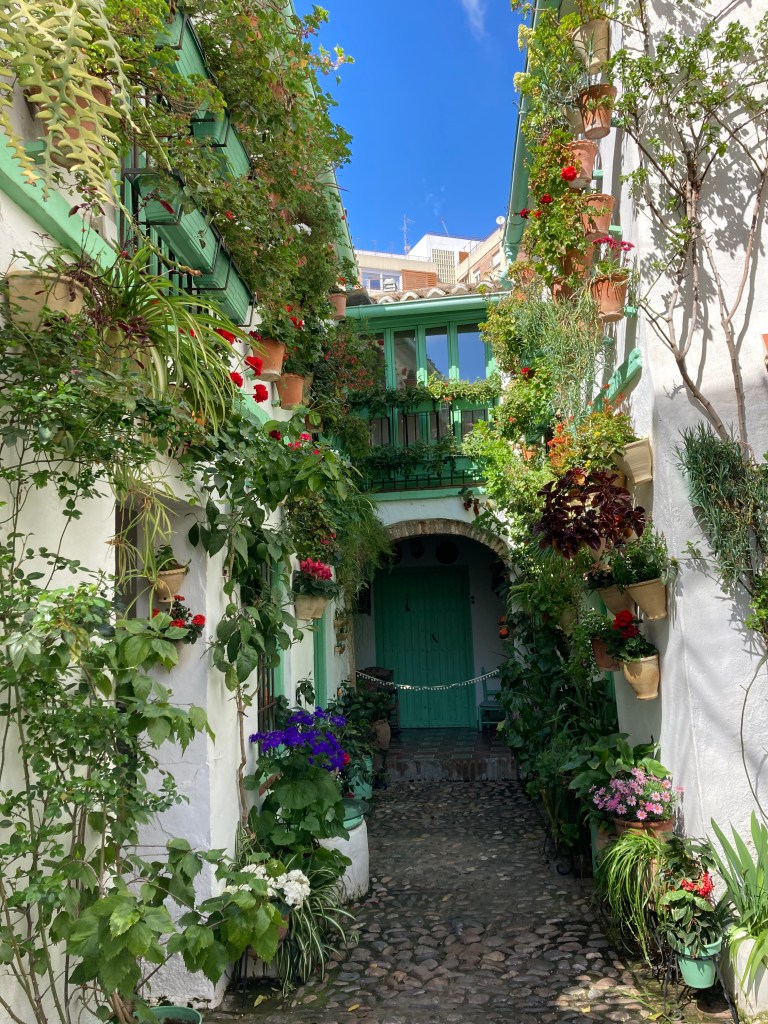
We had never heard of this festival before travelling to Cordoba. It takes place every year during the first two weeks of May and before I start getting really excited, about the preparations we saw whilst there, I have to share how historically fascinating it was to learn about how it all began.

On Day 2 in Cordoba we started the day by visiting the Archeological Museum. As museums of this subject go it isn’t all that big but does have some interesting antiquities going back to Roman times. Whilst there, we learnt that when the Romans came to Cordoba in 206 BC they built houses in a specific design. Due to the hot, dry climate houses centred around an inner courtyard (patio in Spanish) open to the sky. There was often a beautiful centrepiece, quite often a fountain and also a well to collect rainwater.
When the Moslems arrived and Córdoba became the capital of Islamic Spain in 756 AD they gave houses an entrance from the street which passed through a porch and started filling the courtyards with plants and water features as a way to keep homes cool and fresh. I find this even more interesting given that I live in an area of England where the Romans were prominent. I guess the English climate wasn’t as conducive to this style of living.

Over the centuries homeowners have developed their courtyards, through their own creativity and imagination, and patio decoration ended up taking on a life all of its own. Eventually someone realised that these hidden treasures were just too good to be kept tucked away behind heavy doors and iron grates. So, once a year, the doors open and everyone is invited in to see the wonders of Córdoba’s patios. The Patio contest is sponsored by the Córdoba City Hall and began in 1918. Again celebrations have grown over time with the inclusion of the “Battle of the Flowers” and May Crosses Festival.

These patios not only offer a chance to admire an array of colourful flowers but also an opportunity to appreciate the efforts that homeowners have made with beautiful stone mosaics and ceramic decorations. The amalgamation of floral scents such has jasmine and orange blossom alongside herbal plants such as oregano and basil assault your senses as you wander in off the street.
As a visitor to the festival you not only get to view private homes with such central patios but also larger apartment style buildings with ambitious patios where often many families work together to produce a beautiful shared meeting area.

We, visited Cordoba last week, in mid March but some of the patios are already open for viewing. They are free to visit and our hotel receptionist guided us where to look using a Cordoba city map but there is also a QR code you can pick up on your mobile which produces a map of those open.

Furthermore we visited the Palacio de Viana. The house, itself dates back to the 14th century but the main attraction for its 70,000+ visitors each year is the fantastic 18th century gardens divided into 12 patios. So stunning are the layouts that Vianna has become known as the Museum of the Patios. The layout is such that each patio sort of sneaks up on you. It might be that you turn a corner or wander through an open gateway and suddenly there before you is another secluded patio.
Each area has its own theme described on the entry board in Spanish and English for example “The Courtyard of the Oranges” which features, not surprisingly, orange trees but these are 100 years old!

I was just enchanted and my mind was buzzing with the idea of taking all this information home with me. Not to create a courtyard within my home, as I’m sure English planning laws would probably have something to say about that, but to segment my 120 foot garden and create my own private patio areas.

Needless to say The Courtyards Festival has been added to our list of future adventures and I seriously cannot wait to experience it!

This my final post of a series of three about Cordoba as part of our tour of Western Europe. Want to know more about this fascinating city? Why not check out the other two posts?


Who is Behind The Blog?

I’m sitting in a hotel room at Heathrow airport, with the alarm set for 4 a.m. so we have enough time to shower and grab a free breakfast before heading to the terminal and the start of a new adventure!
I seriously cannot wait. The run up to this point I often find a bit overwhelming, making sure I’ve packed everything we are likely to need, that all the plans I’ve researched and put in place are ready to rock and roll and we have those three key important ingredients: passports, money and a sense of adventure 😊

I’m sat in bed busily creating this next post, looking forward to receiving comments from readers around the world and hopefully some “likes” without those who give up their time to do this actually knowing a lot about me. So who is behind the blog?
Well I was born into a hard working family, in a beautiful Cotswold village, living high up on a hill overlooking the fabulous picturesque valleys below.
My life actually began in a caravan in my father’s field with my parents and my older sister.
I think I was about 4 or 5 when we moved into our family home on what is now known as a “social housing” estate. but back in my day was “council housing” so called because the local council built the houses and then rented them out.

At Junior School (in the UK that is aged 4 to 11 years) I excelled and willingly fought to keep my place at the top of the class.
It was also at this point in my life that I started to learn to ride and then very quickly caught the equine bug and fell in love with horses.
My Dad rented a farm so stabling came free. He was incredibly supportive which sometimes I don’t think I ever really thanked him for. It was a way of life that allowed me to be alone with my thoughts and negated the need at times to make friends. I was never lonely and became very independent, a characteristic that stood me in good stead many times later in life.

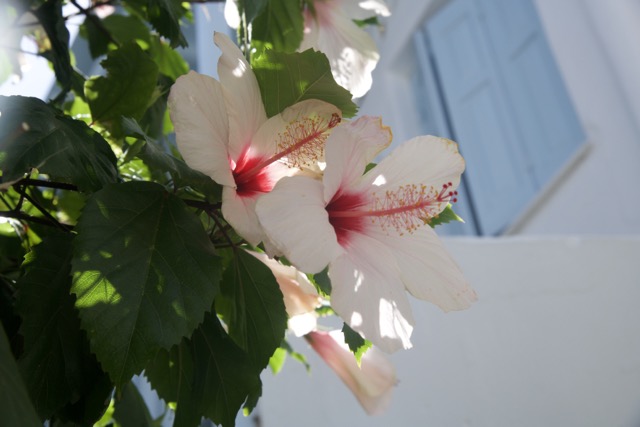
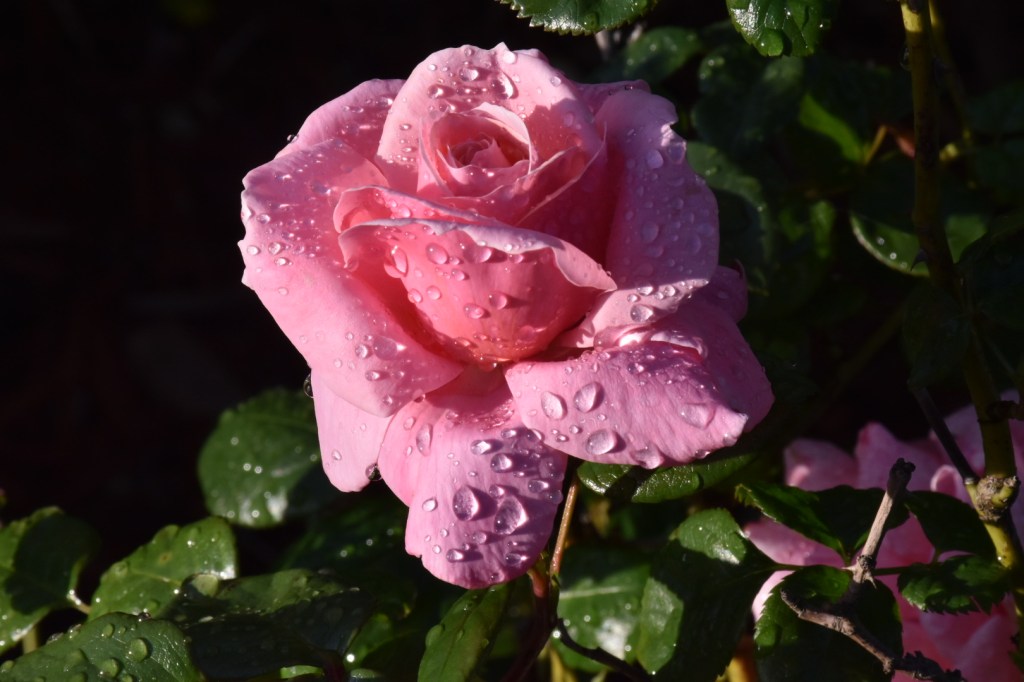
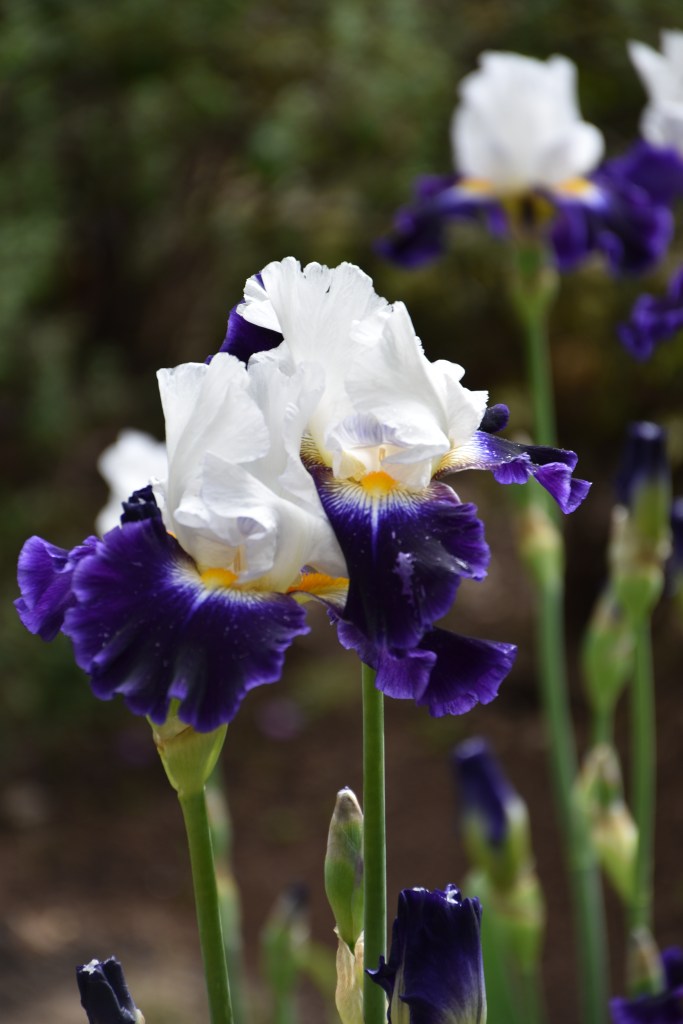
I’ve chosen pictures of flowers for this post taken on my travels

Passing my 11+ exam I then found myself at the Stroud High School for Girls. Suddenly I was no longer top of the class but surrounded by other “clever girls” and being fed an ethos that “we were the cream of the crop”.
This was also my first taste of a divided world, surrounded by girls from middle class backgrounds whose fathers were bankers, solicitors, directors and doctors and whose Mums stayed at home to bring up the children and “keep house”. A social stigma that I have already talked about in a previous post Navigating Midlife: Personal Opinions and Social Prejudice

I left school at 18 with good qualifications but university wasn’t an option for me.
My Mum had died at 55 when I was only 14 and my home life was emotionally and practically difficult and it was time for me to go out into the big wide world and earn a living.
With four job offers in retail management I chose to start my career with a large well known retailer as a Trainee Manager in Basingstoke, Hampshire. I was moved around the country every six months as my training and career progressed. It was a nomadic life style and one that I ultimately decided was not for me.


I left, settling in London and worked initially for a smaller fashion retail chain before joining a gaming and entertainment company. It wasn’t a job I envisaged taking but I desperately wanted to get out of fashion retail and so two days before my twenty second birthday on February 11th I started what turned into a 30 year career!


Apart from the work experience, promotions and sometimes good bonuses this job delivered, it allowed me to come into contact with all aspects of life. From the Mum spending her child allowance betting on the spin of a fruit machine to the thousands that could be bet and won on a roulette wheel along the demands that were listed on a “rider” for a visiting well known singing group or individual artist. Some of these entertainers were down to earth, speaking to you and treating you like a friend whilst others were full of their own self importance and happy to lord it over you.

I loved the fact that I met people from every walk of life, every level of Management and a multitude of nationalities. I listened to true life stories of refugees forced to leave their homes and countries of birth from Sri Lanka to Uganda, Cambodia and beyond.
People who left behind all that they knew to start again in the UK without even the ability to speak the language.
I met people who left their countries on ships from the Caribbean or as internet brides from Russia and the Philippines intent on finding a better way of life for their future generations or the family they were forced to leave behind. I saw bravery and unbroken spirits in these characters who did what they had to do to make a better life.
It was a real eye opener and made me definitely appreciate the country I live in and the freedom we often take for granted.

In February 2002 I began the next stage of my personal life as a single Mum with two mixed race children making hard but rationalised decisions to ensure they had a stable upbringing. It didn’t come without it’s challenges, some from within our family unit and others from the world outside. They were and are still my pride and joy.

2015 was a massive year of change for me.
Just after my birthday in February I found myself out of work, with an NDA, having given 30 years of blood, sweat and tears to a company who no longer valued experience. A company that seemed to all intents and purposes to be set on culling those who added the most expense to their payroll in favour of a cheaper, younger labour market.
Despite this I left with so many happy memories, more life lessons than I will ever be able to recall and a wealth of commercial experience and transferable skills.

With a mortgage still to pay I reinvented myself and for three years worked in the funeral industry. Initially alongside my commercial ability I utilised my hospitality skills to run a crematorium and open their first ever hospitality suite.
A year later I was training to be a funeral celebrant and ultimately used my creative writing ability to write funeral services and eulogies whilst happily standing up and speaking publicly at funerals.

In July 2015 I also met my now hubby. We had known each other previously when we were 19, had dated for about 18 months and then split up amicably. It was just too hard to conduct a relationship when we basically lived at opposite ends of the country!
30+ years later he decided to come looking for me and having found me on line decided to email me one Sunday night completely out of the blue. His research and ultimate belief that we belonged together turned into marriage and a life long love.

With the success of my business clashing with our personal time together, with only two weeks notice I decided to retire early, in February 2018, whilst hubby went on to work for another four years. No doubt you can see the pattern of how the month of February has dominated every major stage of my life thus far.
With on structure or work life I found myself at a complete loss. What was I now going to do with my time?
It took me until September 2020 to even begin to work it out and I probably didn’t reach the finished retired article until the end of last year, 2025!
There’s been a few curve balls thrown in along the way to test my endurance and to knock me off course but I seem to have an inept ability to brush myself off and find my way back to my own personal yellow brick road and finally a life of happiness, enjoyment, adventure and occasionally rest!

Does all this life experience qualify me to write a blog? I think I’ll allow you to decide that and will look forward to your comments………………..
In the meantime I will listen out for that alarm tomorrow morning and get myself to the airport 😊

Religious Unity in Cordoba

As part of our first day in Cordoba we visited the Mosque-Cathedral of Cordoba and I seriously cannot even begin to describe its beauty. A beauty that is not only defined by it’s architecture but also by the unity of religion created within.
In a world where so many countries have experienced or are experiencing religious warfare this cathedral bears witness to the fact that regardless of your religion (or in my case lack of religion) you can exist alongside each other in harmony.


The Visigoth Basilica of San Vicente, built in the mid sixth century became the city’s main Christian temple. With the arrival of the Muslims the area was divided and used by both communities.
Abd-al-Rahman, in response to the growing population, built the first Mosque between 786-788 with eleven naves which stand perpendicular to the qibla wall. The qibla wall is the wall in a mosque that faces Mecca. The mihrab is a niche in the qibla wall indicating the direction of Mecca; because of its importance, it is usually the most ornate part of a mosque, highly decorated and often embellished with inscriptions from the Qur’an. Unlike other Muslim places of worship, the qibla wall here is not pointing towards Mecca but instead faces south.
His successor then enlarged the Mosque further in 833-848 before Abd al-Rahman III constructed a new minaret in 951. A second enlargement took place in 962-966 before the final enlargement in 991.

With the conquest of Cordoba in 1236 the building was consecrated as a Catholic Church and in 1489 a new Main Chapel was constructed and a transept was created in 1607. From the outside the transept’s brickwork gives the building a vertical appearance which contrasts with the horizontal impression provided by the mosque.

The narrative provided by the Mosque-Cathedral states “this is one of the most exceptional monuments in the world, a testimony to the ancient alliance of art and faith. Its islamic architecture, with Hellenistic, Roman and Byzantine touches, comes together with Christian architecture to create one of the most beautiful examples of its kind. Inside among an impressive array of columns, arches and domes, we come across splendid works of art which bear witness to the passage of centuries.”

I cannot write anything better than this, this is such a great summation of this awe inspiring monument to religion. Christians have held mass every single day here since 1236. No one has altered the original Muslim decoration or structure. They have just existed peacefully side by side.

There is a fee to enter ( tickets can be purchased on line or across the courtyard from the main entrance) and an audio guide is also available. But let me suggest something in advance of your visit.
Leave the audioguide alone and enter this sacred place with an open mind, let the atmosphere draw you in, let the sheer beauty of the architecture awake your senses and let the peace and tranquillity surround your soul. If you allow this Mosque-Cathedral to envelope you, believe me you will leave this place with a feeling of a greater sense of harmony and an aura of peace.

This my second post of a series of three about Cordoba as part of our tour of Western Europe. Want to know more about this fascinating city? Why not check out the other two posts?

Touring Western Europe -Spain -Cordoba

Wow! What an amazing place!
We arrived yesterday afternoon and settled into our hotel for three nights. Sequestered in the old part of town with cobbled streets, beautiful but varied architecture and an atmosphere of conviviality and somehow tranquility .

Our day began with a 15 minute walk from our hotel through newer parts of the town and then into the Jewish Quarter.

Cordoba Synagogue

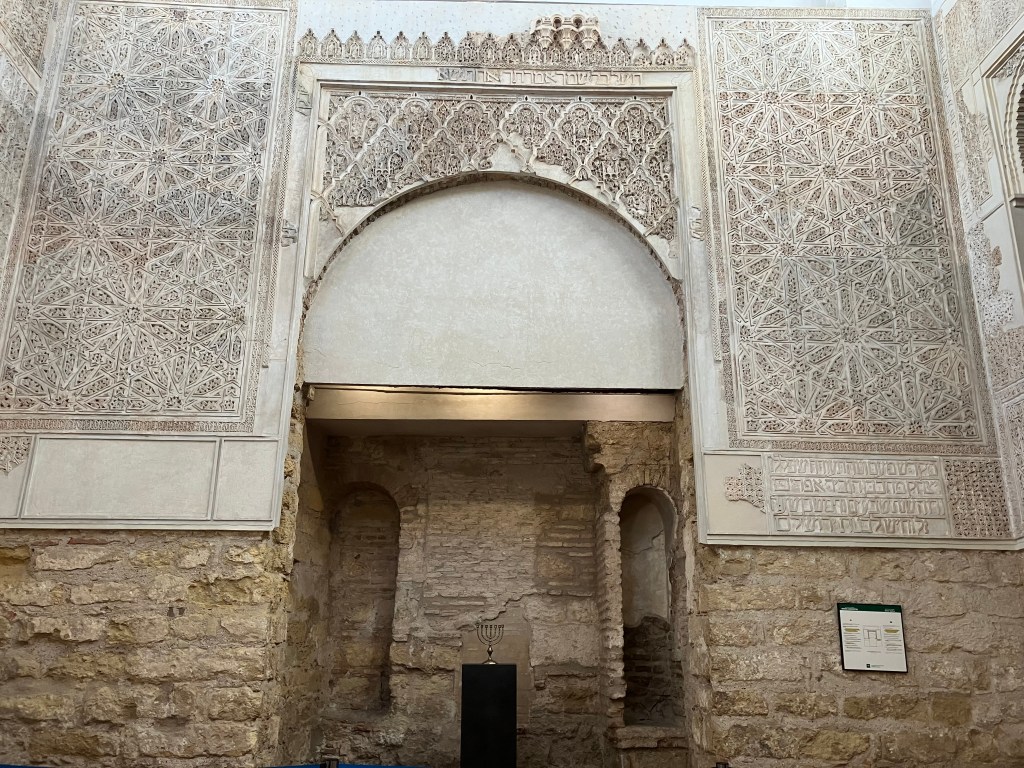
It’s only small, free to go in and takes only about 10 minutes to view but is one of the most well preserved Jewish history sites in Spain. Built in 1315 this sacred site features Mudéjar-style plasterwork and detailing throughout with original Hebrew inscriptions that adorn the walls of the main hall. After the expulsion of the Jews in 1492 only three synagogues remained throughout Spain and this is one of them with restoration beginning as far back as 1885!

Walking on from here we headed to the Banos del Alcazar Califal de Cordoba or……

Califal Baths.
This Islamic bath house is located underground so you have to walk down the stairs or slope to the entrance. Within the historic centre of Cordoba and part of the Unesco World Heritage Site the baths formed part of the Caliphal Palace of the Umayyads (which is now the Alcazar de los Reyes Cristianos) .

Built in the 10th century to serve those who lived in the Palace when bathhouses were a common feature of Muslim cities the baths were frequented both for ritual purification purposes and also for hygienic and social purposes. 
The layout was very similar to that of Roman baths in that there would be a cold room, a warm room and then a hot room. 

 Latrines were also accessible near the cold room, with underground running water washing away the waste. Bathers visited the cold room first, then moved to the warm room and finally the hot room, the purpose of which was to induce perspiration as part of the cleaning or purification process. Visitors were also cleaned with vigorous rubbing and massaging by bathhouse staff. 
In contrast to other versions of steam baths, Muslim bathers did not actually immerse themselves in water but instead washed themselves at the end of the process by having warm water poured onto them.

Furnaces provided hot water for the steam rooms, and also generated hot air and smoke which was then channeled through pipes under the floors of the hot and warm rooms, similar again to the Roman hypocaust system before being released  through the walls and up to the chimneys. This was over 1000 years ago and yet they had already mastered these techniques!

During the 11th century a reception room was added which is still present today, in front of which was a sunken garden. The garden was likely planted with orange and lemon trees along with myrtle and other plants. Water was brought to the baths from the aqueduct along the city walls and also stored in a cistern. 

Following the takeover of the city by the Christians in the 12th century the baths remained in use with a water basin specifically for bathing being added. Alas in the 13th century the baths fell into disuse when King Alfonso XI built a new set of baths within the royal palace itself. As a result the baths were buried in order to create a small square known as the Campillo del Rey.

It wasn’t until 1691 that the baths were rediscovered by accident when building work was taking place around the square. Covered over again they did not resurface for over 200+ years in 1903 and despite being dated back to the reign of Al-Hakam II’s reign they were again covered over. They finally saw the light of day when they were excavated in the early 1960’s and eventually converted into as museum, which opened in 2006.

The marvel of the baths for me, other than the engineering ability is walking upon some of the original marble floor and thinking about all those who went before me.

Alcazar de los Reyes Cristianos
The present day Palace was begun in 1328 by Alfonso XI of Castile on the site of an old fortress and appears Islamic due to the king adopting the Mudejar style. 

In the reign of Henry IV of Castille it became involved in the civil war and his successor Isabella and her husband Ferdinand of Aragon used the Alcazar as one of the first permanent tribunals of the Spanish Inquisition. In 1482, as it became the headquarters of the inquisition, much of the Alcazar was converted into torture and interrogation chambers which continued for another three centuries. 
On a lighter and more positive note it was here in 1486 that Christopher Columbus had his first audience with Isabella and Ferdinand in order to gain support for his expedition to find a western sea route to Asia.

The alcazar again came into its own, serving as a garrison for Napoleon Bonaparte’s troops in 1810, before returning to a prison in 1821. It became a national monument in the 1950’s.

Gardens
These are the piece de resistance of the Palace. As you walk out you cannot help but be amazed. Created in the mid 20th century they are just stunningly beautiful and well kept. Ignore the map of the layout and just let yourself wander at will amongst the beautiful fountains, well kept flower borders and contemporary glass sculptures. It’s hard to get photos without other visitors present but be patient, take your time and you will achieve it. If you have the time take a book with you and just sit and read or better still take a breath and just treasure the moment. Trust me you will not be disappointed.

NB:
This is part seven of our tour of Western Europe. Why not check out all the previous posts and follow us as we learn more about this fascinating area of the world?

Touring Western Europe -Spain- El Retiro -The Best Park In The World!

“The Best Park in the World”
As we reached our last day in Madrid and another train journey loomed, we left our Air BnB for our final afternoon under sunny skies and excitedly set off for El Retiro. We had discovered this oasis of activity and tranquillity on our last visit to Madrid and were eager to go and explore again. 

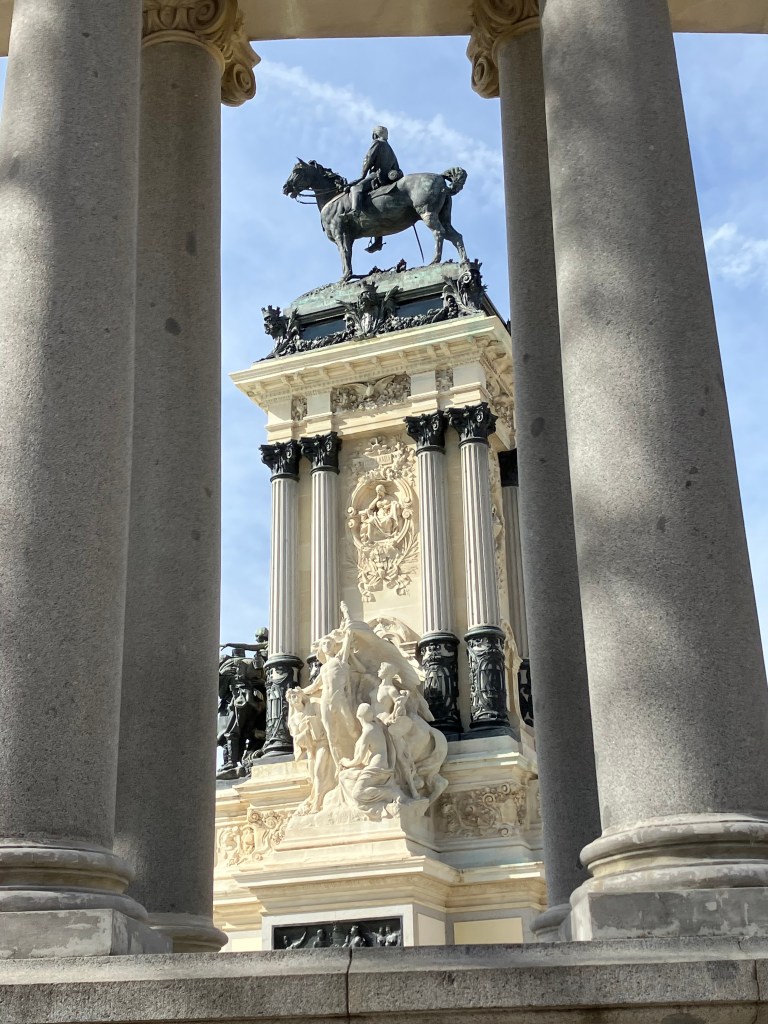
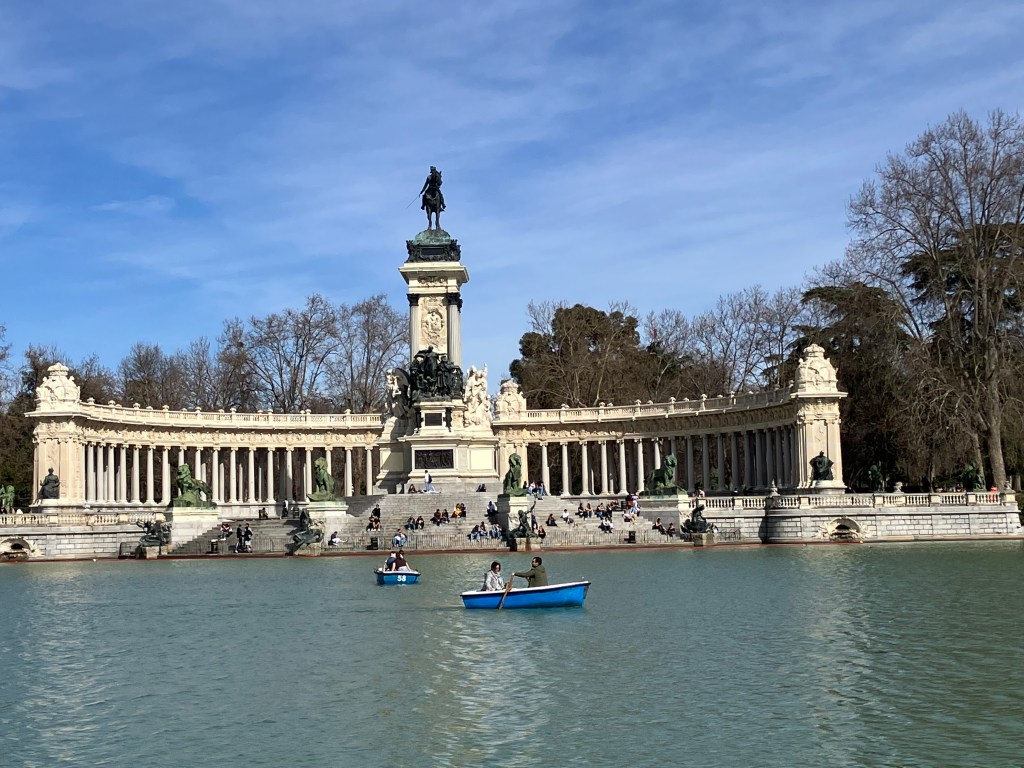
Walking the 20 minutes, past the Prado, we entered through the Felipe IV gateway and headed straight for the lake. This artificial lake, on which you can hire rowing boats, is overlooked by the monument to Alfonso XII of Spain and features a semicircular colonnade and an equestrian statue of the monarch on the top of a tall central core. Visitors splay themselves on the steps of the monument and across the colonnades so getting a tourist free photo is never easy.

There are various food outlets scattered about the circumference of the lake but we head off in an ante clockwise direction just taking in the ambiance, watching the efforts of the rowers, enjoying the sun’s rays and an afternoon stroll.

Taking a short break I click off a photo of a wide walkway surrounded by benches for no other reason than to show how clean the place is. There is no litter! 

In fact the pride of the Madrilenos in their city is part of what heightened its appeal to us on our first visit. The park is filled with statues, fountains, commemorative monuments and well kept grass and flower beds. There are so many benches to sit on or patches of grass to lie on, you can take a picnic, read a book or just watch the world go by. It’s safe, there is no intimidation, there are no vagrants or homeless people.
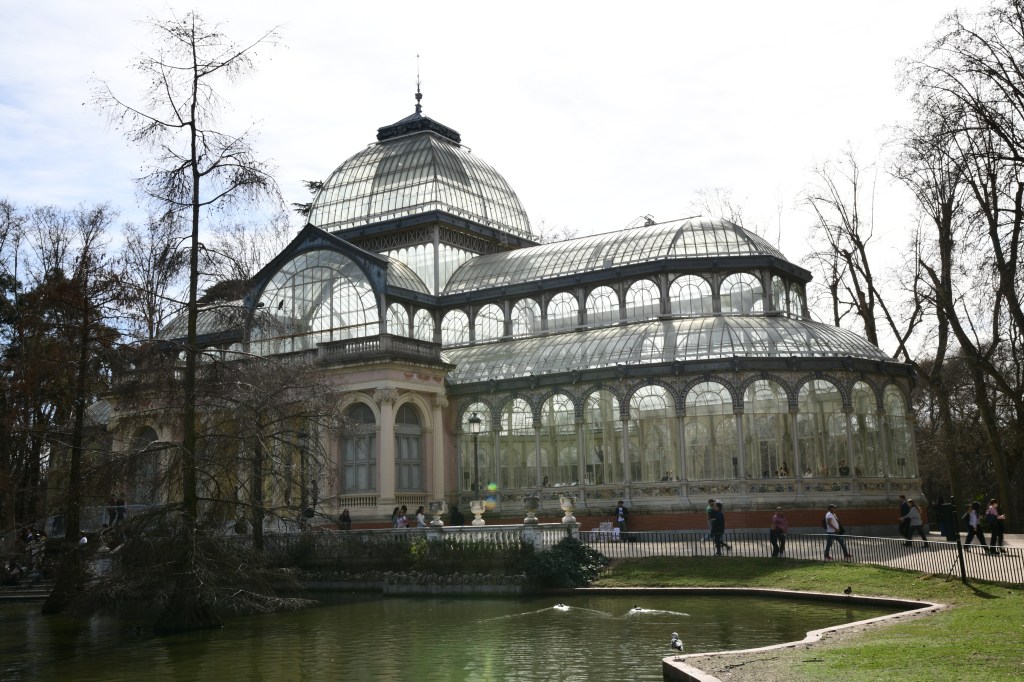
From the lake we head off to the two existing buildings in the park that normally house one off exhibitions: the Velazquez Palace and the Crystal Palace. Neither current exhibitions appeal to us but it’s lovely to sit by the Crystal Palace lake and admire the central fountain whilst watching the terrapins on the lake’s edge vie for the best position to sunbathe in!

Our final stop is the Rose Garden, created in the 1930’s and 1940’s and a beautiful place to stop when the roses are in full bloom as they were when we visited in May last time. It’s too early this year so we find ourselves another fountain to sit beside, dig out our books from our rucksack and forget about the world for an hour.
We have been fortunate to visit Hyde Park in London, Central P:ark in New York, City Park in New Orleans amongst others and El Retiro beats them all for us. There is no doubt we will return not only to Madrid but to El Retiro probably in time for the roses to bloom next year.

NB:
This is my sixth contribution detailing our tour of Western Europe. Why not check out all the previous posts and follow us as we learn more about this fascinating area of the world?

Touring Western Europe -Spain-The Palace of El Escorial

Armed with the Renfe Cercanios Madrid network map I made another attempt at ascertaining what times these trains run and managed to find a Renfe page on line which appeared to be helpful. According to this there was a train from Sol Metro station to El Escorial at 39 minutes past the hour.

The sun was shining on Sunday morning as we set off for our walk to Sol complete with our picnic lunch and drinks. We managed to find a friendly member of staff ,on arrival, who advised us that we couldn’t go straight from there to El Estorial but we needed to change at Chamartin. So much for my internet page!
She helped us buy the tickets and told us to head to platform 1 for the next train. The next train was terminating just one station further up the line. Personally I would have waited for a Chamartin train but hubby decided we were going to get on regardless. Needless to say the train stopped at the next station and we then had to muck about changing platforms to get the correct train to Chamartin. Hopping out here we soon found a train to El Escorial sat waiting to leave in 10 minutes time. 

The metro train trundled out of Madrid and headed the 30 odd miles north west through the outer city and countryside to our destination, arriving about an hour later.

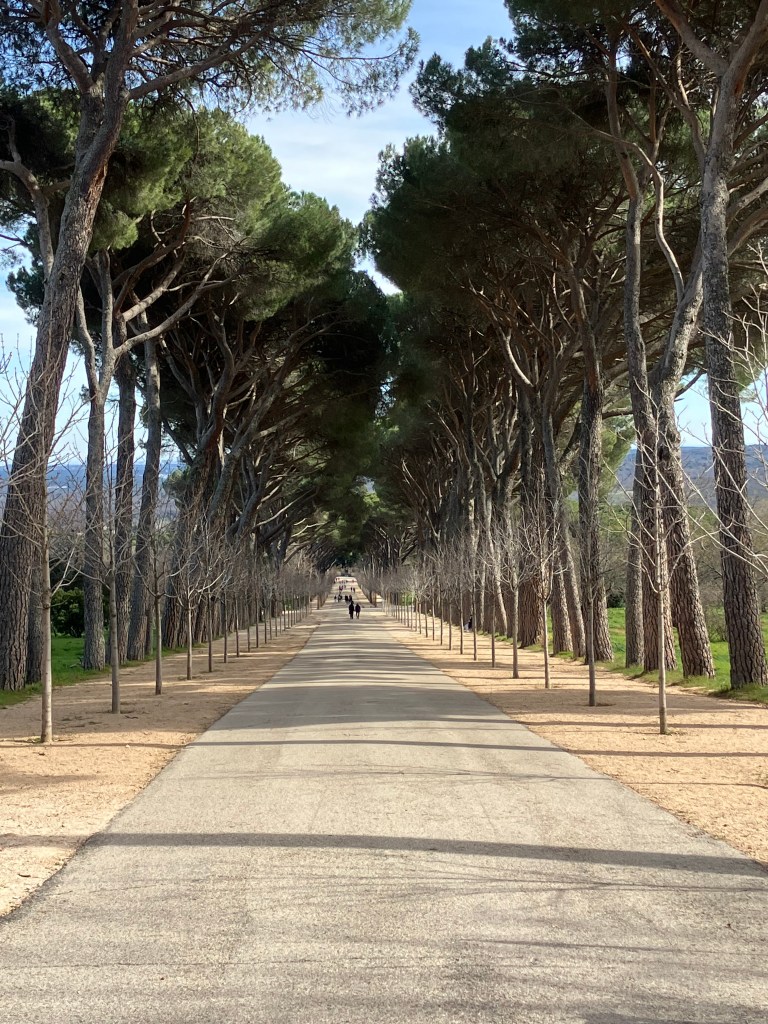
Leaving the train we headed out of the train station, across the road and entered the park of Casita Del Principe. It wasn’t hard to know where to go it was just a case of following the crowd! It’s about a 30 minute walk uphill through the park, just under 1.5 miles. I must admit I did have to take a couple of breaks particularly as the gradient got steeper the further you went.

We finally reached the entrance, paid our entry fee, collected an audio guide and map and headed off to tour the palace. Toilets and luggage lockers are also provided just beyond the main entry point, which is useful for your camera as no photos can actually be taken in the Palace.

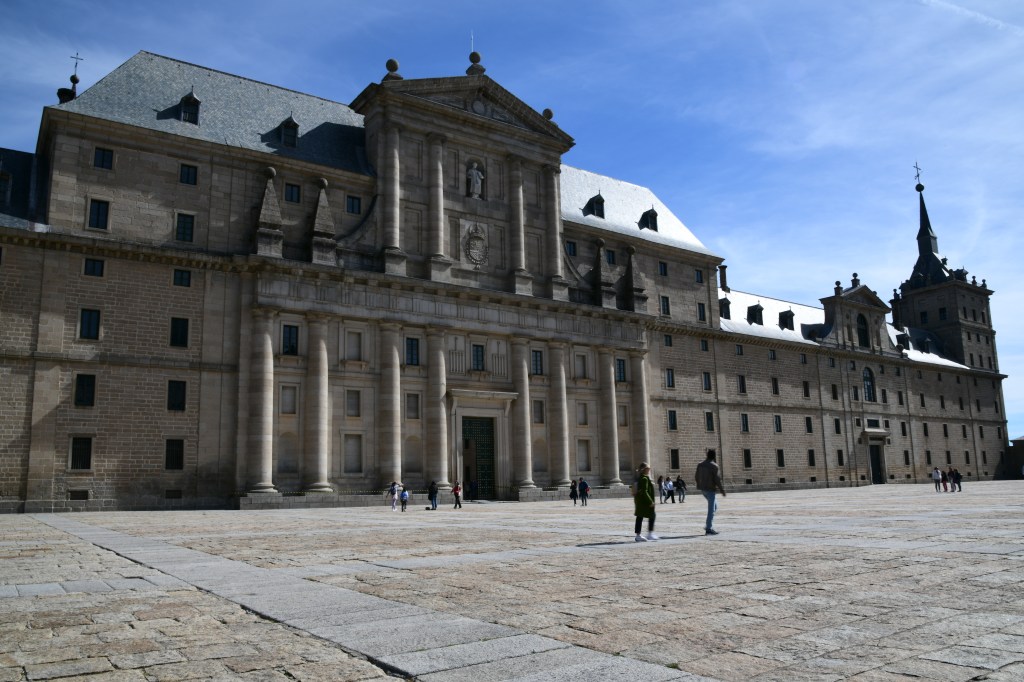
El Escorial or the Royal Site of San Lorenzo de El Escorial, to give it the full title, or the Monasterio del Escorial is a historical residence of the King of Spain. It was built by King Phillip II and is the largest Renaissance building in the world. El Escorial was both a Spanish royal palace and a monastery although Phillip II is the only monarch to have lived in the main building. Building began in 1563 and it was finished 21 years later in 1584. Since then it has become the burial site for most of the Spanish kings of the last five centuries, Bourbons as well as Hapsburgs. 

The tour begins with the Courtyard of the Kings before heading upstairs to the royal library and then bringing you back down to the Basilica. Services still take place here so it’s worth noting the times as you may have to return later. 
You also get to walk through the Hall of Battles, originally called the King’s Gallery, which is adorned with fresco paintings depicting the most important Spanish military victories. 

The palatial rooms of Phillip II form part of the tour along with information on the architecture and the galleries of art.

You also head down to the lowest level of the palace to the Royal Pantheon crypt. 
Twenty six marble tombs contain the remains of the kings and queens from Charles I to the present day. Remains of Royal consorts who were parents of monarchs also have tombs here. Once abdicated King Juan Carlos I’s parents are interred here it will actually be full and no plans have yet been released as to where Juan Carlos, his wife Queen Sofia or their off spring will be buried.
The Pantheon of the Princes, built in the 19th century houses the tombs of princes and princesses and royal consorts who were not parents of monarchy. Among their most recent interment was that of Infante Alphonse in October 1992, the younger brother of King Juan Carlos I.

This section of the pantheon is quite a sad collection of small tombs.

Jardin de los Frailes

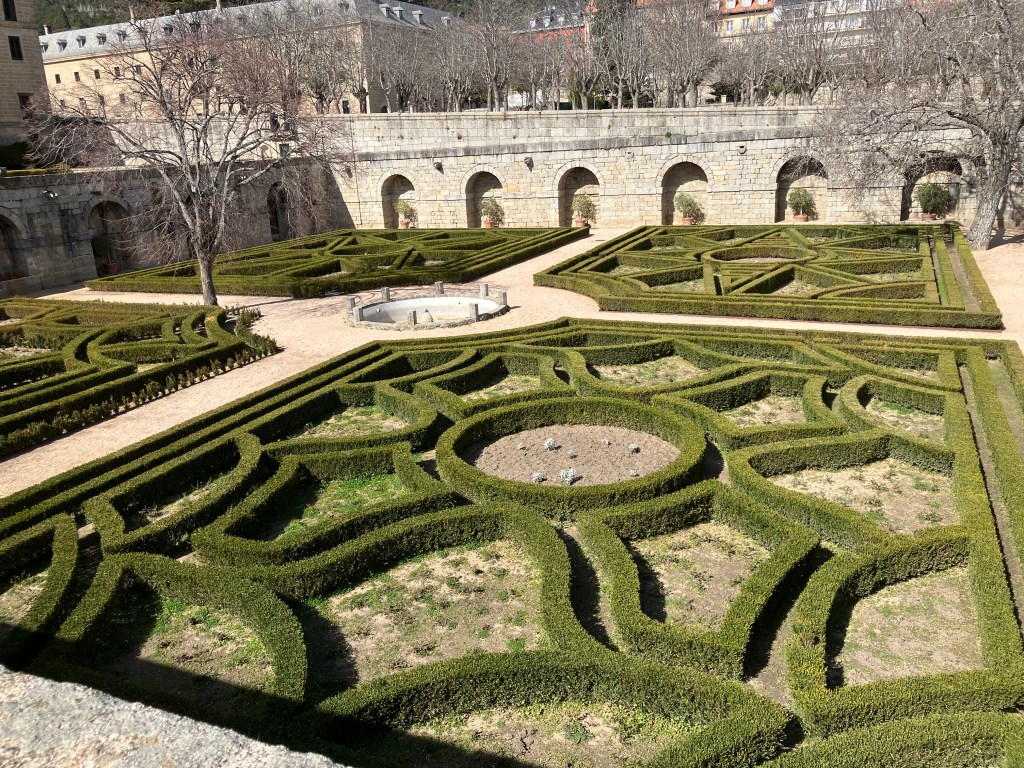
Having left the Palace itself you can make your way across to the far left corner of the front courtyard in order to access the gardens. These can be seen from above, through the windows of the Palace and are box hedge gardens laid out in geometrical patterns although it isn’t easy to see this at ground level. 

We wandered the pathways, admiring the views across the valley and mountains beyond before retiring to the park for our picnic.

NB:
This is my fifth contribution detailing our tour of Western Europe. Why not check out all the previous posts and follow us as we learn more about this fascinating area of the world?