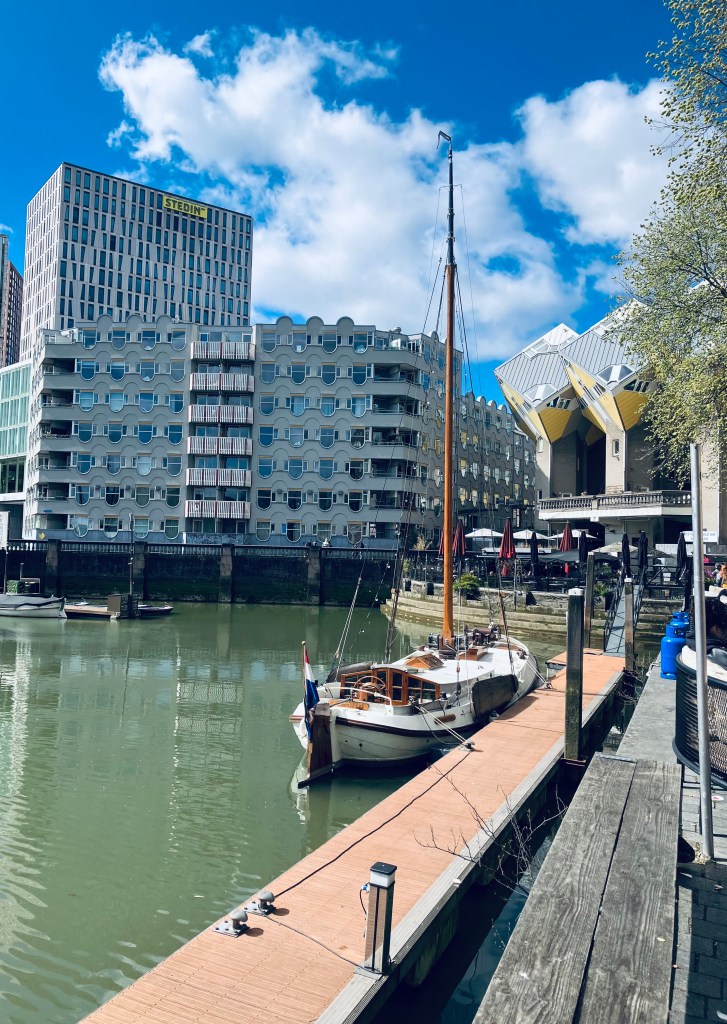
Day 2: Exploring Kew Gardens in London -History, Attractions and Planning Tips

Travelling to Kew by underground:
Day 2 dawned sunny and bright and we jumped on the Jubilee line at Canary Wharf station and made our way to Westminster. Changing onto the District line to reach our destination -Kew Gardens. From the tube station it is only about a five minute walk to the Victoria Gate entrance.

Entry tickets for Kew can be bought on line which is always slightly cheaper than just turning up on the day. We took advantage of a special offer from National Rail where tickets are currently 2for1 if you travel to London and back by train. It doesn’t have to be a day trip it can, as with us, be a longer trip but it’s worth having your outward and return train tickets available with you in case you get asked.
Whether you live in the UK or are here visiting it is always worth looking at their website National Rail.com for offers particularly during the summer and any other main school holiday.

History of Kew Gardens:
Kew Gardens can trace its history back over 250 years to 1759, when Augusta, Princess of Wales, founded a nine acre botanic garden within the pleasure grounds of Kew Palace. Over the years, the Gardens have seen a huge amount of change, but incredibly, some of the plants from the original grounds still survive today. It is now not just a beautiful garden but a globally renowned scientific institution for plant and fungal research employing over 1,100 staff.

It is one of London’s top tourist attractions consisting of 330 acres of gardens and botanical glasshouses. As a World Heritage Site it also contains four Grade 1 listed buildings and 36 Grade II listed structures on site. It’s not surprising that Kew Gardens is listed Grade I on the Register of Historic Parks and Gardens.

Planning Your Day:
There are four gates through which you can gain entry:
The Lion Gate -this is the nearest to Richmond Station which has both underground and overground rail links
The Victoria Gate -which links to Kew Gardens Underground Station
The Elizabeth Gate -this is near Kew Pier if you are using river bus services or Kew Bridge Station which is on the overground
The Brentford Gate -next to the car park if you are travelling in by car. Parking charges are available on the Kew Gardens website.

It is worth pointing out that Kew Gardens can get very busy particularly at weekends and in school holidays with numbers increasing in the middle of the day. We chose to come on a Thursday (mid-week) and arrived as it opened at 10 a.m.
It’s also worth mentioning that school parties tend to arrive early but, from our experience, they quickly disperse once inside.
At the entrance it is worth picking up the map and guide pamphlet and then grabbing a bench nearby and planning out what you want to see and in what order you wish to do this. You can, of course, do this beforehand as the map is accessible on the Kew Garden website.
There is a lot of walking involved in exploring these beautiful gardens so trying to encapsulate everything of interest to you in a circuitous route does have its advantages.
If walking isn’t for you, you can catch the”Kew Explorer” for an easier way to travel around. Up to date ticket prices are again available on the website.

The pamphlet also highlights key attractions and seasonal highlights and gives you details of Free Guided Walking tours including timings. Check with on site staff at the entrance gate before setting off into the gardens as to how and where you join one of these.

Finally if you haven’t brought a picnic or lunch there are details within the pamphlet of the various six eating places on site. There is somewhere for all price ranges and for those with or without children.

Our Day At Kew:
These are my highlights of our day and some of the rationale we used for what we saw but don’t forget this day is your day to explore as you please.
We started our day with the two main glass houses as we didn’t want to have to contend with crowds of people later on.

Palm House:
This beautiful glass building, shaped like the upturned hull of a ship, was the first of its kind as no one had ever built a glasshouse of this size before. Designed by Decimus Burton with Richard Turner and completed around 1844 they actually borrowed techniques from the ship building industry in order to complete its structure hence its shape. There are 16,000 panes of toughened glass some of which are curved and very expensive . What you see today is the result of the second renovation which took place between 1984 and 1988 when the original building was completely dismantled, restored and rebuilt.
The temperature is maintained to a minimum of 18C. There is no maximum but the vents are opened when it gets above 28C .
They also have a misting unit designed to keep the relative humidity above 75%. Apart from the vents everything is controlled by a computer sited downstairs so when the water sprayers suddenly come on you know it’s not some ghost you cannot see but a pre determined event. The staff also manually water the plants every day.

Many rare and threatened species grow in the Palm House including several palms endemic to tropical islands, such as one from Comoros, an island nation in the Indian Ocean. There are very few left in their natural habitat.
Another critically endangered, very beautiful palm originates from French Polynesia.

We entered this Palm filled oasis from the left as you look at the map, splitting up as is often the case. This allows us to admire the plants individually in our own way. Hubby is very into photography and so tends to look from that perspective whereas I like to wander around, usually in a uniform fashion i.e. up and down the rows, ensuring I don’t miss anything and grabbing photos on my phone. It’s easy to feel like you are in a different world when inside with all the different species growing merrily.

I was fascinated by all the flowers and fruits that were growing. I had no idea what some of them were but I still took delight in photographing them for myself.
This was one of the stranger flowers I saw?

Keep your eye open when inside the Palm House for the world’s oldest potted plant, a prickly cycad, which was brought from South Africa to the UK and planted in 1775.

Don’t forget either that important scientific work also takes place in the Palm House, including DNA research and finding new medicines. For example a study took place here on water retention in palms with relation to climate change.

The Temperate House:
Leaving by the same entrance from whence we had arrived we then made our way to the Temperate House originally created to house frost-tender plants.

The first thing you will notice is its pure size. At more than twice the size of the Palm House, the Temperate House covers nearly 5000 square metres and is 19 metres high at its tallest point. Like the Palm it was designed by Decimus Burton and completed between 1845 and 1848,
Architecturally the oldest part of the house is the central block with the two octagons being completed and opened in 1863. The north and south ends were added much later and completed in 1899.

The building was last refurbished in 2018. It took five years to complete and now houses 1,500 species and more than 10,000 individual plants, all from temperate regions of the world. The world’s rarest and most threatened temperate plants are housed here. Six species in the Temperate House are considered Extinct in the Wild.
The tallest tree in the glasshouse is a pink trumpet tree which began its life here at 9 meters and can potentially reach 30 metres when fully mature. Three plants arrived here back in the 1800’s!

Being temperate plants the temperature inside must be above 10 degrees celsius in order for them to survive. On cold winter days, the glasshouse is heated by boilers and radiators, while the windows are kept shut. Conversely on warm summer days, the windows are all opened. If the temperature exceeds 12°C inside the building, vents in the glass roof open, all controlled by a localised sensored mechanism.

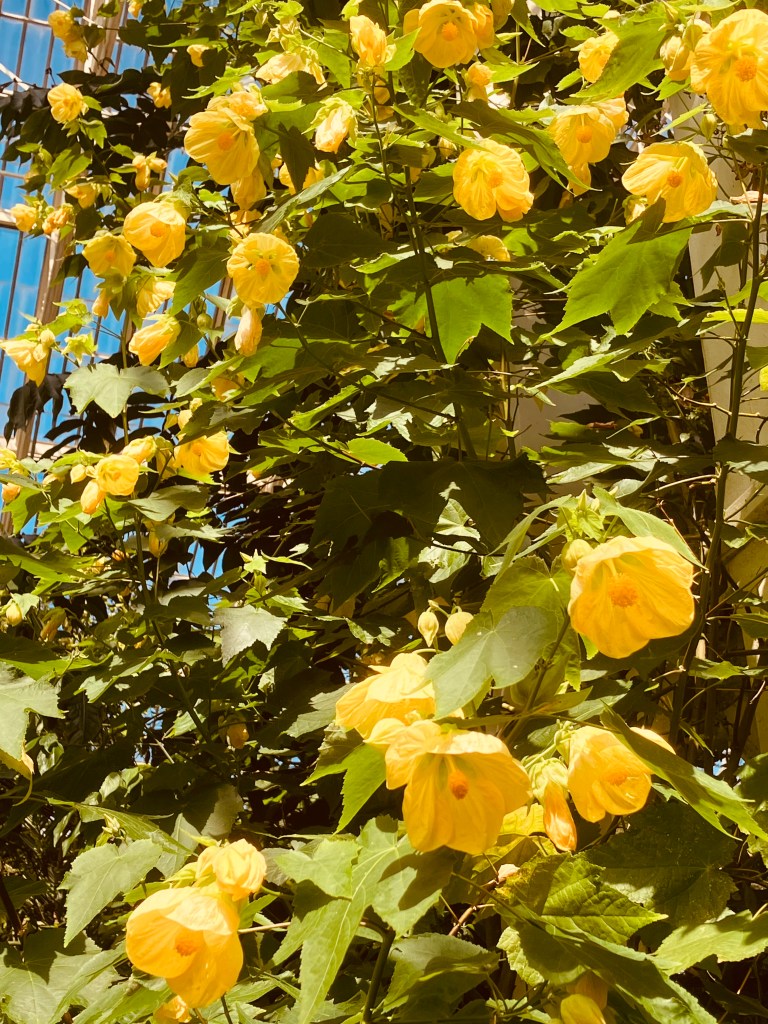
Being from temperate zones there were more species that I recognised such as these beautiful yellow flowers:
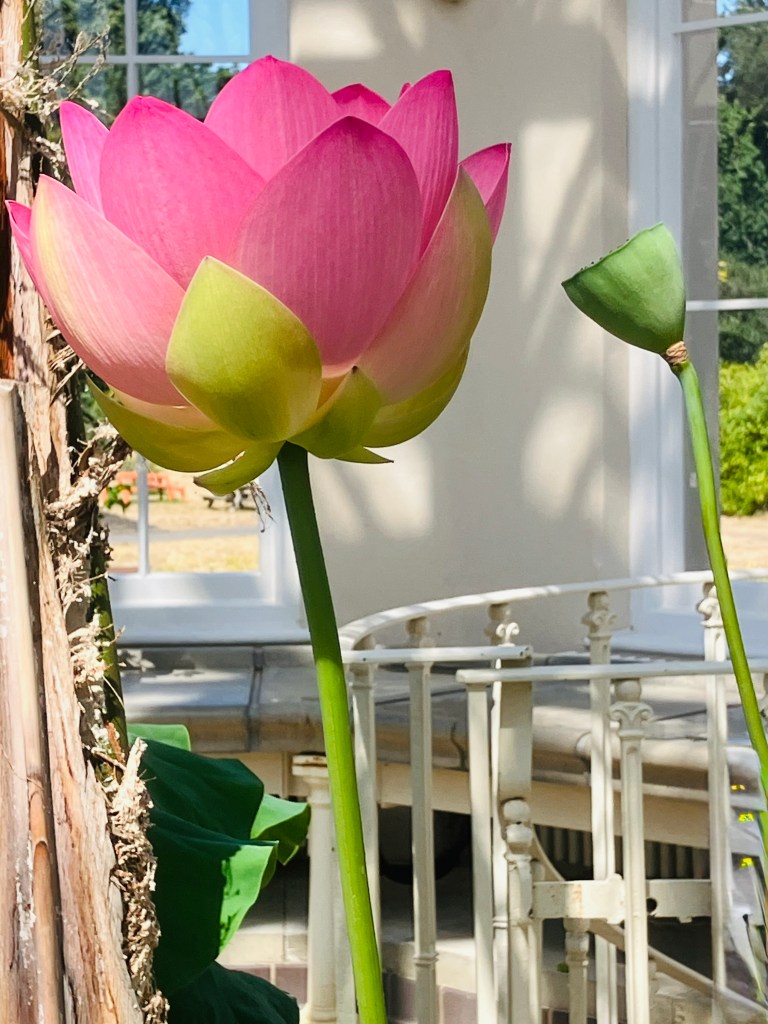
Conversely there were some flowers that I’d never seen before like this giant pink flower that looked like something from a sci-fi movie.
Being a larger environment it has also been possible to include man made embellishments such as statues and a lovely waterfall:

The Great Pagoda:
Having entered the Temperate House from Cherry Walk we left via Thorn Avenue and made our way to the Great Pagoda.
Built in 1761 by Sir William Chambers as a present for Princess Augusta, the founder of the gardens. Chambers had spent time travelling and studying the architecture of East Asia and thus it is a beautiful and striking example of chinoiserie architecture. Most pagodas were designed as a religious monuments but Chambers instead intended it to be a window for the British people into Chinese culture.
The pagoda is made of grey brick and stretches up 10 storeys, totalling 163 ft in height, A popular ‘folly’ of the age, it offered one of the earliest and finest bird’s eye views of London.

Like many of the buildings here at Kew it had to undergo restoration and thus was returned to its former splendour in 2018. Adorning the building are 80 dragons, which were removed in 1784 when repairs were undertaken to the building’s roof. Lost for 200 years they are now back thanks to 3D printing technology and hand wood carving techniques.

Access to The Great Pagoda requires a separate ticket, in addition to your Kew Gardens ticket and a degree of good health to climb the 253 steps to the viewing gallery.

We chose to take a break here and eat our picnic relaxing on one of there nearby benches with the glorious view of the building in the foreground.

Treetop Walkway and Lake:
Walking past the pagoda we set off along Cedar Vista, stopping off at the Treetop Walk before moving onto the lake.
The treetop walk is fairly self explanatory. Catching the lift to the top and at 18 meters off the ground you get a birdseye view of the gardens and the landscapes of London beyond.

The Lake is definitely worth walking around, we went clockwise from Cedar Vista and with many benches strategically placed on the circumference it offers a peaceful interlude from an otherwise fairly full on day.
It was created in 1856 in an area that was excavated to provide gravel for terracing the original Temperate House and covers five acres of water with four islands. Underground channels connect the Lake with the Thames, and it was filled for the first time in 1861.  

The Sackler Crossing, designed by architect John Pawson, opened in 2006 and became the first ever bridge across the Lake. He designed it to mimic the Lake’s rounded banks. It also provides a great spot to stop and check out all the fish in the lake below.

Having crossed over the lake we went left onto Boat House Walk and then left again onto Princess Walk following this all the way to The Orangery.
Walking in front of this restaurant which is housed within a magnificent eighteenth-century Grade I listed building, you get a feel for the sheer grandeur of Kew. Designed by Sir William Chambers, and was completed in 1761, it measures 92 by 33 ft. With i’ts tall glass windows looking out over the grounds it has a very light and airy feel.

Princess of Wales Conservatory:
We walked on and turned right onto Ginkgo Lane leading us down past The Hive and onto The Princess of Wales Conservatory on the left.
The building was designed by architect Gordon Wilson, replacing 26 smaller buildings and opened in 1987 by Diana, Princess of Wales in commemoration of her predecessor Augusta’s associations with Kew.

With a floor space of 4,500 square metres, the glasshouse contains a whopping 10 different climatic zones and a huge variety of plants, from cacti and carnivorous plants to orchids and bromeliads.
Each of these climatic zones, from the cool desert to the tropical mountain and rainforest, is maintained by a computer which adjusts heat, ventilation and humidity automatically.

I struggled inside this conservatory to remember where I had been and where I hadn’t. It is definitely a bit of a maze and takes longer to meander around than either of the previous glasshouses.

Interestingly during its construction Sir David Attenborough buried a time capsule in the foundation of the building containing seeds of important food crops and several endangered species. It will be opened in 2085, when many of the plants it contains may be rare or extinct. People will be able to use those seeds and understand how much we cared about the future of our planet.

Leaving the conservatory behind we made our way back onto Broad Walk and returned to our starting point admiring the lake and gardens in front of The Palm House.

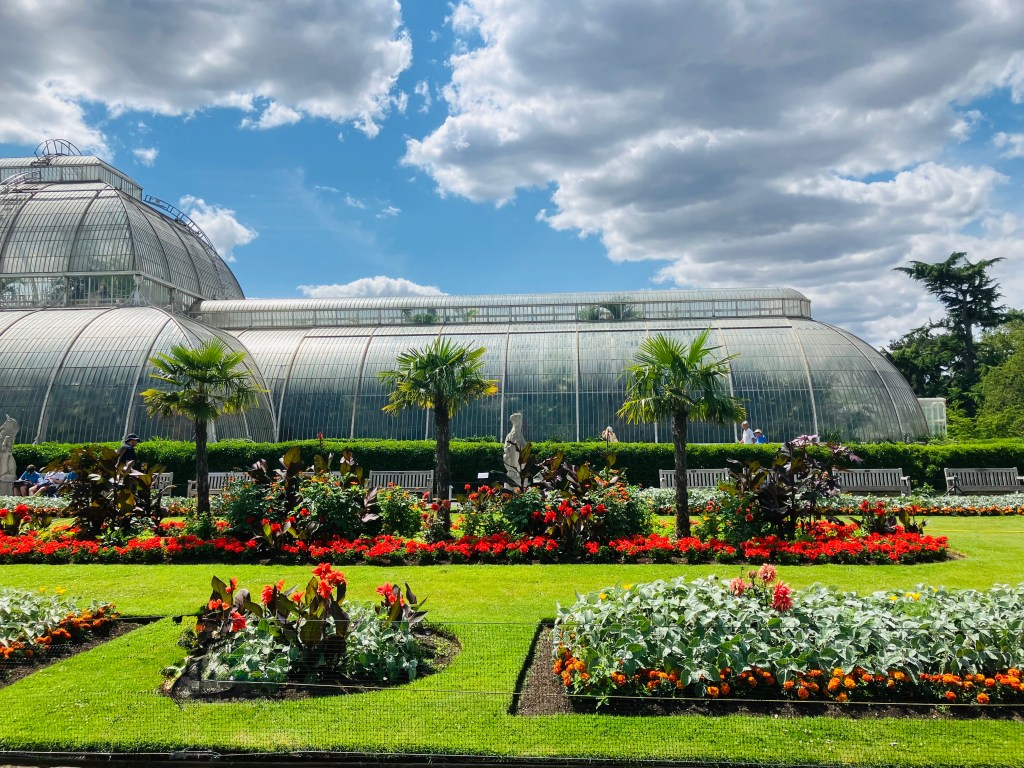
With over 6 miles walked we bade our farewells to this wonderful piece of botanical history and headed back to our hotel to prepare for Day 3…………………

.
Day 1 -Sculpture and Serenity in London

Having decided to spend our ten year anniversary in London I began researching last year where to stay and what to do. Way back in September of last year I managed to secure a good deal on a Premier Inn Hotel right next to the Westferry DRL Station in Canary Wharf. Premier Inn is actually the UK’s biggest hotel brand with 86,000 rooms. They are a mid range hotel chain but perfectly adequate for our needs and we quite like the fact that we know when we book and then arrive, what to expect.

We arrived last Wednesday for our five night stay and checked in mid afternoon. Normally when we are off on an adventure I don’t plan anything for us to do straight away. It’s nice to chill out, unpack and relax before hitting the streets to explore but on this occasion I had decided to hit the ground running, so to speak, and head out on a Sculpture Trail.

Both of us enjoy art and my particular passion is Sculpture. We are fortunate to have a Sculpture Park near where we live in Gloucestershire which I have featured previously in a post:
https://amidlifeadventure.org/2024/06/28/discover-the-cotswolds-sculpture-park-a-harmony-of-nature-and-modern-art/

I had no previous knowledge of the sculptures at Canary Wharf but it is actually home to London’s largest collection of outdoor public art. With more than 100 pieces of stand-alone sculptures and integrated architectural works, each piece was created by a highly-respected artist and it would appear from our search goes largely unnoticed by those who live and work in the area.

Being midlife adventurers we haven’t ever got into the Pokemon search via phone that so many young people are involved in and from what I’ve seen on Instagram even some famous English celebrities! This was, for us, like an older persons artistic equivalent. It is completely free, in the open air and gave us a great introduction to this area of London that we had never previously explored. You can download a copy of the map and information about each statue directly from the Canary Wharf. com website: https://canarywharf.com/artwork/art-map/

I printed it off so I didn’t have to rely upon my phone battery, given I would also be using it for photographs and mapping our way. However be warned it doesn’t print accurately onto A4 paper!

Divided into five separate areas labelled A to E we started in Zone A purely because it was the closest to our hotel and we managed to complete about half of it in the three hours we had allocated before our dinner reservation. Here are my highlights, mainly in photographic form, of our afternoon stroll:

Zone A -Westferry
Our starting point was at a sculpture entitled “Windward” which stands directly on the riverside at a height of 50 metres. Made of red carbon fibre it bends in the wind. When it is particularly windy the tip of the needle can bend down to 20 meters!
This in itself was a beautiful spot to begin. The sun was still shining and the view across the Thames to The Schard was lovely enough to distract me from taking my first sculpture photograph!.

Adjacent to this is Westferry Circus where seven other sculptures stand. We found the map in this area slightly confusing with the numbered pictures matching the associated descriptions but not always matching the map.

The park is a small haven in an otherwise busy commercial area. It provides respite and calm with this focal sculpture entitled “Sasso Cosmico”standing out amongst the summer flowers and foliage.
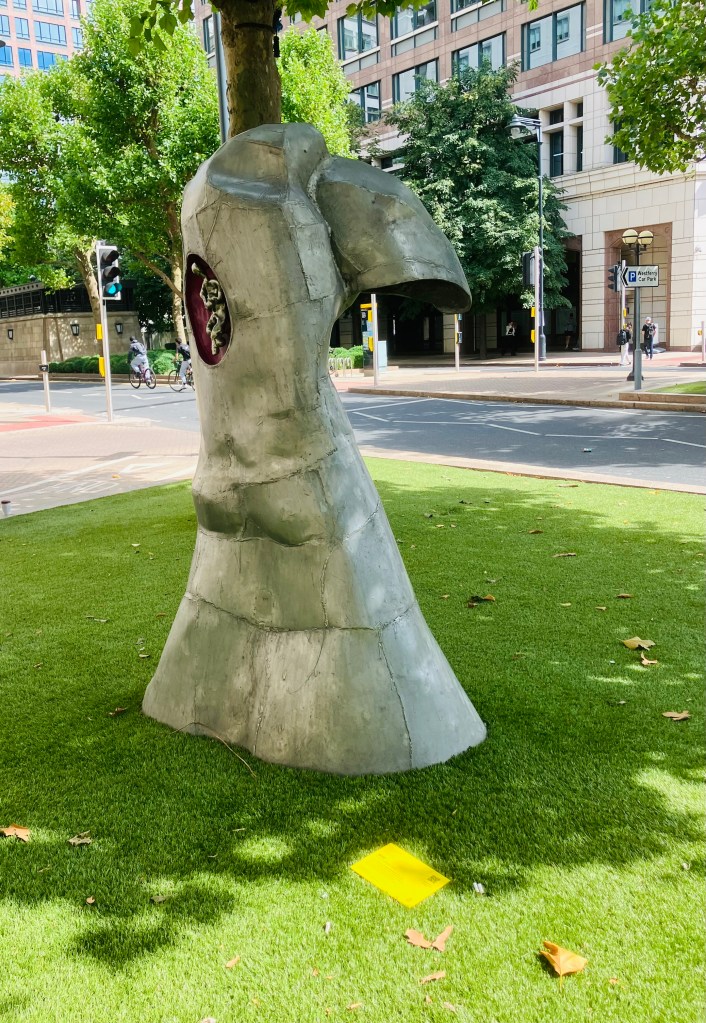
En route to Columbus Courtyard was this piece called “Avatar” which portrays a hawk-like beast with a human form embedded in its back. You can see the yellow plaque on the floor next to this piece. This also gives information about the artist and details of the sculpture. Most of the sculptures we saw had their plaques intact.

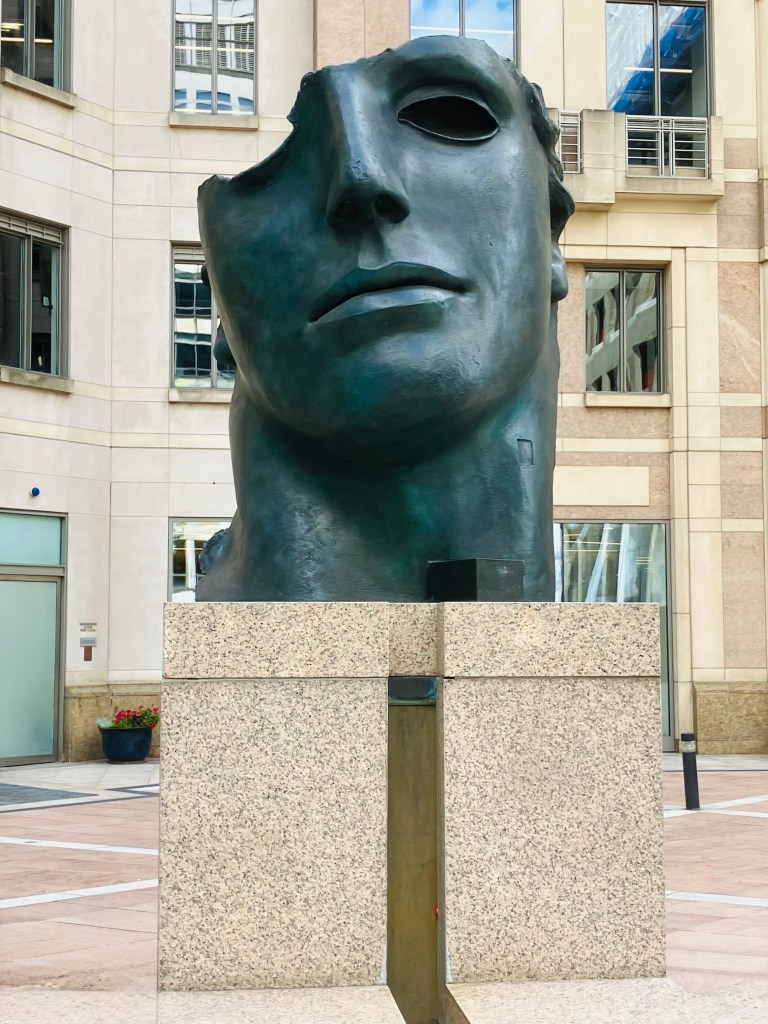
The next photo shows my favourite in this first area -Centurione I by Igor Mitoraj.
I like the fact that the sculpture has its origins in the Roman era. I wanted to know who this handsome fellow was and really felt that Mitoraj had captured the human form well.

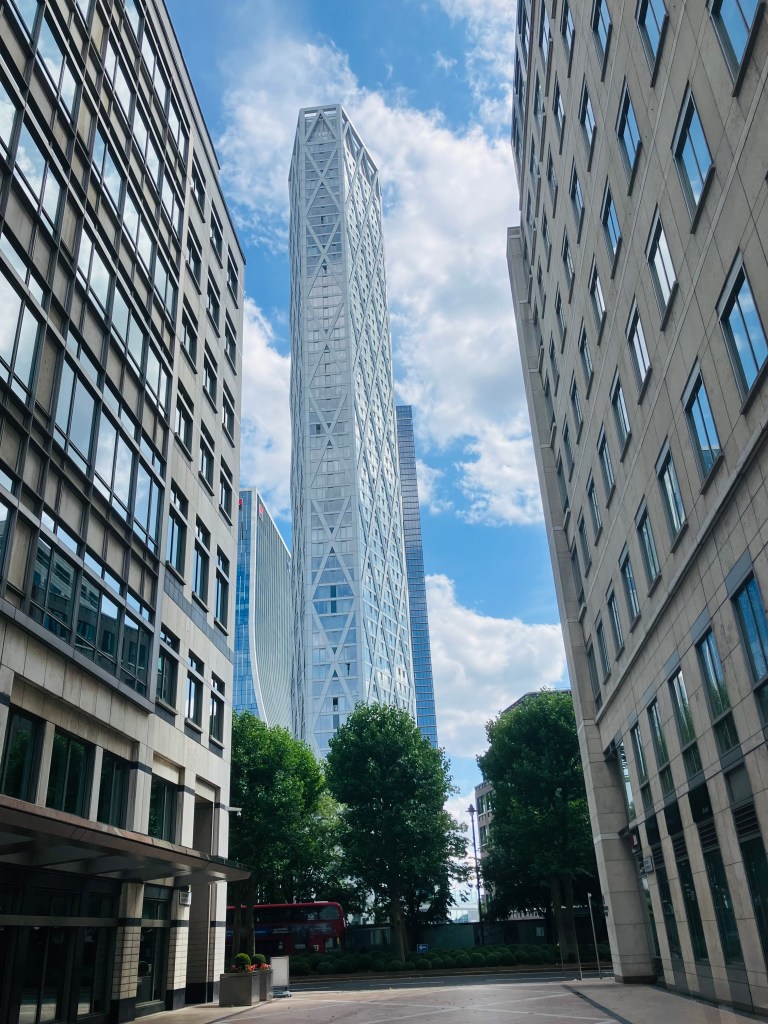
Walking around this fairly intense commercial area I couldn’t fail to also admire the architecture itself:

And look how clean all the streets are, it’s amazing!

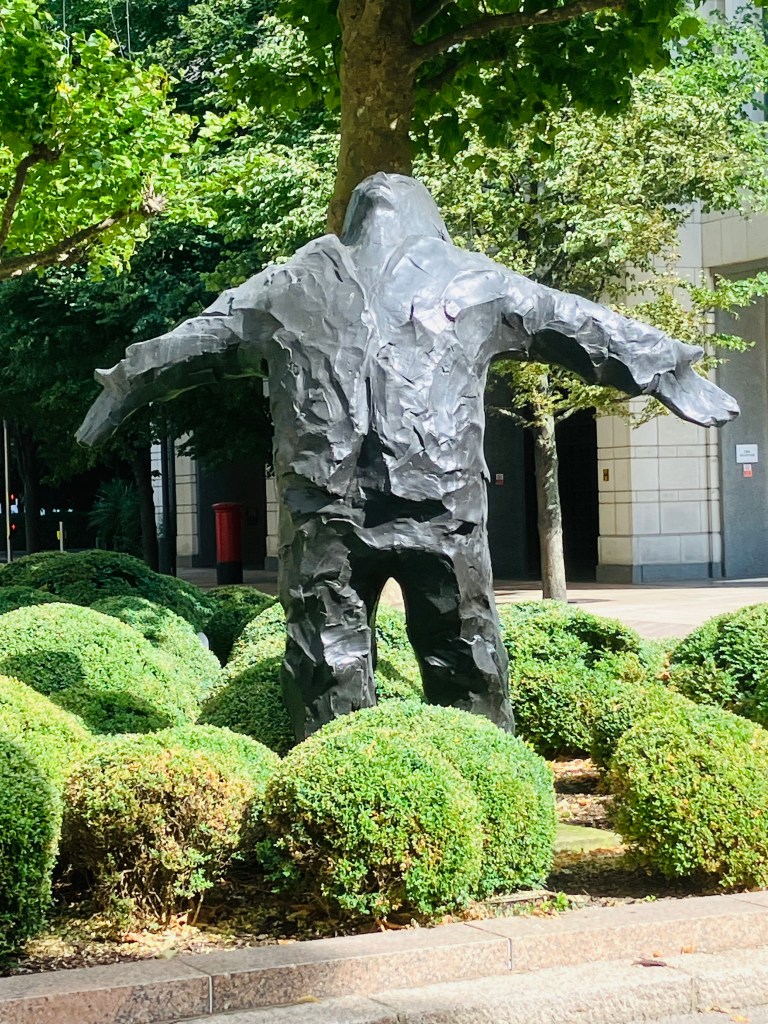
We finished Zone A with “Man With Open Arms” by Giles Perry. Another of his sculptures also captured my attention in Zone B.

Zone B-Cabot:
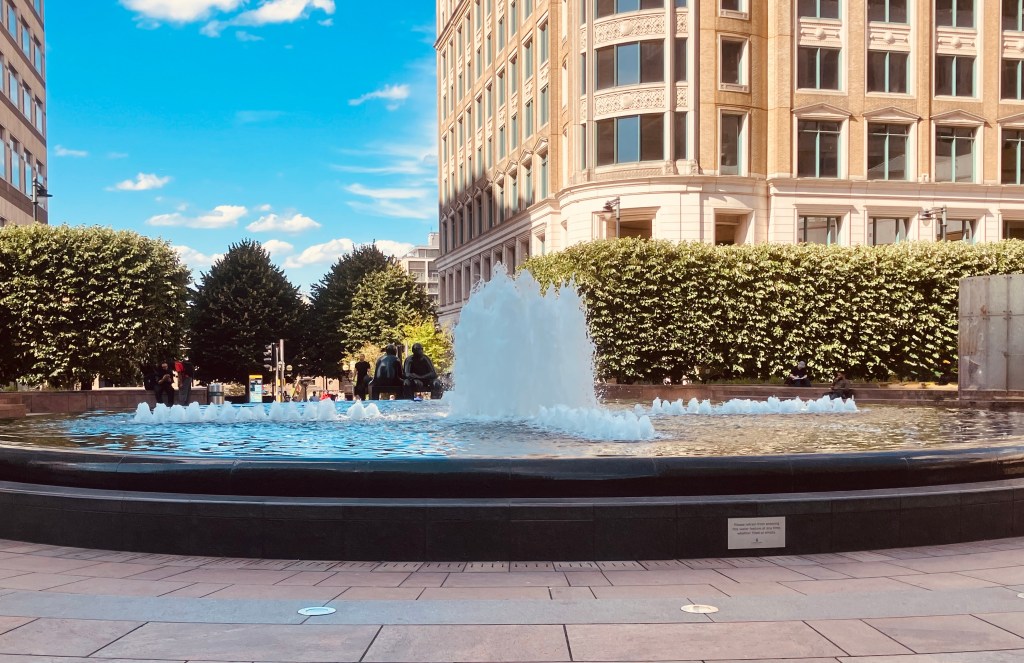
At the centre of Cabot Square is a fountain which again offers refuge, a moment of calm and an ornate area to have your packed lunch whether visiting, like us or working here.

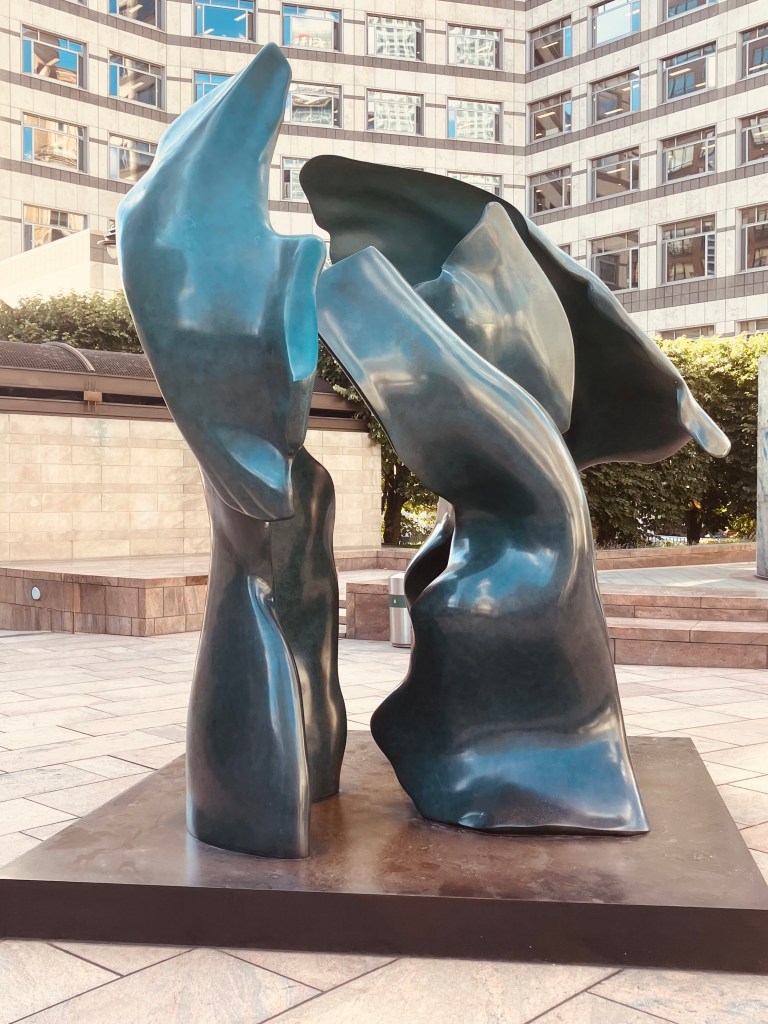
Six statues surround the square including this bronze statue by Helaine Blumenfeld called “Illusion”. The information given on the map tells us that the artist wanted visitors to interact with her piece and invited them to touch it, step into it and walk within and between its separate parts which I duly did. You do get different perspectives from completing this artistic suggestion.

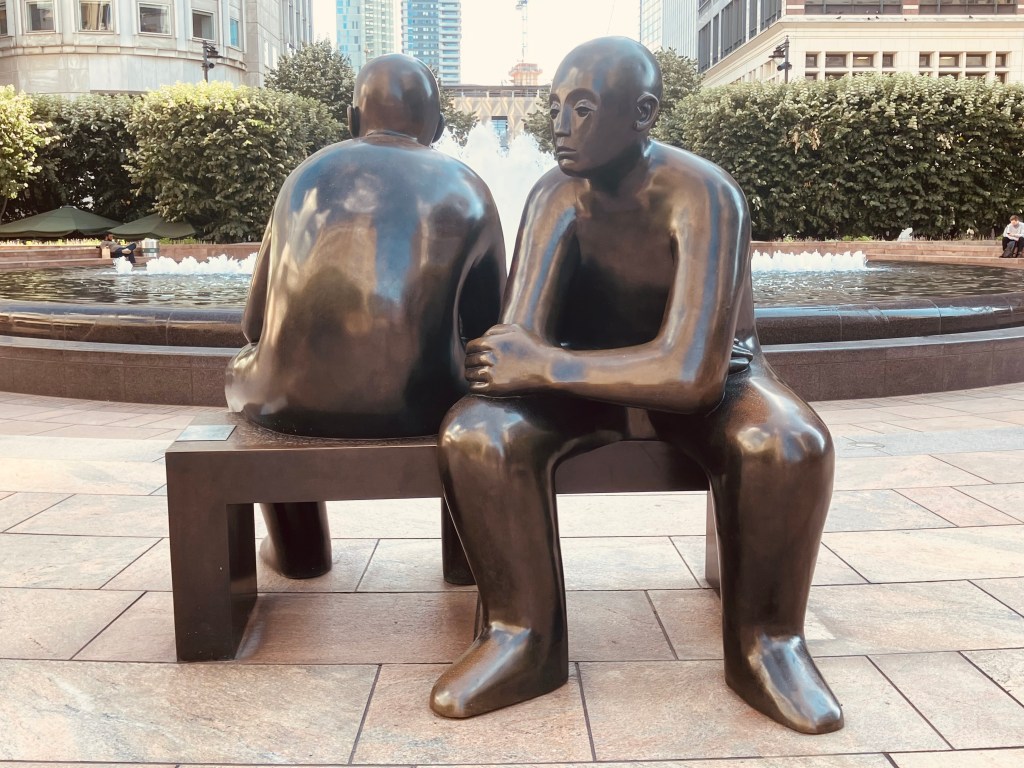
Giles Perry’s second statue “Two Men on a Bench sits adjacent to the fountain. I really like this artists work and having been introduced to him on this walk will definitely look out for more in the future.

The men made of bronze are so solid in stature whilst smoothly presented and slightly historic, as if they have emerged from a period many hundreds of years ago.

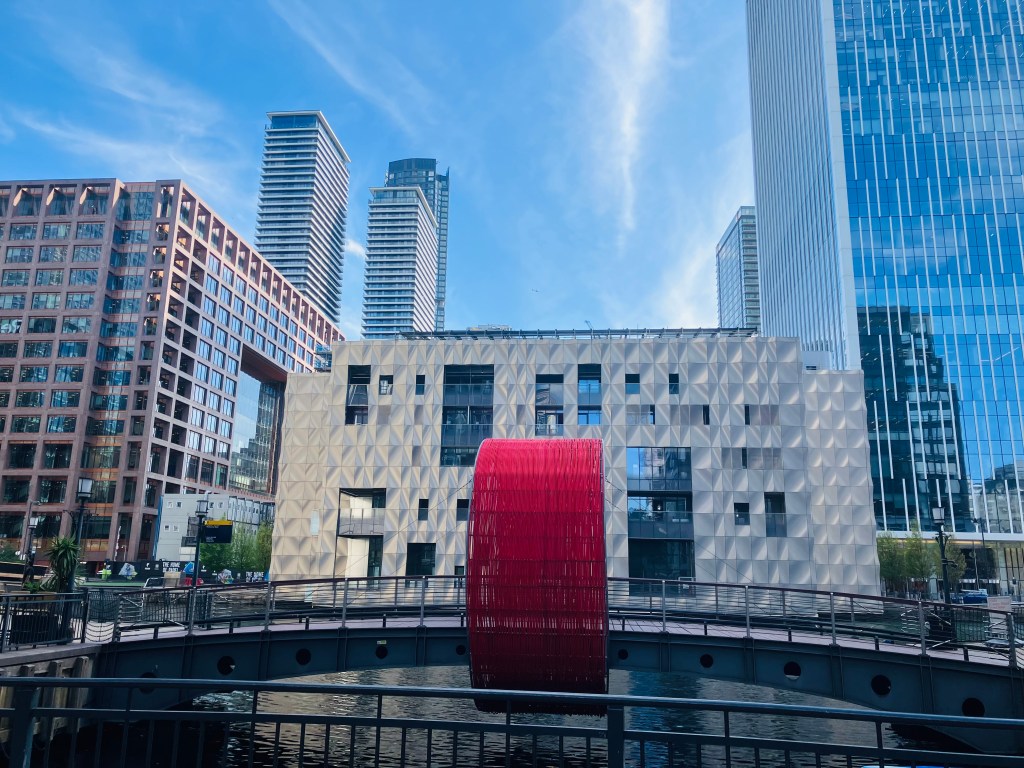
Walking away from Cabot Square down the Cubitt Steps you reach this marvellous piece entitled “The Clew”. Made from 100 circles of red light, it was created by Ottotto, a Portuguese architectural firm.
It is actually timed to come on at dusk, there are a few other pieces en route that also are better seen in the dark rather than daylight. I still enjoyed it in daylight though particularly backed by the clever architectural stonework of the oblong building behind.

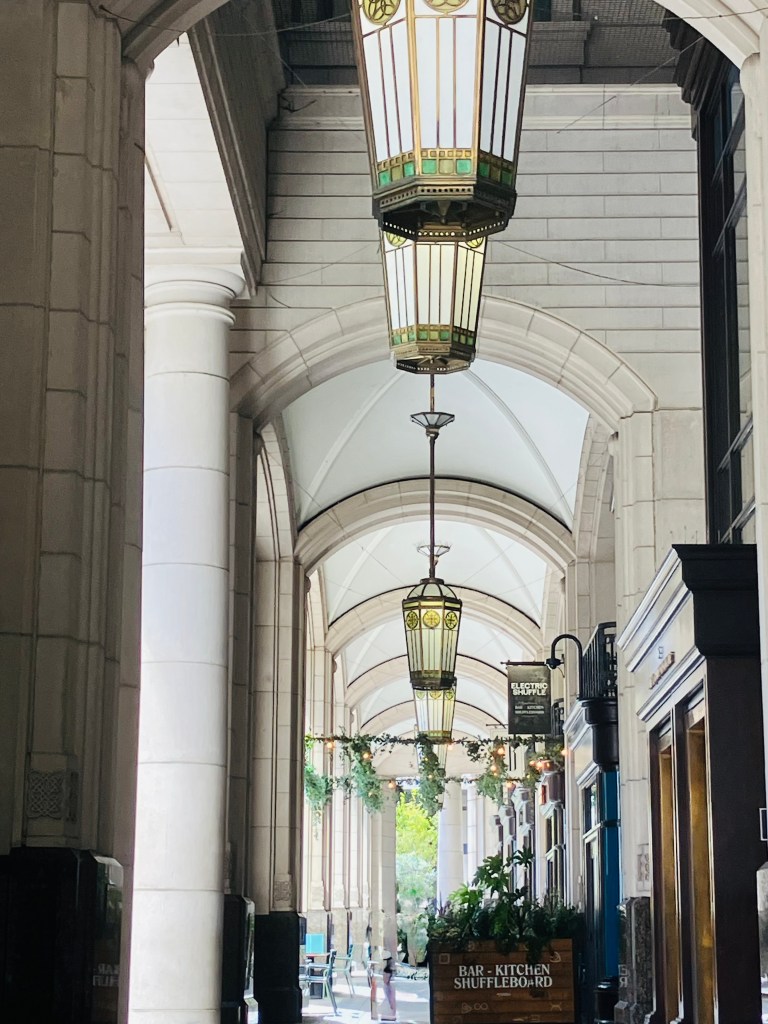
Leaving this piece behind we strolled alongside the water of Mackenzie Walk. Turning left onto South Colonnade and then right into Cabot Place Mall to check out number thirteen. Walking through here we reached North Colonnade on the other side ,had a look at number fourteen before doubling back on ourselves to walk to number twelve. Once again we were met with a beautiful piece of architecture with an Art Deco ceiling complete with fantastic ceiling lights.

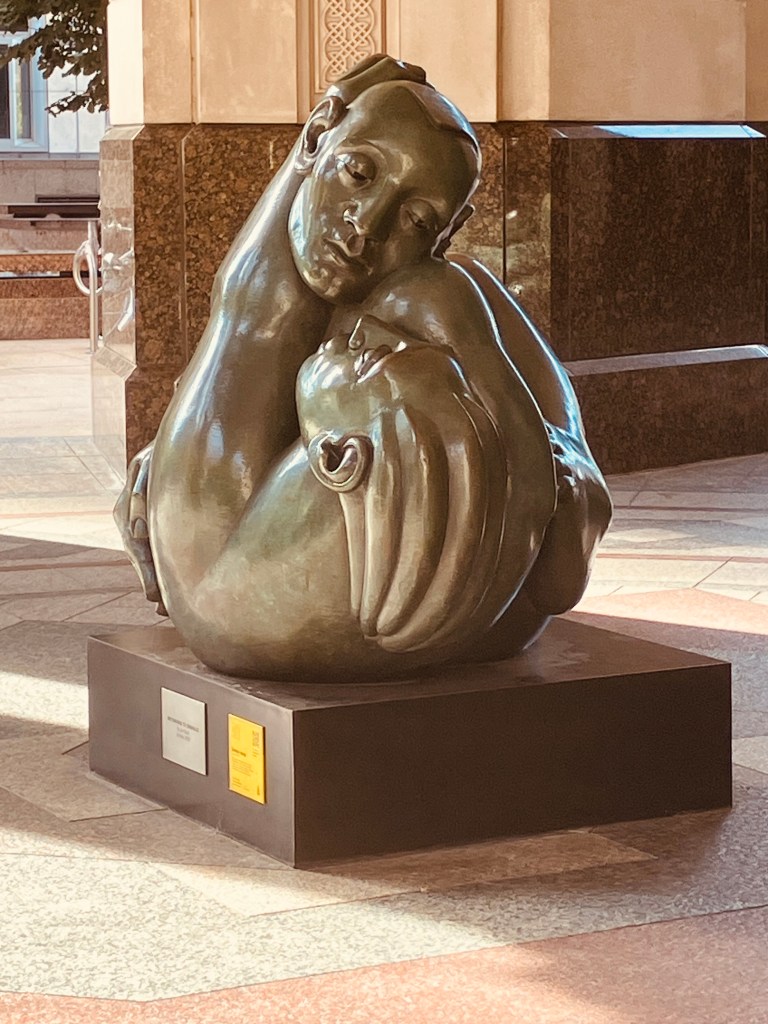
Number Twelve -Jon Buck’s “Returning to Embrace” encapsulated for me the act of a total embrace where two people merge into one. I found it very romantic and reminiscent of Ancient Roman architecture and statues.
Before leaving this exhibit behind it is worth looking above your head in order to marvel at the ceiling which follows the Art Deco theme of the previous photo.

Walking from here towards Wren Landing to finish this section we headed onto the next zone.

Zone C -Canada Square and Crossrail Place:
Fishermans Walk in Zone B led us to Frobisher Passage thus joining Zone C at number sixteen. My two favourite pieces of the whole walk were in this area:

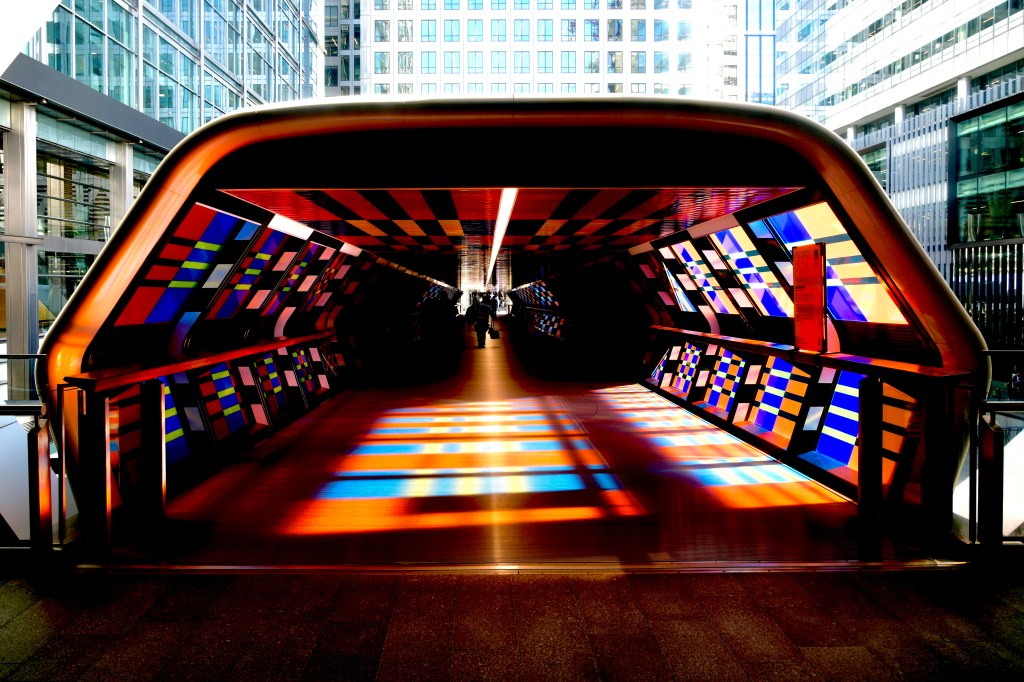
Camille Walala’s “Captivated By Colour” just mesmerised me. This local artist has designed colourful geometric shapes, playing with the long perspective of the tunnel. The design shows an optical pattern that shrinks and elongates as it moves across the panel of the bridge – creating a distorted effect as visitors pass through.
I have never seen anything quite like this and cannot think of anywhere else we have currently travelled to where this amount of effort has been put into creating what is in effect a tunnel for pedestrians to walk through. Outstanding!

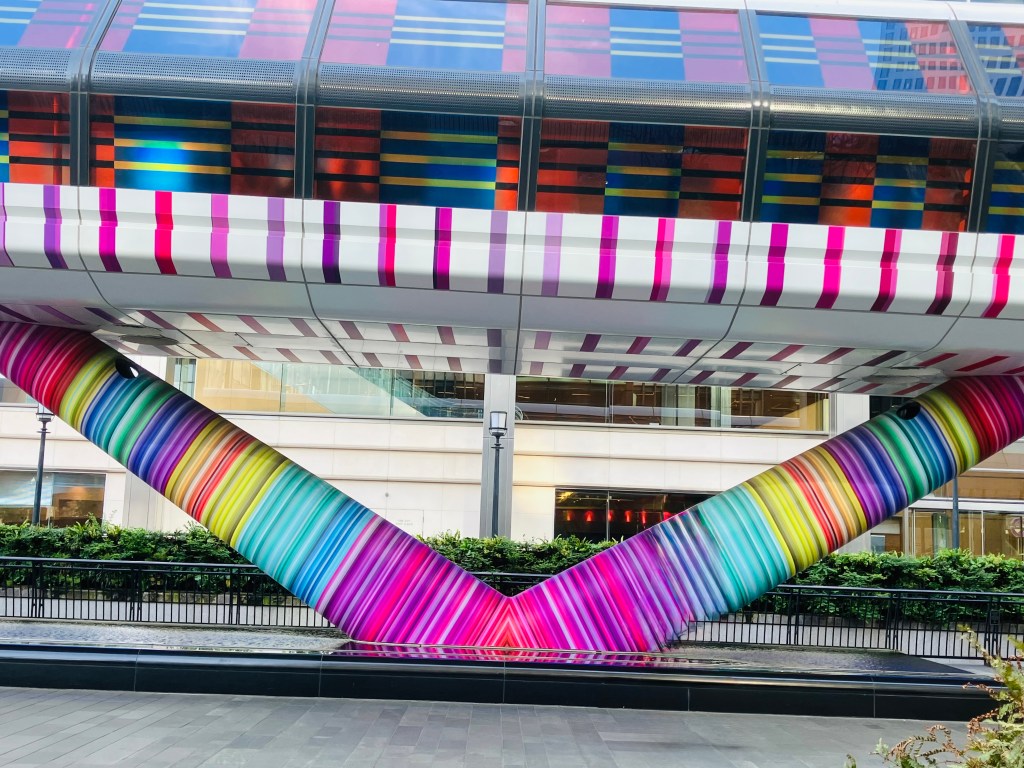
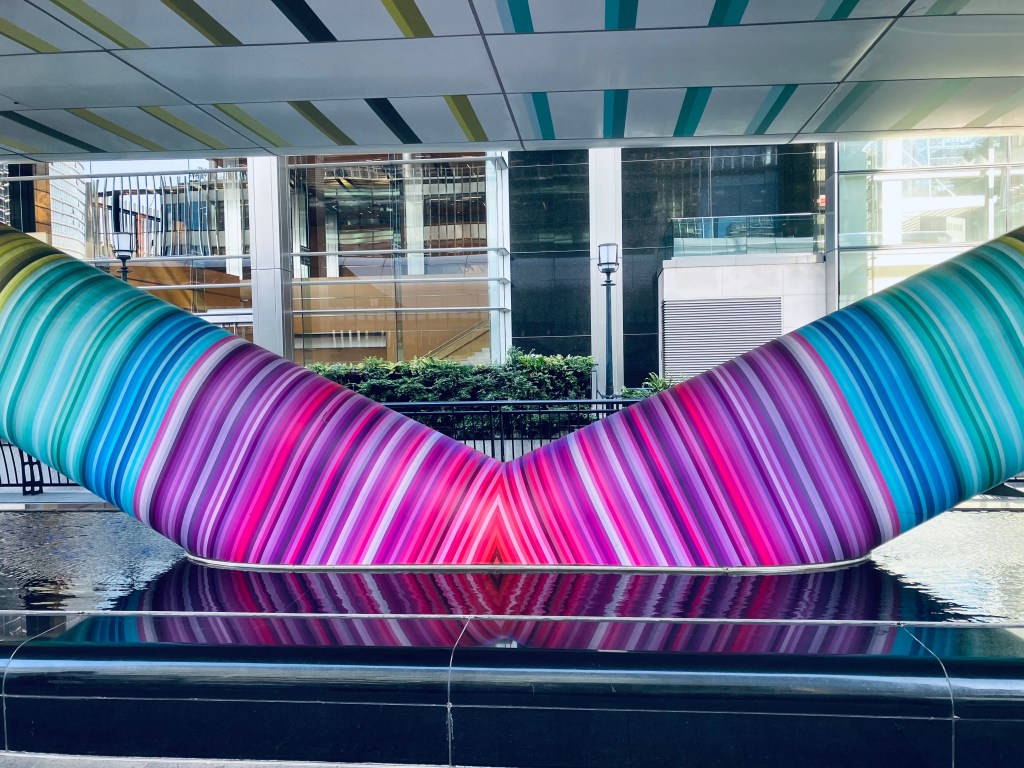
The photos above and below show Adam Nathaniel Furman’s creation entitled “Click Your Heels Together Three Times”. This is a new piece installed for Pride Month in June 2023, celebrating the rainbow colours and embeds queer coded artworks within the public realm.
I just found it so celebratory, bright, cheerful and with the addition of being placed in water the colours reflect on the surface.
Again where else could you see something so jubilant?

We finished our exploration by popping into the lift at Crossrail Place and zooming up to the Roof Garden. Yet another beautifully designed garden in which to find some solitude and disconnect from the frenzy of modern life.

Alongside the sculptures we were able to discover on our five mile walk it was also the addition of these strategically placed areas of calm that really made me want to explore further how the whole area of Canary Wharff was designed for modern life and work. I was truly impressed!

We still have half of Zone C and the whole of D and E to finish but on this occasion our dinner date was calling. We will be back though without a doubt to continue!

Day 1 of our trip to London was complete, on to Day 2………………………

Exploring Hidcote Garden: A Hidden Gem in the Cotswolds

As Spring turns into summer hubby and I have started to once again think about day trips and short stays we can make from home.
Last year we had invested in an annual pass for the Royal Horticultural Society (RHS) which had allowed us to visit many gardens, often for free, alongside the gardens that the RHS also own themselves. One particular trip we had taken for two days was to RHS Wisley:
https://amidlifeadventure.org/2024/11/15/gardens-of-england-and-wales-top-attractions-at-rhs-wisley/

and to Painshill in Surrey:
https://amidlifeadventure.org/2024/11/01/gardens-of-england-and-wales-discovering-painshill-park-a-hidden-gem-in-surrey/

These form a series of five posts where I wrote about Gardens of England and Wales should you wish to search for and read further.

The National Trust:
This year we didn’t renew our RHS membership choosing instead to join the National Trust (NT). A one year membership for hubby and I currently costs £160. We, however, chose to pay monthly at £13.40 per month giving us access to over 500 National Trust properties alongside other benefits.
I appreciate I have readers from outside the UK in particular in the USA. You can join the NT in advance of your visit and it’s well worth it if you are going to be visiting properties throughout the UK, as paying for individual entries can add up. The membership fee pays for itself fairly quickly.

Introduction to Hidcote:
Hidcote sits in The Cotswolds in the county of Gloucestershire and is famous for its Arts and Crafts-inspired garden. Located near Chipping Campden, this area is home to many famous celebrities such as David Beckham, Jeremy Clarkson, Ellen DeGeneres and Calvin Harris to mention but a few.
As a National Trust property known for its series of garden “rooms” with distinct atmospheres and vistas it has been on our list of places to see for a while. 

The property began its life back in 1907 and throughout the next 30+ years its owner Major Lawrence Johnston designed the gardens in phases creating separate rooms for different themes. He was a talented garden designer and was passionate about plants. Using these skills he created 10.5 acres of beautiful, often awe inspiring scenery, frequently furnishing his borders with newly discovered plants and exotic rarities that he had found during his expeditions across the world.

In 1948 Lawrence gifted Hidcote to the National Trust and they have continued to upkeep the gardens in the spirit with which he created them. You won’t see any labels identifying the plants. The garden was for himself, family and friends to enjoy and not a botanical show garden and thus his spirit lives on.

There is a cafe on site called The Winthrop but there also many strategically placed benches throughout should you wish to bring your own packed lunch/picnic as we did.

On entering the garden and armed with the information leaflet we opted to follow the route indicated in red on the map starting with…

The Old Garden:
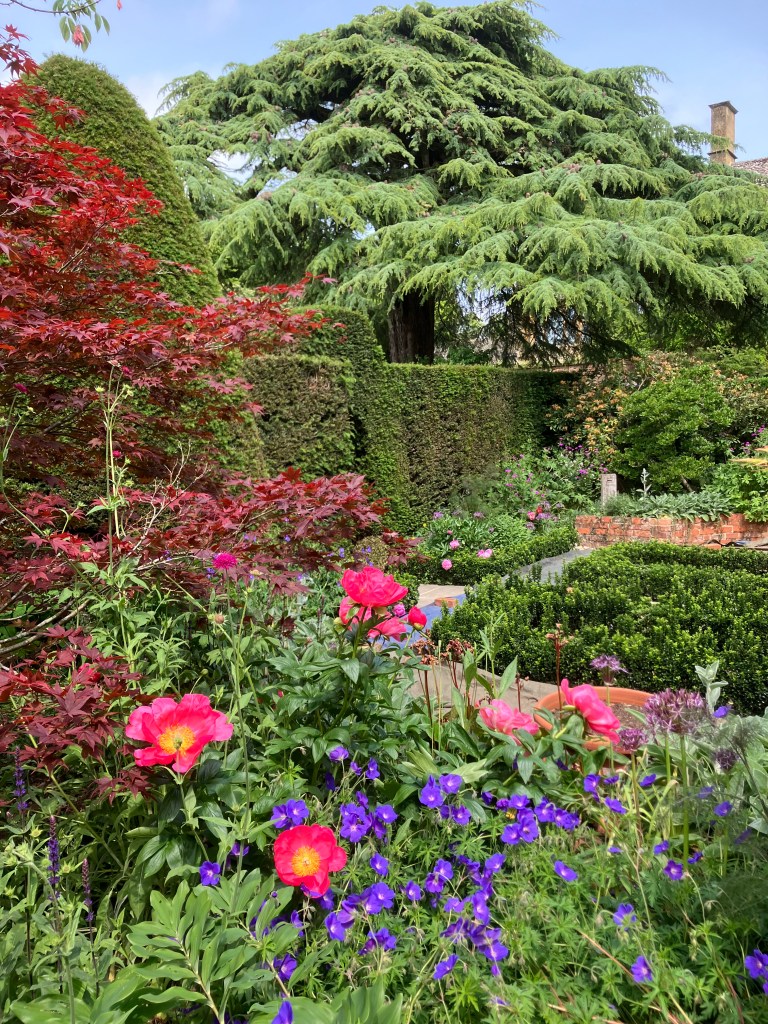
It was lovely to be met straight away with vibrant displays of colour with a mix of red roses, peonies as they came to the end of their season, iris and poppies. The dahlias were yet to bloom and showed no signs of slug nibbling which are all too frequent at my home!

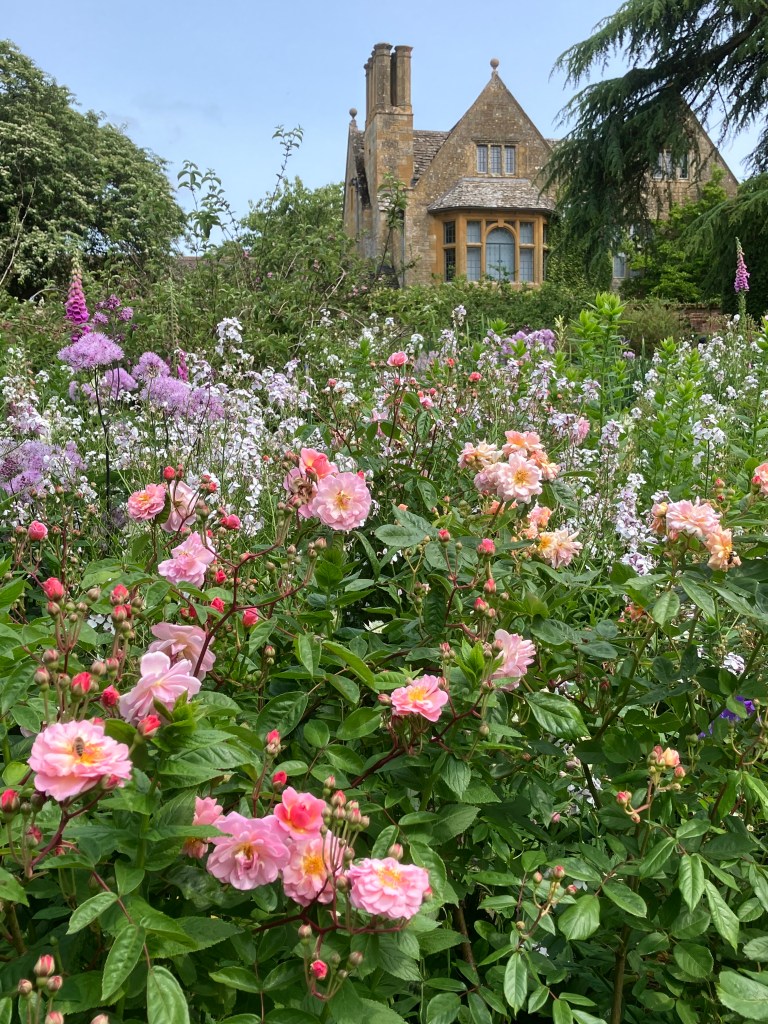
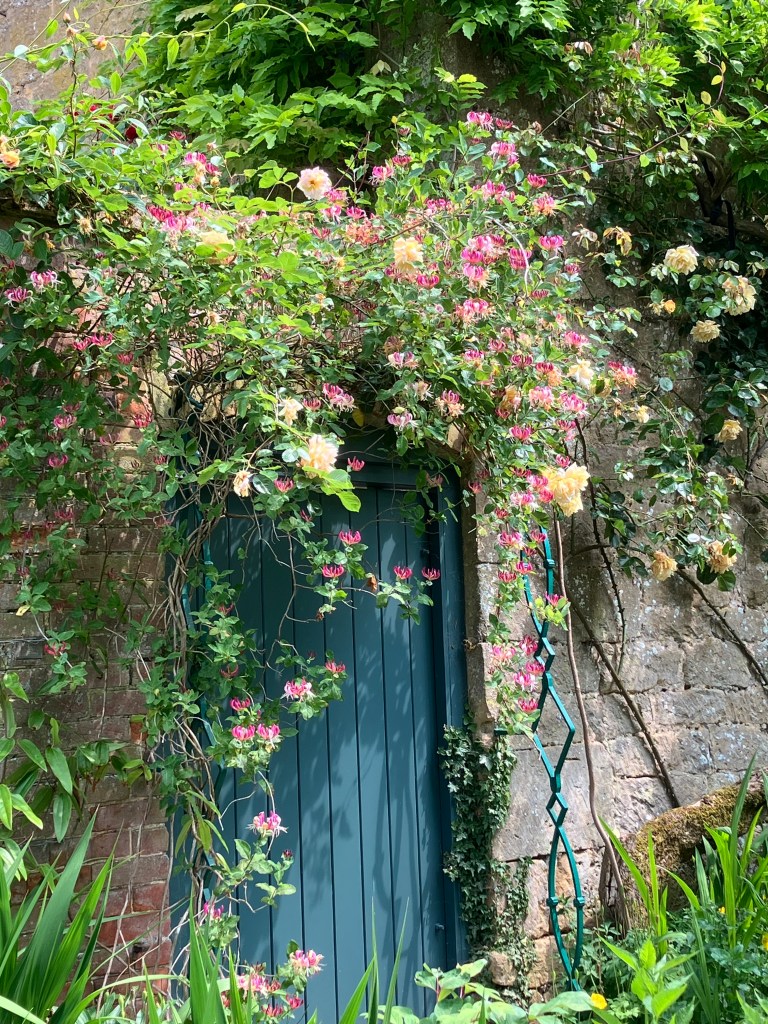
There is also a rustic arch covered in honeysuckle and roses and tucked away on the left of the pathway as you walk back towards the rear of the house a beautiful blue door smothered again in roses which I personally loved.

The White Garden is a separate garden room, within this area, featuring white flowers and silver/grey foliage which although creating a cool, calming atmosphere, even on hot days wasn’t as attractive to me as all the colours I’d seen on first entering. Despite my personal views the White Garden was, in fact, an inspiration for Vita Sackville-West’s White Garden at Sissinghurst.
Exiting this area we moved onto the…


Great Lawn:
This prominent, formal lawn often referred to as the Theatre Lawn serves as a focal point and a space for recreation within the design of the garden. For us it provided a bench on which to enjoy our mini picnic but is also a classic Arts and Crafts style feature, contributing to the garden’s overall structure and aesthetic.
Trying to get a picture without any visitors was time consuming but eventually possible!

After lunch I realised that whilst hubby had already visited the Bathing Pool Garden I had managed to miss it so I popped into here before continuing our journey.

The Bathing Pool:
This large, rectangular pool, was originally designed as a swimming pool, with a deeper end for diving. It’s no longer used for swimming and instead serves as a reflective water feature, mirroring the surrounding hedges and trees. The pool is a prominent part of the garden, framed by tall box hedges with topiary birds. The water, itself, I felt was a bit green and murky.

Retracing my steps back to the lawn we then continued to explore the….

Red Borders:
This area features a mix of shrubs, perennials, and annuals, with a focus on red, purple, and burgundy foliage with a neatly mown lawn dividing the space, creating two mirror-image borders. 
To the left of here Lawrence Johnston designed Mrs. Winthrop’s Garden, a small square, brick-paved garden for his mother, incorporating her favourite colours, yellow and blue. It was intended to be a warm and sunny spot in which she could relax. 

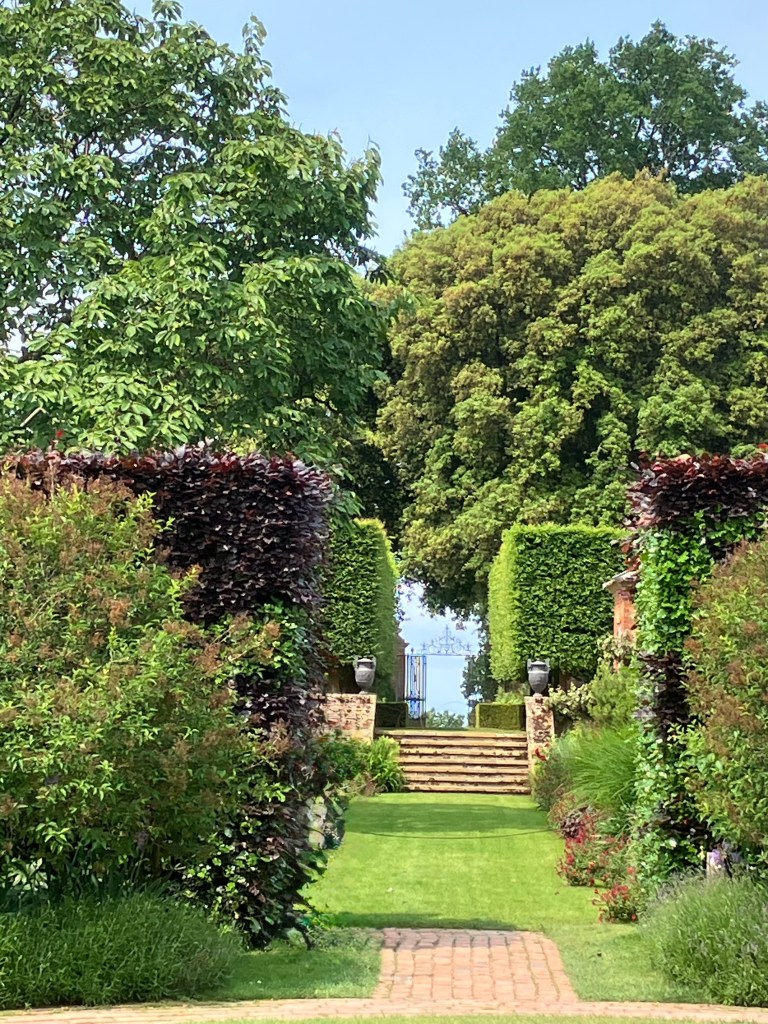
Beyond the Red Borders we walked onto The Stilt Garden, a formal garden feature which is characterised by two cubed blocks of tall, clipped hornbeam trees, enclosed by yew hedges and framed by gazebos at one end.

The Gazebos:
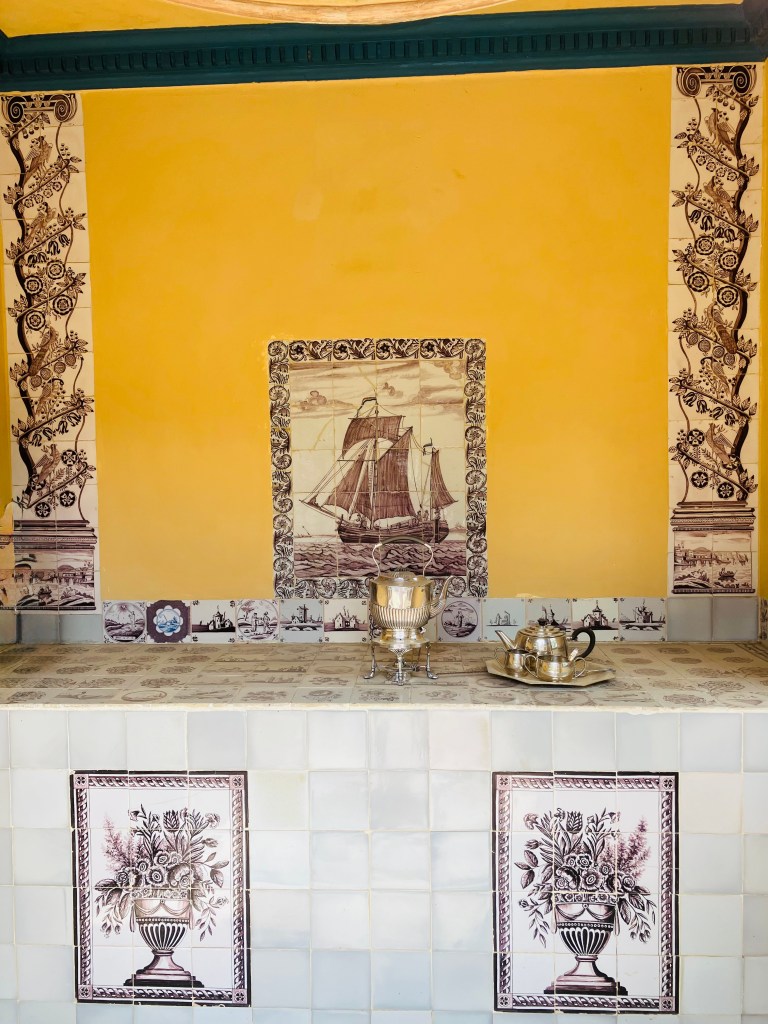
This pair of structures designed by Johnston have been in place since 1915. Built from Flemish bond brick with limestone slate roofs they have a domed ceiling and some lovely decorative elements. I particularly liked the tile work within and shown in my photo below.

They are a notable feature of the garden, situated at a crossing point and still to this day offer shelter and a place to pause and enjoy the surroundings. 

At the end of this area of the garden we were able to exit through a gate which provided us with views of the surrounding countryside, including the Malvern Hills.

Turning right we headed into…..
The Beech Allee:
This lined path or alleyway with it’s avenue of tall beech trees forms a “cathedral-like” walkway that acts as a focal point and pathway through the garden, also providing some shade on a hot summer’s day.


This led us to the……
Productive Garden:
This is, as described, an area for the on site gardeners to grow produce which is used in the cafe whilst also nurturing new plants that can be planted out into the main gardens at a later date.
There are also two orchards in this area aptly described as The Old and New Orchards.
The older orchard contains trees that have been there for a long time, with some dating back to the initial planting in the early 20th century. The exact varieties of the oldest trees are actually unknown. They did look a bit gnarly and forlorn.
The “new orchard” was planted around three decades ago and provides visitors, with manicured grass and seating. 
Walking on back towards the main house we came to….

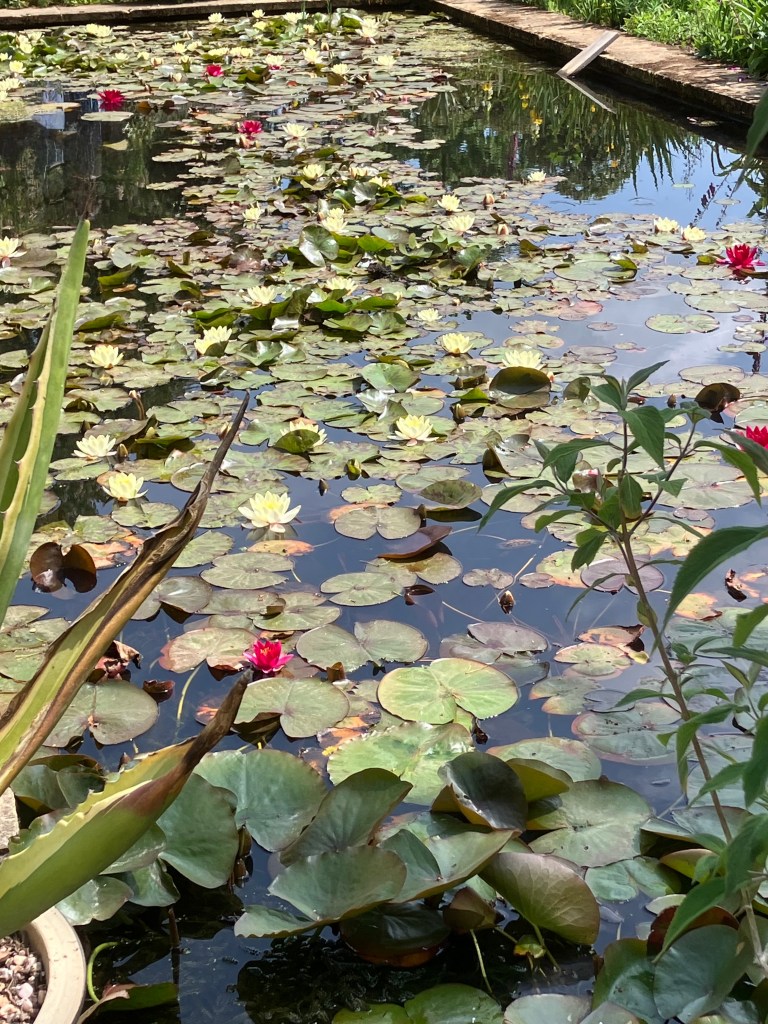
The Lily Pond:
Very popular with visitors, taking a photo was in itself a bit of a feat!

Alive with newts skitting under the water, it serves as both an ornamental pool and a bathing pool, with its history documented in the Hidcote archive. We also managed to see a few beautiful irridescent dragonflies who cleverly defied my camera lens!
The pond has a couple of vibrant flower borders alongside with a raised seating area.

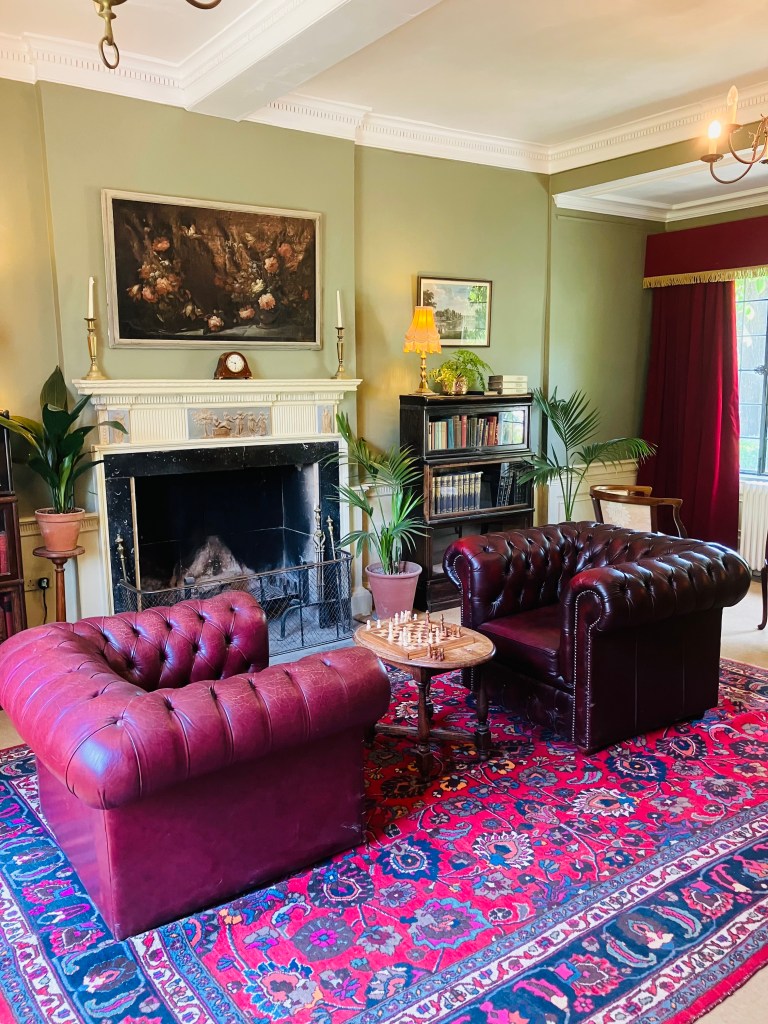
From here we made our way back to the main house and courtyard. You can pop inside the house and view a couple of downstairs rooms including the drawing room which gives you some idea of how Major Lawrence Johnston lived.

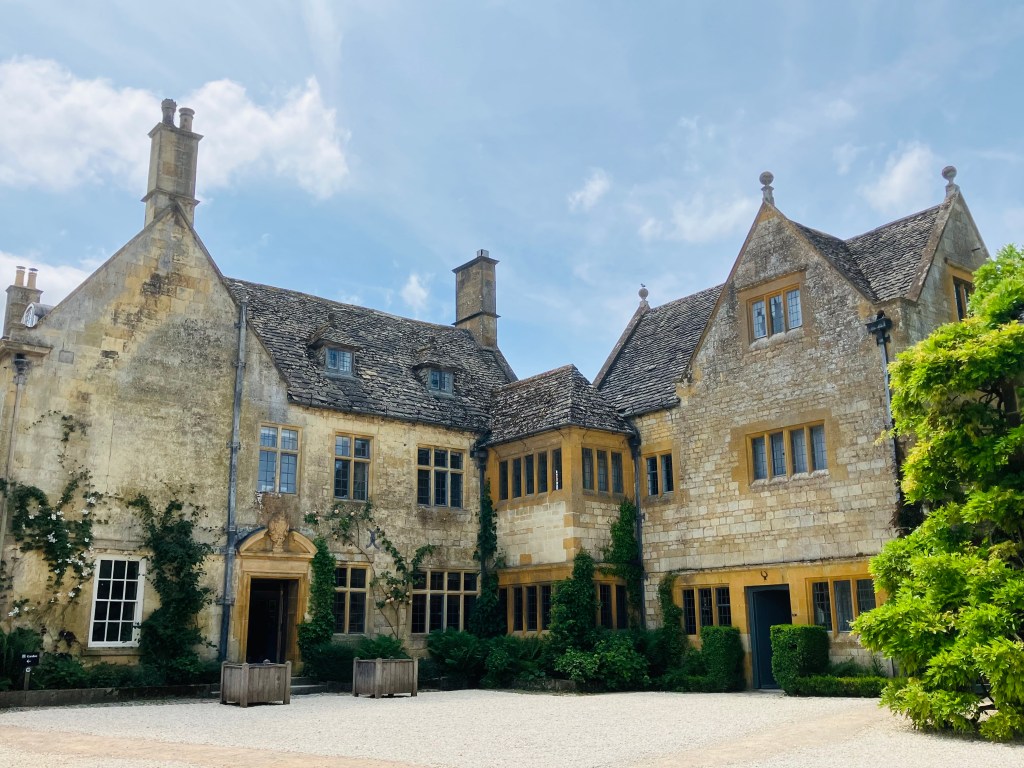
We were also fortunate on leaving to be able to admire the outside architecture without visitors in the frame! It is a beautiful example of a traditional Cotswold stone with it’s honey coloured bricks.

To give you some idea of timing we got to the garden at 11.45 a.m. and left at 2.00 p.m. so not a particularly long visit by our standards but worth a look if you are exploring the Cotswolds and wish to add it into your itinerary .

NB:
This is my thirteenth post in a series I have written about The Cotswolds. Why not check out the others and share with me any that you would recommend for us.

Explore the Free Hidden Wonders Inside Las Vegas Casinos

The Las Vegas Strip is full of architectural wonderment as described in my last post:
https://amidlifeadventure.org/2025/06/17/top-free-attractions-in-las-vegas-a-visitors-guide/

What lies behind these facades? Casino gaming floors, cafes and restaurants, night-time entertainment but also along with the wealth of external architecture there is also another world of decor within, that again is free to view and my starting point has to be-

Inside the Bellagio:
As you enter the lobby of this magnificent casino and look above your head you will see the famous glass ceiling. This is one of the most iconic and breathtaking glass art installations in the world. Created by Dale Chihuly when the Bellagio opened back in 1998 and named “Fiori di Como.” or Flowers of Como it is estimated to have cost 10 million dollars!

It is a stunning work of art in a vibrant explosion of colour that has captivated millions of visitors ever since. We were fortunate to also see evidence of Chihuly’s work in St Louis when on our Route 66 road trip a couple of years ago. The exhibition there was entitled “Chihuly in the Garden,” and staged in the Missouri Botanical Garden.

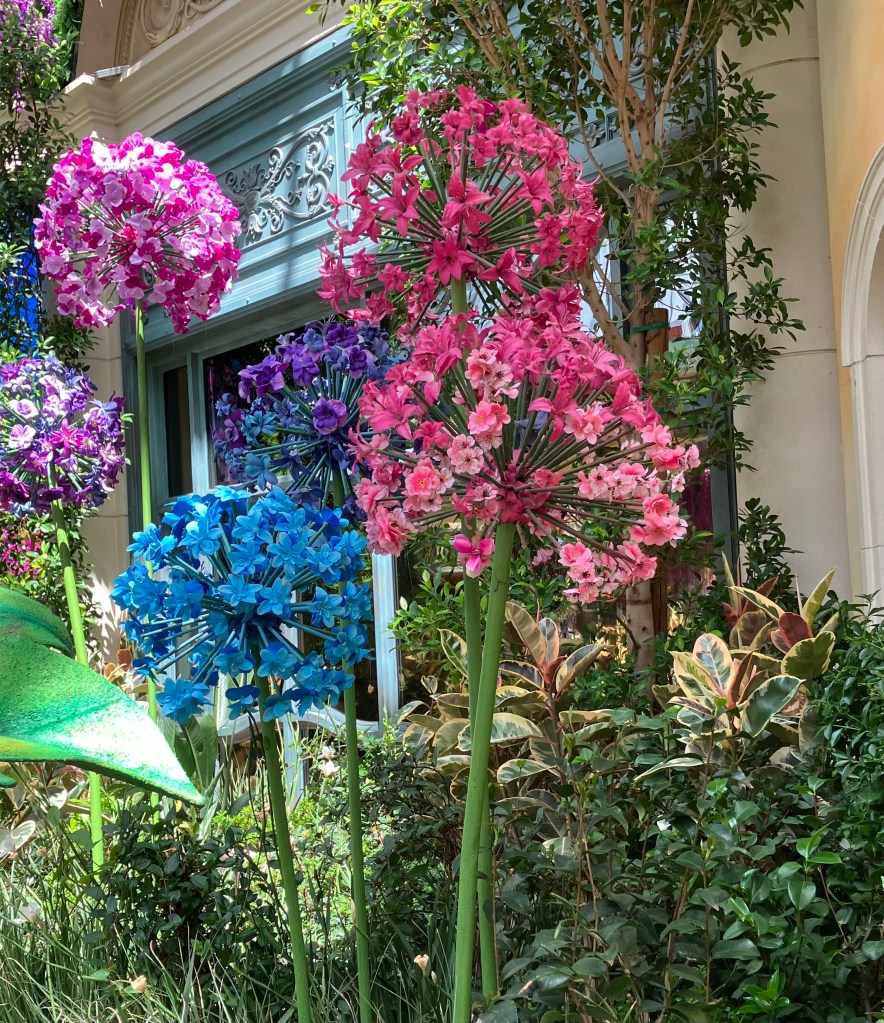
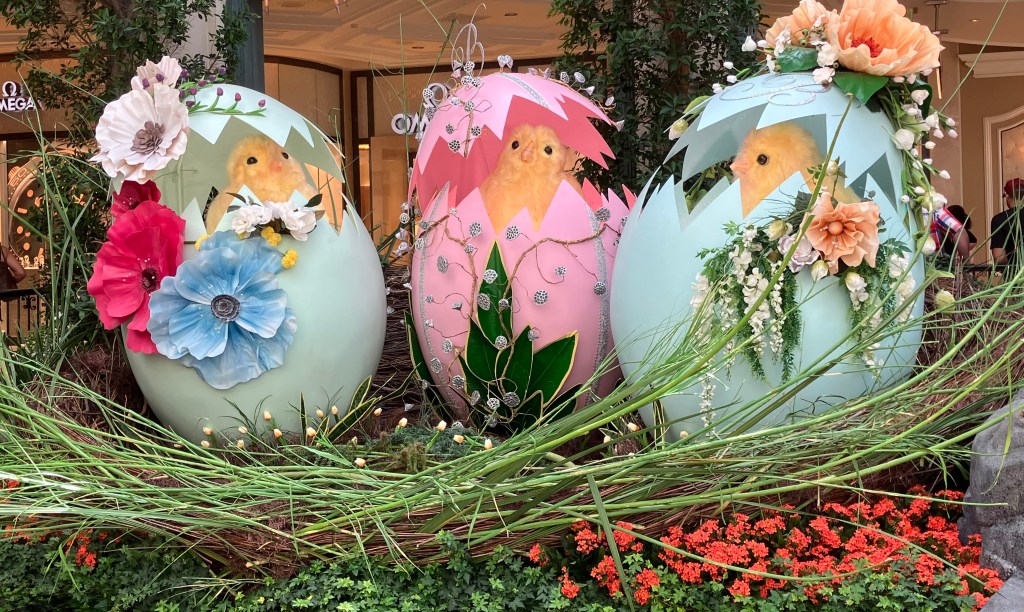
Continue walking through the lobby and you will enter the Bellagio Conservatory and Botanical Gardens. There is again no cost to wander through this 14,000 square foot indoor garden. What I really like about this is that they change the display five times a year for each of the four seasons and also for the Chinese New Year. The displays are completely transformed and feature new plants, decoration and designs. Each transformation takes about a week to install offering a unique experience depending upon the time of year you visit.
Our latest visit was in the Spring and, therefore, included Easter. Think of Spring and our minds are drawn to flowers poking through the earth, bees starting to seek pollen and birds nesting in the treetops. Easter brings chocolates and treats, Easter bunnies and chicks.

The Forum Shops at Caesars Palace:
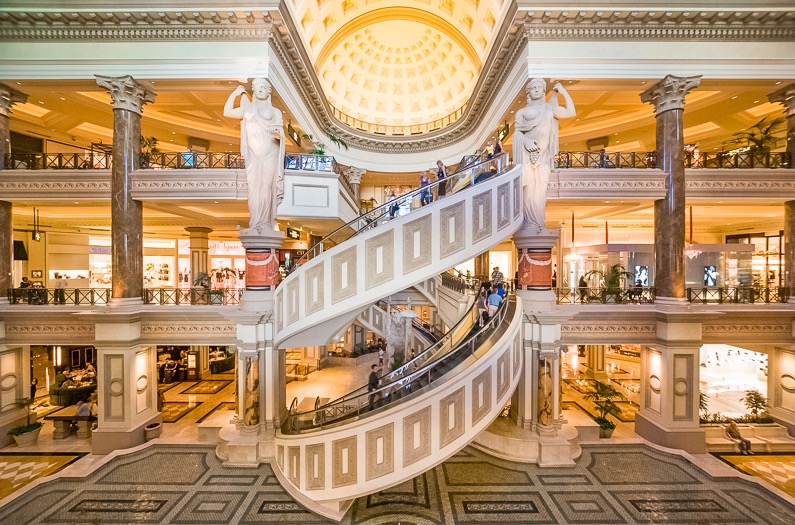
Just next door to the Bellagio is the famous Caesars Palace Casino which is another definite free internal visit you should make. Don’t be put off by it’s over 160 mainly high end stores because it also has a huge amount of internal architecture and features which you can view for free as you take a wander around.
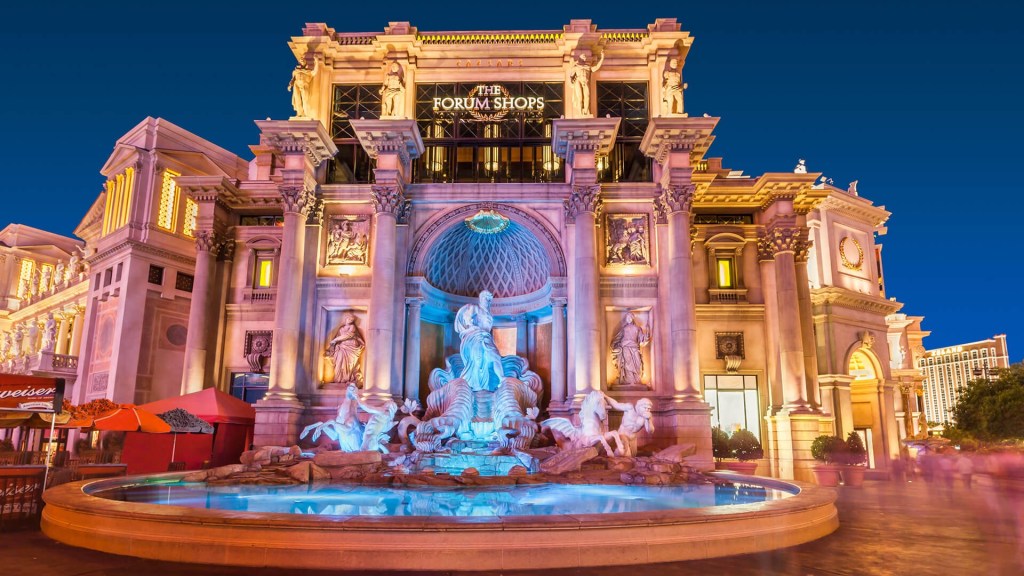
With 636,000 sq. feet of space the Forum Shops were designed to resemble a Roman forum, with marble columns and statues. It also has several fountains including a detailed replica of the famous Trevi Fountain!

As you will see from the above photo once you are inside you are fully encapsulated and will have no idea of whether it is day or night outside but don’t forget to check out the ornate ceilings as you wander around.

Within the mall itself you will also find a large saltwater aquarium and the famous Atlantis Show which runs every hour on the hour daily from 10am to 11pm. It is an animatronic display of fire, water and nine-foot-tall talking statues set in the kingdom of Atlantis and telling the story of when King Atlas has to decide which of his children will take on the responsibility of the throne.

Don’t leave out the main part of the shopping mall where the installation of spiral escalators presented unique challenges. The design had to match the curve of the building and offer as much transparency as possible to allow unobstructed views of the elite retail shops while still matching the unique design aesthetic of Caesars. To meet this demand arching support structures were used to create the illusion of escalators suspended in mid-air. The support system was enclosed in the “stone” facade, creating the appearance of escalators gracefully curving from one floor to the next, fulfilling the building owner’s objective and allowing riders to enjoy panoramic views of the grand atrium’s surrounding boutiques.

The Flamingo “Flamingoes”:
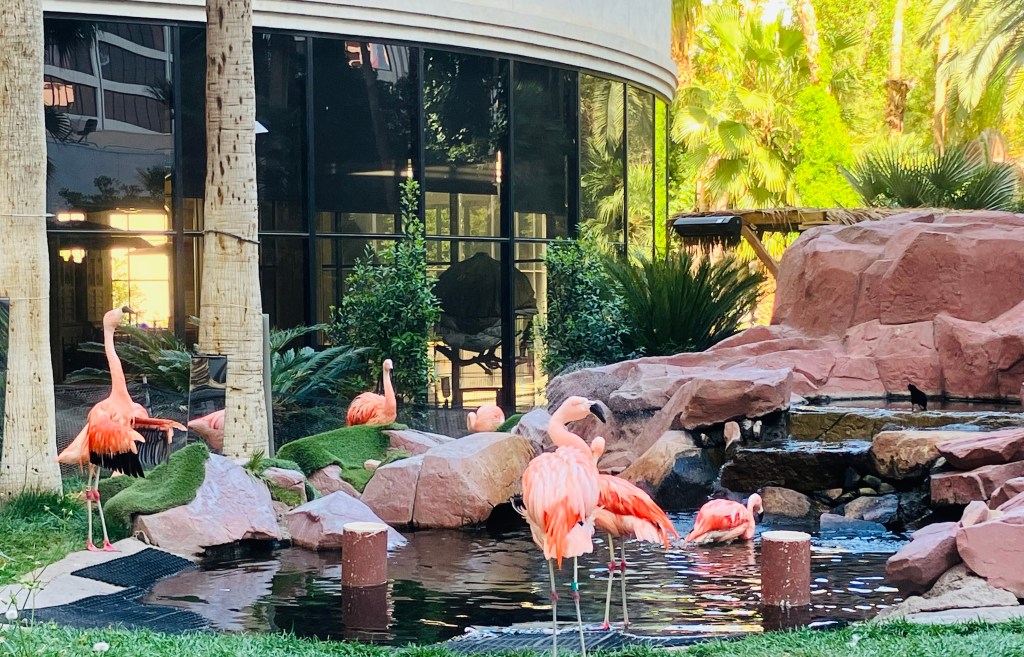
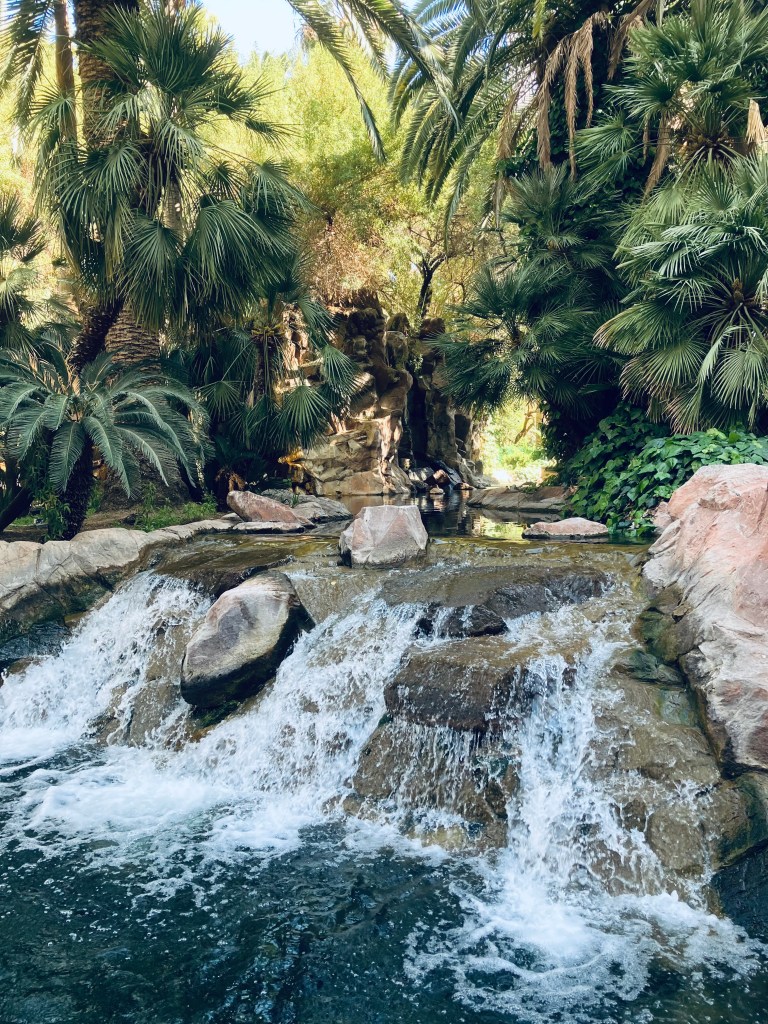
Across the Strip from Caesars you will find The Flamingo which opened way back in 1946 but some fifty years later the wildlife habitat was created, opening in 1995. It is still free to enter and is home to a range of wildlife not least the famous Chilean Flamingoes. Within the four acres of landscaped gardens are beautiful streams with waterfalls and lush vegetation. Strolling through definitely brings an element of calm to an otherwise frenetic environment outside.
On our latest visit we managed to spot different species of exotic waterfowl and some brown pelicans. Within the clear waters Koi Carp, Albino Catfish, Sturgeon and even turtles were available to view. Various local songbirds were competing in song although we didn’t manage to catch a glimpse of the native hummingbirds.
Dotted amongst the vegetation and gardens are picnic areas and places to sit so if, like us, you are trying to keep the daytime expenditure to a minimum, grab a meal deal at Target and bring it along with you.

The Venetian:
Just up the street from The Flamingo is The Venetian which welcomes you to Venice.
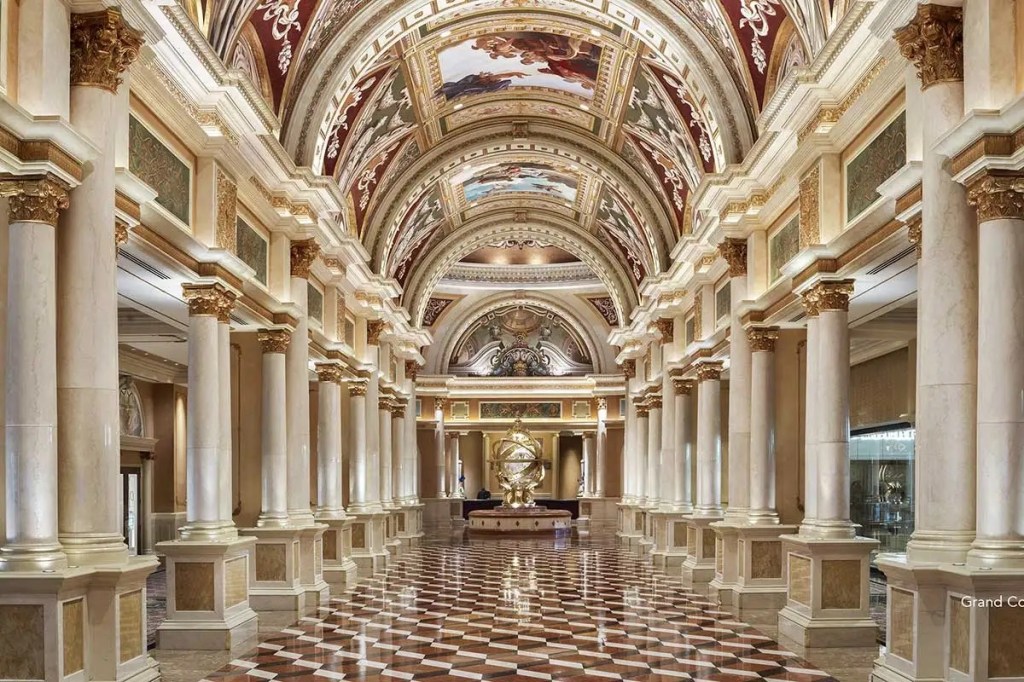
A stroll around inside presents a vibrant mixture of 160 shops which flow along both sides of the canals designed to represent those in the city of Venice itself complete with gondola rides. (If you fancy partaking in this you do need to buy a ticket and they are usually cheaper on line.)

Whilst you can explore the Renaissance-inspired art and architecture throughout the resort (as seen above), there is also a replica of St Marks Square to round off this architectural experience (as seen below).

The Wynn Casino:
To finish off my free internal tour of the Las Vegas Strip walk a little further to The Wynn. Like the Bellagio, The Wynn also has a beautifully decorative lobby so it is definitely worth taking a stroll inside. Famous for its opulence this casino impresses with dramatic floral displays, fanciful sculptures, and an artistic atmosphere.

I particularly like the floral baubles hanging from the trees which are lit up day and night.

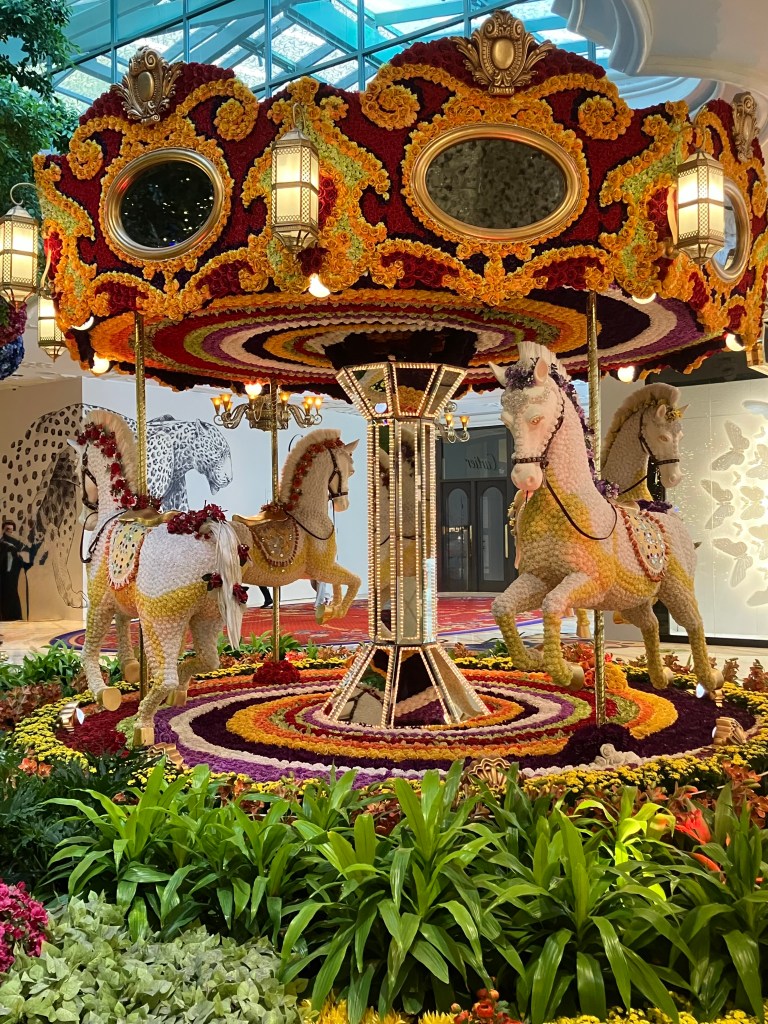
And the beautiful carousel

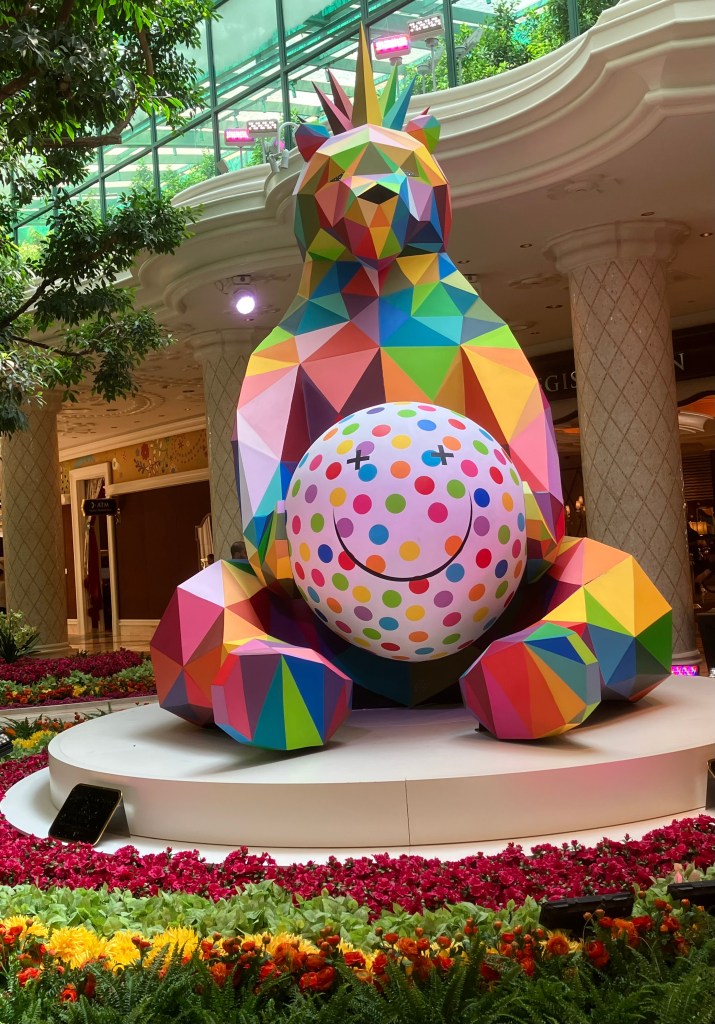
Whilst you are inside The Wynn it is also worth seeking out some of the sculptures and other artefacts in residence here. These can vary, as updates do take place, but below are a couple of photos from my collection. Firstly a beautiful geometric teddy:

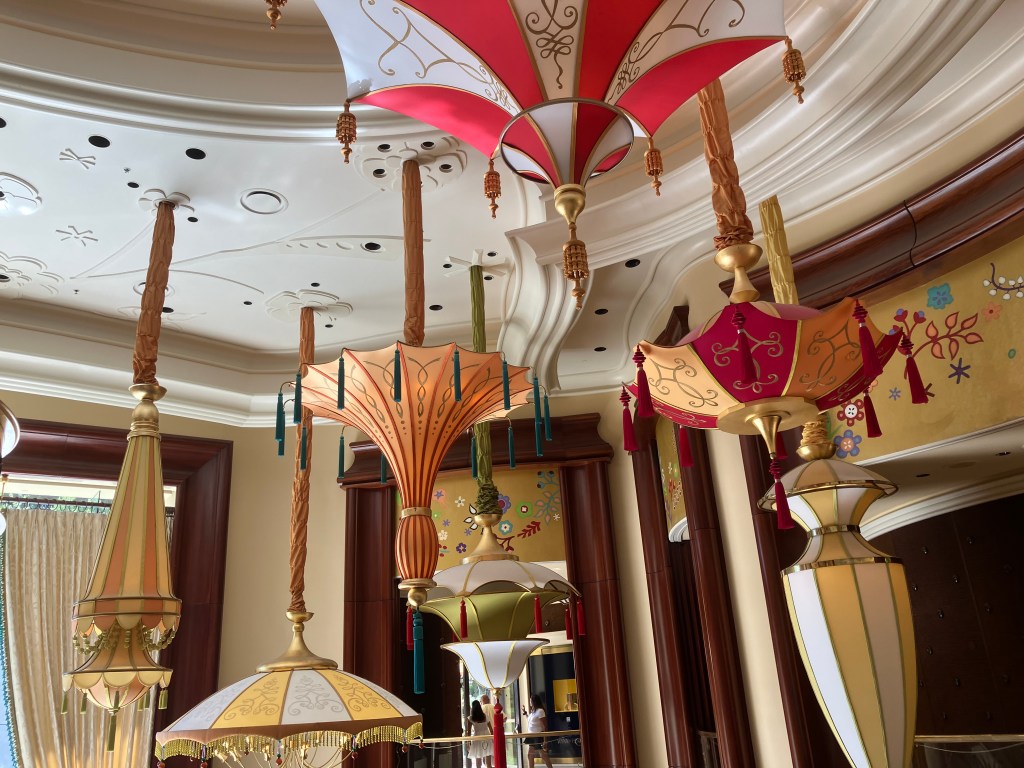
And for diversity purposes a selection of hanging lanterns

Once you have wandered around admiring various installations it’s also worth making your way to The Lake Of Dreams.
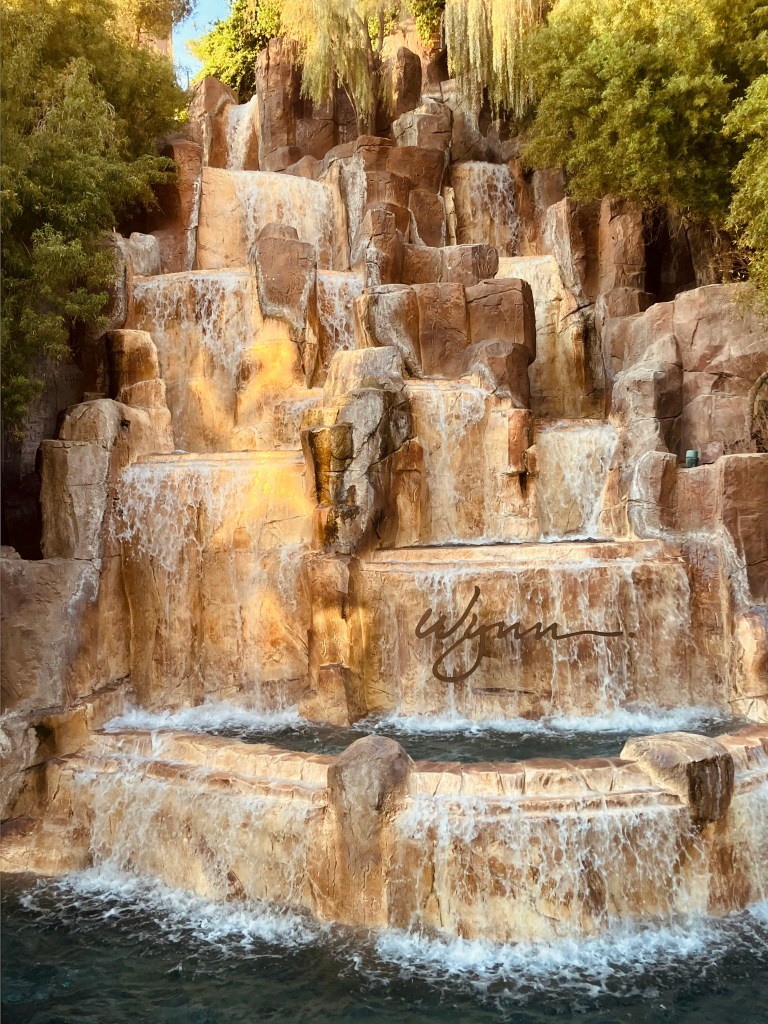
Tucked inside the Wynn and set against a 45-foot waterfall and a mountainside backdrop there is a nightly show that starts at dusk and takes place every half hour until 11.30 p.m. You can watch completely free from The North Show Terrace. This area provides a good view of the show without requiring any purchase or reservation although if you want to sit down I’d suggest getting there early. On our most recent visit there was a time displayed in this area for the first show.
It is quite magical and sets out to bring art, nature, and technology together in a dazzling nighttime spectacle. This photo was taken beforehand.

Las Vegas is many things to many different people and it doesn’t have to be solely a place of monetary excess. Hopefully as I conclude this post I have inspired you to take a trip along the Strip to explore everything it has to offer for free both inside and outside.

Please send me a “like” if you have enjoyed my post and I’m aways open to feedback and questions

Top Free Attractions in Las Vegas: A Visitor’s Guide

We had last visited Las Vegas in the summer of 2023 as part of our journey along Route 66 – https://amidlifeadventure.org/2023/07/18/las-vegas-for-better-or-worse/ and made the decision when we left that we would one day come back.
Well that day arrived a couple of months ago when I was faced with an opportunity to see Carrie Underwood in residence in Vegas. I have loved her songs ever since she walked away as the winner of American Idol Series 4. She has since become a major recording artist in the USA selling over 85 million records worldwide and becoming the most awarded country artist of all time.

Having already visited the city previously I upped my research for this trip in the hope of finding things to do particularly during the day for free. Not because we were being frugal but we wanted to focus our expenditure into the evening. In addition to tickets to see Carrie’s concert at Resort World we also bought tickets to see a third Vegas Cirque du Soleil performance and wanted to revisit The Wynn buffet amongst other items on our agenda.
Our first free adventure was to view the architecture along the Strip. ……

Architecture:

Las Vegas is full of beautiful architecture and whilst some may frown at the duplication of worldwide sites onto the Las Vegas Strip it is a great walk from the southern end of the strip at the Luxor Casino to Caesars Palace. It’s about 2 miles but there are so many architectural spectacles to admire. Depending upon what time of the year you travel you might need to take a break en route and escape from the desert heat. I will be giving you some suggestions of what to visit for free inside some of the casinos on my next post.


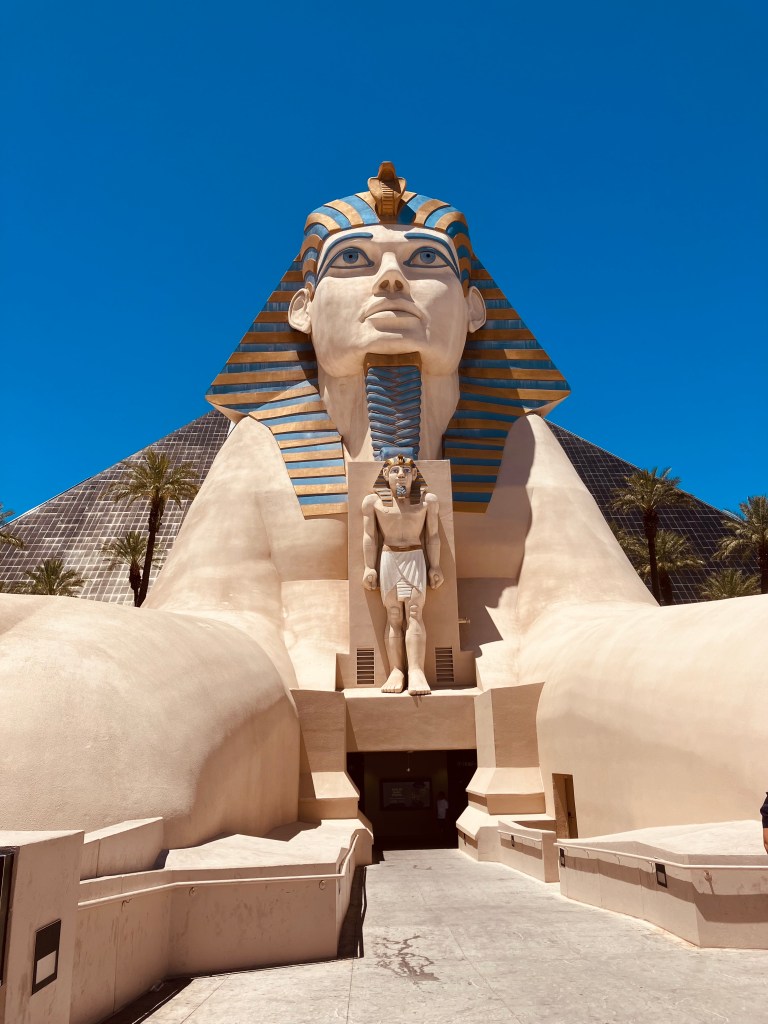
The Luxor was opened in October 1993 and was built upon an Ancient Egyptian theme. The pyramid is 30 stories high and contains the world’s largest atrium by volume. Egyptologists were actually hired to create and oversee the Luxor’s theme and when you escape the heat and meander inside you will find replicas of various Egyptian artifacts, made of fiberglass and plaster.

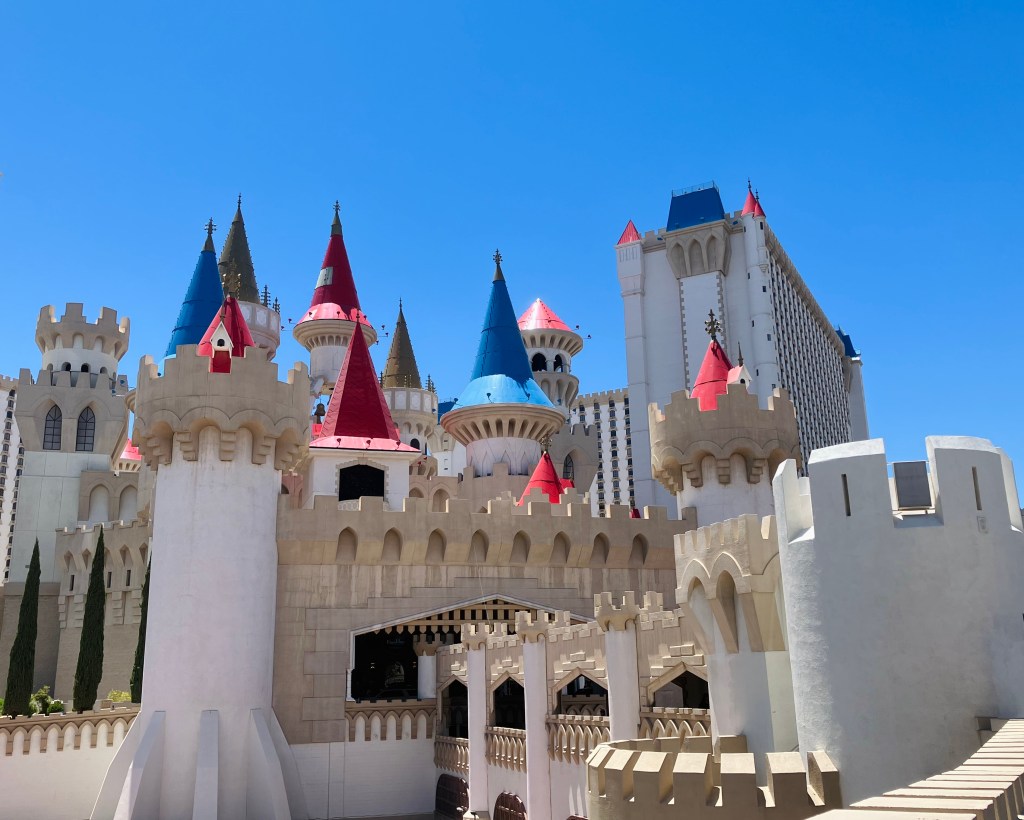
Next door to the Luxor you are then transported to the world of Camelot. With its beautiful medieval castle and turrets topped by colourful triangular roofs Excalibur is named after King Arthur’s mythical Excalibur sword.
Opened on June 19, 1990, it was the largest hotel in the world with 4032 rooms before it was overtaken by the MGM Grand in 1993.
The Luxor and Excalibur along with the Mandalay Bay are connected via the Mandalay Bay Free Tram should you not wish to walk between them. The Excalibur Tram stop is right next to Tropicana Avenue.

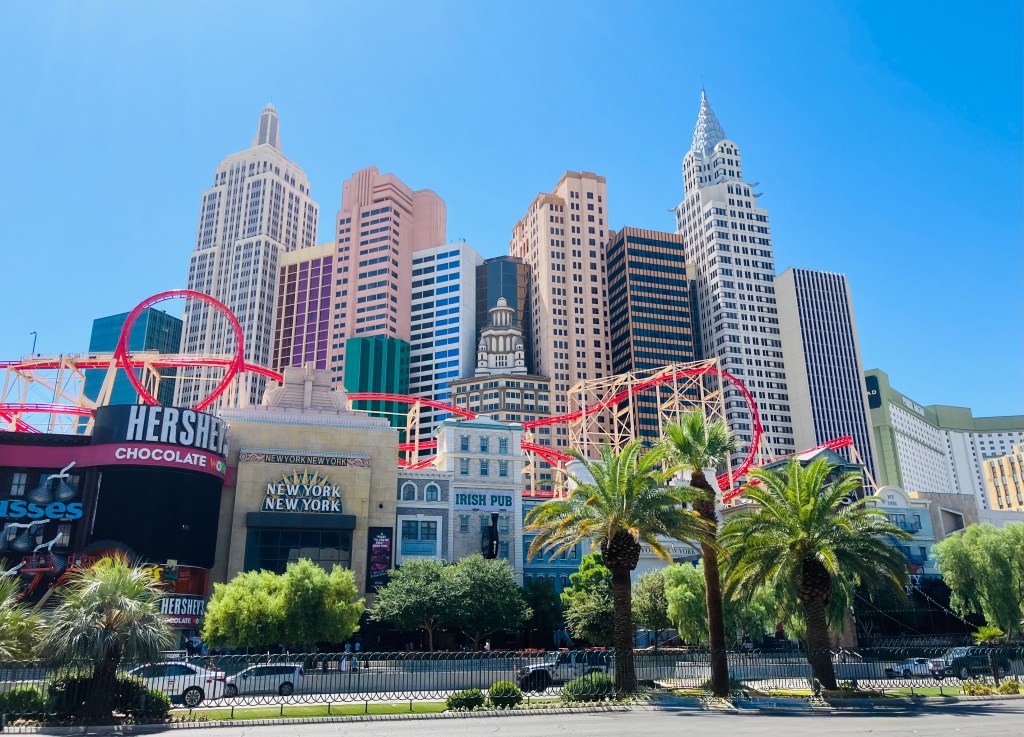
Across the bridge from here you will then come upon New York, New York.
We are now architecturally in the city that never sleeps!
Opened on January 3, 1997 this hotel and casino were designed to feature smaller replicas of numerous city landmarks including the Statue of Liberty. The tallest building in Nevada, at the time, became the replica of the Empire State Building which stood at 529 feet tall and had 47 stories. The record, since 2005, is now held by The Wynn Las Vegas.
Travelling around the hotel tower is the famous Big Apple Coaster which reaches a top speed of 67 mph and is also known for its 203-foot drop and the world’s first 180-degree “heartline” twist and dive maneuver. 

Many more casinos sit alongside the strip but the next real great feature for me is the world famous Bellagio.
Opened in October 1998, with 3,005 rooms in a 36-story tower and built at a cost of $1.6 billion, it was the world’s most expensive resort up to that point. You just cannot visit Las Vegas without stopping to watch the Fountains of Bellagio at play. Located at the front of the casino, nestling right next to the Strip itself, the 8.5-acre man-made lake features dancing water fountains that are synchronised to music. With water shooting as high as 460 feet this spectacle is one of the most photographed sites in Vegas and of course featured in the film Oceans 11 with George Clooney and Brad Pitt. It is easy to check out the timings on line so you can ensure you are there in plenty of time to get a prime position.

Opposite the Bellagio is Paris, Las Vegas. You may want to cross over the main strip at this point to get a closer look or you could merely admire it from afar. Alternatively you could continue on your way to Caesars Palace and then double back later.
Opened in 1999, architecturally Paris, Las Vegas is of course based upon the capital city of France with a half scale replica of the Eiffel Tower standing at 540 feet. There are also scaled down versions of the Arc de Triomphe, Paris Opera House, the famous Louvre Art Gallery and the Musee D’Orsay.

Moving on up the Strip and right next door to the Bellagio is our final external architectural wonder- Caesars Palace. Opened back in 1966 with a design based upon Ancient Rome, it is fourteen stories high and covers 34 acres of land, certainly worthy of its place on the Strip.
Externally in addition to the beautiful Roman columns reminiscent of Italy’s great capital there is also a twenty foot statue of Augustus Caesar to admire and further along outside the Forum Shops a replica of the Trevi Fountains.

Las Vegas does everything on a grand scale and this is certainly the case for the actual architecture of its key casinos. When you are there it feels like the majority of visitors spend their time indoors gambling on the many and varied casino games but taking a look at these edifices from the outside is definitely worth a walk.

Join me on my next post which highlights free places to visit inside the casinos themselves.

Are UK Bed and Breakfasts Becoming Obsolete?

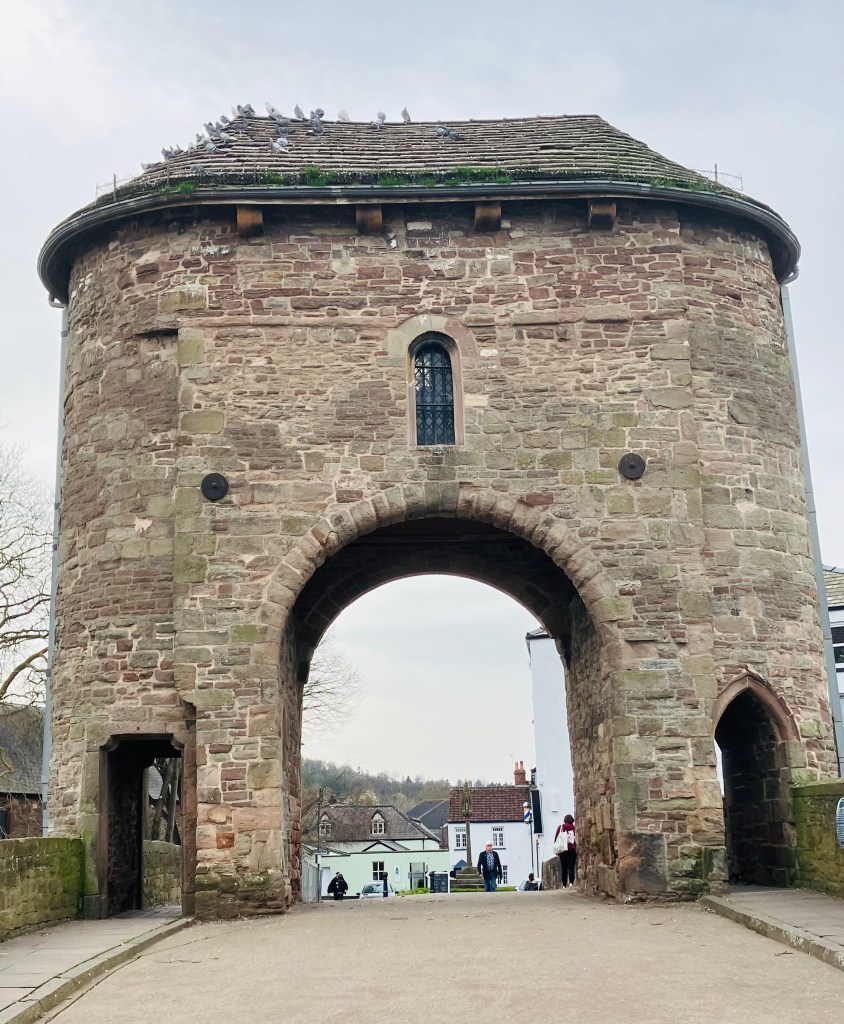
We recently decided to stay overnight having visited the county town of Monmouth. We had a wander around the town during the day, from which I have selected a few photos to accompany this post. We had a lovely lunch in a local garden centre and then checked into our Bed and Breakfast (BnB) before going back into town to see Ben Fogle – “Wild” at the local theatre.

I have reviewed the BnB on Tripadvisor but I came away with a more leading question, hence the title of my post.

From extensive experience of travelling and knowledge of this style of accommodation in the Western World, I think it is important to firstly point out, particularly to my USA readers, that there is a vast difference between BnB accommodation in the UK to that in America.

America versus UK – Bed and Breakfast:

In the UK, BnB accommodation was traditionally cheaper than a hotel whereas in America it seems to have always been of a similar price range. The reason for this lies in the way it is marketed.

In America they are set up like small hotels and usually run by a family who are very present. Family gardens are shared with the guests including, where present, swimming pools. Rooms are dressed cosily with those little extras like bottled water, a small ornament with sweets (replenished daily) and home-made or locally sourced bath products.

American establishments would all be en suite whereas in the UK you may be required to share a bathroom or leave your room to get to your bathroom.

American accommodation is also very communal. Guests, particularly if American themselves, naturally mingle.
All guests are included by the hosts. For example everyone sits around a large table for breakfast encouraging cross communication about themselves, the area, what everyone did yesterday etc. Having a quick sit down n eat style breakfast just doesn’t happen!

There are also sometimes early evening soirées with drinks and nibbles.

UK establishments tend to be houses that the owners have converted for the purpose of renting out rooms with a communal car park and a dining room to have breakfast. There is no encouraged community feel.
Accommodation varies according to the standard to which it has been refurbished/ redecorated. It can often lack some of the facilities offered in a standard “chain hotel” bedroom particularly where showers, bathrooms, heating and air conditioning are concerned.


History of Bed and Breakfast in the UK:

This key difference between the UK and America is perhaps based in the past.
Historically in the UK BnB accommodation began to emerge after the Second World War as the term “Bed and Breakfast” gained popularity. The concept grew as local residents opened their homes to travelers, offering rooms and breakfast. This was also fueled by increased tourism and car travel, making B&Bs a convenient and affordable option in rural areas.
I remember my Dad talking about how back when he married my Mum in 1952 this was often the type of accommodation used by honeymooners but only for the actual wedding night because it was all they could afford!
Later in life, after my Mum had died, and my Dad had a new relationship he would sometimes pop down south to the coast for a couple of nights where they would stay in a BnB. Nothing was ever booked in advance, you just set off and hoped for the best.

Even holidays, as children, were sometimes spent in a BnB and to be honest I don’t have great memories of the accommodation back then. I just remember it being someone’s house and cramming into a small dining room for breakfast.

BnB in the Modern World:

Our BnB in Monmouth was just off a main road. There was no warm greeting on arrival from the host and breakfast in the morning was a fairly “conveyor belt” style event.
Maybe this is a UK cultural issue because I have fond memories of a BnB I stayed at in Milan with my son. It was probably nearly ten years ago, where a lavish spread of Italian breakfast items was loaded upon a big round table, headed by the host, and all the guests gathered around it. I remember actually looking forward to this mini social gathering each day.

There are so many other options these days if you are looking for somewhere to stay without “breaking the bank” which are increasingly putting the traditional BnB in the shadows.

Booking.com -download their app and you soon have a massive selection of properties at your finger tips. This can include hotels, BnB’s and self catering properties. It’s always worth popping in a few filters to eliminate the countless number of properties that one search can produce. I tend to use:
-Free Wi-fi
-Free Parking
-Free Cancellation
-Review rating 8+

I find if I put in too many filters, whilst this gives me a smaller amount to work through, you can sometimes miss out on a really nice property because you asked for something specific which, hand on heart, wasn’t a necessity but “a like to have”.

Air BnB -This site gained popularity rapidly after its launch in August 2008 and by 2011 had listings in 89 countries with over 1 million nights booked. The rapid growth continued, with Airbnb announcing over 9 million guests since its founding by October 2013. However figures started to take a downturn towards the end of 2024.
Some countries and specific cities are even legislating against this type of short term rental.
Notwithstanding this when you download the app and begin a search you are faced with many places to stay.

Premier Inn /Travelodge – These two groups of branded hotels are constantly upgrading their offers partly to compete against each other and are still very popular here in the UK. Premier Inn is actually the UK’s biggest hotel brand with 86,000 rooms.

So Is Traditional Bed and Breakfast Accommodation Going Out of Fashion?

Covid -Returning to my original question I think Covid has definitely contributed to the decline of the traditional BnB with unfortunately a lot of them going out of business during this era.
But secondly and possibly the most significant change was that once they reopened the restrictions placed upon them meant that quite a few introduced self-check-in rather than a friendly, personal greeting; and big changes to how they do breakfast.
It’s not unusual to now be given a “breakfast hamper” to enjoy in your bedroom, rather than sitting at a table in the dining room. While most places aren’t offering something this high end, the “continental breakfast in room” or “find your own breakfast” practice is becoming more common.
Whilst this perhaps also reflects the self-sufficient preferences of travellers who are now accustomed to Airbnbs it also means the B&B experience isn’t quite what it once was.

Statistics -show that Millenials and Gen Z (those currently aged between 18 and 42) have a lower demand for domestic holidays than the rest of the adult age groups in the UK. So they aren’t as interested in holidaying here which doesn’t bode well for the domestic holiday market as a whole.

Just over half of Brits who stayed in a home rental last year were Millennials (53%) and 15% were Gen Z with Booking.com leading the way in terms of the brand they are most likely to use. This was followed by AirBnB and then Premier Inn.

These are the visitors of the future for any traditional BnB and they are not currently indicating a preference for BnB style accommodation.
They are an age group who seem to like standardisation. They drink at Starbucks because they know what they are going to get, they eat from Deliveroo because it is convenient and can also be delivered to a hotel room they might be staying in. Conversely a lot of BnB owners do not encourage food being brought back or being delivered to the room. Additionally, as mentioned above, this age group tends to favour specific holiday booking companies.

The late Baby Boomers, born at the start of the 1960’s, with private pensions and housing wealth are more likely to retire early. A third fewer baby boomers were in the labour market at age 62 than at age 55, with retirement being the most common reason for leaving the workforce.
With a desire for a more fulfilling lifestyle a lot of these people are contributing to the rise of the retired nomadic lifestyle in the UK or taking off to travel worldwide on “golden gap years”. There is also a growing appeal for affordable and flexible living options like van life.

With remote working becoming a greater option than it ever has, this also adds to the appeal for both this age group and those from the younger labour market to experiment with different lifestyles.

When you take into account that the average BnB booking will cost you 25-50% more than say a Premier Inn whilst owners are cutting back their hosting duties and style of breakfast you have to question where their future lies.
Then in combining all of this information above together the conclusion has to be that Bed and Breakfast accommodation is losing its appeal and may well die out over the next 10-20 years. Younger generations are not topping up numbers as older clientele die off and as the digital age continues to grow and move forward I cannot see this changing.

Exploring Keukenhof: A Must-Visit in the Netherlands

No trip to The Netherlands would be complete without a visit to Keukenof.
This was my second visit having included it two years previously in our tour of Western Europe. Last time I had been in total awe and left entranced with it’s beauty, amazed at the imagination of the gardeners and inspired to go home and revolutionise my own garden:
https://amidlifeadventure.org/2023/05/12/keukenhof-beauty-imagination-and-inspiration/

Arriving at Keukenof:
We arrived this time, having taken a train from Utrecht to Schipol and then, after a few wrong turns, found the “tulip” bus which took us to the location. Tickets can be purchased online in advance with a choice of places to pick up the bus.
Arriving early is always a good idea, you definitely get to see a good section of the gardens before the crowds start to build up and more to the point you don’t have to queue to show your ticket and enter.
Last time we visited it was early May whereas we were coming six weeks earlier this time and there was a slight concern that we would not have such a good time. I’m going to be honest and say there were quite a few flower beds not yet in bloom so I would opt to come late April/early May if I returned a third time. However despite it being early in the season I still had a fabulous time.

Starting Out Exploring:
Armed with the useful little pocket map and my trusty iPhone to shamelessly click away at every beautiful opportunity, we followed the same route as last time, heading away from the entrance along the path diagonally right, passing but not entering the Oranje Nassau on our left.
I will include quite a few photographs from our visit as Keukenof is truly astounding and to be frank in this situation “a picture often speaks a thousand words”.
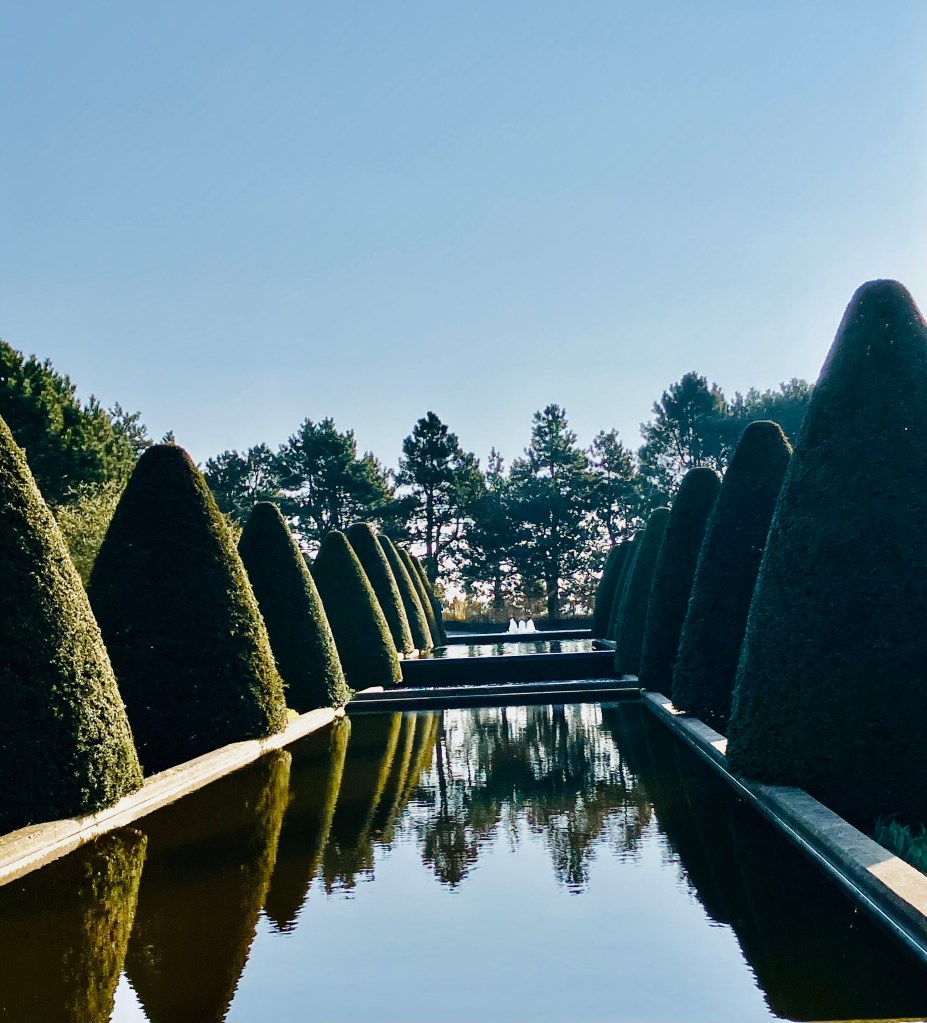
The view to the right at Oranje Nassau is one such case in point with a conical avenue of evergreen trees, smartly trimmed, reflecting in the narrow expanse of water as it stretches to the fountain beyond.

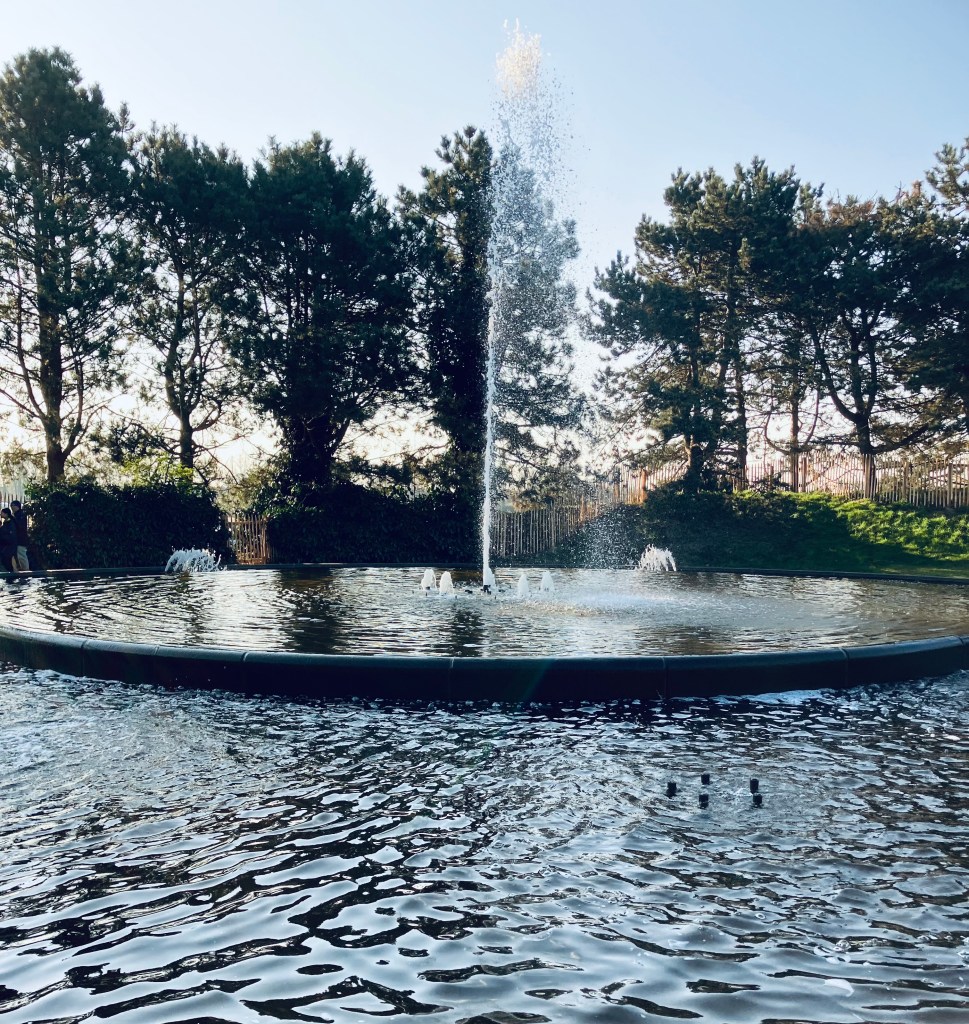
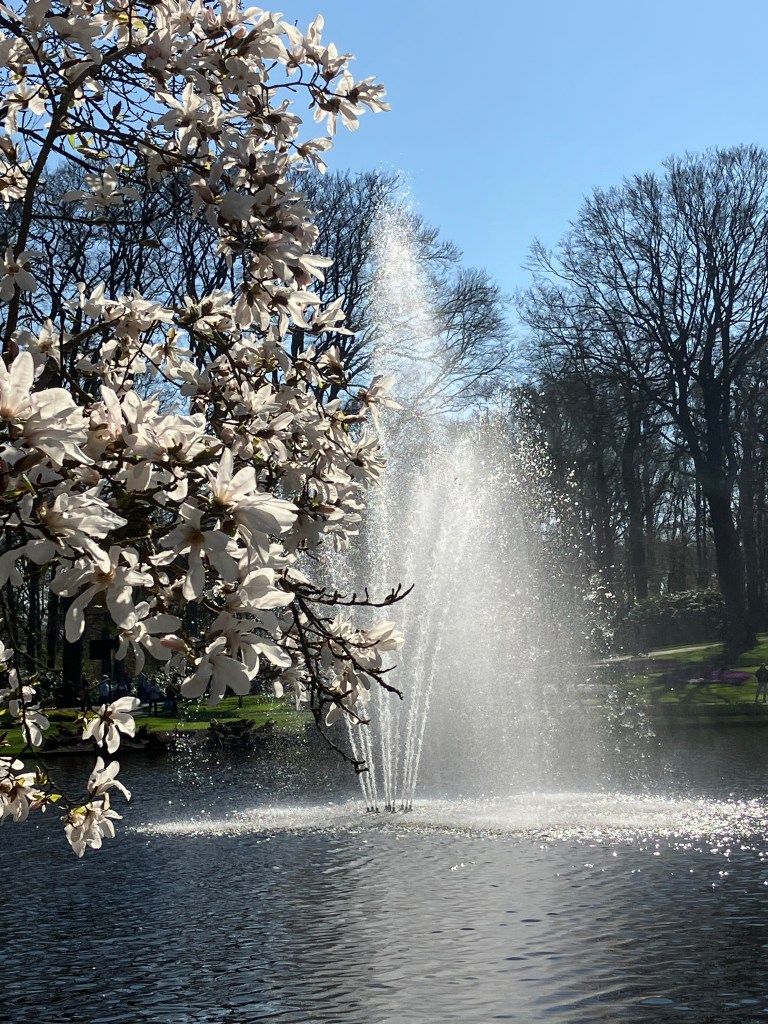
Stopping at the fountain is another “must do”. I do love a water feature! From this photo we branched off right and followed the path to our destination.The morning Spring light isn’t quite fully developed and the trees beyond the fountain look dark and moody.

Just beyond the fountain is a great viewpoint out across the blossoming tulip and flower fields.

There are several more viewpoints on our right as we make our way up the gardens towards the windmill. It’s worth stopping even if only to catch the baby moorhens and other wildlife paddling in the stream that separates the main gardens from the fields beyond.

The Windmill:
The gardeners, here at Keukenof, are so clever. They devise great ways to beautify every area not just focusing upon flower beds but also planting in wooded areas and popping the odd unique plant pot along your route.

When you see the first of these that stops you in your tracks your inspiration bubble starts to simmer and alongside many photos taken as reminder of my visit I will click away at these types of installations purely for my “Potential Gardening Ideas” folder on my Mac at home!

Just before the windmill is a glass building, that looks a bit like a large greenhouse, where you can grab a coffee and cake etc. The above display was outside this building and they tend to create something magical here every year. We’ve not actually sampled their food as on both occasions it has been in the process of opening when we have reached it.
Just by the windmill though there is a wooden kiosk where we have stopped on both visits to perk ourselves up with coffee and a morning pastry.
The “Whisper Boat” departs near here as well. Most visitors buy their tickets in advance in order to secure a ride along the waterways and into the fields of flowers.
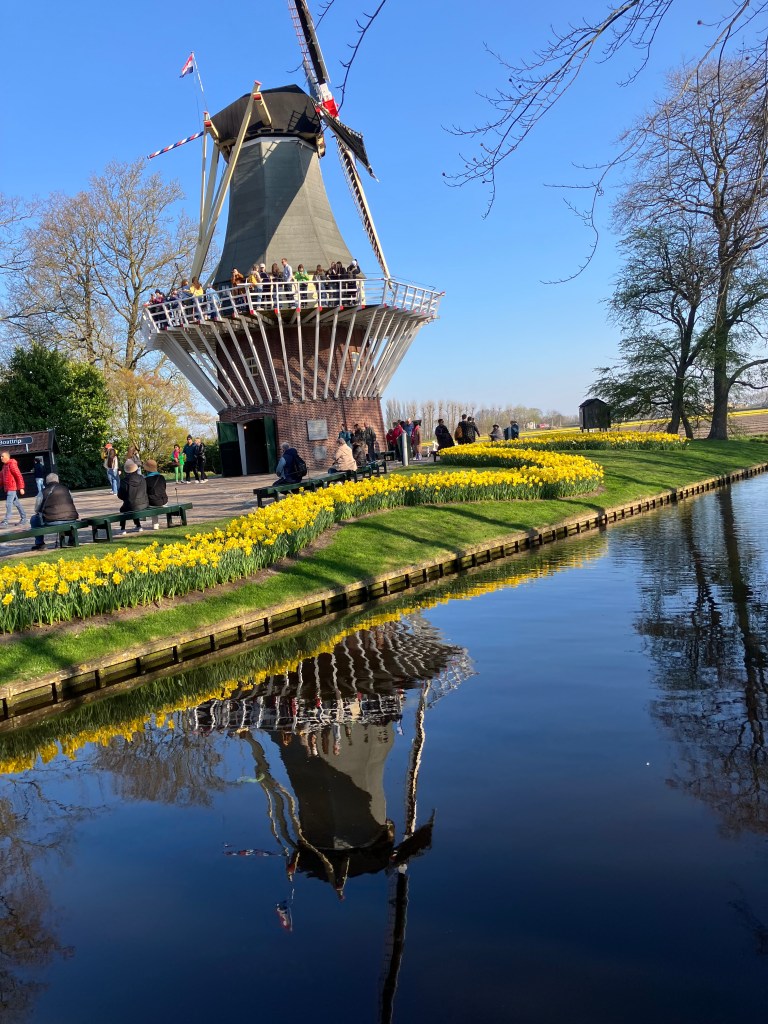
Taking a photo of the windmill reflecting in the waterway was a must for me!

As was recording a video of the vertical bells, which stand to the left of the windmill, chiming the hour.


Beatrix:
Keukenof has several indoor display areas and, in leaving the windmill behind, we head off to view the first of these -Beatrix. Once again we cross over a waterway giving us a lovely view of the trees reflecting in the water and the various bridges beyond.
I felt it was important to include this photo so that future visitors understand that Keukenof isn’t solely about borders of tulips and flower beds, there is so much more to it than that. They really work with the nature already within the grounds.

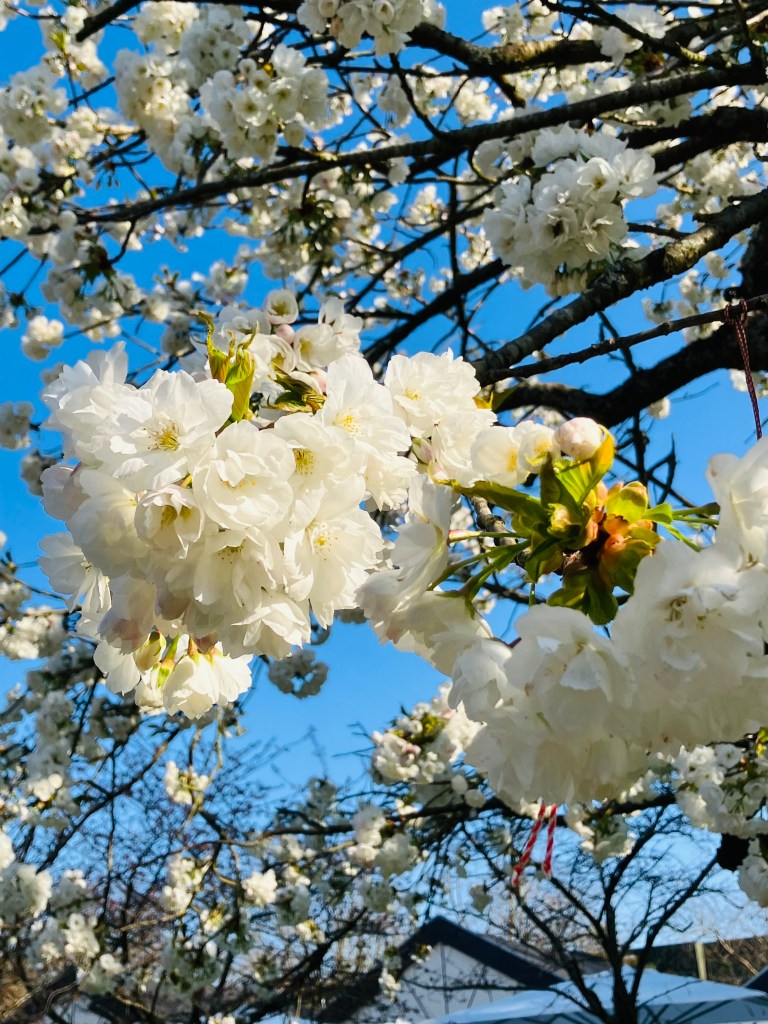
Just before arriving at the indoor display area we passed some beautiful trees showing off their blossom.

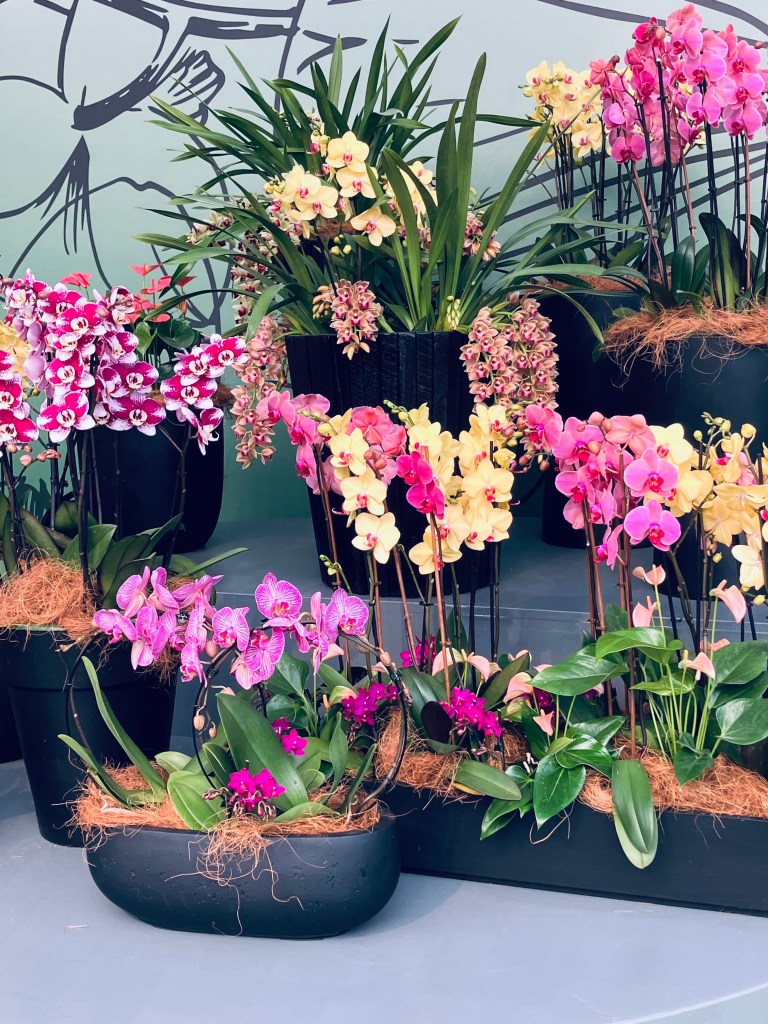
Beatrix which is named after the former Queen of the Netherlands is an indoor display area known for showcasing a variety of orchids and other tropical plants in a climate-controlled environment. As an avid lover of orchids I soon lose myself amongst the spectacular displays and in examining my photos afterwards struggle to pick the best ones to include in this post.
Let’s begin with orchids as this is the main purpose of this show area.

I still haven’t repotted my orchids at home and arranged them in these type of displays despite buying large pots, orchid compost and straw for the purpose!
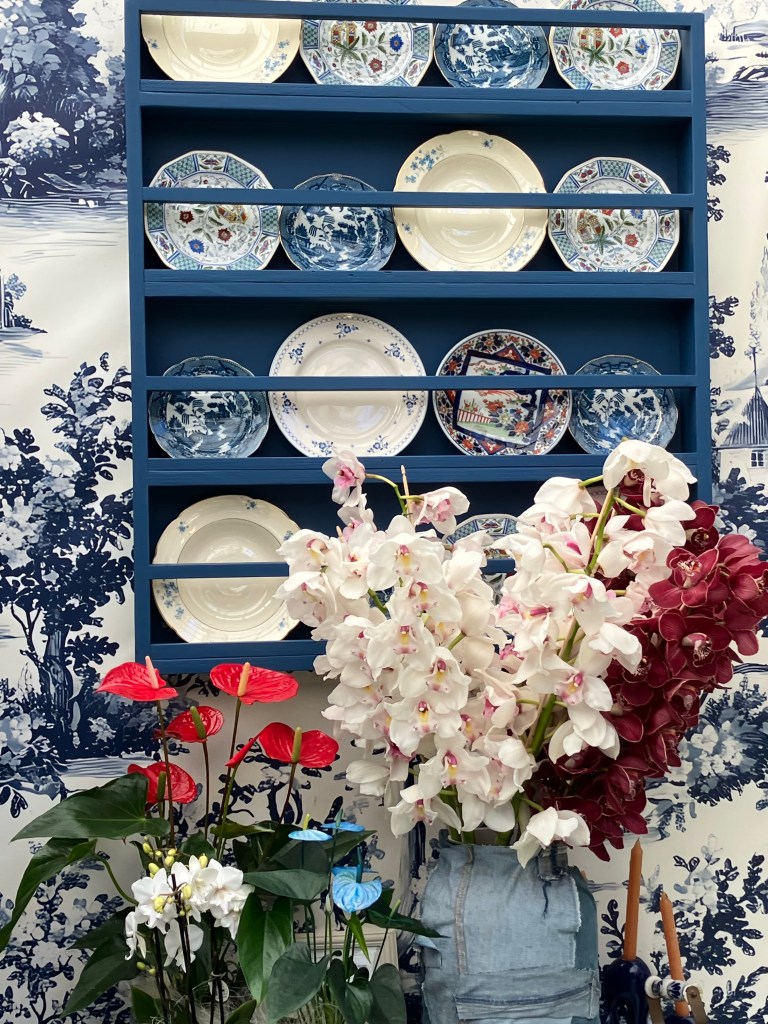
This area also showcases ideas for how to design areas within your home using your plants to make everything a bit more interesting.

I wonder if the designers of these displays actually take these ideas home with them or do the ideas come from their homes?

Willem-Alexander:
Leaving Beatrix behind we turn right and walk down the pathway amidst an avenue of trees and flowering borders. Beautiful displays of flowers blooming in all their glory greet us.

Then just opposite the second entrance to the park we bear left heading to Willem-Alexander, another indoor display area. Our route takes us through a slightly wooded area where the gardeners have once again used their imagination to create some wonderful displays that sit quite nicely amongst the foliage.

Branching left we follow the path towards the small shop. Ensuring there is something for every age group this area is dedicated to Dutch childrens’ characters.

And just prior to entering the next display area there is a cute little bridge crossing over another stream.

This year the Willem-Alexandrer building show cases what feels like hundreds of new varieties of tulips. My phone is red hot in my hand. With a Spring flower display to work on this winter to give my garden an all round burst of colour and interest, I need to ensure I snap the names of the flowers I like the most. Having waded through a ton of such photos here are a couple of my favourites.

The ones below made me think of Christmas candy canes!

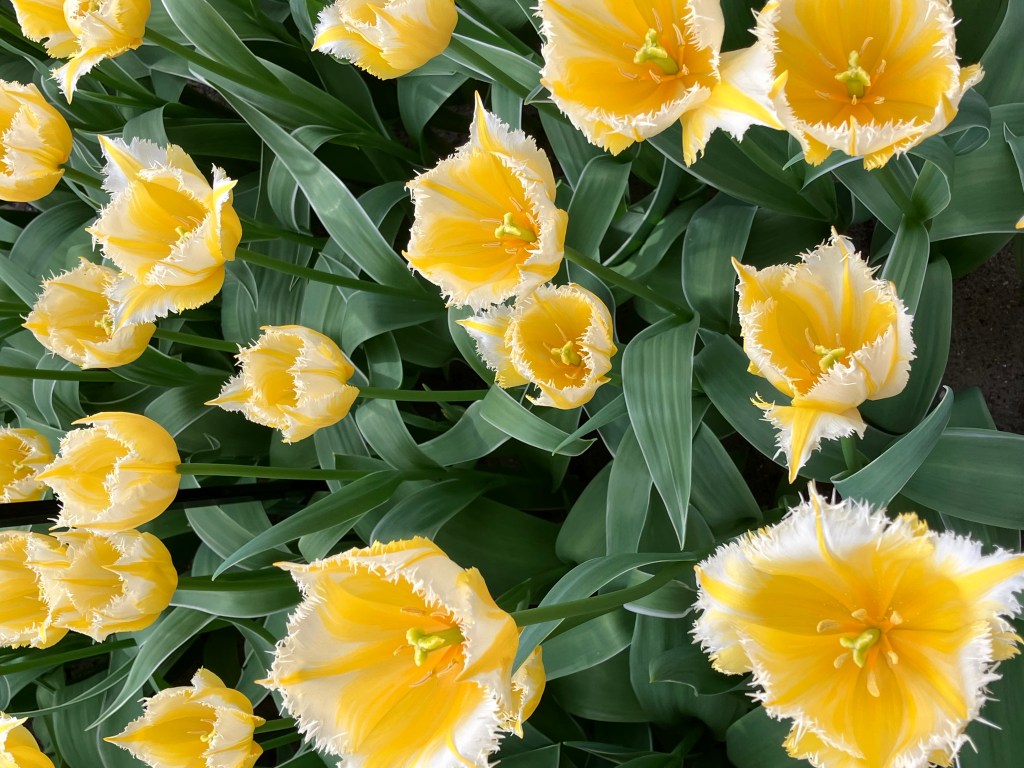
And these wonderful yellow tulips brought lemon curd to mind!

In the centre of the building is the below water feature:

And there was the odd display to give the “Instagrammers” something to post on line!

The Lake:
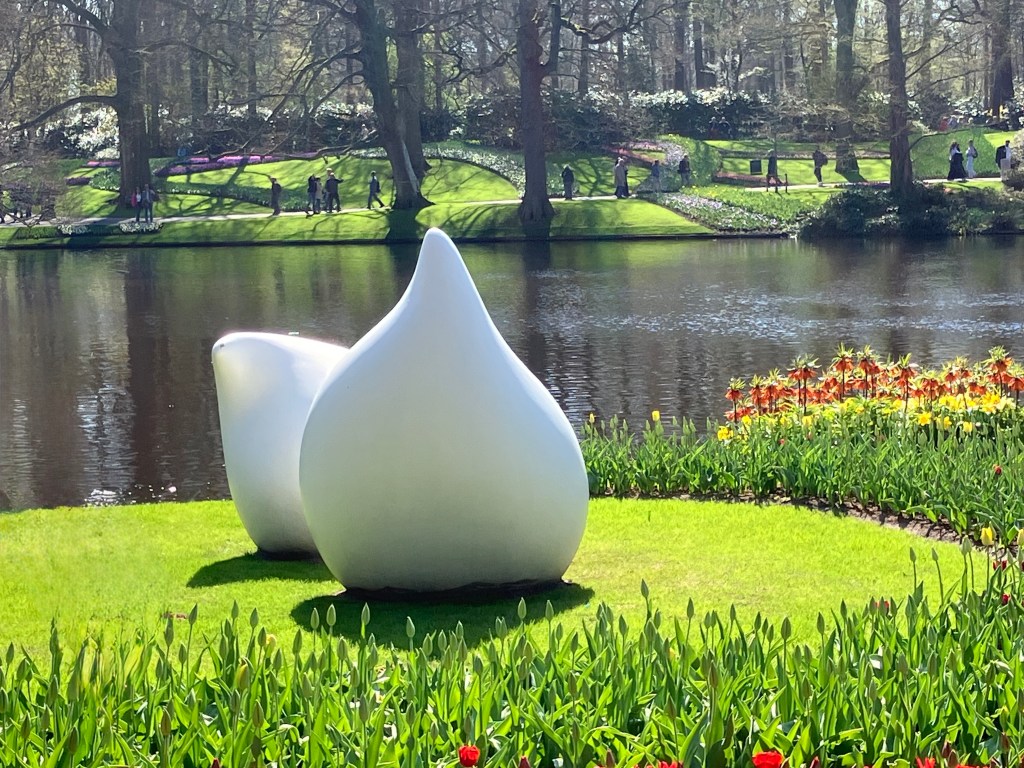
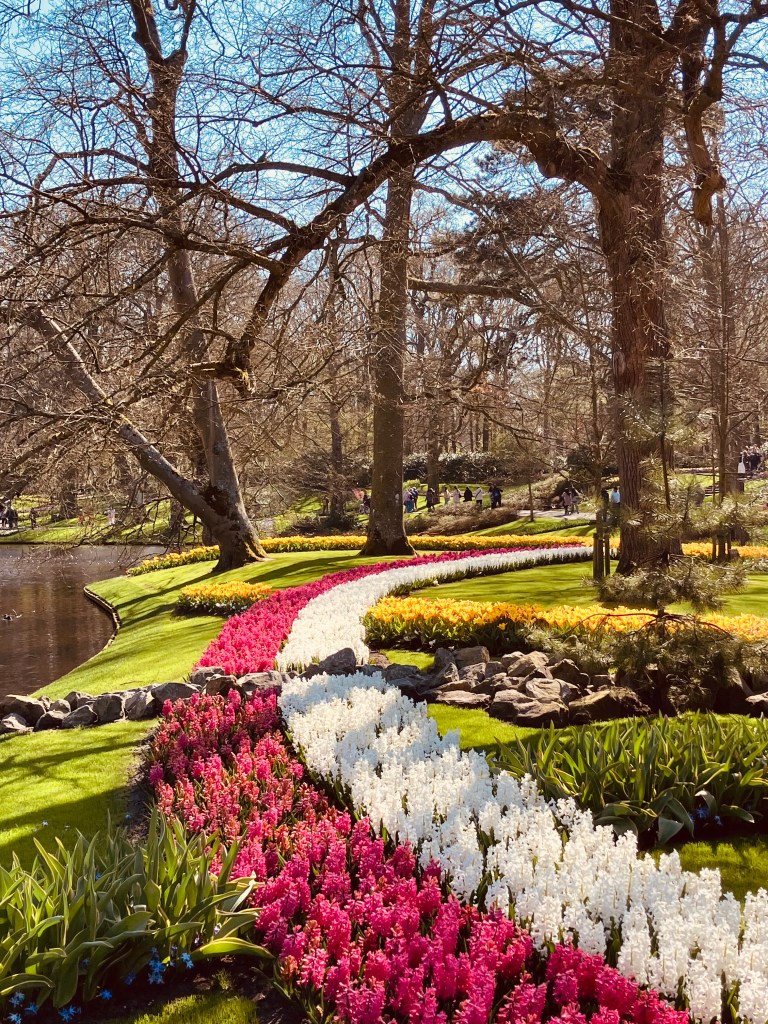
We leave this display building by the rear exit, opposite where we had come in, and take the path opposite heading back out into the grounds and down towards the lake. The path takes us once again over and alongside various water features. The lake, itself, is quite a feature of Keukenof with it’s central spray fountain, modern sculptures and of course flower beds that meander alongside the natural curve of the lake:

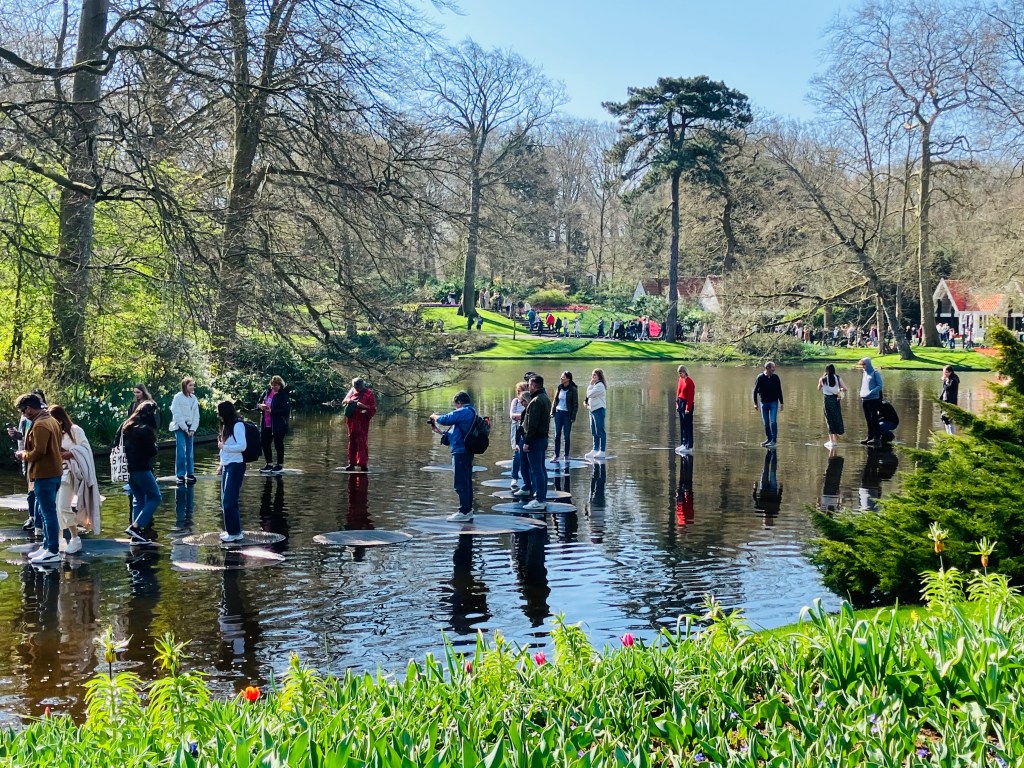
And once again in trying to ensure everyone is catered for they have designed this “stepping stone” game for people to not only enjoy but, of course, to photograph themselves and post on their Instagram account! If the queue to take part is anything to go by, Keukenof has hit its intended audience.

Oranje Nassan:
Having crossed the bridge over the lake we go left and follow the right hand pathway as it meanders around the woods and then across the bridge into the Oranje Nassan building. This features an ode to the last 75 years of Keukenof and traces the history from its humble beginnings to the present day.

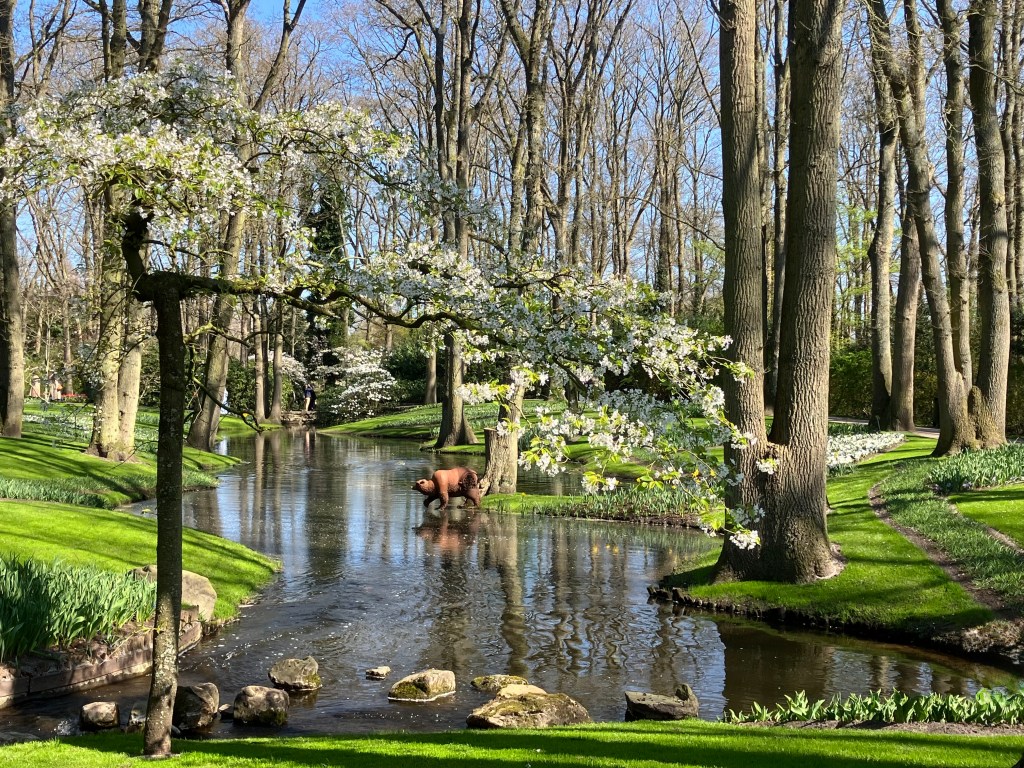
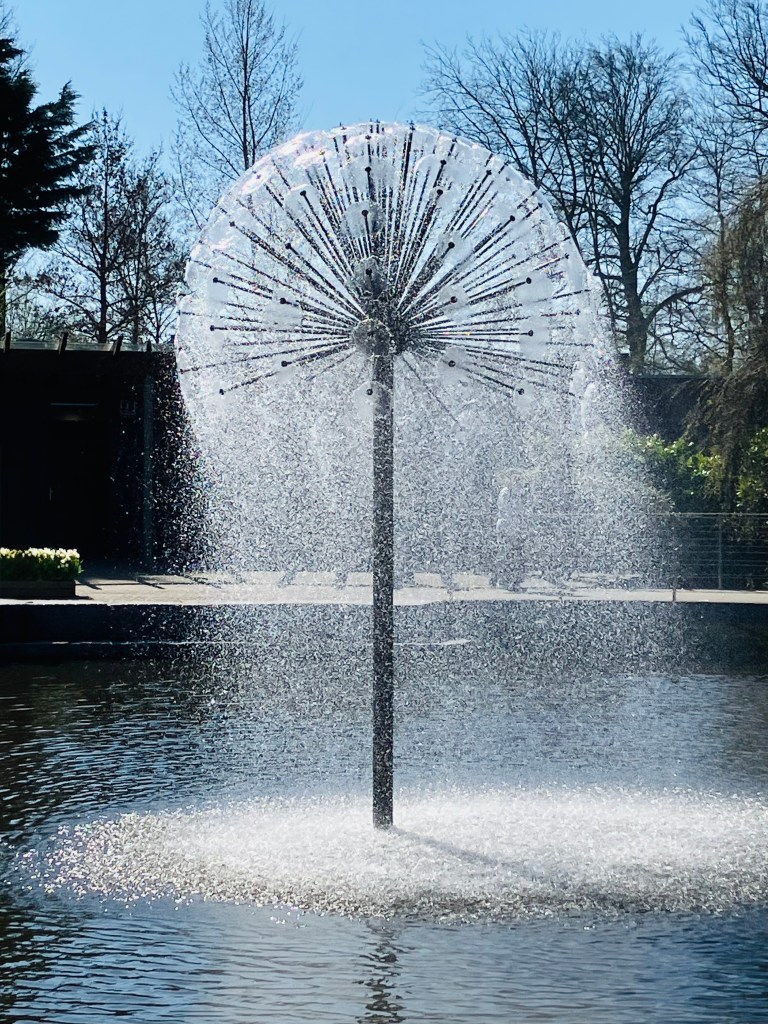
It was finally time to head back to the entrance and so I’ll leave you with these final two photos:- A peaceful woodland scene and the dandelion because Keukenof is not all about flowers. It is about so much more -tranquility, serenity and nature in all its glory!

This post forms part of a series based upon a recent trip we took to The Netherlands. Please feel free to read my previous posts from this series and contact me should you want any more information.

Exploring Gouda: A Self-Guided Tour Through History

On Day Five of our visit to the Netherlands we once again set off by train from our base in Utrecht and headed South West to Gouda. Alighting at the train station we google mapped our route to the town hall in order to start a self guided walk.
It was a bright sunny Spring day and as we walked along I soon became aware that Gouda was not what I had anticipated. Instead it was very quaint, with the old medieval city centre surrounded and traversed by gorgeous canals. It seemed like a really happy place to live, if that is possible from a first impression but I knew immediately that I was going to enjoy this visit.

A Little Bit About The City
First it is a city and not a town and has held official city rights since 1272, making it older than cities such as Amsterdam and Rotterdam! The city grew up on the banks of the Gouwe River and became known for its cloth trade and later for being a hub for cheese production. 
The economy began to diversify in the 17th and 18th centuries to encompass the making of clay pipes and pottery. In the 19th century candle factories were established here but with the advent of the Second World War the city was badly hit by the Luftwaffe.

As the war became part of history the city needed to rebuild and efforts were made to preserve its historical heritage while accommodating modern development. The architecture in Gouda is stunning and made for a lot of photos for us to preserve memories of our visit.

Of course today when anyone mentions the city everyone thinks about the cheese, named after the city itself and for which the city is very famous. The cheese market still takes place every Thursday Morning from April to the end of August starting at 10 a.m. and finishing at 12.30 p.m. Its worth getting your timings right to experience it!

Highlights of Our Self Guided Walk
We like to follow self guided walks around cities as this allows us the freedom to stop and start when we wish should something particular take our fancy and require further investigation. We don’t have to worry about following the narrator with the flag on a pole or jostle to get the best position when wishing to take photos.
Here are my highlights of Gouda:


The Town Hall
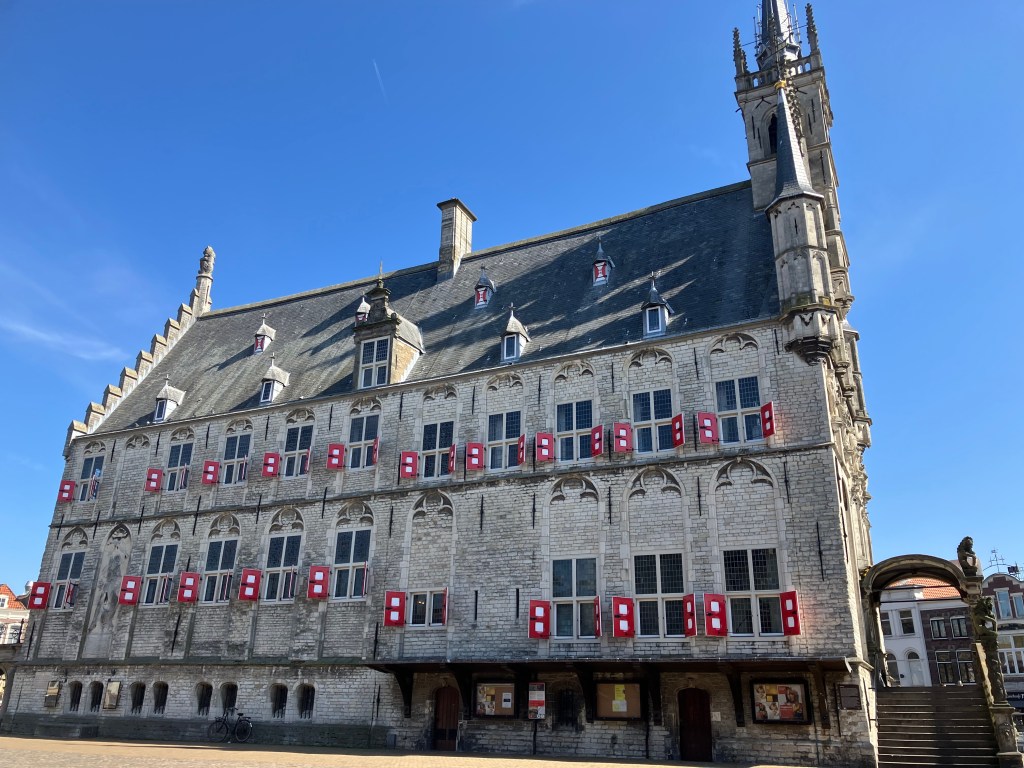
We began at this famous and beautiful building situated on the central plaza. It was deliberately built centrally following a great fire in the city in 1438, the plan being to ensure that with no adjoining buildings it would avoid such a fate again in the future.
It is truly remarkable to behold, built in late Gothic style with sculptures on the facades based upon Lords and Ladies of the region at the time and beautiful red and white shutters. This is the oldest Gothic city hall in the Netherlands and looks like something straight out of a fairytale!

St John’s Church
Heading away from the town hall at the end of the plaza we came upon this wonderful, fully enclosed church. The surrounding buildings appear to be cosseting it from the outside world and really exemplify how small everything was back then with the houses encroaching in upon each other and doorways reflecting the human size and height at the time they were built.
Originating in 1280 but destroyed by lightening in 1552 and then rebuilt the church was named after the patron saint of Gouda -St John the Baptist. Inside you can admire the famous 72 stained-glass windows as well as the actual length of the church which at over 400 feet makes it the longest church in the Netherlands. Many of the windows were financed by wealthy families and benefactors including the window financed by William of Orange from whom the current Dutch family originate. Needless to say those windows, financed in this manner, bear images of their patrons memorialised in the glass itself!

We walked around the church which also features a lovely quiet garden at its rear containing two statues.
The first represents Gerald Leeu, who was a pioneering book printer in the late 1400’s. The layout of books are somewhat taken for granted nowadays but Leeu was the first person within his trade to develop a technique whereby images and printed text could both feature together on the same page. Prior to this they had to be printed separately. He also devised the idea of a title page at the front of every book. Prior to this book text just began immediately on the first written page!

The second sculpture is of Erasmus, the famous European scholar who translated books, prayers and letters making him one of the most influential and famous European “thinkers” of the Northern Renaissance. His school education took place here in Gouda.

The Museum
We left the church behind us and headed through The Lazarus Gate. At over 400 years old the gate was relocated here in the 1960’s from an old leprosy house outside of the old city walls. Leprosy was often referred to by the Dutch as Lazarus disease hence the name of the gate.Passing through the gate we found ourselves in a courtyard.
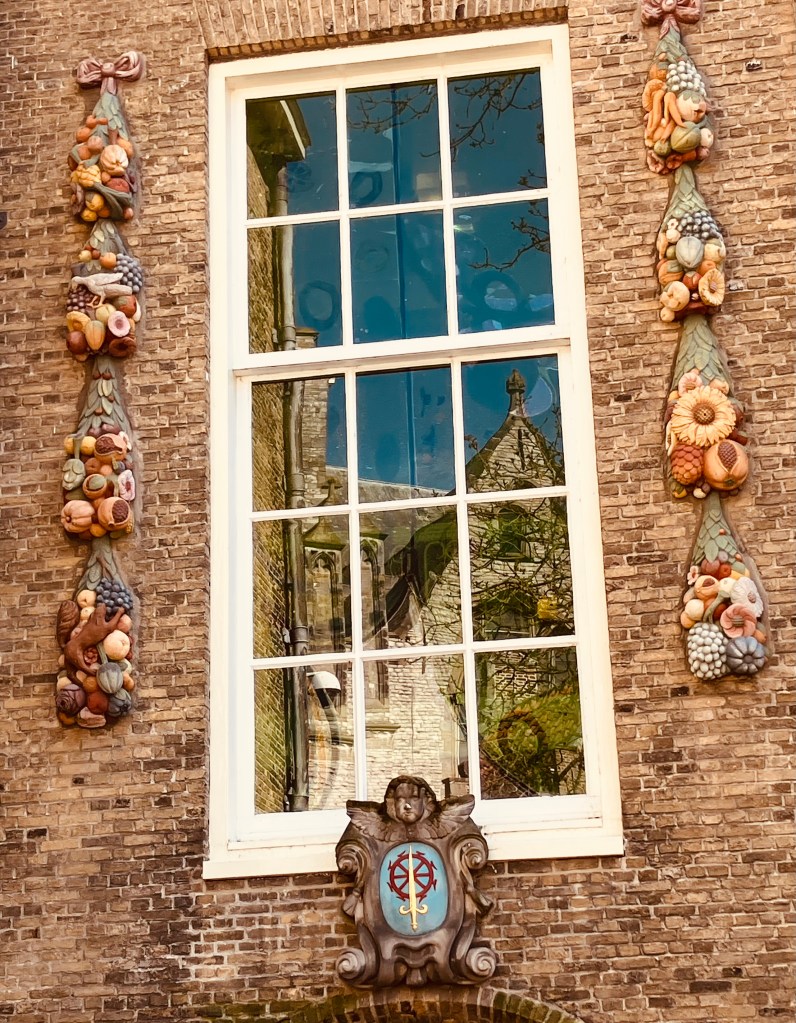
Originally established to care for the poor the buildings that now make up the museum were once a hospital, the St Catherine’s Guest House, a pharmacy and a chapel before being formulated into the main hospital for the city. Whilst we chose not to visit the museum I was entranced by the collection of sculptures that can be seen on the outside wall of the museum. These were collected from other buildings in Gouda which have now disappeared.

There is also a small sculpture garden to the right of the Lazarus gate which we took a wander around. Gouda seems to have many little nooks and crannies, moments of peace and tranquillity amongst the normal more hectic life of a city.

The Fish Market
Further along our walk we came upon the old fish market, another beautiful historic building. Fish was sold here until about 1879 at a weekly Friday fish market. What is really interesting is that the market was split into two sections. The gallery on our side of the water was for local fishermen and the one on the other was for strangers! There is a small hut on our side which is where the overseer would assess the fish and decide upon the taxes to be charged.

Wandering Past The Beautiful Houses
As we wandered along on our walk it is often the little titbits of information that I find most enlightening particularly when they relate to everyday life.
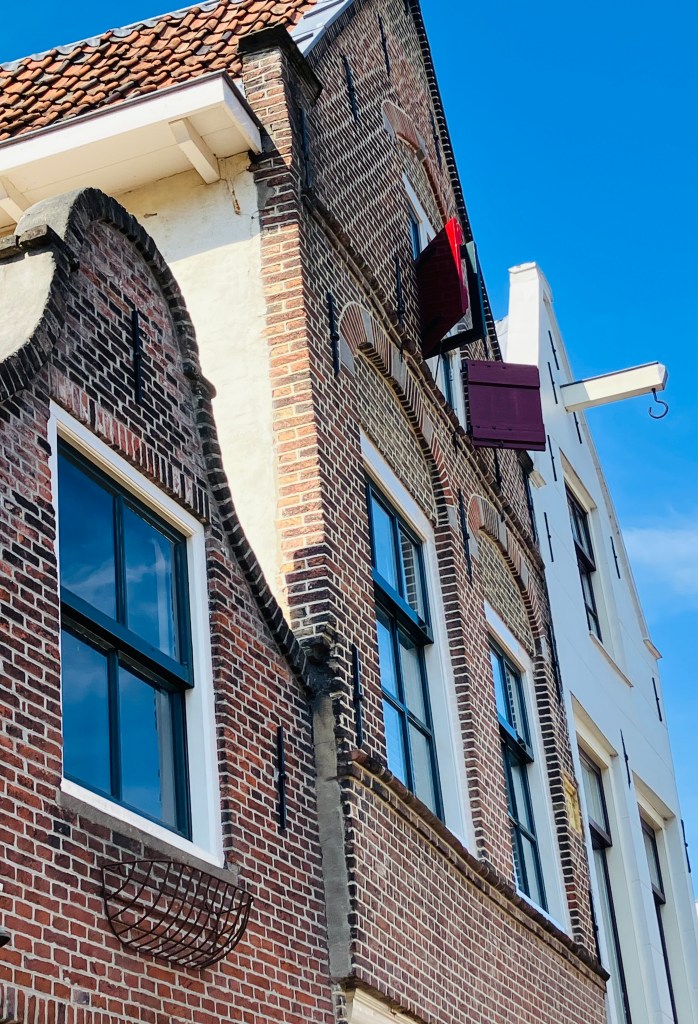
Many of the inner city houses, for example, do not possess a garden so to compensate for this the locals often put their own bench or floral display outside the front of their homes or “on the stoop” as it is known in The Netherlands. Everyday moments that we maybe take for granted such as a morning coffee or afternoon tea at a patio table outside the kitchen door or a family meal around an outside garden table are transferred here onto the street directly outside their homes.
The New York idea of having hooks, to which strong ropes can be attached, at the first floor level of a home enabling furniture etc to be lifted in through the windows of the upper floors directly from the street also exists here in Gouda.

I’m not sure who thought of this first but I’m guessing it probably originated from The Netherlands.

Stolpersteine
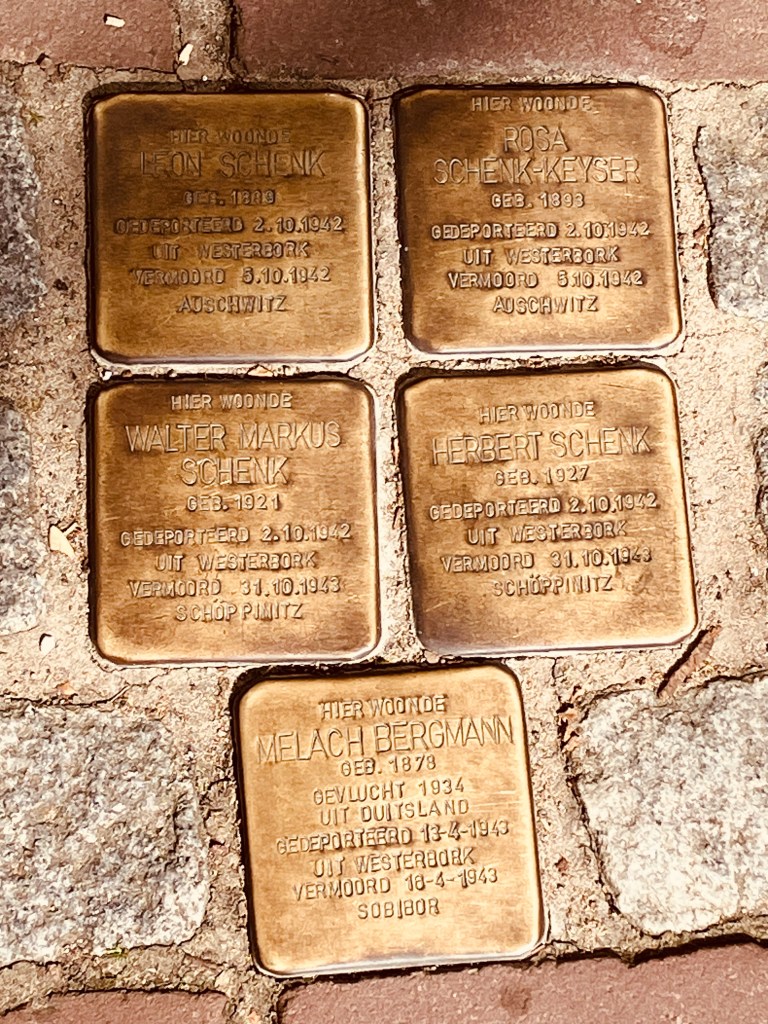
Whilst walking along the beautiful cobbled streets and taking in the views of the canals as we stroll along, our guided walk also brought our attention to the Stolpersteine found laid into the pavements at our feet. These “Stolpersteine” or “stumbling stones” are the creation of the German artist Gunter Demnig who is committed to keeping alive the names of those who perished in the Holocaust. Over 100,000 of these stones have been laid across Europe, and we have personally seen examples in many of the places we have visited previously e.g. Paris, Amsterdam and Berlin.
The names engraved upon the stones are of the Jewish people who used to live here before the Second World War. In this example the top two are the parents and the middle two are the young sons of the Schenk-Keyser family, all of whom were forced to leave on October 2nd 1942. The parents died a few days later in Auschwitz, while the sons survived a year in a labour camp in Poland . The final stone is for Melach Bergman, who had already fled the troubles in Germany in 1934, was then picked up in April 1943 and murdered a few days later in Poland.
Will we as a world ever learn the lesson portrayed by these stones?

Gouda Castle:
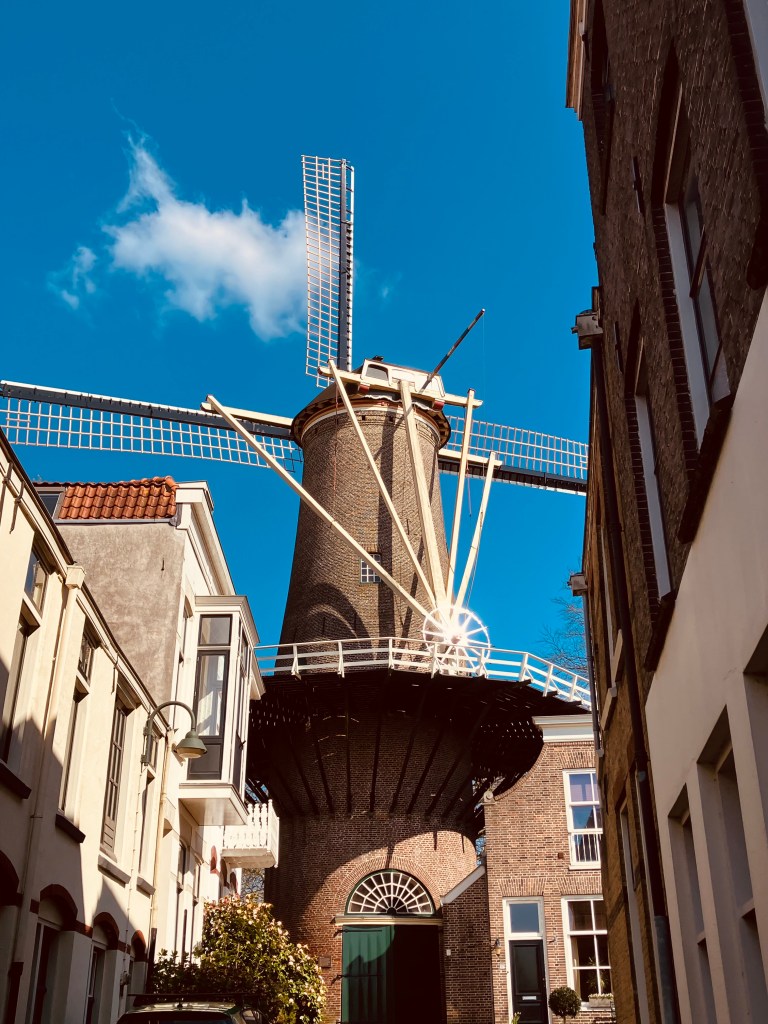
Our walk also brought us to the riverside, to the Hollandsche Ijssel and from here to the former Gouda Castle where a windmill now stands.The castle was built back in the mid 1300’s complete with six towers overlooking both the river and the then town. The count who built it rarely lived there feeling it was too cold and damp.
Eventually, some 200 years later it was torn down by the city council and permission was given to build the windmill that stands on the site today. It was here that we learnt that every windmill in The Netherlands has a name in this case “t Slot” or The Lock referring to the locks that allowed passing boats to access the inner city from the river we had just passed.
To the right of the windmill is the miller’s house under which some of the castles cellars are still located. There is a park to the rear of the windmill which in the Spring is full of traditional Dutch bulbs. This allowed us a welcome rest and a quiet place for reflection before continuing on to finish our walk.

This is a picture of the windmill from the front

The Former Orphanage:

This beautiful building, which marked the end of our walk, operated as an orphanage from 1586 for some 350 years until 1948. The children who lived here were taught practical skills thus enabling them to later join the workforce and earn money. They were cared for and taught by church-appointed regents.
The building now houses the Weeshuis Hotel resplendent with these lovely red shutters and an external courtyard where on a sunny day you can partake of afternoon tea. Alternatively inside cosy tables invite customers to have a snack or a relaxing drink.

We returned to the Market Place and browsed the shops. No visit to Gouda would be complete without a visit to a cheese shop and there are several to choose from. All Gouda cheese is made from unpasteurised cows milk with a yellow wax rind but it doesn’t have to originate from Gouda itself, it is only a style of cheese rather than a cheese specifically originating from Gouda.

We also found ourselves a nice restaurant, flanking the square, to sit down outside in the last of the afternoon sunshine and partake in some traditional food such as this Gouda Cheese Soup!

From Gouda we then ventured to the famous tulip fields and Keukenof, my story of which will be coming soon!

This post forms part of a series based upon a recent trip we took to The Netherlands. Please feel free to continue reading this series and contact me should you want any more information.

Explore Delfshaven -Rotterdam’s Hidden Gem

Having discovered the key points of interest in the main city of Rotterdam
https://amidlifeadventure.org/2025/05/09/exploring-rotterdam-a-guide-to-its-must-see-attractions/
We caught the metro to Marconiplein which took us about twenty minutes. Alighting at the metro station we headed down Schiedamseweg towards the Aelbrecht Waterway and it wasn’t long before we came across an example of the modern art that I had previously mentioned the city of Rotterdam was famous for:
“A sign of its modernity is its love for unconventional art. The city reserves space for experimental artwork standing out maybe for its size or even its subject”.

On the right hand side of the road standing tall and proud is the:
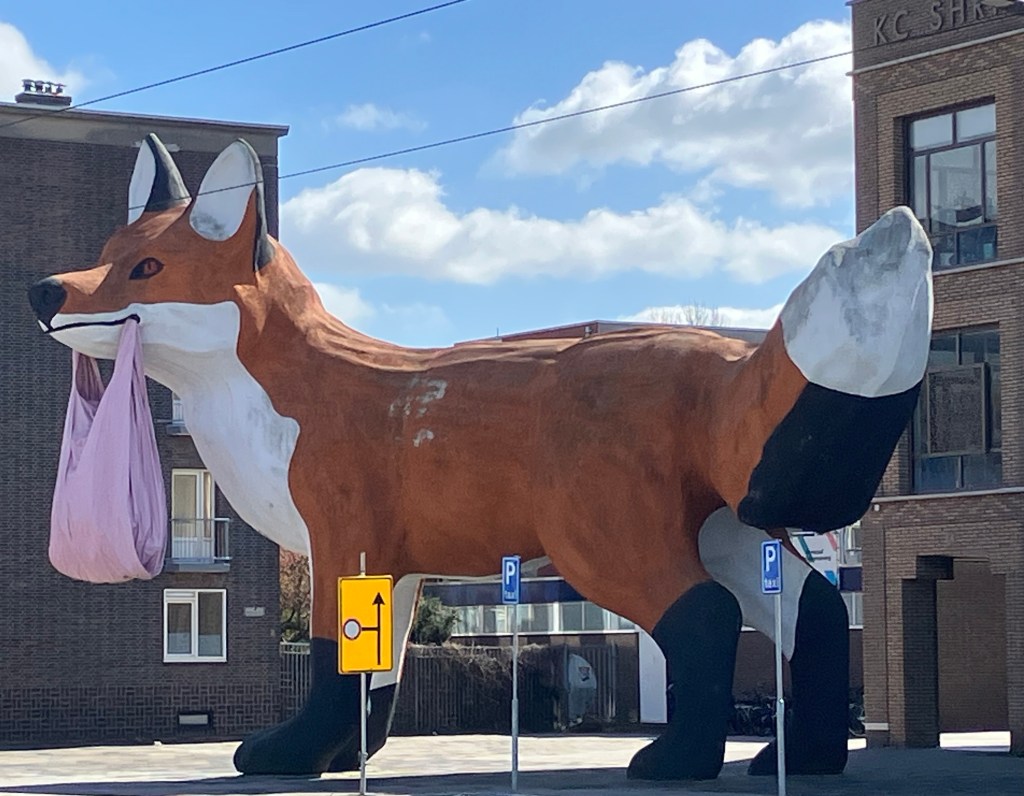
Bospoldervos by Florentijn Hofman erected in 2020.
The Forest Polder Fox, as it is known, stands 10 meters high and measures 16 meters in length and holds a large plastic bag in its mouth. With the increasing visibility of foxes in urban spaces Hofman wanted to create a connection between the city and nature whilst also commenting on the ban on plastic bags. To give you some idea of the scale of the Fox the photo below shows genuine road signs alongside!

Schiedamseweg Shopping Street:
Walking along this one mile street which stretches from the metro station all the way to the Aelbrecht Waterway we were met with an assortment of both splendid architecture and an example of Rotterdam’s broader demographic profile. This is a diverse area with a significant ethnic mix.

Built in 1910 the Schiedamseweg connected Delfshaven and Schiedam with beautiful Neo-Renaissance style buildings. These still remain on the east side of the road but the west side is far simpler in build. The reason for this is that in 1943, during the war, this side of the street fell victim to bombing, leading to the loss of around 400 lives and leaving approx 16,000 people homeless. Post the war, in the 1950’s reconstruction took place but alas the original architecture was not replaced.
Being fans of architecture we couldn’t fail to stop and admire the buildings still remaining.

Aelbrecht:
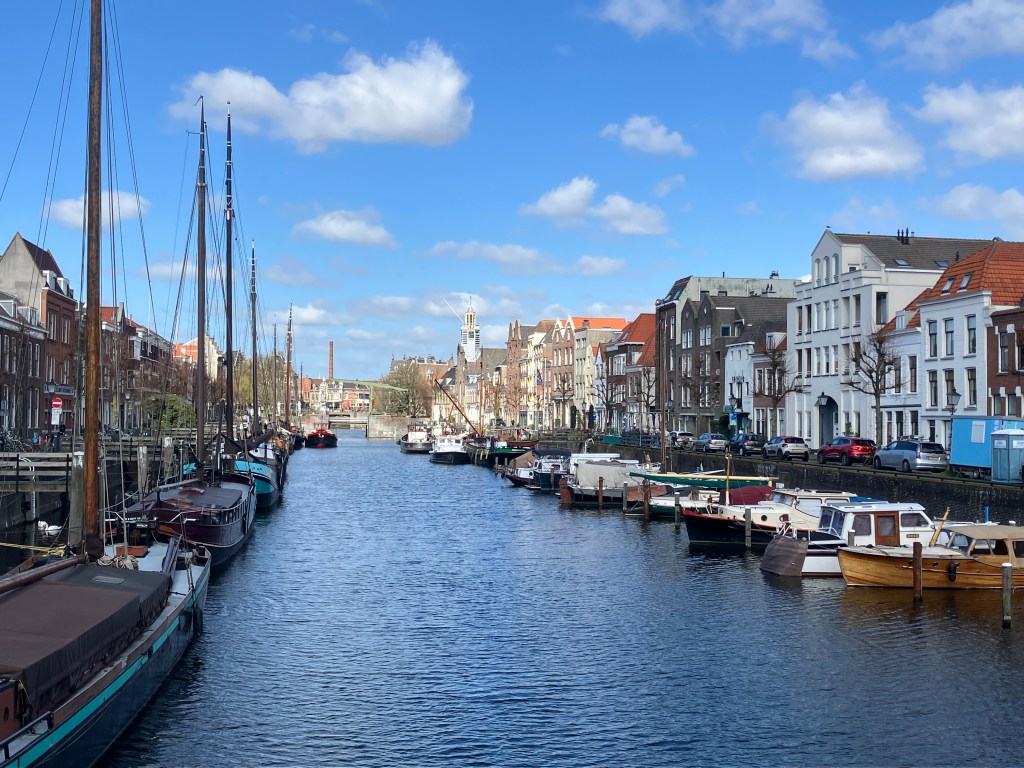
Reaching Aelbrecht we were immediately met with not just a picturesque panorama but also a real sense of tranquillity. This area is a former canal-lock, built in the 15th century with the original lock situated where today’s Cafe De Oude Sluis is sited. Reflecting the rich maritime history of this area this cafe is a lovely place to pop into, particularly on a sunny day where you can while away time sipping on a drink or partaking in some food whilst admiring the surrounding architecture and watching life meander by on the canal-side.

Also on view here, in the far distance, is the historic Voorhaven or Outer Harbour which was built in 1389 as part of the the construction of the Delfshaven Waterway between Overshoe and the Nieuwe Maas, functioning as the outer harbour for the then inland city of Delft.

We walked along the right hand side of the canal soaking up the pure history of the area and catching a glimpse of life on the water from the many boats moored alongside.
Reaching the end of the pathway you have to look back from whence you have come and just soak up the view.

“The Distilling Kettle Mill”
This windmill stands at the end of the canal and is the only surviving windmill in the city of Rotterdam. In order to access it you need to turn around, walk back and cross over the water via the first bridge and then turn right to walk to the end of the opposite canal path.
The windmill was originally built in 1727 to grind malt for the distilleries with an upright cylindrical tower standing 10 meters tall, it is constructed from stone and topped with a cap. Whilst it was partially destroyed during the bombing of 1940 it was restored by local citizens in 1986.
Since 2018 the windmill also has a small shop inside where you can gain access to views of historic Delfshaven and Rotterdam from the upper deck for a small fee. It was unfortunately shut when we visited on a Monday but is open Wed-Sat from 11-6 pm

Leaving the windmill behind we strolled along the canal path heading back towards the start of our walk.

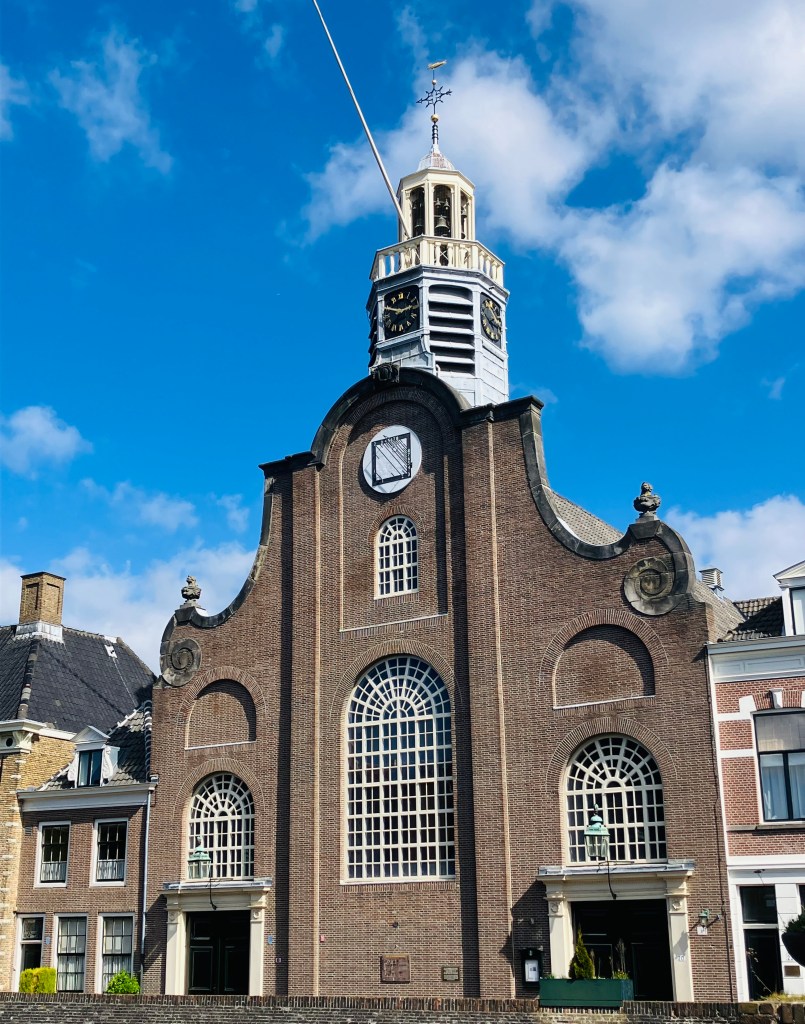
The Pilgrim Fathers Church:
En route we came across the above church whose origins date back to 1417 when it was consecrated as a Roman Catholic Church. During the Reformation of 1574 it changed to a Protestant Church.
In 1608 a group of English Dissenters left England to form their own religious group, making their home in Leiden where they lived for eleven years and became known as Pilgrims.
In 1620 this group gathered on the dock here, adjacent to the church, and prayed for a safe voyage, setting off for America in the ship “Speedwell” with the aim of reaching this new land and being able to worship freely whilst maintaining their English identity. Their plan was to meet the Mayflower at Southampton in England en route but unfortunately the Speedwell developed leaks and thus the group had to leave the ship and join other Pilgrims aboard the Mayflower. Together they left Plymouth in Devon on 21 August 1620 disembarking five months later at what then became Plymouth, Massachusetts, where they established the Plymouth Colony.

The church was later renamed by American visitors “The Pilgrim Fathers Church”. You can visit the interior of the church and read more about it’s history and admire the stained glass windows should you wish.

Other points of interest along this side of the canal include the Dutch Pinball Museum and the De Pelgrim Brewery but we didn’t stop off here.

Piet Heynstraat and the Monument of Piet Heyn:
We finished our walk by taking a wander along Piet Heyn Street, a small but historic street where the 17th century Dutch Admiral Piet Heyn was born in 1577 at number 6. The street is only about 50 meters long and ends at the Piet Heyn Square where there is a statue to commemorate the man himself. Piet is famous for his naval career including his triumph over the Spanish in 1628 when he captured a large part of a Spanish treasure fleet which transported huge amounts of gold and silver from Spanish America to Spain.

Although Delfshaven is a fairly small area of Rotterdam it made a welcome addition to our explorations and utilising the metro we were able to return to Rotterdam Central. With a quick change at Schiedam Central we were back there in just twenty minutes!

My next post about our trip to The Netherlands will feature the town of Gouda, famous for its cheese and surprisingly for us a very pretty city!

This post forms part of a series based upon a recent trip we took to The Netherlands. Please feel free to continue reading this series and contact me should you want any more information.

.


Exploring Rotterdam: A Guide to Its Must-See Attractions

On our last visit to The Netherlands back in 2023 when we were touring Western Europe by train we had planned to visit the city of Rotterdam but we were coming to the end of our travels and to be honest we were somewhat citied out. We decided instead of visiting Rotterdam to take a day off and watch the Coronation of King Charles III on Dutch TV!

Returning to the country on this revisit we had, therefore, spotlighted the city as one of our “must-do’s”.

Key Facts About The City:
I would normally give you a brief history of the city but on this occasion I’ll keep this quite brief because there was an awful lot to see in Rotterdam and I don’t want my post to be too long and lose your attention!
Rotterdam:

  1. Is the second largest city in The Netherlands after Amsterdam having developed from it’s beginnings as a small fishing village on the banks of the River Rote in 1250
  2. It lies 19 miles away from the North Sea and is connected to this major trading waterway via The New Waterway Canal . This makes it the largest port in Europe and currently one of the largest in the world as a whole. A large percentage of the city’s economy is still based upon shipbuilding.
  3. It was a major target for the Germans during World War II and as a result had to be rebuilt after the war had ended. This has made it one of the most modern cities in The Netherlands characterised by its modern architecture and impressive harbour.
  4. One of the only areas not flattened during the war was Delfshaven. As a result this area has a rich architectural history with beautiful buildings from the 1920s and 1930s, many of which are still in their original state and which we went to following our central Rotterdam visit.
  5. A sign of its modernity is its love for unconventional art. The city reserves space for experimental artwork standing out maybe for it’s size or even it’s subject.

Key Highlights Of Our Walk Around The City:
If you have read any of my previous posts you will already be aware that a large proportion of our visits to cities are based upon walking, with sometimes as in this case, an element of public transport. We are not the type to do “hop on, hop off” bus trips or similar. It’s each to their own but we prefer discovering a city for ourselves with a self guided walk.
Having caught the train from Utrecht (which was our base), see previous post –https://amidlifeadventure.org/2025/05/03/discover-utrecht-must-see-attractions-and-shopping-spots/
we exited the main train station and walked via Binnenrotte Square and St Lawrence Church to
Markthal (Market Hall):

This magnificent structure opened in 2014 and is the largest indoor market in The Netherlands. It has an unusual arch design similar to a horseshoe. It houses apartments, offices, retail space and of course the daily market. It has a glass facade made up of smaller glass windows which is supported by a 112 foot high steel cable structure, the largest of its type in Europe.

When they were excavating for the build a 10th century farm was discovered along with a house containing two stoves and several fireplaces, all of which are now displayed near the central staircases.

Inside visitors are often so bewitched by the 100+ stalls and food outlets to choose from that they actually fail to ever look up which is such a shame as there are 11,000 square meters of artwork above their heads. Designed by Arno Coenen and Iris Roskam and named “Horn of Plenty” pictures of vegetables, fruit, flowers, insects and enlarged fish adorn the ceiling.
These were created digitally and the file was so large that the artists had to turn to the Pixar Studios to actually store it! Separating it into 4000 pieces they then printed each section on perforated aluminium panels and thus decorated the inside of the market hall. They are beautiful to behold and ironically made me feel as if I was inside one of Pixar movies like “Bug’s Life”!

Leaving the market behind us we then headed off to Kubuswoningen or The Cube Houses:

These are one of the most iconic landmarks in The Netherlands. Designed by Dutch architect Piet Blom and originally built in the 1970’s these very unique homes are cubes tilted at a 45 degree angle in order to optimise space.
You can, for a small fee, view one of these houses from the inside. Climbing initially up a fairly narrow staircase from the ground floor, where there appeared to be storage space, we arrived on the first floor with a living room and kitchen. The second floor houses two bedrooms and the bathroom.

They are no doubt unique and very cleverly designed to maximise the space but I’m not sure I could get used to the slanting walls or to be honest the interior size.

Not far from the Cube Houses we then wandered down to the Old Harbour or Oude Haven:

This area is an integral part of the city with the first jetty being built here in 1350. However in the modern era this is now Rotterdam’s entertainment centre. Overlooking the tranquil waters, with some boats still moored up alongside, you will find cafes and restaurants, each allowing you a choice of tables that nestle alongside the waters edge. We were fortunate that even though it was still Spring, the weather was quite warm and so a break for some lunch and an accompanying drink was very much in order.
You can still spot some traditional sailing boats which may perhaps remind you of days gone by and the city’s history. Should you want to know more the Maritime Museum is sited just a short walk away.

If you want to explore more bars, restaurants or even the odd art gallery Witte de Withstraat Street is just a bit further along from the museum. If, however, a city exploration isn’t complete without browsing the shops then head to Lijnbaan Street or Beurstraverse Street
The former was actually the first purpose built pedestrian street in Europe post the war, and opened in 1953.Today it is beautifully landscaped with flower beds, statues, trees and benches.
The latter, with it’s 40+ shops, is also unique in that it was built under the Main Street in an excavated passageway that leads to the Beurs metro station.

We opted not to go shopping and instead took the metro in order to complete a second self guided walk around Delfshaven but that walk is for another day, so join me on my next post when I introduce you to this beautiful part of the old city of Rotterdam

This post forms part of a series based upon a recent trip we took to The Netherlands. Please feel free to continue reading this series and contact me should you want any more information.